
Hey there! Some links on this page may be affiliate links which means that, if you choose to make a purchase, I may earn a commission at no extra cost to you. I greatly appreciate your support. Read the full disclosure here.
Over 80% of the U.S. population lives in urban areas, yet most city dwellers walk past dozens of edible plants every single day without recognizing them. This Urban Foraging Guide: What You Can Eat Growing in the City is built for preppers and survivalists who understand that food security doesn’t stop at the pantry shelf. When supply chains break down, stores empty out, or a grid failure stretches into weeks, knowing what grows in your immediate environment could be the difference between eating and going hungry.
Urban foraging is not a fringe hobby. It’s a legitimate, practical survival skill that belongs in every prepper’s toolkit alongside water storage, long-term food storage, and evacuation planning.
Key Takeaways
- Dozens of edible plant species grow in most North American cities, including dandelions, purslane, wood sorrel, lamb’s quarters, and wild garlic.
- Positive identification is non-negotiable. Never eat a plant you cannot identify with 100% certainty using multiple characteristics.
- Urban plants carry real contamination risks from pesticides, heavy metals, and vehicle exhaust, location scouting matters as much as plant identification.
- Foraging legality varies by city and park system. Many public spaces allow personal-use harvesting; others prohibit it entirely.
- The best foraging seasons are spring and early summer for leafy greens, late summer through fall for berries and seeds.
- A field guide, a harvest bag, gloves, and a folding knife are the core tools you need to start.
- Urban foraging supplements stored food supplies, it does not replace them during a serious crisis.
- Beginners consistently make the same mistakes: misidentification, ignoring contamination zones, and over-harvesting a single patch.
Find this useful? Add us as a preferred source on Google and more of what we publish will show up in your results.
What Is Urban Foraging and How Do You Get Started
Urban foraging is the practice of harvesting wild or naturalized edible plants from city environments, parks, vacant lots, roadsides, green spaces, and even sidewalk cracks. It requires no special permit to learn, costs almost nothing to practice, and builds a skill set that compounds over time.
Getting started takes three steps:
- Learn five plants first. Don’t try to memorize 50 species at once. Master dandelion, purslane, lamb’s quarters, plantain (the weed, not the banana), and wood sorrel. These are common, easily identified, and genuinely nutritious.
- Get a regional field guide. A guide specific to your geographic area is far more useful than a general one. Samuel Thayer’s Nature’s Garden and The Forager’s Harvest are considered authoritative references for North American foragers.
- Scout your local green spaces. Walk parks, trail edges, and community gardens with your field guide in hand before you ever harvest anything.
Urban foraging as a survival skill pairs naturally with other core competencies covered in the urban survival skills most preppers ignore. The mindset is the same: use what your environment provides.
What Plants Are Safe to Eat in the City
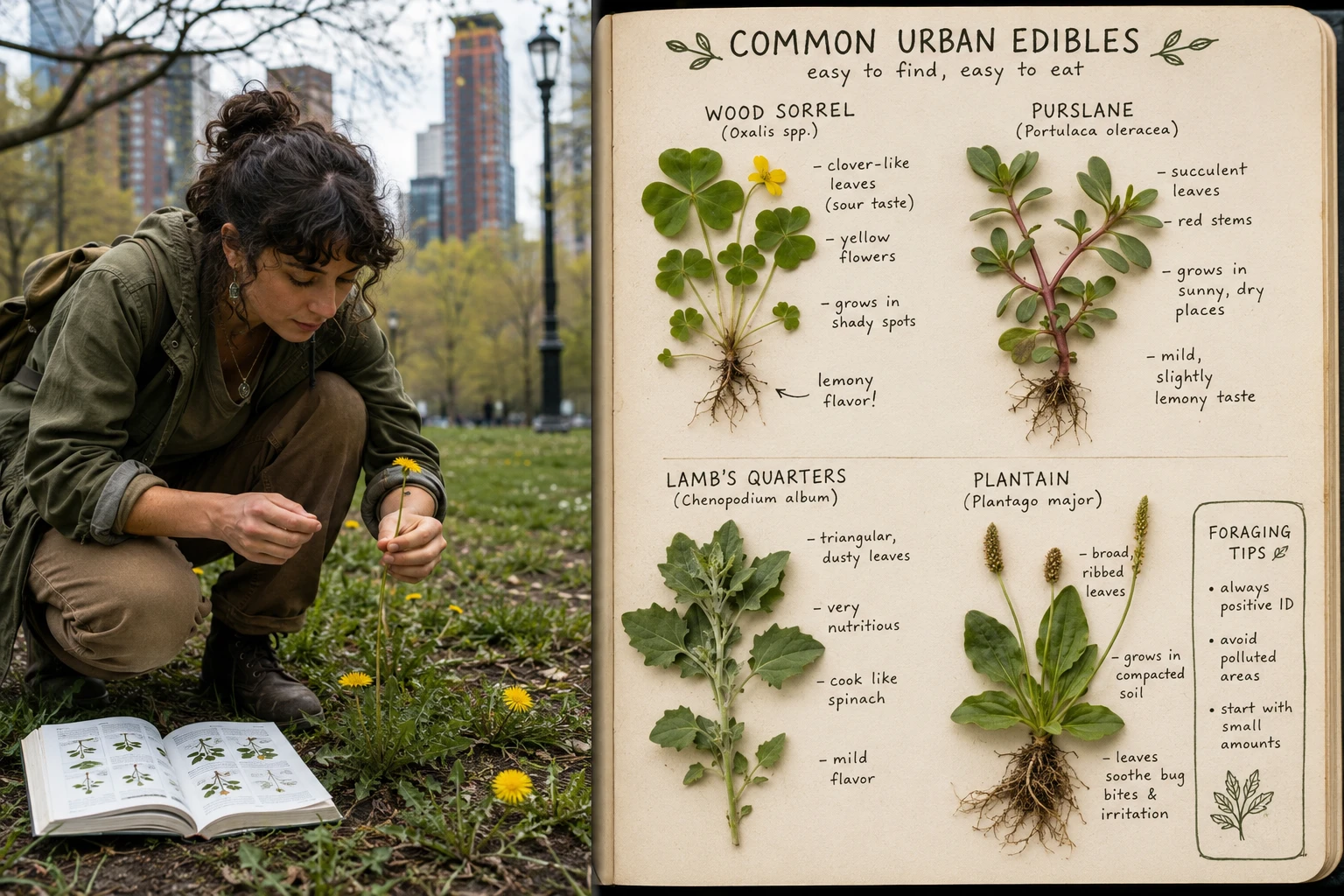 Many common urban plants are safe to eat, provided they are correctly identified and sourced from uncontaminated areas. The safest urban edibles are widespread, have no dangerous lookalikes, and have a long history of human consumption.
Top edible urban plants for preppers:
| Plant | Edible Parts | Flavor Profile | Ease of ID |
|---|---|---|---|
| Dandelion | Leaves, flowers, roots | Bitter, earthy | Very easy |
| Purslane | Leaves, stems | Mild, slightly sour | Easy |
| Lamb’s Quarters | Leaves, seeds | Mild, spinach-like | Moderate |
| Wood Sorrel | Leaves, flowers | Tart, lemony | Easy |
| Plantain (Plantago) | Leaves | Mild, slightly bitter | Easy |
| Clover (red/white) | Leaves, flowers | Mild, slightly sweet | Easy |
| Wild Garlic / Garlic Mustard | Leaves, bulbs | Garlicky, pungent | Moderate |
| Chickweed | Leaves, stems | Mild, fresh | Moderate |
Dandelion deserves special attention. The entire plant is edible. Young spring leaves are the least bitter and best raw. Roots can be roasted and used as a coffee substitute. Flowers can be eaten raw or used in teas. For preppers managing caloric intake during a crisis, dandelion greens also provide vitamins A, C, and K.
How Do You Know If Wild Plants Are Poisonous
The only reliable way to avoid poisonous plants is through positive identification, confirming every identifying characteristic before consuming anything. “It looks like” is not sufficient. You need leaf shape, stem structure, smell, habitat, and ideally flower or seed characteristics to match.
The “rule of five” for safe identification:
- Confirm the leaf shape matches your field guide exactly
- Check the stem (round vs. square, hollow vs. solid, hairy vs. smooth)
- Smell the plant, many edible species have distinct aromas
- Note the habitat and growth pattern
- Cross-reference with at least two independent sources
Plants with dangerous lookalikes to know about:
- Wild carrot (Queen Anne’s Lace) can be confused with poison hemlock. Hemlock has purple-blotched stems and lacks the hairy texture of wild carrot.
- Wild garlic can be confused with lily of the valley, which is toxic. True wild garlic smells unmistakably of garlic when a leaf is crushed.
- Elderberries look similar to pokeweed berries. Pokeweed is toxic.
When in doubt, don’t eat it. That rule has no exceptions in a survival context.
Best Edible Plants to Forage in Urban Areas
The best urban edibles combine high nutritional value, wide availability, easy identification, and low contamination risk. For preppers, prioritizing calorie-dense and vitamin-rich plants makes the most strategic sense.
Purslane is arguably the most underrated urban survival food. It grows in sidewalk cracks, garden beds, and disturbed soil across most of North America. Purslane contains more omega-3 fatty acids than almost any other leafy plant, along with vitamins A, C, and E. It can be eaten raw, sautéed, or added to soups.
Lamb’s quarters (Chenopodium album) is a nutritional powerhouse often called wild spinach. It’s high in calcium, iron, and vitamins A and C. The young leaves are best raw; mature leaves hold up well when cooked.
Plantain (Plantago major or Plantago lanceolata) grows in compacted soil, along paths, and in lawns. The leaves are edible raw or cooked, and the plant has well-documented use as a topical wound treatment, useful knowledge for any prepper interested in emergency herbal medicine.
Clover is abundant in parks and lawns. Both red and white clover flowers and leaves are edible. The flowers can be dried for tea, which provides a mild source of isoflavones and nutrients.
Where Can You Legally Forage in Cities
Foraging legality in urban areas is not uniform. Some cities actively support foraging in designated public spaces; others prohibit removing any plant material from parks.
General rules by location type:
- City parks: Many prohibit foraging under municipal codes that protect park vegetation. Check your city’s parks department website or call directly.
- National forests and grasslands near urban areas: The USDA Forest Service generally allows personal-use foraging of small quantities (typically up to 2 lbs per day) without a permit.
- Vacant lots: Legally complex. The land is typically privately owned even if it appears abandoned. Trespassing laws apply.
- Community gardens and urban farms: Some have designated foraging plots or welcome volunteers who can harvest in exchange for labor.
- Your own property and easements: Generally no restrictions.
The practical approach for preppers: scout your area now, before a crisis, and identify which green spaces are accessible and legally available. During a genuine grid-down or supply chain emergency, legal frameworks shift in priority, but knowing the landscape in advance is always the smarter play. For broader urban survival context, the ultimate urban survival guide for preppers covers this kind of environmental awareness in depth.
Urban Foraging vs Rural Foraging: Key Differences
Urban foraging and rural foraging require the same core identification skills, but the risk profiles are different. Rural foraging carries higher risks of misidentification due to species diversity; urban foraging carries higher risks of contamination due to human activity.
Key differences:
- Contamination: Urban soils often contain lead, cadmium, and other heavy metals from decades of vehicle traffic and industrial activity. Rural soils generally do not.
- Pesticide exposure: Urban parks and lawns are frequently treated with herbicides and pesticides. Rural wild areas are less likely to be sprayed, though agricultural runoff is a concern near farmland.
- Species variety: Rural environments typically offer more diversity, more mushroom species, more root vegetables, more berries. Urban environments offer reliable access to common weeds and a narrower but dependable range of edibles.
- Accessibility: Urban foraging requires no vehicle, no long hike, and no remote navigation. It’s available to apartment dwellers and city residents who may have no access to rural land.
For preppers who split time between urban and rural environments, understanding both contexts is valuable. The urban bug out vs rural bug out breakdown addresses the broader strategic differences between these two survival environments.
How to Identify Edible Weeds and Herbs
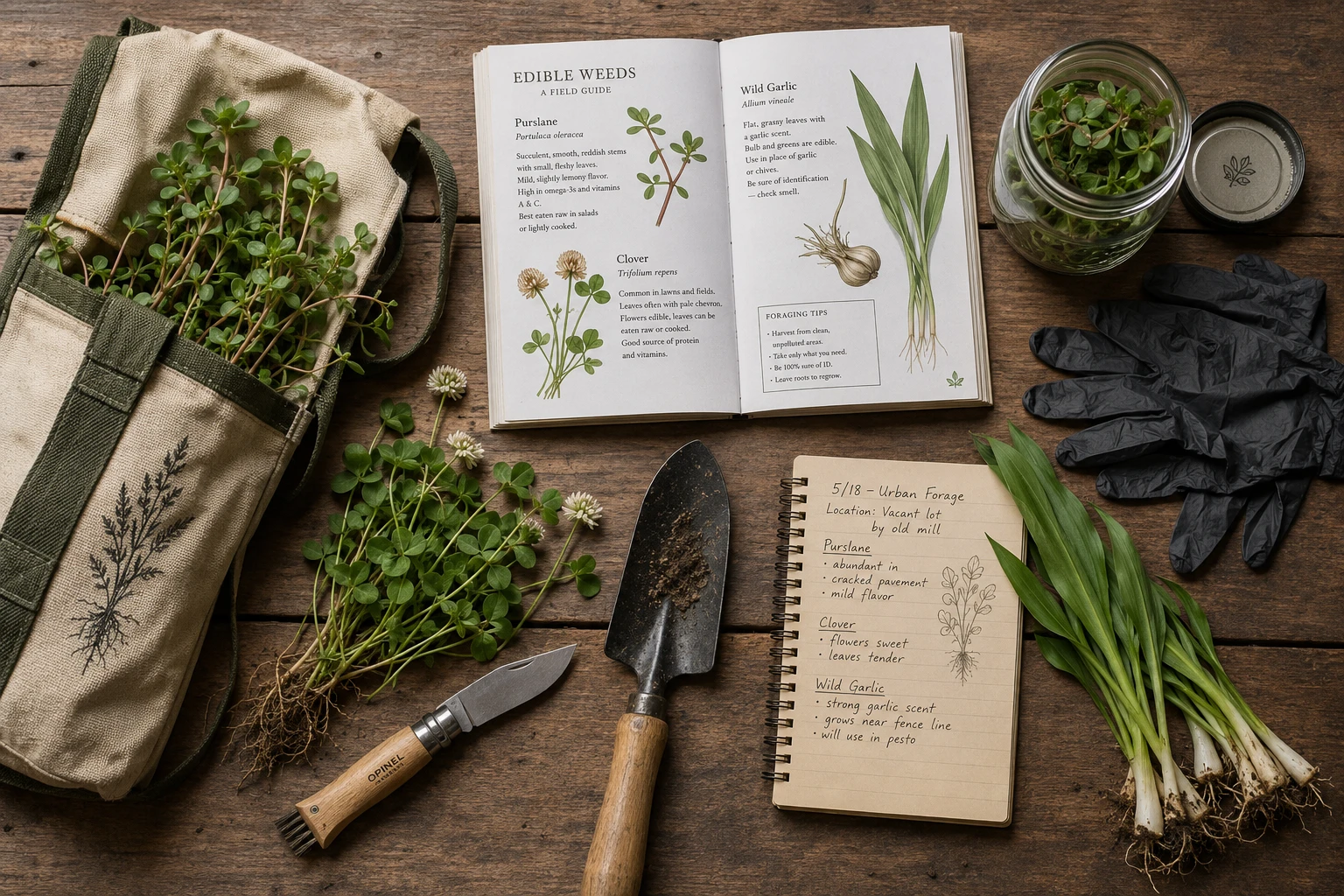
Edible weed identification relies on a systematic process, not guesswork. The goal is to confirm identity through multiple independent characteristics, not just visual resemblance to a photo.
Step-by-step identification process:
- Note the overall growth habit (rosette, upright, vining, spreading)
- Examine the leaves: shape, margin (smooth, toothed, lobed), surface texture, and arrangement on the stem
- Smell the plant, crush a small leaf between your fingers
- Check the stem: color, texture, cross-section shape, presence of milky sap
- Look for flowers or seed heads if present, these are often the most definitive identifiers
- Match all characteristics against your field guide, not just one feature
Common urban edibles and their key identifiers:
- Dandelion: Toothed leaves in a basal rosette, hollow stem with milky sap, single yellow flower per stem
- Purslane: Thick succulent leaves, reddish stems, grows flat against the ground
- Wood sorrel: Heart-shaped leaflets in groups of three (similar to clover but with distinct heart shape), sour taste when a leaf is chewed
- Garlic mustard: Triangular toothed leaves, smells strongly of garlic, white four-petaled flowers in spring
What Time of Year Is Best for Urban Foraging
Spring and early summer are the most productive seasons for urban foraging, particularly for leafy greens. Late summer through fall shifts the focus toward berries, seeds, and roots.
Seasonal foraging calendar:
- Early spring (March-April): Dandelion leaves, chickweed, garlic mustard, wood sorrel, all emerging tender and at peak nutrition before they bolt
- Late spring to early summer (May-June): Lamb’s quarters, purslane, clover, plantain, abundant and easy to find
- Late summer (July-August): Purslane peaks, elderberries ripen, wild berries appear
- Fall (September-October): Acorns, rose hips, roots (dandelion root, burdock), seeds
- Winter: Slim pickings in most climates, but evergreen needles (pine, spruce, fir) can be used for vitamin C-rich teas
The practical takeaway for preppers: build your foraging knowledge during spring and summer when plants are abundant and identifiable. Don’t wait until a crisis to learn, that’s when mistakes happen.
Can You Forage in Parks and Public Spaces
Yes, but it depends on the specific park system and local ordinances. Many city parks technically prohibit removing vegetation, but enforcement for small personal-use harvesting is rare in most jurisdictions.
What to check before foraging in a park:
- Look for posted signs about park rules
- Search your city’s municipal code for “foraging” or “vegetation removal”
- Contact the parks department directly, many are supportive of foraging and can direct you to appropriate areas
- Some cities (Seattle, San Francisco, and others) have designated food forests or foraging-friendly parks
The safest legal approach: stick to invasive species like garlic mustard and Japanese knotweed. Many municipalities actively want these removed and will not object to harvesting them.
Urban Foraging Tools and Equipment You Need
The core toolkit for urban foraging is minimal and inexpensive. You don’t need specialized gear to start, but the right tools make identification more accurate and harvesting cleaner.
Essential foraging kit:
- Regional field guide: The single most important tool. Get one specific to your geographic region.
- Canvas or mesh harvest bag: Allows plants to breathe and prevents wilting. Avoid plastic bags for harvesting.
- Folding knife or pruning shears: For clean cuts that don’t damage the plant’s root system.
- Nitrile gloves: Protect against skin irritants and contamination when harvesting in unknown areas.
- Small trowel: For harvesting roots like dandelion or burdock.
- Magnifying glass: Helpful for examining fine leaf details and stem characteristics.
- Notebook: Record locations, species found, and seasonal timing for future reference.
This kit fits easily into a daypack and costs under $50 total if you already own a knife. For preppers building out their gear systematically, the essential survival gear guide provides a broader framework for prioritizing equipment purchases.
How to Avoid Pesticides When Foraging in Cities
Pesticide and heavy metal contamination is the most serious and underappreciated risk in urban foraging. The plant may be correctly identified and perfectly edible by nature, and still be dangerous because of where it grew.
High-risk locations to avoid:
- Within 50 feet of a heavily trafficked road (lead and cadmium from vehicle exhaust accumulate in soil)
- Maintained lawns in parks, golf courses, and corporate campuses (regularly sprayed with herbicides)
- Former industrial sites, brownfields, and land near railroad tracks
- Areas near stormwater drains and runoff channels
- Soil that appears discolored, oily, or has an unusual smell
Lower-risk locations:
- Established community gardens with known soil testing
- Wooded areas within parks, away from maintained turf
- Rooftops and elevated planters (less soil contamination)
- Your own yard or container gardens
A practical mitigation strategy: harvest leaves and above-ground parts rather than roots when contamination is a concern, since roots accumulate heavy metals at higher concentrations. Wash everything thoroughly before eating. If you’re uncertain about a site, soil testing kits are available at most garden centers for under $20.
Common Mistakes Beginners Make Foraging
Most foraging mistakes fall into three categories: misidentification, contamination blindness, and over-harvesting. All three are preventable.
The most common beginner errors:
- Eating before 100% positive ID. Partial identification is not identification. If you can’t confirm every characteristic, don’t eat it.
- Ignoring the location. A perfectly identified dandelion growing next to a highway is not safe to eat.
- Harvesting too much from one patch. Sustainable foraging means taking no more than 20-30% of any single plant population. Over-harvesting destroys the resource.
- Skipping the wash. Urban plants carry surface contaminants, insect eggs, and bacteria. Always wash before eating.
- Relying on a single source for ID. One field guide photo is not enough. Cross-reference with multiple sources.
- Foraging unfamiliar mushrooms. Mushroom identification requires a separate, specialized skill set. Beginners should avoid urban mushroom foraging entirely until they have significant training.
Is Urban Foraging Actually Safe to Do
Urban foraging is safe when practiced with proper identification skills, contamination awareness, and site selection. It carries real risks that can be managed, not eliminated, but managed.
The honest risk assessment:
- Misidentification risk: High for beginners, low for experienced foragers with good field guides. Mitigated by learning only well-known species first.
- Contamination risk: Moderate to high in dense urban areas, lower in suburban parks and green corridors. Mitigated by site selection and washing.
- Legal risk: Low in most jurisdictions for personal-use harvesting of common weeds. Mitigated by knowing local ordinances.
For preppers, the calculus is straightforward: the skill is worth developing now, before it’s needed. Practiced in low-stakes conditions, urban foraging becomes a reliable supplemental food source during emergencies. It won’t replace a well-stocked survival pantry, but it extends your resources when supply chains fail.
What Should You Never Eat When Foraging in the City
Some plants found in urban environments are genuinely dangerous, and a few are deadly. Knowing what not to eat is as important as knowing what to harvest.
Plants to never eat without expert-level certainty:
- Poison hemlock (Conium maculatum): Extremely toxic. Can be confused with wild carrot. Purple-blotched hollow stems are the key warning sign.
- Pokeweed (Phytolacca americana): All parts are toxic, especially roots and berries. Commonly found in disturbed urban soils.
- Lily of the valley (Convallaria majalis): Toxic. Can be confused with wild garlic, but lacks the garlic smell.
- Nightshade species (Solanum): Berries range from mildly toxic to dangerous. Avoid all nightshade berries unless you are an expert.
- Yew (Taxus) berries: The red berries look appealing. The seeds inside are highly toxic.
- Any white-flowered plant in the carrot family (Apiaceae): This family contains both edible species (wild carrot, angelica) and deadly ones (poison hemlock, water hemlock). Avoid entirely until you have expert-level training.
- Any mushroom you cannot identify to species level: The death cap mushroom (Amanita phalloides) and destroying angel (Amanita bisporigera) are responsible for the majority of fatal mushroom poisonings worldwide.
The rule is simple: when the stakes are your life, certainty is the only acceptable standard.
Frequently Asked Questions
Do I need any experience to start urban foraging?
No prior experience is required, but you do need to invest time in learning before you eat anything. Start with a good regional field guide, pick five easy species, and spend several sessions identifying plants before harvesting. Confidence comes from practice, not from reading alone.
Can I forage in my apartment building’s green space?
Generally yes, if it’s on property you have access to. Check with building management first. Rooftop gardens, courtyard planters, and building-adjacent green strips are often overlooked foraging opportunities with lower contamination risk than street-level sites.
Is purslane really safe to eat raw?
Yes. Purslane is one of the safest and most nutritious urban edibles. It has no dangerous lookalikes and is eaten raw in salads across Mediterranean and Middle Eastern cuisines. Rinse it well before eating.
How do I know if a park has been sprayed with herbicide?
Look for yellowing or browning plants in otherwise healthy areas, an unusual chemical smell after rain, or posted signs near treated zones. When in doubt, avoid harvesting from maintained turf areas entirely.
Can children eat foraged urban plants?
Only plants that have been positively identified and sourced from clean, uncontaminated sites. Children are more vulnerable to heavy metal exposure and plant toxins than adults. Apply the same contamination avoidance rules with extra caution.
What’s the fastest edible plant to find in any North American city?
Dandelion. It grows in virtually every city on the continent, is unmistakable once you know it, and every part is edible. If you can only learn one urban foraging plant, make it dandelion.
Should urban foraging replace my food storage plan?
No. Urban foraging is a supplemental skill, not a primary food strategy. It works best alongside a stored food supply. For building that foundation, see the guide to 50 best foods for long-term storage.
What if I accidentally eat something toxic?
Call Poison Control immediately (1-800-222-1222 in the U.S.) and bring a sample of the plant if possible. Do not induce vomiting unless specifically instructed to do so. This is why identification before eating is non-negotiable.
Is urban foraging worth learning if I already have a 6-month food supply?
Yes. Food supplies run out. Skills don’t. Urban foraging extends your food security timeline and builds environmental awareness that pays off in multiple survival scenarios.
Can I forage in winter?
In most North American climates, winter foraging is limited. Pine needle tea, rosehips, and some root vegetables are available. The real value of winter is scouting and planning for the spring season.
Conclusion
Urban foraging is one of those skills that feels optional until it isn’t. The preppers who practice it now, learning their local plants, scouting clean sites, building identification confidence, are the ones who will have options when grocery store shelves go empty or a crisis stretches beyond their stored supplies.
Start with five plants. Get a regional field guide. Walk your neighborhood with new eyes. The food growing in sidewalk cracks and city parks has been there all along. You just need to know how to see it.
Urban foraging doesn’t replace preparation, it deepens it. Pair this skill with a solid long-term food storage plan and the broader framework in the complete prepping guide for beginners, and you’re building the kind of layered resilience that holds up under real pressure.
Recommended Tools and Resources
Field Guides
- Nature’s Garden by Samuel Thayer, the most authoritative North American foraging reference available
- The Forager’s Harvestby Samuel Thayer, companion volume with detailed species profiles
- Edible Wild Plants by Lee Allen Peterson (Peterson Field Guides series), compact and regionally organized
Gear
- A quality folding knife with a locking blade (look for full-tang construction and a 3-4 inch blade)
- Canvas harvest bags, avoid plastic, which causes wilting
- Nitrile gloves for contaminated-site harvesting
- A basic soil test kit (available at garden centers) for evaluating potential foraging sites
Apps as Secondary References
- iNaturalist, community-verified plant identification, useful as a cross-reference but never as a sole identifier
- PlantNet, AI-assisted plant ID, same caveat: use to supplement field guide confirmation, not replace it
Related Reading on Preppers HQ
- Urban survival skills most people ignore for city emergencies
- 14 essential survival skills every prepper must know
- Emergency herbal medicine when pharmacies are unavailable