

Hey there! Some links on this page may be affiliate links which means that, if you choose to make a purchase, I may earn a commission at no extra cost to you. I greatly appreciate your support. Read the full disclosure here.
Most urban apartment dwellers have less than three days of food on hand at any given time — and that’s not a guess, that’s a pattern documented repeatedly by emergency management researchers. For anyone serious about preparedness, that gap is unacceptable. The good news: emergency food storage for small apartment is entirely achievable, even in a 400-square-foot studio with no pantry, no garage, and a landlord who frowns on modifications.
This guide covers exactly how to build a meaningful food reserve when space is your biggest constraint. No wasted square footage. No excuses.
Key Takeaways
- A minimum 72-hour supply is the floor, not the goal — aim for 30 days as your first real milestone
- Under-bed space, closet floors, and furniture with hidden storage are the most underused real estate in small apartments
- Freeze-dried meals, white rice, lentils, and canned proteins deliver the best calorie-per-cubic-inch ratio for compact storage
- Rotate stock using the FIFO (first in, first out) method to prevent waste and keep supplies fresh
- Avoid foods with high moisture content, bulky packaging, or short shelf lives — they eat space without earning it
- Match your food storage plan to your dietary needs, not a generic checklist
- Store at least one gallon of water per person per day alongside your food supply
- Compact emergency food kits from brands like Mountain House, Augason Farms, and ReadyWise fit under most standard bed frames
- Living in a studio does not disqualify you from serious preparedness — it just demands smarter systems
- Label everything with purchase dates and rotate every 6 to 12 months depending on shelf life
How Much Emergency Food Should You Store in a Tiny Apartment?
The baseline recommendation from FEMA is 72 hours of food and water per person. For serious preppers, that’s a starting point, not a destination. A 30-day supply is a realistic and achievable first milestone for most apartment dwellers, and it requires far less space than most people assume.
Here’s a practical framework based on apartment size and household size:
| Household Size | 72-Hour Supply | 30-Day Supply (Est. Space) |
|---|---|---|
| 1 person | ~6 lbs of food | ~2–3 cubic feet |
| 2 people | ~12 lbs of food | ~4–6 cubic feet |
| 4 people | ~24 lbs of food | ~8–12 cubic feet |
A single under-bed storage bin (roughly 2.5 cubic feet) can hold a 30-day supply for one person if you choose high-calorie, compact foods. Two bins cover a couple. The math works — but only if you’re choosing the right foods.
Decision rule: If you’re just starting out, build a 72-hour supply first, then expand by one week at a time. Don’t try to build three months of storage overnight. Consistency beats ambition every time.
For a deeper look at scaling up, the 3-Month Emergency Food Supply guide walks through exactly how to get there from zero.
What Foods Take Up the Least Space for Emergency Prep?
The best foods for emergency food storage in small apartments are calorie-dense, shelf-stable, and compact. Think in terms of calories per cubic inch, not just total weight.
Top space-efficient emergency foods:
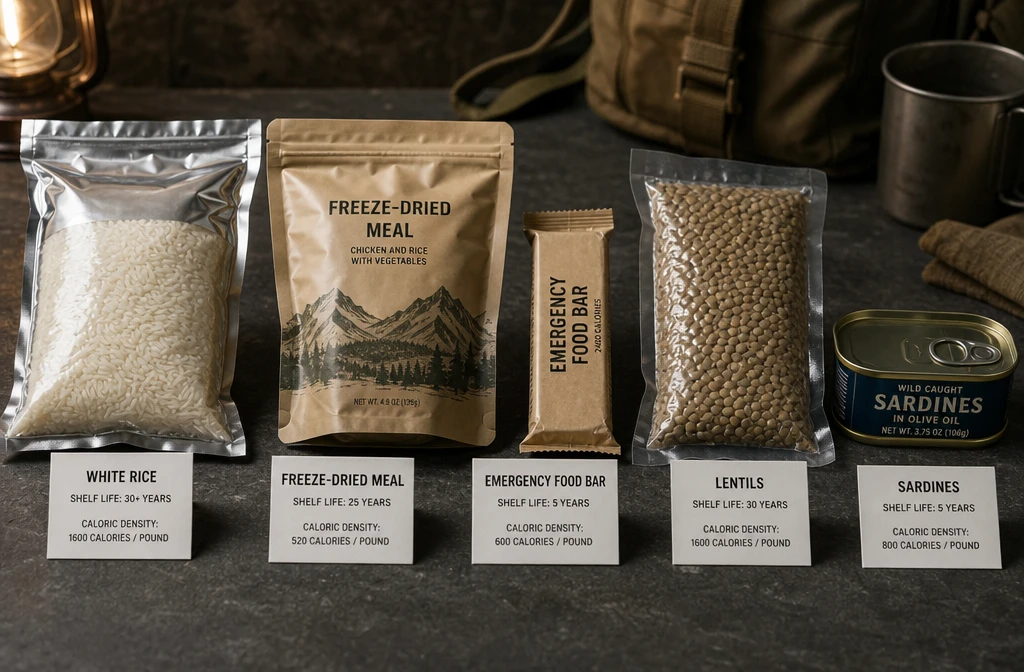
- White rice — roughly 1,700 calories per pound, stores 25+ years in sealed mylar bags with oxygen absorbers
- Dried lentils and beans — high protein, high fiber, stores 8–10 years sealed
- Freeze-dried meals — purpose-built for compact storage, 25-year shelf life, just-add-water simplicity
- Rolled oats — versatile, calorie-dense, stores 30+ years in sealed containers
- Peanut butter (powdered) — takes up a fraction of the space of jarred versions, 4–5 year shelf life
- Canned fish and meat — sardines, tuna, and chicken in pull-tab cans are compact protein sources
- Hard candy and honey — indefinite shelf life, useful for morale and quick energy
- Multivitamins — not food, but critical for nutritional gaps during extended emergencies
For a thorough breakdown of the best options across all categories, the 50 Best Foods for Long-Term Storage guide is worth bookmarking.
Common mistake: People default to canned goods because they’re familiar. Cans are heavy, bulky, and have shorter shelf lives than mylar-sealed dry goods. They have a place in your supply, but they shouldn’t dominate it.
What Foods Are Worst for Small Apartment Emergency Storage?
Some foods actively work against you in a space-constrained prep setup. Avoid these or minimize them sharply.
- Bulky freeze-dried buckets — the 5-gallon bucket format is designed for basements, not studio apartments
- Bottled water cases — necessary, but they consume floor space fast; use collapsible water containers instead
- Fresh produce — obvious, but worth stating: no shelf life means no place in long-term storage
- Foods in glass jars — heavy, breakable, and space-inefficient compared to mylar or vacuum-sealed alternatives
- Single-serving snack packaging — excessive air and packaging material per calorie
- Anything requiring refrigeration — if the power goes out, that’s the first thing you lose
The 15 Food Storage Mistakes to Avoid article covers the full list of costly errors preppers make when building their first supply.
Best Compact Food Storage Options for Apartments: Where to Put It All
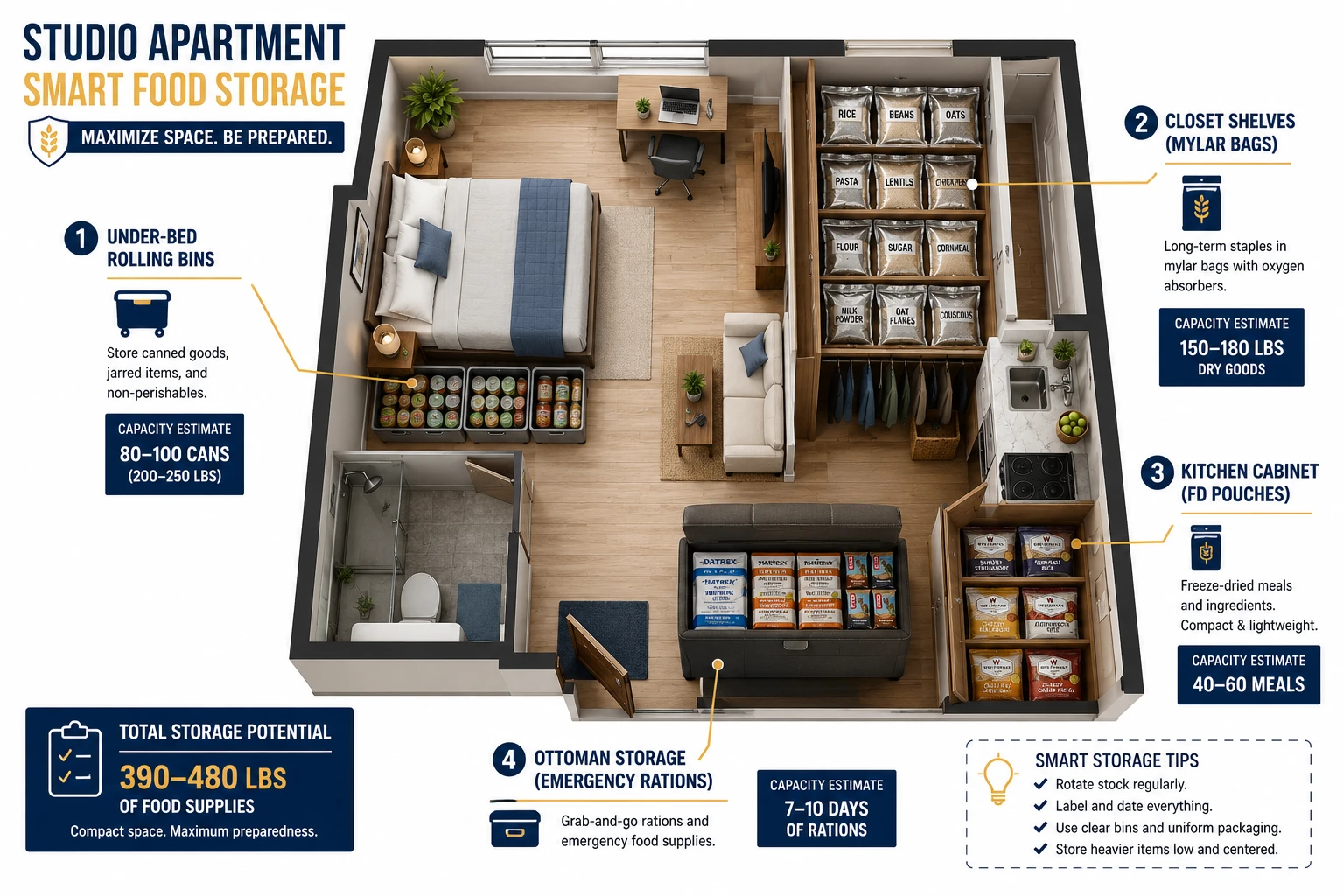
Emergency food storage for small apartments works because apartments have more usable space than residents realize — it’s just unconventional space. The key is thinking in three dimensions and using every zone deliberately.
The five best storage locations in a small apartment:
-
Under the bed — the single most valuable real estate. A standard queen bed frame has roughly 10–15 inches of clearance. Low-profile rolling bins or vacuum storage bags fit perfectly. This alone can hold a 30-day supply for two people.
-
Closet floors and upper shelves — most closets have dead space at the top and bottom. Stackable bins on the floor and a second shelf installed near the ceiling can double your closet storage capacity without touching your hanging clothes.
-
Behind furniture — the gap between a sofa and the wall, or behind a dresser, can hold flat storage containers or cases of canned goods.
-
Inside furniture — ottomans with storage lids, hollow bed frames, and storage benches are purpose-built for this. A storage ottoman can hold 20–30 pounds of emergency food.
-
Kitchen cabinet reorganization — most people use only 60–70% of their cabinet vertical space. Adding shelf risers or stackable organizers immediately creates room for a dedicated emergency food section.
For renters who want to go deeper on this, the Ultimate Guide to Prepping in a Small Apartment covers apartment-specific strategies in detail, including how to prep without alerting a landlord or neighbors.
How Long Can Emergency Food Actually Last in Small Spaces?
Shelf life depends on three factors: the food itself, the packaging, and the storage conditions. In a small apartment, temperature and humidity are the variables you control — and they matter more than most people think.
Shelf life by food type and packaging:
| Food | Standard Packaging | Mylar + Oxygen Absorbers |
|---|---|---|
| White rice | 2–5 years | 25–30 years |
| Dried beans | 3–5 years | 8–10 years |
| Rolled oats | 1–2 years | 20–30 years |
| Freeze-dried meals | 25 years (sealed) | N/A (already optimized) |
| Canned goods | 2–5 years | N/A |
| Peanut butter | 1–2 years | N/A |
The apartment storage challenge: Most apartments don’t have a cool, dark basement. Heat and humidity are the enemies of shelf life. Aim to store food in the coolest, darkest location available — typically an interior closet or under the bed away from exterior walls that absorb heat.
Rule of thumb: Every 10°F increase in storage temperature roughly halves the effective shelf life of most dry goods. A pantry at 80°F is significantly worse than one at 60°F.
For the full breakdown on long-term food storage science and systems, the Long Term Food Storage Beginner’s Guide is a solid reference.
Cheap Emergency Food Storage Solutions for Renters
Building a solid emergency food supply doesn’t require spending hundreds of dollars upfront. Renters on tight budgets can build a meaningful supply incrementally.
Budget-first approach:
- Buy extra at every grocery trip — add $10–$20 worth of shelf-stable staples to each shopping run. Rice, oats, canned beans, and canned fish are all under $2 per pound.
- Shop discount grocery stores — Aldi, Lidl, and ethnic grocery stores often carry bulk dry goods at 30–50% below standard supermarket prices.
- Use mylar bags and oxygen absorbers — a pack of 50 mylar bags with oxygen absorbers costs around $15–$25 and dramatically extends the shelf life of cheap bulk foods.
- Repurpose food-grade buckets — bakeries and delis often give away or sell cheaply the 5-gallon food-grade buckets they receive from suppliers. These are excellent for bulk dry good storage.
- Avoid pre-packaged “emergency food kits” as your primary strategy — they’re convenient but expensive per calorie. Use them to supplement a bulk dry goods base, not replace it.
Realistic budget milestone: A 30-day supply for one person, built on rice, lentils, oats, canned goods, and a few freeze-dried meal pouches, can be assembled for $75–$150 over several weeks of intentional shopping.
Is Emergency Food Storage Worth It If You Live in a Studio?
Yes — unambiguously. The size of your living space doesn’t reduce your vulnerability to power outages, supply chain disruptions, job loss, or natural disasters. It may actually increase it, since urban apartment dwellers often have less redundancy built into their daily lives than suburban or rural households.
A studio apartment prepper faces real constraints, but none of them are dealbreakers:
- Limited floor space → solved by vertical storage and under-bed systems
- No pantry → solved by closet shelving and furniture storage
- Landlord restrictions → solved by freestanding storage solutions that require no installation
- No car to transport bulk goods → solved by ordering online and building supply gradually
The confidence that comes from knowing you can feed yourself for 30 days without leaving your apartment — regardless of what’s happening outside — is worth every square inch of storage space it takes.
How Do Preppers Store Food in Apartments With No Pantry?
No pantry is not a disqualifier. Preppers in apartments without pantries use a combination of dedicated storage furniture, repurposed closet space, and creative placement to build functional food reserves.
Practical no-pantry solutions:
- Kitchen island with storage — a rolling kitchen cart with shelves underneath can hold 50+ pounds of canned and dry goods
- Dedicated bookshelf in a corner — a standard 5-shelf bookcase can hold an impressive amount of canned goods and sealed containers when organized tightly
- Bed risers — raising a bed frame by 6–8 inches with bed risers dramatically increases under-bed storage capacity
- Vacuum storage bags for dry goods — compress bulk grains and oats into flat, stackable packages that slide under furniture or into tight closet corners
- Stackable airtight containers — square containers stack more efficiently than round ones and waste less space
The Ultimate Guide to Apartment Food Storage covers the full system for building a 6-month supply in small spaces, including stealth storage strategies for renters who prefer to keep their preparedness low-profile.
Emergency Food Kits That Fit in Closets or Under Beds
Pre-packaged emergency food kits are the fastest way to establish a baseline supply, and several brands now design specifically for compact storage.
Top compact emergency food kit options in 2026:
- Mountain House 3-Day Emergency Food Supply — fits in a backpack, freeze-dried meals with 30-year shelf life, approximately 1.5 cubic feet
- Augason Farms 30-Day 1-Person Emergency Food Supply — designed to fit under a standard bed frame, roughly 2 cubic feet
- ReadyWise 84-Serving Emergency Food Kit — stackable bucket format, fits in a closet corner, 25-year shelf life
- Patriot Pantry (4Patriots) 72-Hour Survival Food Kit — compact pouch format, fits in a standard drawer or backpack
- S.O.S. Rations Emergency Food Bars — the most compact option available, 3,600 calories per bar pack, fits in a shoebox
Choose a kit if: You want an immediate baseline supply without the time investment of building from scratch. Kits are also excellent for renters who may need to evacuate quickly — they’re portable by design.
Build from scratch if: Budget is a priority and you have time to source and package your own supply. The per-calorie cost of DIY bulk storage is significantly lower than pre-packaged kits.
What Emergency Foods Are Good for People With Dietary Restrictions?
Dietary restrictions — whether medical, religious, or personal — don’t disappear during an emergency. Planning for them in advance is a core part of responsible preparedness.
By restriction type:
- Gluten-free: White rice, corn tortillas (shelf-stable), quinoa, certified GF oats, canned beans, freeze-dried fruits and vegetables, most freeze-dried meat options
- Vegan/vegetarian: Lentils, dried beans, rice, oats, nuts, seeds, nut butters, dried fruits, freeze-dried vegetables, nutritional yeast
- Diabetic/low-glycemic: Lentils, chickpeas, nuts, canned fish, freeze-dried vegetables, whole grain options where tolerated
- Nut allergies: Rice, beans, oats, canned meats, freeze-dried meals (check labels — many are processed in nut-free facilities)
- Kosher or Halal: Several freeze-dried brands offer certified options; canned fish and vegetables are widely compliant
Critical step: Read labels on freeze-dried and pre-packaged emergency foods before purchasing. Cross-contamination warnings are common in this category. Build a custom supply rather than relying on generic emergency kits if allergies are severe.
If you have pets, their dietary needs belong in your emergency plan too. The Ultimate Pet’s Emergency Preparedness Checklist covers how to include animals in your food and supply planning.
How Much Water Should You Store With Your Emergency Food Supply?
Water storage is inseparable from food storage planning. The standard recommendation is one gallon per person per day for drinking and basic sanitation — but that number increases if your emergency food supply relies heavily on foods that require cooking water, such as rice, oats, or freeze-dried meals.
Water storage calculation for apartment preppers:
- 1 person, 30 days: minimum 30 gallons
- 2 people, 30 days: minimum 60 gallons
- Add 25–50% if your food supply is primarily dry goods requiring rehydration
In a small apartment, storing 30+ gallons of water is its own challenge. The Apartment Water Storage Complete Guide covers how to store 30+ gallons in 500 square feet using collapsible containers, WaterBOB bathtub bladders, and stackable water bricks.
Also worth reading: The Ultimate Emergency Water Storage and Purification Guide for purification methods when stored water runs low.
Key point: Freeze-dried meals require water to prepare. If your food storage plan leans heavily on freeze-dried options, your water storage needs go up proportionally. Plan both together, not separately.
Common Mistakes People Make Storing Emergency Food in Small Spaces
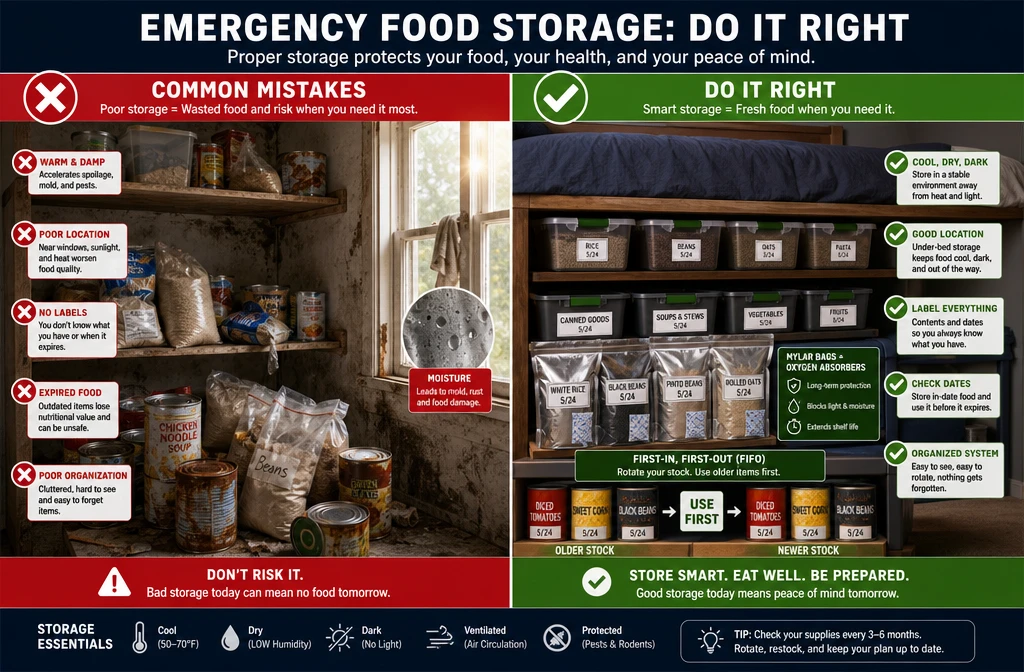
Even experienced preppers make avoidable errors when working with limited space. These are the most common — and the most costly.
Mistake 1: Storing food near heat sources
Appliances, exterior walls, and heating vents all raise ambient temperature. Even a 10°F difference in storage temperature can cut shelf life significantly. Keep food in interior closets or under beds away from exterior walls.
Mistake 2: Ignoring rotation
Food stored and forgotten is food wasted. Use the FIFO system — first in, first out. Label every item with its purchase date and set a calendar reminder to audit your supply every six months.
Mistake 3: Buying only what you like in normal life
Emergency food storage is not a gourmet pantry. Prioritize caloric density and shelf life first. Variety and preference come second.
Mistake 4: Forgetting a manual can opener
This sounds obvious. It gets overlooked constantly. A manual can opener costs $5 and is non-negotiable if your supply includes canned goods.
Mistake 5: No cooking plan
Storing food without a plan for cooking it off-grid is a critical gap. If the power goes out, how are you preparing that rice or those oats? A single-burner propane camp stove and a small propane canister supply solves this for most apartment preppers. See the Emergency Cooking Without Power guide for a full breakdown.
Mistake 6: Storing everything in one location
If that one location becomes inaccessible — flooded, blocked, or compromised — your entire supply is gone. Distribute storage across two or three locations within the apartment.
Most Space-Efficient Emergency Food Brands for Apartments
When evaluating brands specifically for apartment-scale storage, the criteria are: caloric density per unit volume, packaging format (stackable vs. bulky), and shelf life.
Top performers in 2026:
- Mountain House — industry-leading freeze-dried quality, pouches stack flat, 30-year shelf life, wide variety including dietary restriction options
- Augason Farms — best value per calorie among major brands, offers apartment-sized packaging (not just 5-gallon buckets), good variety
- 4Patriots / Patriot Pantry — compact pouch format, strong marketing but verify caloric content per serving before purchasing
- Wise Company / ReadyWise — stackable bucket design works well for closet storage, solid shelf life
- Legacy Food Storage — premium option with high caloric density per package, good for those prioritizing taste alongside storage efficiency
For DIY bulk storage: Augason Farms and LDS (Church of Jesus Christ of Latter-day Saints) cannery products offer bulk dry goods at competitive prices with proper food-grade packaging.
The Ultimate Prepper’s Guide to Freeze-Dried Food provides an in-depth comparison of freeze-dried brands, including taste tests and cost-per-calorie analysis.
FAQ-Emergency Food Storage For Small Apartment
Can I really build a meaningful emergency food supply in a studio apartment?
Yes. A 30-day supply for one person requires roughly 2–3 cubic feet of storage space — the equivalent of two under-bed storage bins. The constraint is real, but it’s manageable with the right food choices and storage locations.
What’s the minimum I should store to be considered “prepared”?
FEMA recommends 72 hours. Most experienced preppers consider 30 days the real minimum for meaningful resilience. Start with 72 hours, then build toward 30 days over the next few months.
Do I need special containers, or can I use what I already have?
For short-term storage (under 1 year), food-grade plastic bins and airtight containers work fine. For long-term storage (5+ years), mylar bags with oxygen absorbers sealed inside food-grade buckets are the standard.
How do I keep pests out of my emergency food supply in an apartment?
Sealed mylar bags and airtight hard containers are your primary defense. Avoid cardboard boxes — they’re not pest-resistant. Bay leaves placed inside storage bins are a low-cost deterrent for pantry moths and weevils.
Should I tell my landlord about my food storage?
Generally, no disclosure is required for stored food. Freestanding storage solutions — bins, shelves, ottomans — don’t require installation and don’t violate standard lease terms. If you’re concerned, review your lease’s storage clauses.
How often should I rotate my emergency food supply?
Audit your supply every 6 months. Rotate canned goods annually. Dry goods in mylar with oxygen absorbers can go 5–10 years without rotation depending on the food. Set calendar reminders — this is the step most people skip.
What if I have to evacuate? Can I take my food supply with me?
Build a grab-and-go component: a 72-hour food supply in a portable bag or backpack that can leave with you in under 5 minutes. This is separate from your in-apartment supply. Pre-packaged emergency food kits and energy bars work well for this role.
Is freeze-dried food worth the cost for apartment preppers?
For the space-to-calorie ratio and shelf life, yes — especially for the core of a compact supply. Supplement with cheaper bulk dry goods to keep overall costs manageable.
What about cooking smells during an emergency? Will neighbors notice?
This is a legitimate concern in dense apartment buildings. Foods that can be eaten without cooking — energy bars, canned fish, peanut butter, crackers — are worth including for scenarios where discretion matters.
Can I store emergency food in a car if I have no space at home?
A car can serve as supplemental storage for short-term supplies, but temperature extremes (especially heat in summer) significantly degrade food quality and shelf life. It’s a backup option, not a primary strategy.
Conclusion: Start Where You Are, Build From There
Emergency food storage for small apartments is not a problem to solve perfectly on day one. It’s a system to build deliberately, one week’s worth of food at a time, using the space you actually have.
Actionable next steps:
- This week: Audit your current food supply. How many days could you actually eat without leaving your apartment?
- Week 2: Purchase a 72-hour baseline — rice, canned goods, oats, and water. Store it under your bed.
- Month 1: Expand to a 2-week supply. Add freeze-dried meals for convenience and variety.
- Month 2–3: Build toward 30 days. Invest in mylar bags and oxygen absorbers for long-term dry good storage.
- Ongoing: Rotate stock every 6 months, audit for gaps, and adjust for any dietary changes in your household.
The apartment prepper who acts today — even imperfectly — is in a dramatically better position than the one who waits for the perfect setup. Space is a constraint, not an excuse.
Products, Tools, and Resources Worth Knowing
For storage containers: IRIS USA under-bed storage bins are a consistent recommendation among apartment preppers — low-profile, durable, and available in sets. Vtopmart stackable airtight containers work well for kitchen-based dry good storage.
For mylar bag sealing: A basic clothes iron works for sealing mylar bags. A dedicated impulse sealer (around $20–$30) is faster and more consistent if you’re processing larger quantities.
For freeze-dried meals: Mountain House and Augason Farms are the two most commonly recommended brands among experienced preppers for quality, shelf life, and value respectively. Both offer apartment-friendly packaging formats.
For water storage alongside food: WaterBOB bathtub bladders (100-gallon capacity) and Aqua-Tainer 7-gallon rigid containers are the two most practical options for apartment-scale water storage.
For cooking off-grid: A single-burner butane camp stove with a supply of butane canisters is the most apartment-friendly off-grid cooking solution — compact, safe for indoor use in ventilated spaces, and inexpensive.
For deeper reading: The Ultimate Survival Pantry List and the Complete Guide to Emergency Food Rationing and Cooking are two of the most practical resources for anyone building their first serious food supply.
Preparedness isn’t about having the perfect setup. It’s about being ready enough — and then getting more ready from there.