
Hey there! Some links on this page may be affiliate links which means that, if you choose to make a purchase, I may earn a commission at no extra cost to you. I greatly appreciate your support. Read the full disclosure here.
Every year, search-and-rescue teams across the United States respond to tens of thousands of wilderness distress calls. A significant portion of those incidents involve people who had no survival gear, or who packed the wrong items entirely. The difference between a manageable emergency and a fatal one often comes down to what’s in your pack before you leave the trailhead.
This ultimate wilderness survival kit list for hikers & preppers covers everything you need to build a kit that actually works, whether you’re a weekend hiker, a serious backpacker, or a prepper who spends time in the backcountry. The items here are ranked by survival priority, not by what looks impressive on a shelf.
Key Takeaways
- A functional wilderness survival kit must address five core needs: water, fire, shelter, navigation, and first aid, in that order of priority.
- Beginners can build a solid kit for $75,$150; comprehensive kits from reputable brands run $200,$400.
- Bug out bags and survival kits serve different purposes, one is for evacuation, the other for in-place emergency response.
- Desert and forest environments require different kit configurations; a one-size-fits-all approach leaves dangerous gaps.
- Day hikers need a minimum kit just as much as overnight campers, most wilderness emergencies happen on short trips.
- Replacing expired items annually and checking gear before every trip is non-negotiable for preppers who want gear they can trust.
- Solo female hikers should add personal safety tools and communication redundancy to their standard kit.
- The most overhyped survival items are multi-tools with poor blade quality, novelty fire starters, and single-use emergency kits sold at gas stations.
What Should Be in a Basic Wilderness Survival Kit
A basic wilderness survival kit must cover the five survival priorities: water procurement, fire starting, emergency shelter, navigation, and first aid. These categories address the most common causes of wilderness fatalities, dehydration, hypothermia, and getting lost.
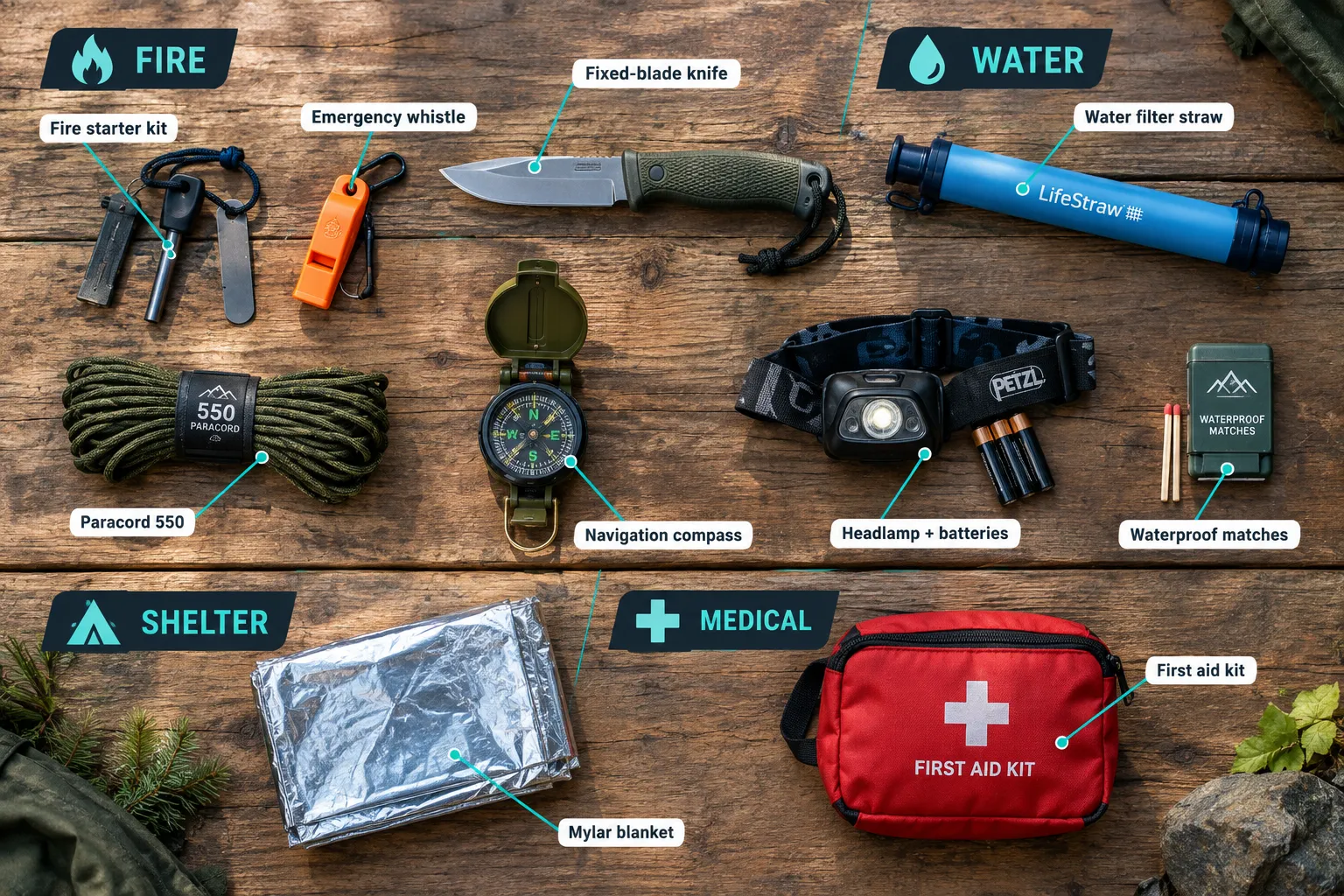
Here’s what belongs in every kit, regardless of experience level:
Water
- Water filter (Sawyer Squeeze or LifeStraw-style filter)
- Iodine or chlorine dioxide tablets as a backup
- Collapsible water container (1-2 liters minimum)
Fire
- Waterproof matches in a sealed case
- Butane lighter (BIC-style, not novelty)
- Ferrocerium rod as a backup ignition source
- Tinder bundle or commercial fire-starting cubes
Shelter
- Emergency mylar space blanket (heavier foil type, not the tissue-thin versions)
- Lightweight tarp or bivy sack
- 50 feet of 550 paracord
Navigation
- Baseplate compass (Suunto A-10 or Silva Ranger)
- Topographic map of the area, laminated or in a waterproof sleeve
- Signal mirror
First Aid
- Comprehensive first aid kit including wound closure strips, gauze, medical tape, antiseptic wipes, and nitrile gloves
- Personal medications (minimum 3-day supply)
- SAM splint and elastic bandage
Tools and Signaling
- Fixed-blade knife (full-tang construction)
- Headlamp with extra batteries
- Emergency whistle (Fox 40 or similar pealess design)
- Duct tape (small flat-wrapped amount)
For a deeper look at the tools that matter most in the field, see this guide to 7 Essential Wilderness Survival Tools Every Hiker Needs.
How Much Does a Good Survival Kit Cost
A functional wilderness survival kit costs between $75 and $150 when built from scratch using quality individual components. Pre-assembled kits from reputable brands like SOL (Survive Outdoors Longer), Adventure Medical Kits, or Gerber typically run $100,$250 for a solid mid-range option. High-end custom kits can reach $400 or more.
The key is avoiding the cheap “survival kits” sold at gas stations or discount retailers. Those kits often contain low-quality fire starters that fail in wet conditions, single-use items, and first aid supplies that are more symbolic than functional.
Budget breakdown for a DIY kit:
| Category | Estimated Cost |
|---|---|
| Water filter + tablets | $25,$45 |
| Fire starting kit | $15,$25 |
| Emergency shelter (tarp + blanket) | $20,$35 |
| Navigation (compass + map) | $15,$30 |
| First aid kit | $25,$50 |
| Fixed-blade knife | $30,$80 |
| Signaling (whistle + mirror) | $10,$20 |
| Headlamp | $20,$40 |
Building your own kit gives you control over quality. Buying a pre-assembled kit saves time but requires careful vetting. Either way, the total investment is modest compared to the cost of a search-and-rescue operation.
Best Wilderness Survival Kit for Beginners
Beginners should prioritize simplicity, reliability, and weight. The best beginner wilderness survival kit is one that covers all five survival priorities without overwhelming the user with gear they don’t know how to use.
The Adventure Medical Kits Ultralight/Watertight series is a strong starting point for first aid. Pair it with a Sawyer Squeeze filter, a BIC lighter, a ferrocerium rod, a SOL Emergency Bivvy, and a Silva compass, and you have a functional kit for under $120.
Beginner mistakes to avoid:
- Buying gear without practicing with it first. A ferrocerium rod is useless if you’ve never struck one.
- Over-packing to compensate for inexperience. Heavy kits get left behind.
- Skipping navigation tools because “the phone has GPS.” Batteries die; maps don’t.
For new preppers building their broader preparedness foundation, the Prepper Checklist for Beginners 30-Day System is a practical companion resource.
Survival Kit Essentials for Different Environments: Desert vs. Forest
Your wilderness survival kit essentials list must change based on where you’re going. A kit optimized for the Pacific Northwest rainforest will leave you dangerously under-prepared in the Sonoran Desert, and vice versa.
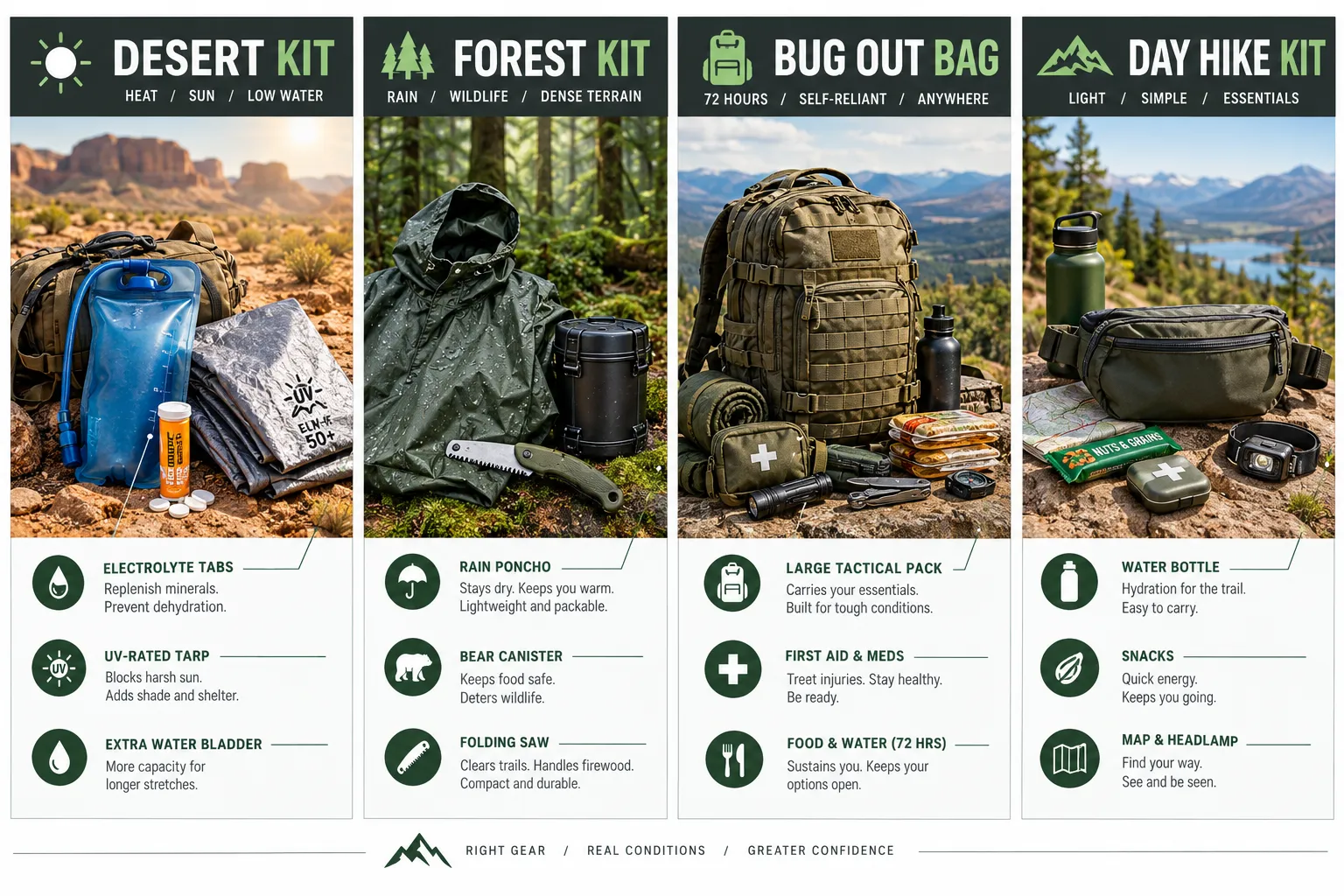
Desert environment additions:
- Extra water capacity (minimum 4 liters on your person)
- Electrolyte packets to counter sodium loss from sweating
- UV-rated sun shelter or reflective tarp (not dark-colored)
- Lightweight long-sleeve sun protection clothing
- Snake bite protocol in your first aid kit
Forest/temperate environment additions:
- Rain poncho or waterproof shell
- Folding saw for shelter building
- Bear canister or bear hang system if in bear country
- Insulating layers (hypothermia is a forest killer, even in summer)
- Tick removal tool and insect repellent
High altitude additions:
- Altitude sickness medication (consult a physician)
- Extra insulation layers
- UV-blocking sunglasses
The core five categories remain constant. What changes is the weight distribution and specific product choices within each category.
For families navigating these decisions with children in tow, the Wilderness Survival for Families With Children guide covers environment-specific planning in detail.
What’s the Difference Between a Bug Out Bag and a Survival Kit
A bug out bag is a 72-hour evacuation pack designed to sustain you while moving from a dangerous location to a safe one. A wilderness survival kit is a compact emergency kit designed to help you survive an unplanned situation, getting lost, injured, or stranded, until rescue arrives or you self-rescue.
The key differences:
- Scope: A bug out bag contains food, water, clothing, shelter, and documentation for 72 hours of independent living. A survival kit focuses on immediate life-safety tools for shorter emergencies.
- Weight: Bug out bags typically weigh 25-45 lbs. A wilderness survival kit should weigh 2-5 lbs.
- Purpose: Bug out bags support evacuation. Survival kits support emergency response in place.
Many preppers carry a survival kit inside their bug out bag as a dedicated sub-kit. That’s a smart layering approach. For a full breakdown of evacuation planning, see Bug Out Plans for Survival Preparedness.
How to Make Your Own Survival Kit vs. Buying One
Building your own kit gives you better quality control, customization for your specific environment, and often better value. Buying a pre-assembled kit saves time and ensures nothing obvious is forgotten.
Choose DIY if:
- You have specific medical needs or environmental requirements
- You want to select each item based on tested performance
- You’re an experienced prepper who knows what works
Choose pre-assembled if:
- You’re new to preparedness and need a starting point quickly
- You’re building a kit for a family member who isn’t gear-savvy
- You want a gift-ready or vehicle-stored emergency kit
The best approach for most preppers is a hybrid: start with a quality pre-assembled first aid kit (Adventure Medical Kits or Surviveware), then build out the fire, water, shelter, and navigation components yourself using individual items you’ve researched and tested.
Do I Need a Survival Kit for Day Hikes or Just Overnight Trips
Day hikers need a survival kit just as much as overnight campers. Most wilderness search-and-rescue operations involve day hikers who got lost, injured, or caught in unexpected weather, not multi-day backpackers who planned for contingencies.
A day hike survival kit can be lighter and more compact than a full overnight kit, but it must still address the core five priorities. A compact kit for day hikes fits in a small dry bag or a dedicated pouch inside your daypack.
Minimum day hike kit:
- Water filter or purification tablets
- BIC lighter and ferrocerium rod
- Emergency mylar blanket
- Baseplate compass and downloaded offline map
- Basic first aid supplies (wound closure, bandages, antiseptic)
- Emergency whistle
- Headlamp (even for day hikes, delays happen)
The Essential Survival Gear Guide: 50 Items Ranked by Priority is a useful reference for trimming a full kit down to day-hike weight without sacrificing critical coverage.
Common Mistakes People Make When Packing a Survival Kit
The most common mistake is packing gear you’ve never used. The second most common is packing for the trip you planned rather than the emergency you might face.
Other critical mistakes:
- Relying on a single ignition source. Lighters fail in cold and wet. Always carry two fire-starting methods.
- Skipping navigation tools. Phone GPS depends on battery life and signal. A compass and map never fail.
- Using an expired first aid kit. Antiseptics degrade. Adhesives fail. Check dates annually.
- Packing too heavy. A kit left in the car because it’s too heavy to carry is worthless on the trail.
- No signaling device. A whistle carries farther than a human voice and uses no energy. It’s one of the lightest items you can carry.
- Forgetting personal medications. Prescription medications and EpiPens belong in every kit for anyone who needs them.
For a deeper look at the skills that make your gear actually useful, see 25 Most Critical Wilderness Survival Skills.
What Survival Items Are Actually Useless or Overhyped
Several popular survival products consistently underperform in real field conditions. Knowing what to leave out is as important as knowing what to include.
Overhyped items to reconsider:
- Cheap multi-tools: The blade on a $15 multi-tool is rarely sharp enough for serious cutting tasks. A dedicated fixed-blade knife outperforms it every time.
- Survival bracelets (paracord only): 8-10 feet of paracord is not enough for most shelter or rigging tasks. Carry a proper 50-foot length separately.
- Novelty fire starters (magnesium blocks with poor rods): Many cheap ferrocerium rods produce weak sparks. Test your rod before trusting your life to it.
- Gas station survival kits: These typically contain low-quality components that fail under real conditions.
- Solar chargers for emergency use: Useful for long-term camping, but too slow and weather-dependent to be a reliable emergency power source.
- Signal flares without training: Flares have expiration dates, require specific handling, and are often misused. A signal mirror and whistle are more reliable for most hikers.
How Often Should I Replace Items in My Survival Kit
Most survival kit items should be inspected before every trip and replaced on an annual maintenance schedule. Some items have specific shelf lives that require more frequent attention.
Replacement schedule:
- Water purification tablets: Check manufacturer expiration (typically 4-5 years unopened, 1 year once opened)
- First aid supplies: Inspect annually; replace antiseptics, adhesives, and medications per expiration dates
- Batteries: Replace annually or when stored in extreme heat/cold
- Food rations: Most emergency bars last 5 years; check packaging
- Lighters: Test before every trip; replace if fuel is low
- Medications: Follow prescription expiration dates strictly
Set a calendar reminder each year, many preppers use the same date as daylight saving time changes, to do a full kit audit. This habit is the difference between gear you can trust and gear that fails when it matters most.
Survival Kit Essentials for Solo Female Hikers
Solo female hikers should build from the same core wilderness survival kit essentials list as any other hiker, then add a layer of personal safety and communication redundancy.
Additional items for solo female hikers:
- Personal locator beacon (PLB) or satellite communicator (Garmin inReach Mini or SPOT Gen4), this is the single most important addition for any solo traveler
- Personal alarm (130dB minimum)
- Pepper spray (where legally permitted)
- Written trip plan left with a trusted contact, including expected return time and trailhead location
- Second communication method (satellite messenger in addition to a cell phone)
The PLB recommendation applies to all solo hikers regardless of gender, but the personal alarm and communication redundancy are especially critical for women traveling alone in remote areas. A satellite communicator transforms a potential fatality into a manageable rescue.
Lightweight Survival Kit for Backpacking vs. Car Camping
Backpackers need to minimize weight aggressively; car campers can afford redundancy and comfort. Both still need the core five survival categories covered.
Backpacking kit priorities (target: under 2 lbs):
- Sawyer Squeeze filter (3 oz) instead of a heavy pump filter
- SOL Emergency Bivvy (3.8 oz) instead of a full sleeping bag
- Titanium spork and minimal cookware
- Compact navigation tools only
Car camping kit priorities (weight is secondary):
- Full first aid kit with more comprehensive medical supplies
- Larger water storage capacity
- Redundant fire-starting tools
- Heavier, more durable shelter options
Car campers can also store a more comprehensive ultimate emergency supplies list in their vehicle as a base camp resource.
Survival Kit Checklist for Extreme Weather Conditions
Extreme weather demands targeted additions to your base kit. Cold weather and blizzard conditions are the most dangerous for unprepared hikers because hypothermia can set in within minutes of wet exposure.
Cold weather and blizzard additions:
- Chemical hand warmers (HeatMax or similar, minimum 4 pairs)
- Wool or synthetic base layer (no cotton)
- Waterproof outer shell
- Insulated gloves and balaclava
- High-calorie emergency rations (cold weather burns more calories)
For a full cold-weather kit breakdown, the Winter Blizzard Survival Kit guide covers gear selection and layering strategy in detail.
Hot weather and wildfire additions:
- N95 masks or respirator for smoke
- Extra water (double your normal carry)
- Electrolyte supplementation
- Cooling towel
Flood and wet environment additions:
- Dry bags for all electronics and fire-starting gear
- Waterproof matches as primary (not backup) ignition
- Extra socks in a sealed bag
What to Do If You Get Lost Without a Survival Kit
Getting lost without a survival kit is a serious situation, but it’s survivable with the right decisions. The first and most important rule is STOP: Stop, Think, Observe, Plan.
Immediate priorities without gear:
- Stay calm and stay put if you were on a known trail. Searchers look for people near their last known location.
- Signal for help using any available means, a bright piece of clothing, a reflective surface, or three whistle blasts (the universal distress signal).
- Find or build shelter before nightfall. Hypothermia kills faster than dehydration.
- Locate water using terrain, valleys and low ground typically lead to streams.
- Do not drink untreated water unless dehydration becomes immediately life-threatening.
This scenario is exactly why carrying even a minimal kit on every outing matters. The skills to improvise in a no-gear situation are covered in depth in the 14 Essential Survival Skills Every Prepper Must Know guide.
Frequently Asked Questions
What’s the single most important item in a wilderness survival kit?
Clean water access is the top priority. A quality water filter like the Sawyer Squeeze addresses the most immediate life-threatening need in most wilderness environments. Without water, survival time drops to 3 days or less.
Can I use my phone instead of a compass?
A phone is a useful backup but should never replace a physical compass. Phone GPS requires battery power, can fail in extreme temperatures, and loses signal in deep terrain. A baseplate compass works in any condition with no power source.
How heavy should my wilderness survival kit be?
A day hike kit should weigh 1-2 lbs. An overnight or multi-day kit should weigh 3-5 lbs for the survival components alone, separate from food and clothing. If your kit is too heavy to carry comfortably, you’ll leave it behind.
Is a satellite communicator worth the cost?
Yes, for solo hikers and anyone traveling in remote areas. Devices like the Garmin inReach Mini run approximately $350,$400 with a monthly service plan. That cost is trivial compared to a search-and-rescue operation, which can run tens of thousands of dollars in some jurisdictions.
Do I need a survival kit for a well-traveled trail?
Yes. Emergencies happen on popular trails too, twisted ankles, sudden weather changes, and disorientation don’t discriminate by trail traffic. A compact kit adds minimal weight and addresses scenarios that happen on any terrain.
What’s the best water purification method for a survival kit?
A two-method approach is best: a physical filter (Sawyer Squeeze or similar) as the primary method, and chemical tablets (Aquatabs or Potable Aqua) as a backup. Filters can freeze or clog; tablets work in any condition.
Should children have their own survival kit?
Children old enough to carry a daypack should carry a simplified kit with a whistle, emergency blanket, and a small water bottle. Full kit responsibility stays with adults. The Wilderness Survival for Families With Children guide covers age-appropriate gear in detail.
How do I waterproof my survival kit?
Store all kit components in a waterproof dry bag or a hard-sided waterproof case. Within the kit, keep fire-starting materials and electronics in individual zip-lock bags as a secondary barrier. Assume your pack will get wet.
What’s the difference between a PLB and a satellite communicator?
A PLB (Personal Locator Beacon) sends a one-way distress signal to search-and-rescue authorities with no subscription fee. A satellite communicator (Garmin inReach, SPOT) allows two-way messaging and GPS tracking but requires a monthly plan. PLBs are cheaper to own long-term; satellite communicators offer more functionality.
Can I build a survival kit for under $50?
A minimal functional kit is possible at that price point, but quality suffers. A better approach is the 72-Hour Emergency Kit for Under $50 framework, which prioritizes the most critical items within a tight budget.
Conclusion
A well-built wilderness survival kit isn’t about having the most gear. It’s about having the right gear, knowing how to use it, and keeping it maintained. The wilderness survival kit essentials list in this guide covers every critical category, water, fire, shelter, navigation, first aid, and signaling, across different environments, experience levels, and trip types.
Actionable next steps:
- Audit your current kit against the five core categories. Identify the gaps.
- Replace any expired items, especially first aid supplies and purification tablets.
- Practice with your fire-starting tools before your next trip. Strike that ferrocerium rod until it’s second nature.
- Add a satellite communicator if you hike solo or in remote areas.
- Customize your kit for your specific environment using the desert vs. forest breakdown above.
- Set an annual maintenance reminder to inspect and refresh your kit every year.
Preparedness isn’t about fear. It’s about the confidence that comes from knowing you’ve done the work before the emergency happens.
Recommended Tools and Resources
- Sawyer Squeeze Water Filter, Lightweight, reliable, and field-proven for both backpacking and emergency kits
- Adventure Medical Kits Ultralight/Watertight Series, Best-in-class first aid for weight-conscious hikers
- Garmin inReach Mini 2, The most practical satellite communicator for solo wilderness travel in 2026
- SOL Emergency Bivvy, A significant upgrade from standard mylar blankets for cold-weather emergency shelter
- Silva Ranger Compass, Trusted by search-and-rescue professionals for decades
- Survival Skills Checklist: 7 Core Skills Every Prepper Needs, Build the knowledge to back up your gear
- Free Printable Medical Preparedness Checklist, A practical reference for home and travel first aid kits