
Hey there! Some links on this page may be affiliate links which means that, if you choose to make a purchase, I may earn a commission at no extra cost to you. I greatly appreciate your support. Read the full disclosure here.
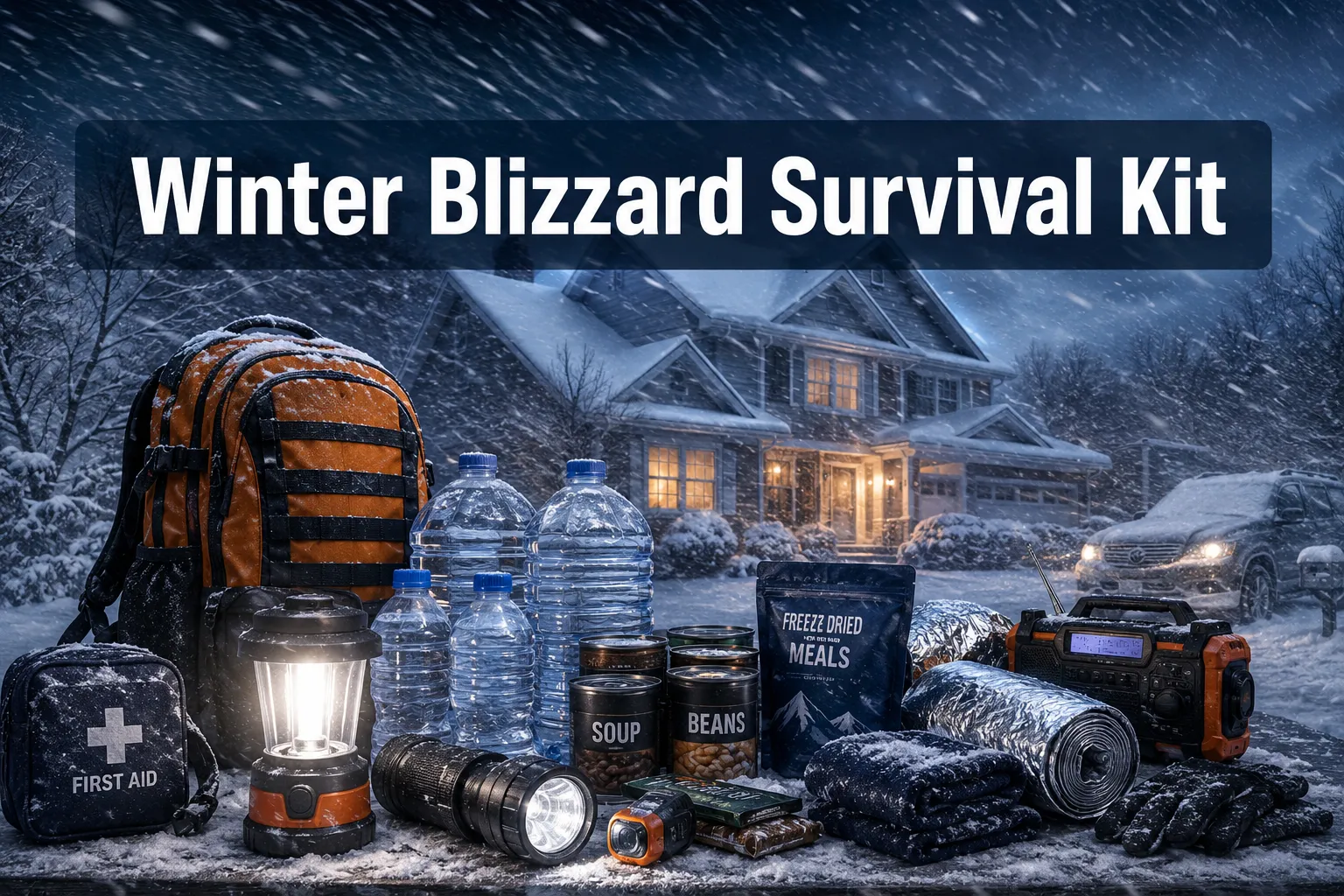
Every year, winter storms strand thousands of Americans in their homes and vehicles with no power, no heat, and supplies that run out within 24 hours. The National Weather Service recorded over 400 weather-related fatalities in a single recent winter season, with hypothermia and carbon monoxide poisoning accounting for a significant share. Most of those deaths were preventable. A properly assembled winter blizzard survival kit changes the outcome, but only if it’s built before the storm arrives, not during it.
This guide covers everything that belongs in a winter blizzard survival kit, how to scale it for families and special needs, what to keep in your car, and the most common mistakes that leave people exposed when conditions turn deadly.
Key Takeaways
- A complete winter blizzard survival kit covers heat, water, food, light, communication, and first aid for a minimum of 72 hours, ideally 7 days.
- Store one gallon of water per person per day; for a family of four over 7 days, that’s 28 gallons minimum.
- A blizzard kit differs from a standard emergency kit because it prioritizes heat retention, backup warming sources, and cold-specific gear.
- Car blizzard kits are non-negotiable, a stranded vehicle can become a death trap within hours without the right supplies.
- Families with children, elderly members, or people with disabilities need kit modifications that address medication, mobility, and warmth needs.
- Building a solid home kit costs between $150 and $400 depending on what you already own.
- Apartment dwellers face real constraints but can build effective kits using compact, high-density supplies.
- The most dangerous mistake is assuming the storm won’t last long enough to matter.
What Should Be in a Winter Blizzard Survival Kit
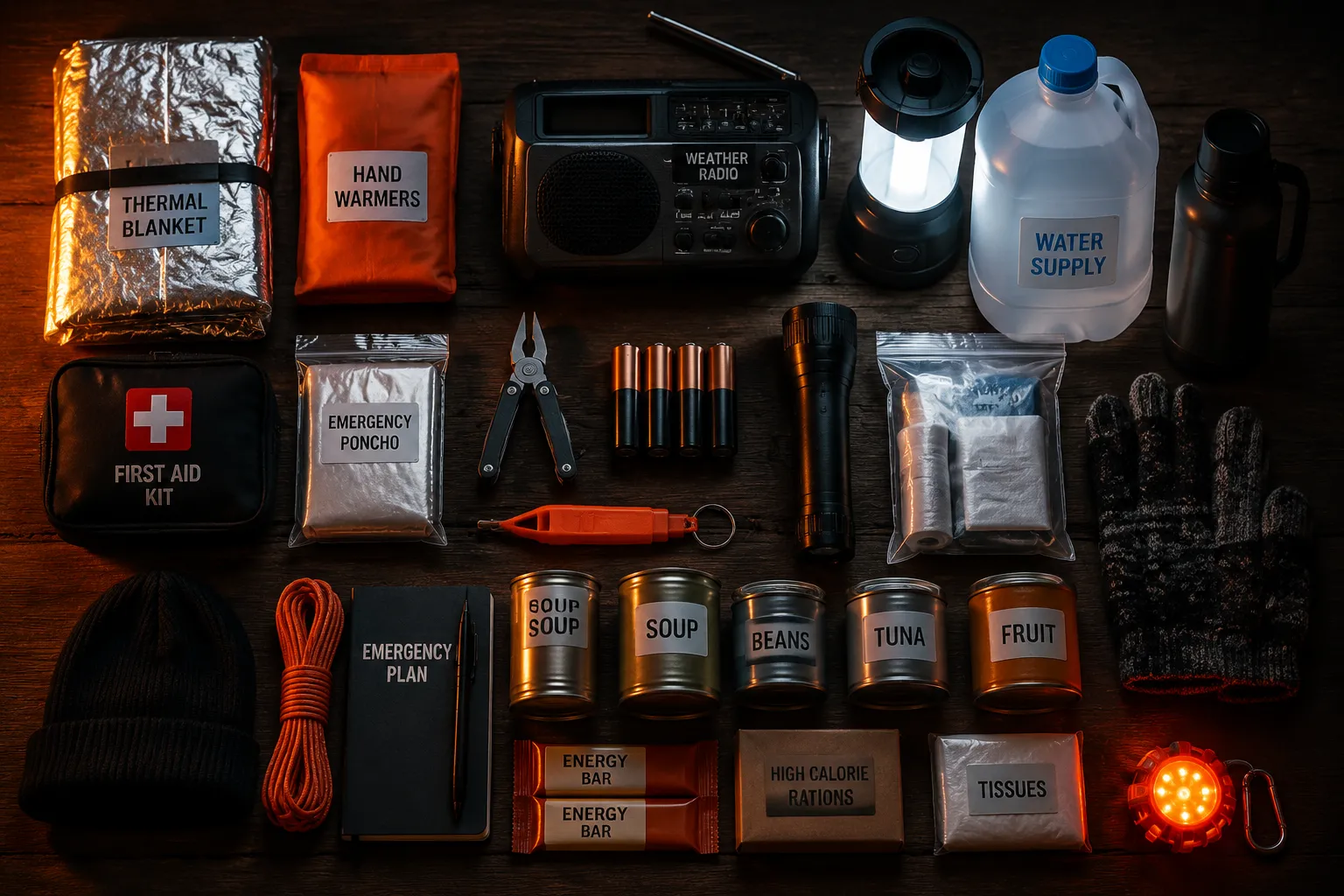
A winter blizzard survival kit must cover six core categories: warmth, water, food, light and power, communication, and first aid. Every item should be chosen with the assumption that power is out, roads are impassable, and help is 72 hours away at minimum.
Warmth and Shelter
- Wool or synthetic sleeping bags rated to 0°F or below
- Emergency Mylar thermal blankets (minimum 4 per household)
- Hand and foot warmers (chemical activated, no electricity needed)
- Extra layers: wool base layers, insulated gloves, hats, and wool socks
- A backup heat source: propane heater (Mr. Heater Big Buddy is a popular choice), wood stove, or kerosene heater with proper ventilation
- Draft stoppers for doors and thermal curtains to retain heat
Water
Store one gallon per person per day. For a family of four planning for 7 days, that’s 28 gallons. Keep water in food-grade containers away from direct sunlight. For more on long-term water storage strategy, the ultimate emergency water storage and purification guide covers container selection, rotation schedules, and purification methods in depth.
Food
- Minimum 3-day supply of non-perishable, no-cook or low-cook foods
- Canned goods (with a manual can opener), peanut butter, crackers, dried fruit, nuts
- A camp stove with extra fuel canisters for hot meals
- For a deeper food storage strategy, see the ultimate survival pantry list
Light and Power
- Flashlights with extra batteries (LED preferred)
- Battery-powered or hand-crank lanterns
- Power banks for phones and small devices
- Glow sticks as backup
Communication
- Battery-powered or hand-crank NOAA weather radio
- Fully charged cell phone with emergency contacts saved
- Printed list of local emergency numbers and family contacts
First Aid
A blizzard kit needs a first aid kit that specifically addresses cold-weather injuries: frostbite, hypothermia, and carbon monoxide exposure. See the 47-item prepper first aid kit guide for a complete breakdown of what to include.
How Much Food and Water Do You Need for a Blizzard
Plan for at least 72 hours, but serious preppers stock for 7 to 14 days. Blizzards can knock out power for a week or longer in severe events, and road closures can prevent resupply for days after the storm ends.
Water: One gallon per person per day is the standard benchmark from FEMA. That covers drinking and basic sanitation. In cold conditions, hydration needs may feel lower, but they aren’t, dehydration accelerates hypothermia. Don’t cut corners here.
Food: Target 2,000 calories per adult per day under sedentary conditions. If you’re doing physical work (shoveling, hauling wood), add 500 to 1,000 calories. Prioritize calorie-dense, shelf-stable foods:
- Peanut butter: roughly 190 calories per 2 tablespoons
- Canned beans: 200-250 calories per half cup
- Oats: 150 calories per half cup dry
- Hard cheeses (if refrigeration is unavailable, consume early)
- Freeze-dried meals as a longer-term backup
For families with infants, stock formula, baby food, and extra water specifically for preparation. Don’t assume you can improvise.
Buy a Pre-Made Kit or Build Your Own
Pre-made blizzard kits are convenient but often incomplete. Building your own gives you better control over quality, quantity, and customization, and usually costs less per item.
Pre-made kits typically run $50 to $150 and include basics like Mylar blankets, light sticks, and basic first aid. The problem is they’re rarely sized for more than 72 hours, and they often skip critical cold-weather items like backup heat sources and high-calorie food.
Building your own costs $150 to $400 for a solid home kit, but you get exactly what your household needs. Use the checklist in this article as your foundation.
Choose a pre-made kit if: You’re starting from zero and need something immediately, or you want a base to build on.
Choose to build your own if: You have specific household needs (children, elderly, medical conditions), you want 7+ day coverage, or you already own some components.
A hybrid approach works well: buy a mid-range pre-made kit for the basics, then add custom layers for heat, food, and communication.
How Long Can You Survive in a Car During a Blizzard
A person can survive in a stranded vehicle for 24 to 48 hours with the right supplies, but without heat sources, hypothermia can set in within hours if temperatures drop below 20°F. The vehicle itself provides wind protection, which is significant, but it’s not enough on its own.
The biggest danger in a car during a blizzard isn’t the cold alone. It’s running the engine for heat with the exhaust pipe blocked by snow, which causes carbon monoxide poisoning. This kills people every winter.
If you’re stranded:
- Stay with the vehicle, it’s easier for rescuers to spot than a person on foot
- Run the engine for 10 minutes per hour maximum, and only after clearing the exhaust pipe
- Use a car blizzard kit to supplement heat (see the section on car kits below)
- Signal for help with a brightly colored cloth on the antenna or door
For a full breakdown of staying warm in a vehicle emergency, the guide to keeping warm in cold car emergencies covers positioning, insulation techniques, and when to leave the vehicle.
What to Do If You Get Stranded in a Blizzard
Whether you’re stranded in a car or caught outdoors, the first priority is shelter from wind. The second is heat retention. The third is signaling for help.
In a vehicle:
- Pull completely off the road and turn on hazard lights
- Clear snow from the exhaust pipe before running the engine
- Layer every piece of clothing you have
- Use Mylar blankets to reflect body heat inside the car
- Stay awake and move your arms and legs periodically to maintain circulation
- Call 911 or emergency services and give your exact location
On foot:
- Never walk in whiteout conditions, disorientation happens fast
- Find any windbreak: a building, a vehicle, a tree line
- Insulate yourself from the ground (ground conducts cold faster than air)
- Signal with a whistle or bright material
The 10 critical bug-out survival skills covers situational awareness and decision-making under pressure, skills that apply directly to blizzard emergencies.
Blizzard Survival Kit Checklist for Families with Kids
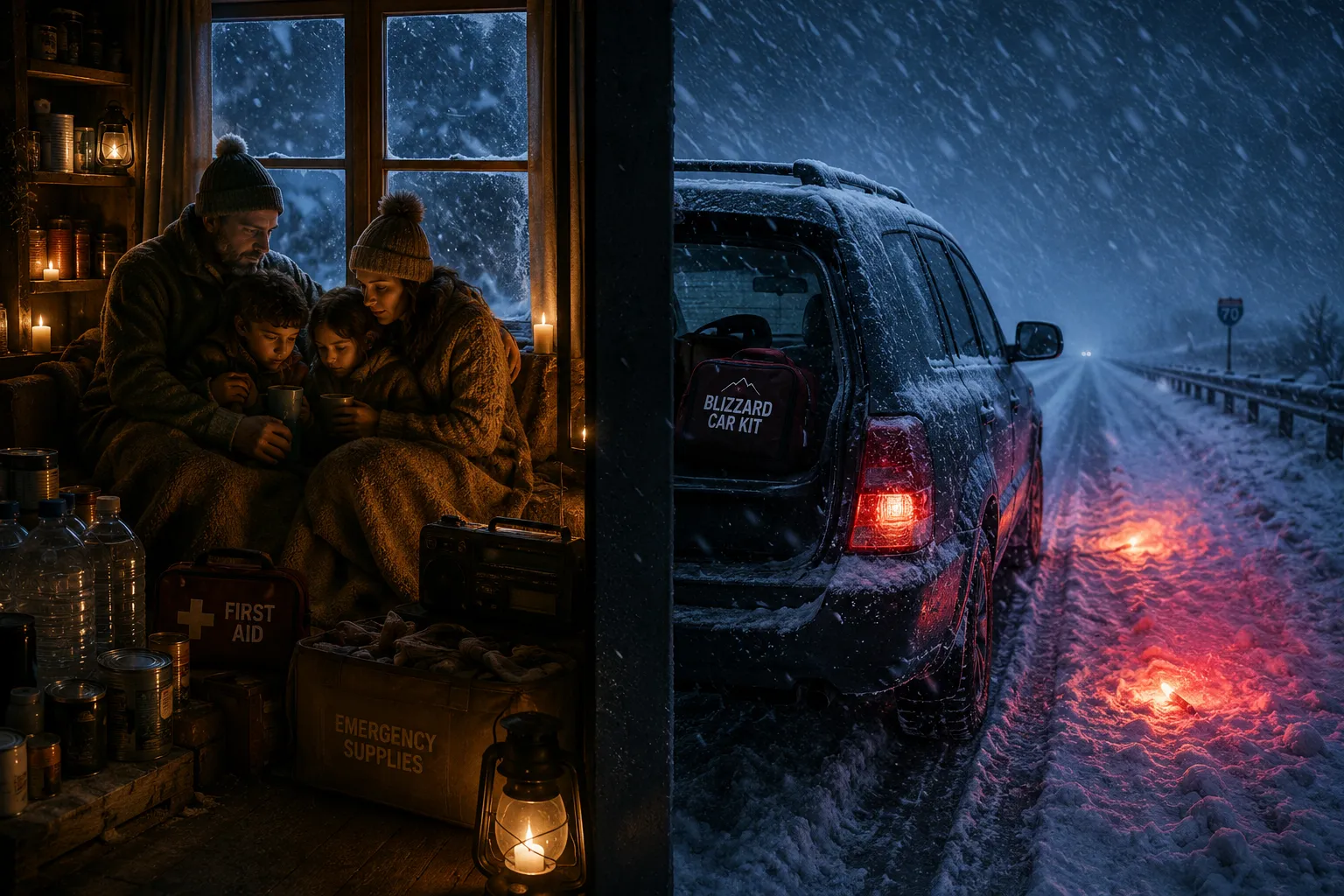
Families with children need a modified kit that accounts for caloric needs by age, warmth requirements (children lose heat faster than adults), and the psychological need for comfort and routine during a crisis.
Add to your standard kit:
- Child-sized sleeping bags or extra blankets for each child
- Age-appropriate snacks and comfort foods (familiar foods reduce stress)
- Infant formula, diapers, and wipes (a 2-week supply minimum)
- Prescription medications with at least a 30-day buffer
- Games, books, or activities that don’t require power
- A stuffed animal or comfort item for young children
- Glow sticks (safer than candles around kids)
For infants specifically: Keeping an infant warm is the highest priority. Skin-to-skin contact under blankets is an effective heat transfer method if your backup heat source fails.
For a comprehensive family-specific approach, the family emergency plan template walks through role assignments and communication protocols that work during blizzard scenarios.
Do You Need a Blizzard Kit If You Stay Home
Yes. Staying home during a blizzard does not eliminate risk, it changes the nature of it. Power outages during winter storms are common, and without heat, a well-insulated home can drop to dangerous temperatures within 12 to 24 hours in extreme cold.
A home blizzard kit addresses three scenarios that sheltering in place does not automatically solve:
- Extended power outage, your furnace won’t run without electricity (unless it’s a wood stove or propane system)
- Water line freeze, pipes can burst, cutting off your water supply
- Supply depletion, if roads are closed for 5 to 7 days, your normal pantry may not be enough
Home-specific additions to consider:
- A propane or kerosene heater with adequate fuel reserves
- Pipe insulation and heat tape for vulnerable water lines
- A generator with fuel (or a solar generator for cleaner indoor use)
- Sand or cat litter for traction on icy walkways
- A snow shovel and ice melt near the door before the storm hits
Common Mistakes People Make with Emergency Blizzard Prep
Most blizzard prep failures come down to underestimating duration, overlooking heat, and assuming modern infrastructure will hold.
The most common mistakes:
- Waiting until the storm is forecast, stores sell out of batteries, water, and fuel within hours of a storm warning
- Relying on a gas furnace without a backup, most gas furnaces require electricity to run the blower
- Storing water in flimsy containers, thin plastic degrades and can crack in cold temperatures
- Not testing equipment, flashlights with dead batteries, propane heaters that haven’t been used in years, radios with corroded battery contacts
- Forgetting about pets, dogs and cats need food, water, and warmth too; see the ultimate pet emergency preparedness checklist
- No communication plan, if family members are separated when the storm hits, no one knows where to go or who to call
The 15 things missing from most emergency kits covers overlooked items that experienced preppers catch, worth reviewing before you finalize your kit.
How Much Does a Good Blizzard Survival Kit Cost
A functional blizzard survival kit for a family of four costs between $150 and $400 built from scratch, or $75 to $150 if you already own camping gear, extra blankets, and basic first aid supplies.
Rough cost breakdown:
| Category | Estimated Cost |
|---|---|
| Backup heat source (propane heater + fuel) | $60-$120 |
| Water storage (7-day supply, containers) | $30-$60 |
| Food (7-day non-perishable supply) | $40-$80 |
| Lighting (lanterns, flashlights, batteries) | $25-$50 |
| First aid kit | $20-$50 |
| Thermal blankets, hand warmers, layers | $20-$40 |
| NOAA weather radio | $25-$40 |
The biggest cost driver is the backup heat source. Don’t skip it to save money, it’s the item most likely to keep your family alive if the power goes out for days.
Blizzard Survival Kit for Elderly or People with Disabilities
Elderly individuals and people with disabilities face compounding risks during blizzards: medication dependency, reduced mobility, impaired thermoregulation, and a higher likelihood of living alone.
Key modifications:
- Maintain a 30-day minimum supply of all prescription medications; talk to your doctor about emergency refills before winter
- Keep medical equipment (CPAP machines, oxygen concentrators) connected to a power bank or generator
- Store supplies at accessible heights, no reaching into high cabinets or bending to floor-level storage
- Include a medical alert device with battery backup
- Establish a check-in system with a neighbor or family member before storm season
- Keep a list of medical conditions, medications, and emergency contacts in a waterproof bag with the kit
For a detailed guide on emergency planning with accessibility in mind, emergency preparedness for disabled individuals provides a thorough framework.
Should You Keep a Blizzard Kit in Your Car Year Round
Yes. A car blizzard kit should stay in your vehicle from October through April at minimum, and in northern climates, year-round makes sense given the unpredictability of late-season storms.
What belongs in a car blizzard kit:
- Wool or fleece blanket (one per regular passenger)
- Hand warmers (10-20 packets)
- High-calorie snacks: energy bars, nuts, jerky
- Small water supply (at least 1 liter per person)
- Flashlight with extra batteries
- Jumper cables or a jump starter pack
- Ice scraper and small folding shovel
- Traction aids: sand, cat litter, or traction mats
- Bright orange or red signal flag
- First aid kit
- Fully charged power bank
- Whistle
The ultimate car emergency kit list covers vehicle-specific gear in greater depth, including tire chains and roadside signaling tools.
What’s the Difference Between a Blizzard Kit and a Regular Emergency Kit
A standard emergency kit is designed for general disasters: earthquakes, floods, power outages. A blizzard survival kit is a cold-weather-specific version that prioritizes thermal management above almost everything else.
Key differences:
- A blizzard kit includes a backup heat source; a standard kit often doesn’t
- Blizzard kits carry cold-specific gear: hand warmers, insulated sleeping bags, thermal blankets, and extra wool layers
- Water storage in a blizzard kit must account for freezing, containers need to be kept in a location that won’t freeze solid
- Blizzard kits include snow-specific tools: ice scrapers, shovels, traction aids
- Food in a blizzard kit should be higher in calories and fat to support thermoregulation in cold conditions
A regular emergency kit is still the foundation. A blizzard kit is a layer on top of it, not a replacement.
How to Prepare for a Blizzard If You Live in an Apartment
Apartment dwellers can absolutely build an effective blizzard kit, it just requires creative storage and compact gear choices. The core challenge is space, not capability.
Apartment-specific strategies:
- Use under-bed storage containers for water and food
- Choose compact, high-density supplies: freeze-dried meals over canned goods, collapsible water containers over rigid jugs
- A propane heater rated for indoor use (with a carbon monoxide detector) can heat a small apartment for hours on a single canister
- Store supplies in a rolling suitcase or duffel that can double as a go-bag if evacuation becomes necessary
- Know your building’s emergency heating protocol, some apartments have backup systems; many don’t
For heat specifically, apartment emergency heating without electricity covers safe indoor heating options, ventilation requirements, and what to avoid in a confined space.
If you’re new to prepping in a small space, survival prepping in small spaces offers a practical framework for maximizing limited square footage without turning your apartment into a warehouse.
Frequently Asked Questions
How long should my blizzard kit last? Build for a minimum of 72 hours, but 7 days is the practical target. Major blizzards can knock out power for 5 to 7 days, and road closures can prevent resupply even longer. If you can only start with 72 hours, build from there.
Can I melt snow for drinking water during a blizzard? Yes, but only after purifying it. Snow absorbs pollutants from the air and ground. Melt it first, then boil or filter it before drinking. Never eat snow directly, it lowers your core body temperature.
What’s the safest indoor heat source during a power outage? A propane heater rated for indoor use (like the Mr. Heater Portable Buddy) with a working carbon monoxide detector is the most practical option for most households. Never use a gas range, charcoal grill, or outdoor generator indoors.
How do I keep my water from freezing in a blizzard? Store water containers in an interior room away from exterior walls. If temperatures inside drop below freezing, insulate containers with blankets. Keep some water in insulated bottles that you can sleep with to prevent freezing.
What if I have no backup heat and the power goes out? Consolidate your household into one interior room. Use body heat, sleeping bags, and Mylar blankets. Close off all other rooms to retain warmth. If temperatures become dangerous, call emergency services, don’t wait.
Do I need a generator for a blizzard kit? A generator is useful but not essential. A propane heater, battery power banks, and a NOAA hand-crank radio cover the most critical needs without a generator. If you do use a generator, it must run outdoors only, never in a garage or enclosed space.
How often should I rotate my blizzard kit supplies? Check your kit every October before winter season. Replace expired food and medications, test batteries and electronics, and refill any consumed supplies. Water in sealed containers can last 6 to 12 months before needing rotation.
What’s the single most important item in a blizzard kit? A backup heat source. Dehydration and hunger are serious, but hypothermia kills faster. In a prolonged power outage during a severe blizzard, staying warm is the highest priority.
Should children have their own kit items? Children should have age-appropriate items in the family kit: their own thermal blanket, comfort items, snacks they’ll actually eat, and any medications. Older children (10+) can carry a small personal kit as part of their preparedness education.
Is a blizzard kit different from a bug-out bag? Yes. A bug-out bag is designed for rapid evacuation. A blizzard kit is primarily for sheltering in place. They share some overlap (first aid, water, food), but a blizzard kit is heavier, more home-based, and cold-weather specific. For evacuation scenarios, see the winter bug-out bag setup guide.
Conclusion
A winter blizzard survival kit isn’t a luxury for hardcore preppers, it’s basic insurance for anyone who lives where winter storms happen. The difference between a dangerous situation and a manageable one often comes down to whether you assembled your kit in October or scrambled for supplies the morning the storm warning hit.
Start with the six core categories: warmth, water, food, light, communication, and first aid. Build for 7 days. Add cold-weather specifics that a standard emergency kit misses. Then customize for your household, whether that means a family with young children, an elderly parent on medication, or a studio apartment with limited storage.
The storm doesn’t care whether you’re ready. You do. That’s the whole point.
Products, Tools, and Resources Worth Having
- Mr. Heater Portable Buddy, one of the most reliable indoor-safe propane heaters for emergency use; pair it with 1-lb propane canisters and a carbon monoxide detector
- Kaito KA500 Emergency Radio, hand-crank and solar powered, receives NOAA weather alerts, charges via USB; a staple in serious emergency kits
- SOL Emergency Bivvy, a step up from standard Mylar blankets; windproof, waterproof, and reusable
- Augason Farms 30-Day Emergency Food Bucket, a practical starting point for blizzard food storage; long shelf life, calorie-dense, and compact
- Anker Power Bank, 26,800 mAh, a high-capacity power bank that keeps phones and small devices running through extended outages
- WaterBOB Emergency Water Storage, fits in a standard bathtub and holds up to 100 gallons; fill it when a storm warning is issued as a backup water source
- Lifestraw Personal Water Filter, compact, no batteries required, filters up to 1,000 gallons; useful if your stored water runs low
For a broader look at emergency readiness beyond blizzard season, the natural disaster preparedness step-by-step guide covers all-hazards planning that complements your winter prep work.
Blizzard Survival Kit Checklist
Check off each item as you pack it. Track your readiness below.