

Hey there! Some links on this page may be affiliate links which means that, if you choose to make a purchase, I may earn a commission at no extra cost to you. I greatly appreciate your support. Read the full disclosure here.
Every year, search and rescue teams in the United States respond to an estimated 250,000 calls, according to the National Park Service, and a significant portion involve hikers and outdoor travelers who simply lost their way. Knowing what to do when you get lost in the wilderness step by step isn’t a skill reserved for hardcore survivalists. It’s a baseline competency that anyone who spends time outdoors owes themselves and the people counting on them to come home.
This guide walks through every critical phase of a wilderness emergency, from the first moment of disorientation to the moment rescue arrives.
Find this useful? Add us as a preferred source on Google and more of what we publish will show up in your results.
Key Takeaways
- Stop moving the instant you realize you’re lost. Continuing to walk deepens confusion and burns energy you can’t afford to waste.
- The S.T.O.P. method (Stop, Think, Observe, Plan) is the most effective first-response framework for any lost-in-the-wilderness situation.
- Staying in one place is almost always the right call, search and rescue teams find stationary people far more reliably than moving ones.
- Signal for help using the universal distress signals: three whistle blasts, three fires, or a signal mirror aimed at aircraft.
- Water is your most urgent survival need. Food deprivation is survivable for weeks; dehydration becomes dangerous within 24 to 48 hours.
- Hypothermia is one of the leading killers in wilderness emergencies. Shelter and dry clothing take priority over almost everything else.
- A personal locator beacon (PLB) or satellite communicator is the single most effective piece of gear you can carry for getting rescued quickly.
- Tell someone your exact route and expected return time before every trip. This one habit dramatically accelerates search and rescue response.
What To Do First If You Get Lost in the Woods
The moment you realize you’re lost, stop walking. That single decision prevents the most common and dangerous mistake lost hikers make: continuing to move in the wrong direction, burning energy, and putting more distance between themselves and the last known point.
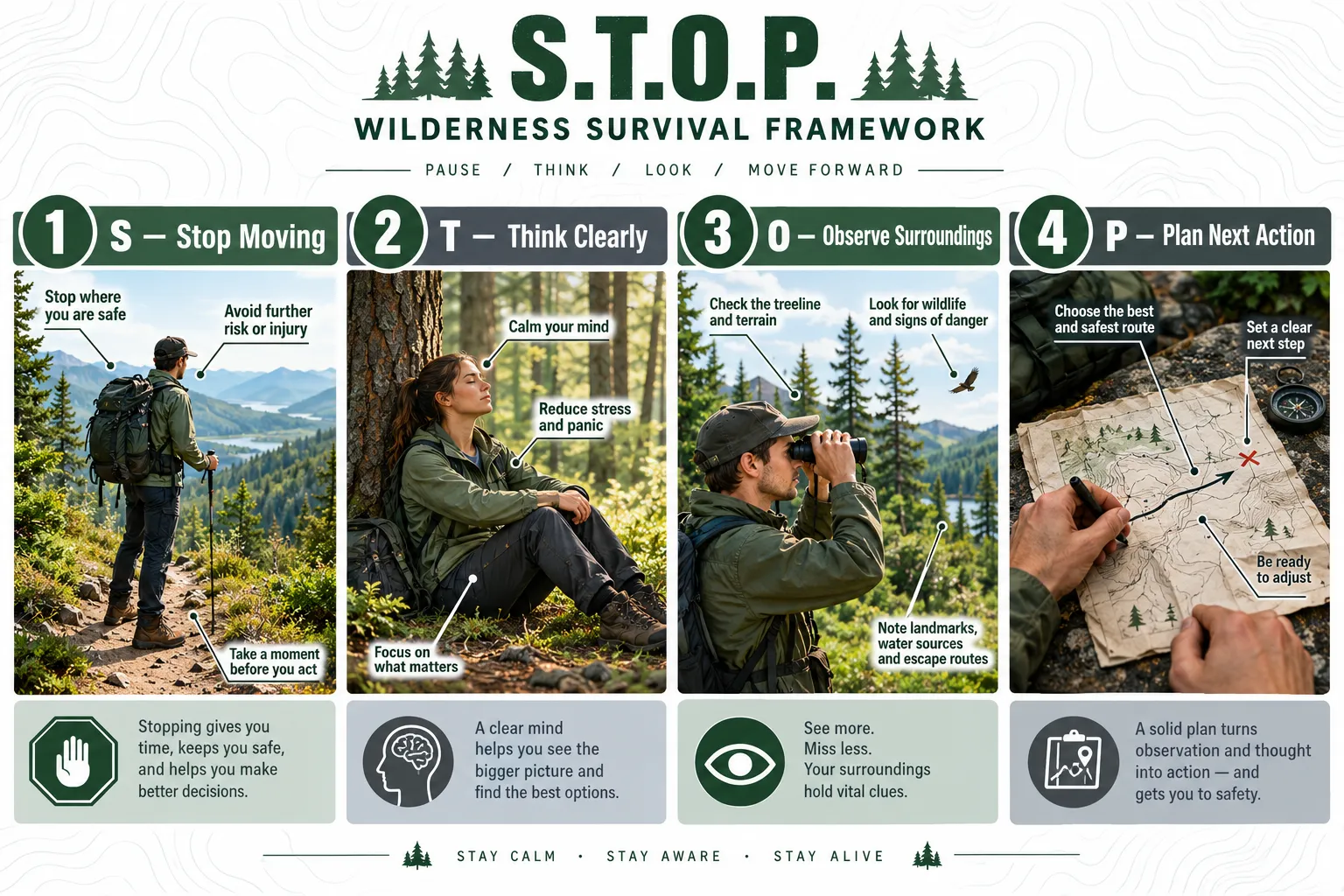
The proven first-response framework is called S.T.O.P.:
- S, Stop: Sit down. Resist the urge to “just keep going a little further.”
- T, Think: Mentally retrace your steps. When did you last know exactly where you were? What landmarks did you pass?
- O, Observe: Look around carefully. Note the sun’s position, terrain features, sounds (roads, water, towns), and your physical condition.
- P, Plan: Based on what you’ve observed, decide on a deliberate course of action rather than reacting emotionally.
This framework applies whether you’re a seasoned prepper or a first-time day hiker. It costs nothing and works every time it’s actually used.
How To Stay Calm When Lost in the Wilderness
Panic is the real enemy in a survival situation. It triggers poor decisions, accelerates dehydration through rapid breathing, and exhausts the body faster than almost any physical activity.
Staying calm is a trainable skill, not a personality trait. Here’s how to manage it in the moment:
- Control your breathing first. Slow, deliberate breaths (inhale for four counts, exhale for four counts) activate the parasympathetic nervous system and reduce the cortisol spike that drives panic.
- Focus on the immediate task. Don’t think about being lost for three days. Think about the next five minutes: sit down, drink water, assess your gear.
- Inventory what you have. Going through your pack methodically gives your brain a concrete task and replaces fear with problem-solving.
- Talk out loud if you’re alone. Narrating your actions keeps your mind organized and counters the psychological weight of isolation.
For preppers who want to build this skill before they need it, the Mental Health Preparedness Plan for Emergencies covers stress inoculation techniques that directly apply to wilderness scenarios.
Should You Stay in One Place or Keep Moving When Lost
Stay in one place. This is the near-universal recommendation from search and rescue professionals, and it’s backed by how SAR operations actually work.
Search teams start from your last known location and expand outward. If you’re moving, you’re working against that search pattern. A stationary person is found faster, uses less energy, and is easier to signal from a fixed position.
When staying put is the right call (almost always):
- Someone knows your planned route and expected return time.
- You have or can build shelter at your current location.
- You have water access or a supply.
- It’s getting dark or weather is deteriorating.
The narrow exception, moving makes sense when:
- Nobody knows where you are and no rescue is coming.
- You can see or hear a clear landmark (road, town, river) within reasonable distance.
- Your current position is actively dangerous (flash flood zone, unstable terrain).
- You are physically able to travel and have a reliable navigation method.
If you do decide to move, always travel downhill and follow water downstream. Civilization almost always exists at lower elevations near water sources.
How To Signal for Help When Lost Outdoors
Signaling is your highest-priority active task once you’ve stabilized your position. The goal is to make yourself visible and audible to search teams, aircraft, and other people.
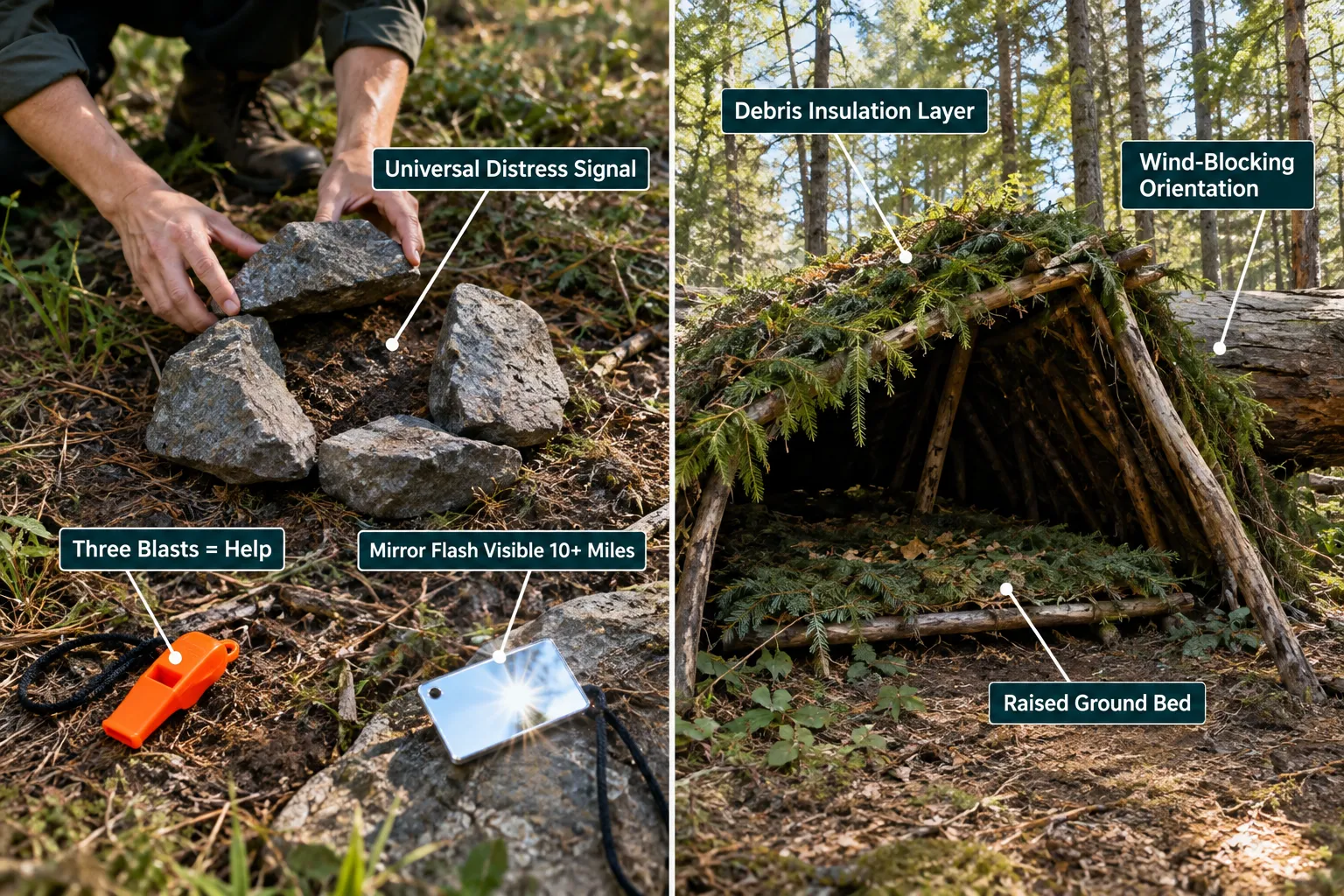
The universal distress signal is three of anything: three whistle blasts, three gunshots, three fires in a triangle formation. Any rescuer trained in wilderness SAR will recognize this pattern.
Most effective signaling methods, ranked:
- Personal Locator Beacon (PLB) or satellite communicator, Sends your GPS coordinates directly to rescue services. This is the gold standard.
- Signal mirror, Can be seen by aircraft up to 10 miles away in clear conditions. Even a phone screen or any reflective surface works in a pinch.
- Whistle, Three sharp blasts, pause, repeat. A whistle carries far further than a human voice and uses a fraction of the energy.
- Ground-to-air signals, Stomp large letters (SOS, X, or an arrow) in snow, sand, or open ground. Use rocks, logs, or bright gear to make them visible from the air.
- Smoke signal, A fire with green leaves or wet wood produces white smoke visible for miles in daylight. At night, a bright flame is more visible than smoke.
- Bright clothing, Lay your most brightly colored gear in an open clearing, away from tree cover.
How To Find Water and Shelter When Lost
Water is your most urgent survival need. Dehydration impairs judgment within hours and becomes life-threatening within 24 to 48 hours, especially in hot or physically demanding conditions. Shelter becomes critical when temperatures drop or weather turns.
Finding water:
- Follow terrain downhill. Water flows to valleys.
- Listen for the sound of running water.
- Look for animal trails, they often lead to water sources.
- Morning dew can be collected from leaves and grass using a cloth or bandana.
- Never drink untreated water if you have any means to purify it. Boiling for one minute kills most pathogens. Water purification tablets are compact and effective.
For a deeper breakdown of water sourcing and purification methods, the Ultimate Emergency Water Storage and Purification Guide covers field-applicable techniques in detail.
Building emergency shelter:
- Prioritize wind and moisture protection over comfort.
- A lean-to built against a large fallen log uses minimal energy and materials.
- Debris shelters (piling leaves, pine needles, and branches over a frame) provide surprising insulation.
- Never sleep directly on the ground. Even a layer of dry leaves beneath you dramatically reduces heat loss.
The Bushcraft Shelter Building Techniques for Wilderness Survival guide covers construction methods for multiple terrain types and seasons.
Can You Use Your Phone To Get Help When Lost in the Woods
Yes, but with significant limitations. A smartphone is a useful tool in a wilderness emergency, not a reliable rescue device.
What your phone can do:
- Call or text emergency services if you have any cell signal. Even one bar may be enough for a text.
- In the U.S., dialing 911 with a weak signal will attempt to connect through any available carrier, not just your own.
- GPS apps (like Gaia GPS or AllTrails) work offline if you downloaded maps before your trip. GPS itself doesn’t require cell signal.
- The iPhone Emergency SOS via satellite feature (available on iPhone 14 and later) can reach emergency services in areas with zero cell coverage.
What your phone cannot reliably do:
- Connect to emergency services in deep wilderness with no cell towers nearby.
- Run indefinitely, battery life is a critical constraint. Put it in airplane mode to conserve power, and use it only when needed.
Bottom line: Carry a dedicated PLB or satellite communicator like a Garmin inReach as your primary rescue device. Your phone is a backup.
How Long Can You Survive Lost in the Wilderness Without Food
Longer than most people think. The human body can survive approximately three weeks without food under normal conditions, assuming adequate hydration. Food is not your immediate survival priority.
The survival priority order is:
- Shelter (protection from exposure)
- Water (3 days without it is the hard limit)
- Signaling (getting rescued quickly)
- Food (energy for long-term survival)
That said, caloric intake matters for maintaining body temperature and decision-making quality. If you’re in a multi-day survival situation, knowing basic foraging is a genuine advantage. The Foraging Edible Wild Plants for Beginners guide covers identification of common edible species across North American environments.
Never eat anything you cannot positively identify. Misidentified plants and mushrooms have killed experienced outdoorspeople.
What Mistakes Do People Make When They Get Lost
The most common and deadly mistakes in wilderness emergencies are predictable and preventable.
| Mistake | Why It’s Dangerous | What To Do Instead |
|---|---|---|
| Continuing to walk after getting lost | Increases distance from last known point | Stop immediately, use S.T.O.P. |
| Panicking and making rushed decisions | Burns energy, causes injury | Breathe, inventory gear, think methodically |
| Not telling anyone your plans | No one initiates rescue | Always file a trip plan with a contact |
| Underestimating weather | Hypothermia sets in fast | Check forecasts, carry layers |
| Relying solely on a phone | Battery dies, no signal | Carry a PLB or satellite communicator |
| Drinking untreated water | Waterborne illness worsens dehydration | Purify all water sources |
| Leaving the trail to “shortcut” | Deeper disorientation | Stay on marked trails when possible |
Without tools, natural navigation requires observation and patience. These methods are reliable in clear conditions but become less precise in dense forest or overcast skies.
Sun-based navigation:
- In the Northern Hemisphere, the sun rises roughly east and sets roughly west. At noon, it’s due south.
- A stick shadow method: plant a stick upright, mark the tip of its shadow, wait 15 minutes, mark again. The line between the two marks runs roughly east-west.
Star navigation:
- The North Star (Polaris) sits almost directly above true north. Find the Big Dipper and follow the two stars at the end of its cup, they point directly to Polaris.
Natural indicators (use as rough guides only):
- Moss tends to grow on the north-facing side of trees in the Northern Hemisphere, though this is not reliable in all environments.
- Rivers and streams flow downhill toward lower elevations and typically toward populated areas.
For a comprehensive breakdown of field navigation and other critical outdoor competencies, the 25 Most Critical Wilderness Survival Skills article is an essential reference.
What Should You Carry on a Hike To Prepare for Getting Lost
Preparation before the trail begins is the most effective survival strategy of all. The gear you carry determines how many options you have when things go wrong.
The core ten items for any hike:
- Navigation tools (map, compass, downloaded offline GPS)
- Personal Locator Beacon or satellite communicator
- Water and purification method (tablets, filter, or both)
- Fire-starting kit (lighter, waterproof matches, ferro rod)
- Emergency shelter (space blanket or bivy, weighs under 4 oz)
- First aid kit
- Headlamp with extra batteries
- Whistle (loud, pealess design)
- Signal mirror
- Extra food and a high-calorie emergency bar
If you’re building out a broader emergency kit, the Ultimate Emergency Supplies List provides a thorough framework that extends well beyond the trail.
For families heading into the backcountry, Wilderness Survival for Families with Children addresses age-specific preparation and what to teach kids before a trip.
How Do Search and Rescue Teams Find Lost People
Search and rescue (SAR) teams use a combination of probability modeling, systematic grid searches, aerial reconnaissance, and technology to locate missing persons. Understanding this process helps you make better decisions when you’re the one being searched for.
How SAR operations work:
- Teams start from your last known point (LKP) and work outward using probability maps based on terrain, weather, and your profile.
- Trained tracking dogs can follow a scent trail for miles under the right conditions.
- Helicopter crews scan open areas and clearings, which is why you should move to open ground to signal.
- Cell phone ping data and PLB signals dramatically narrow the search area.
What you can do to help rescuers find you:
- Stay near your last known location.
- Make noise at regular intervals (whistle blasts).
- Build a signal fire in a clearing, not under dense tree cover.
- Respond to any aircraft or distant voices immediately and loudly.
- Leave markers on your trail (torn cloth, arrows made from rocks) if you must move.
What Are the Signs of Hypothermia When Lost in Cold Weather
Hypothermia occurs when core body temperature drops below 95°F (35°C) and is one of the leading causes of death in wilderness emergencies. It can develop in temperatures well above freezing, especially when wet, windy, or exhausted.
Progressive signs of hypothermia:
- Mild (95°F, 90°F): Shivering, slurred speech, loss of fine motor control, poor coordination.
- Moderate (90°F, 82°F): Shivering stops (a dangerous sign), muscle stiffness, confusion, drowsiness.
- Severe (below 82°F): Loss of consciousness, very slow pulse, pupils dilated. This is a life-threatening emergency.
Immediate treatment steps:
- Get out of wind and wet conditions immediately.
- Remove wet clothing and replace with dry layers.
- Insulate from the ground, lie on a pack or debris layer.
- Apply heat to the core (armpits, groin, neck) using body heat from another person or chemical heat packs.
- Consume warm (not hot) fluids if the person is conscious and can swallow.
- Do not rub the extremities, this can drive cold blood to the core and worsen the condition.
Cold-weather preparedness extends beyond the trail. The Winter Blizzard Survival Kit covers cold-environment gear and protocols for scenarios where exposure is the primary threat.
Is It Better To Hike Alone or With Others To Avoid Getting Lost
Hiking with others is significantly safer. Groups are harder to miss, can share gear loads, provide physical assistance in an emergency, and reduce the psychological toll of disorientation.
That said, solo hiking is a reality for many people and isn’t inherently reckless, it just requires more preparation.
If hiking alone:
- File a detailed trip plan with a trusted contact, including your trailhead, planned route, and expected return time.
- Carry redundant navigation tools and a PLB.
- Check in at planned intervals if you have cell service.
- Know your personal limits and turn around earlier than you think you need to.
With a group:
- Designate a navigator and keep the group together.
- Establish a protocol for what happens if someone gets separated (stay put, signal, meet at a landmark).
- The slowest person sets the pace, splitting up is how groups become multiple emergencies.
FAQ
What is the very first thing to do when you realize you’re lost in the wilderness?
Stop moving immediately. Sit down, control your breathing, and use the S.T.O.P. method: Stop, Think, Observe, Plan. Continuing to walk is the most common mistake that turns a minor navigation error into a serious emergency.
How do you signal for help without a whistle or flare?
Use three of any loud, repeating signal, shouts, banging rocks together, or banging a metal object. Build a smoky fire in an open clearing. Lay bright-colored gear in a large X pattern visible from the air. A signal mirror or phone screen can also reflect sunlight toward aircraft.
Should I drink water from a stream if I’m desperate?
Only if you have no purification method and dehydration is becoming an immediate threat. Waterborne illness takes 24 to 72 hours to develop, while severe dehydration impairs judgment within hours. If you must drink untreated water, do it, but treat any water you find whenever possible.
How long before search and rescue starts looking for me?
It depends entirely on whether someone knows your plans. If you filed a trip plan with a contact and didn’t return on time, SAR can be activated within hours. Without a trip plan, it may be days before anyone realizes you’re missing. This is why filing a trip plan before every outing is non-negotiable.
Does a personal locator beacon work everywhere?
PLBs work anywhere with a clear view of the sky, regardless of cell coverage. They transmit your GPS coordinates to the COSPAS-SARSAT satellite system, which relays the signal to rescue coordination centers. They are one-time-use distress devices, not two-way communicators. Satellite communicators like the Garmin inReach offer two-way messaging in addition to emergency signaling.
What should I do if I’m lost and it’s getting dark?
Stop moving and focus on shelter first. Find or build a windbreak, insulate yourself from the ground, and conserve body heat. Mark your position with any available signal (whistle, fire, bright gear) and wait for daylight before attempting navigation. Traveling at night dramatically increases injury risk.
Can children learn what to do if they get lost in the wilderness?
Yes, and they should. Teaching kids the “hug a tree” protocol, stay in one place, hug a tree to anchor themselves, blow a whistle, and respond to their name, is age-appropriate and effective. The 12 Essential Survival Skills for Kids guide covers this and other foundational skills.
What’s the difference between a PLB and a satellite communicator?
A PLB is a one-way emergency beacon that sends a distress signal and GPS coordinates to rescue services. It has no subscription fee and a battery life of 5+ years. A satellite communicator (like Garmin inReach) allows two-way messaging, trip tracking, and weather updates in addition to emergency signaling, but requires a subscription. For pure rescue reliability, a PLB is the baseline. For regular backcountry travel, a satellite communicator adds meaningful capability.
Conclusion
Knowing what to do when you get lost in the wilderness step by step is the difference between a frightening inconvenience and a fatal outcome. The core principles are simple: stop immediately, stay calm, prioritize shelter and water, signal actively, and stay put unless you have a compelling reason to move. None of these require expensive gear or years of training, they require knowledge and the discipline to apply it under pressure.
The best time to build that knowledge is before you ever need it. Practice the S.T.O.P. method on day hikes. Build a signal fire in your backyard. Learn to read terrain and follow water. Tell someone your plans every single time you go out.
Actionable next steps:
- Build a dedicated day-hike kit that includes a whistle, signal mirror, emergency bivy, water purification tablets, and a fire starter.
- Purchase and register a PLB or satellite communicator before your next backcountry trip.
- File a written trip plan with a trusted contact for every outing, including trailhead location, planned route, and expected return time.
- Study the 7 Essential Wilderness Survival Tools Every Hiker Needs to ensure your kit covers the critical bases.
- If you’re preparing for broader emergencies beyond the trail, the Step-by-Step Guide to Natural Disaster Preparedness is a natural complement to wilderness readiness.
Preparedness isn’t about fear. It’s about having the confidence to handle what comes, because you’ve already thought it through.
Products, Tools, and Resources
Personal Locator Beacons and Satellite Communicators
- ACR ResQLink 400 PLB, Compact, no subscription required, COSPAS-SARSAT registered. A reliable baseline rescue device for any backcountry traveler.
- Garmin inReach Mini 2, Two-way satellite messaging, SOS capability, and GPS tracking. Requires a subscription but adds significant communication value for regular wilderness users.
Navigation Tools
- Suunto A-10 Field Compass, Durable, accurate, no batteries required. Pairs with any topographic map.
- Gaia GPS App, Download offline topo maps before your trip. Works without cell signal using your phone’s built-in GPS chip.
Signaling and Emergency Gear
- Fox 40 Pealess Whistle, Works in wet conditions, audible at long distances, weighs almost nothing.
- SOL Escape Bivvy, Reflects 70% of body heat, waterproof, weighs 3.8 oz. The most compact emergency shelter available.
- Jetec’s Signal Mirror, Glass mirror with sighting hole. Visible to aircraft up to 10 miles away in clear conditions.
Water Purification
- Sawyer Squeeze Filter, Filters 100,000 gallons, weighs 3 oz. One of the most reliable field water filters available.
- Aquatabs Water Purification Tablets, Compact backup option. Effective against bacteria and viruses.
Reference and Training
- Wilderness First Responder (WFR) certification courses through NOLS or Wilderness Medical Associates provide hands-on training that no article can fully replicate.
- The 25 Most Critical Wilderness Survival Skills is a practical reference for building a complete outdoor competency framework.