
Hey there! Some links on this page may be affiliate links which means that, if you choose to make a purchase, I may earn a commission at no extra cost to you. I greatly appreciate your support. Read the full disclosure here.
Most people who fail in emergencies don’t fail because they lacked gear. They fail because their brain betrayed them at the worst possible moment. Research on disaster survivor behavior consistently shows that psychological errors, not equipment shortfalls, are the leading cause of preventable deaths in survival situations. The survival mindset mistakes people make under stress are predictable, well-documented, and, most importantly, trainable out of your system before a crisis ever arrives.
Key Takeaways
- Panic is not the same as fear. Fear is useful. Panic shuts down rational decision-making and must be managed, not suppressed.
- Normalcy bias, the instinct to assume everything will be fine, causes dangerous delays in evacuation and response.
- Tunnel vision under stress narrows your awareness to one threat, causing you to miss exits, resources, and secondary dangers.
- The freeze response is biological, not a character flaw. Understanding it is the first step to overcoming it.
- Trained, repeated rehearsal is the only reliable way to override stress-induced cognitive errors.
- Solo survival thinking is a critical mistake. Group coordination and delegation save lives.
- Post-emergency regret almost always centers on hesitation, denial, and failure to act on early warning signs.
Find this useful? Add us as a preferred source on Google and more of what we publish will show up in your results.
What Is Survival Mindset and Why Does It Matter
A survival mindset is the trained mental framework that allows a person to assess threats accurately, make decisions under pressure, and take purposeful action when their nervous system is screaming at them to freeze or flee. It matters because the brain under acute stress does not function like the brain in a calm state, and most people have never practiced thinking clearly while afraid.
Without a deliberate survival mindset, even well-prepared people can become paralyzed by the gap between what they planned and what reality delivers. Gear, food stores, and bug-out routes only work if the person using them can think straight. That’s why mental preparation is the foundation of everything else at Preppers HQ, and why understanding the survival mindset and mental preparation for disaster is a non-negotiable part of real preparedness.
Common Survival Mindset Mistakes People Make Under Stress
The most common survival mindset mistakes people make under stress fall into predictable categories: denial, panic, tunnel vision, poor prioritization, and failure to adapt. These are not random, they are hard-wired stress responses that evolved for a different threat environment than the one modern emergencies present.
Here is a breakdown of the most dangerous mental errors:
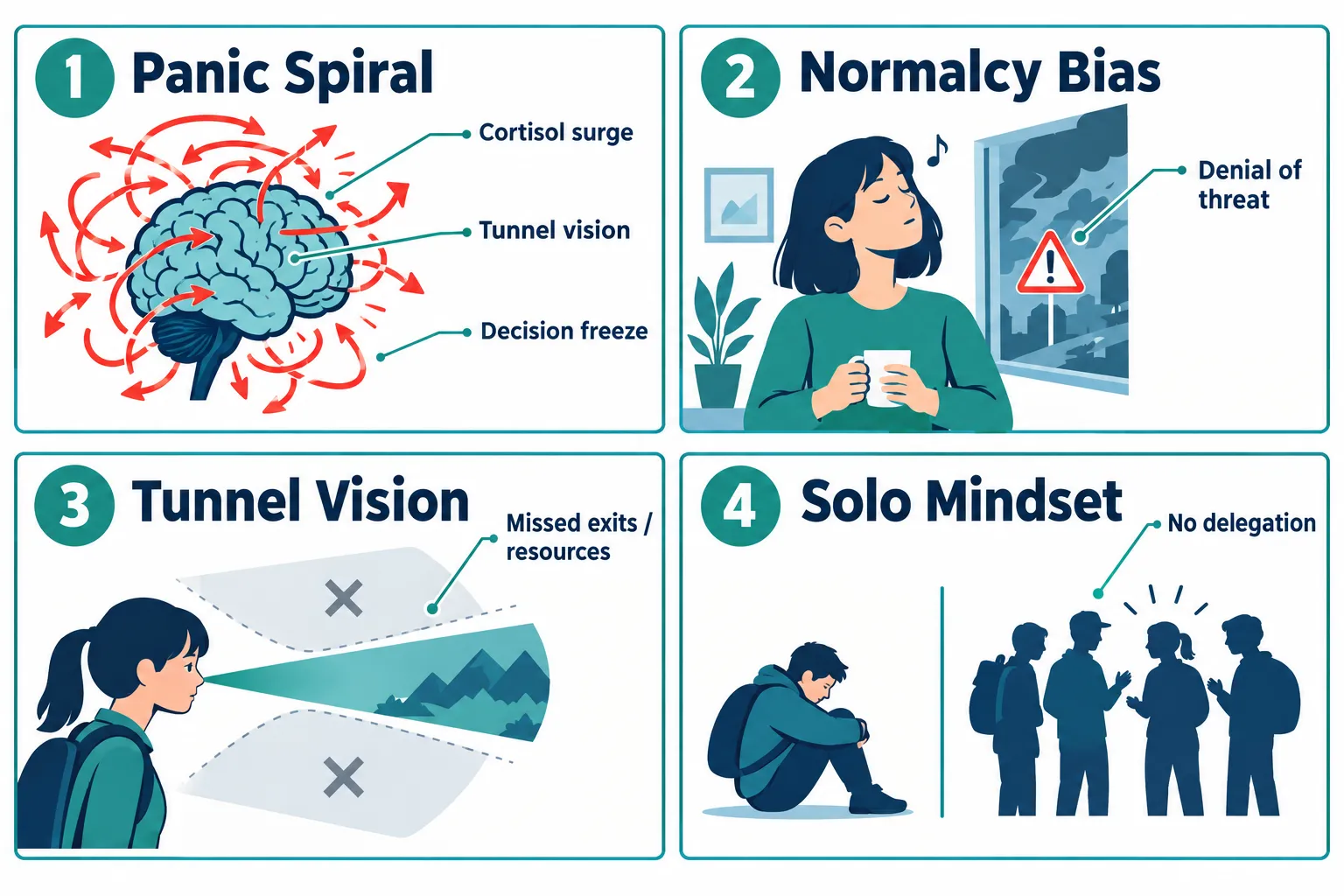
- Normalcy bias: Assuming the situation is less serious than it is, leading to delayed action.
- Panic spiral: Allowing fear to escalate into irrational, frantic behavior that wastes energy and time.
- Tunnel vision: Fixating on one problem while missing the larger picture.
- Analysis paralysis: Overthinking options until no action is taken at all.
- Solo mindset: Refusing to delegate, ask for help, or coordinate with others.
- Catastrophizing: Assuming the worst outcome is inevitable, which shuts down problem-solving.
- Overconfidence: Believing preparation alone guarantees safety without accounting for variables.
Each of these errors has a specific trigger and a specific counter-strategy. Knowing which one you’re prone to is the first step toward correcting it.
How Does Panic Affect Decision Making in Emergencies
Panic degrades decision-making by flooding the brain with stress hormones, primarily cortisol and adrenaline, that redirect cognitive resources away from the prefrontal cortex (rational thought) and toward the amygdala (threat response). The result is faster reaction time for simple physical tasks but dramatically worse performance on complex decisions, sequencing, and problem-solving.
In practical terms, a panicking person will:
- Repeat ineffective actions (trying the same door handle multiple times)
- Abandon established plans in favor of impulsive action
- Lose the ability to recall trained procedures
- Misread environmental cues and make incorrect threat assessments
This is why preppers who have drilled their emergency plans perform better under stress than those who simply own the right gear. The plan has to be practiced until it bypasses the panic response entirely.
Why Do People Freeze Instead of Taking Action Under Stress
Freezing is a biological survival response, the “tonic immobility” reaction, that the nervous system triggers when neither fight nor flight seems viable. It is not cowardice, and it is not a personality weakness. It is an automatic neurological event that can affect anyone who has not specifically trained to override it.
The freeze response is most likely to occur when:
- The threat is sudden and unexpected
- The person has no pre-planned response for that specific scenario
- Sensory overload (noise, smoke, chaos) exceeds the brain’s processing capacity
- The person is alone with no social cues from others to prompt action
The counter to freezing is pre-commitment. When you have a specific, rehearsed action tied to a specific trigger (“if the power goes out, I immediately go to the kit in the hall closet”), the brain has a pre-loaded script to run. That script can fire even when the higher-order thinking is temporarily offline. Reviewing your survival skills checklist regularly and practicing those skills physically, not just reading about them, is what builds that pre-commitment.
How to Avoid Tunnel Vision When You’re in Danger
Tunnel vision under stress is the narrowing of attention to a single focal point, usually the most immediately threatening stimulus, while peripheral awareness collapses. It is one of the most dangerous survival mindset mistakes people make under stress because it causes people to miss exits, overlook available resources, and fail to detect secondary threats.
To counter tunnel vision deliberately:
- Force a scan. Train yourself to physically turn your head and scan left-right before taking any action in an emergency. This is a physical habit, not a mental one, which makes it more reliable under stress.
- Use verbal anchors. Saying out loud “What else do I see?” activates the language centers of the brain and partially re-engages rational processing.
- Pause for three seconds. A deliberate three-second pause before acting is enough to allow some prefrontal cortex function to return.
- Practice situational awareness daily. Urban survival situational awareness is a trainable skill. The more you practice reading environments calmly, the more that habit persists under pressure.
What’s the Difference Between a Healthy Stress Response and Harmful Panic
A healthy stress response sharpens focus, increases physical capability, and accelerates reaction time, all without shutting down rational thought. Harmful panic crosses the threshold where the stress response becomes self-defeating: energy is wasted, decisions deteriorate, and the person becomes less capable, not more.
The key distinction is controllability. A healthy stress response feels intense but manageable. The person can still access their training, recall their plan, and communicate with others. Harmful panic feels uncontrollable, the person reports “going blank,” losing track of time, or acting without any awareness of what they were doing.
Recognizing which state you’re in is a skill. Physiological signals that you’ve crossed into harmful panic include:
- Hyperventilation or inability to take a full breath
- Tunnel vision (as described above)
- Inability to recall simple information you know well
- Compulsive repetition of a single behavior
Controlled breathing, specifically a slow exhale that is longer than the inhale, is the fastest physiological intervention to shift back toward a healthy stress response. This is not a metaphor. Slow exhalation activates the parasympathetic nervous system and measurably reduces cortisol levels within 60 to 90 seconds.
Can You Train Your Brain to Stay Calm Under Pressure
Yes. The brain’s stress response is plastic, meaning it can be shaped by repeated experience. Stress inoculation training, a method used by military and emergency responders, works by deliberately exposing a person to controlled stressors until the nervous system learns that the stressor is survivable and manageable. Over time, the threshold for panic rises significantly.
For preppers and survivalists, practical stress inoculation includes:
- Running drills under time pressure (not just planning them)
- Practicing skills in uncomfortable conditions (cold, dark, fatigued)
- Deliberately putting yourself in low-stakes stressful situations (cold water exposure, timed problem-solving)
- Debriefing after each drill to identify where thinking broke down
The goal is not to eliminate the stress response, that would be counterproductive. The goal is to keep the response within the range where it enhances performance rather than destroying it. Building mental toughness for survival situations is a long-term process, but even a few months of consistent practice produces measurable improvement.
Why Do People Make Poor Choices When Scared or Threatened
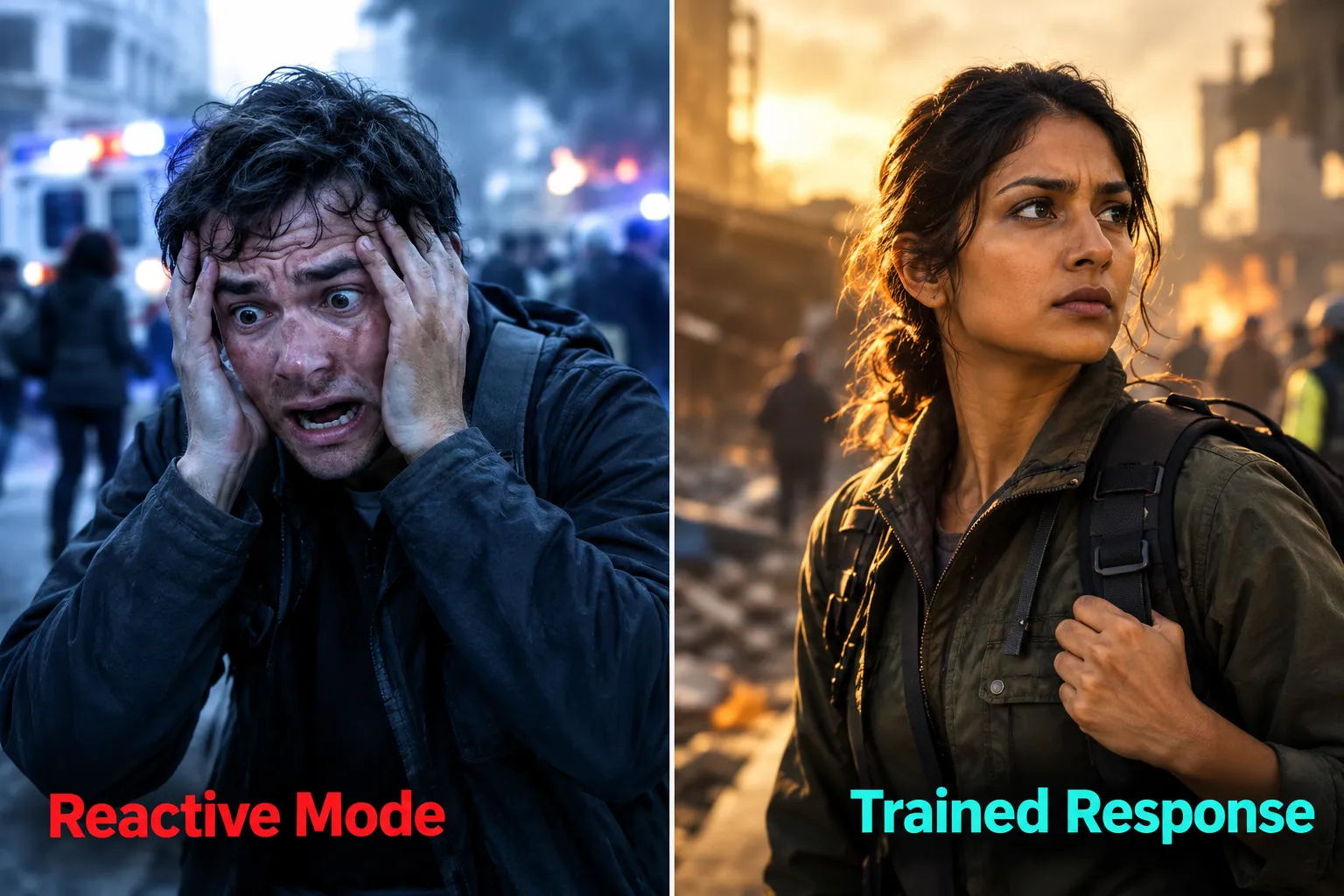
Fear degrades the quality of decision-making through two primary mechanisms: it narrows the range of options the brain considers, and it biases the brain toward immediate relief over long-term outcomes. When threatened, the brain’s priority shifts from “what is the best decision?” to “what stops this feeling right now?”
This is why people in emergencies often:
- Evacuate without critical supplies because grabbing them felt like delay
- Return to a burning building for replaceable objects
- Follow crowds into dangerous situations because social conformity feels safer than independent judgment
- Abandon a working plan because it requires enduring short-term discomfort
The antidote is pre-made decisions. Every choice you make before a crisis is a choice you don’t have to make under fear. A detailed bug-out plan for survival preparedness removes dozens of in-the-moment decisions from the equation. So does a pre-packed kit. The fewer decisions fear has to make, the better.
How Survival Instinct Sometimes Works Against Us
The survival instinct is not always aligned with modern survival scenarios. It evolved for a threat environment characterized by predators, physical combat, and immediate dangers, not house fires, chemical spills, or grid-down scenarios that require sustained, methodical action over hours or days.
Specific ways survival instinct misfires in modern emergencies:
- Returning to familiar locations: The instinct to return home can drive people back into danger zones after evacuation orders.
- Hoarding behavior: Stress triggers resource-hoarding that can lead to poor allocation and conflict within a group.
- Threat fixation: The instinct to watch a threat (fire, rising water) instead of acting on it costs critical time.
- Social conformity under threat: The instinct to follow the group can override individual judgment even when the group is making a fatal error.
Understanding these misfires is not about fighting your instincts, it’s about having a plan that accounts for them. If you know you’ll be tempted to return home, you pre-commit to a rally point with your family before the emergency happens.
What Mental Mistakes Do People Regret After Emergencies
Post-disaster survivor accounts and after-action reports consistently identify the same categories of regret. These are the survival mindset mistakes people make under stress that survivors wish they had corrected before the event.
The most commonly reported regrets include:
- Waiting too long to act. Normalcy bias caused delays that narrowed options significantly.
- Not having a practiced plan. Knowing what to do in theory was not enough when fear hit.
- Underestimating how scared they would be. Most people overestimate their calm under pressure.
- Failing to communicate with family members. Assuming everyone knew the plan when no one had rehearsed it.
- Ignoring early warning signs. Dismissing credible warnings because acting felt inconvenient or embarrassing.
The psychological effects of long-term disaster survival compound these initial errors. Poor decisions made in the first hours of an emergency can create psychological burdens that last for years. That’s a powerful argument for investing in mental preparedness now, not after the fact.
How to Recognize When You’re in Survival Mode Thinking
Survival mode thinking has specific, recognizable signatures. Catching yourself in this state early allows you to apply corrective techniques before the thinking deteriorates further.
Signs you have shifted into survival mode thinking:
- Time feels distorted (either very fast or very slow)
- You are fixated on a single problem and cannot think about anything else
- You feel an urgent need to act but cannot decide what to do
- You are dismissing information that contradicts your current plan
- Physical symptoms: dry mouth, tunnel vision, shallow breathing, trembling hands
None of these are signs of weakness. They are signs that your nervous system is doing its job. The question is whether you have the tools to work with that state rather than be controlled by it.
A simple self-check phrase used by military and emergency responders: “What do I know? What do I need? What can I do right now?” Running through those three questions forces the brain back into structured, sequential thinking even when the stress response is active.
Does Survival Mindset Training Actually Help in Real Situations
Yes, and the evidence from military, law enforcement, and emergency responder training is consistent on this point. People who have undergone scenario-based stress training perform significantly better in real emergencies than those who have only studied preparedness conceptually.
The mechanism is straightforward: trained responses are stored in procedural memory, which is more resilient to stress than declarative (factual) memory. When you practice a skill until it is automatic, it remains accessible even when the prefrontal cortex is partially offline due to acute stress.
For preppers, this means:
- Running actual drills, not just reading about them
- Practicing under realistic conditions (at night, in cold, under time pressure)
- Involving every household member, including children, see 12 essential survival skills for kids for age-appropriate training
- Reviewing and updating plans regularly so they remain current and familiar
Training does not guarantee perfect performance. But it dramatically narrows the gap between how you expect to perform and how you actually perform when it counts.
What Should You Do Instead When Your Fight-or-Flight Kicks In
When fight-or-flight activates, the goal is not to suppress it but to channel it. The physiological arousal that comes with the stress response, increased heart rate, heightened alertness, physical readiness, is genuinely useful in a survival scenario. The problem is direction, not intensity.
Practical steps to redirect fight-or-flight productively:
- Breathe first. One slow, controlled exhale (longer than the inhale) before any action. This is non-negotiable.
- Name the situation. Say out loud or internally: “This is an emergency. I have a plan.” Verbalization re-engages the rational brain.
- Execute the first step only. Do not try to solve the whole problem. Identify the single next action and take it.
- Reassess after each action. Once the first step is complete, pause briefly and scan for new information before taking the next step.
- Communicate. If others are present, say what you are doing. Verbal communication anchors you in rational processing and helps coordinate the group.
This sequence works because it gives the stress response a structured channel. The energy goes somewhere useful instead of cycling into panic.
FAQ
What is the single biggest survival mindset mistake people make?
Normalcy bias, the assumption that the situation is not as serious as it appears, is consistently the most dangerous mental error in emergencies. It causes critical delays in action when time is the most valuable resource.
Can anyone develop a strong survival mindset, or is it something you’re born with?
Anyone can develop a stronger survival mindset through deliberate practice. It is a trained skill, not a fixed personality trait. Consistent scenario-based drills and stress exposure training are the most effective methods.
How long does it take to train out panic responses?
There is no universal timeline, but most stress inoculation programs show measurable improvement within 8 to 12 weeks of regular practice. The key variable is whether training includes realistic stress exposure, not just knowledge acquisition.
Is it normal to freeze during an emergency even if you’re well-prepared?
Yes. Freezing is a biological response that can occur even in trained individuals, especially when the scenario differs significantly from what was rehearsed. The goal of training is to shorten the freeze duration, not guarantee it never happens.
What’s the difference between situational awareness and paranoia?
Situational awareness is calm, continuous observation of your environment with the goal of detecting changes early. Paranoia is a fear-driven, hypervigilant state that misinterprets neutral stimuli as threats. One is a skill; the other is a stress response.
Why do people make worse decisions in groups during emergencies?
Group dynamics under stress can amplify normalcy bias (everyone waits for someone else to act) and social conformity (individuals suppress correct individual judgments to match the group). Designating a clear decision-maker before an emergency prevents this.
Does having more gear reduce mental stress in emergencies?
Having the right gear, properly organized and familiar, reduces cognitive load during an emergency. But gear alone does not replace mental preparation. An unfamiliar kit can actually increase stress if the person has never practiced using it under pressure.
How does sleep deprivation affect survival mindset?
Sleep deprivation significantly worsens every stress-related cognitive error: it amplifies the panic response, narrows decision-making, and reduces the brain’s ability to access trained procedures. Maintaining sleep in a prolonged emergency scenario is a genuine survival priority.
What role does physical fitness play in mental performance under stress?
Physically fit individuals tend to have lower baseline cortisol levels and recover from acute stress responses faster. Regular physical training also builds the psychological tolerance for discomfort that is central to stress inoculation.
Can children be taught survival mindset skills?
Yes. Age-appropriate scenario practice, clear family plans, and calm parental modeling during low-stakes stressful events all contribute to a child’s stress resilience. Starting early produces significantly better outcomes.
Conclusion
The survival mindset mistakes people make under stress are not random failures of character. They are predictable, neurologically grounded errors that happen to unprepared minds in high-stakes moments. The good news is that every one of them is addressable before a crisis arrives.
Start with the basics: build a plan, rehearse it, and practice the physical skills that support it. Then go one level deeper, understand your own stress triggers, identify which mental errors you’re most prone to, and build specific counter-habits for each one. That’s the difference between someone who survives and someone who simply owns survival gear.
Actionable next steps:
- Review and rehearse your emergency plan with every household member this month
- Run at least one timed drill under realistic conditions (at night, without your phone)
- Study the psychological effects of long-term disaster survival to understand what extended stress does to decision-making
- Audit your bug-out bag for common mistakes that could add cognitive load in an emergency
- Build your mental toughness for survival situations through deliberate, progressive stress exposure
Recommended Resources and Tools
For preppers serious about mental preparedness, a few resources stand out. The Unthinkable by Amanda Ripley is a well-researched examination of how ordinary people behave in disasters and why, grounded in real survivor accounts and behavioral science. For scenario-based training, look into CERT (Community Emergency Response Team) programs offered through local FEMA offices, which provide hands-on stress exposure in realistic settings. For daily practice, a simple journaling habit of running through “What would I do if…” scenarios during calm moments builds the mental rehearsal pathways that pay off when things go wrong. These are not expensive investments. They are the kind of preparation that no kit can replace.