
Hey there! Some links on this page may be affiliate links which means that, if you choose to make a purchase, I may earn a commission at no extra cost to you. I greatly appreciate your support. Read the full disclosure here.
The average American household keeps fewer than three days of food on hand. When supply chains fail, grocery shelves empty within 24 to 72 hours, a pattern confirmed repeatedly during regional disasters and the 2020 pandemic disruptions. For anyone serious about long-term preparedness, foraging and gardening for emergency food supply isn’t a hobby. It’s a core survival skill that bridges the gap between stored provisions and true food independence.
This guide covers everything from identifying safe wild plants to building a productive emergency garden on a tight budget, so you can feed your family when the system fails.
Find this useful? Add us as a preferred source on Google and more of what we publish will show up in your results.
Key Takeaways
- Foraging provides immediate, free calories from wild plants but requires solid identification skills and carries misidentification risks. Gardening is slower to produce but more reliable and calorie-dense.
- The safest beginner forage plants include dandelion, chickweed, purslane, and wood sorrel. Avoid all white-flowered plants, wild mushrooms (unless formally trained), and any plant with milky sap until you have expert-level knowledge.
- A family of four needs roughly 1/4 to 1/2 acre of intensively planted garden to produce a significant portion of annual calories, though container and raised-bed systems can supplement meaningfully in smaller spaces.
- The best crops for long-term food storage include potatoes, dried beans, winter squash, sweet potatoes, and dried corn, all high in calories and storable without refrigeration.
- Foraging is legal in most areas but is subject to local ordinances, land ownership rules, and national park regulations. Always verify before harvesting.
- Preserving foraged and garden food without refrigeration is achievable through drying, lacto-fermentation, root cellaring, and pressure canning.
- Combining both strategies, a productive garden plus working knowledge of local wild edibles, creates the most resilient emergency food system possible.
What Is the Difference Between Foraging and Gardening for Emergency Food
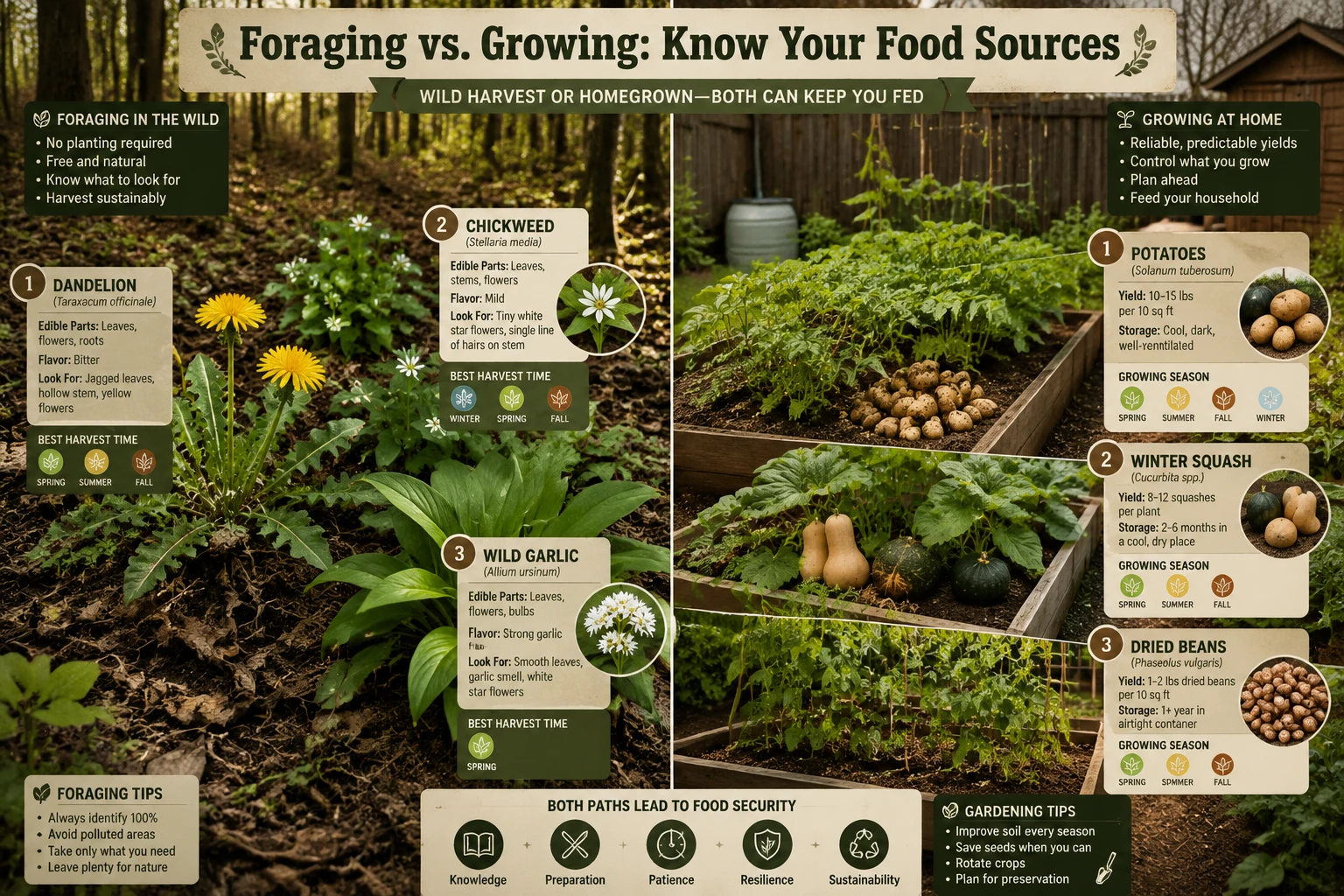
Foraging means harvesting wild plants, fungi, and other edibles that grow without human cultivation. Gardening means deliberately planting, tending, and harvesting food crops. For emergency food supply purposes, both strategies serve different roles and work best together.
Foraging advantages:
- Zero startup cost
- Available immediately in a crisis
- Requires no land ownership
- Provides nutritional variety, especially vitamins and minerals
Gardening advantages:
- Predictable yields and calorie density
- Controllable variety selection
- Storable crops (beans, grains, squash)
- Scalable with effort and space
The critical distinction: foraging is a supplement and a bridge. Gardening is the foundation. Wild plants are rarely calorie-dense enough to sustain a family long-term on their own, but they provide critical micronutrients and variety when stored food runs low. A well-rounded emergency food plan uses both. For a broader look at how food fits into your overall preparedness system, the 3 Month Emergency Food Supply guide is a strong companion resource.
Best Plants to Grow for Long-Term Food Storage
The best emergency garden crops are calorie-dense, store well without refrigeration, and produce reliably in most climates. Prioritize these over salad greens or tomatoes when building a survival food system.
| Crop | Calories per lb | Storage Life (dry/cool) | Notes |
|---|---|---|---|
| Dried beans | ~650 | 10+ years sealed | Complete protein with grains |
| Potatoes | ~350 | 6-12 months in root cellar | High yield per sq ft |
| Winter squash | ~200 | 3-6 months | Stores at room temperature |
| Sweet potatoes | ~390 | 4-6 months | Heat-tolerant, productive |
| Dried corn | ~1,600 | 10+ years sealed | Grind for flour |
| Sunflower seeds | ~2,600 | 1-2 years | High fat, high calorie |
| Garlic | ~600 | 6-12 months | Medicinal value too |
Crops to deprioritize for pure survival gardening: lettuce, cucumbers, and most summer squash. They produce water and nutrients but few calories, and they don’t store.
Choose varieties labeled “open-pollinated” or “heirloom” so you can save seeds year after year without buying replacements. This is non-negotiable for long-term food independence. For a deeper look at what to stock alongside your garden harvests, see the 50 Best Foods for Long-Term Storage guide.
How to Identify Edible Wild Plants Safely
Safe plant identification requires learning a small number of reliable species thoroughly before expanding your foraging range. The most dangerous mistake beginners make is learning plants from a single source, one photo in a book or one online image, and assuming that’s enough.
The “rule of three” for safe identification:
- Match the plant to at least three distinct identifying features (leaf shape, stem structure, smell, habitat, flower color, root type).
- Confirm with at least two independent sources (a regional field guide plus a local expert or verified foraging course).
- Start with species that have no dangerous lookalikes in your region.
Beginner-safe plants with low misidentification risk:
- Dandelion (Taraxacum officinale), entire plant is edible, distinctive toothed leaves, hollow stem with milky sap (safe exception to the milky-sap rule)
- Chickweed (Stellaria media), tiny white flowers, grows in cool weather, mild flavor
- Purslane (Portulaca oleracea), succulent leaves, reddish stems, found in disturbed soil
- Wood sorrel (Oxalis spp.), clover-like leaves with heart-shaped leaflets, sour taste
- Lamb’s quarters (Chenopodium album), mealy white coating on young leaves, spinach substitute
Never eat a plant you cannot identify with 100% certainty. When in doubt, leave it out. This isn’t overcaution, it’s the rule that keeps foragers alive. Wild plants that cause poisoning are rarely labeled by nature.
Can You Forage Year-Round or Just Certain Seasons
Foraging is possible year-round in most climates, but the variety and abundance shift dramatically by season. In northern climates, winter foraging is limited but not impossible. In the South and Pacific Coast regions, winter is often productive.
Seasonal foraging overview:
- Spring: The most abundant season. Dandelion, chickweed, ramps, nettles, and many other greens emerge before trees leaf out. This is the best time to build foraging skills.
- Summer: Berries, fruits, and seeds dominate. Elderberries, blackberries, mulberries, and wild plums ripen in sequence. Greens become bitter in heat.
- Fall: Nuts (acorns, hickory, walnuts), late berries, and root vegetables. Acorns require leaching but are extremely calorie-dense and abundant.
- Winter: Evergreen needles (vitamin C), inner bark of certain trees, overwintering roots (cattail, Jerusalem artichoke), and dried seed heads.
Key point for preppers: Don’t wait for a crisis to learn seasonal patterns. Walk your local area monthly for a full year and document what grows where. That knowledge becomes a living map of your emergency food landscape.
What Supplies Do You Need to Start an Emergency Food Garden
Starting an emergency food garden requires minimal investment if you prioritize function over aesthetics. The core supplies are seeds, soil amendment, basic tools, and water access.
Minimum viable garden supply list:
- Open-pollinated/heirloom seed collection (focus on beans, squash, root vegetables, greens)
- Hand trowel, garden fork, and hoe
- Compost or aged manure to improve soil
- Watering can or basic drip irrigation
- Raised bed lumber or in-ground plot space
- Seed storage containers (airtight, cool, dark)
Optional but high-value additions:
- Row cover fabric (extends growing season by 4-6 weeks)
- Cold frames or low tunnels
- Rain barrel for water independence (see the rainwater collection survival setup guide for setup details)
- Pressure canner for long-term preservation
The cheapest way to set up an emergency food supply garden is to start with seeds, not transplants, and build soil with free compost from kitchen scraps and yard waste. A basic heirloom seed collection covering 10-12 survival crops costs between $30 and $60 and can be saved and replanted indefinitely.
How Much Space Do You Need to Grow Enough Food for a Family
A family of four needs roughly 1/4 to 1/2 acre of intensively managed garden to produce a meaningful portion of annual calories. That said, even 100 square feet of raised beds can provide significant supplemental nutrition and reduce dependence on stored food.
Space benchmarks (intensive planting methods):
- 100 sq ft: Enough greens and herbs for daily supplemental nutrition
- 400 sq ft: Meaningful vegetable production, some storage crops
- 1,000 sq ft: Substantial food production for 1-2 people
- 4,000-8,000 sq ft (1/10 to 1/5 acre): Significant calorie contribution for a family of four
- 1/4 to 1/2 acre: Primary food production for a family of four with proper crop selection
For apartment or urban preppers: Container gardening with 5-gallon buckets can produce cherry tomatoes, herbs, green onions, and even compact bean varieties. It won’t replace a full garden, but it builds skills and provides fresh food during disruptions. The emergency food storage for small apartment guide covers urban food strategies in detail.
The math matters here: one pound of dried beans requires roughly 10-15 square feet of growing space. To produce 100 pounds of beans (a meaningful annual supply for one person), you need 1,000-1,500 square feet dedicated to beans alone.
Common Mistakes People Make When Foraging Wild Plants
The most dangerous foraging mistakes involve overconfidence, poor timing, and inadequate plant identification. These errors cause real harm, poison control centers in the U.S. handle thousands of plant ingestion cases annually.
Critical mistakes to avoid:
- Relying on a single identifying feature. Many toxic plants share leaf shapes, flower colors, or growth habits with edible species. Always confirm multiple features.
- Eating plants near roadsides, industrial sites, or treated lawns. Wild plants absorb heavy metals and pesticides from contaminated soil. Stick to clean, unpolluted areas.
- Harvesting without knowing the full plant. Some plants are edible at one growth stage and toxic at another (elderberry flowers and ripe berries are safe; raw unripe berries and leaves are not).
- Foraging mushrooms without formal training. This is covered in detail below.
- Over-harvesting a single patch. Sustainable foraging means taking no more than 1/3 of any plant population so it regenerates.
- Assuming “natural” means safe. Many of the most toxic substances on earth are natural. Hemlock, death camas, and water hemlock are all wild plants that have killed experienced foragers.
Which Is Faster: Foraging or Growing Your Own Vegetables
Foraging is faster, wild plants are available immediately if you know where to look. Growing vegetables takes weeks to months from seed to harvest. But speed isn’t the only variable that matters in a survival scenario.
Comparison:
- Foraging produces food within hours of a crisis, assuming you already know your local edible plants.
- Fast-maturing garden crops (radishes in 25 days, lettuce in 30-45 days, green beans in 50-60 days) can supplement within weeks of planting.
- Storage crops like potatoes and winter squash take 90-120 days but produce bulk calories.
The practical answer for preppers: Forage first to bridge the gap. Plant fast-maturing crops immediately. Rely on stored provisions while the garden matures. This layered approach, foraging, fast crops, slow storage crops, and a long-term food storage system, is what separates resilient preppers from those who run out of options.
How to Preserve Foraged and Garden Food Without Refrigeration
Preserving food without refrigeration is achievable through several proven methods, each suited to different food types. The goal is to remove moisture, reduce oxygen, or create an acidic environment that prevents bacterial and mold growth.
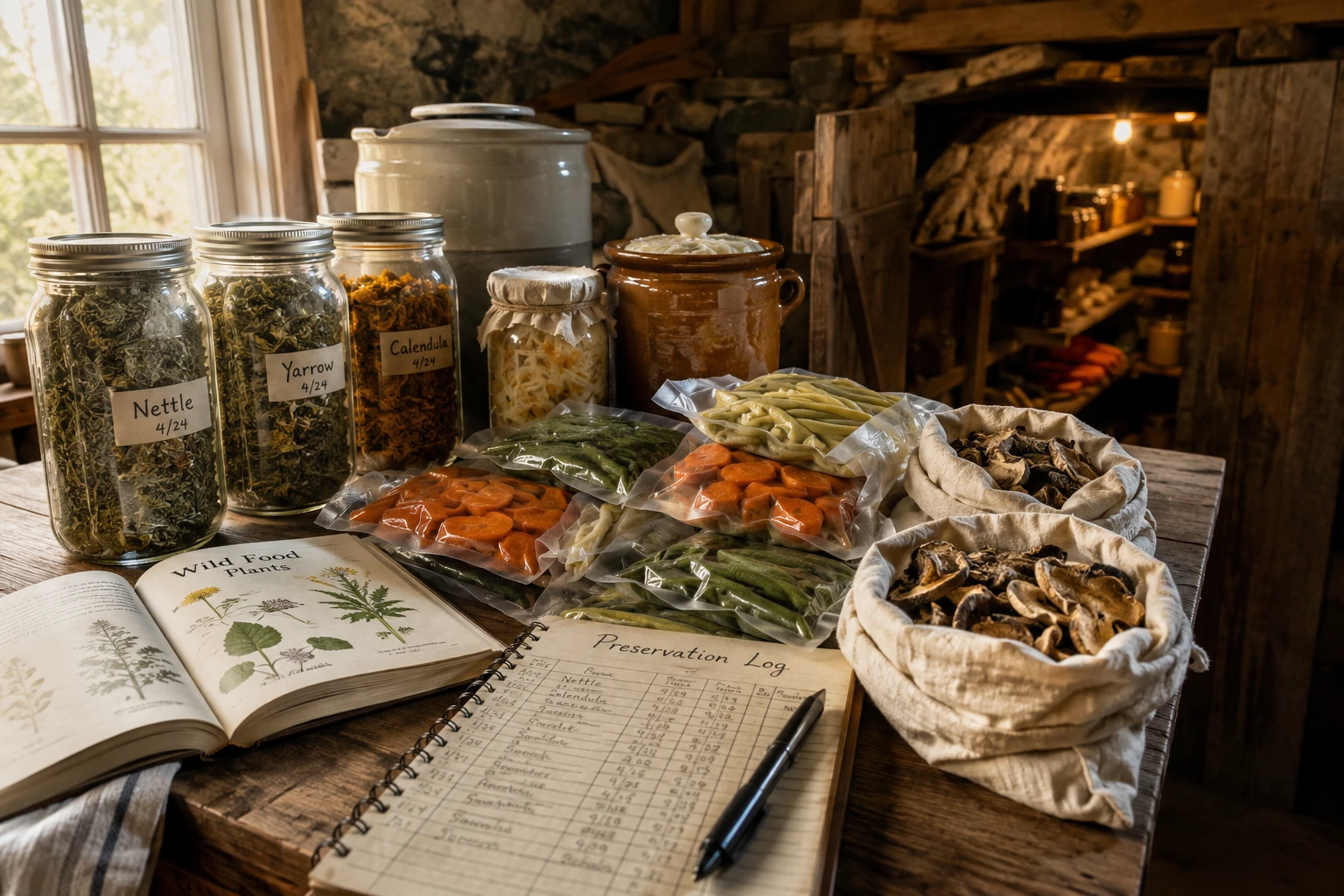
Primary preservation methods:
Dehydrating/Drying
Works for: herbs, greens, mushrooms, fruits, beans, grains
Method: Air dry in warm, well-ventilated space or use a food dehydrator. Store in airtight containers away from light and heat. Most dried foods last 1-5 years.
Lacto-Fermentation
Works for: vegetables (sauerkraut, kimchi, pickles), wild greens
Method: Submerge vegetables in a salt brine (2% salt by weight). Ferments at room temperature in 3-7 days. Keeps for months in a cool location.
Root Cellaring
Works for: potatoes, carrots, beets, turnips, winter squash, apples
Method: Store in a cool (32-40°F), humid, dark space. A basement corner or buried insulated box works well.
Pressure Canning
Works for: low-acid foods including beans, meat, vegetables
Method: Requires a pressure canner. Shelf life of 2-5 years for most foods. This is the most reliable method for calorie-dense storage crops.
Salt Curing
Works for: meat, fish, some vegetables
Method: Pack in dry salt or brine. Historically reliable but requires significant salt reserves.
For more on cooking and using preserved food in an emergency, the emergency food rationing and cooking guide is an essential read.
Is Foraging Legal in My Area
Foraging legality depends on land ownership and local regulations. On private land you don’t own, foraging without permission is trespassing. On public land, rules vary significantly by jurisdiction.
General legal framework:
- Private land: Always requires landowner permission.
- National Parks (U.S.): Foraging is generally prohibited or restricted to small personal-use quantities. Rules vary by park.
- National Forests and BLM land: Personal-use foraging is generally allowed in small quantities. Commercial harvesting requires permits.
- State parks: Rules vary by state. Many allow limited personal foraging.
- Urban parks and greenways: Most prohibit plant removal. Check local ordinances.
- Your own property: No restrictions.
Practical advice: Contact your local land management agency before foraging on public land. Many areas have specific rules about quantities, species, and seasons. In a genuine survival emergency, legal considerations may shift in priority, but building your foraging knowledge on legally accessible land beforehand is the smart approach.
Can You Forage in Cities or Only Rural Areas
Urban foraging is genuinely viable. Cities contain an abundance of edible plants, many of which are considered weeds, growing in parks, vacant lots, greenways, and along sidewalks.
Common urban edibles:
- Dandelion (almost everywhere)
- Mulberry trees (common street and park trees in many U.S. cities)
- Purslane (sidewalk cracks, garden beds)
- Lamb’s quarters (vacant lots, disturbed soil)
- Chickweed (shaded areas, spring and fall)
- Plantain (Plantago spp.) (lawns, paths)
Urban foraging cautions:
- Avoid plants near heavy traffic (lead and exhaust contamination)
- Avoid areas with known pesticide or herbicide use
- Be aware of dog waste contamination in low-lying plants
- Check local ordinances before harvesting in parks
Urban foraging works best as a supplemental skill. The yields per area are lower than rural environments, but the knowledge and practice gained in an urban setting transfers directly to higher-yield rural scenarios. For preppers in cities, the urban bug out vs. rural bug out comparison covers how food access factors into evacuation decisions.
What Plants Should Beginners Avoid When Foraging
Beginners should avoid any plant that belongs to the carrot family (Apiaceae), any plant with white umbrella-shaped flower clusters, all wild mushrooms, and any plant with milky sap (with the dandelion exception noted above).
High-risk plant categories for beginners:
- Apiaceae family (carrot/parsley family): Contains both edible plants (wild carrot, angelica) and some of the most toxic plants in North America (poison hemlock, water hemlock). The family is notoriously difficult to distinguish without expert training.
- White-berried plants: Almost universally toxic. Avoid all of them.
- Plants with milky sap (other than dandelion): Euphorbias and many other toxic species produce milky latex.
- Death camas (Anticlea elegans): Resembles wild onion but lacks the onion smell. If it doesn’t smell like onion, don’t eat it.
- Nightshade family: Some edible (tomato, potato), many toxic. Wild nightshades should be avoided by beginners.
The rule is simple: master five to ten species thoroughly before expanding. Depth beats breadth in foraging safety.
How Do You Know If Foraged Mushrooms Are Safe to Eat
You cannot reliably determine mushroom safety without formal training and hands-on expert verification. This is not an area where field guides alone are sufficient for beginners.
Why mushrooms are uniquely dangerous:
- Some of the most deadly mushrooms (Amanita phalloides, the “death cap”) closely resemble edible species.
- Symptoms of the most serious mushroom poisonings are delayed 6-24 hours, by which time liver damage has already begun.
- No simple test (color change, silver spoon reaction, cooking) reliably identifies toxic mushrooms.
Safe approach to mushroom foraging:
- Take an in-person course with a certified mycologist or experienced forager.
- Start with “foolproof four” species that have no dangerous lookalikes: giant puffballs, chicken of the woods, hen of the woods (maitake), and morels (with proper training on false morel distinction).
- Never eat a mushroom you cannot identify from multiple physical characteristics confirmed by an expert.
- When in doubt, leave it out. No mushroom is worth the risk.
What’s the Cheapest Way to Set Up an Emergency Food Supply Garden
The cheapest emergency food garden starts with free or low-cost inputs: saved seeds, homemade compost, reclaimed containers, and in-ground planting in existing soil. A functional survival garden can be started for under $50 if you’re resourceful.
Budget setup strategy:
- Seeds: Buy a basic heirloom survival seed pack ($30-60) covering beans, squash, root vegetables, and greens. Save seeds each year to eliminate future seed costs.
- Soil improvement: Start a compost pile immediately using kitchen scraps and yard waste. Free and highly effective within 3-6 months.
- Containers: 5-gallon buckets (free from bakeries and restaurants), old trash cans, or wooden pallets repurposed as raised beds.
- Tools: A basic hand trowel and hoe are sufficient to start. Check garage sales and estate sales for quality tools at low cost.
- Water: Connect a rain barrel to a downspout (basic setup costs $30-80) to reduce water costs and maintain water independence.
Avoid: Expensive raised bed kits, branded soil mixes, and elaborate irrigation systems when starting out. These add value later but aren’t necessary for a functional emergency food garden in year one.
For a complete picture of avoiding costly mistakes in food storage and production, the 15 food storage mistakes to avoid guide is worth reading before you spend a dollar.
FAQ: Foraging and Gardening for Emergency Food Supply
Q: How long does it take to become competent at foraging?
Most people can safely identify 10-15 reliable edible plants in their region within one full growing season of active study and practice. Competency with mushrooms takes significantly longer, typically 2-3 years of guided learning.
Q: Can I forage enough food to survive without a garden?
In most regions, foraging alone cannot provide sufficient calories for long-term survival. Wild plants are nutritionally valuable but calorie-light. A garden is necessary for calorie-dense staples like beans, grains, and root vegetables.
Q: What is the single most important crop for an emergency garden?
Dried beans. They’re calorie-dense, protein-rich, store for a decade or more when properly sealed, and produce well in most climates with minimal inputs.
Q: Is it safe to eat plants I find using a phone app?
Plant identification apps are useful as a starting point but should never be the sole basis for eating a wild plant. Apps misidentify plants frequently, especially in poor lighting or with partial plant images. Always cross-reference with a regional field guide and, when possible, an expert.
Q: How do I store seeds long-term for my emergency garden?
Store seeds in airtight containers (glass jars with tight lids work well) in a cool, dark, dry location. Adding a silica gel packet reduces moisture. Most vegetable seeds stored this way remain viable for 3-5 years; some (beans, squash) last longer.
Q: What’s the best way to learn foraging if I have no experience?
Take a local foraging walk led by an experienced guide or join a regional mycological or foraging society. Hands-on, in-person learning with someone who knows your specific region is far more effective and safer than self-teaching from books alone.
Q: Can children participate in foraging and gardening for emergency food supply preparation?
Yes, and involving children builds life-long skills. Teach plant identification as a game, starting with the most distinctive and safe species. Gardening tasks are age-appropriate from early childhood. The kids emergency preparedness guide has more on building preparedness skills as a family.
Q: Do I need a lot of water to maintain an emergency garden?
Water access is critical. Most vegetable gardens need 1 inch of water per week. A rain barrel system, drip irrigation, and drought-tolerant crop selection (beans, sweet potatoes, sunflowers) can dramatically reduce water requirements. See the emergency water storage and purification guide for water planning strategies.
Q: What’s the difference between open-pollinated and hybrid seeds for emergency use?
Open-pollinated seeds produce plants whose seeds can be saved and replanted with consistent results. Hybrid seeds often don’t breed true from saved seed. For emergency preparedness, open-pollinated and heirloom varieties are essential because they allow seed saving, eliminating dependence on seed suppliers year after year.
Q: Should I prioritize foraging or gardening first?
Start both simultaneously. Plant a small garden immediately to begin building soil and growing skills. Start learning two or three local edible plants right now. Neither skill develops overnight, and the time to learn is before you need to rely on either.
Conclusion
Foraging and gardening for emergency food supply are not backup plans, they are core competencies for anyone serious about long-term self-reliance. Stored food runs out. Supply chains fail. But a productive garden and a working knowledge of local wild edibles create a food system that regenerates itself, costs almost nothing to maintain, and cannot be disrupted by logistics failures or empty store shelves.
Actionable next steps to take this week:
- Identify one edible wild plant growing in your immediate area and learn its three key identifying features.
- Order an open-pollinated seed collection focused on dried beans, winter squash, and root vegetables.
- Choose a garden location, even a single raised bed or a row of containers, and begin improving the soil with compost.
- Set up a basic rain barrel to establish water independence for your garden.
- Pick up a regional field guide specific to your area and commit to one foraging walk per month.
The combination of foraging knowledge and a productive emergency garden is one of the most powerful investments a prepper can make. It costs little, builds over time, and pays dividends in every scenario from short-term disruption to long-term grid failure.
Products, Tools, and Resources
Field Guides Worth Owning
Samuel Thayer’s “Nature’s Garden” and “Forager’s Harvest” are widely regarded as the most accurate and detailed North American foraging references available. Peterson Field Guides offer region-specific editions for most of the U.S. For mushrooms, David Arora’s “Mushrooms Demystified” is the standard reference, though in-person training remains essential.
Seed Collections
Survival seed vaults from companies like Seed Savers Exchange, Baker Creek Heirloom Seeds, and Southern Exposure Seed Exchange offer curated open-pollinated collections. Look for collections that include dried beans, winter squash, root vegetables, and leafy greens. Avoid collections heavy in lettuce and herbs if calorie production is the primary goal.
Preservation Equipment
A quality pressure canner (All American or Presto brands have long track records) is the single most valuable preservation tool for a serious emergency food garden. A food dehydrator handles herbs, greens, and fruits efficiently. Wide-mouth mason jars in quart and half-gallon sizes are essential for both canning and dry storage.
Courses and Community
Local cooperative extension offices (run through land-grant universities in every U.S. state) offer free or low-cost gardening and food preservation classes. Regional foraging societies and mycological clubs provide hands-on identification training that no book or app can replicate.