
Hey there! Some links on this page may be affiliate links which means that, if you choose to make a purchase, I may earn a commission at no extra cost to you. I greatly appreciate your support. Read the full disclosure here.
The average American household has less than a week of food on hand at any given time. That single fact is the most compelling argument for building a solid food storage for 30 days emergency supply, because most disasters don’t resolve in 72 hours, and supply chains are far more fragile than most people realize.
Whether you’re preparing for a hurricane, a prolonged power outage, job loss, or a broader regional crisis, a 30-day food supply is the minimum baseline that serious preppers and emergency management professionals recommend. This guide covers exactly what to buy, how much you need, how to store it properly, and how to avoid the mistakes that waste money and leave you underprepared.
Key Takeaways
- A 30-day emergency food supply requires roughly 2,000 calories per person per day, stored in shelf-stable, rotation-friendly formats.
- The cheapest and most practical foundation is dry staples: white rice, dried beans, oats, and pasta.
- Airtight containers, cool dark storage, and oxygen absorbers are the three pillars of effective long-term food storage.
- Freeze-dried food is convenient and long-lasting but not necessary to build a functional 30-day supply.
- Rotation, eating what you store and replacing it, is the single most important habit to maintain your supply’s quality.
- Water storage is inseparable from food storage. Plan for at least one gallon per person per day.
- Avoid storing foods that require excessive water, have short shelf lives, or that your household won’t actually eat.
Find this useful? Add us as a preferred source on Google and more of what we publish will show up in your results.
What Foods Should You Buy for a 30-Day Emergency Supply
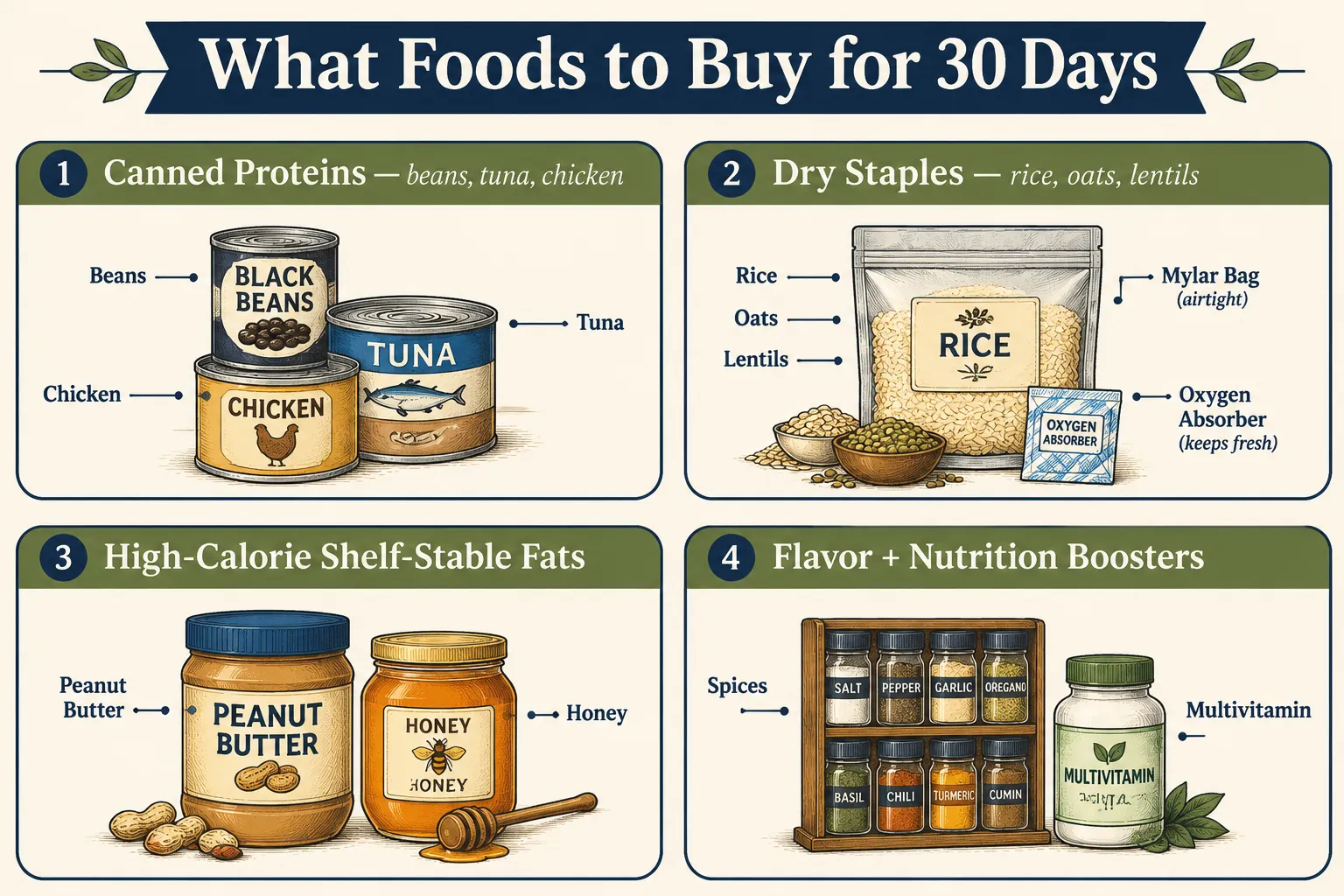
The best foods for a 30-day emergency supply are shelf-stable, calorie-dense, and versatile enough to form complete meals. Think white rice, dried beans, canned proteins, oats, pasta, peanut butter, and canned vegetables. These foods are widely available, affordable, and store well without refrigeration.
Here’s a practical breakdown by category:
Dry Staples (the foundation)
- White rice, stores 25+ years sealed, cheap per calorie
- Dried beans and lentils, protein, fiber, and long shelf life
- Rolled oats, breakfast and baking versatility
- Pasta, fast to cook, calorie-dense
Canned Goods
- Canned tuna, chicken, and salmon
- Canned beans (backup to dry)
- Canned tomatoes, corn, and mixed vegetables
- Canned soups and stews for ready-made meals
High-Calorie Shelf-Stable Items
- Peanut butter and other nut butters
- Honey (indefinite shelf life when sealed)
- Cooking oil (olive or coconut)
- Crackers and hardtack
Flavor and Nutrition Boosters
- Salt, pepper, and basic spices
- Bouillon cubes
- Multivitamins (to fill nutritional gaps)
- Instant coffee, tea, or comfort drinks
For a deeper look at the best individual options, see the 50 best foods for long-term storage, a well-organized reference that covers shelf life, calorie density, and storage requirements for each item.
How Much Food Do You Need for 30 Days Per Person
A single adult needs approximately 2,000 calories per day to maintain basic function during a low-activity emergency. That translates to roughly 60,000 calories per person for a full 30-day supply. For physically active adults or those doing manual labor during a crisis, that number climbs to 2,500 or more.
Here’s a simple per-person 30-day quantity guide for core staples:
| Food Item | Amount Per Person (30 Days) | Approx. Calories |
|---|---|---|
| White rice | 20 lbs | 32,000 |
| Dried beans/lentils | 10 lbs | 16,000 |
| Oats | 5 lbs | 8,500 |
| Pasta | 5 lbs | 8,000 |
| Canned proteins | 12-15 cans | 3,000-4,000 |
| Peanut butter | 3-4 jars | 6,000-8,000 |
| Canned vegetables | 15-20 cans | 2,000-3,000 |
Adjust quantities for children (roughly 60-70% of adult needs), elderly individuals, and anyone with specific dietary requirements. If you have pets, don’t forget to account for their food separately. The ultimate pet’s emergency preparedness checklist covers this in detail.
Best Containers for Storing Emergency Food Long Term
The right containers are what separate a functional food storage for 30 days emergency supply from a pile of groceries that goes stale or gets infested. For long-term storage, food-grade containers with airtight seals are non-negotiable.
Best container options:
- Mylar bags with oxygen absorbers, the gold standard for dry goods like rice, beans, and oats. A 5-gallon mylar bag with a 2,000cc oxygen absorber can extend white rice shelf life to 25+ years.
- Food-grade 5-gallon buckets with gamma-seal lids, durable, stackable, and rodent-resistant. Use them as the outer shell for mylar bags.
- Glass mason jars, excellent for smaller quantities of spices, dried herbs, and seeds. Not ideal for bulk storage due to weight and fragility.
- Original sealed cans, commercial canned goods are already in their best packaging. Don’t transfer them.
- BPA-free plastic containers, acceptable for short-term storage (1-3 years) but not ideal for decade-long preservation.
Avoid cardboard boxes, standard zip-lock bags, and any container that isn’t airtight. Moisture, oxygen, light, and pests are the four enemies of stored food, and your containers are the first line of defense.
How to Store Food for 30 Days Without a Freezer
Almost all the best emergency foods store perfectly well at room temperature, making freezer-free storage completely practical. The key variables are temperature, light exposure, humidity, and container integrity.
Core storage rules:
- Keep temperatures between 50°F and 70°F. Every 10°F increase in storage temperature roughly halves shelf life.
- Store away from direct light. UV exposure degrades both nutrients and packaging over time.
- Maintain low humidity. Moisture is the primary driver of mold and spoilage in dry goods.
- Keep food off the floor. Concrete floors can transfer moisture and temperature fluctuations.
Ideal locations include interior closets, under-bed storage, a dedicated pantry shelf, or a basement. For those with access to a root cellar, the naturally cool and stable environment is outstanding for long-term storage. See the guide on how to build a root cellar for long-term food storage if that’s an option for your property.
What’s the Cheapest Way to Build a 30-Day Food Supply
Building a food storage for 30 days emergency supply doesn’t require a large upfront investment. The most cost-effective approach is to start with bulk dry staples from warehouse stores or restaurant supply outlets, then add canned goods gradually.
Budget-friendly strategy:
- Buy white rice and dried beans in 25-50 lb bags from Costco, Sam’s Club, or restaurant supply stores. These provide the most calories per dollar of any shelf-stable food.
- Add canned goods during sales. Most grocery stores cycle sales on canned goods regularly.
- Purchase mylar bags and oxygen absorbers in bulk online, the per-unit cost drops significantly.
- Build incrementally. Adding $20-30 per week to your food storage budget will get most households to a 30-day supply within 2-3 months.
For those working with a very tight budget, the guide on building a 3-month emergency food supply for $100 shows exactly how to stretch every dollar without sacrificing nutritional value.
How to Rotate Emergency Food So It Doesn’t Go Bad
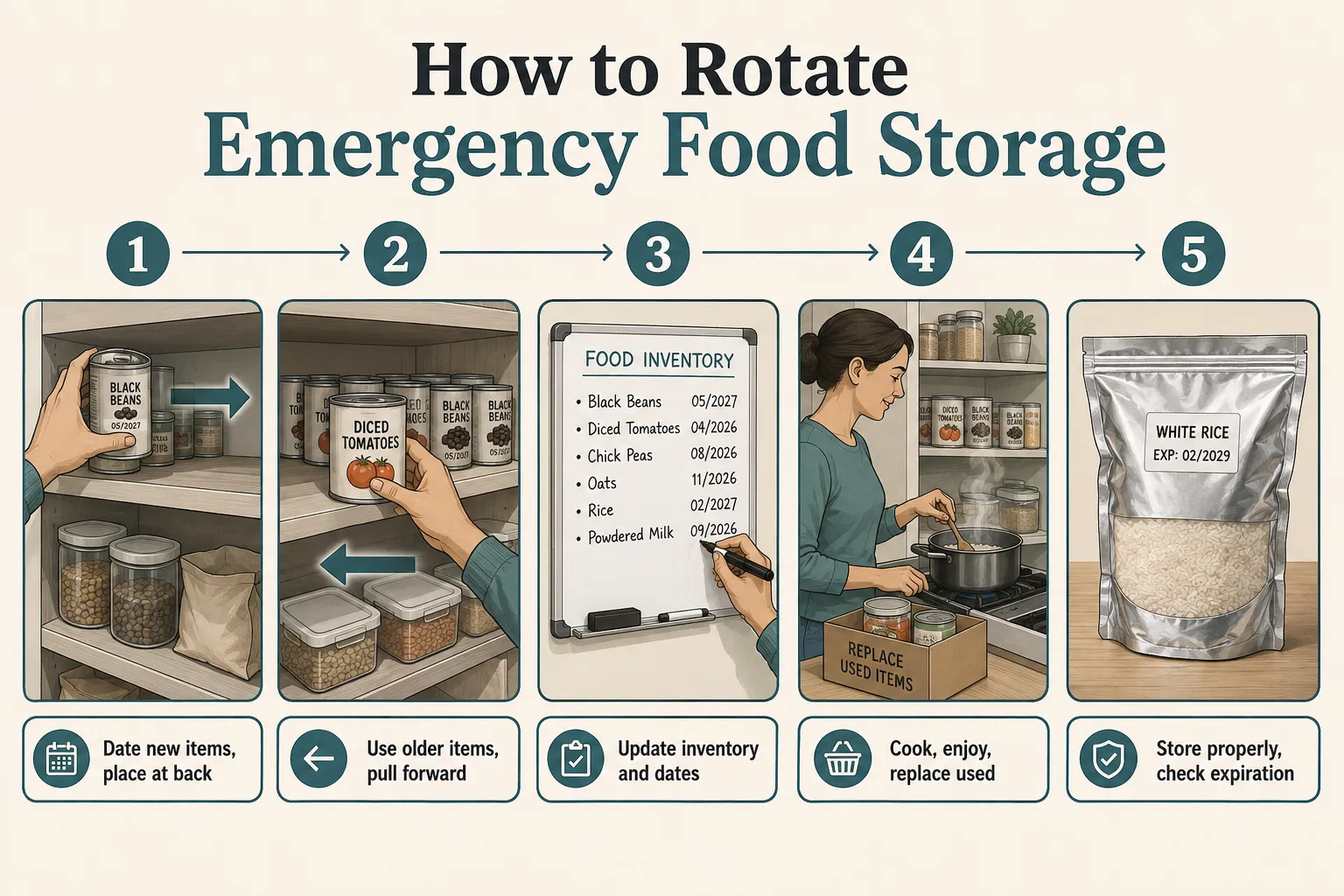
Rotation is the practice of consuming your oldest stored food first and replacing it with fresh stock. It’s the single most important maintenance habit for any emergency food supply, and most people either skip it entirely or do it inconsistently.
The FIFO method (First In, First Out):
- Label every item with the purchase date using a permanent marker.
- Store new items at the back of the shelf, older items at the front.
- Cook from the front of your storage regularly; treat your emergency pantry as a living pantry, not a museum.
- Replace what you use within the same week or month.
- Conduct a full inventory check every 6 months. Note anything approaching its best-by date and prioritize it in meals.
A written or digital inventory log makes this far easier. Even a simple spreadsheet with item name, quantity, and purchase date is enough. For practical meal ideas that use stored food, the 30 easy prepper pantry recipes guide makes rotation feel less like a chore and more like everyday cooking.
Can You Eat Expired Canned Goods from Emergency Storage
In most cases, yes, commercially canned goods are safe to eat well past their printed date, provided the can is undamaged. The “best by” date on canned food refers to peak quality, not safety. The USDA notes that properly stored canned goods can remain safe indefinitely, though flavor and nutritional content may degrade over time.
When to discard canned goods:
- The can is bulging, rusted, or severely dented (especially on the seams)
- The lid spurts liquid or foam when opened
- The contents smell off or have an unusual color or texture
- The can has been exposed to flooding or contamination
High-acid canned goods (tomatoes, citrus, vinegar-based products) degrade faster than low-acid items (beans, meats, corn). Plan to rotate high-acid cans within 18-24 months for best quality, even if they remain technically safe longer.
Do You Need Special Equipment to Store Food for a Month
No specialized equipment is required to build a functional 30-day food supply. The basics, mylar bags, oxygen absorbers, food-grade buckets, and a permanent marker, cost less than $50 total and are sufficient for most households.
That said, certain tools make the process easier and more effective:
- Vacuum sealer, useful for extending the shelf life of opened dry goods and for portioning bulk items.
- Moisture meters, helpful if you’re storing food in a basement or humid climate.
- Hand-crank can opener, essential for any emergency kit, since electric openers won’t work during a power outage.
- Food thermometer, useful for monitoring storage area temperature.
A hand-crank can opener is genuinely non-negotiable. It costs a few dollars and is the kind of thing that gets overlooked until it’s urgently needed.
Best Foods That Don’t Need Cooking for Emergency Supply
Some emergencies eliminate cooking as an option, no power, no fuel, no safe cooking environment. Having a portion of your 30-day supply that requires zero preparation is smart redundancy.
Top no-cook emergency foods:
- Canned beans, tuna, chicken, and salmon (eat straight from the can)
- Peanut butter and crackers
- Dried fruit and nuts
- Granola bars and energy bars
- Honey
- Ready-to-eat (RTE) canned soups and stews
- Jerky and other dried meats
- Shelf-stable nut milk cartons
For a more complete list with meal ideas, see the guide to best no-cook survival meals for emergency and bug-out kits. It’s a practical resource for building the no-cook portion of your supply without relying on expensive pre-packaged survival kits.
What Foods Should You Avoid in Emergency Storage
Certain foods seem logical for storage but create real problems. Avoiding them saves money, space, and frustration.
Foods to avoid or limit:
- White flour, absorbs moisture, goes rancid, and attracts pests quickly. Hard wheat berries with a grain mill are a far better long-term option.
- Brown rice, the oil in the bran layer causes it to go rancid within 6-12 months. White rice is the correct choice for long-term storage.
- Crackers and chips, short shelf life, fragile packaging, poor calorie-to-space ratio.
- Foods your family won’t eat, this sounds obvious, but many preppers stock items they’d never normally consume. A crisis is not the time to introduce unfamiliar foods to children or picky eaters.
- Heavily processed snack foods, high sodium, poor nutrition, and short shelf life relative to cost.
- Alcohol, not a food storage item, though small amounts of spirits have legitimate bartering and medicinal uses in a long-term scenario.
Also avoid the common food storage mistakes that cost preppers money and compromise their supply, things like buying in bulk without proper containers or ignoring temperature and humidity conditions.
Where Should You Store 30 Days of Emergency Food in Your Home
The best storage location is cool, dark, dry, and accessible. For most homes, that means an interior closet, a dedicated pantry, under-bed storage containers, or a basement. Avoid garages (temperature extremes), attics (heat), and anywhere near plumbing (moisture risk).
For apartment dwellers, space is a genuine constraint. Creative solutions include:
- Under-bed storage using flat, stackable containers
- Inside ottomans or bench storage furniture
- Dedicated shelving in a closet or hallway
- Inside unused luggage stored in closets
The guide to emergency food storage for small apartments addresses this challenge directly and is worth reading if square footage is a limiting factor.
How Long Does Canned Food Actually Last in Storage
Commercially canned food has a practical shelf life of 2-5 years for best quality and can remain safe for consumption well beyond that if stored properly. Low-acid canned goods (meats, beans, corn, peas) typically maintain quality for 3-5 years. High-acid canned goods (tomatoes, citrus, pickled items) are best used within 18-24 months.
The USDA’s Food Safety and Inspection Service confirms that commercially canned goods stored in a cool, dry location can remain safe indefinitely, the quality simply declines over time. This is why rotation matters: you want to be eating food at its nutritional peak, not just its safety threshold.
Home-canned goods follow different rules. If you’re canning your own food, proper pressure-canning technique is critical for safety. The beginner’s guide to canning covers safe food preservation methods in detail.
Is Freeze-Dried Food Worth It for Emergency Supplies
Freeze-dried food is worth including in a 30-day emergency supply, but it shouldn’t be the foundation of your plan. It’s expensive per calorie, requires water for rehydration, and isn’t necessary when bulk dry staples accomplish the same goal at a fraction of the cost.
Where freeze-dried food genuinely earns its place:
- Long shelf life (20-25 years) makes it ideal for set-and-forget portions of your supply
- Lightweight and compact for bug-out bags or vehicle kits
- Retains nutritional content better than most other preservation methods
- Convenient for situations where cooking time is limited
Where it falls short:
- Cost per calorie is significantly higher than rice, beans, or canned goods
- Requires clean water for rehydration, a constraint during some emergencies
- Variety and quality vary widely by brand
For a thorough breakdown of brands, nutritional content, and real-world taste testing, the ultimate prepper’s guide to freeze-dried food covers everything you need to make an informed decision.
What About Water Storage for a 30-Day Emergency
Water storage is inseparable from food storage. Without adequate water, much of your stored food, particularly dry staples that require cooking, becomes unusable. The standard recommendation is one gallon per person per day for drinking and basic sanitation, which means 30 gallons per person for a full month.
That’s a significant volume. Practical storage options include:
- 55-gallon food-grade water barrels (one barrel covers nearly two people for a month)
- WaterBOB bathtub liners for emergency short-term storage
- Stackable 5-7 gallon water containers
- Commercially bottled water for short-term supply
Water purification capability is equally important. Filters, purification tablets, and the ability to boil water give you options when stored water runs out. The ultimate emergency water storage and purification guide is the most comprehensive resource available for building a complete water plan alongside your food supply.
Frequently Asked Questions
How much does a 30-day food supply cost to build?
For one adult, a functional 30-day supply built around bulk dry staples and canned goods typically costs between $150 and $300. Freeze-dried or pre-packaged emergency food kits cost significantly more, often $400-$800 or higher for a single person.
Can I just buy pre-packaged 30-day emergency food kits?
Yes, and they’re convenient, but they’re expensive per calorie and often lack variety. Building your own supply from bulk staples and canned goods gives you more food, better nutrition, and far more flexibility for the same budget.
How do I store a 30-day food supply in a small apartment?
Use under-bed storage, closet shelving, and multi-purpose furniture with hidden storage. Flat stackable containers and vacuum-sealed mylar bags maximize density. Even a 400-square-foot apartment can accommodate a 30-day supply with intentional organization.
Do I need to store a special diet for medical conditions?
Absolutely. Anyone managing diabetes, celiac disease, severe allergies, or other dietary conditions needs a supply tailored to those requirements. Standard emergency food lists are a starting point, not a prescription.
What if I don’t have a cool, dark place to store food?
Do the best you can with what you have. Even imperfect storage is better than no storage. Use insulated containers, store food away from exterior walls and windows, and prioritize rotation more aggressively in warmer conditions.
How often should I check and update my emergency food supply?
A full inventory check every six months is the minimum. Many experienced preppers do a quick visual check monthly and a full audit twice a year, typically in spring and fall.
Should I store cooking fuel alongside my food supply?
Yes. Propane canisters, a camp stove, or a wood-burning rocket stove ensure you can actually prepare your stored food. See the guide to emergency cooking without power for practical options.
Is a 30-day supply enough, or should I aim for more?
Thirty days is a solid baseline and the right starting point. Once you’ve achieved it, extending to 3 months is the logical next step. The 3-month emergency food supply complete prepper’s guide maps out exactly how to scale up from your 30-day foundation.
What’s the single most important thing to do first?
Start with water. A week’s worth of stored food is useless without water to cook it or drink alongside it. Get your water supply established first, then build your food supply around it.
Conclusion
Building a food storage for 30 days emergency supply is one of the most practical, high-return actions any household can take. It doesn’t require a bunker, a massive budget, or years of experience. It requires a clear plan, the right containers, the right foods, and the discipline to rotate your supply so it stays fresh and functional.
Start with the basics: white rice, dried beans, canned proteins, oats, and peanut butter. Store them properly in mylar bags and food-grade buckets in a cool, dark location. Build your water supply in parallel. And then keep going, because 30 days is a milestone, not a ceiling.
Actionable next steps for 2026:
- Calculate your household’s total calorie needs for 30 days.
- Purchase your first round of dry staples and canned goods this week.
- Source food-grade buckets, mylar bags, and oxygen absorbers.
- Identify and prepare your storage location.
- Set a calendar reminder for your first 6-month inventory check.
- Plan your water storage alongside your food supply.
Products, Tools, and Resources
Recommended tools for building your supply:
- Mylar bags (5-gallon, 5-mil thickness), the most cost-effective long-term storage solution for dry staples. Available in bulk packs online.
- 2,000cc oxygen absorbers, pair with mylar bags for rice, beans, and oats. Buy in packs of 50 or 100 for the best per-unit price.
- Gamma-seal lids for 5-gallon buckets, these screw-on lids make accessing stored food practical without breaking the seal on the entire bucket.
- Hand-crank can opener, non-negotiable. Keep at least two in your kit.
- FoodSaver vacuum sealer, useful for portioning and extending the life of opened bulk goods.
- Water storage barrels (55-gallon, food-grade), the most space-efficient way to store large volumes of water.
- LifeStraw or Sawyer Squeeze filter, backup water purification for when stored water runs out.
For a broader look at everything your emergency preparedness system should include, the long-term food storage complete beginner’s guide is the natural next read after this one.