

Hey there! Some links on this page may be affiliate links which means that, if you choose to make a purchase, I may earn a commission at no extra cost to you. I greatly appreciate your support. Read the full disclosure here.
Hypothermia can set in at indoor temperatures as low as 50°F (10°C) — and it can kill in hours if the body isn’t warming itself. When a winter storm knocks out power for three or four days, most households are completely unprepared to generate heat without a furnace, gas line, or wood stove. This emergency heat sources without fuel guide exists to fix that gap. It covers every practical, tested method for generating and retaining warmth indoors when conventional fuel-based systems are unavailable — ranked by safety, cost, and effectiveness for preppers and survivalists who need real answers, not theory.
Key Takeaways
- Hypothermia risk begins when indoor temperatures drop below 55°F, especially for elderly people, children, and anyone with respiratory conditions.
- The safest fuel-free heat sources for indoor use are electric blankets, battery-powered heaters, chemical heat packs, and body heat layering.
- Solar-charged portable power stations can run low-wattage electric heaters and blankets for 6–20+ hours depending on battery capacity.
- Candles can provide marginal supplemental warmth in very small, well-insulated spaces but carry significant fire risk and should never be the primary heat source.
- Heat retention — sealing drafts, hanging blankets over windows, creating a “warm room” — is as important as heat generation.
- Chemical hand warmers and body heat packs are effective for personal warming but cannot heat a room.
- People with asthma or COPD should avoid any combustion-based backup heat source; battery and solar options are the safest alternatives.
- An electric blanket uses roughly 50–200 watts, far less than a portable space heater (750–1500 watts), making it the more efficient choice for limited battery power.
- The minimum safe indoor temperature to prevent hypothermia in a healthy adult is approximately 55–60°F; for vulnerable individuals, keep it above 65°F.
- Preparing a dedicated “warm room” — one small, well-insulated space — is the single most effective heat conservation strategy during a prolonged outage.
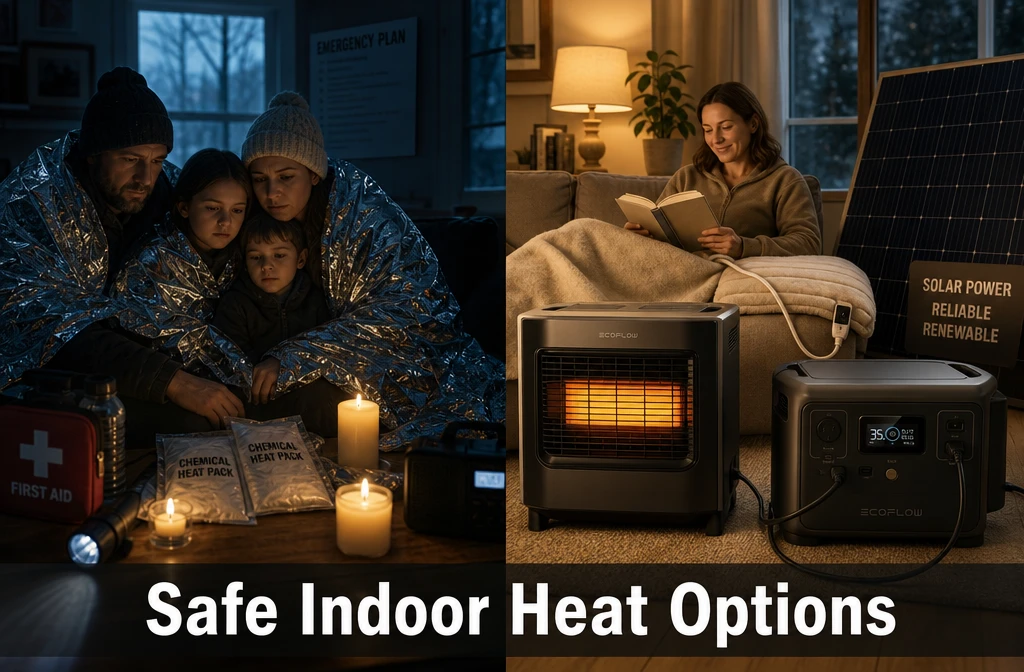
What Are the Safest Indoor Heat Sources During a Power Outage?
The safest indoor heat sources during a power outage are those that produce no combustion byproducts — meaning no carbon monoxide, no open flame, and no risk of oxygen depletion. Battery-powered electric heaters, electric blankets connected to a portable power station, and chemical heat packs are the top choices for enclosed indoor spaces.
Here’s how the main options stack up:
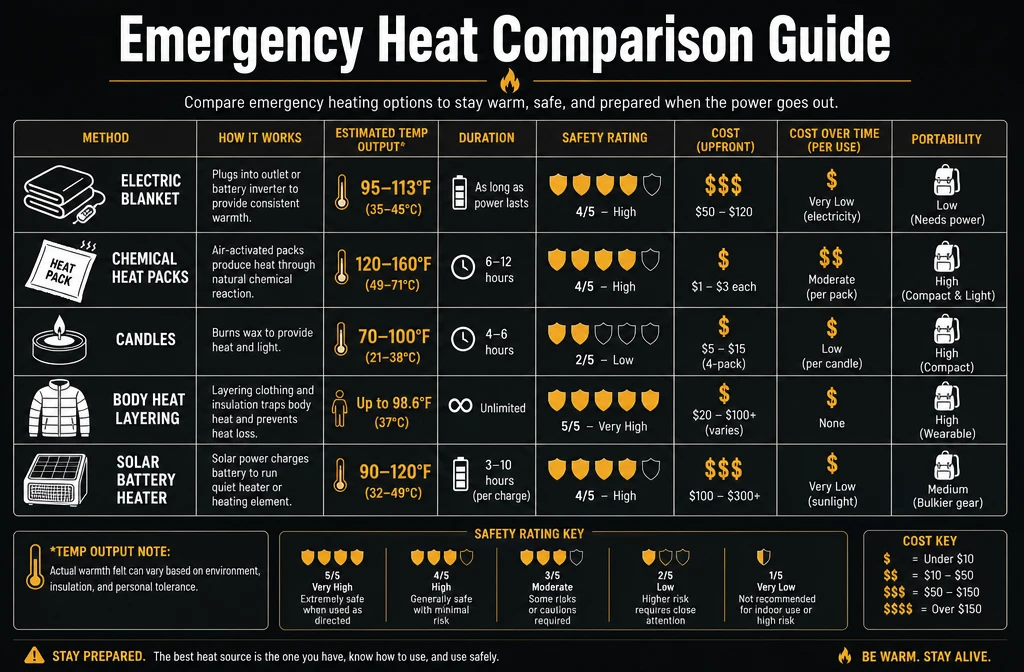
| Heat Source | Fuel Required | CO Risk | Indoor Safe | Approx. Cost |
|---|---|---|---|---|
| Electric blanket (battery) | No | None | Yes | $30–$80 |
| Battery/solar heater | No | None | Yes | $60–$300 |
| Chemical heat packs | No | None | Yes | $1–$5 each |
| Beeswax/soy candles | No (wax) | Low | Marginal | $5–$20 |
| Propane heater (indoor-rated) | Yes | Moderate | With ventilation | $60–$150 |
| Kerosene heater | Yes | High | Not recommended | $80–$200 |
Decision rule: If anyone in the household has respiratory issues, heart disease, or is under 5 or over 65, stick exclusively to electric/battery options. Combustion sources — even “indoor-safe” propane heaters — require ventilation that defeats heat retention.
For a broader look at staying prepared when infrastructure fails, the Ultimate Guide to Home Emergency Preparedness covers the full system, not just heat.
How Do Solar Battery-Powered Heaters Work in Emergencies?
Solar battery-powered heaters work by drawing stored energy from a portable power station — a large rechargeable battery bank — that has been pre-charged via solar panels, a wall outlet, or a vehicle. The heater itself is a standard electric resistance or ceramic heater; the difference is the power source.
How the system works:
- A portable power station (like a Jackery, EcoFlow, or Bluetti unit) stores energy in lithium or LiFePO4 cells.
- Solar panels charge the station during daylight hours — even on overcast days, though output drops significantly.
- A low-wattage ceramic heater (200–500W) or electric blanket (50–150W) draws from the battery.
- Runtime depends on battery capacity (measured in watt-hours) divided by the heater’s wattage.
Rough runtime estimates:
- 500Wh battery + 200W heater = ~2.5 hours of continuous heat
- 1000Wh battery + 100W electric blanket = ~8–10 hours
- 2000Wh battery + 200W heater = ~8–9 hours (plus solar recharge during the day)
Common mistake: People buy a 1000W space heater and a 500Wh power station, then wonder why the battery dies in 30 minutes. Match your heater wattage to your battery capacity before the emergency happens.
For more on building a reliable power backup system, see the complete guide to backup power for emergencies.
Can Candles or Tea Lights Heat a Small Room Safely?
Candles can raise the temperature of a very small, well-insulated space by a few degrees, but they cannot meaningfully heat even a medium-sized room and carry real fire and air quality risks. A single candle produces roughly 80 BTUs of heat — a standard home furnace produces 80,000 BTUs or more. The math is unforgiving.
Where candles can help:
- Inside a small tent or sleeping bag “cocoon” setup within a larger room
- As supplemental warmth in a bathroom or closet (under 50 sq ft) that’s been heavily insulated
- The “flower pot heater” (tea lights under a terracotta pot) is a popular DIY method — it does concentrate radiant heat slightly but does not generate more heat than the candles alone produce
Safety rules if you use candles:
- Never leave burning candles unattended
- Keep a fire extinguisher within arm’s reach
- Ensure some air circulation to prevent carbon dioxide buildup
- Use candles in stable holders on non-flammable surfaces
- Beeswax or soy candles burn cleaner than paraffin
Bottom line: Candles are a last-resort supplemental option, not a primary heat source. Treat them as light sources that happen to produce a small amount of warmth.
What’s the Difference Between an Emergency Electric Blanket and a Portable Space Heater?
An electric blanket is almost always the more efficient emergency heat choice compared to a portable space heater when running on limited battery power. Electric blankets use 50–200 watts; portable space heaters typically use 750–1,500 watts. For battery-powered operation during an outage, that difference is enormous.
Side-by-side comparison:
- Electric blanket: 50–150W, heats the person directly, 8–20+ hours on a 1000Wh battery, low fire risk, silent
- Portable space heater: 750–1500W, heats room air, 40 minutes to 1.5 hours on a 1000Wh battery, higher fire risk if tipped
Choose an electric blanket if: battery power is limited, you’re heating one or two people, or you need all-night warmth.
Choose a low-wattage ceramic heater (200–400W) if: you have a large power station, multiple people need warmth, or someone cannot use a blanket due to mobility issues.
Heated vests and heated sleeping bag liners are worth mentioning here too — they use even less power (20–50W) and are excellent for individual warming in a bug-out or shelter-in-place scenario.
How Much Heat Can Body Warmth Generate in a Survival Situation?
A resting adult human body generates approximately 80 watts of heat — roughly equivalent to a standard light bulb. In a survival situation, that heat output becomes a critical resource when managed correctly through layering, shared body warmth, and insulation.
Maximizing body heat in an emergency:
- Layer clothing: Base layer (moisture-wicking), insulating mid-layer (wool or fleece), outer windproof shell
- Cover the head: Up to 10% of body heat loss occurs through the head, especially in children
- Sleeping together: Two people sharing a sleeping bag or blanket can maintain core temperature far more effectively than sleeping separately
- Mylar emergency blankets: Reflect up to 90% of radiated body heat back toward the user — they’re not just for outdoor use
- Sleeping bag ratings: A sleeping bag rated to 20°F (-7°C) can keep a person comfortable at that temperature; pair two bags or add a liner for colder conditions
Pull quote: “Your body is a 80-watt heater. Insulation doesn’t create warmth — it traps the warmth you’re already generating.”
Edge case: Wet clothing destroys this system entirely. Staying dry is the single most important factor in body-heat-based warming. Always have a dry change of clothes in your emergency kit.
Best Emergency Heat Methods for People With Respiratory Issues
People with asthma, COPD, or other respiratory conditions should rely exclusively on non-combustion heat sources during emergencies. Any open flame or combustion heater — including propane, kerosene, or wood — produces particulate matter, nitrogen dioxide, and carbon monoxide that can trigger severe respiratory events.
Safe options for respiratory-sensitive individuals:
- Battery-powered electric blankets and heated vests
- Low-wattage ceramic or infrared electric heaters on a portable power station
- Chemical heat packs (air-activated, no combustion)
- Layered wool or down clothing and sleeping bags
- Mylar emergency blankets
What to avoid entirely:
- Propane heaters (even “indoor-safe” models)
- Kerosene heaters
- Wood-burning fireplaces or improvised fire pits
- Charcoal — this is fatal indoors and should never be used for heating
Preparation tip: People with respiratory conditions should prioritize a larger-capacity portable power station (2000Wh+) and a quality low-wattage heater as part of their emergency kit. This is non-negotiable, not optional. For a comprehensive emergency kit checklist, see 15 things missing from your emergency kit that could cost you everything.
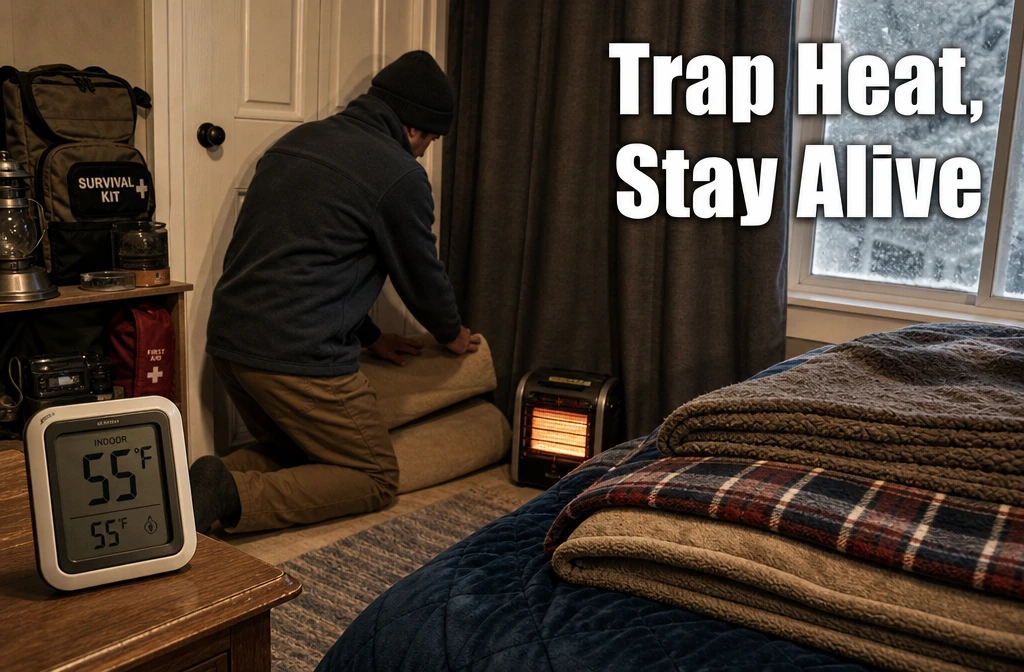
What Household Items Can Trap Heat During a Winter Emergency?
Heat retention is half the battle. Generating warmth is useless if that warmth escapes through drafts, windows, and uninsulated walls within minutes. Several common household items can dramatically reduce heat loss in a designated warm room.
Top heat-trapping strategies using household items:
- Heavy curtains or blankets over windows: Windows account for 25–30% of residential heat loss. Hang blankets, moving pads, or even taped-up cardboard to create an insulating barrier.
- Draft stoppers: Roll up towels or clothing and place them at the base of doors and windows to block cold air infiltration.
- Designate one “warm room”: Choose the smallest, most interior room in the house. Seal the door with tape or a blanket. One person’s body heat can raise the temperature of a 100 sq ft room by several degrees over a few hours.
- Rugs and carpet: Bare floors are cold floors. Layer rugs, sleeping bags, or foam pads on hard surfaces.
- Reflective Mylar sheets on walls: Tape emergency blankets to interior walls to reflect radiant heat back into the room.
- Furniture rearrangement: Move beds and seating away from exterior walls and windows, which are always the coldest surfaces.
Common mistake: People try to heat the entire house during an outage. That’s a losing battle. Concentrate people and heat sources in one small room and seal it off.
Are Chemical Heat Packs Effective for Warming a Small Space?
Chemical heat packs (hand warmers, body warmers, toe warmers) are highly effective for personal warming but cannot meaningfully raise the air temperature of any room. They work through an exothermic chemical reaction — typically iron oxidation — that produces heat for 8–12 hours per pack.
What they’re good for:
- Keeping hands, feet, and core warm while wearing clothing
- Placing inside sleeping bags near the feet or torso
- Providing warmth to infants or elderly individuals who cannot regulate body temperature well
- Emergency car kit warmth during a breakdown in winter
What they can’t do:
- Heat a room or enclosed space to a meaningful degree
- Replace a heater for extended multi-day warmth (cost adds up quickly)
- Be reused (single-use only, unless you buy reusable catalytic warmers)
Reusable option: Sodium acetate “click warmers” can be recharged by boiling. They’re less powerful than iron-oxidation packs but reusable indefinitely, which makes them a smarter long-term prep investment.
Cost reality: A 40-pack of hand warmers costs roughly $15–$25. For a family of four over a 72-hour outage, you’d need dozens. Stock them as a supplement, not a primary strategy.
Risks of Using Alternative Heat Sources Indoors During a Winter Storm
The biggest risk of improvised indoor heating is carbon monoxide (CO) poisoning — an odorless, colorless gas that kills without warning. According to the CDC, CO poisoning sends approximately 50,000 Americans to emergency rooms each year, with spikes during major winter storms when people turn to improvised heating.
High-risk sources that should never be used indoors:
- Charcoal grills or hibachi grills
- Gas-powered generators (run these outside, 20+ feet from windows)
- Outdoor propane heaters not rated for indoor use
- Ovens or stovetops used for space heating
- Camping stoves with inadequate ventilation
Lower-risk combustion sources (use with caution and ventilation):
- Indoor-rated propane heaters (e.g., Mr. Heater Buddy) — crack a window
- Alcohol stoves — lower CO output but still require ventilation
- Candles — minimal CO risk but fire hazard
Non-negotiable safety equipment:
- Battery-operated CO detector in every sleeping area
- Smoke detector with fresh batteries
- Fire extinguisher (ABC-rated) accessible in the warm room
Pull quote: “A CO detector costs $20 and takes 30 seconds to install. Carbon monoxide poisoning kills in minutes. This is not an optional prep.”
For a full breakdown of grid-down scenarios and how to prepare your home, the EMP attack and grid failure survival guide covers the broader threat landscape.
What Temperature Do You Need to Prevent Hypothermia in an Unheated Home?
Hypothermia begins when core body temperature drops below 95°F (35°C). In an unheated home, this can occur at indoor air temperatures well above freezing — especially in sedentary, elderly, or medically vulnerable individuals.
Indoor temperature thresholds to know:
- Below 68°F (20°C): Increased health risk for elderly individuals and infants (WHO guideline)
- Below 60°F (15.5°C): Hypothermia risk rises significantly for sedentary adults, especially overnight
- Below 55°F (13°C): Dangerous for anyone without adequate clothing and insulation
- Below 50°F (10°C): Serious hypothermia risk for all individuals without active warming
Practical target: Keep your designated warm room at or above 60°F using any combination of the heat sources in this emergency heat sources without fuel guide. If you can’t measure temperature, use the “comfortable without a coat” rule — if you need a heavy coat indoors, the space is too cold for prolonged habitation.
Vulnerable populations need higher temperatures: Infants, the elderly, and people on certain medications (beta-blockers, sedatives) have impaired thermoregulation. Aim for 65–68°F minimum for these individuals.
Cheapest Ways to Generate Emergency Heat Without Electricity or Fuel
The cheapest emergency heat methods are those that cost little or nothing to implement and rely on physics rather than purchased energy. Layering clothing, sealing drafts, and concentrating body heat in a small space costs essentially nothing and can keep a family safe through a multi-day outage.
Ranked by cost (lowest to highest):
- Body heat + layering — Free. Wool blankets, sleeping bags, and shared body warmth in a sealed room.
- Draft sealing — Free. Towels, tape, and cardboard from around the house.
- Mylar emergency blankets — $1–$3 each. Reflect body heat, insulate windows, line walls.
- Chemical hand warmers — $0.50–$1 each. Effective for personal warming for 8–12 hours.
- Beeswax candles — $5–$20. Supplemental warmth in very small spaces.
- Electric blanket — $30–$80 one-time cost. Most efficient battery-powered option.
- Low-wattage ceramic heater + power station — $150–$400 combined. Most effective fuel-free active heating solution.
The free strategy in detail: Choose the smallest interior room. Seal every gap. Everyone sleeps together under every blanket in the house. Body heat alone can keep a well-insulated 100 sq ft room 10–15°F warmer than the outside temperature. This is how people survived winters before central heating existed — and it still works.
For apartment-specific strategies, the ultimate guide to prepping in a small apartment covers heat, food, and water storage in constrained spaces.
Emergency Heating Options for Apartments With No Fireplace
Apartments without fireplaces are actually well-suited to fuel-free emergency heating because they tend to be smaller, better insulated (shared walls retain heat), and easier to seal into a warm room. The best options are battery-powered electric heaters, electric blankets on a portable power station, and aggressive heat retention techniques.
Apartment-specific strategies:
- Shared walls are your allies: Interior walls shared with neighbors retain heat far better than exterior walls. Position your warm room against shared walls.
- Portable power station + low-wattage heater: A 1000–2000Wh station can run a 200W heater for 5–10 hours or an electric blanket all night.
- Insulate windows with plastic film: Window insulation kits (available at hardware stores for $15–$30) reduce heat loss by 35–45% according to manufacturer estimates.
- Under-door draft snakes: Critical in apartment buildings where hallway air is cold.
- No open flame: Many apartment leases prohibit open flames, and building ventilation systems make combustion sources especially risky in multi-unit buildings.
Edge case — high-rise apartments: Upper floors lose heat faster through the roof and are more exposed to wind. Lower floors in a multi-story building are actually warmer during an outage. If you’re on an upper floor, aggressive window insulation is especially important.
For those building out a complete apartment preparedness system, the ultimate guide to apartment food storage pairs well with this guide.
Frequently Asked Questions
Can I use my gas stove for heat during a power outage?
No. Using a gas stove or oven for space heating is dangerous and can cause carbon monoxide buildup, fire, and gas leaks. It’s also ineffective — the heat dissipates quickly and the risk is not worth it. Use a dedicated heating solution instead.
How long can a battery-powered heater actually keep you warm?
It depends on the battery’s watt-hour capacity and the heater’s wattage. A 1000Wh power station running a 200W ceramic heater will last roughly 4–5 hours. The same battery running a 100W electric blanket will last 8–10 hours. Always calculate watt-hours divided by watts to get your runtime estimate.
Is a sleeping bag rated for 0°F enough to sleep in an unheated house?
A 0°F sleeping bag is designed for outdoor use where ambient temperatures can be extreme. Indoors, even in a very cold house, a 0°F bag will keep a healthy adult warm. Pair it with a sleeping pad (insulates from cold floors) and a dry base layer for best results.
What’s the best emergency heat source for a baby or infant?
Skin-to-skin contact with a caregiver inside a sleeping bag or under multiple blankets is the safest and most effective method for infants. Never place chemical heat packs directly against an infant’s skin. Keep the room above 68°F if at all possible using battery-powered heat.
Do Mylar emergency blankets actually work indoors?
Yes. Mylar blankets reflect up to 90% of radiated body heat. Used inside a sleeping bag or wrapped around a person, they’re highly effective. Taped to windows or walls, they also reduce radiant heat loss from the room. They’re one of the best cost-to-performance emergency supplies available.
Can I heat a room with candles alone?
Technically, yes — but only a very small, heavily insulated space, and only marginally. You’d need dozens of candles to raise the temperature of even a small room by more than a few degrees. The fire risk makes this impractical as a primary strategy. Use candles as supplemental warmth and light only.
What’s the minimum number of people needed to heat a small room with body heat?
Two people in a sealed 100 sq ft room with good insulation can generate enough body heat to maintain a temperature 10–15°F above the outdoor temperature. Three or more people significantly improves this. The key variables are room size, insulation quality, and how well drafts are sealed.
Are propane heaters safe to use indoors?
Indoor-rated propane heaters (like the Mr. Heater Buddy series) can be used indoors with proper ventilation — a cracked window or door. They should never be used in completely sealed spaces or while sleeping. Always run a battery-operated CO detector when using any combustion heat source indoors.
How do I know if I’m developing hypothermia?
Early signs include uncontrollable shivering, slurred speech, confusion, and loss of coordination. If shivering stops suddenly in a cold environment, that’s a medical emergency — it means the body has lost the ability to generate heat. Warm the person immediately and seek medical help.
What’s the best way to stay warm in a car during a winter emergency?
Run the engine for 10 minutes every hour to generate heat, but always ensure the exhaust pipe is clear of snow to prevent CO buildup. Use emergency blankets, sleeping bags, and chemical heat packs between engine cycles. For a complete vehicle kit, see the ultimate car emergency kit list.
Products, Tools, and Resources Worth Having
After working through this emergency heat sources without fuel guide, here’s what actually belongs in a serious preparedness kit for winter emergencies:
Portable power stations: The Grid Doctor 3300 is well-regarded option for longer outages or larger households, wit Battery Capacity: 2048Wh provides more runtime. Pair it with 200W of solar panels for recharging capability.
Electric blankets: Sunbeam and Biddeford make reliable heated blankets in the $40–$80 range. Look for models with auto-shutoff and multiple heat settings. A 12V heated blanket designed for vehicle use can also run directly from a power station.
Low-wattage ceramic heaters: The Vornado VMH300 and Lasko 200W personal heater are good options for battery-powered use. Avoid anything over 400W if you’re running on a portable power station.
Chemical heat packs: HeatMax and HotHands are the most widely available brands. Buy in bulk (40–100 packs) before winter. Reusable sodium acetate warmers (Grabber brand) are worth stocking for long-term use.
Mylar emergency blankets: SOL (Survive Outdoors Longer) makes a heavier-duty version that lasts multiple uses. Standard thin Mylar blankets work but tear easily. Stock at least one per person, plus extras for window insulation.
CO detectors: Kidde and First Alert make battery-operated CO detectors for $20–$30. Every household should have at least two — one near sleeping areas and one in the main living space. This is non-negotiable when any combustion heat source is in use.
Window insulation kits: 3M Window Insulator Kit and Duck Brand alternatives are available at hardware stores for $15–$30 and can reduce window heat loss by a meaningful margin in a sealed warm room.
For anyone building out a complete preparedness system beyond just heating, the ultimate emergency preparedness guide for preppers is the logical next step — it covers food, water, communication, and shelter in a single comprehensive framework.
Being prepared for a winter power outage isn’t about having the most expensive gear. It’s about understanding the principles — retain heat, reduce exposure, use the most efficient power source available — and having the right tools in place before the storm hits. The families who stay warm in a crisis are the ones who planned for it when the weather was still fine.