
Hey there! Some links on this page may be affiliate links which means that, if you choose to make a purchase, I may earn a commission at no extra cost to you. I greatly appreciate your support. Read the full disclosure here.
Most people who die in disasters don’t die from lack of food, water, or shelter in the first 72 hours. They die because they freeze, make catastrophically poor decisions, or completely shut down under psychological pressure they were never trained to handle. Psychological preparedness — the deliberate cultivation of mental resilience, decision-making capacity, and emotional regulation before a crisis hits — is the most consistently overlooked element in survival planning. Physical gear matters. Skills matter. But the mind is the system that controls all of it.
Key Takeaways
- Psychological preparedness means training your mind to function under extreme stress before a crisis occurs, not improvising your way through panic when it does.
- The brain’s threat-response system (the amygdala) can override rational thinking during emergencies, causing freeze responses, tunnel vision, and poor decisions — all of which can be mitigated through prior mental training.
- Mental resilience is a learnable skill, not a fixed personality trait. Anyone can build it with consistent, deliberate practice.
- Common psychological failures in crisis include normalcy bias, panic-driven decision-making, social dependency paralysis, and catastrophizing.
- First responders and military personnel build mental toughness through stress inoculation, scenario rehearsal, and structured debriefing — techniques civilians can adapt.
- Natural disasters and human-made emergencies trigger different psychological responses and require different mental preparation strategies.
- Signs of psychological unreadiness include avoidance of crisis scenarios, inability to make decisions under mild pressure, and no practiced emergency plan.
- Professional crisis psychology training ranges from free community programs to structured courses costing $200–$2,000+, depending on depth and provider.
- The best mental resilience resources combine cognitive-behavioral techniques, scenario-based training, and community support systems.
- Psychological preparedness amplifies every other form of preparedness — a calm, focused mind uses physical resources more effectively.
Find this useful? Add us as a preferred source on Google and more of what we publish will show up in your results.
What Exactly Is Psychological Preparedness?
Psychological preparedness is the proactive process of training your mind to remain functional, focused, and decision-capable during high-stress or life-threatening situations. It’s not about eliminating fear — fear is a biological survival tool. It’s about ensuring that fear doesn’t become the decision-maker.
At its core, psychological preparedness involves three interconnected capacities:
- Cognitive control: The ability to think clearly and prioritize when information is incomplete or overwhelming.
- Emotional regulation: Managing acute stress, grief, anger, or panic without letting those states dictate your actions.
- Behavioral readiness: Having practiced responses so deeply that they activate automatically when conscious reasoning is compromised.
The World Health Organization and disaster psychology researchers have long recognized that psychological factors — not physical resource shortages — are frequently the primary driver of poor outcomes in the first hours of an emergency. People who have mentally rehearsed crisis scenarios consistently outperform those who haven’t, regardless of gear quality or physical fitness.
For preppers and survivalists, this means that building a comprehensive emergency preparedness system without addressing the mental component is like building a truck with no steering wheel. The engine runs. You’re still going nowhere useful.
How Does Mental Readiness Help During Emergencies?
Mental readiness directly improves survival outcomes by reducing the time between perceiving a threat and taking effective action. In crisis psychology, this gap is sometimes called “recognition-primed decision time,” and it can mean the difference between escaping a building fire and being trapped by indecision.
Here’s what happens in an untrained mind during acute crisis:
- The amygdala (the brain’s alarm system) fires, flooding the body with adrenaline and cortisol.
- Blood flow shifts away from the prefrontal cortex — the rational, planning part of the brain.
- The person experiences tunnel vision, time distortion, and impaired memory.
- Without a pre-programmed response, the brain defaults to one of three states: fight, flight, or freeze.
The freeze response is particularly dangerous in survival situations. Research published in the journal Frontiers in Psychology (Bracha et al., 2004) documented that a significant portion of people in acute threat situations experience tonic immobility — a biological freeze state — that can last critical minutes.
Mentally prepared individuals short-circuit this cascade. Because they’ve rehearsed responses, the prefrontal cortex doesn’t need to construct a plan from scratch. The plan already exists. The mind retrieves it rather than inventing it under pressure.
Practical benefits of mental readiness during emergencies include:
- Faster, more accurate threat assessment
- Reduced panic-driven resource waste (people who panic often burn calories, water, and time on counterproductive actions)
- Better communication with family members or group members under stress
- Greater capacity to comfort and lead others, which matters enormously in family survival scenarios
- Faster recovery from setbacks, because mentally prepared people expect adversity rather than being blindsided by it
This is why a solid family emergency plan isn’t just a logistics document — it’s a psychological anchor. When everyone knows the plan, the cognitive load during crisis drops dramatically.
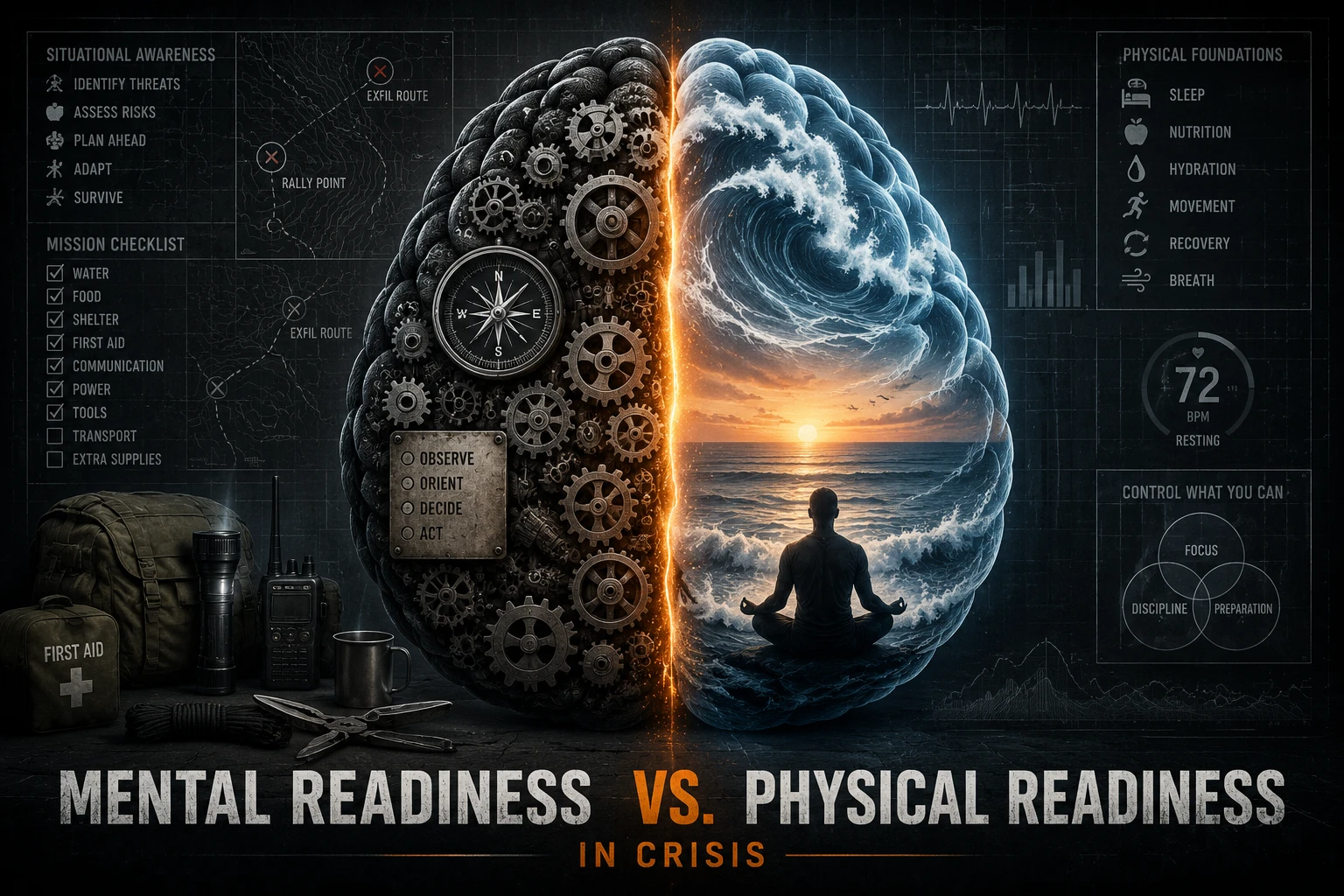
Psychological Preparedness vs. Physical Survival Skills
Physical survival skills and psychological preparedness are not competing priorities — but they’re not equal in a crisis either. Psychological preparedness is the foundation that makes physical skills usable.
Consider this: a person who knows how to purify water but panics and forgets the steps under pressure is less effective than a person with moderate water knowledge who stays calm and methodical. Physical skills live in procedural memory. Psychological distress blocks access to that memory.
| Factor | Physical Survival Skills | Psychological Preparedness |
|---|---|---|
| Primary function | Execute specific tasks | Enable all tasks to be executed |
| Degrades under stress? | Yes, significantly | Less so, with training |
| Requires gear/resources? | Often yes | No |
| Transferable across scenarios? | Partially | Highly |
| Training method | Practice, repetition | Scenario rehearsal, stress exposure, mindset work |
| Time to build baseline | Weeks to months | Weeks to months |
The practical takeaway: build both, but don’t neglect the mental side because it’s less tangible. A prepper who has memorized 25 critical wilderness survival skills but has never stress-tested their decision-making under pressure has a significant gap in their readiness profile.
Choose physical skills first if: you have zero baseline knowledge and face an imminent, specific threat.
Prioritize psychological preparedness if: you already have solid physical skills but notice you shut down, freeze, or make poor decisions when things go wrong in everyday life — because those patterns will amplify in a real crisis.
Training Techniques to Improve Mental Resilience
Mental resilience can be built through deliberate, consistent practice. The most effective techniques used by crisis professionals and military psychologists are fully accessible to civilians.
Stress Inoculation Training
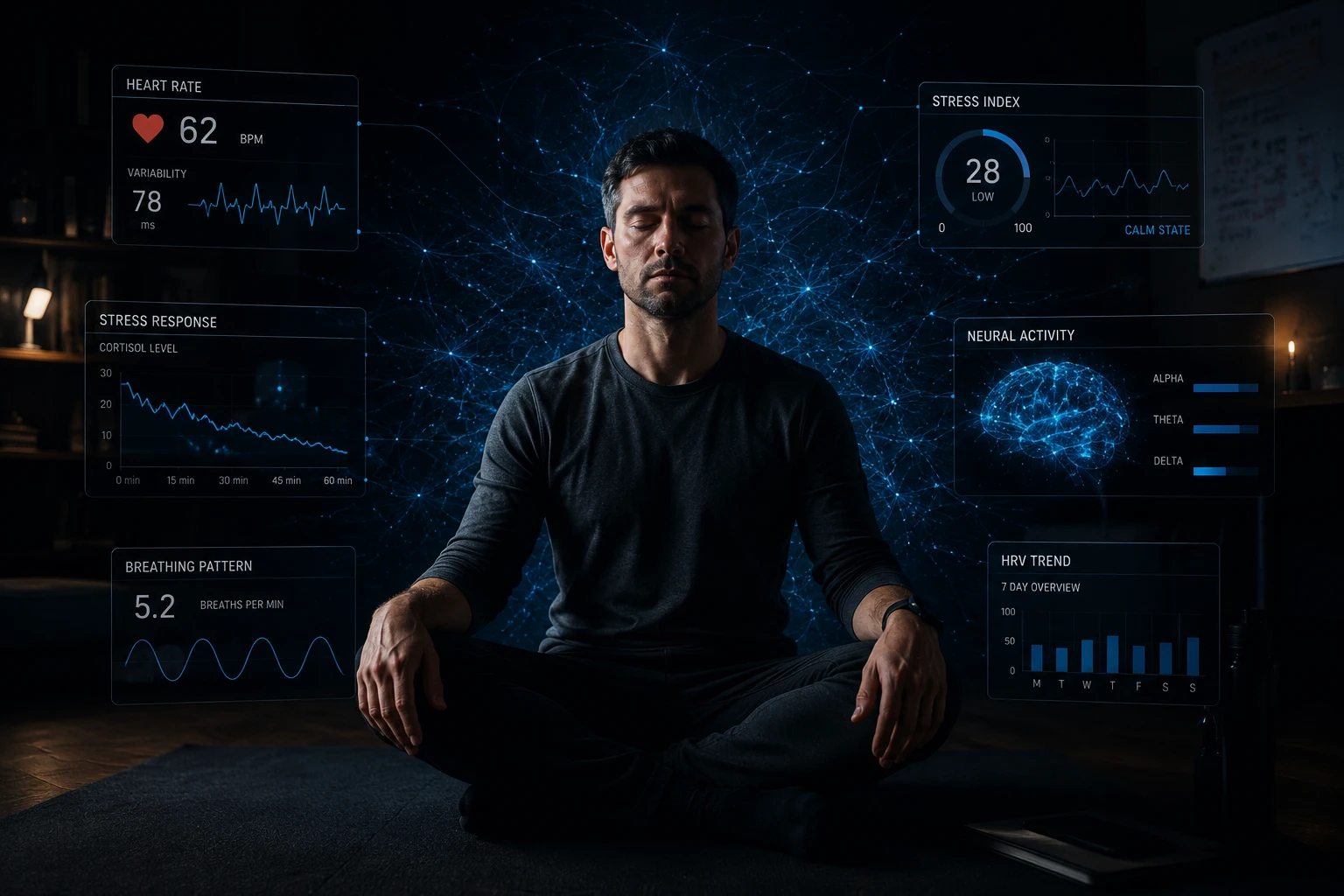
Stress inoculation (SIT) is a structured method developed by psychologist Donald Meichenbaum that exposes individuals to graduated levels of stress in controlled environments. The goal is to build familiarity with the physiological and emotional experience of high stress so it becomes less disruptive.
For preppers, this looks like:
- Running timed fire drills at unexpected hours
- Practicing bug-out scenarios with a full pack in actual weather conditions
- Completing navigation exercises without GPS under mild time pressure
- Simulating power outages for 48–72 hours and managing all household functions
Each controlled stress exposure builds what psychologists call “stress tolerance bandwidth” — the range of pressure within which you can still think and act effectively.
Scenario-Based Mental Rehearsal
Mental rehearsal (also called visualization or mental simulation) involves walking through crisis scenarios in detail in your mind before they happen. This is not daydreaming. It’s structured cognitive practice.
Effective mental rehearsal includes:
- Specific scenario (house fire, grid-down event, civil unrest)
- Sensory detail (what you’d see, hear, smell)
- Decision points (what you’d do at each stage)
- Failure contingencies (what if Plan A fails?)
Athletes, surgeons, and military operators use this technique extensively. The brain processes vivid mental rehearsal similarly to actual experience, which means practiced scenarios build genuine neural pathways.
Controlled Breathing and Physiological Self-Regulation
Tactical breathing (box breathing: 4 counts inhale, 4 hold, 4 exhale, 4 hold) is used by Navy SEALs and law enforcement to lower heart rate and restore prefrontal cortex function during acute stress. It works because it activates the parasympathetic nervous system, counteracting the adrenaline response.
Practice this daily, not just in emergencies. The technique only works reliably if it’s already a habit.
After-Action Reviews
After any training exercise, drill, or real stressful event, conduct a structured debrief with yourself or your group:
- What happened?
- What did you do well?
- What would you change?
- What will you train next?
This builds metacognitive awareness — the ability to observe your own mental performance and improve it deliberately.
Common Psychological Mistakes People Make in Crisis
The most dangerous psychological failures in crisis situations are predictable. Knowing them in advance is half the battle.
Normalcy Bias: The tendency to underestimate both the likelihood and severity of a disaster because “things like that don’t happen here.” This is why people ignore evacuation orders, delay leaving during wildfires, and fail to act on early warning signs. Normalcy bias is not stupidity — it’s a cognitive shortcut the brain uses to avoid processing uncomfortable information.
Panic-Driven Decision-Making: Panic produces fast, high-confidence decisions that are often catastrophically wrong. People run toward danger, abandon working plans, and exhaust resources in minutes. The antidote is a pre-committed plan that you follow even when your gut is screaming to improvise.
Social Proof Paralysis: In ambiguous situations, people look to others for cues on how to respond. If everyone around you is standing still, your brain interprets that as a signal that standing still is correct — even when it isn’t. This is why crowd behavior during emergencies can be so deadly.
Catastrophizing and Learned Helplessness: Some individuals, when confronted with a crisis, mentally leap to worst-case outcomes and conclude that action is pointless. This produces passivity at exactly the moment when action is most needed.
Over-Reliance on Authority: Waiting for official instructions before acting has cost lives in every major disaster on record. Psychologically prepared individuals make decisions based on available information, not on permission.
Failure to Communicate Under Stress: Stress degrades communication. People become terse, misread tone, and assume others share their understanding of the situation. A pre-established emergency communication plan reduces this significantly by giving everyone a shared language and protocol before stress enters the picture.
Signs You’re Not Psychologically Ready for a High-Stress Situation
Psychological unreadiness shows up in everyday behavior long before a crisis arrives. These are the warning signs worth taking seriously.
- You avoid thinking about or planning for emergencies because it feels overwhelming or anxiety-inducing.
- You have a physical prep setup (food, water, gear) but no practiced plan — meaning you’ve prepared for logistics but not for decision-making under pressure.
- In everyday stressful situations (traffic, arguments, unexpected schedule changes), you consistently freeze, overreact, or shut down rather than problem-solve.
- You’ve never run a drill, rehearsed a scenario, or stress-tested any part of your preparedness plan.
- You depend entirely on one other person (a spouse, partner, or group leader) to make decisions in any high-pressure situation.
- You feel confident about your gear but have never used it under physical or emotional stress.
- You have no established breathing or grounding techniques for managing acute anxiety.
None of these are permanent deficits. They’re gaps that targeted training addresses directly. The complete prepping guide for beginners is a solid starting point for building the full preparedness system — but the mental layer requires its own deliberate attention.
Who Benefits Most from Psychological Preparedness Training?
Everyone benefits, but certain groups have the most to gain and the most to lose without it.
Parents and family leaders carry the psychological weight of others during a crisis. Their ability to stay calm directly regulates the emotional state of children and other dependents. Research in developmental psychology consistently shows that children’s stress responses mirror those of their primary caregivers. A parent who freezes or panics creates a cascade effect across the entire family unit.
Individuals with pre-existing anxiety disorders are at heightened risk for psychological breakdown during crisis. Paradoxically, structured preparedness training — including controlled stress exposure — is one of the most effective ways to reduce baseline anxiety, because it replaces vague dread with concrete competence.
Community organizers and group leaders who plan to coordinate others during emergencies need psychological training as much as they need tactical knowledge. Leadership under stress is a distinct skill set.
Seniors face unique psychological challenges in crisis, including increased vulnerability to confusion, social isolation, and health-related stress compounding. Specific disaster preparedness strategies for seniors address both the physical and psychological dimensions of this population’s needs.
People in high-risk geographic areas — those living in hurricane corridors, earthquake zones, or wildfire regions — have a higher probability of needing these skills. The geographic threat prep guide can help identify which specific crisis scenarios are most relevant to your location.
Is Psychological Preparedness Different for Military vs. Civilians?
The core neuroscience is identical — both military personnel and civilians experience the same stress hormones, the same cognitive impairment under pressure, and the same potential for freeze responses. The difference lies in training structure, intensity, and the types of scenarios rehearsed.
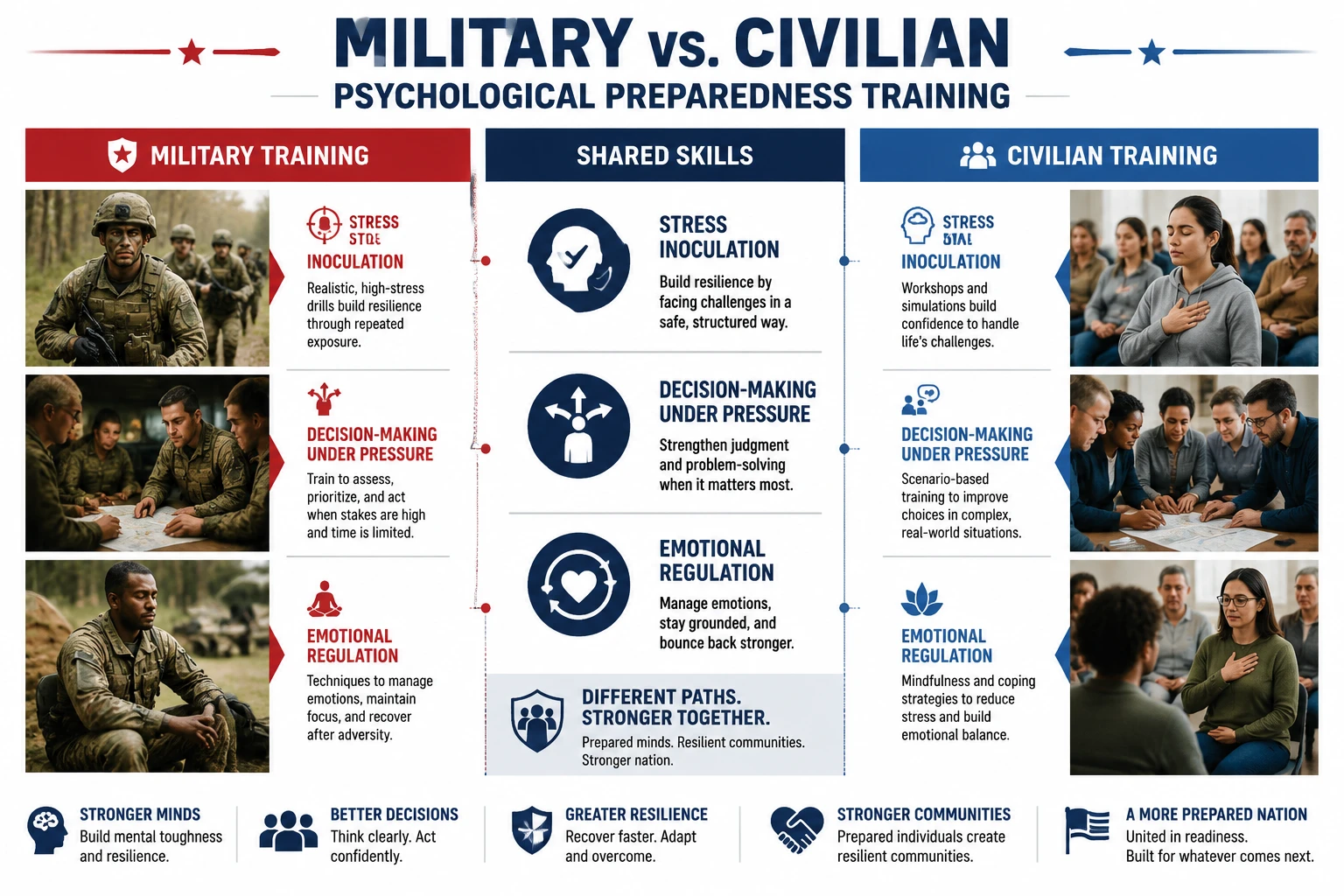
Military psychological preparedness is embedded in a continuous, institutional training system. Soldiers undergo stress inoculation through sleep deprivation, physical exhaustion, and high-stakes decision drills from the earliest stages of training. The military also provides structured post-event psychological support (after-action reviews, unit cohesion programs, access to mental health professionals) that civilians rarely have access to by default.
Civilian psychological preparedness must be self-directed and community-built. It draws from the same evidence base but requires individuals to create their own training structures. The good news: the most effective techniques — scenario rehearsal, controlled stress exposure, breathing regulation, and pre-committed planning — are all accessible without military infrastructure.
Key differences in application:
| Dimension | Military | Civilian |
|---|---|---|
| Training structure | Institutional, mandatory | Self-directed, voluntary |
| Scenario types | Combat, tactical, unit operations | Natural disasters, grid failure, civil unrest, family emergencies |
| Peer support | Built into unit structure | Must be deliberately built (family, community groups) |
| Post-event support | Formal debriefing, mental health access | Self-managed or community-based |
| Stress inoculation intensity | Extreme (by design) | Moderate and graduated (appropriate for most civilians) |
Civilians who want military-grade mental toughness training can pursue programs like CERT (Community Emergency Response Team), wilderness first responder courses, or civilian versions of stress inoculation training offered through some community colleges and emergency management agencies.
How Much Does Professional Psychological Crisis Training Cost?
Professional psychological preparedness training ranges from free to several thousand dollars, depending on the format, provider, and depth of instruction.
Free and low-cost options (under $50):
- FEMA’s Community Emergency Response Team (CERT) training — free in most US communities, covers basic disaster psychology alongside physical response skills.
- American Red Cross disaster preparedness courses — free to low-cost, include psychological first aid modules.
- FEMA’s Independent Study Program (IS-100, IS-200, IS-700) — free online, includes crisis decision-making frameworks.
- Psychological First Aid (PFA) training through the National Child Traumatic Stress Network — free online certification.
Mid-range options ($50–$500):
- Wilderness First Responder (WFR) courses — typically $600–$900 for an 8-day course, but include substantial crisis decision-making and stress management content.
- Tactical Combat Casualty Care (TCCC) for civilians — $150–$400, includes high-stress decision training.
- Online resilience and crisis psychology courses through platforms like Coursera or edX — $50–$200 for structured programs from accredited universities.
High-end options ($500–$2,000+):
- Civilian crisis response training programs through private tactical training companies.
- Executive protection and crisis management courses.
- One-on-one work with a licensed psychologist specializing in performance psychology or crisis intervention.
For most preppers, the CERT training combined with scenario-based self-training and a solid book-based education provides an excellent foundation at minimal cost.
Psychological Preparedness for Natural Disasters vs. Human-Made Emergencies
Natural disasters and human-made emergencies produce different psychological profiles, and preparation strategies should account for both.
Natural disasters (earthquakes, hurricanes, wildfires, floods) tend to produce acute, compressed trauma. The threat arrives, peaks, and passes within a defined timeframe. The primary psychological challenges are:
- Acute stress response in the immediate phase
- Grief and loss processing in the aftermath
- Decision fatigue during extended recovery periods
- Community trauma (everyone around you is also affected)
For natural disaster preparedness, the psychological priority is having a pre-committed action plan that removes the need for complex decision-making in the acute phase. When the earthquake hits, you don’t decide what to do — you execute what you’ve already decided. The step-by-step natural disaster preparedness guide covers the physical planning layer that supports this mental approach.
Human-made emergencies (civil unrest, economic collapse, infrastructure attacks, prolonged grid failure) produce a different psychological profile:
- Slower onset creates prolonged uncertainty and anxiety rather than acute shock
- Threat sources are often ambiguous or human, which activates different fear responses than natural threats
- Social trust erodes, creating interpersonal stress alongside survival stress
- The situation may not have a clear “end point,” which makes psychological recovery more difficult
For human-made emergencies, the psychological priorities shift toward:
- Maintaining social cohesion within your group
- Managing information overload and media-driven anxiety
- Sustaining morale over extended periods
- Developing clear decision-making frameworks for ambiguous, evolving situations
Both categories benefit from the same foundational mental training — but scenario rehearsal should include both types so the mind isn’t caught off-guard by the specific emotional texture of each.
How Do First Responders Develop Mental Resilience?
First responders — firefighters, paramedics, law enforcement, and emergency medical technicians — develop mental resilience through a combination of institutional training, peer culture, and structured psychological support systems. Their methods are directly applicable to civilian preppers.
Graduated exposure: First responders don’t start with the most intense scenarios. Training escalates progressively, building stress tolerance incrementally. A new paramedic doesn’t begin with mass casualty incidents — they build up to them through structured clinical progression.
Operational debriefing: After significant events, first responder agencies conduct formal after-action reviews. These aren’t therapy sessions — they’re structured analyses of what happened, what worked, and what needs to change. This process prevents trauma from calcifying into dysfunction.
Peer support programs: Many fire and EMS agencies now have formal peer support teams — trained colleagues who provide psychological first aid to fellow responders after difficult calls. The peer relationship matters because it normalizes struggle without stigma.
Pre-commitment to protocols: First responders follow protocols even under extreme stress. The protocol exists precisely because individual judgment under pressure is unreliable. This is the professional version of what preppers do when they build and practice a 4-layer disaster plan — the plan does the thinking so the person doesn’t have to improvise under duress.
Physical fitness as a psychological buffer: First responders maintain physical conditioning not just for job performance but because physical fitness is one of the most well-documented buffers against psychological stress. Exercise reduces baseline cortisol, improves sleep quality, and builds the physical confidence that translates to psychological confidence.
Can Psychological Preparedness Be Learned, or Is It Innate?
Psychological preparedness is a learnable skill set, not a fixed personality trait. This is one of the most important and most misunderstood facts in crisis psychology.
The belief that some people are “just wired” for crisis and others aren’t is largely a myth. What looks like innate resilience is almost always the product of prior experience, deliberate training, or a combination of both. Research in neuroplasticity — the brain’s ability to reorganize itself based on experience — confirms that stress response patterns are malleable throughout adult life.
The American Psychological Association’s resilience research (APA, 2012) identified resilience as “ordinary, not extraordinary” — meaning it’s a set of behaviors and thought patterns that most people can develop, not a rare genetic gift.
What is genuinely variable between individuals:
- Baseline stress sensitivity: Some people have naturally higher cortisol reactivity. This doesn’t prevent resilience — it means training may need to be more gradual.
- Prior trauma: Unresolved trauma can lower the threshold at which stress becomes overwhelming. Working with a mental health professional alongside preparedness training is appropriate for individuals with significant trauma histories.
- Temperament: Introversion, extroversion, and baseline anxiety levels affect how people experience and process stress. These traits influence training approach but don’t determine outcomes.
The bottom line for preppers: don’t use “I’m not that type of person” as a reason to skip mental preparedness work. That belief is itself a form of psychological unreadiness. Anyone who can build a preparedness lifestyle through consistent action can build mental resilience through the same mechanism — deliberate, repeated practice.
Best Books and Resources for Building Mental Toughness
The literature on mental resilience, crisis psychology, and stress management is extensive. These are the most practically relevant resources for preppers and survivalists.
Books:
- The Unthinkable: Who Survives When Disaster Strikes — and Why by Amanda Ripley (2008) — Deeply researched examination of how ordinary people respond to crisis, with direct implications for preparedness training.
- Extreme Ownership by Jocko Willink and Leif Babin (2015) — Military-derived leadership and mental discipline framework applicable to civilian crisis scenarios.
- The Gift of Fear by Gavin de Becker (1997) — Essential reading on threat perception, intuition, and the psychology of danger recognition.
- Man’s Search for Meaning by Viktor Frankl (1946) — The foundational text on psychological resilience under extreme conditions, written from direct experience in Nazi concentration camps.
- Tribe: On Homecoming and Belonging by Sebastian Junger (2016) — Examines the psychological role of community in crisis survival and recovery.
- Deep Survival: Who Lives, Who Dies, and Why by Laurence Gonzales (2003) — Analyzes real survival scenarios through the lens of neuroscience and psychology.
Online Resources:
- FEMA’s IS-907 (Active Shooter: What You Can Do) — free, includes psychological response components.
- The National Center for PTSD’s Psychological First Aid Field Operations Guide — free download, evidence-based.
- Ready.gov’s psychological preparedness resources — basic but useful for family-level planning.
Training Programs:
- CERT (Community Emergency Response Team) — find local programs at ready.gov/cert
- Mental Health First Aid USA — community-based training for psychological crisis response
- Wilderness First Responder programs through NOLS or Wilderness Medical Associates
Frequently Asked Questions
What’s the difference between psychological preparedness and mental health? Mental health refers to your overall psychological wellbeing in daily life. Psychological preparedness is specifically about training your mind to function effectively during crisis situations. Someone can have excellent mental health and still be psychologically unprepared for emergencies — and vice versa.
How long does it take to build meaningful psychological resilience? Noticeable improvement in stress tolerance can occur within 4–8 weeks of consistent practice, based on cognitive-behavioral research. Full integration of crisis-specific mental skills typically takes 3–6 months of deliberate training, including scenario rehearsal and stress exposure exercises.
Can children be trained in psychological preparedness? Yes, and they should be. Age-appropriate crisis education — explaining what emergencies are, practicing family drills, and teaching basic breathing techniques — builds resilience rather than fear. Children who participate in family preparedness planning consistently show lower anxiety about emergencies than those who are shielded from the topic.
Does having a detailed emergency plan actually reduce psychological stress? Yes, significantly. Pre-committed plans reduce the cognitive load during crisis by eliminating the need to generate decisions from scratch under stress. The plan becomes a psychological anchor — it tells the brain “we’ve already figured this out,” which reduces the amygdala’s threat response.
What’s the single most important psychological skill to develop first? Emotional regulation — specifically, the ability to recognize when you’re in an acute stress state and apply a reliable technique (like tactical breathing) to restore enough cognitive function to make decisions. Everything else builds from that foundation.
Is psychological preparedness relevant for everyday emergencies, or just major disasters? Both. The same mental skills that help during a major disaster also improve performance during car accidents, medical emergencies, workplace crises, and interpersonal conflicts. Training for large events builds capacity that transfers to smaller ones.
How do I know if my stress response is normal or a problem that needs professional help? If stress responses (panic attacks, dissociation, persistent hypervigilance, or avoidance behaviors) are already interfering with daily life, working with a licensed mental health professional before adding crisis training is the appropriate sequence. Crisis training is not a substitute for trauma treatment.
What’s normalcy bias and how do I counteract it? Normalcy bias is the cognitive tendency to underestimate the probability and severity of disasters because they fall outside normal experience. Counter it by deliberately studying historical disaster case studies, running regular drills, and making a rule that you take early warning signs seriously even when they feel excessive.
Can psychological preparedness help after a crisis, not just during one? Absolutely. Post-crisis psychological recovery — processing grief and loss, rebuilding routine, maintaining social connections — is a direct application of the same resilience skills. Mentally prepared individuals typically show faster recovery trajectories after disasters than unprepared ones.
Does group preparedness training improve individual psychological resilience? Yes. Social connection is one of the most powerful buffers against psychological breakdown in crisis. Training with a group — family, neighbors, or a formal preparedness community — builds both practical coordination skills and the interpersonal trust that sustains morale during extended emergencies.
Conclusion: The Mind Is Your Most Critical Survival Asset
Every piece of gear in a bug-out bag, every gallon of stored water, every practiced skill — all of it depends on the mind that deploys it. Psychological preparedness isn’t a soft add-on to a serious survival strategy. It’s the core system that makes every other element of preparedness actually work when the pressure is real.
The path forward is straightforward, even if it requires consistent effort:
- Audit your current psychological readiness using the warning signs outlined above. Be honest about where the gaps are.
- Start with stress inoculation — run one unannounced drill this month. Make it realistic enough to create mild discomfort.
- Build a daily breathing practice — five minutes of box breathing daily, practiced consistently, not just in emergencies.
- Read at least one book from the recommended list — The Unthinkable by Amanda Ripley is the highest-leverage starting point for most preppers.
- Register for a CERT course in your area. It’s free, it’s practical, and it connects you with a community of people who take preparedness seriously.
- Review and practice your family emergency plan with every member of your household — including the psychological components of who leads, how decisions get made, and what happens if the plan needs to adapt.
- Pair mental training with physical preparedness — ensure your disaster preparedness for families plan addresses both dimensions explicitly.
Being prepared isn’t about fear. It’s about building the kind of confidence that only comes from knowing — genuinely knowing — that when things go wrong, your mind will stay in the fight.
Products, Tools, and Resources
Recommended for Building Psychological Preparedness:
Books worth owning: Amanda Ripley’s The Unthinkable and Laurence Gonzales’s Deep Survival are the two most practically useful books in this category for preppers. Both are available in paperback and audiobook formats. Gonzales’s work is particularly useful because it analyzes real survival cases through neuroscience — it reads like a thriller but teaches like a textbook.
Training tools: A quality heart rate monitor (Garmin or Polar models in the $80–$150 range) is genuinely useful for stress inoculation training — it provides objective feedback on your physiological stress response during drills, helping you calibrate training intensity.
Apps: The Wim Hof Method app and the Box Breathing app (both free or low-cost) provide structured breathing training with guided sessions. These are not substitutes for practice, but they lower the barrier to starting.
Journals: A dedicated after-action review journal — any quality notebook works — used consistently after drills and stressful events builds metacognitive awareness faster than any other single habit. The act of writing forces structured reflection.
Community: CERT training (free, find at ready.gov/cert) and local ARES (Amateur Radio Emergency Service) groups provide both practical skills and the social infrastructure that psychological resilience research consistently identifies as critical for crisis survival and recovery.
The mental component of preparedness costs almost nothing to develop. The return on that investment, when it matters, is everything.