
Hey there! Some links on this page may be affiliate links which means that, if you choose to make a purchase, I may earn a commission at no extra cost to you. I greatly appreciate your support. Read the full disclosure here.
A standard 20-piece drugstore kit won’t save your life when the grid goes down. According to the American College of Surgeons, preventable deaths from traumatic injuries — particularly uncontrolled hemorrhage — account for a significant portion of pre-hospital fatalities, and most of those deaths happen in the first few minutes before professional help arrives. The 47 Things Every Prepper First Aid Kit Needs & How to Use Them is built around one core principle: when 911 isn’t coming, you are the first responder.
This guide covers every item you need, why it belongs in your kit, how to use it, and what skills you must practice before you ever need them for real.
Key Takeaways
- A prepper first aid kit goes far beyond basic bandages — it includes trauma gear, medications, diagnostic tools, and long-term care supplies.
- The 47 items in this guide are organized by category: bleeding control, wound care, airway management, fracture stabilization, medications, and tools.
- A complete prepper medical kit costs between $150 and $600 depending on quality and depth of supplies.
- Skills matter more than supplies. A tourniquet in untrained hands is nearly as dangerous as no tourniquet at all.
- Kits should be scenario-specific: a wilderness kit differs meaningfully from an urban or home-based trauma kit.
- Supplies have expiration dates. Rotate medications and replace degraded materials on a set schedule.
- Families with children need pediatric-specific additions including child-dose medications and smaller airway adjuncts.
- The hardest conditions to manage without professional care are sepsis, cardiac events, and diabetic emergencies — plan for them.

What Is the Difference Between a Basic First Aid Kit and a Prepper First Aid Kit
A basic first aid kit handles minor injuries — cuts, scrapes, and mild burns. A prepper first aid kit is designed to manage life-threatening trauma and extended medical care when professional help is unavailable for hours, days, or longer.
The gap between the two is significant:
| Feature | Basic Kit | Prepper Kit |
|---|---|---|
| Primary use | Minor injuries | Trauma, extended care |
| Bleeding control | Bandages, gauze | Tourniquet, hemostatic gauze, pressure bandage |
| Airway management | None | NPA, OPA, BVM |
| Wound closure | Adhesive strips | Sutures, staples, steri-strips |
| Medications | Aspirin, antihistamine | Broad-spectrum antibiotics, epinephrine, antidiarrheal |
| Diagnostic tools | None | Blood pressure cuff, pulse oximeter, thermometer |
| Cost range | $10–$30 | $150–$600 |
A prepper kit is built for scenarios where the standard of care drops to “keep them alive until help arrives” — or possibly much longer.
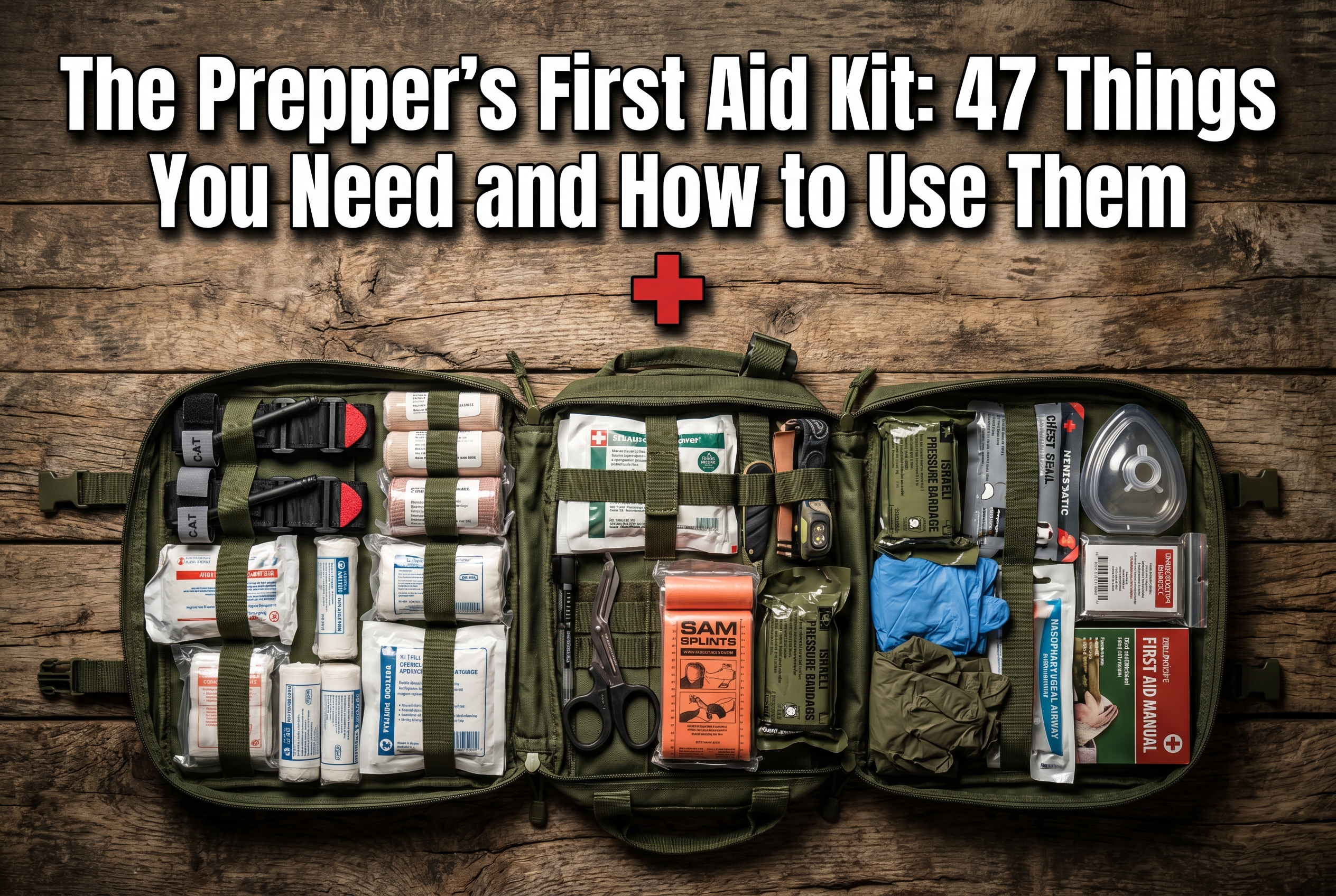
The Prepper’s First Aid Kit: 47 Things You Need and How to Use Them (Complete List)
These 47 items are the foundation of a serious prepper medical kit. They’re organized by function so you can build, audit, or upgrade your kit systematically.
Bleeding Control (Items 1–8)
Uncontrolled hemorrhage kills faster than almost any other trauma. These items address it directly.
- CAT Tourniquet (Combat Application Tourniquet) — Apply 2–3 inches above a limb wound, tighten until bleeding stops, write application time on the band. Do not remove in the field.
- SOFTT-W Tourniquet — A wider-band alternative to the CAT, preferred by some for larger limbs.
- Hemostatic Gauze (QuikClot or Combat Gauze) — Pack directly into deep wounds with firm, sustained pressure for 3–5 minutes. Works by accelerating clotting.
- Israeli Pressure Bandage (Emergency Bandage) — A self-applying pressure dressing for wounds where a tourniquet can’t be placed (torso, groin, neck).
- Chest Seals (vented, pair) — Applied immediately to penetrating chest wounds to prevent tension pneumothorax. Vented seals allow air to escape on exhalation.
- Wound Packing Gauze (plain) — For packing wounds before hemostatic gauze is needed or when conserving specialty supplies.
- Elastic Bandage (4-inch, 2 rolls) — Secures dressings, provides compression, and supports sprains.
- Nitrile Gloves (multiple pairs) — Non-negotiable. Protect both patient and provider from bloodborne pathogens.
Wound Care (Items 9–18)
- Sterile Gauze Pads (4×4, assorted) — The workhorse of wound coverage.
- Adhesive Bandages (assorted sizes) — Still useful for minor lacerations.
- Butterfly Closures / Steri-Strips — Close lacerations without sutures when appropriate.
- Suture Kit — For closing deep lacerations when evacuation isn’t possible. Practice on a suture pad before you need it on a person.
- Medical Stapler — Faster than sutures for scalp and straight-edge lacerations.
- Irrigation Syringe (60ml) — Flush wounds with clean water or saline to reduce infection risk. Wound irrigation is one of the most effective infection-prevention measures available.
- Saline Solution (sterile, 500ml) — For wound irrigation and eye washing.
- Povidone-Iodine Solution — Wound antiseptic. Dilute to 0.5–1% for wound irrigation.
- Medical-Grade Superglue (Dermabond-type) — Closes minor lacerations quickly and reduces infection exposure.
- Burn Dressing (Water-Jel or similar) — Hydrogel-based dressings cool burns, reduce pain, and protect against infection.
Airway and Breathing (Items 19–23)
- Nasopharyngeal Airway (NPA, 28Fr with lubricant) — Inserted through the nostril to maintain an open airway in unconscious patients who still have a gag reflex. Safer for semi-conscious patients than an OPA.
- Oropharyngeal Airway (OPA, assorted sizes) — Used only in deeply unconscious patients without a gag reflex to keep the tongue from blocking the airway.
- Bag-Valve Mask (BVM) — Delivers rescue breaths without mouth-to-mouth contact. Essential for CPR scenarios.
- Pulse Oximeter — Clips to a fingertip to measure blood oxygen saturation. Below 94% warrants concern; below 90% is a medical emergency.
- Chest Decompression Needle (14g, 3.25-inch) — For tension pneumothorax. This is an advanced skill — only use if trained. Insert at the second intercostal space, midclavicular line.
Fracture and Immobilization (Items 24–27)
- SAM Splint (36-inch) — A moldable aluminum splint that immobilizes fractures and dislocations. Can be shaped for any limb.
- Triangular Bandage (sling) — Supports arm and shoulder injuries; doubles as a head bandage or improvised tourniquet in extremis.
- Traction Splint (Kendrick or similar) — For femur (thigh bone) fractures, which can cause life-threatening internal blood loss. A traction splint reduces pain and hemorrhage simultaneously.
- Cohesive Bandage (CoFlex, 3-inch) — Wraps and secures splints without sticking to skin or hair.
Medications (Items 28–36)
Important: Prescription medications require a physician’s authorization. Discuss your prepper medical needs with a doctor who understands preparedness. Some preppers work with wilderness medicine physicians or travel medicine clinics to obtain appropriate prescriptions.
- Aspirin (325mg) — Administer immediately for suspected cardiac events (chew, don’t swallow whole).
- Diphenhydramine (Benadryl) — Antihistamine for allergic reactions. Not a substitute for epinephrine in anaphylaxis.
- Epinephrine Auto-Injector (EpiPen) — For anaphylactic shock. Inject into the outer thigh, hold for 10 seconds.
- Ibuprofen (200mg tablets) — Anti-inflammatory and pain reliever. Also reduces fever.
- Acetaminophen (500mg tablets) — Pain and fever management, especially when ibuprofen is contraindicated.
- Loperamide (Imodium) — Controls severe diarrhea, which can cause dangerous dehydration in a grid-down scenario.
- Oral Rehydration Salts (ORS packets) — Replaces electrolytes lost through diarrhea, vomiting, or heat exposure.
- Broad-Spectrum Antibiotic (prescription) — Amoxicillin-clavulanate or doxycycline are commonly discussed in wilderness medicine contexts. Discuss options with your physician.
- Antacid (calcium carbonate) — Stress and dietary changes during emergencies frequently trigger severe heartburn and GI distress.
Diagnostic Tools (Items 37–41)
- Digital Thermometer — Fever above 103°F (39.4°C) in adults warrants close monitoring and aggressive hydration.
- Blood Pressure Cuff (manual sphygmomanometer) — Monitors for shock, hypertension, and cardiovascular decline. Learn to read it accurately.
- Stethoscope — Used with the blood pressure cuff and for listening to lung sounds.
- Blood Glucose Meter with strips — Critical for diabetic family members or anyone with suspected hypoglycemia.
- Otoscope — Examines ears for infection, which can become serious without antibiotic treatment.
Tools and Accessories (Items 42–47)
- Trauma Shears — Cut through clothing, boots, and seatbelts without risk to the patient.
- Headlamp (with extra batteries) — Hands-free lighting for treating injuries in low-light conditions.
- CPR Face Shield or Pocket Mask — Barrier protection during rescue breathing.
- Medical Reference Card or Handbook — A laminated quick-reference card or a book like the Wilderness Medicine Handbook. Memory fails under stress.
- Permanent Marker — Write tourniquet application time, medication doses, and patient notes directly on skin or bandaging.
- Waterproof Storage Bag or MOLLE Pouch — Keeps supplies dry, organized, and accessible. A disorganized kit in a crisis is nearly useless.

How Much Does a Complete Prepper First Aid Kit Cost
A complete prepper first aid kit costs between $150 and $600, depending on whether you buy a pre-assembled kit or build it item by item. Most serious preppers do both: start with a quality trauma kit base, then add diagnostic tools and medications separately.
Cost breakdown by category (estimated 2026 retail):
- Bleeding control items (tourniquet, hemostatic gauze, chest seals): $60–$120
- Wound care supplies: $30–$60
- Airway and breathing tools: $40–$80
- Splinting and immobilization: $30–$50
- Medications (OTC only): $25–$50
- Diagnostic tools: $50–$150
- Tools and accessories: $20–$40
Pre-built option: Kits from brands like North American Rescue, MyMedic, and Rescue Essentials range from $80 (basic trauma) to $400+ (fully stocked extended-care kits). These are good starting points, but most require additions to reach the 47-item standard described here.
Where to buy: North American Rescue (narescue.com), Rescue Essentials (rescue-essentials.com), MyMedic (mymedic.com), and Amazon carry the majority of these supplies. For prescription medications, consult a wilderness medicine physician or travel medicine clinic.
What Medical Supplies Are Absolutely Necessary for Emergency Preparedness
The non-negotiable core of any prepper medical kit comes down to five categories: hemorrhage control, wound closure, airway management, infection prevention, and pain management.
If budget forces prioritization, build in this order:
- CAT tourniquet and hemostatic gauze (stops the fastest killers)
- Israeli bandage and chest seals (addresses torso and non-limb bleeding)
- Nitrile gloves and wound irrigation supplies (prevents infection)
- NPA airway and BVM (maintains breathing in unconscious patients)
- Aspirin and epinephrine auto-injector (cardiac and anaphylaxis emergencies)
Everything else in the 47-item list builds on this foundation. For a broader look at what belongs in a complete emergency kit, the ultimate emergency supplies list provides a useful cross-reference.
What Items Should Be Avoided in a First Aid Kit
Several items commonly found in consumer first aid kits are either ineffective or potentially harmful in a serious emergency.
Avoid or reconsider these:
- Hydrogen peroxide for wound cleaning — Damages tissue and slows healing. Use saline or diluted povidone-iodine instead.
- Tourniquets with velcro-only closures — Inadequate for arterial bleeding. Use windlass-style tourniquets (CAT, SOFTT-W) only.
- Expired medications — Potency degrades. Some medications (like tetracycline antibiotics) become toxic after expiration.
- Cotton balls for wound packing — Fibers shed into wounds and cause infection. Use sterile gauze only.
- Alcohol wipes for deep wound cleaning — Appropriate for skin surface prep, not internal wound irrigation.
- Rubber tourniquet tubing — Improvised rubber tubing tourniquets frequently fail to achieve adequate pressure.
How to Treat Common Injuries Without Going to a Hospital
Most trauma scenarios a prepper will face fall into a handful of categories. Here’s the direct approach for each:
Severe bleeding from a limb: Apply a CAT tourniquet 2–3 inches above the wound, tighten until bleeding stops, note the time. If the wound is in the groin or armpit, pack with hemostatic gauze and apply sustained direct pressure with an Israeli bandage.
Deep laceration: Irrigate thoroughly with saline using a 60ml syringe. Close with steri-strips for minor wounds or sutures for deeper ones. Cover with sterile gauze and monitor for infection (redness spreading from wound edges, fever, pus).
Suspected fracture: Immobilize the joint above and below the injury with a SAM splint. Do not attempt to realign bones. Manage pain with ibuprofen or acetaminophen.
Burns: Cool with water for 10–20 minutes (never ice). Apply a hydrogel burn dressing. Do not pop blisters. Burns covering more than 10% of body surface area or involving the face, hands, or genitals require professional care as soon as it becomes available.
Suspected cardiac event: Have the patient chew an aspirin (325mg) immediately if not allergic. Keep them still and calm. Begin CPR if they lose consciousness and stop breathing normally.
For wilderness-specific scenarios, the 25 most critical wilderness survival skills covers medical improvisation alongside other life-saving priorities.
What First Aid Skills Do Preppers Need to Learn for Survival Situations
Supplies without skills are just expensive clutter. The skills that matter most, ranked by frequency and severity of need:
- Tourniquet application — Practice until you can apply one correctly in under 30 seconds, one-handed.
- Wound packing and pressure dressing — The technique matters as much as the material.
- CPR and rescue breathing — Take a hands-on course. Reading about it is not sufficient.
- Airway management (NPA insertion) — Straightforward with practice, but practice is required.
- Splinting — Knowing how to immobilize a fracture properly prevents secondary injury.
- Vital signs assessment — Blood pressure, pulse, respiratory rate, and temperature tell you whether a patient is improving or deteriorating.
- Wound closure — Suturing and stapling on a training pad before you need the skill on a person.
Recommended training: Stop the Bleed certification (free, widely available), Wilderness First Responder (WFR) courses, and Combat Lifesaver training provide the most relevant skill sets for preppers. The 14 essential survival skills every prepper must know provides a broader framework for where medical skills fit into overall preparedness.
Are There First Aid Kits Designed for Specific Scenarios Like Wilderness or Urban Survival
Yes, and the differences are meaningful. A wilderness kit prioritizes wound management, fracture stabilization, and environmental emergencies (hypothermia, altitude sickness, envenomation). An urban kit emphasizes blast and ballistic trauma, burn care, and managing large numbers of casualties.
Wilderness-specific additions:
- SAM splints and traction splint
- Blister care kit (moleskin, lancets)
- Snake bite protocol card (do not use suction devices)
- Altitude sickness medication (acetazolamide, prescription)
- Water purification tablets (secondary to a dedicated water system)
Urban-specific additions:
- Multiple tourniquets (mass casualty events)
- Additional chest seals
- N95 masks (chemical or biological contamination)
- Burn dressings (structure fires)
For urban-specific preparedness, the ultimate urban survival guide for preppers addresses the broader context in which your medical kit will operate.
How to Store and Maintain Medical Supplies Long-Term
Medical supplies stored improperly degrade faster than their labeled expiration dates suggest. Heat, humidity, and UV exposure are the primary enemies.
Storage best practices:
- Keep supplies in a cool, dark location (below 77°F / 25°C)
- Use airtight, waterproof containers or MOLLE pouches with moisture-absorbing desiccant packs
- Store medications separately from sharp instruments
- Label everything with purchase date and expiration date
- Keep a physical inventory list inside the kit
Maintenance schedule:
| Interval | Task |
|---|---|
| Monthly | Check for visible damage, leaks, or contamination |
| Every 6 months | Review medication expiration dates, replace as needed |
| Annually | Full inventory audit, replace expired or degraded items |
| After every use | Restock immediately, do not wait |
Hemostatic gauze, chest seals, and suture kits typically have 3–5 year shelf lives. Medications vary widely — check each individually.
What Medical Conditions Are Hardest to Treat in an Emergency
Some conditions are genuinely difficult to manage without professional resources, and preppers should plan accordingly.
- Sepsis — A systemic infection response that can kill within hours. Signs include fever, rapid heart rate, confusion, and low blood pressure. Broad-spectrum antibiotics and aggressive hydration are the only field-expedient interventions.
- Cardiac arrest — CPR and an AED (automated external defibrillator) improve survival odds, but outcomes without advanced cardiac life support are poor.
- Diabetic emergencies — Hypoglycemia (low blood sugar) can be corrected with oral glucose if the patient is conscious. Diabetic ketoacidosis requires IV fluids and insulin — resources rarely available off-grid.
- Stroke — No field treatment exists. The only intervention is rapid transport to a hospital.
- Severe burns (>20% body surface area) — Require IV fluid resuscitation volumes that are difficult to manage without clinical support.
Knowing the limits of your kit is as important as knowing how to use it. For families with elderly members who may face higher risk for several of these conditions, the 9 essential disaster prep strategies for seniors covers additional considerations.
What First Aid Supplies Are Most Important for Families With Kids
Pediatric emergencies require specific supplies and adjusted dosing. A prepper kit for a family with children should include several additions beyond the standard 47-item list.
Pediatric-specific additions:
- Child-dose acetaminophen and ibuprofen (liquid formulations for young children)
- Pediatric OPA airways (sizes 0, 1, and 2)
- Pediatric BVM mask
- Smaller SAM splints (18-inch)
- Oral rehydration salts (children dehydrate faster than adults)
- Diphenhydramine in child-appropriate dosing
Dosing rule: Pediatric medication doses are weight-based, not age-based. Keep a weight-to-dose chart laminated inside your kit. For a complete family preparedness framework, the disaster preparedness for families guide is worth reviewing alongside this medical guide.
How Often Should Items in a Prepper First Aid Kit Be Replaced
Replace items on a schedule, not just when they look worn. Most people discover expired supplies at the worst possible moment.
- Medications: Check every 6 months. Replace at expiration without exception.
- **Hemostatic gauze and