
Hey there! Some links on this page may be affiliate links which means that, if you choose to make a purchase, I may earn a commission at no extra cost to you. I greatly appreciate your support. Read the full disclosure here.
Carbon monoxide poisoning kills an estimated 400 Americans every year, and the majority of those deaths happen during power outages when people reach for heating solutions they don’t fully understand. That number isn’t a scare tactic — it’s a planning problem. Finding the top indoor fire alternatives for emergency survival situations demand requires more than just buying a heater and hoping for the best. It means knowing exactly which options work, which ones kill quietly, and how to use each one correctly when the grid goes down and temperatures drop.
This guide covers every major indoor heating option available to preppers in 2026 — ranked by safety, cost, and practical effectiveness — so you can make a confident decision before the emergency, not during it.
Key Takeaways
- Carbon monoxide (CO) is the primary killer with indoor combustion heaters — always pair any fuel-burning device with a working CO detector.
- Electric space heaters are the safest option when grid power or backup power is available; they produce zero combustion byproducts.
- Propane heaters rated for indoor use (like the Mr. Heater Buddy series) are the most practical combustion option, but still require ventilation.
- Kerosene heaters can be used indoors with strict ventilation protocols, but are not recommended for small, sealed spaces or homes with respiratory-sensitive occupants.
- Battery-powered heaters are real, but their heat output is limited — best used for spot warming, not whole-room heating.
- Families with children, pets, or respiratory conditions should prioritize electric options and passive insulation strategies over combustion heaters.
- The biggest mistake preppers make is using outdoor-rated combustion devices (camp stoves, charcoal grills) indoors — this is frequently fatal.
- A layered heating strategy — insulation + primary heat source + backup — is always more reliable than a single solution.
What Are the Most Reliable Indoor Heat Sources During Power Outages?
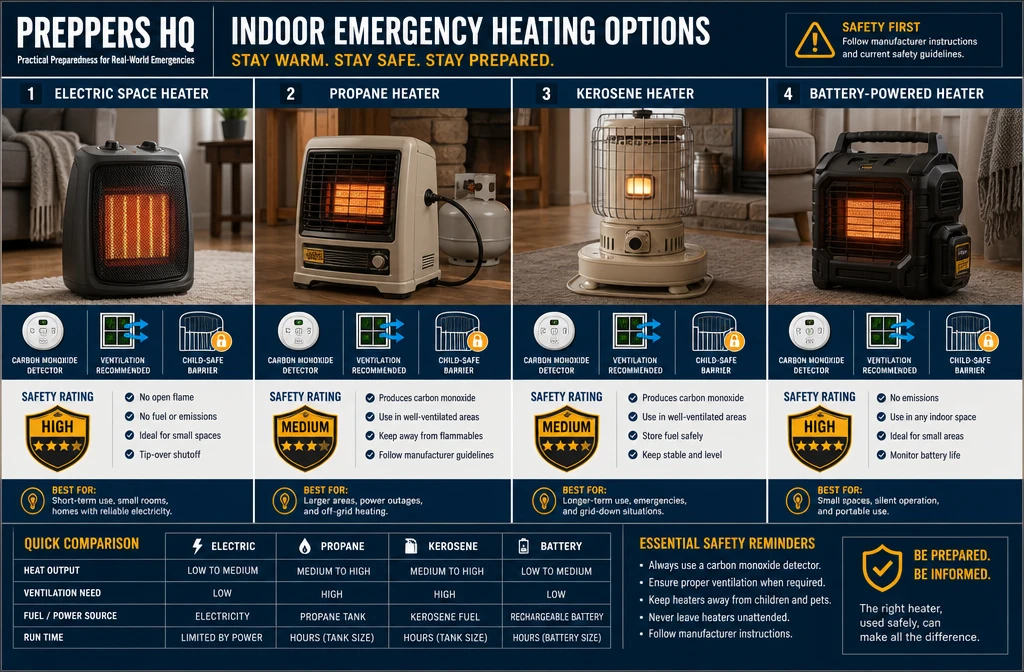
The most reliable indoor heat sources during a power outage fall into three categories: electric (requires backup power), combustion-based (propane, kerosene, wood), and passive thermal retention (insulation, body heat, thermal mass). Each has a different risk profile and fuel availability.
For preppers building a layered heating plan, the hierarchy looks like this:
Tier 1 — Safest (electric, requires power source):
- Corded electric space heaters (with a generator or solar + battery bank)
- Oil-filled electric radiators (efficient, no exposed heating element)
- Infrared electric panel heaters
Tier 2 — Practical combustion options (requires ventilation):
- Indoor-rated propane heaters (Mr. Heater Buddy, Dyna-Glo)
- Kerosene heaters (with proper airflow management)
- Wood-burning stoves (permanent installation, highest heat output)
Tier 3 — Supplemental and passive:
- Battery-powered personal heaters (limited BTU output)
- Thermal blankets and sleeping bag layering
- Room consolidation (heating one small room instead of the whole house)
Decision rule: If you have a generator or solar setup, start with electric. If you don’t, an indoor-rated propane heater with a CO detector is your most practical combustion fallback.
For a broader look at how heating fits into your overall grid-down readiness, see this EMP attack and grid failure survival guide — it covers backup power infrastructure that makes electric heating viable long-term.
How Do Electric Heaters Compare to Propane Heaters for Indoor Safety?
Electric heaters are significantly safer indoors than propane heaters because they produce no combustion byproducts — no CO, no CO2, no moisture accumulation. The trade-off is that they require a power source, which means they’re only as reliable as your backup power system.
| Feature | Electric Space Heater | Indoor Propane Heater |
|---|---|---|
| CO risk | None | Moderate (requires ventilation) |
| Requires power? | Yes | No |
| Fuel storage needed? | No | Yes (propane canisters) |
| Cost per hour (est.) | $0.10–$0.25 (grid) | $0.40–$0.80 (1lb canister) |
| Safe for sealed rooms? | Yes | No |
| Best for | Grid/generator scenarios | Off-grid, no power situations |
| Heat output | 750–1,500W typical | 4,000–18,000 BTU typical |
Common mistake: Preppers often buy a propane heater without ever testing their ventilation setup. Cracking a window two inches in a 200 sq ft room is very different from cracking a window in a 1,200 sq ft open floor plan. Test your setup before you need it.
Can You Use a Kerosene Heater Inside Without Carbon Monoxide Risks?
A properly maintained kerosene heater can be used indoors, but it cannot be used in a sealed room without ventilation. Kerosene combustion produces carbon monoxide, nitrogen dioxide, and water vapor — all of which accumulate in enclosed spaces. The risk is real and dose-dependent: the longer the heater runs in a poorly ventilated space, the more dangerous it becomes.
Safe indoor kerosene heater protocol:
- Use only 1-K grade kerosene (the clearest, lowest-sulfur grade available).
- Keep a window cracked at least 1 inch — ideally on opposite sides of the room for cross-ventilation.
- Never run the heater while sleeping.
- Place a working CO detector within 10 feet of the heater at breathing height (not near the ceiling, where CO doesn’t concentrate).
- Refuel outside — never inside the home.
- Keep the wick trimmed and clean; a dirty wick produces significantly more CO and particulates.
Edge case: In extremely cold climates, cracking a window feels counterproductive. In that scenario, run the heater for 20–30 minutes to warm the space, then shut it off and seal the room. Repeat as needed rather than running it continuously.
Cheapest Emergency Heating Options That Won’t Break the Bank
The most budget-friendly emergency heating options are passive insulation strategies combined with a single mid-range combustion or electric heater. Spending $30 on door draft stoppers, window insulation film, and heavy curtains can reduce heat loss by 20–30% in a typical room — meaning your heater works less and your fuel lasts longer.
Budget heating options ranked by upfront cost:
- Thermal emergency blankets — $2–$5 each, reusable, reflect 90% of body heat. Every prepper should have at least four.
- Sleeping bag rated to 0°F — $40–$120, eliminates the need for room heating in many scenarios.
- Mr. Heater Little Buddy (indoor propane) — $60–$80, runs on 1lb canisters, heats up to 95 sq ft.
- Oil-filled electric radiator — $40–$90, extremely efficient, safe to leave unattended (with caveats).
- Kerosene heater (mid-size) — $80–$150, high BTU output, fuel is inexpensive and storable.
The real cost is fuel. A 1lb propane canister lasts roughly 3–6 hours on low setting. For a 72-hour outage, you’d need 12–24 canisters at $1.50–$3 each — roughly $18–$72 just in fuel. Bulk 20lb tanks are far more economical if you have a compatible heater.
For a complete look at what else belongs in your emergency kit, the ultimate emergency supplies list covers heating alongside every other critical category.
Which Indoor Heating Method Is Best for Small Apartments?
For small apartments, an electric oil-filled radiator or a low-wattage infrared heater is the best choice — they’re safe in enclosed spaces, don’t dry out the air excessively, and won’t trigger smoke detectors or violate most lease agreements. Combustion heaters in apartments are a serious risk because ventilation is harder to control and neighbors or building management may be affected.
Apartment-specific heating priorities:
- Avoid propane and kerosene heaters unless you have a window you can reliably crack and a working CO detector. Many apartment buildings prohibit open-flame or fuel-burning devices entirely.
- Consolidate to one room. Close off unused rooms and focus heat on the space where people sleep. A 150 sq ft bedroom is far easier to keep warm than a 700 sq ft apartment.
- Use door draft stoppers and window insulation film before turning on any heater — this is free or near-free and dramatically improves efficiency.
- A 1,500W electric space heater on a 15-amp circuit is the practical ceiling for most apartment outlets. Don’t run multiple high-draw devices on the same circuit.
For apartment-specific prepping strategies beyond heating, the ultimate guide to prepping in a small apartment is worth bookmarking.
What Are the Biggest Mistakes People Make With Indoor Emergency Heating?
The single most dangerous mistake is using outdoor combustion devices indoors — charcoal grills, camp stoves, and outdoor propane burners. These are not designed to burn cleanly in enclosed spaces and have caused hundreds of deaths during winter storms and power outages. This is not a fringe risk; it happens every major winter emergency event.
The full list of critical mistakes:
- Using a charcoal grill or camp stove indoors. Produces lethal CO concentrations within minutes in a closed room.
- Running a generator inside the garage. CO travels through walls and under doors. Generators belong outside, at least 20 feet from any opening.
- No CO detector. CO is odorless and colorless. You will not know it’s accumulating until symptoms start — by which point evacuation is urgent.
- Sleeping with a combustion heater running. CO poisoning is most dangerous during sleep because early symptoms (headache, drowsiness) go unnoticed.
- Storing propane canisters near the heater. Store fuel away from heat sources, ideally in a cool, ventilated space.
- Ignoring heater placement. Heaters need 3 feet of clearance from flammable materials — curtains, bedding, and furniture are the most common ignition sources.
- Assuming “indoor-rated” means “no ventilation needed.” Even indoor-rated propane heaters require some air exchange.
Are Battery-Powered Heaters Actually Effective for Survival Situations?
Battery-powered heaters are real products, but their heat output is limited compared to combustion or electric heaters. Most battery-powered personal heaters produce 200–400 watts at best — enough to warm your hands or a very small enclosed space (like a sleeping bag or tent), but not enough to heat a room.
Where battery-powered heaters genuinely help:
- Spot warming — keeping hands, feet, or a small area warm while conserving fuel or power.
- Sleeping bag warmth boosting — a small battery heater inside a tent or under blankets can make a significant comfort difference.
- Short-duration emergencies — a 10,000–20,000 mAh power bank can run a small 45W heated blanket for 2–4 hours.
Where they fall short:
- Room heating in temperatures below 40°F — the math simply doesn’t work at low wattages.
- Extended outages — battery capacity runs out quickly with high-draw devices.
Better alternative: A large capacity power station (like a 1,000Wh–2,000Wh unit) paired with a 500W infrared heater is far more effective than any dedicated “battery heater” product. It’s also more versatile for charging other devices.
How Long Can a Typical Indoor Propane Heater Run Safely?
A typical indoor-rated propane heater like the Mr. Heater Buddy runs approximately 3 hours on low (4,000 BTU) or 1.5 hours on high (9,000 BTU) per standard 1lb canister. On a 20lb tank with an adapter hose, runtime extends to roughly 60 hours on low or 30 hours on high.
Safe runtime guidelines:
- Never run continuously in a sleeping space. Use a timer or alarm system to cycle the heater on and off.
- Ventilate every 30–60 minutes in tightly sealed rooms, even with indoor-rated units.
- Monitor your CO detector — if it alarms at any level, shut the heater off and ventilate immediately.
- Fuel planning for a 72-hour outage: At 6 hours of daily use on low, you need roughly 6 standard 1lb canisters or one 20lb tank with adapter.
For a full 72-hour preparedness framework that includes heating, food, and water, the 72-hour bug out bag checklist offers a solid planning baseline.
What Heating Options Work Best If You Have Kids or Pets at Home?
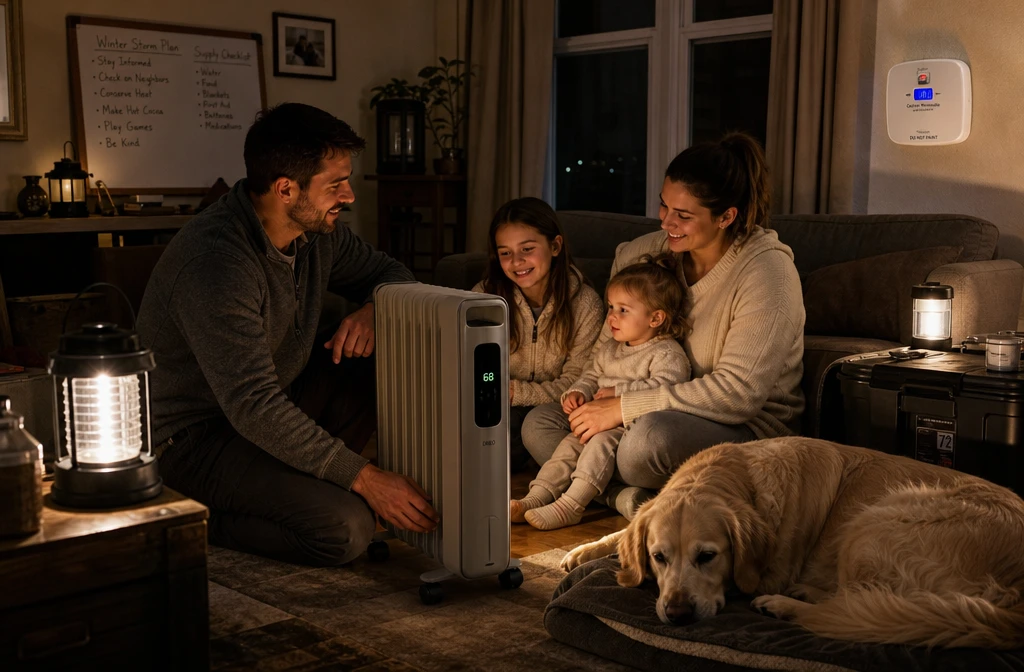
Families with children and pets should prioritize electric heaters with tip-over protection and cool-touch exteriors, combined with passive insulation strategies. Open flames, exposed heating elements, and combustion heaters all carry elevated risks when small children or curious animals are in the space.
Safe heating for families:
- Oil-filled electric radiators — no exposed heating element, surfaces stay warm but not hot enough to cause immediate burns, tip-over auto-shutoff on most modern units.
- Infrared panel heaters mounted on walls — completely out of reach of children and pets, no moving parts, no fire risk.
- Ceramic space heaters with tip-over protection — acceptable if placed on a stable surface away from high-traffic areas.
What to avoid with kids and pets:
- Kerosene heaters (open flame, hot surfaces, fuel fumes)
- Propane heaters with exposed burner elements
- Any heater without tip-over auto-shutoff
Additional precautions: Use a physical barrier (baby gate or playpen) around any heater that can’t be wall-mounted. Teach older children the 3-foot rule — nothing within 3 feet of any heater. For pet-specific emergency planning, the ultimate pet’s emergency preparedness checklist covers heating and shelter needs for animals in detail.
Emergency Heating Solutions for People With Respiratory Issues
People with asthma, COPD, or other respiratory conditions should avoid combustion-based heaters entirely when possible. Propane and kerosene combustion produces nitrogen dioxide, particulate matter, and water vapor — all of which can trigger respiratory episodes even at levels well below CO danger thresholds.
Best options for respiratory-sensitive households:
- Electric oil-filled radiators — no combustion, no particulates, no fumes. The gold standard for respiratory safety.
- Infrared electric heaters — heat objects and people directly without heating and circulating air (which can spread dust and allergens).
- Passive insulation + layered clothing — often underestimated; a well-insulated room with thermal blankets can maintain livable temperatures without any heater.
If combustion heating is unavoidable:
- Use only 1-K kerosene (lowest particulate output of combustion fuels).
- Maximize ventilation even at the cost of some heat.
- Keep the heater in an adjacent room if possible and let heat transfer passively.
- Have rescue inhalers or relevant medications stocked and accessible.
How Much Ventilation Do You Really Need With Indoor Portable Heaters?
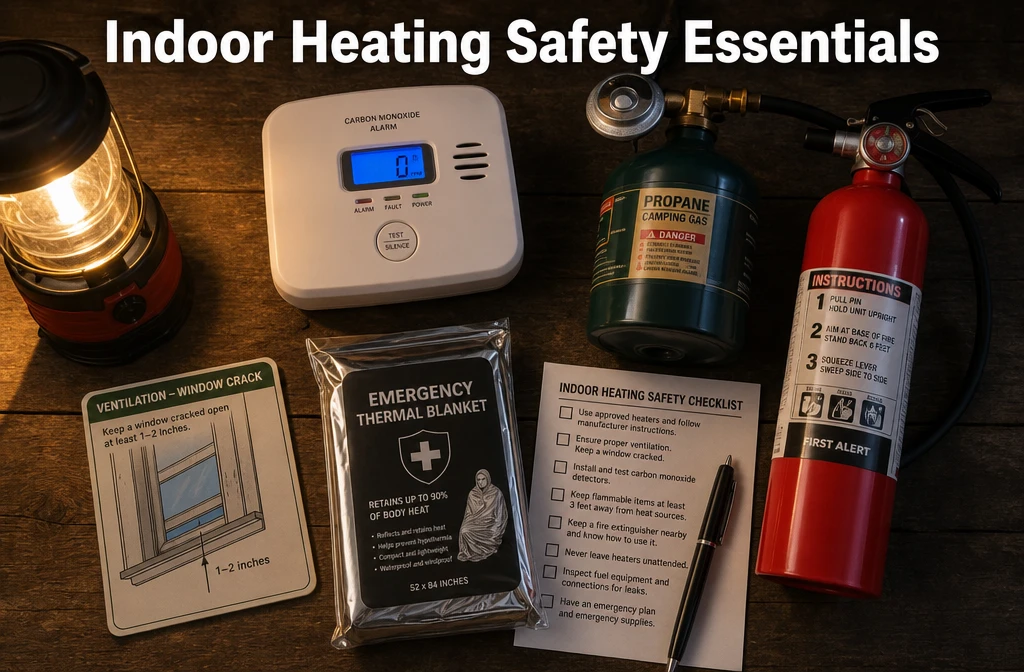
For indoor-rated propane heaters, most manufacturers recommend at least one air change per hour in the room — practically, this means cracking a window 1–2 inches or leaving a door to an adjacent room slightly open. For kerosene heaters, ventilation requirements are higher: a 1–2 inch window gap plus a door crack is the minimum for safe operation.
Ventilation by heater type:
| Heater Type | Minimum Ventilation | Notes |
|---|---|---|
| Electric (any type) | None required | No combustion byproducts |
| Indoor propane (Buddy-type) | 1-inch window crack | More in smaller rooms |
| Kerosene | 1–2 inch window + door gap | Run shorter cycles in tight spaces |
| Wood stove | Dedicated flue/chimney | Not applicable to portable use |
The practical test: If your CO detector reads above 35 ppm (the OSHA 8-hour exposure limit), you need more ventilation. Many modern CO detectors display a digital PPM reading — this is worth the extra $10–$20 over basic alarm-only models.
What Are Professional Preppers Recommending for Indoor Heat Survival in 2026?
Experienced preppers in 2026 consistently recommend a three-layer heating strategy rather than relying on a single heat source. The consensus approach combines passive insulation, a primary electric or propane heater, and a thermal sleeping system as the final fallback.
The professional prepper heating stack:
- Passive layer: Window insulation film, door draft stoppers, heavy curtains, and room consolidation. This costs under $50 and reduces heat demand by 20–40%.
- Primary heat source: An indoor-rated propane heater (for off-grid) or a 1,500W electric heater on a backup power system. Budget $60–$200 for the heater plus fuel or power storage.
- Thermal fallback: A 0°F-rated sleeping bag per person, plus emergency thermal blankets. If all else fails, two people in a quality sleeping bag can maintain body temperature in very cold conditions.
The safest indoor fire alternatives survival experts recommend also include investing in a quality CO/smoke combination detector, keeping it battery-backed, and testing it monthly. That single $30–$50 device is the most important safety item in any indoor heating setup.
For a comprehensive view of how heating fits into your overall preparedness infrastructure, the ultimate guide to home emergency preparedness covers heating alongside power, water, and food systems.
Signs That Your Emergency Heater Might Be Malfunctioning
A malfunctioning emergency heater can produce dangerous levels of CO or become a fire hazard before any visible sign appears. Knowing the warning signs — and trusting your CO detector — is the difference between catching a problem early and a serious emergency.
Warning signs by heater type:
Propane heaters:
- Yellow or orange flame instead of blue (indicates incomplete combustion and elevated CO output)
- Soot or black residue on the heater body or nearby surfaces
- Unusual smell beyond normal propane odor
- Pilot light that repeatedly goes out
Kerosene heaters:
- Dark, sooty smoke from the burner
- Strong fuel smell that doesn’t dissipate
- Wick that won’t stay lit or burns unevenly
- Visible flame that’s too high or flickering excessively
Electric heaters:
- Burning smell (could indicate dust on elements, but also wiring issues)
- Tripping circuit breakers repeatedly
- Discoloration or melting on the cord or plug
- Heater cycling on and off more frequently than normal
Universal rule: If your CO detector alarms, don’t investigate the heater first — get everyone out, then ventilate. CO detectors alarm at 70 ppm for 1–4 hours of exposure (UL 2034 standard), but symptoms can begin at lower levels in sensitive individuals.
FAQ: Indoor Emergency Heating for Preppers
Can I use a propane camp stove for heat indoors?
No. Camp stoves are designed for cooking, not heating, and burn fuel inefficiently in ways that produce high CO concentrations. Using one for heat in an enclosed space is genuinely life-threatening.
What’s the safest heater to leave on overnight?
An oil-filled electric radiator with tip-over protection and a thermostat is the safest option for overnight use. Never leave a combustion heater running while sleeping.
How many 1lb propane canisters should I stockpile?
For a 72-hour outage using a Mr. Heater Buddy on low for 6 hours daily, plan for 6–8 canisters minimum. For longer scenarios, a 20lb tank with an adapter hose is more economical and takes up less storage space.
Do I really need a CO detector if I crack a window?
Yes. Ventilation reduces CO buildup but doesn’t eliminate it. CO detectors are inexpensive insurance against the gap between “I think this is enough ventilation” and “this is actually enough ventilation.”
Is a fireplace safe for indoor heating during emergencies?
A properly maintained wood-burning fireplace with an open damper and functional flue is safe and effective. A gas fireplace requires a functioning gas line. Neither should be used if the chimney hasn’t been inspected recently — creosote buildup is a significant fire risk.
Can I heat my home with candles?
Not meaningfully. A standard candle produces roughly 80 BTU/hour — you’d need hundreds to make a dent in room temperature. Candles are useful for light and minor psychological warmth but are not a practical heat source.
What’s the minimum temperature a home needs to stay above to prevent pipe damage?
Generally, indoor temperatures should stay above 55°F to prevent pipe freezing, though 50°F is often cited as the absolute minimum. Focus heating efforts on rooms with exposed pipes if temperatures drop that low.
Are infrared heaters better than ceramic heaters?
Infrared heaters warm objects and people directly without heating the air first, making them more efficient in drafty spaces. Ceramic heaters warm the air, which works better in well-insulated rooms. Both are safe electric options.
How do I know if my indoor propane heater is rated for indoor use?
Look for explicit “indoor safe” or “indoor/outdoor” labeling on the product. The Mr. Heater Buddy series is the most widely recognized indoor-rated propane heater. Heaters without this designation should be assumed outdoor-only.
What’s the best heating option for a basement shelter?
An electric oil-filled radiator (if power is available) or an indoor-rated propane heater with a window crack. Basements are often better insulated than above-grade spaces, which works in your favor — but they also have less natural ventilation, so CO risk is higher with combustion heaters.
Can I use a kerosene heater in a garage?
With the garage door open or cracked significantly, yes. In a closed garage, no — same CO risk as any enclosed space.
What’s the most important single purchase for indoor emergency heating safety?
A CO detector with a digital PPM display. It costs $30–$60 and is the one device that catches every combustion heating mistake before it becomes fatal.
Products, Tools, and Resources Worth Having
Building a reliable indoor heating system doesn’t require spending thousands of dollars. These are the items experienced preppers actually use — not the most expensive options, but the ones that deliver consistent results when it matters.
VESTA IndoorHeater— The most widely trusted indoor-rated portable propane heater in the prepper community. designed to run on InstaFire 6-Hour Canned Heat.
Oil-Filled Electric Radiator (DeLonghi or Pelonis) — The safest electric option for families. No exposed elements, retains heat after shutoff, and runs quietly. The DeLonghi TRD40615T is a reliable mid-range choice at $80–$120.
Grid Doctor 3300 Solar Generator System w/ EMP Intercept Technology — The Grid Doctor 3300 is a high-output, mid-to-high capacity solar generator system. It’s designed for people who need to power real household loads, not just small electronics.
Kidde KN-COPP-3 CO Detector — Shows actual PPM readings, not just an alarm. Battery-backed. Around $30–$45. Buy two — one for the sleeping area, one near the primary heat source.
Emergency Mylar Thermal Blankets (10-pack) — Under $15 for a pack of 10. Reflect 90% of body heat. Every member of your household should have one in their emergency kit and one in their bedroom during winter outages.
1-K Kerosene and a Dyna-Glo or Sengoku kerosene heater — For preppers who want a combustion backup that doesn’t depend on propane canister availability. Kerosene stores well in sealed containers and is widely available. A mid-size kerosene heater runs $80–$150 and produces serious BTU output.
For a full breakdown of how heating integrates with your backup power setup, the complete prepper’s guide to backup power for emergencies is an essential companion to this guide. And if you’re building out your broader preparedness system, the 14 essential survival skills every prepper must know covers the foundational competencies that make all your gear actually useful.
Staying warm when the grid fails isn’t complicated — but it does require making decisions before the emergency, not during it. Pick your primary option, stock your fuel or power, install your CO detector, and practice your ventilation setup at least once before winter. That’s the difference between being prepared and being caught off guard.