
Hey there! Some links on this page may be affiliate links which means that, if you choose to make a purchase, I may earn a commission at no extra cost to you. I greatly appreciate your support. Read the full disclosure here.
The average American household spends over $5,000 per year on groceries, and every dollar of that depends on a supply chain that can fail in ways most people never anticipate. Trucking strikes, regional droughts, grid failures, and economic shocks have all disrupted food access in recent memory. Survival garden planning for food independence is the practical answer to that vulnerability. It’s not a hobby. It’s a strategic system that converts sunlight, soil, and seed into genuine security for your family.
Key Takeaways
- A survival garden differs from a regular garden in purpose: it’s designed to produce maximum calories and nutrients per square foot, not aesthetic variety.
- A family of four needs roughly 4,000 to 6,000 square feet of productive growing space to meet most of their caloric needs from a garden alone.
- Heirloom, open-pollinated seeds are non-negotiable for long-term food independence because they can be saved and replanted indefinitely.
- The most valuable survival crops combine high calorie density with long storage life: potatoes, dry beans, winter squash, sweet potatoes, and corn.
- No garden alone covers 100% of nutritional needs without supplementation from stored food, foraging, or animal husbandry.
- Beginners should start small (200 to 400 square feet), master core skills, then scale up over two to three growing seasons.
- Water is the single biggest constraint in a survival garden, rainwater collection and gravity-fed irrigation should be built into the plan from day one.
- Preservation without electricity (root cellaring, lacto-fermentation, dehydrating, and dry storage) is as important as growing the food itself.
- Container and small-space gardens can meaningfully supplement stored food even for apartment dwellers.
- Setup costs for a functional beginner survival garden run between $200 and $800 depending on soil condition and infrastructure needs.
Find this useful? Add us as a preferred source on Google and more of what we publish will show up in your results.
What Is a Survival Garden and How Is It Different from a Regular Garden
A survival garden is a food-producing system engineered specifically for caloric output, nutritional completeness, and long-term storage, not curb appeal. Where a typical backyard garden might grow a few tomato plants and some herbs for summer salads, a survival garden is built around the question: “Could this garden keep my family fed if the grocery store closed tomorrow?”
The differences are significant:
- Purpose: Regular gardens supplement meals. Survival gardens replace them.
- Crop selection: Survival gardens prioritize high-calorie, storable staples (beans, potatoes, squash) over low-calorie, perishable produce (lettuce, cucumbers).
- Seed type: Survival gardens rely on heirloom, open-pollinated seeds that can be saved year after year. Hybrid seeds from a garden center cannot be reliably replanted.
- Scale: A survival garden is sized to meet a meaningful percentage of a household’s annual caloric needs.
- Infrastructure: Water storage, soil building, and preservation systems are built in from the start, not added as afterthoughts.
The mindset shift is what matters most. Survival garden planning for food independence treats the garden as critical infrastructure, not a weekend project.
How Much Land Do You Need for a Survival Garden to Feed a Family
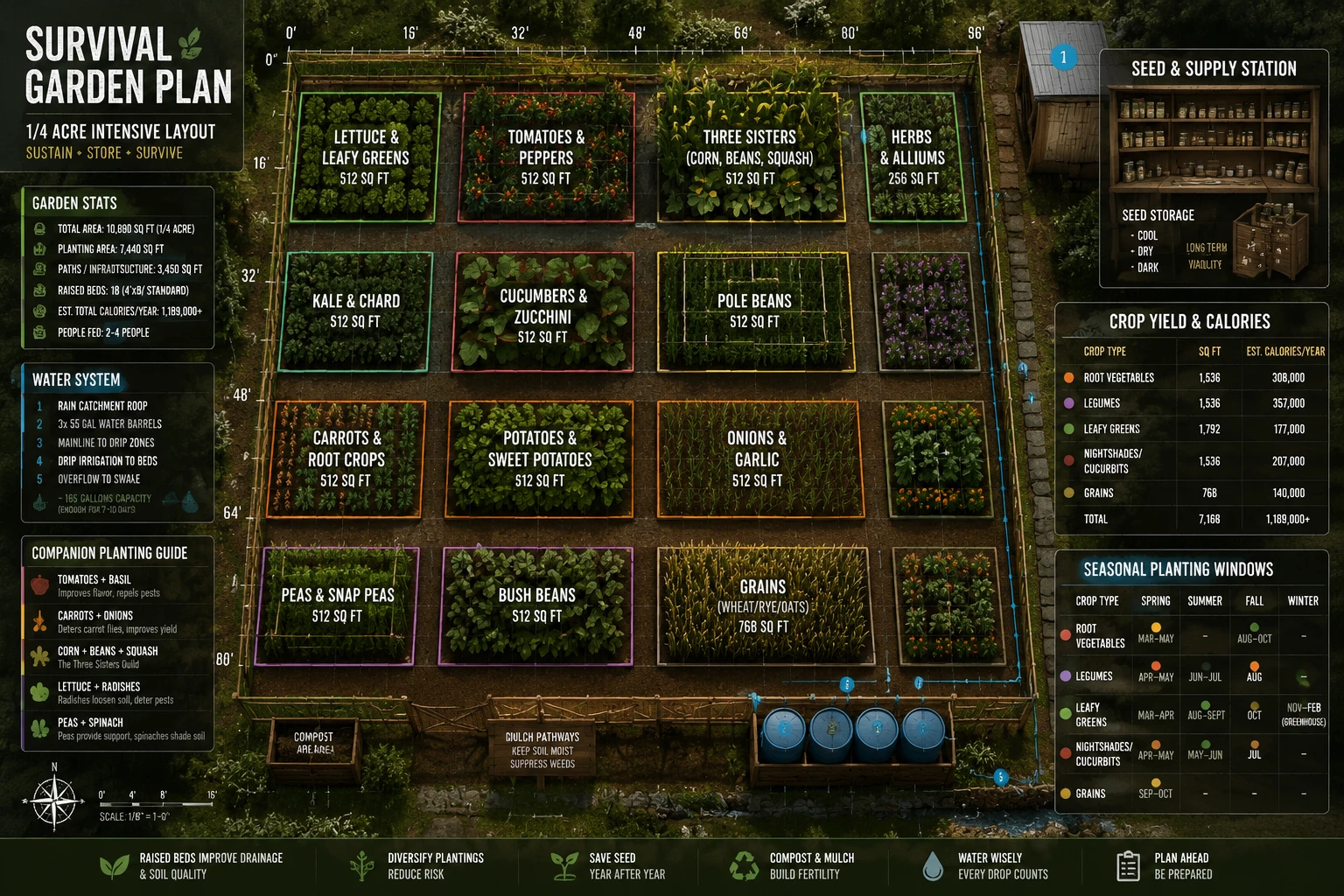
For a family of four to meet the majority of their caloric needs from a garden, plan for 4,000 to 6,000 square feet of productive growing space. This estimate assumes intensive planting methods, good soil, and a mix of high-calorie staple crops. It does not account for losses to pests, drought, or crop failure, which is why most experienced preppers add a 20 to 30 percent buffer.
Here’s a practical breakdown by household size:
| Household Size | Minimum Space (sq ft) | Recommended Space (sq ft) | Notes |
|---|---|---|---|
| 1 person | 1,000 | 1,500 | Supplements stored food |
| 2 people | 2,000 | 3,000 | Covers ~60-70% of calories |
| 4 people | 4,000 | 6,000 | Full-season production needed |
| 6 people | 6,000 | 9,000 | Add grain crops if space allows |
These numbers assume intensive raised-bed or in-ground planting, not wide-row conventional spacing. Techniques like square-foot gardening and vertical growing can compress these requirements somewhat, but caloric math doesn’t lie, people need roughly 2,000 calories per day, and most vegetables are not calorie-dense enough to carry that load without serious acreage.
Common mistake: Beginners overestimate how many calories a vegetable garden actually produces. A bed of lettuce and tomatoes looks productive but delivers very few calories. Build your space plan around calorie-dense staples first, then add nutrient crops.
Best Vegetables to Grow in a Survival Garden for Long-Term Storage
The best survival garden crops combine high caloric density, reliable yields, and the ability to be stored for months without refrigeration. Prioritize these above all others when planning your garden.
Tier 1, Calorie Staples (plant the most of these):
- Dry beans and legumes (black beans, pinto beans, navy beans): 1,500+ calories per pound dried, easy to store for 10+ years
- Potatoes: 300-400 calories per pound, store well in a root cellar for 4-6 months
- Sweet potatoes: High in calories and vitamin A, store 4-6 months in cool, dry conditions
- Winter squash (butternut, hubbard, acorn): Stores 3-6 months at room temperature, calorie-dense
- Corn (dent corn or flour corn): Can be dried and ground into meal, stores for years
Tier 2, Nutritional Density (plant plenty of these):
- Kale and collard greens: Cold-hardy, packed with vitamins C and K
- Garlic and onions: Long shelf life, medicinal value, flavor for stored-food cooking
- Sunflowers: Seeds provide healthy fats, which are scarce in a vegetable-only diet
- Beets: Calorie-dense root, greens are edible, stores well
Tier 3, Supplemental Crops (grow what space allows):
- Tomatoes (canning), cucumbers (pickling), peppers (drying), herbs (medicinal and culinary)
A survival garden built around Tier 1 crops will keep a family fed. One built around Tier 3 crops will leave them hungry. Plan accordingly.
Survival Garden Planning Timeline: What to Plant When
Effective survival garden planning for food independence depends on working with your growing season, not against it. The planting timeline varies by climate zone, but the general framework holds across most of North America.
Year-Round Planning Calendar (Northern Hemisphere, Zones 5-7):
- January, February: Order heirloom seeds, test stored seeds for germination rate, plan bed layouts, start onions and leeks indoors
- March, April: Start tomatoes, peppers, and squash indoors 6-8 weeks before last frost; direct sow cold-hardy greens (kale, spinach, peas) outdoors
- May: After last frost, transplant warm-season crops; direct sow beans, corn, and potatoes
- June, July: Succession-plant beans every 2-3 weeks for continuous harvest; maintain, weed, and water
- August, September: Begin harvesting and preserving; plant fall crops (brassicas, root vegetables, garlic for next year)
- October, November: Harvest winter squash and root crops; cure potatoes and sweet potatoes; collect and dry seeds
- December: Inventory preserved food, assess what worked, order seeds for next year
Critical rule: Always plant more than you think you need. Crop failure is not a hypothetical, it’s a statistical certainty over multiple seasons. A 30% failure rate on any given crop is normal.
How to Start a Survival Garden with No Experience
Anyone can start a survival garden in 2026 with zero prior experience, but the first season should be treated as a learning investment, not a food production target. Start with 200 to 400 square feet, choose forgiving crops, and build skills before scaling.
Step-by-step for first-time growers:
- Test your soil before planting anything. A basic soil test (available from most county extension offices for under $20) tells you pH and nutrient levels. Most survival crops need a pH between 6.0 and 7.0.
- Build or amend beds using compost, aged manure, or a no-till lasagna method. Good soil is the single biggest predictor of success.
- Start with forgiving crops: Zucchini, beans, kale, radishes, and potatoes are hard to kill and produce reliably for beginners.
- Buy heirloom seeds only. Avoid hybrid seed packets from big-box stores. Sources like Baker Creek Heirloom Seeds, Seed Savers Exchange, and Southern Exposure Seed Exchange carry reliable open-pollinated varieties.
- Learn to save seeds from your best plants at the end of the season. This skill eliminates seed dependency entirely over time.
- Keep a garden journal. Record what you planted, when, what worked, and what failed. This data becomes invaluable by year two.
For those building toward full self-reliance, pairing a survival garden with a broader homesteading strategy creates a much stronger foundation. The complete beginner’s guide to homesteading covers the broader skill set needed to make that transition.
Where to Get Heirloom Seeds for a Survival Garden
Heirloom, open-pollinated seeds are the foundation of long-term food independence because they can be saved, replanted, and passed down indefinitely. Never build a survival garden around hybrid seeds that require annual repurchasing.
Trusted sources for heirloom seeds in 2026:
- Baker Creek Heirloom Seeds (rareseeds.com): One of the largest heirloom seed catalogs in North America, with thousands of varieties
- Seed Savers Exchange (seedsavers.org): Non-profit organization dedicated to preserving heirloom varieties; excellent for rare and regional cultivars
- Southern Exposure Seed Exchange: Specializes in varieties adapted to hot, humid climates
- Native Seeds/SEARCH: Focuses on drought-tolerant, arid-climate varieties ideal for Southwest preppers
- Local seed libraries: Many public libraries and community gardens now host seed libraries, free and locally adapted
Seed storage for preppers: Store seeds in airtight containers (glass mason jars with oxygen absorbers work well) in a cool, dark, dry location. Properly stored heirloom seeds can remain viable for 3 to 10 years depending on the species. Onions and parsnips have the shortest viability (1-2 years); tomatoes, beans, and squash can last 4-6 years or more.
Decision rule: If you’re buying seeds for a long-term cache, prioritize beans, corn, squash, and tomatoes first, they store longest and produce the most calories.
Can You Survive on Just a Garden, or Do You Need Other Food Sources
A garden alone cannot provide complete nutrition for most people without careful planning and supplementation. This is one of the most important truths in survival garden planning for food independence.
The gaps a garden typically cannot fill on its own:
- Fats: Vegetables contain almost no fat. Without cooking oil, animal fat, or oilseeds (sunflowers, flax), calorie intake collapses even with a large harvest.
- Complete proteins: Plant proteins are incomplete. Combining beans with corn or grains solves this, but requires intentional planning.
- Vitamin B12: Found almost exclusively in animal products. Long-term deficiency causes serious neurological damage.
- Calories in winter: Most gardens produce little to nothing from November through March in cold climates.
The realistic answer: A well-planned survival garden can realistically cover 50 to 70 percent of a family’s caloric needs during the growing season. The remaining gap should be filled by a combination of long-term stored food, animal husbandry (chickens for eggs, rabbits, or goats), foraging, and hunting or fishing where applicable.
Pairing your garden with a deep pantry is essential. The ultimate survival pantry list outlines exactly what to stock to cover the nutritional gaps a garden can’t fill. For calorie-dense options with a long shelf life, the complete guide to freeze-dried food is worth reading alongside this one.
Survival Garden Watering and Maintenance When SHTF
Water is the hardest constraint to solve in a grid-down scenario. Municipal water pressure disappears, electric pumps stop working, and hand-watering a 5,000-square-foot garden becomes an enormous daily labor burden. Plan your water system before you need it.
Water-efficient strategies for survival gardening:
- Rainwater collection: Install gutters and collection barrels on any outbuilding near the garden. A 1,000-square-foot roof can collect roughly 600 gallons from a single inch of rain. The rainwater collection emergency survival setup guide covers the setup in detail.
- Swales and earthworks: Contour swales dug along hillside gardens slow runoff and direct water into the soil passively.
- Mulch heavily: 3 to 4 inches of wood chip or straw mulch reduces soil moisture evaporation by 50 to 70 percent, dramatically cutting watering needs.
- Drip irrigation from gravity-fed barrels: A barrel elevated 2 to 3 feet above ground level generates enough pressure to run basic drip tape without electricity.
- Drought-tolerant varieties: Choose crop varieties specifically bred for low water needs. Many heirloom varieties pre-date irrigation and are naturally more drought-tolerant than modern hybrids.
Maintenance priorities in a grid-down scenario: Focus labor on weeding (which competes directly for water and nutrients), pest management, and harvesting at peak ripeness. Let non-critical tasks slide before you let watering and weeding slide.
Survival Garden Mistakes Beginners Make
Most first-year survival gardeners make the same predictable errors. Knowing them in advance saves an entire growing season.
The most costly mistakes:
- Planting only what you like to eat, not what stores well. Zucchini is fun to grow but won’t feed you in February. Dry beans and winter squash will.
- Ignoring soil health. Planting in poor, compacted, or pH-imbalanced soil guarantees weak yields regardless of how much effort goes into everything else.
- Buying hybrid seeds instead of heirloom. Hybrids can’t be reliably saved. This creates a seed dependency that defeats the purpose of food independence.
- Underestimating water needs. A 4,000-square-foot garden in summer may need 1,000 gallons per week during a drought. Plan water storage accordingly.
- No preservation plan. Growing food and then losing it to spoilage because there’s no preservation system in place is one of the most demoralizing mistakes a prepper can make.
- Planting everything at once. Without succession planting, everything ripens simultaneously and overwhelms preservation capacity.
- Skipping seed saving. Even one season of seed saving creates a self-sustaining seed bank. Delay this skill and you remain dependent on outside supply chains.
For a broader look at food storage errors that compound these garden mistakes, the guide on food storage mistakes to avoid is directly relevant.
How to Preserve and Store Survival Garden Food Without Electricity
Preservation without electricity is a non-negotiable skill for anyone serious about survival garden planning for food independence. Growing food and losing it to spoilage defeats the entire purpose.
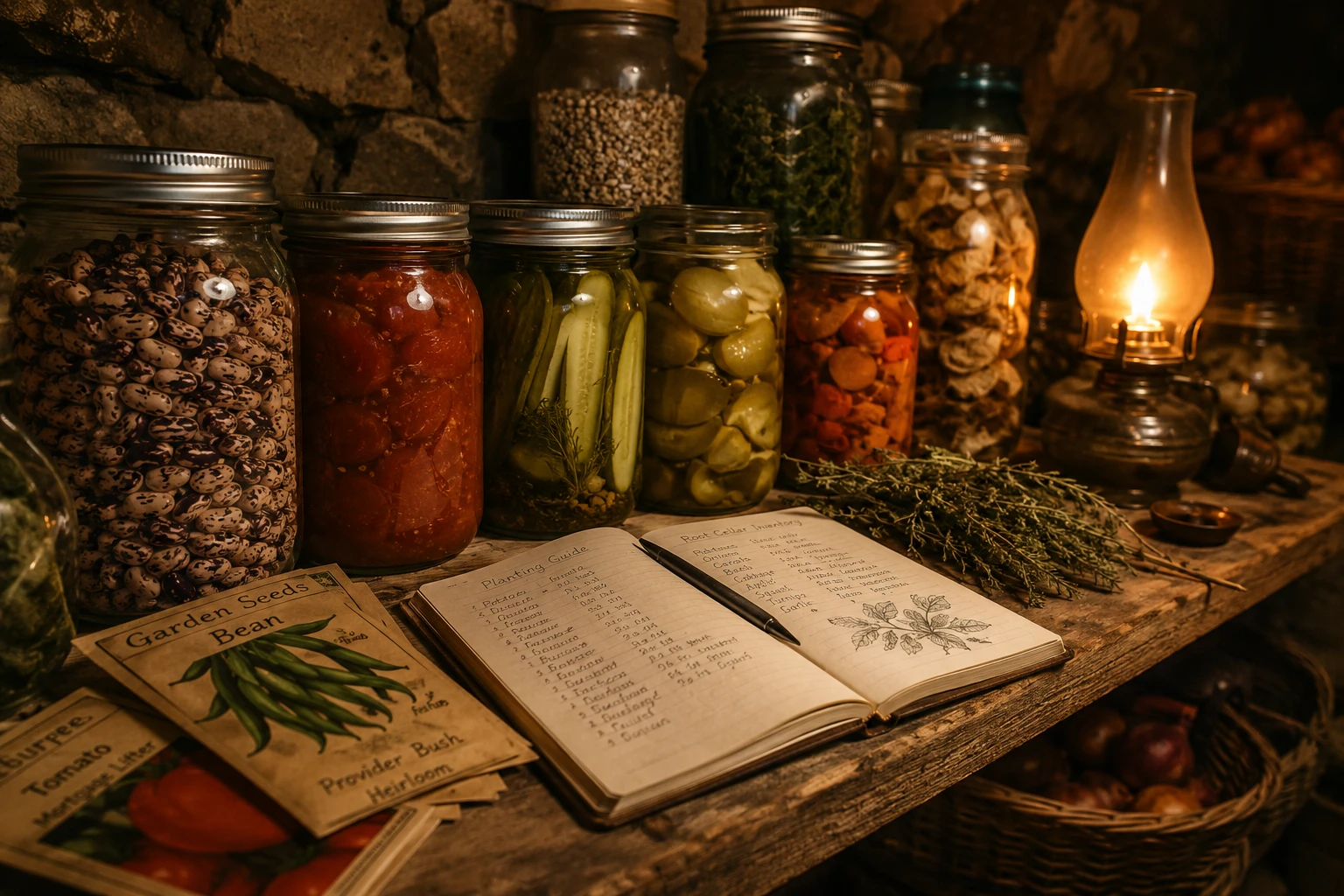
Primary preservation methods that require no electricity:
- Root cellaring: A cool (32-40°F), humid, dark space (basement corner, buried barrel, or dedicated root cellar) stores potatoes, carrots, beets, turnips, and winter squash for months without any processing.
- Lacto-fermentation: Salt-brining vegetables (sauerkraut, kimchi, pickles) preserves them for 6 to 12 months at room temperature and adds beneficial probiotics. No canning equipment needed.
- Dehydrating: Sun-drying or using a solar dehydrator removes moisture from fruits, vegetables, and herbs. Dried food stores for 1 to 3 years in airtight containers.
- Dry storage: Beans, corn, and grains dried to under 12% moisture content store for 10+ years in sealed containers with oxygen absorbers.
- Pressure canning (wood-fired): A wood-burning stove or outdoor fire can power a pressure canner. This method is essential for low-acid foods like beans, meat, and vegetables.
- Salt curing: High-salt brines preserve meat and fish without refrigeration, a technique used for centuries before electricity existed.
Priority order for preppers: Learn root cellaring and dry storage first (lowest skill barrier, highest caloric payoff), then fermentation, then dehydrating, then canning. Each method covers different food types and storage durations.
Pair your preservation knowledge with a solid long-term storage system. The complete beginner’s guide to long-term food storage covers the storage side in depth.
Survival Garden for Small Spaces, Apartments, or Containers
Small-space gardening cannot replace a full survival garden, but it can meaningfully supplement stored food supplies and build critical growing skills. For apartment dwellers, container gardening is a practical starting point.
High-value crops for containers and small spaces:
- Dwarf/bush beans: Produce well in 5-gallon containers, high protein content
- Kale and Swiss chard: Extremely productive per square inch, grow in window boxes or small raised beds
- Cherry tomatoes: High yield in containers, can be sun-dried for preservation
- Herbs (basil, thyme, rosemary, oregano): Medicinal and culinary value, very small footprint
- Microgreens: Extremely nutrient-dense, grow in trays on a windowsill, harvest in 7-14 days
- Dwarf sweet potatoes: Can be grown in large containers (15+ gallons) on a balcony
Realistic expectation: A well-managed apartment container garden might supply 5 to 15 percent of a person’s vegetable needs. That’s meaningful supplementation, not food independence. Use it to build skills and reduce grocery dependence while working toward a larger growing setup.
For urban preppers working within tight space constraints, the ultimate guide to prepping in a small apartment covers the full picture of urban self-reliance, including food strategies.
Survival Garden in Cold Climates: What Grows in Winter
Cold-climate preppers face a real gap in food production from roughly November through March. The solution is a combination of cold-hardy crops, season extension techniques, and heavy reliance on preserved summer harvest.
Crops that survive or thrive in cold conditions:
- Kale: Survives hard frosts and actually improves in flavor after freezing; some varieties survive to -10°F
- Spinach: Hardy to about 20°F, can be overwintered under row cover or low tunnels
- Garlic: Planted in fall, overwinters underground, harvested in summer
- Leeks: Cold-hardy to 0°F, can be harvested through winter in many climates
- Parsnips and carrots: Left in the ground and harvested as needed through winter; cold converts starch to sugar, improving flavor
- Mache (corn salad): One of the most cold-hardy salad greens, survives under snow
Season extension tools:
- Cold frames: Simple box with a glass or polycarbonate lid extends the growing season by 4 to 6 weeks on each end
- Row cover (Agribon): Lightweight fabric adds 4 to 8 degrees of frost protection
- Hoop houses and low tunnels: PVC or wire hoops with plastic sheeting create a microclimate that enables winter growing in Zones 5 and above
Cold-climate strategy: Grow as much as possible during the warm season, preserve aggressively, and use cold-hardy crops and season extension to stretch fresh production into late fall and early spring.
Survival Garden Pest Control Without Chemicals
Chemical pesticides create a dependency on supply chains and can contaminate food intended for long-term storage. Effective pest management in a survival garden relies on ecological methods that work without any external inputs.
Proven non-chemical pest control strategies:
- Companion planting: Interplanting repellent plants disrupts pest cycles. Basil repels aphids and spider mites near tomatoes. Marigolds deter nematodes and whiteflies. Nasturtiums act as trap crops for aphids.
- Physical barriers: Row cover fabric prevents most flying insect pests from reaching crops entirely. Copper tape deters slugs. Collars around transplant stems stop cutworms.
- Crop rotation: Never plant the same crop family in the same bed two years in a row. This breaks the life cycle of soil-dwelling pests and diseases.
- Beneficial insects: Attract ladybugs, lacewings, and parasitic wasps by planting flowering herbs (dill, fennel, yarrow). These predators consume aphids, caterpillars, and other pests.
- Diatomaceous earth: Food-grade DE applied around plant bases kills soft-bodied insects through physical abrasion. Safe for humans and animals, effective against slugs, beetles, and crawling insects.
- Hand-picking: Labor-intensive but highly effective for large pests like tomato hornworms, squash bugs, and Colorado potato beetles. Check plants daily during peak pest season.
Decision rule: If a single pest is destroying a critical calorie crop, prioritize physical removal and barriers first. Chemical intervention, even organic-approved options, should be the last resort in a true survival scenario where supply chains may be compromised.
How Much Does It Cost to Set Up a Survival Garden
A functional beginner survival garden can be set up for $200 to $800, depending on existing soil quality and whether infrastructure (fencing, raised beds, water collection) needs to be built from scratch. This is one of the most cost-effective preparedness investments available.
Cost breakdown for a 400-square-foot starter garden:
- Heirloom seed collection: $50,$100 (one-time; seeds saved annually after year one)
- Soil amendment (compost, aged manure): $50,$150 depending on quantity needed
- Basic tools (shovel, hoe, trowel, watering can): $80,$150 if buying new; often free from estate sales or neighbors
- Raised bed lumber (optional): $100,$200 for 2-4 beds
- Row cover and basic pest protection: $30,$60
- Rain barrel (55-gallon): $30,$80 new; often free from food-grade barrel sources
Scaling costs: Moving from a 400-square-foot beginner garden to a 4,000-square-foot family production garden adds roughly $500 to $2,000 in additional soil, infrastructure, and water storage costs, spread over two to three seasons as skills and confidence grow.
The real return on investment: A family growing 50 percent of their own food from a mature survival garden can realistically save $1,500 to $3,000 per year in grocery costs, while building a food security buffer that no store-bought stockpile can fully replicate.
Frequently Asked Questions
How long does it take to build a fully functional survival garden?
Most preppers reach meaningful food production in year one, but a fully functional survival garden, with established soil health, saved seed stock, preservation systems, and proven crop yields, typically takes two to three full growing seasons to develop.
What are the most calorie-dense vegetables I can grow?
Potatoes, dry beans, sweet potatoes, and dent corn deliver the most calories per square foot. Winter squash and sunflowers are close behind. These five crops should anchor any calorie-focused survival garden.
Do I need to own land to start a survival garden?
No. Container gardening works for apartments. Community garden plots are available in most cities for $25 to $75 per season. Some preppers rent or borrow land from rural neighbors in exchange for a share of the harvest.
What’s the difference between heirloom and hybrid seeds?
Heirloom seeds are open-pollinated varieties that breed true from saved seed. Hybrid seeds are crosses between two parent lines and do not reliably reproduce the same plant when saved. For food independence, heirloom seeds are the only viable long-term choice.
How do I store seeds long-term?
Seal seeds in airtight glass jars with a small silica gel packet to control moisture. Store in a cool, dark location (ideally below 50°F). A chest freezer or refrigerator works for multi-year storage if power is available; a cool basement works otherwise.
Can a survival garden work in a drought-prone area?
Yes, with the right crop selection and water management. Choose drought-tolerant heirloom varieties, mulch heavily, build water catchment systems, and consider dryland farming techniques like swales and hugelkultur beds that retain moisture passively.
How do I keep animals out of my survival garden without electricity?
A physical fence is the most reliable solution. A 6-foot fence with a 12-inch outward-angled top deters deer. Hardware cloth buried 12 inches underground stops burrowing animals. For smaller pests, row cover and raised beds with hardware cloth bottoms are effective.
What should I grow first if I only have one season to prepare?
Prioritize dry beans, potatoes, and winter squash. These three crops together provide carbohydrates, protein, and fat-soluble vitamins, store without refrigeration, and produce reliably for beginners.
Is a survival garden worth it if I already have a year’s worth of stored food?
Absolutely. Stored food has a finite end date. A survival garden is a renewable food system that produces indefinitely. The two systems complement each other, stored food covers the gap while the garden is establishing, and the garden reduces dependence on the stored supply.
What tools are truly essential for a survival garden?
A quality spade or fork, a hoe, a hand trowel, and a watering can or hose cover 90 percent of garden tasks. Add a broadfork for deep soil aeration and a wheel hoe for large-scale weeding as the garden scales up.
Conclusion
Survival garden planning for food independence is one of the highest-leverage preparedness investments a person can make. It converts a passive stockpile mentality into an active, renewable food system that produces real security season after season. The skills compound. The soil improves. The seed bank grows. And the family that tends it becomes genuinely less dependent on supply chains that can and do fail.
Start with the fundamentals: good soil, heirloom seeds, calorie-dense crops, and a water plan. Build preservation skills alongside growing skills. Scale up as confidence grows, not before. And pair the garden with a strong stored food foundation so that a bad harvest year doesn’t become a crisis.
The goal isn’t perfection in year one. It’s progress, and the kind of quiet confidence that comes from knowing your family’s food supply doesn’t depend entirely on a truck arriving on time.
For those building out a complete preparedness system alongside their garden, the 3-month emergency food supply guide and the 50 best foods for long-term storage are the logical next resources to consult.
Products, Tools, and Resources
Building a survival garden doesn’t require expensive equipment, but a few well-chosen tools make a significant difference in both productivity and longevity.
Seeds: Baker Creek Heirloom Seeds and Seed Savers Exchange are the two most trusted sources for preppers. Both offer bulk seed options and carry varieties specifically noted for storage and cold-hardiness.
Soil testing: The Luster Leaf Rapitest Soil Test Kit (~$20) gives accurate pH and NPK readings in minutes and is a worthwhile first purchase for any new garden site.
Preservation equipment: A quality pressure canner (All American or Presto brands) is a one-time investment that lasts decades and enables safe preservation of low-acid foods. For non-electric preservation, a set of wide-mouth mason jars with oxygen absorbers covers dry storage and fermentation.
Water collection: A 55-gallon food-grade barrel with a brass spigot and diverter kit is the most cost-effective entry point for rainwater collection. Two to four barrels connected in series provide meaningful water reserves for a small garden.
Season extension: Agfabric Plant Covers row cover fabric is inexpensive, reusable for several seasons, and provides 4 degrees of frost protection, worth having on hand for both spring and fall shoulder seasons.
Reference books: “Gardening When It Counts” by Steve Solomon and “The Market Gardener” by Jean-Martin Fortier are the two most practically useful books for survival-scale food production. Both focus on low-input, high-yield methods that translate directly to a preparedness context.