
Hey there! Some links on this page may be affiliate links which means that, if you choose to make a purchase, I may earn a commission at no extra cost to you. I greatly appreciate your support. Read the full disclosure here.
How to Start Homesteading From Scratch — The Complete Beginner’s Guide
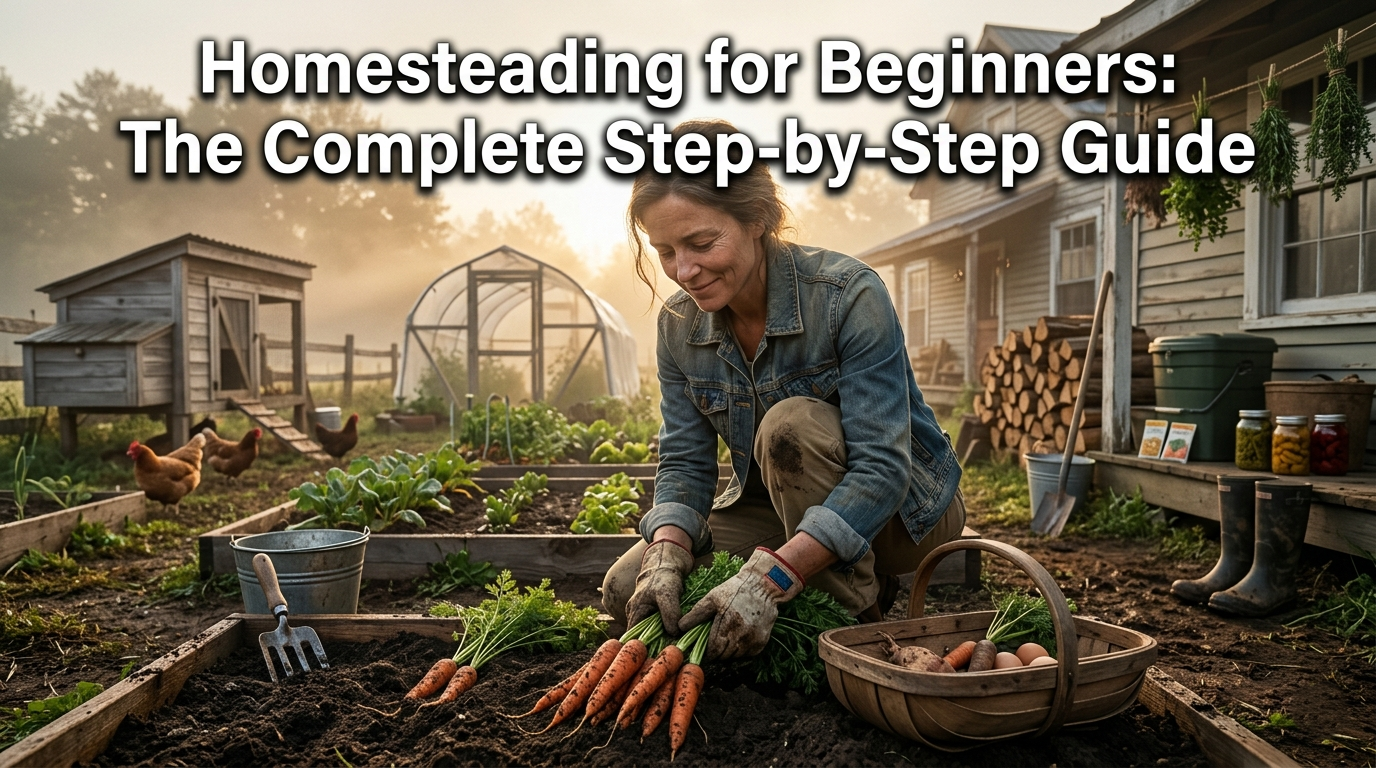
Homesteading changes the way you see food, self-sufficiency, and daily life. The first time you grow your own vegetables or collect fresh eggs from backyard chickens, you begin to understand where food truly comes from — not grocery store shelves, but healthy soil, hard work, practical skills, and sustainable living. That realization is often the first step into the rewarding world of homesteading.
At its core, homesteading is about building a more self-sufficient lifestyle. It’s not about picture-perfect farmhouse trends or social media aesthetics. Real homesteading means learning traditional skills, growing your own food, raising animals, preserving harvests, and creating systems that make your household stronger and more resilient. For many beginners, homesteading also brings a deeper connection to nature, greater food security, and a level of fulfillment modern life rarely provides.
This beginner’s guide to homesteading is designed to help you start that journey with confidence. Whether you want to create a backyard garden, raise chickens, preserve food, or move toward a more sustainable and self-reliant lifestyle, this guide will show you the practical first steps to successful homesteading.
What Homesteading Actually Is — And Why the Definition Matters More Than You Think
 Homesteading is the practice of pursuing household self-sufficiency — growing your own food, raising animals, preserving the harvest, and reducing dependence on external systems for life’s necessities. It exists on a spectrum, and understanding that spectrum is the first step toward making a decision that fits your actual life rather than someone else’s dream.
The Ultimate Guide to Off-Grid Living: Achieving Independent Homestead
The homesteading spectrum:
Backyard homesteading: Practiced on properties of any size, including urban lots and suburban backyards. Focuses on food production — vegetable gardens, fruit trees, chickens, bees — without requiring land ownership or rural relocation. More people start here than anywhere else.
Small-scale homesteading: Typically 1 to 5 acres. Adds larger gardens, more livestock (goats, pigs, rabbits), food preservation systems, and the beginning of genuine food self-sufficiency.
Full homesteading: 5 to 20+ acres. Includes comprehensive food production, livestock, food preservation, and often off-grid utility systems. Approaches genuine self-sufficiency for a household.
The critical distinction that most guides blur: homesteading is not the same as off-grid living (which focuses on utility independence) or hobby farming (which focuses on agricultural production for its own sake). Homesteading is specifically about household self-sufficiency — producing what your household needs, rather than producing for markets or pursuing independence as an end in itself.
The short version: Homesteading for beginners means starting the practice of household self-sufficiency — growing food, raising animals, and preserving the harvest — on whatever land and resources you currently have. The beginner’s priority sequence is: develop skills first, build infrastructure second, acquire animals third, and expand production fourth. Most beginners can achieve meaningful food production in their first year without owning land.
Key Takeaways
– Start homesteading by developing essential skills (gardening, food preservation, animal care) before investing in land or animals to avoid costly mistakes.
– Water access, soil quality, sun exposure, and legal zoning are critical factors when selecting homestead land for long-term success.
– Begin with practical, low-maintenance livestock like chickens, then progress to goats or rabbits only after building proper infrastructure and knowledge.
– Food preservation methods such as canning, fermentation, dehydration, and root cellaring are vital to extend harvests into year-round food security.
– Successful homesteading often combines skill-building, small-scale production, and supplemental income — frequently including remote work or value-added homestead products.
The Beginner’s Priority Framework — Why Most People Start in the Wrong Order and Pay for It
The most common and most expensive homesteading mistake is buying land before developing skills. Land without skills is an expensive liability. Skills without land can be developed anywhere — in a backyard, in a community garden, on a rented plot, or through apprenticeships on working farms.
The correct beginner sequence:
- Skills first:Learn to garden, preserve food, and care for animals before acquiring land or livestock. These skills can be developed in your current location, starting this weekend.
- Infrastructure second:Build the physical systems (garden beds, water systems, animal housing) that your skills require.
- Animals third:Acquire animals only after you have the infrastructure to house them and the skills to care for them. Not before.
- Expansion fourth:Scale what’s working, add new elements, and develop the systems that move you toward your self-sufficiency goals.
This sequence is not intuitive — the desire to buy land and start immediately is powerful. But the homesteaders who succeed consistently are the ones who developed competence before making major financial commitments. The ones who don’t follow this sequence tend to find themselves overwhelmed, financially stretched, and quietly wondering if they made a terrible mistake.
Finding and Buying Homestead Land — What Beginners Actually Need to Know
 When you’re ready for land, the decisions you make will affect your homesteading life for decades. Getting them right requires understanding what actually matters — and what doesn’t.
How much land do you actually need?
| Goal | Minimum Land |
| Vegetable garden + chickens | 1/4 acre |
| Significant food production | 1–2 acres |
| Goats + large garden | 2–5 acres |
| Meaningful food self-sufficiency | 5–10 acres |
| Full self-sufficiency (family of 4) | 10–20 acres |
What to look for in homestead land:
Water is the most critical factor — full stop. A property with a reliable well, spring, or year-round stream is significantly more valuable than one without. Water rights (particularly in the western United States) must be verified before purchase. This is not a detail to discover after closing.
Soil matters more than most beginners realize. Most rural land has been farmed, grazed, or neglected in ways that have depleted soil quality. Get a soil test before purchasing. Poor soil can be improved, but it takes time and investment — often years.
Sun exposure determines what you can grow. A property with significant tree cover or north-facing slopes will limit your garden productivity in ways that are difficult and expensive to overcome.
Access is practical and non-negotiable. Year-round road access is essential. Properties accessible only by seasonal roads create serious problems that become apparent the first time you need to get somewhere in February.
Zoning and building codes can surprise you. Verify what you can legally build and what animals you can legally keep before purchasing. Some rural areas have surprisingly restrictive regulations that don’t become apparent until you’re already committed.
The cheapest regions for homestead land in the US:
The most affordable homestead land is currently found in the Ozarks (Missouri, Arkansas), Appalachia (West Virginia, Kentucky, Tennessee), the rural Southeast, and parts of the Great Plains. Expect to pay $1,000 to $5,000 per acre in these regions for land suitable for homesteading.
The Homestead Garden — Where Self-Sufficiency Actually Begins
The garden is the foundation of every homestead. It is also the skill that takes the longest to develop — a productive garden requires understanding your soil, your climate, your pests, and your plants in ways that only come from years of practice. Start now. Start small. Start before you think you’re ready.
What to plant in year one:
Focus on high-calorie, high-yield crops that store well and that your household will actually eat. This last part matters more than most guides acknowledge.
High-calorie foundation crops:
- Potatoes: 50 to 100 pounds per 100 square feet. Store for 6 to 12 months. The most calorie-dense vegetable crop available.
- Winter squash: 30 to 60 pounds per 100 square feet. Store for 3 to 6 months without refrigeration.
- Dried beans: 5 to 15 pounds per 100 square feet. Store for 1 to 5 years. Essential protein source.
- Sweet corn (dried): 10 to 20 pounds per 100 square feet. Store for 1 to 5 years.
High-nutrition supplementary crops:
- Leafy greens (kale, chard, spinach) for vitamins and minerals
- Tomatoes for vitamins C and K
- Garlic and onions for flavor and preservation
- Herbs for flavor and medicinal use
Soil building — the investment that makes everything else possible:
Most beginner homesteaders underestimate the importance of soil quality and overestimate how quickly it can be improved. Building productive soil is a multi-year process that requires:
- Composting: Converting kitchen scraps, garden waste, and animal manure into rich compost. A well-managed compost system produces 1 to 2 cubic yards of finished compost per year from a household’s organic waste.
- Cover cropping: Planting nitrogen-fixing cover crops (clover, vetch, peas) in the off-season to build soil fertility without purchased inputs.
- Mulching: Applying thick layers of organic mulch (wood chips, straw, leaves) to suppress weeds, retain moisture, and build soil organic matter over time.
Seed saving — the skill that closes the loop:
Purchasing seeds every year creates ongoing dependency on seed suppliers. Learning to save seeds from open-pollinated and heirloom varieties closes the loop — your garden becomes self-sustaining. Start with easy seed-saving crops: tomatoes, beans, peas, squash, and lettuce. These are forgiving for beginners and produce seeds reliably.
Homestead Animals for Beginners — The Right Livestock in the Right Order
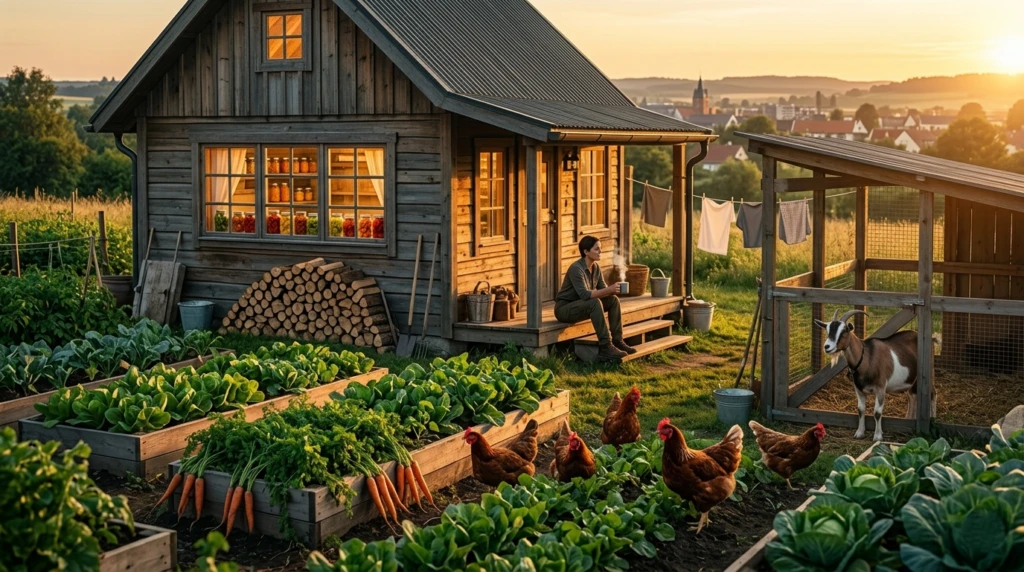 Animals are the element of homesteading that most beginners are most excited about — and the element that most consistently overwhelms them. The key is starting with the right animals in the right order, not the animals that look best in photographs.
Chickens — start here, always:
Chickens are the most practical livestock for most beginner homesteaders. They require minimal space, produce eggs daily, provide meat, and convert kitchen scraps and garden waste into eggs and manure. They are also forgiving of beginner mistakes in ways that larger animals are not.
- Space requirement: 4 square feet per bird in the coop, 10 square feet per bird in the run
- Egg production: 250 to 300 eggs per year per hen (for productive breeds)
- Feed requirement: 0.25 pounds of feed per bird per day (supplemented by foraging)
- Best beginner breeds: Rhode Island Red, Plymouth Rock, Australorp — dual-purpose breeds that produce both eggs and meat
Goats — when you’re ready for dairy:
Goats are the most practical dairy animal for homesteads without sufficient land for cattle. They require more management than chickens but provide dairy products (milk, cheese, yogurt, butter) that significantly expand homestead food production.
- Space requirement: 200 square feet per goat in the pen, plus grazing area
- Milk production: 1 to 3 quarts per day per doe (breed-dependent)
- Best beginner breeds: Nigerian Dwarf (small, high butterfat milk), Nubian (larger, good milk production)
Rabbits — the most efficient meat animal for beginners:
Rabbits convert feed to meat more efficiently than any other livestock. They require minimal space, reproduce quickly, and can be managed quietly — making them suitable for suburban homesteads where larger animals aren’t practical.
- Space requirement: 4 square feet per rabbit in a hutch
- Reproduction: A doe can produce 4 to 8 litters per year of 6 to 10 kits each
- Feed requirement: 0.5 pounds of feed per rabbit per day
What NOT to start with:
Cattle, pigs, and horses require significant infrastructure, experience, and land that most beginners don’t have. Starting with these animals before developing basic animal husbandry skills is one of the most common and most expensive beginner mistakes. The animals suffer. The homesteader suffers. And the dream starts to feel like a burden.
Food Preservation — The Skill That Makes Everything Else Worth It
Food preservation is the skill that transforms seasonal abundance into year-round food security. Without it, a productive garden and healthy livestock still leave you dependent on grocery stores for most of the year. This is the skill that closes the loop.
Water bath canning:
Suitable for high-acid foods (fruits, tomatoes, pickles, jams). Uses boiling water to create a vacuum seal in glass jars. Properly canned foods last 1 to 5 years. This is where most beginners start, and it’s the right place to start.
Pressure canning:
Required for low-acid foods (vegetables, meat, beans, soups). Uses steam pressure to reach temperatures that kill botulism spores. Properly pressure-canned foods last 1 to 5 years. More intimidating than water bath canning, but not difficult once you understand the process.
Fermentation:
One of the oldest and most nutritious preservation methods. Lacto-fermentation (sauerkraut, kimchi, pickles, kefir) uses beneficial bacteria to preserve food and enhance nutritional value. No special equipment required — just salt, vegetables, and time.
Dehydration:
Removes moisture that bacteria and mold require to grow. Solar dehydrators (no electricity required) can dry fruits, vegetables, herbs, and meat effectively in sunny climates. Electric dehydrators are more reliable in cloudy climates.
Root cellaring:
A cool, dark, humid space (typically underground) that maintains temperatures of 32 to 40°F (0 to 4°C). Ideal for storing root vegetables, apples, cabbage, and other produce that doesn’t require freezing. The most energy-efficient preservation method available.
The Financial Reality of Homesteading — What It Actually Costs
The financial reality of homesteading is more complex than most beginners expect. Understanding the numbers before you commit prevents the financial stress that derails most homesteading transitions.
The realistic startup cost breakdown:
| Category | Budget Range | Notes |
| Land (5 acres, rural US) | $10,000–$50,000 | Highly variable by region |
| Basic shelter | $20,000–$100,000 | Cabin kit to conventional home |
| Garden infrastructure | $500–$5,000 | Beds, tools, irrigation |
| Chicken setup | $500–$2,000 | Coop, run, birds, feed |
| Goat setup | $1,000–$5,000 | Fencing, shelter, animals |
| Food preservation equipment | $500–$2,000 | Canner, jars, dehydrator |
| Water system | $5,000–$20,000 | Well, pump, storage |
| Total (modest homestead) | $40,000–$180,000 |
Homestead income streams:
Most homesteads don’t generate significant income in year one. The realistic income development timeline:
- Year 1: Minimal income. Focus on skill development and infrastructure.
- Year 2 to 3: Small income from surplus eggs, produce, and value-added products.
- Years 3 to 5: Meaningful income from established production systems.
The most viable homestead income streams:
- Selling surplus eggs, produce, and dairy at farmers’ markets or through CSA subscriptions
- Value-added products (jams, pickles, cheese, soap, candles)
- Agritourism (farm stays, workshops, educational experiences)
- Remote work combined with homesteading is the most common successful model, and the one most experienced homesteaders quietly rely on
The Homesteading Skills Every Beginner Must Develop — In the Right Order
 Homesteading requires competence across a wider range of skills than almost any other lifestyle. The good news: most of these skills can be learned progressively, and each one builds on the previous.
The essential homesteading skill stack:
Tier 1 — Foundation skills (develop before acquiring land or animals):
- Vegetable gardening
- Basic food preservation (canning, fermenting, dehydrating)
- Basic animal care (start with chickens)
- Basic carpentry and construction
Tier 2 — Production skills (develop in year one to two):
- Soil building and composting
- Seed saving
- Dairy animal management (if applicable)
- Meat processing and butchering
- Advanced food preservation
Tier 3 — Systems skills (develop in years two to three):
- Water system management
- Basic electrical and plumbing
- Mechanical repair and maintenance
- Herbal medicine and natural remedies
- Foraging and wild food identification
Frequently Asked Questions
I don’t own land. Can I even start?
Yes — and many successful homesteaders start exactly this way. Options include renting land from farmers (many are willing to rent small plots to motivated beginners), community garden plots, backyard homesteading on rented property with landlord permission, and WWOOFing — working on organic farms in exchange for room and board. The skills you develop without land are directly transferable when you do acquire property. Don’t wait for the land to start becoming a homesteader.
How much money do I actually need?
You can begin homesteading with almost no money — a packet of seeds, a small garden plot, and a library card are sufficient to start developing the foundational skills. A meaningful homestead with land, animals, and infrastructure requires $40,000 to $180,000, depending on location and scale. The most important financial preparation is eliminating debt and building savings before making major homesteading investments. The homesteaders who struggle financially are almost always the ones who started before they were financially ready.
What’s the easiest skill to learn first?
Vegetable gardening is the most accessible entry point — it requires minimal investment, can be practiced anywhere, and produces immediate, tangible results. Start with a small raised bed (4×8 feet is sufficient for a beginner) and focus on easy, high-yield crops: lettuce, radishes, beans, and tomatoes. The confidence and knowledge you build from a successful first garden season will inform every other homesteading decision you make. It’s also the skill that most clearly shows you whether homesteading is actually for you.
Can I homestead while working full-time?
Yes — and most successful homesteaders do exactly this, at least initially. The key is starting small, automating what can be automated (drip irrigation, automatic chicken doors), and building systems that require minimal daily intervention. Many homesteaders maintain full-time remote work indefinitely, using homestead income to supplement rather than replace their primary income. The homestead-plus-remote-work combination is the most financially stable model available to most beginners.
What’s the single biggest mistake I should avoid?
Buying land before developing skills. The second biggest mistake is acquiring too many animals too soon. Both mistakes stem from the same impulse: wanting to be a homesteader before doing the work of becoming one. The homesteaders who succeed are almost always the ones who spent 1 to 2 years developing skills and building knowledge before making major financial commitments. The ones who don’t tend to find themselves overwhelmed, financially stretched, and quietly wondering if they made a terrible mistake.
Products / Tools / Resources
These are the specific items, books, and resources that consistently come up in serious homesteading conversations — selected for genuine usefulness to beginners, not for how well they photograph.
Books
The Market Gardener by Jean-Martin Fortier — The definitive guide to small-scale intensive vegetable production. Applicable to homestead food production at any scale. Fortier’s methods are proven, practical, and profitable. If you read one gardening book before starting, make it this one.
Storey’s Guide to Raising Chickens by Gail Damerow — The most comprehensive and readable guide to chicken keeping for beginners. Covers breeds, housing, health, and egg production in practical detail. The book that chicken keepers return to repeatedly.
The Encyclopedia of Country Living by Carla Emery— The closest thing to a complete homesteading reference available. Covers gardening, livestock, food preservation, and dozens of other homesteading topics in extraordinary depth. Dense, practical, and worth every page.
Preserving Food Without Freezing or Canning by The Gardeners and Farmers of Terre Vivante — A comprehensive guide to traditional food preservation methods. Essential reading for homesteaders who want to preserve food without electricity.
Gaia’s Garden by Toby Hemenway — The most accessible introduction to permaculture design for home-scale food production. Essential reading for anyone planning a homestead food system.
Tools and Equipment
All American 921 Pressure Canner — The gold standard for homestead pressure canning. Made in the USA, all-metal construction, no rubber gaskets to replace. An investment that lasts decades and pays for itself in the first season.
Ball Complete Book of Home Preserving — The most trusted reference for water bath and pressure canning. Every homestead kitchen should have a copy within reach of the stove.
Lehman’s Non-Electric Catalog — The most comprehensive source for non-electric homestead tools and equipment. Hand-powered grain mills, butter churns, root cellar supplies, and hundreds of other items that make homesteading more practical and less dependent on electricity.
Johnny’s Selected Seeds — The most trusted seed supplier for homestead gardeners. Excellent variety selection, reliable germination rates, and detailed growing information for every variety. Their catalog is worth reading cover to cover.
Premier 1 Supplies — The most recommended source for electric net fencing, which is the most practical fencing solution for most beginner homesteaders with chickens and goats. Moveable, effective, and reasonably priced.
Online Communities
r/homestead (Reddit) — The largest online homesteading community. Excellent for specific questions, equipment recommendations, and connecting with experienced homesteaders who have already made the mistakes you’re trying to avoid. The search function alone is worth the visit.
Homesteading Today Forum— A long-established forum community covering all aspects of homesteading. Particularly strong on livestock, food preservation, and traditional skills. The kind of place where people give real answers.
WWOOF (World Wide Opportunities on Organic Farms) — The most accessible way to gain hands-on homesteading experience before committing to land. Work on organic farms in exchange for room and board. Available in most countries. Genuinely transformative for beginners who take it seriously.
Courses and Education
Rodale Institute Online Courses— Evidence-based organic farming and homesteading education from one of the most respected agricultural research organizations in the world. Practical, science-backed, and applicable to any scale.
The Herbal Academy — The most comprehensive online herbal medicine education for homesteaders. Covers plant identification, medicine making, and home health care. A skill set that becomes more valuable the further you get from conventional medical infrastructure.