
Hey there! Some links on this page may be affiliate links which means that, if you choose to make a purchase, I may earn a commission at no extra cost to you. I greatly appreciate your support. Read the full disclosure here.
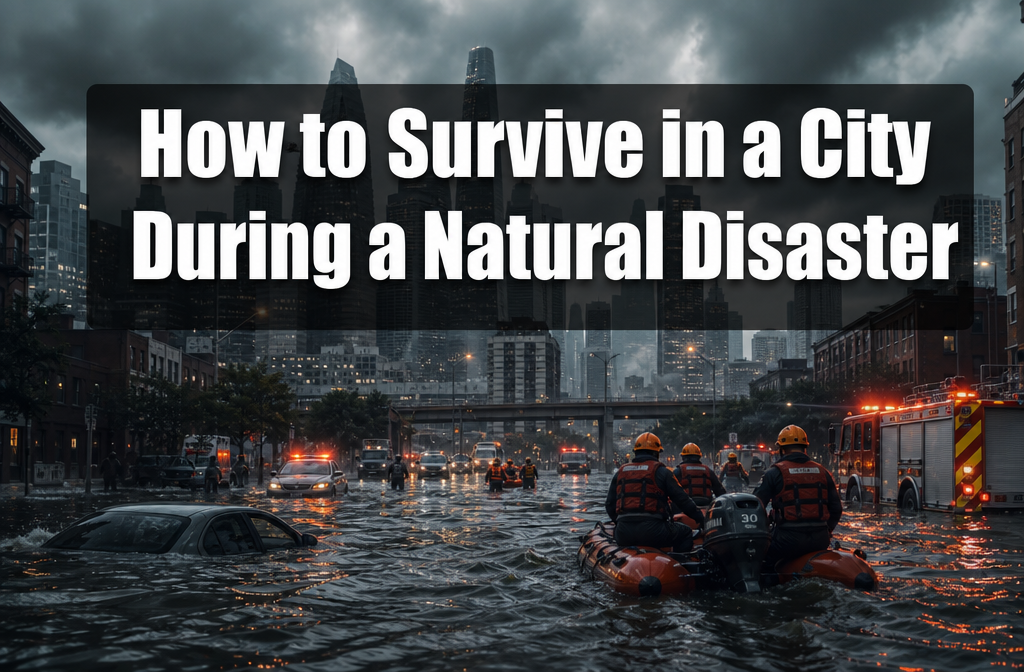
Urban residents account for more than 56% of the global population — and they face a distinct, often underestimated set of risks when disasters strike. Knowing how to survive in a city during a natural disaster is not the same as wilderness survival. The threats are different, the resources are different, and the mistakes are costlier. Concrete canyons trap floodwater. High-rise buildings become death traps in earthquakes. Cell networks collapse under the weight of simultaneous emergency calls. This guide covers every critical layer of urban disaster survival, from your first 72 hours to long-term resilience planning.
Key Takeaways
- Store a minimum of 1 gallon of water per person per day for at least 72 hours (ideally 2 weeks) in your apartment or home.
- Build a go-bag that fits your living situation — a studio apartment kit looks different from a suburban household kit.
- Know your building’s evacuation routes, your neighborhood’s flood zones, and at least two exit routes out of the city before disaster strikes.
- Different disasters demand different responses: earthquakes require shelter-in-place instincts, hurricanes demand early evacuation, floods require vertical movement.
- Seniors, people with mobility limitations, and families with children or pets all need customized plans — generic checklists leave these groups exposed.
- When cell networks fail, battery-powered NOAA weather radios and pre-arranged neighborhood check-in protocols become your most reliable communication tools.
- Government resources exist but are often overwhelmed in the first 72 hours — self-reliance during that window is not optional, it’s critical.
What Basic Supplies Do You Need for Urban Emergency Preparedness?
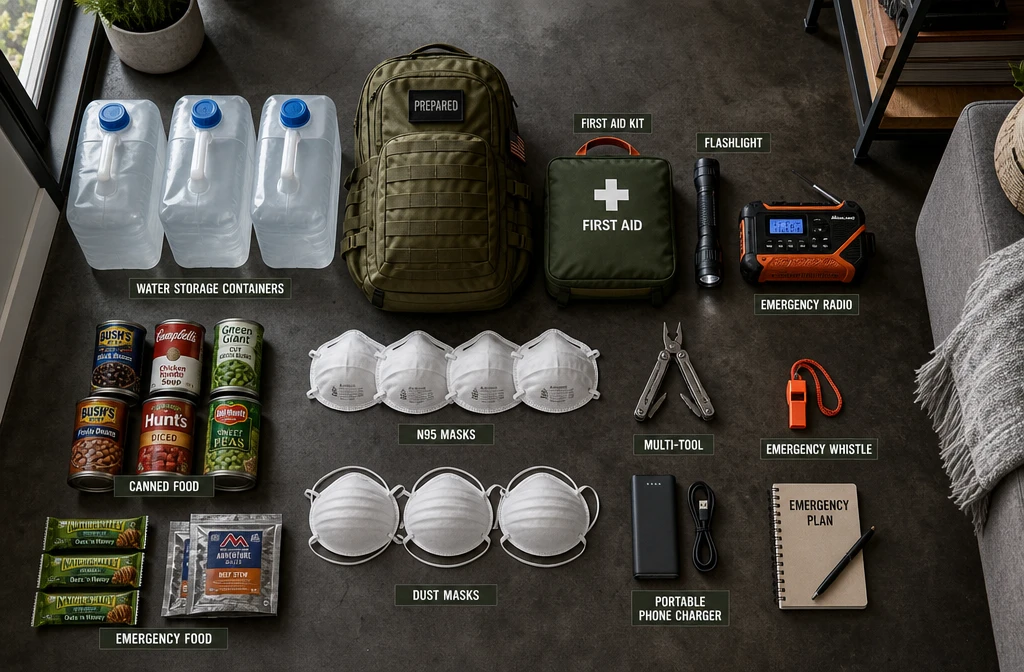
Every urban prepper needs a core supply kit that covers water, food, communication, first aid, and documentation. The goal is to sustain your household independently for a minimum of 72 hours — though two weeks is the more realistic and recommended target.
The non-negotiable urban emergency kit includes:
- Water: 1 gallon per person per day (minimum 3-day supply; 2-week supply is strongly preferred). For apartment storage strategies, see the Apartment Water Storage Complete Guide.
- Food: Non-perishable, calorie-dense items requiring minimal or no cooking — canned goods, freeze-dried meals, energy bars, peanut butter.
- First aid kit: See the dedicated medical supplies section below.
- Flashlights and batteries (or hand-crank/solar alternatives).
- Battery-powered or hand-crank NOAA weather radio.
- Portable phone charger (power bank) — minimum 20,000 mAh capacity.
- Cash in small bills — ATMs and card readers fail when power goes out.
- Copies of critical documents — ID, insurance, prescriptions, stored in a waterproof bag.
- N95 masks, work gloves, and sturdy closed-toe shoes stored near your bed.
- Multi-tool or Swiss Army knife.
- Whistle — for signaling if trapped.
For a comprehensive breakdown of what most people forget, the 15 Things Missing From Your Emergency Kit is worth reading before you finalize your list.
Common mistake: Buying a pre-packaged “emergency kit” and never opening it. Many contain expired food, inadequate water, and tools you’ve never used. Build your own kit and rotate supplies every 12 months.
How Do Different Natural Disasters Impact City Infrastructure?
Natural disasters don’t hit cities uniformly. Each type of disaster attacks specific infrastructure systems, and understanding those vulnerabilities changes how you prepare and respond.
| Disaster Type | Primary Infrastructure Impact | Immediate Threat to Urban Residents |
|---|---|---|
| Hurricane | Power grid, roads, communications | Storm surge, wind damage, flooding, evacuation gridlock |
| Earthquake | Buildings, gas lines, bridges, water mains | Structural collapse, gas leaks, fires, aftershocks |
| Flood | Sewage systems, roads, basements, transit | Contaminated water, trapped residents, vehicle damage |
| Wildfire (urban interface) | Air quality, power lines, evacuation routes | Smoke inhalation, rapid fire spread, road closures |
| Tornado | Buildings, power lines, communication towers | Structural damage, debris, sudden onset with little warning |
Cities amplify disaster damage in specific ways. Impermeable surfaces (concrete and asphalt) accelerate flooding by preventing water absorption. Dense populations overwhelm emergency services. High-rise buildings create elevator dependency and evacuation bottlenecks. Underground infrastructure — subways, utility tunnels, parking garages — becomes lethal when flooded.
For region-specific threat mapping, the Ultimate Geographic Threat Prep Guide by US Region breaks down which disasters are most likely based on where you live.
Differences Between Hurricane, Earthquake, and Flood Urban Survival Strategies
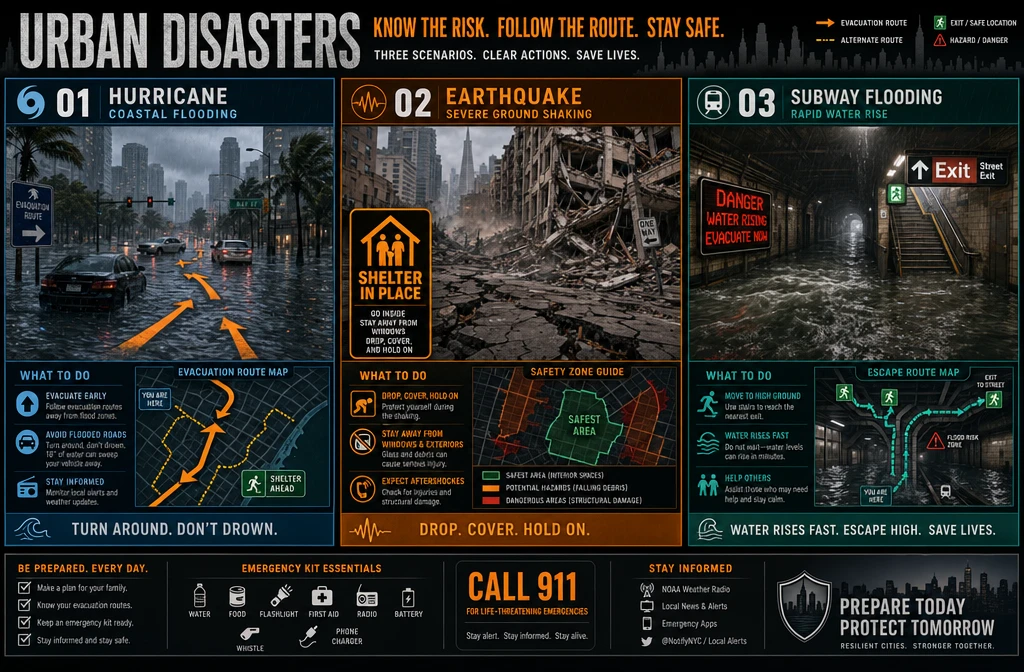
The core survival strategy shifts dramatically depending on the disaster type. Treating all disasters the same is one of the most dangerous assumptions urban residents make.
Hurricane survival in a city:
- Evacuate early — before mandatory orders are issued. Traffic during mandatory evacuations can strand you for 8–12 hours on highways with no fuel available.
- If sheltering in place, move to an interior room on a middle floor (away from windows, above flood level).
- Fill bathtubs with water before the storm hits — municipal water pressure often fails during hurricanes.
- Know your city’s designated hurricane shelters in advance.
Earthquake survival in a city:
- Drop, cover, and hold on during shaking — do not run outside (falling glass and debris are the primary killers).
- After shaking stops, check for gas leaks (smell, hissing sounds) and shut off the main gas valve if suspected.
- Expect aftershocks. Do not re-enter a building until it’s been inspected.
- Avoid elevators entirely. Stairwells can also be compromised — know your building’s structural type.
Flood survival in a city:
- Move vertically, not horizontally. If trapped by rising water, go up — to upper floors, not out into the street.
- Never walk or drive through floodwater. Six inches of moving water can knock a person down; 12 inches can carry away a vehicle (FEMA guidance).
- Assume all floodwater is contaminated with sewage, chemicals, and pathogens.
- Turn off electricity at the breaker if water is approaching electrical outlets.
For a structured, layered approach to planning across all disaster types, the 4-Layer Disaster Plan based on FEMA protocols provides a solid framework.
Best Emergency Communication Methods When Cell Networks Are Down
When cell networks are down during a city disaster, your best communication options are battery-powered NOAA weather radios, pre-arranged neighborhood check-in protocols, and two-way FRS/GMRS radios. Social media and standard phone calls are the first systems to fail.
Ranked by reliability during urban disasters:
- NOAA Weather Radio (battery/hand-crank): Receives official emergency broadcasts even when cell and internet infrastructure is down. This is your primary information source.
- Two-way FRS/GMRS radios: Effective for household and neighborhood communication within 1–2 mile range in urban environments (buildings reduce range significantly).
- SMS text messages: Often get through when voice calls cannot, because they require less bandwidth. Try texting before calling.
- Social media check-ins (Facebook Safety Check, etc.): Useful when internet is partially available, but unreliable in full outages.
- Pre-arranged in-person meeting points: The most reliable method of all — requires zero technology. Establish a primary and secondary meeting location with your household before any disaster occurs.
For a complete communication planning system, see the Emergency Communication Plan: The Complete Prepper’s Guide.
Edge case: In major earthquakes or hurricanes, even NOAA radio towers can go offline. A battery-powered AM/FM radio with fresh batteries is a useful backup — local AM stations often broadcast emergency information during extended outages.
How Much Emergency Water and Food Should You Stockpile in a Small Apartment?
For a small apartment, store at least 3 gallons of water per person (covering 3 days at 1 gallon/day) as an absolute minimum — but a 2-week supply of 14 gallons per person is the realistic survival target. For food, a 2-week supply of calorie-dense, shelf-stable items is achievable even in tight spaces.
Water storage by household size (2-week target):
| Household Size | Minimum (3 days) | Recommended (2 weeks) |
|---|---|---|
| 1 person | 3 gallons | 14 gallons |
| 2 people | 6 gallons | 28 gallons |
| 4 people | 12 gallons | 56 gallons |
Add 1 gallon/day per pet. Add extra for sanitation if your building’s water is cut off.
Space-efficient storage options for apartments:
- WaterBOB bathtub bladder (100 gallons, fills before a storm, stores flat when not in use)
- 5-gallon stackable water containers stored under beds or in closets
- Commercially sealed water pouches stored in a go-bag
For food, target 1,800–2,500 calories per adult per day. Prioritize foods your household already eats. Rotate stock every 12 months. The Apartment Food Storage Guide covers how to build a 6-month supply in under 500 square feet.
Avoid the worst water storage mistakes — storing in containers that leach chemicals, placing containers in direct sunlight, or failing to treat tap water before long-term storage.
What Medical Supplies Should You Keep in Your City Emergency Kit?
A city emergency medical kit should cover wound care, prescription medications, over-the-counter essentials, and basic life-saving tools. Urban disasters often overwhelm hospitals and emergency services for 24–72 hours, making personal medical preparedness non-negotiable.
Core medical supplies for an urban emergency kit:
- Wound care: Sterile gauze pads, medical tape, bandages (assorted sizes), elastic bandage wrap, antiseptic wipes, antibiotic ointment, butterfly closures for deep cuts.
- Medications: 30-day supply of all personal prescriptions (rotate regularly), ibuprofen, acetaminophen, antihistamines, anti-diarrheal medication, antacids.
- Tools: Nitrile gloves (multiple pairs), tweezers, scissors, oral thermometer, CPR face shield, tourniquet (CAT or SOFTT-W style), SAM splint.
- Eye and respiratory: Saline eye wash, N95 masks (especially critical in wildfire smoke or post-earthquake dust environments).
- Documentation: List of all household members’ medications, dosages, allergies, blood types, and physician contact information in a waterproof bag.
Choose a trauma-capable kit if: You live in an earthquake-prone city, are more than 30 minutes from a hospital, or have household members with serious medical conditions.
What Are Common Mistakes People Make During Urban Evacuations?
The most common urban evacuation mistakes are leaving too late, taking the wrong route, and being unprepared for vehicle failure. These three errors account for the majority of preventable evacuation deaths and injuries.
Evacuation mistakes to avoid:
- Waiting for the official order: By the time mandatory evacuation is declared, fuel stations are empty and highways are gridlocked. Leave at the first voluntary evacuation recommendation.
- Only knowing one route out: Bridges close, roads flood, and highways jam. Plan at least two alternate evacuation routes and drive them before disaster season. The Bug Out Route Planning guide covers this in depth.
- Leaving with an empty gas tank: Keep your vehicle above half a tank during any declared watch or warning period.
- Not knowing where you’re going: Have a confirmed destination — a friend’s home, a family member’s address, or a pre-identified shelter — before you leave.
- Forgetting critical documents and medications: Keep a go-bag packed and near the door so you can leave in under 10 minutes.
- Underestimating pets: Animal shelters often don’t accept pets. Know pet-friendly shelters or hotels along your route in advance. The Ultimate Pet Emergency Preparedness Checklist is a practical resource here.
How to Create an Emergency Plan If You Have Kids or Pets
Families with children and pets need a written, practiced emergency plan — not just a mental checklist. Children need to know what to do if a disaster strikes while they’re at school. Pets need carriers, supplies, and pre-identified pet-friendly shelters.
For families with children:
- Teach children their home address, a parent’s phone number, and the family meeting point.
- Know your child’s school evacuation and reunification policy before a disaster occurs.
- Pack a child-specific go-bag with comfort items, snacks, medications, and copies of medical records.
- Practice evacuation drills at home at least twice a year.
For pets:
- Keep a 72-hour pet supply kit: food, water, medications, leash, carrier, vaccination records, and a recent photo of the pet with you.
- Identify pet-friendly hotels along your evacuation route and save their contact numbers offline.
- Microchip all pets and ensure contact information is current.
For comprehensive family planning, Disaster Preparedness for Families: 12 Strategies Every Prepper Must Know covers the full system.
Survival Tips for Seniors and People with Limited Mobility in Disaster-Prone Cities
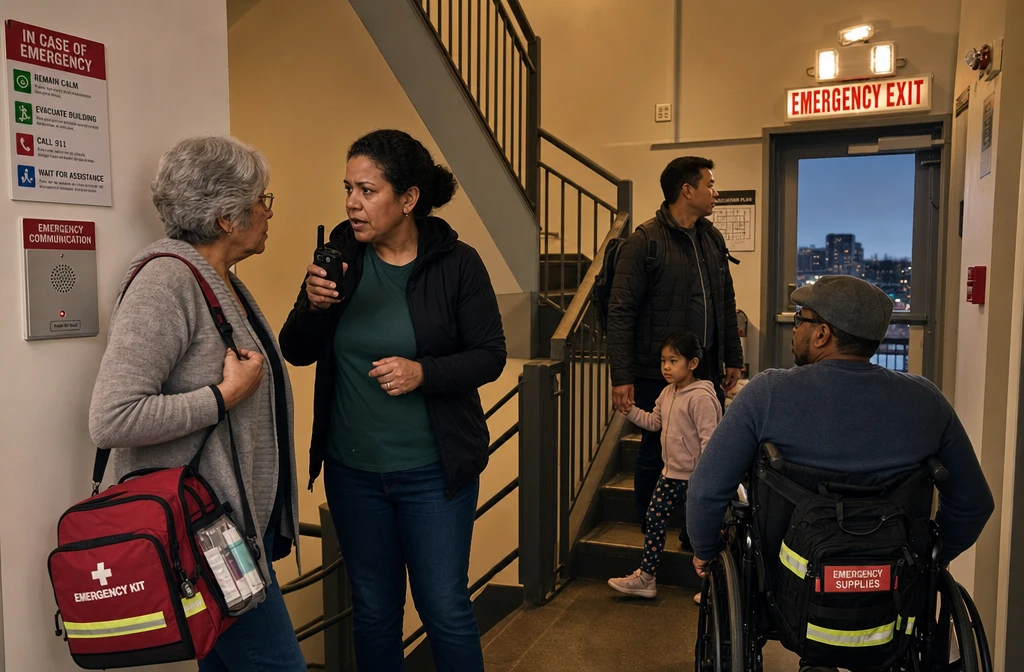
Seniors living alone and people with limited mobility face compounded risks during urban disasters — and generic preparedness advice often fails them entirely. The key is building a support network before disaster strikes, not during it.
For seniors living alone:
- Register with your local emergency management office’s Special Needs Registry if one exists — this flags your address for priority welfare checks.
- Establish a check-in agreement with at least two neighbors who will physically verify your safety after a disaster.
- Keep a 30-day supply of all medications and a list of medical conditions in a waterproof bag near the door.
- Consider a medical alert device with GPS capability.
For people with limited mobility:
- Map your building’s accessible evacuation routes and identify which stairwells have evacuation chairs.
- Notify your building manager and local fire department of your location and mobility needs.
- Pack a go-bag that can be attached to a wheelchair or walker.
- Identify a personal support network of at least two people who can assist with evacuation.
For a dedicated deep-dive, 9 Essential Disaster Prep Strategies for Seniors addresses the specific gaps that most preparedness guides overlook.
Cheapest Emergency Survival Kits for Apartment Dwellers
A functional urban emergency kit for one person can be built for $75–$150 by sourcing items individually rather than buying pre-packaged kits. Pre-packaged kits often contain low-quality tools, insufficient water, and food with poor caloric density.
Budget-friendly build approach:
- Water: 6 x 1-gallon jugs from a grocery store ($6–$10) or a WaterBOB bathtub bladder (~$30) for large-scale storage.
- Food: Canned goods, peanut butter, crackers, oats, and energy bars from a grocery store ($30–$50 for 72 hours per person).
- Flashlight: A reliable hand-crank or LED flashlight with batteries ($10–$20).
- First aid kit: A basic kit from a pharmacy ($15–$25), supplemented with a tourniquet (~$30) if budget allows.
- Radio: A hand-crank NOAA weather radio ($20–$40).
- Power bank: A 20,000 mAh power bank ($25–$40).
Total estimated cost for a single-person 72-hour kit: approximately $100–$175.
Choose pre-packaged kits if: You have no time to build your own and need something immediately. Then upgrade it over the following months.
Alternative Shelter Options If Your Building Is Compromised
If your building is compromised during a city disaster, your options include public emergency shelters, community centers, hotels outside the affected zone, and staying with family or friends. Sleeping in your vehicle is a last resort — not a plan.
Alternative shelter options, ranked by preference:
- Pre-arranged stay with family or friends outside the immediate disaster zone — the most comfortable and resource-rich option.
- Pet-friendly hotels along your evacuation route, booked in advance during a watch period.
- Designated public emergency shelters — typically schools, community centers, or convention centers. Bring your own supplies; shelter resources are often strained.
- Red Cross or faith-based organization shelters — often more organized than municipal shelters and may accept pets at some locations.
- Vehicle shelter — acceptable for a single night in safe conditions, but creates serious risks during extreme heat, cold, or ongoing disaster conditions.
Always have a destination confirmed before you leave your building. Wandering in a disaster zone looking for shelter is dangerous and exhausting.
What Government Resources Are Available During City Emergencies?
Government resources during city emergencies include FEMA individual assistance programs, local emergency management agencies, Red Cross shelters, and 211 social services hotlines. However, these resources are typically overwhelmed in the first 72 hours — which is exactly why self-reliance during that window is the foundation of urban survival.
Key government and institutional resources:
- FEMA (Federal Emergency Management Agency): Provides individual assistance grants, temporary housing, and disaster loans after a presidentially declared disaster. Register at DisasterAssistance.gov.
- Local Office of Emergency Management (OEM): Your city’s OEM coordinates local response and maintains shelter locations. Find yours before a disaster and save the contact number.
- 211 Hotline: A social services referral line that can connect you with food, shelter, and utility assistance during and after disasters.
- NOAA Weather Service: Provides official watches, warnings, and advisories. Monitor via weather radio or the NOAA website.
- Red Cross: Operates emergency shelters, provides disaster relief supplies, and offers mental health support after major events.
The honest reality: In a major urban disaster, first responders are triaged to life-threatening emergencies. Non-critical needs — including shelter, food, and water — may not be addressed by government resources for 24–72 hours or longer. The Step-by-Step Guide to Natural Disaster Preparedness provides a complete framework for building the self-reliance that fills that gap.
FAQ-How to Survive in a City During a Natural Disaster
What’s the single most important thing to do right now to prepare for a city disaster?
Build a 72-hour emergency kit and write down a two-page emergency plan that covers evacuation routes, meeting points, and out-of-area contact information. Do this before anything else. Supplies without a plan are far less effective than a plan with minimal supplies.
How do I know if I should evacuate or shelter in place?
Evacuate for hurricanes, wildfires, and floods — especially if you’re in a low-lying area or a flood zone. Shelter in place for earthquakes (during shaking) and most tornadoes (if you can’t reach a sturdy shelter in time). When in doubt, follow official guidance from your local emergency management office — but don’t wait for a mandatory order to start preparing.
Can I survive a city disaster in a high-rise apartment?
Yes, but with specific preparations. Know your building’s evacuation plan, identify the stairwell exits, store water and food on your floor, and understand that elevators will be unavailable. Upper floors are safer from flooding but more exposed to wind. Middle floors are generally safest in most scenarios.
How long should my emergency food supply last?
A minimum of 72 hours, but a 2-week supply is the realistic target for urban preparedness. Major disasters — hurricanes, earthquakes, and large-scale floods — can disrupt supply chains and municipal services for 7–14 days or longer.
What if I can’t afford a full emergency kit?
Start with water. One gallon per person per day for three days costs less than $10. Add one item per week — a flashlight, a first aid kit, canned food. A functional kit built over 30 days is far better than waiting until you can afford everything at once.
How do I prepare for a disaster if I rent and can’t modify my apartment?
Focus on portable preparedness — go-bags, water storage containers, and communication tools that don’t require structural modifications. Know your building’s existing evacuation routes and fire suppression systems. Most critical urban preparedness actions require no modifications to your living space.
What should I do if I’m at work when a disaster strikes?
Know your workplace’s emergency plan and shelter-in-place locations. Keep a small emergency kit at your desk or in your car — water, a power bank, comfortable shoes, and a flashlight. Establish a family communication plan so everyone knows what to do if contact is lost.
Are pets allowed in emergency shelters?
Most government-operated emergency shelters do not accept pets, though some jurisdictions have made progress on this since the post-Katrina reforms. Identify pet-friendly hotels and Red Cross shelters along your evacuation route before you need them.
How do I prepare for a city disaster if I have a medical condition?
Maintain a 30-day supply of all medications, keep a written medical summary in your go-bag, register with your local Special Needs Registry if available, and identify the nearest hospital along your evacuation route. Discuss your disaster plan with your physician annually.
What’s the difference between a go-bag and a shelter-in-place kit?
A go-bag is a portable 72-hour kit designed for rapid evacuation — lightweight, compact, and ready to grab in under two minutes. A shelter-in-place kit is a larger home supply intended to sustain your household for 2 weeks or more without leaving. Both are necessary for complete urban preparedness.
Conclusion: Build Confidence Before the Sirens Sound
Knowing how to survive in a city during a natural disaster comes down to one principle: preparation done before the event determines outcomes during it. The residents who fare best aren’t the ones who react fastest when disaster strikes — they’re the ones who already had water stored, a plan written, and a go-bag packed.
Your immediate action steps:
- This week: Store 3 days of water for every person and pet in your household.
- This month: Build a complete 72-hour go-bag and write a two-page emergency plan with evacuation routes and meeting points.
- This quarter: Expand your food and water supply to 2 weeks, add a NOAA weather radio, and establish a neighborhood check-in network.
- Ongoing: Rotate supplies annually, practice evacuation drills twice a year, and update your plan whenever your household situation changes.
Urban survival isn’t about fear. It’s about knowing that when the city around you goes into chaos, your household doesn’t have to.
Products, Tools, and Resources Worth Having
These aren’t affiliate recommendations for the sake of it — they’re tools that genuinely fill the gaps most urban preppers discover too late.
For water storage in small spaces: The WaterBOB bathtub bladder is one of the most space-efficient solutions for apartment dwellers. It stores flat until needed and fills a standard bathtub with up to 100 gallons before a storm. Pair it with a hand pump for access. For ongoing storage, 5-gallon stackable BPA-free containers from Scepter or Reliance are the standard for a reason.
For communication: The Midland ER310 hand-crank NOAA weather radio covers emergency alerts, has a built-in phone charger, and runs on batteries, solar, or hand-crank power. It’s the one device that works when everything else fails.
For medical preparedness: A pre-built IFAK (Individual First Aid Kit) from North American Rescue or MyMedic provides trauma-capable supplies in a compact, organized package. Add a CAT tourniquet and a SAM splint to any basic kit.
For go-bag building: The Complete Bug Out Bag Guide walks through building a full 72-hour kit for under $200 — a realistic budget for most urban preppers.
For ongoing preparedness education: The Ultimate Urban Survival Guide for Preppers at Preppers HQ covers the full spectrum of city-specific survival skills that go beyond basic kit building.
The best emergency kit is the one you actually have when you need it. Start where you are, build consistently, and don’t wait for the next disaster to motivate you.