

Hey there! Some links on this page may be affiliate links which means that, if you choose to make a purchase, I may earn a commission at no extra cost to you. I greatly appreciate your support. Read the full disclosure here.
Every year, FEMA estimates that fewer than half of American households have an emergency plan that accounts for children’s specific needs. That gap is dangerous. A bug out bag for kids is not simply a scaled-down adult pack, it’s a carefully considered system built around a child’s physical limits, emotional needs, medical requirements, and developmental stage.
This guide covers everything: what goes in, how much it should weigh, how to build one by age, how to handle special needs, and how to make practice feel less like a drill and more like an adventure.
Key Takeaways
- A bug out bag for kids should weigh no more than 10-15% of the child’s body weight, compared to 20-25% for adults.
- Every child age 3 and older can carry something, even if it’s just a comfort item and a snack.
- Toddler and infant needs belong in a parent’s bag, not the child’s own pack.
- Medical needs, allergies, and special requirements must be addressed before any other gear decision.
- Children should know what’s in their bag and why, participation builds confidence, not fear.
- A laminated ID card with emergency contacts is one of the most critical items in any child’s pack.
- Pre-made kids’ bug out bags exist, but most experienced preppers customize them significantly.
- Practice runs, framed as adventure games, dramatically improve a child’s ability to respond calmly in a real event.
Find this useful? Add us as a preferred source on Google and more of what we publish will show up in your results.
What Should You Put in a Kid’s Bug Out Bag
A child’s bug out bag should contain the essentials for 72 hours of survival, scaled to what the child can realistically carry and use. The core categories are hydration, nutrition, shelter, communication, identification, and comfort.
Here’s a practical breakdown:
Hydration
- A personal water bottle (stainless steel or BPA-free)
- A LifeStraw or similar personal filtration straw (ages 8+)
- Water purification tablets as a backup
Nutrition
- High-calorie, low-prep snacks: protein bars, trail mix, dried fruit, peanut butter packets
- Comfort foods the child actually likes, morale matters in a crisis
- For children with dietary restrictions, verified allergen-free options only
Shelter and Warmth
- A compact emergency Mylar blanket
- A lightweight rain poncho (sized for the child)
- An extra pair of socks and underwear in a zip-lock bag
Communication and Identification
- A laminated card with full name, parents’ names, home address, and two emergency contact numbers
- A small whistle on a breakaway lanyard
- A simple written copy of the family’s emergency communication plan
Light and Navigation
- A small LED flashlight or headlamp with fresh batteries
- Glow sticks as a backup (no batteries needed, safer for young kids)
First Aid Basics
- Adhesive bandages, antiseptic wipes, and any personal medications
- A written note of allergies and medical conditions
Comfort Item
- A small stuffed animal, a favorite book, or a deck of cards, this is not optional for younger children. Emotional regulation in a crisis is a survival skill.
For a broader look at what a complete 72-hour kit should include, see the 72-hour bug out bag checklist.

How Much Should a Child’s Bug Out Bag Weigh
A child’s bug out bag should weigh no more than 10% of their body weight for younger or smaller children, and up to 15% for older, more physically capable kids. This is a hard limit, not a guideline.
For reference:
- A 40 lb child (typical 5-6 year old): max 4-6 lbs
- A 60 lb child (typical 8-9 year old): max 6-9 lbs
- A 90 lb child (typical 11-12 year old): max 9-13 lbs
- A 120 lb teenager: max 12-18 lbs
Overloading a child’s pack doesn’t just slow them down, it causes fatigue faster, increases injury risk, and can make a child refuse to carry the bag at all. Weigh the packed bag before every practice run and adjust seasonally.
Common mistake: Parents often pack what they think the child needs, not what the child can actually carry. If the bag is too heavy, move items to an adult pack and keep the child’s bag to essentials only.
Best Bug Out Bag For Kids by Age
The right bag and its contents change significantly as children grow. Here’s how to think about it by developmental stage.
Ages 1-3 (Toddlers) Toddlers do not carry their own bags. Their supplies, diapers, formula, baby food, medications, a comfort item, belong in a parent’s pack or a dedicated toddler supply pouch attached to an adult bag. Keep toddler supplies in a clearly labeled, separate section so they’re fast to access.
Ages 4-7 (Early Childhood) Children in this range can carry a small daypack (think: a school backpack sized for kindergarten). Load it with only their comfort item, a snack, a water bottle, and a whistle. The goal at this stage is familiarity with the bag, not load-bearing.
Ages 8-12 (Pre-Teen) This is when a real bug out bag starts to make sense. Children can carry 8-12 lbs comfortably and can begin to understand and use basic gear. Include a flashlight, rain poncho, emergency blanket, basic first aid items, and their personal ID card. Involve them in packing decisions.
Ages 13+ (Teenagers) Teenagers can carry a near-adult load and should understand how to use most items in their pack. A water filtration straw, a multi-tool (where legally appropriate), a map of the family’s bug out route, and a basic first aid kit are all reasonable additions.
For a complete family-level breakdown, the family bug out bag guide covers how to coordinate packs across all ages.
Bug Out Bag For Kids vs Adults: What’s Different
A kid’s bug out bag differs from an adult’s in four key ways: weight capacity, gear complexity, emotional content, and identification requirements.
| Factor | Adult Bug Out Bag | Kids Bug Out Bag |
|---|---|---|
| Weight limit | 20-25% of body weight | 10-15% of body weight |
| Tools | Multi-tools, fire starters, knives | Whistle, flashlight, glow sticks |
| Navigation | Map, compass, GPS | Laminated family contact card |
| Emotional gear | Optional | Essential (comfort item required) |
| ID documentation | Driver’s license | Laminated emergency ID card |
| Food type | High-calorie survival rations | Familiar, preferred snacks + rations |
Adults carry the heavy, complex gear. Children carry what they can manage and what helps them stay calm. The family system only works when each pack is appropriate for the person wearing it.
Bug Out Bag For Toddlers: What to Include
Toddler supplies should be packed by parents, not carried by the toddler. A dedicated toddler supply kit within an adult’s bag should include: diapers and wipes (3-day supply), formula or shelf-stable milk, familiar snack foods, a comfort item, any medications, a copy of the child’s medical information, and a recent photograph of the child in case of separation.
One often-overlooked item: a written note of the child’s routine. In a shelter or evacuation center, maintaining a semblance of normal schedule, nap time, feeding time, reduces toddler distress significantly and frees up parental attention for other tasks.
Children ages 4 and older should have their own dedicated bag, even if it only carries a few items. Sharing a bag creates confusion during an evacuation, eliminates the child’s sense of ownership and responsibility, and puts all supplies in one location that could be lost or separated from the child.
The exception is infants and toddlers under age 4, whose supplies should remain with a parent or caregiver.
The ownership principle matters: When a child packs their own bag, knows what’s in it, and has practiced using it, they become an active participant in the family’s preparedness plan rather than a passive burden. That shift in mindset has real value when things go wrong.
Bug Out Bag For Kids With Allergies or Medical Needs
Medical needs must be addressed before any other gear decision in a child’s bug out bag. For children with allergies, asthma, diabetes, epilepsy, or other conditions, the bag becomes a portable medical support system first and a survival kit second.
Critical steps for medically complex children:
- Consult with the child’s physician about what a 72-hour emergency supply of medications looks like and how to store them properly.
- Include a written medical summary: diagnosis, medications, dosages, allergies, and emergency instructions, laminated and stored in an exterior pocket.
- For severe allergies, carry at least two epinephrine auto-injectors. Check expiration dates every 6 months.
- For children with diabetes, include fast-acting glucose sources, testing supplies, and insulin storage appropriate for the expected climate.
- Notify any school, daycare, or emergency contact about what’s in the bag and where it’s stored.
For children with physical disabilities or developmental conditions, the emergency preparedness guide for disabled individuals provides additional frameworks that apply directly to children with special needs.
Bug Out Bag For Kids With Special Needs or Disabilities
Children with sensory processing disorders, autism spectrum conditions, mobility limitations, or cognitive disabilities require a modified approach to both bag contents and evacuation planning.
Key adaptations:
- Include sensory comfort items: noise-canceling earmuffs, a familiar-textured item, or a specific scent that provides grounding.
- For non-verbal children, include a communication card with pictures or symbols the child uses.
- For mobility-limited children, ensure the evacuation plan accounts for equipment (wheelchair, walker) and that the child’s bag is accessible to them or to a caregiver.
- Practice the bug out scenario in a way that accounts for sensory sensitivities, a full alarm drill may be overwhelming; a quiet walkthrough may be more effective.
- Coordinate with the child’s therapist or school support team to identify what calming items and communication tools are most effective.
The goal is to reduce the number of unknown variables the child faces. Familiarity, with the bag, the route, the plan, is the single most effective accommodation for most special needs situations.
How to Teach Kids to Use a Bug Out Bag
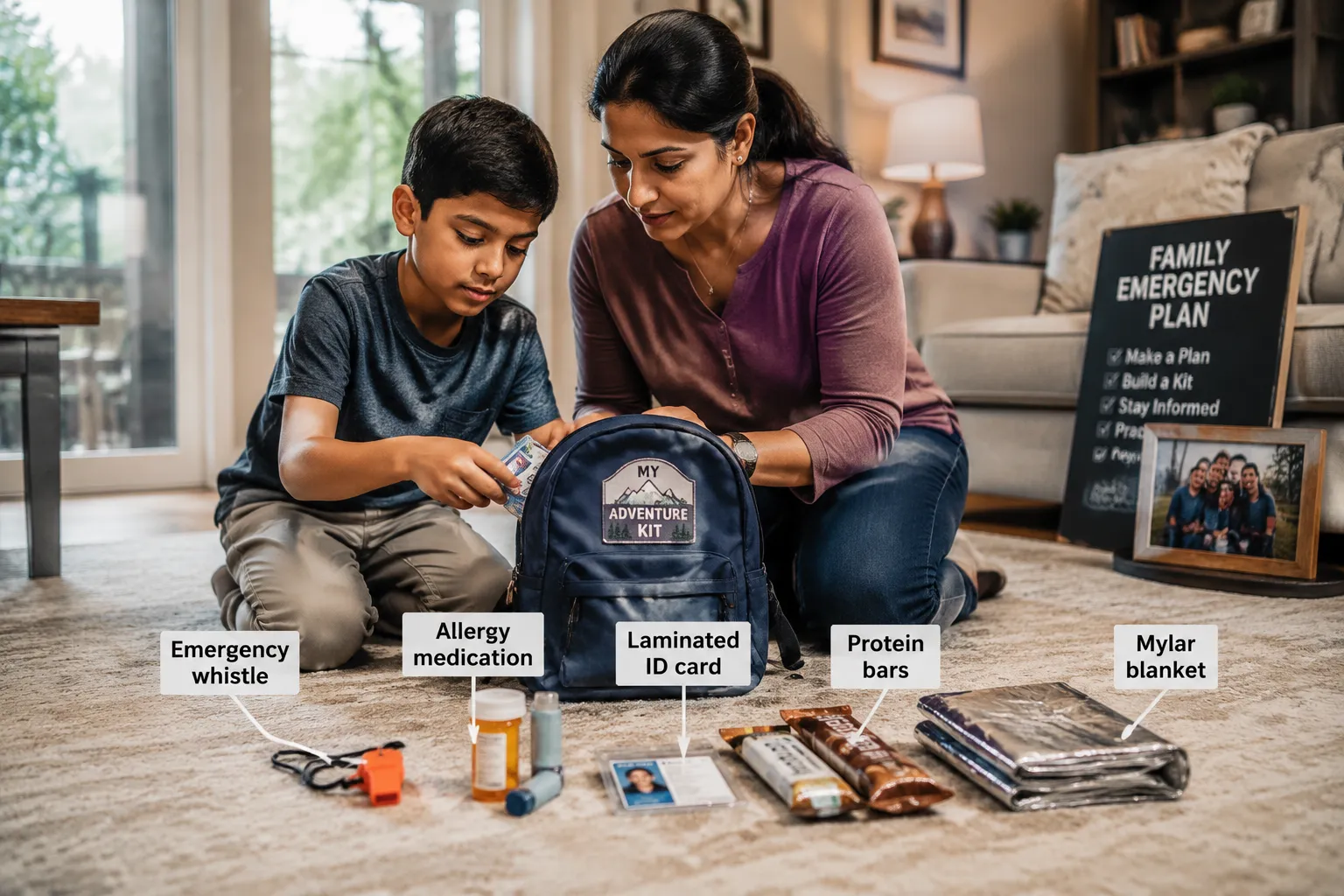
Children learn to use their bug out bag through repetition, explanation, and positive association, not fear. Start by showing the child each item, naming it, and explaining its purpose in simple terms appropriate for their age.
A practical teaching sequence:
- Unpack the bag together. Let the child handle each item.
- Explain one item per session rather than overwhelming them all at once.
- Practice specific skills: blowing the whistle, turning on the flashlight, opening the emergency blanket.
- Run a short “practice walk” with the packed bag so the child feels the weight.
- Review the ID card and make sure the child can recite the emergency contact number from memory.
For age-appropriate skill building beyond the bag itself, the guide on 12 essential survival skills for kids covers what children at each developmental stage can realistically learn and retain.
How to Make Bug Out Bag Practice Fun for Kids
Frame practice as an adventure, not an emergency. Children who associate their bug out bag with positive experiences are far more likely to respond calmly and cooperatively when a real event occurs.
Practical ideas:
- Backyard camping nights: Use the bug out bag as the only gear allowed. Children discover what works and what’s missing in a low-stakes environment.
- Scavenger hunts: Hide items around the house and have children “pack their survival bag” to find them.
- Timed challenges: How fast can the family be ready to walk out the door? Make it a family record to beat.
- Skill badges: Create a simple homemade badge system for mastering each skill, using a whistle, reading a map, identifying their contact card.
- Story-based drills: Frame the scenario as an adventure story rather than a disaster. “We’re explorers heading to base camp” lands very differently than “there’s an emergency.”
Regular practice, even once per season, builds the kind of automatic, calm response that matters most when real stress is present. See the emergency preparedness for kids guide for age-appropriate drills that complement bag practice.
What If a Child Refuses to Carry Their Bug Out Bag
Some children will resist carrying a bag, especially if it feels heavy, unfamiliar, or associated with scary scenarios. This is normal and manageable with the right approach.
First, check the weight. A child refusing to carry their bag is often a sign the bag is too heavy. Reduce the load immediately.
Second, involve them in customization. Let the child choose the bag color or style. Let them pick one item to add that’s entirely their choice. Ownership reduces resistance.
Third, separate the bag from fear. If a child associates the bag with disaster scenarios, reframe it as their “adventure pack” or “explorer kit.” The contents are the same; the emotional framing is different.
Fourth, don’t force it during practice. A child who is forced to carry a bag they hate will not carry it cooperatively in a real event. Build positive association first; compliance follows.
If a child consistently refuses due to anxiety, address the underlying anxiety directly, through conversation, age-appropriate books about preparedness, or professional support if needed. Forcing preparedness on an anxious child can backfire significantly.
Where to Buy Kids Bug Out Bags and How Much They Cost
Pre-made kids’ bug out bags are available from several preparedness-focused retailers, typically ranging from $30 to $150 depending on contents and quality. However, most experienced preppers treat pre-made kits as a starting point, not a finished product.
What to look for in a pre-made kit:
- Bag size and weight appropriate for the child’s age
- Durable, water-resistant material
- Adjustable straps with a chest clip for stability
- Exterior pockets for fast-access items like a whistle and ID card
Reputable sources in 2026:
- Amazon (search “kids emergency backpack” or “children’s 72-hour kit”), wide selection, read reviews carefully
- ReadyAmerica and Sustain Supply Co. offer family-oriented emergency kits with child-specific components
- Tactical baby gear brands (like Tactical Baby Gear) offer durable packs in smaller sizes
- Local outdoor retailers (REI, Bass Pro Shops) carry youth packs that work well as a base
Budget guidance:
- Basic functional kit (DIY): $25-$50
- Quality pre-made starter kit: $50-$100
- Fully customized, high-quality build: $100-$200
Building a kit yourself from a quality youth daypack plus targeted gear purchases usually delivers better value and a better fit than most pre-made options. For a cost-conscious approach to the full family system, the complete bug out bag guide for under $200 provides a practical framework.
Bug Out Bag For Kids Checklist: Essentials at a Glance
Use this as a starting point and adjust for your child’s age, weight, medical needs, and your family’s specific bug out plan.
Universal Essentials (all ages 4+)
- Compact backpack, properly fitted and sized
- Personal water bottle
- 2,000+ calories of familiar, non-perishable snacks
- Emergency Mylar blanket
- Lightweight rain poncho (child-sized)
- LED flashlight or headlamp with extra batteries
- Emergency whistle on a breakaway lanyard
- Laminated ID card with name, contacts, and medical notes
- Change of socks and underwear in a zip-lock bag
- Comfort item (non-negotiable for ages 4-10)
- Basic first aid: bandages, antiseptic wipes, personal medications
- Copy of family bug out route and rally point
Add for Ages 8+
- Personal water filtration straw
- Glow sticks (2-3)
- Small notepad and pencil
- Basic map of local area
Add for Teens
- Multi-tool (age and legally appropriate)
- Water purification tablets
- Small fire-starting kit (with parental guidance and training)
- Emergency contact list with out-of-area numbers
For food planning within the kit, no-cook survival meals covers options that work well for children who may not have access to cooking during an evacuation.
Frequently Asked Questions
At what age should a child have their own bug out bag? Children can begin carrying a small, lightly loaded pack as early as age 4. The bag at that age is more about familiarity and ownership than load-bearing. A meaningful, functional bug out bag typically starts around age 7-8.
Can my child carry their school backpack as a bug out bag? A school backpack can work as a base, but most aren’t water-resistant or durable enough for extended outdoor use. If budget is a constraint, use the school bag temporarily while saving for a purpose-built pack.
How often should I update my child’s bug out bag? Review and repack every 6 months. Children grow quickly, clothing, shoes, and pack fit change faster than most parents expect. Check food and medication expiration dates at the same time.
What’s the single most important item in a child’s bug out bag? The laminated ID card with emergency contacts. If a child is separated from their family during an evacuation, that card is what gets them home.
Should I tell my child what the bag is for? Yes, in age-appropriate terms. Children handle uncertainty better when they have some context. “This is our adventure pack for when we need to leave home quickly and stay safe” is honest, clear, and not frightening.
How do I handle food allergies in a kid’s bug out bag? Every food item in the bag must be verified allergen-free before packing. Include a written allergy alert on the outside of the bag and on the ID card. Carry two epinephrine auto-injectors if prescribed, and check expiration dates every 6 months.
What if my child has autism and doesn’t tolerate backpacks? Explore alternatives: a rolling bag, a fanny pack, or a caregiver-carried pouch with the child’s items. The goal is to have the supplies accessible and associated with the child, the delivery method can be adapted.
Do I need a separate bug out bag for each child? Yes. Each child age 4 and older should have their own dedicated bag. Shared bags create confusion during evacuations and put all supplies in one location.
What’s the best bag brand for kids? There’s no single best brand. Look for adjustable sternum straps, water-resistant fabric, and appropriate sizing for the child’s torso length. Osprey, Deuter, and REI Co-op all make youth packs that work well.
How heavy is too heavy for a child’s bug out bag? If the bag causes the child to lean forward to compensate, it’s too heavy. Use the 10-15% of body weight rule as a hard ceiling, and err toward the lower end for younger children.
What should a teenager’s bug out bag include that a younger child’s shouldn’t? Teenagers can handle water filtration tools, basic navigation aids, a multi-tool, and more complex first aid supplies. They should also carry a written copy of the family’s full bug out plan and know how to execute it independently if separated.
Should kids know the family bug out route? Absolutely. Children age 8 and older should know at least one rally point and the primary route to get there. Practice the route at least once per year so it’s familiar, not theoretical.
Conclusion
A bug out bag for kids is one of the most meaningful investments a prepared family can make, not because disasters are inevitable, but because preparation builds the kind of calm confidence that protects children when things go wrong. The bag itself is a tool. The real value is in the process: packing it together, practicing with it, and making sure every child in the family knows what it’s for and how to use it.
Start simple. A well-fitted pack, a laminated ID card, a whistle, some familiar snacks, and a comfort item are enough to begin. Build from there as the child grows and as your family’s plan becomes more detailed.
Actionable next steps:
- Weigh each child in your household and calculate their maximum safe bag weight.
- Purchase or designate a properly sized pack for each child age 4 and older.
- Build the bag together, let the child participate in every packing decision.
- Run one practice walk this month. Time it. Make it fun.
- Review and repack every 6 months without exception.
For families building out a complete preparedness system beyond the kids’ bags, the disaster preparedness for families guide and the kids emergency preparedness overview are the logical next steps.
Products, Tools, and Resources
Recommended gear for building a kids’ bug out bag in 2026:
- Osprey Daylite Kids Pack, Well-fitted, durable, water-resistant. Excellent for ages 7-12. Adjustable torso length means it grows with the child.
- LifeStraw Personal Water Filter, Lightweight, no batteries, reliable. Appropriate for children age 8 and older who understand how to use it.
- SOL Emergency Mylar Blanket, Compact, reusable, and genuinely warm. Include one per child.
- Fox 40 Pealess Whistle, Louder than standard whistles, works in wet conditions, and has no moving parts to fail. Attach to a breakaway lanyard.
- Coghlans Waterproof Matches + Stormproof Case, For teen bags where fire-starting is part of the plan.
- ReadyAmerica 72-Hour Emergency Kit (Child Version), A solid pre-made starting point that most families then customize with personal items and medications.
- Lamination pouches + a home laminator, One of the most underrated prepper tools. Laminate ID cards, medical summaries, maps, and contact lists for every family member’s bag.
The best bug out bag for a child is the one that fits them, that they’ve practiced with, and that they’ll actually carry when it matters. Build it with them, not just for them.