
Hey there! Some links on this page may be affiliate links which means that, if you choose to make a purchase, I may earn a commission at no extra cost to you. I greatly appreciate your support. Read the full disclosure here.
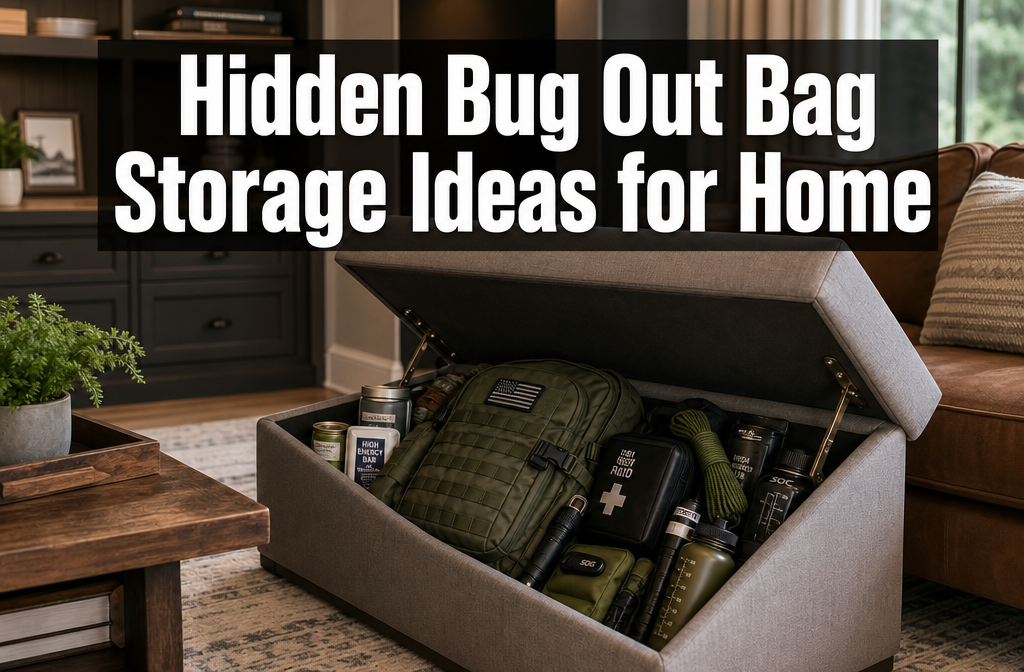
The best hidden bug out bag storage ideas for home use dead space that most people ignore: under-stair compartments, false-bottom ottomans, hollow wall panels, and deep closet ceiling voids. The goal is to keep your bag accessible within 60–90 seconds while keeping it invisible to casual observers — whether that means nosy guests, opportunistic thieves, or anyone who might compromise your preparedness setup. Concealment and access speed must be balanced, not traded against each other.
Find this useful? Add us as a preferred source on Google and more of what we publish will show up in your results.
Key Takeaways
- Dead space is your best friend. Most homes have 15–30 cubic feet of unused storage in walls, under stairs, and above closet ceilings that can hide a fully packed bag.
- Accessibility beats perfect concealment. A bag hidden so well you can’t reach it in 90 seconds defeats its purpose.
- Distribute, don’t centralize. Experienced preppers keep multiple smaller caches rather than one large bag in a single spot.
- Moisture and heat are silent killers. Long-term hidden storage requires waterproofing, silica gel, and temperature-aware placement.
- Plain-sight storage works in small apartments. Disguised furniture, fake utility panels, and “normal-looking” containers fool most people.
- A bug out bag isn’t just for doomsday scenarios. House fires, flash floods, and rapid evacuations are far more common — and a well-stored bag is useful for all of them.
- Avoid garages for primary storage. Temperature swings degrade medications, batteries, and food faster than any other location in a home.
- Rotate your bag every 6–12 months. Hidden doesn’t mean forgotten. Expired supplies in a concealed bag are worse than no bag at all.
- Families with kids need age-specific bags stored at heights children can reach independently during an emergency.
- The location itself can be compromised. Regular audits of your storage spots prevent discovery and ensure the gear is still there when you need it.
What Exactly Is a Bug Out Bag — and Why Does Every Household Need One?
A bug out bag (BOB) is a pre-packed emergency kit designed to sustain one person for 72 hours during a rapid evacuation. It’s not a doomsday fantasy — it’s a practical tool for the most common emergencies most families will face.
House fires displace over 1.3 million Americans annually (National Fire Protection Association, 2023). Flash floods, chemical spills, gas leaks, and power grid failures can force a household out the door with less than five minutes’ notice. A bug out bag closes the gap between chaos and control.
What separates a bug out bag from a general emergency kit:
- It’s designed to be grabbed and carried, not wheeled or loaded into a car over multiple trips
- It’s packed for mobility, not comfort
- It assumes you may not return home for 72 hours or longer
For a deep dive into building one from scratch, the Complete Bug Out Bag Guide at Preppers HQ walks through every layer of a solid 72-hour kit. And if you’re newer to the concept, the Bug-Out Bag for Beginners: Complete 2026 Guide is an excellent starting point.
Are Bug Out Bags Just for Doomsday Preppers — or Useful for Everyone?
Bug out bags are for everyone. The scenario most likely to require one isn’t a collapse of civilization — it’s a wildfire evacuation order, a burst gas main, or a flood warning at 2 a.m.
FEMA recommends that every household maintain a 72-hour emergency kit (FEMA Ready, 2023). A bug out bag is simply that kit in portable form. The difference between a prepper’s BOB and a standard emergency kit is mostly organization and intentionality.
“Preparedness isn’t about fear — it’s about confidence, independence, and protecting the people you love when the unexpected happens.” — Preppers HQ
People who benefit most from a well-stored bag at home:
- Families in wildfire, hurricane, or flood zones
- Urban residents near industrial corridors or chemical plants
- Anyone living in an older home with aging electrical or gas systems
- People with elderly family members or young children who need extra lead time
The Best Hidden Bug Out Bag Storage Ideas for Home — Room by Room
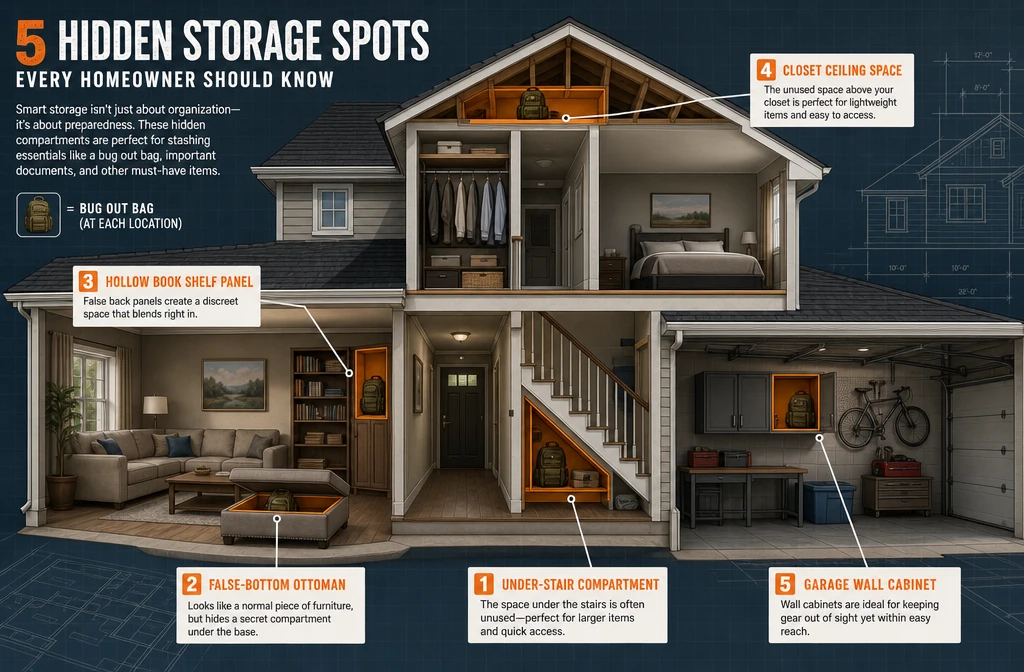
The most effective hidden bug out bag storage ideas for home take advantage of spaces that already exist in your house. No major renovation required for most of them.
Under-Stair Compartments
The void beneath a staircase is one of the most underused spaces in any home. A standard staircase with 13 steps over a 10-foot rise creates roughly 60–80 cubic feet of usable space — enough for multiple bags plus additional supplies.
How to use it:
- Install a hinged panel or false wall with a magnetic latch (no visible handle)
- Line the floor with moisture-resistant rubber matting
- Use a pull-out drawer system on casters for fast access
Best for: Full-size bug out bags, family-sized kits, or a combination bag plus water and food cache.
False-Bottom Ottomans and Furniture
Storage ottomans are sold in every furniture store in the country. Nobody looks twice at them. A large ottoman (24″×24″×18″) holds a compact bug out bag plus a secondary pouch of documents and cash.
Choose ottomans with:
- A firm, load-bearing lid (not flimsy fabric over cardboard)
- Interior depth of at least 14 inches
- A neutral color that blends with your decor
Hollow Wall Panels and False Backs
A recessed wall panel between studs (typically 3.5 inches deep and 14.5 inches wide) can hold a slim emergency pouch, documents, cash, and compact survival tools. These are most practical in closets, laundry rooms, or behind large furniture pieces.
Important: Check for electrical wiring and plumbing before cutting. Always use a stud finder and wire detector first.
Closet Ceiling Voids
The space above a standard closet ceiling — between the drywall and the floor above — is almost always empty. A removable ceiling panel (cut to size and painted to match) creates a hidden compartment large enough for a medium-sized bag.
Access tip: Keep a small, lightweight step stool inside the closet itself. Every second counts.
Garage Wall Cabinets (With Caveats)
Locked wall cabinets in a garage work well for secondary caches — tools, fuel, extra water — but are a poor choice for primary bug out bag storage due to temperature extremes. Batteries, medications, and food degrade significantly in spaces that swing between 10°F and 120°F depending on the season.
Use the garage for: Gear that tolerates temperature swings (paracord, tarps, hand tools, fire starters).
Best Hidden Spots to Store an Emergency Bag in a Small Apartment
Small apartments require creative thinking, but the options are better than most people assume. The Ultimate Guide to Prepping in a Small Apartment covers this in detail, but here are the most practical concealment strategies for tight spaces.
Top apartment storage solutions:
| Location | Capacity | Concealment Level | Access Speed |
|---|---|---|---|
| Under-bed rolling container | Large | Medium | Fast |
| Storage ottoman (living room) | Medium | High | Fast |
| False-bottom suitcase in closet | Medium | High | Medium |
| Hollow decorative books on shelf | Small | Very High | Medium |
| Behind hanging clothes (closet rod bag) | Medium | Medium | Fast |
| Inside a large laundry hamper | Medium | High | Fast |
The suitcase method is particularly effective. A hard-sided suitcase stored in a closet looks completely ordinary. Pack your bug out bag inside it. If you need to evacuate, pull the bag out of the suitcase and go. If you need to leave with the suitcase (car evacuation), it’s already packed.
Can You Hide a Bug Out Bag in a Closet Without Taking Up Too Much Space?
Yes — a well-organized closet can conceal a full bug out bag without sacrificing usable hanging or shelf space. The key is vertical thinking.
Three closet strategies that work:
-
Ceiling shelf placement. Most closets have a single shelf at eye level. Add a second shelf above it, close to the ceiling. Store the bag there in a plain canvas bin. It’s invisible unless someone is actively looking.
-
Behind hanging clothes. A bag hung on a hook at the back of a closet, behind long coats or dresses, is effectively invisible. Use a compression stuff sack to keep the profile slim.
-
False-back panel. In a deep closet (18+ inches), a false back panel can be installed 6–8 inches from the actual wall, creating a hidden compartment behind the visible rear wall. This takes an afternoon to build and is nearly undetectable.
Common mistake: Storing the bag loose on the floor under hanging clothes. It gets kicked around, items shift, and the bag becomes disorganized over time. Always secure it.
How Preppers Store Emergency Supplies in Plain Sight
The “gray man” storage principle — blending in so completely that nothing draws attention — is one of the most practical hidden bug out bag storage ideas for home environments where you can’t build concealed compartments.
Plain-sight storage methods that work:
- Decorative crates and trunks. A vintage wooden trunk at the foot of a bed looks like furniture. It holds a full bag plus extras.
- Bookshelf camouflage. A row of matching binders or boxes on a bookshelf can conceal pouches, documents, and compact gear. Nobody opens other people’s binders.
- Utility room shelving. A laundry room shelf labeled “cleaning supplies” or “seasonal items” draws zero curiosity. Store sealed bags and pouches there.
- Gym bag in the mudroom. A packed bag sitting next to sports equipment looks like it belongs. Nobody questions a gym bag by the door.
The goal isn’t to trick anyone — it’s to avoid broadcasting that you have valuable emergency supplies, which reduces theft risk and keeps your preparedness private.
Bug Out Bag Essentials for Urban Survival
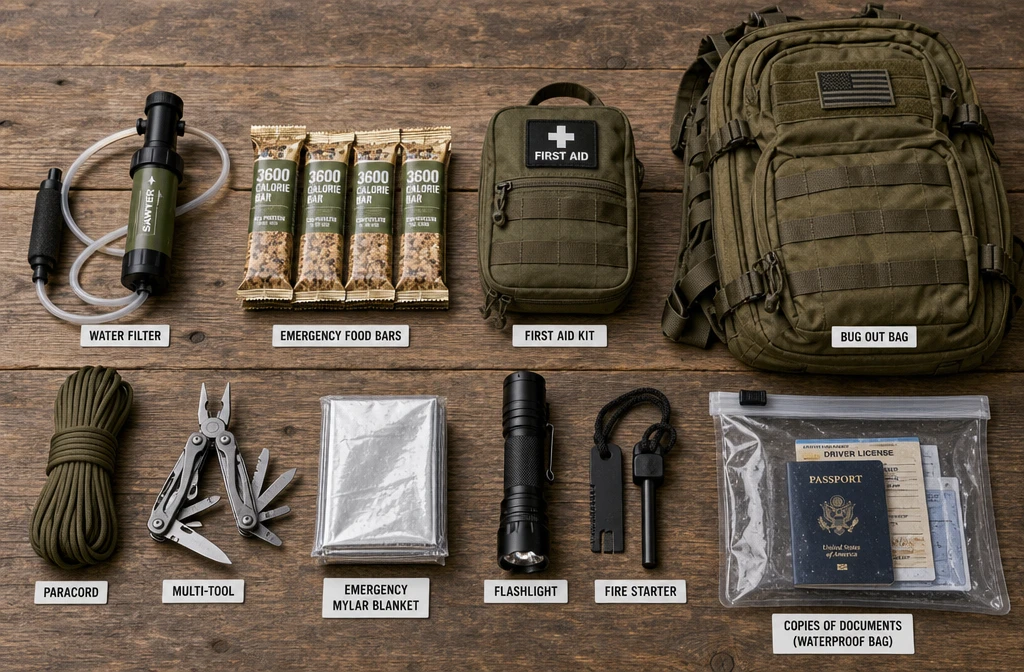
A bug out bag for urban survival has different priorities than a wilderness kit. Urban evacuation means navigating crowds, traffic, and infrastructure failure — not building shelter in the woods.
Core urban BOB essentials:
- Water: 2 liters minimum plus a compact filter (LifeStraw or Sawyer Squeeze)
- Food: 3,600–5,000 calorie emergency bars (72-hour supply)
- Documents: Copies of ID, insurance, bank account info in a waterproof pouch
- Cash: Small bills, $200–$500 minimum (ATMs fail during grid outages)
- First aid: Tourniquet, Israeli bandage, QuikClot, basic medications
- Communication: Hand-crank or battery radio, charged power bank
- Navigation: Paper maps of your city and surrounding region
- Light: Headlamp plus backup batteries
- Multi-tool: Full-size with pliers, blade, and wire cutters
- Shelter: Emergency mylar blanket, lightweight rain poncho
For a complete breakdown, the 72 Hour Bug Out Bag Checklist covers every category with weight and cost estimates. Also worth reviewing: the Ultimate Bug Out Bag Food List for calorie-dense options that store well long-term.
What Items Should Definitely NOT Go in a Hidden Bug Out Bag
Some items degrade, create safety hazards, or become liabilities when stored long-term in a concealed location.
Items to keep out of a hidden, long-term storage bag:
- Perishable medications (insulin, certain antibiotics) — these require refrigeration and cannot be stored in a static hidden cache
- Lithium batteries stored loose — contact with metal objects in a bag can cause shorts and, in rare cases, fires
- Propane or butane canisters — pressurized fuel in an enclosed, warm space is a fire and explosion risk
- Unsealed food items — moisture and pests will ruin them and can damage surrounding gear
- Loaded firearms without a proper holster or case — safety risk in a bag that may be accessed quickly under stress
- Glass containers — they break, contaminate everything else, and add unnecessary weight
Also avoid: Storing your only copy of critical documents. Always keep originals in a fireproof safe and put photocopies in the bag.
How Much Should a Bug Out Bag Cost?
A functional bug out bag for one adult costs between $150 and $400, depending on the quality of gear selected. A family kit for four people typically runs $500–$1,200 when built thoughtfully over time.
Cost breakdown by tier:
| Tier | Cost (Per Person) | What You Get |
|---|---|---|
| Budget | $75–$150 | Basic survival, functional but not durable |
| Mid-range | $150–$300 | Quality gear, 72-hour coverage, good durability |
| Premium | $300–$500+ | Professional-grade, multi-scenario coverage |
The Complete Bug Out Bag Guide: Build a Perfect 72-Hour Kit for Under $200 proves the budget tier is entirely viable if you prioritize correctly.
Where to spend more: Bag itself (durability under load), water filtration, and first aid. Where to save: Emergency blankets, ponchos, paracord, and basic food bars are all cheap and effective regardless of brand.
Bug Out Bag Recommendations for Families With Kids
Families need a different approach to both bag contents and storage location. A single large bag doesn’t work — kids can’t carry adult loads, and one bag per adult means children are left empty-handed if parents get separated.
Age-based bag strategy:
- Under 5: Parents carry everything. No separate bag for toddlers.
- Ages 5–10: A small daypack (10–15L) with comfort items, snacks, a whistle, and their own water bottle. Stored at their accessible height.
- Ages 11–15: A 20–25L pack with age-appropriate gear: food, water, first aid basics, a flashlight, and a copy of family contact info.
- Ages 16+: A full adult bag with complete 72-hour supplies.
Storage tip for families: Keep children’s bags in their own closets or under their beds. Practice the grab-and-go drill so every family member knows exactly where their bag is and can access it independently.
For a complete breakdown, the Family Bug Out Bag: The Complete Age-Specific Guide covers weight limits, contents, and family coordination strategies.
Cheap Ways to Create Secret Storage for Emergency Gear
Smart hidden bug out bag storage ideas for home don’t require a contractor or a big budget. Most of these cost under $50 in materials.
DIY concealment builds under $50:
-
False-bottom drawer ($15–$25): Cut a piece of plywood to fit inside a deep dresser drawer. Place it 3–4 inches above the actual bottom. Store everyday items on top, emergency supplies below.
-
Hollow book cache ($10–$20): Buy a set of matching hardcovers at a thrift store. Cut out the interior pages and glue them together to create a rigid box. Store compact items inside and place on a bookshelf.
-
Fake vent cover ($20–$40): Replace a standard floor or wall vent cover with a deeper box version. The vent looks normal but has 6–8 inches of hidden depth behind it. Available at hardware stores or buildable with basic woodworking skills.
-
Behind-mirror cabinet ($30–$50): A standard bathroom medicine cabinet or full-length mirror on a hinge conceals a wall-depth compartment behind it. The mirror itself is the door.
-
Ceiling tile cache (in basements/utility rooms, $15–$30): Drop ceiling tiles lift out easily. The void above holds flat items like documents, cash, and folded emergency gear.
How to Waterproof and Protect a Bug Out Bag When Storing It Long-Term
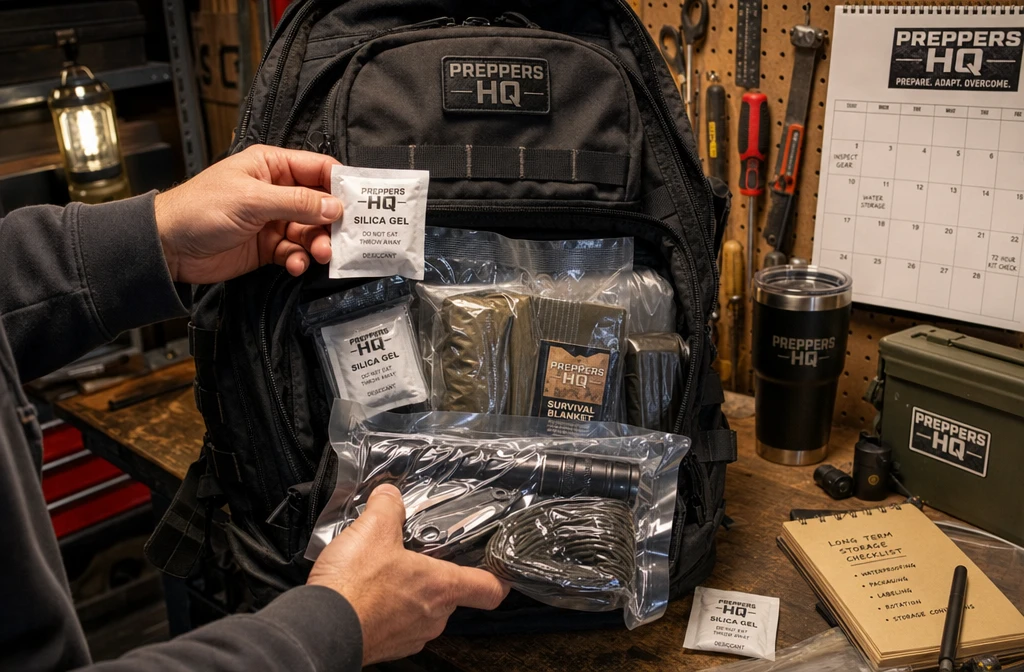
Long-term hidden storage introduces moisture, temperature swings, and pest exposure. A bag stored for 12 months without protection can have degraded food, corroded batteries, and mold-damaged gear.
Step-by-step long-term storage protection:
- Use a waterproof bag liner. A heavy-duty dry bag (30L) inside your pack creates a moisture barrier even if the outer shell gets damp.
- Add silica gel packets. Place 4–6 large desiccant packets inside the bag. Replace them every 12 months.
- Vacuum-seal food items. Emergency bars and food pouches should be in their original sealed packaging. If repackaging, use a vacuum sealer.
- Store batteries separately. Keep batteries in a small zip-lock bag, not installed in devices. Installed batteries leak over time.
- Avoid concrete floors. Moisture wicks up through concrete. Use a shelf, pallet, or rubber mat to keep the bag elevated.
- Maintain 50–70°F storage temperature. Avoid attics (too hot) and uninsulated garages (too cold and too hot seasonally).
- Inspect every 6 months. Check expiration dates, test electronics, and replace anything that has degraded.
Common storage mistakes that destroy gear are covered in depth in the Bug Out Bag Mistakes to Avoid guide — worth reading before you finalize your storage plan.
Warning Signs Your Bug Out Bag Storage Location Might Be Compromised
A compromised storage location is one of the most overlooked risks in home preparedness. “Compromised” doesn’t just mean stolen — it means discovered, damaged, or no longer accessible when you need it most.
Red flags to watch for:
- Someone has moved or disturbed the concealment. A shifted ottoman, a closet shelf that looks different, or a panel that doesn’t sit flush anymore.
- Moisture or condensation inside the bag or on the exterior of the container.
- Pest activity — droppings, chew marks, or nesting material near the storage location.
- You can’t access the bag in under 90 seconds during a timed drill. If it takes longer, the location is functionally compromised even if physically intact.
- A contractor, repair person, or guest has been in the space where the bag is stored. Reassess whether the location is still secure.
- You haven’t checked it in over 12 months. Time itself is a compromise factor.
What to do when a location is compromised: Move the bag immediately. Don’t wait to find a “perfect” new spot — move it to any secure location first, then optimize. A bag in a suboptimal location is infinitely better than one that’s been discovered or damaged.
FAQ: Hidden Bug Out Bag Storage Ideas for Home
Q: How many bug out bags should a household have? One bag per person is the baseline. Beyond that, many experienced preppers keep a secondary “get-home bag” in their vehicle and a smaller cache in a secondary home location. For a family of four, four individual bags plus one shared family cache is a solid setup.
Q: Should I tell family members where the bags are hidden? Yes — every adult and older teen in the household needs to know the location and how to access it. The concealment is from outsiders, not from the people who need to use it.
Q: What’s the best bag type for long-term hidden storage? A mid-size tactical or hiking pack (40–60L) in a neutral color (olive, gray, or black) stores well, carries efficiently, and doesn’t draw attention. Avoid bright colors or military-pattern bags if discretion matters.
Q: Can I store a bug out bag in a storage unit off-site? A storage unit works as a secondary cache, not a primary bug out bag location. If you need to evacuate quickly, driving to a storage unit first adds critical time and introduces a single point of failure.
Q: How do I keep kids from getting into the hidden bag? For young children, height is the best deterrent — store bags above their reach. For older kids, explain what the bag is and why it’s important. Making it a “special emergency tool” rather than a forbidden object reduces curiosity-driven tampering.
Q: What’s the ideal weight for a bug out bag? A loaded bag should not exceed 25–30% of the carrier’s body weight. For most adults, that means 25–45 lbs. Heavier bags slow evacuation speed and cause fatigue quickly.
Q: Does a bug out bag need to be waterproof on the outside? The exterior doesn’t need to be fully waterproof, but a rain cover and an internal dry bag liner are essential for any bag stored long-term or used in wet conditions.
Q: How do I remember to rotate supplies? Set a calendar reminder every 6 months. Many preppers tie their rotation schedule to daylight saving time changes — a built-in twice-yearly reminder that’s easy to remember.
Q: Is it legal to have a hidden storage compartment in my home? In virtually all U.S. jurisdictions, yes. Hidden storage in your own home is entirely legal. The only exception is concealing items that are themselves illegal to possess.
Q: What if I live in a rented apartment and can’t modify walls? Furniture-based concealment (ottomans, trunks, suitcases, storage beds) requires zero modifications and works in any rental. The Ultimate Guide to Apartment Food Storage has additional no-modification storage strategies worth adapting.
Conclusion: Build the System, Then Maintain It
The best hidden bug out bag storage ideas for home share one trait: they’re built around a system, not a single bag in a single spot. Distribute your supplies. Use dead space. Protect against moisture and time. And practice the grab-and-go drill until every household member can be out the door in under two minutes.
Actionable next steps for 2026:
- Walk your home today and identify three potential hidden storage locations using the room-by-room guide above.
- Build or buy your primary bag using the 72 Hour Bug Out Bag Checklist as your baseline.
- Waterproof and seal every perishable item before storing.
- Run a timed drill — can every family member access their bag and reach the front door in 90 seconds?
- Set a 6-month calendar reminder to inspect, rotate, and update.
- Create a secondary cache in a different location using cheap DIY concealment methods.
Preparedness isn’t about living in fear of what might happen. It’s about building the kind of quiet confidence that comes from knowing — when the moment arrives — that you and your family are ready.
For broader emergency planning that complements your hidden storage strategy, the Ultimate Guide to Home Emergency Preparedness and the Ultimate Evacuation Plan Guide are the logical next reads.
Products, Tools, and Resources Worth Knowing
These aren’t paid endorsements — they’re the categories of gear that consistently come up when experienced preppers discuss long-term hidden storage.
- Dry bag liners (30–50L): Sea to Summit and YETI both make reliable options. The liner matters more than the outer bag for long-term storage protection.
- Silica gel desiccant packets (large format): Available in bulk on Amazon. The 50-gram packets work better than the tiny single-use versions for bag storage.
- Magnetic cabinet latches: Used for false-wall panels and hidden compartments. Sugatsune and Richelieu make hardware-store-quality versions that hold up to repeated use.
- Vacuum sealer (FoodSaver or equivalent): Worth owning for both food storage and sealing documents, cash, and compact gear against moisture.
- Storage ottomans with locking lids: Baxton Studio and Skyline Furniture both make models with firm, load-bearing lids and interior depths of 14+ inches.
- Compression stuff sacks: Essential for reducing bag profile when storing inside furniture or behind clothing. Sea to Summit’s Ultra-Sil range compresses well without adding weight.
- Fireproof document bags: For the copies of critical documents inside your bug out bag. The SentrySafe brand is widely available and reliably rated.
References
- National Fire Protection Association. (2023). Home Structure Fires. NFPA. https://www.nfpa.org/education-and-research/research/nfpa-research/fire-statistical-reports/home-structure-fires
- FEMA Ready. (2023). Build a Kit. U.S. Department of Homeland Security. https://www.ready.gov/kit