
Hey there! Some links on this page may be affiliate links which means that, if you choose to make a purchase, I may earn a commission at no extra cost to you. I greatly appreciate your support. Read the full disclosure here.
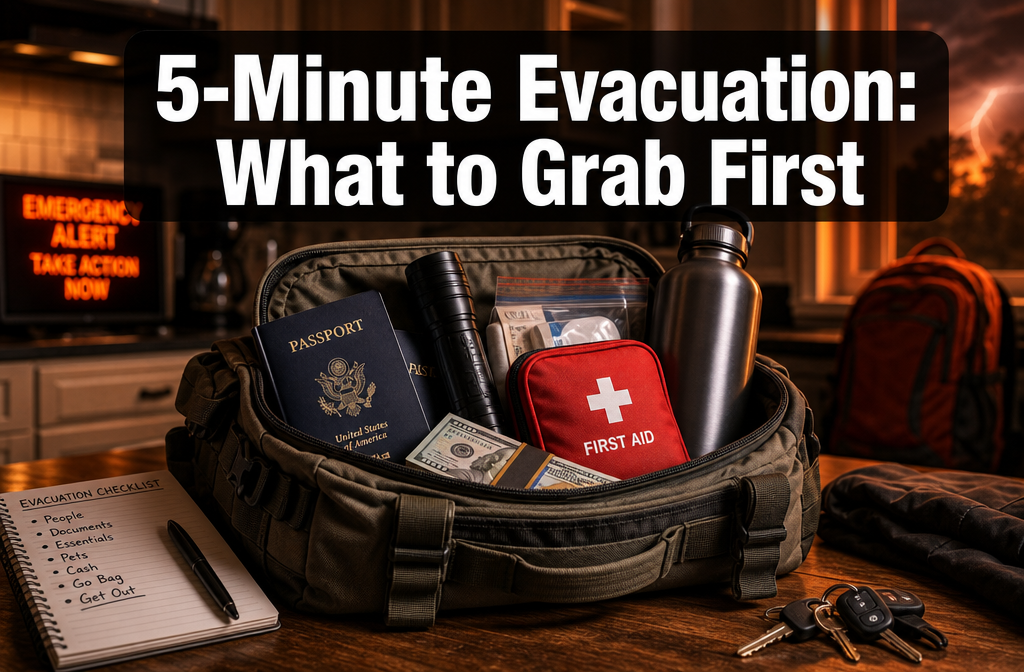
Knowing what to pack for a 5-minute evacuation comes down to one principle: pre-packed beats perfect. The items that matter most are documents, water, medication, cash, and a charged communication device — in that order. Everything else is secondary. If your bag isn’t already packed before the emergency, you will forget something critical.
Key Takeaways
- A pre-packed go-bag is the only reliable solution for a 5-minute evacuation window — improvising under stress leads to dangerous omissions.
- The non-negotiable first grabs are: ID/passport, prescription medications, phone + charger, water, and cash.
- Pack for 72 hours minimum — FEMA’s standard recommendation for self-sufficiency after a disaster.
- Keep your bag under 20–25% of your body weight; heavier bags slow you down and cause fatigue within hours.
- Store $200–$500 in small bills in your go-bag at all times — ATMs and card readers fail during disasters.
- Pets need their own kit: food, leash, vaccination records, and a carrier or harness.
- Families with children or elderly members need a second bag dedicated to their specific needs.
- The single biggest evacuation mistake is waiting until the alert sounds to start packing.
- If you only have 2 minutes, grab the one item that covers the most ground: your pre-staged go-bag by the door.
- Practice a timed evacuation drill at least twice a year — muscle memory saves lives.

What Emergency Items Do You Absolutely Need to Grab First?
The first 60 seconds of an evacuation determine whether you leave with what matters or without it. Prioritize documents, medication, and communication above everything else — these three categories are the hardest to replace and the most immediately life-affecting.
Here’s the non-negotiable first-grab hierarchy:
Tier 1 — Grab these before anything else:
- 🪪 Government-issued ID and passport (stored in a waterproof pouch)
- 💊 Prescription medications (at least a 7-day supply)
- 📱 Charged smartphone + backup battery/charger
- 💵 Emergency cash (pre-staged in your bag)
- 🔑 Car keys and house keys
Tier 2 — Grab these if time allows (30–90 seconds):
- Water (at minimum, one bottle per person)
- A pre-packed go-bag if you have one staged
- Eyeglasses or hearing aids
- A firearm (if licensed and applicable to your situation)
Decision rule: If you can only carry one item, make it your go-bag — because a properly built bag already contains most of Tier 1 and Tier 2 by design.
The smartest preppers don’t make decisions during an evacuation. They make decisions before one and execute on autopilot when it counts. For a deeper breakdown of what belongs in a complete kit, the ultimate emergency supplies list covers items that most standard checklists miss entirely.
What to Pack When Evacuating in 5 Minutes: The Full Go-Bag Breakdown
A 5-minute evacuation pack covers six functional categories: water and food, documents, medical supplies, clothing, communication tools, and cash. Each category has a minimum viable threshold — the least you can carry that still keeps you functional for 72 hours.
The Core 72-Hour Go-Bag Contents
| Category | Minimum Viable Items | Notes |
|---|---|---|
| Water | 1 liter per person + purification tablets | Water is heaviest — prioritize a filter straw |
| Food | 3,000–4,500 calories of compact food | Energy bars, freeze-dried pouches |
| Documents | ID, passport, insurance cards, copies | Waterproof pouch or encrypted USB |
| Medical | Prescriptions, first aid kit, OTC basics | See medical section below |
| Communication | Phone, charger, backup battery, hand-crank radio | Assume cell towers may be down |
| Cash | $200–$500 in small bills | ATMs fail; cards don’t always work |
| Clothing | One change of clothes, rain layer, sturdy shoes | Already wearing counts |
| Tools | Flashlight, multi-tool, lighter, paracord | Compact, high-utility items |
For a fully built-out food list that travels well under pressure, the bug out bag food list is worth bookmarking.
How Much Water and Food Should You Pack for Evacuation?
Pack a minimum of one liter of water per person for the first 24 hours, plus a compact filtration method for ongoing needs. For food, target 1,500–2,000 calories per person per day in shelf-stable, no-cook formats.
Water packing strategy for evacuation:
- One 32 oz water bottle per person (already filled)
- One LifeStraw or Sawyer Squeeze filter per bag
- Water purification tablets as backup (lightweight, near-zero space)
- Avoid packing heavy gallon jugs — they’ll slow you down
Food packing strategy:
- Energy bars (Clif, KIND, or similar) — 200–300 calories each, compact
- Freeze-dried single-serve pouches — light, high calorie, just add water
- Peanut butter packets — calorie-dense, no refrigeration needed
- Avoid anything requiring cooking if you’re moving fast
Common mistake: People pack too much water and not enough caloric density. A filter straw weighs 2 oz and lets you drink from almost any freshwater source — it’s worth 10 water bottles in terms of pack efficiency.
What Important Documents Should You Take With You?
The most important documents to grab during an evacuation are government-issued ID, passport, insurance policies, and medical records. These are difficult or impossible to replace quickly, and their absence can delay disaster relief, medical care, and financial recovery by weeks.
Document evacuation checklist:
- Passport (for every family member)
- Driver’s license or state ID
- Social Security card (or a copy)
- Birth certificates
- Health insurance cards
- Homeowner’s or renter’s insurance policy number
- Vehicle titles and registration
- Prescription list with dosages and prescribing doctor
- Emergency contact list (printed — don’t rely solely on your phone)
- Bank account numbers and a recent statement
Best practice: Store physical copies in a waterproof zip pouch inside your go-bag. Keep a second set of digital copies on an encrypted USB drive or a secure cloud folder you can access from any device.
The ultimate financial survival checklist goes deeper on protecting financial documents and assets before disaster strikes — highly relevant reading for anyone building a serious evacuation plan.
What If You Have Pets During an Emergency Evacuation?
Pets need their own dedicated kit, and that kit needs to be staged and ready before an emergency — not assembled on the spot. The items most people forget are vaccination records (required by many shelters), a spare leash, and enough food for 72 hours.
Pet evacuation essentials:
- Food (3-day supply in a sealed bag)
- Collapsible water bowl + water
- Leash, harness, or carrier
- Vaccination and medical records
- Any regular medications
- A recent photo of your pet (in case you get separated)
- Familiar item (small toy or blanket) to reduce stress
Critical note: Many emergency shelters do not accept pets. Know your evacuation destination’s pet policy before you need it. Identify pet-friendly hotels, friends, or designated animal shelters along your route in advance.
For a full 45-item breakdown, the pet emergency preparedness checklist covers scenarios most pet owners haven’t considered.
What Clothes Are Most Practical to Pack Quickly?
Pack one complete change of weather-appropriate clothing, a rain layer, and sturdy closed-toe shoes. Prioritize function over comfort — clothes that protect you from the elements and allow movement are more valuable than anything else in a fast evacuation.
Clothing priority list:
- Footwear: Wear your most durable shoes or boots during the evacuation itself — don’t pack them
- Base layer: One moisture-wicking shirt and pants or leggings
- Insulation: A lightweight fleece or packable down jacket
- Rain protection: A compact rain poncho (takes up almost no space)
- Socks and underwear: Two pairs minimum
- Gloves and a beanie: If climate-appropriate
Decision rule: Choose synthetic or wool fabrics over cotton. Cotton absorbs moisture and loses insulating value when wet — a real problem if you’re outdoors in cold or wet conditions for hours.
Skip the extras. One outfit, one layer, one rain cover. That’s it for a 5-minute pack.
How Heavy Should My Emergency Go-Bag Be?
Your go-bag should weigh no more than 20–25% of your body weight for sustained carry. For a 160-pound adult, that’s a maximum of 32–40 pounds. Most well-built go-bags for a 72-hour scenario land between 20–30 pounds — and lighter is almost always better.
Weight management rules:
- Water is the heaviest item — use filtration to reduce how much you carry
- Choose multi-use tools over single-purpose items
- Audit your bag every 6 months and remove anything you haven’t mentally justified
- Distribute weight with the heaviest items closest to your back and centered between your shoulder blades
Edge case: If you’re evacuating with children, elderly family members, or individuals with mobility limitations, the primary adult carrier may need to carry more. Plan load distribution in advance, not during the emergency.
For anyone building their first bag from scratch, the complete bug out bag guide walks through building a solid 72-hour kit without overspending or overpacking.
What Medical Supplies Are Most Critical to Bring?
The most critical medical items to pack are prescription medications, a basic first aid kit, and any condition-specific supplies (EpiPen, insulin, CPAP equipment). These items can’t be improvised or substituted — missing them in an emergency can become life-threatening within hours.
Medical evacuation priorities:
Non-negotiable:
- All prescription medications (minimum 7-day supply)
- EpiPen or other emergency injectors if prescribed
- Blood pressure, diabetes, or cardiac medications
- Eyeglasses and/or contact lens supplies
First aid kit minimums:
- Adhesive bandages (assorted sizes)
- Sterile gauze pads and medical tape
- Antiseptic wipes and antibiotic ointment
- Elastic bandage (ACE wrap)
- Tweezers and medical scissors
- Ibuprofen, acetaminophen, antihistamine, antidiarrheal
Condition-specific additions:
- Inhaler (asthma)
- Glucose tablets (diabetes)
- Blood pressure cuff (hypertension management)
Common mistake: People pack a first aid kit but never open it until they need it. Check expiration dates on medications and ointments every six months when you rotate your bag.
What Tech and Chargers Should You Prioritize?
Prioritize a fully charged smartphone, a high-capacity portable battery (20,000+ mAh), and a hand-crank or solar emergency radio. Cell towers can fail or become overloaded during mass evacuations — having multiple communication methods is the difference between informed and blind.
Tech evacuation checklist:
- Smartphone (fully charged before any storm season)
- USB-C and Lightning cables (cover all your devices)
- Portable power bank (20,000 mAh minimum)
- Hand-crank or solar emergency radio (NOAA weather band)
- Headlamp with extra batteries (hands-free lighting beats a flashlight)
- Backup USB drive with documents and photos
Decision rule: If you only have room for one tech item beyond your phone, make it the power bank. A dead phone is worse than no phone because you’ll waste time trying to charge it at the wrong moment.
For a complete look at backup power options for extended outages and evacuation scenarios, the backup power guide for emergencies covers everything from power banks to portable solar setups.
What Emergency Cash Amount Should You Keep Ready?
Keep $200–$500 in small bills ($5s, $10s, and $20s) in your go-bag at all times. During disasters, ATMs run out of cash, card readers lose power, and digital payment systems fail. Cash is the only universally accepted currency in a crisis.
Cash strategy:
- Store bills in a waterproof envelope or zip-lock bag inside your go-bag
- Use small denominations — vendors may not be able to make change
- Don’t rely on a single large bill
- Replenish immediately after any withdrawal from your emergency fund
- Consider keeping a small secondary stash in your vehicle
Edge case: If you evacuate across state lines or to an unfamiliar area, having cash also gives you negotiating power for lodging, fuel, or supplies when demand spikes and card systems are overwhelmed.
How Do You Pack Differently If You Have Kids or Elderly Family Members?

Families with children or elderly members need a second dedicated bag that accounts for their specific physical and medical needs. A standard adult go-bag is not sufficient — children need comfort items and age-appropriate food, while elderly family members often have complex medication schedules and mobility equipment.
For families with children:
- Age-appropriate food and snacks (familiar items reduce panic)
- A comfort item (small stuffed animal, favorite book)
- Diapers, formula, or baby food if applicable
- Children’s medications and dosage instructions
- Copies of custody documents if relevant
- A recent photo of each child
For elderly or mobility-limited family members:
- Full medication list with dosages and pharmacy contact
- Mobility aids (cane, walker, portable wheelchair)
- Hearing aids and extra batteries
- Medical alert information (conditions, blood type, allergies)
- Compression socks or other condition-specific items
- Extra time built into your evacuation plan — they may move slower
The family bug out bag guide offers age-specific packing breakdowns for every family member, including toddlers and seniors.
Decision rule: Assign each able-bodied family member their own bag. Children over 8 can carry a small pack with their own snacks, water, and comfort items. This distributes load and gives kids a sense of agency during a stressful situation.
What Are Common Mistakes People Make When Evacuating?
The most common and dangerous evacuation mistake is not having a pre-packed bag. The second is packing too much and making the bag too heavy to carry effectively. Both errors are entirely preventable with preparation done before the emergency.
Top evacuation mistakes — and how to avoid them:
- Waiting until the alert to start packing — By then, you’re operating under stress, time pressure, and incomplete thinking. Pack the bag today.
- Overpacking “just in case” items — Every extra pound is a real cost over hours of movement. If you haven’t used it in a drill, cut it.
- Forgetting medications — This is the most life-threatening omission. Keep a 7-day supply staged in your bag and rotate it regularly.
- No printed documents — Phones die. Cloud services require internet. Physical copies in a waterproof pouch are non-negotiable.
- Not knowing the route — Having a bag is useless if you don’t know where you’re going. Pre-plan two evacuation routes from your home.
- Ignoring the vehicle — Your car is part of your evacuation system. Keep the tank above half during any elevated threat period.
- No communication plan — If family members are separated, how do you reconnect? Designate an out-of-area contact everyone can call.
For a full audit of what’s commonly missing, 15 things missing from your emergency kit is a sobering read.
What If You Only Have 2 Minutes Instead of 5 to Evacuate?
If you have 2 minutes or less, grab your pre-staged go-bag and leave. Nothing else matters more than exiting safely. If no bag exists, the 2-minute priority order is: medications, ID/passport, phone, keys, shoes — in that sequence, moving as fast as possible.
The 2-minute drill (no pre-packed bag):
- 0:00–0:30 — Grab medications and put on shoes
- 0:30–1:00 — Grab wallet, ID, and passport
- 1:00–1:30 — Grab phone and car keys
- 1:30–2:00 — Grab water bottle and exit
The hard truth: Two minutes is not enough time to make good decisions about what to pack. It’s only enough time to execute a pre-made decision. This is why every serious prepper builds and stages their bag before the threat arrives — not during it.
The best investment you can make right now is building a proper go-bag and placing it near your exit. The bug-out bag for beginners guide walks through the entire build process step by step.
What to Pack When Evacuating in 5 Minutes: The Master Checklist
Use this as your final audit before sealing your bag:
Documents & ID
- Passport and/or government ID
- Insurance cards and policy numbers
- Prescription list and medical records
- Emergency contact list (printed)
- Cash ($200–$500 in small bills)
Water & Food
- 1+ liter of water per person
- Water filter straw or purification tablets
- 3-day supply of compact, high-calorie food
Medical
- All prescription medications (7-day supply)
- First aid kit (stocked and checked)
- Condition-specific supplies (EpiPen, inhaler, etc.)
Communication & Power
- Charged smartphone
- Portable power bank (20,000+ mAh)
- Charging cables
- Hand-crank emergency radio
Clothing & Gear
- One change of clothes
- Rain layer or poncho
- Sturdy footwear (wear them, don’t pack them)
- Headlamp with extra batteries
- Multi-tool or knife
Family & Pets
- Pet food, leash, and vaccination records
- Children’s items (comfort, food, medications)
- Elderly family member’s medications and mobility aids
Frequently Asked Questions
Should I keep my go-bag packed at all times or only during threat seasons? Keep it packed year-round. Disasters don’t follow a calendar. A bag that’s only packed during hurricane season won’t help you during a winter gas leak or a wildfire in October.
How often should I rotate the food and water in my evacuation bag? Rotate food every 6–12 months depending on the item’s shelf life. Replace water every 6 months if stored in plastic bottles. Check medications against expiration dates every 6 months as well.
Can I use a regular backpack instead of a tactical bag? Yes. A comfortable, well-fitting backpack you can carry for hours is better than a tactical bag that fits poorly. Fit and comfort matter more than aesthetics.
What’s the best way to waterproof my documents? Use a dedicated waterproof document pouch (available for under $15 at most outdoor retailers). Alternatively, seal documents in heavy-duty zip-lock bags. Both methods work — the pouch is more durable for long-term staging.
Should I have a separate bag for each family member? Ideally, yes. Each able-bodied adult should carry their own bag. Children over 8 can carry a small daypack. This distributes weight and ensures that if someone gets separated, they still have basic supplies.
What if my medications require refrigeration? Pack an insulated pouch with a reusable ice pack for short-term transport. Know the maximum time your medication can be unrefrigerated (check with your pharmacist) and plan accordingly. Some medications have room-temperature windows of 8–24 hours.
Is a 72-hour kit the same as a go-bag? Essentially yes. A 72-hour kit is designed to sustain you for three days — the standard window before emergency services typically restore basic infrastructure. A go-bag is the portable version of that kit.
What’s the most overlooked item in most go-bags? A printed, physical copy of emergency contacts and medical information. When your phone dies and you’re in an unfamiliar emergency room, having that information on paper can be life-saving.
Do I need a go-bag if I live in a low-risk area? Yes. “Low-risk” describes probability, not possibility. House fires, chemical spills, and infrastructure failures happen everywhere. A go-bag is insurance — you hope you never need it, but you’re glad it exists when you do.
How do I keep my go-bag from being too heavy? Audit it ruthlessly. Remove anything you can’t justify with a specific use case. Prioritize multi-use items (a multi-tool over individual tools, a filter straw over water bottles). Weigh your bag — if it’s over 25% of your body weight, cut items.
Conclusion: The Bag That Buys You Time
Knowing what to pack when evacuating in 5 minutes is really about one thing: making decisions now so you don’t have to make them under pressure later. The families who evacuate successfully aren’t the ones who think fastest in a crisis — they’re the ones who prepared before it arrived.
Actionable next steps:
- Today: Gather your documents and medications and place them in a waterproof pouch.
- This week: Build or audit your go-bag using the master checklist above.
- This month: Run a timed evacuation drill with your household. Time it. Fix what’s slow.
- Every 6 months: Rotate food, water, and medications. Check batteries. Update documents.
Preparedness isn’t about fear. It’s about confidence — the kind that comes from knowing exactly what you’d grab, where you’d go, and how you’d keep your family safe when the unexpected happens. That confidence is built before the alarm sounds.
For a complete system that goes beyond the go-bag, the ultimate evacuation plan guide covers routes, communication protocols, and destination planning in full detail.
Products, Tools, and Resources
These are the items and resources worth having in place before you need them:
- LifeStraw Personal Water Filter — Weighs 2 oz, filters up to 1,000 liters, and fits in any bag. One of the highest-value items per ounce available for evacuation kits.
- Anker PowerCore 20,000 mAh Power Bank — Reliable, widely available, and large enough to charge a phone 4–5 times. Keep it charged and in your bag.
- Midland ER310 Emergency Crank Radio — NOAA weather alerts, solar charging, and a built-in flashlight. Covers communication when cell networks fail.
- Waterproof Document Pouch — A simple, inexpensive item that protects everything irreplaceable. Look for one with a shoulder strap for hands-free carry.
- Freeze-Dried Emergency Meals — Brands like Mountain House and Augason Farms offer single-serve pouches with 25-year shelf lives. Lightweight, calorie-dense, and genuinely edible. The prepper’s guide to freeze-dried food helps you choose the right options.
- Leatherman Wave+ Multi-Tool — Covers cutting, prying, screwdriving, and more in a single compact tool. One of the most-used items in any go-bag.
- 72-Hour Bug Out Bag Checklist — For a printable, field-tested checklist to build or audit your bag, the 72-hour bug out bag checklist is a practical starting point.
None of these items are expensive relative to what they protect. The cost of a well-built go-bag is a fraction of what a single missed evacuation item can cost in health, safety, or financial recovery.