
Hey there! Some links on this page may be affiliate links which means that, if you choose to make a purchase, I may earn a commission at no extra cost to you. I greatly appreciate your support. Read the full disclosure here.
Backup power for emergencies means having a reliable, independent energy source when the grid goes down. For preppers and survivalists, the right system depends on your power needs, location, budget, and how long you expect to be off-grid. The four main options are portable generators, solar-plus-battery systems, portable power stations, and propane or dual-fuel setups — and most serious preppers combine at least two of them.
Key Takeaways
- Grid failures are not rare events. The U.S. experienced over 180 major power outage events in 2023 alone, according to the U.S. Energy Information Administration (EIA).
- A layered power strategy (primary + backup + micro-backup) is more reliable than depending on a single system.
- Solar with LiFePO4 battery storage is the quietest, longest-lasting, and most maintenance-friendly option for home preppers.
- Portable gas generators deliver the most raw wattage per dollar but require fuel storage, ventilation, and regular maintenance.
- Portable power stations (like Jackery or EcoFlow) are ideal for short outages, bug-out scenarios, and powering medical devices.
- Know your critical load (the minimum watts needed to survive) before buying any system.
- Fuel storage, carbon monoxide risk, and EMP vulnerability are the three most overlooked threats in emergency power planning.
- A basic 72-hour power plan costs far less than most preppers assume — often under $500 for a starter setup.
- Medical equipment users (CPAP machines, oxygen concentrators) must prioritize power planning above almost everything else.
- Always test your backup system before you need it.
What Is Backup Power for Emergencies and Why Do Preppers Prioritize It?
Backup power for emergencies is any independent energy source that keeps critical systems running when the utility grid fails. For preppers and survivalists, it’s not a luxury — it’s a core survival layer, sitting right alongside food, water, and shelter.
When the grid goes down, the cascade of problems starts fast. Refrigerated food spoils within four hours. Medical equipment stops. Communication devices die. Security systems go dark. Heating and cooling fail. The longer the outage, the more dangerous the situation becomes, especially for families with medical needs, young children, or elderly members.
The prepper community understands something most people don’t: power outages are not just inconveniences — they are force multipliers for every other emergency. A hurricane is survivable. A hurricane plus no power for two weeks is a different problem entirely.
For a broader view of how power fits into your overall readiness plan, see The Ultimate Emergency Preparedness Guide for Preppers.
What Are the Main Types of Emergency Backup Power Systems?
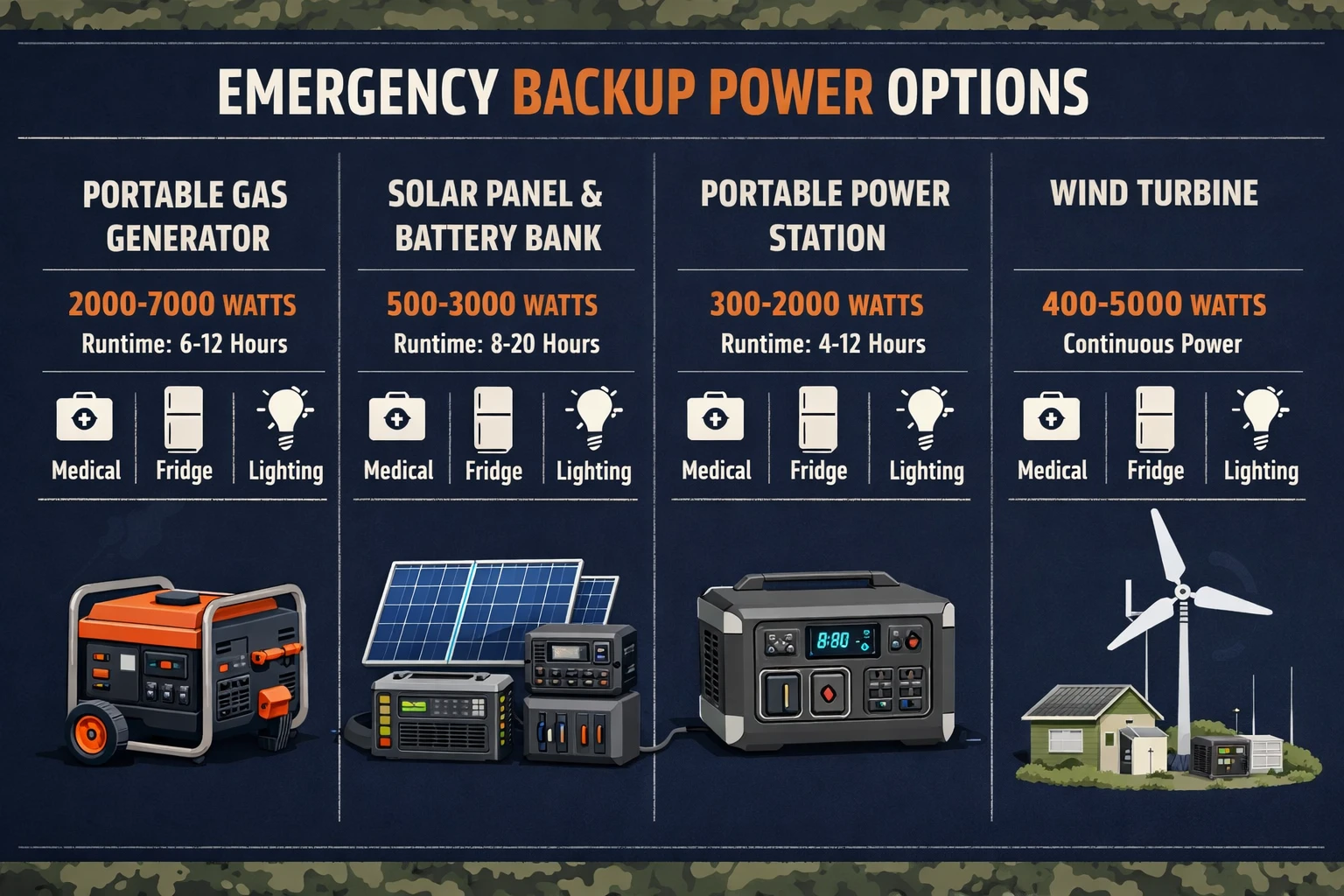
The four primary categories of backup power for emergencies each have distinct strengths, weaknesses, and ideal use cases. No single system is perfect for every situation.
1. Portable Gas or Dual-Fuel Generators
These are the most common first purchases for new preppers. A mid-size unit (3,500–7,500 watts) can run a refrigerator, lights, a well pump, and basic electronics simultaneously.
Pros:
- High wattage output for the price
- Widely available fuel (gasoline, propane)
- Proven technology, easy to repair
Cons:
- Requires ventilation (carbon monoxide risk is real and lethal)
- Noisy — announces your location in a grid-down scenario
- Fuel degrades; requires stabilizer for long-term storage
- Needs regular maintenance (oil changes, carb cleaning)
Choose a generator if you need to power high-draw appliances (well pumps, window AC units, electric ranges) and have a safe outdoor space to run it.
⚠️ Critical safety note: Never run a generator indoors, in a garage, or near windows. Carbon monoxide poisoning kills dozens of Americans every year during power outages, per the CDC.
2. Solar Panels with Battery Storage
A solar array paired with a lithium iron phosphate (LiFePO4) battery bank is the gold standard for long-term, silent, maintenance-light backup power.
Pros:
- Silent operation
- No fuel dependency
- LiFePO4 batteries last 2,000–5,000+ charge cycles
- Scalable from small (400W) to whole-home systems
Cons:
- Higher upfront cost
- Output depends on sunlight availability
- Requires a charge controller, an inverter, and proper wiring
Choose solar + storage if: you’re planning for outages longer than 72 hours, want a permanent home system, or live in a region with reliable sun exposure.
3. Portable Power Stations
Brands like EcoFlow, Jackery, and Bluetti produce all-in-one battery units with built-in inverters, USB ports, and AC outlets. These range from 500Wh to 5,000Wh.
Pros:
- Plug-and-play simplicity
- Indoor-safe (no fumes)
- Rechargeable via solar, wall outlet, or car
- Ideal for CPAP machines, phones, laptops, and small appliances
Cons:
- Limited capacity compared to full solar systems
- Not designed for high-draw appliances (central AC, well pumps)
- Battery replacement can be expensive after several years
Choose a portable power station if you need a fast, portable, or apartment-friendly solution for short outages or bug-out scenarios.
4. Propane and Natural Gas Standby Generators
Whole-home standby generators run on propane or natural gas and start automatically when grid power fails. They’re the most convenient option, but also the most expensive.
Pros:
- Automatic transfer — no manual startup
- Propane stores indefinitely (unlike gasoline)
- Can power an entire home
Cons:
- High installation cost ($5,000–$15,000+, including transfer switch)
- Depends on fuel delivery or a large propane tank
- Not portable
Choose a standby generator if: you have the budget, own your home, and want zero-effort automatic backup power.
How Much Power Do You Actually Need in an Emergency?
 Most preppers overbuy or underbuy because they skip this step. Calculate your critical load first — the minimum wattage needed to keep your household functional and safe.
| Appliance | Typical Wattage |
|---|---|
| Refrigerator | 100–400W |
| CPAP machine (no heat) | 30–60W |
| LED lighting (10 bulbs) | 50–100W |
| Phone/laptop charging | 20–65W |
| Well pump (1/2 HP) | 900–1,000W |
| Window AC unit | 500–1,500W |
| Electric space heater | 750–1,500W |
| Sump pump | 800–1,050W |
How to calculate your needs:
- List every appliance you’d run during an outage.
- Note the running wattage (on the label or in the manual).
- Add 20–25% as a buffer for startup surge (motors draw 2–3x their running wattage at startup).
- That total is your minimum system size.
For most families focused on survival basics (refrigerator, lighting, phone charging, CPAP), a 2,000W system covers the essentials. Running a well pump or AC unit pushes that to 3,500–5,000W.
How Should Preppers Build a Layered Backup Power Strategy?
A single backup power source is a single point of failure. Serious preppers build in layers — a concept borrowed from military redundancy planning.
The three-layer model:
- Layer 1 (Primary): Main backup system — solar array, standby generator, or large portable power station. Handles the bulk of daily power needs.
- Layer 2 (Secondary): A portable gas generator or secondary battery bank. Kicks in if the primary fails or runs out of fuel.
- Layer 3 (Micro-backup): Hand-crank or solar-powered radios, USB battery banks, headlamps, and power banks. Always available, no fuel required.
This approach mirrors the same logic behind building a strong bug-out bag for beginners — redundancy at every level.
Common mistake: Preppers often invest heavily in Layer 1 and ignore Layers 2 and 3. If the generator breaks down or runs out of fuel on day three, they’re left with nothing.
What Fuel Storage and Safety Rules Apply to Emergency Power?
Fuel management is where most generator-dependent preppers fail. Having a generator without a fuel plan is like having a car with no gas.
Gasoline:
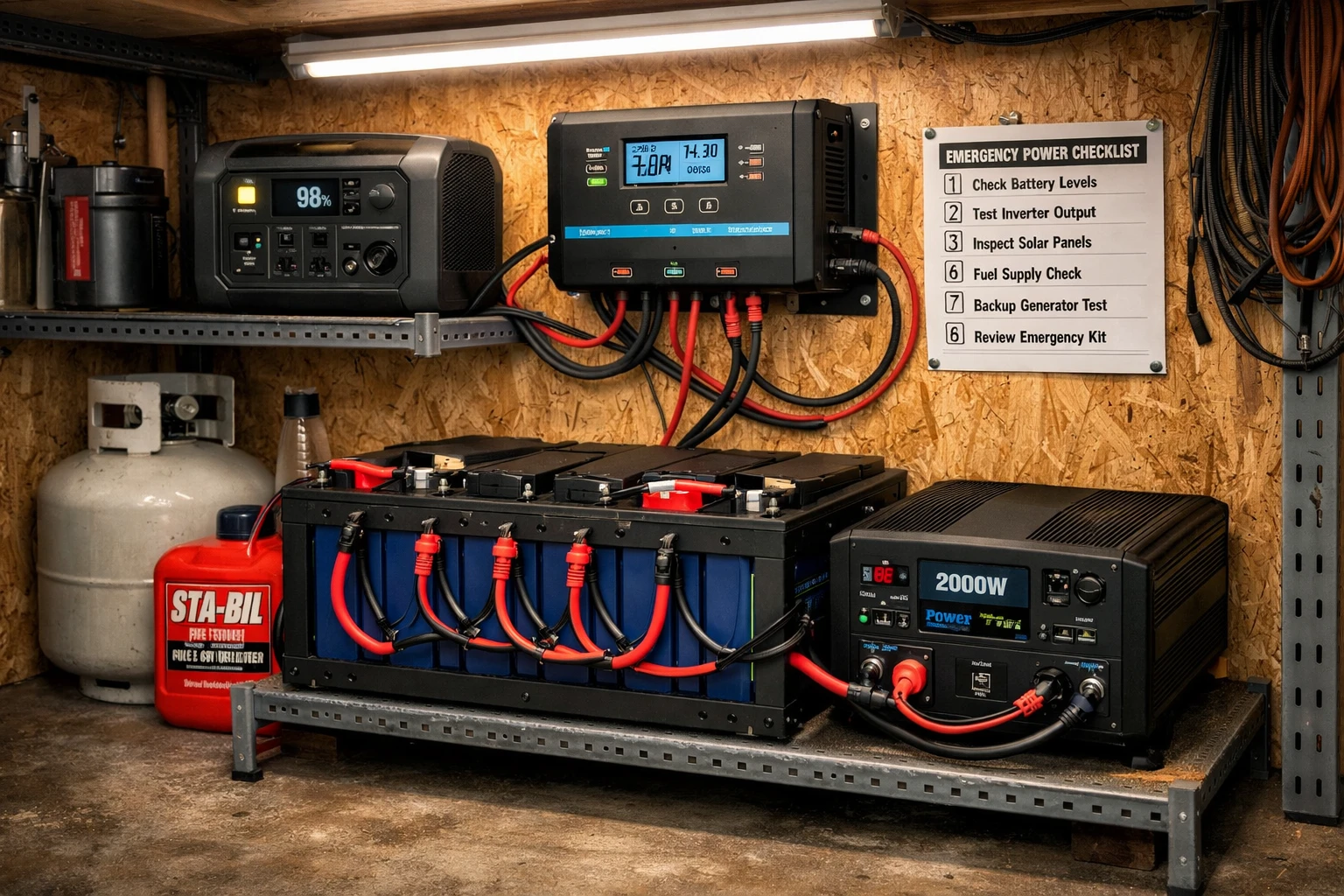
- Degrades in 30–90 days without a fuel stabilizer (like Sta-Bil)
- With stabilizer, shelf life extends to 12–24 months
- Store in approved containers, away from living spaces and ignition sources
- Rotate stock regularly — use old fuel in vehicles, replace with fresh
Propane:
- Stores indefinitely when properly sealed
- 100-gallon tank provides roughly 8–10 days of whole-home generator use (estimate based on 1 gallon/hour consumption at 50% load)
- Requires professional installation for large tanks
Solar (no fuel required):
- Battery storage is the “fuel” — maintain charge cycles and avoid deep discharges below 20% on lithium systems
- Keep panels clean and unshaded
For grid-failure scenarios involving EMP or infrastructure attacks, see this EMP attack andgrid-failure survival guide for additional power-protection strategies.
What Are the Best Backup Power Options for Specific Emergency Scenarios?
Different emergencies demand different power solutions. Here’s a scenario-based breakdown.
Short-term outage (1–72 hours):
- Best option: Portable power station + headlamps + battery banks
- A 1,000–2,000Wh unit handles phones, CPAP, lighting, and a small refrigerator for 1–2 days
Extended outage (3–14 days):
- Best option: Portable gas generator + fuel supply, or solar with battery storage
- Focus on refrigeration, well pump, and medical devices
Long-term grid failure (2+ weeks):
- Best option: Solar array with LiFePO4 battery bank as primary; generator as backup
- Fuel dependency becomes a serious vulnerability beyond two weeks
Bug-out scenario:
- Best option: Portable power station (EcoFlow DELTA or similar) + foldable solar panel
- Weight and portability matter more than raw capacity
- Pair with your 72-hour bug-out bag checklist for a complete mobile kit
Urban apartment:
- Best option: Portable power station (indoor-safe) + solar charging via window or balcony
- Generators are not an option without outdoor space
For seniors or those with medical needs, power planning takes on extra urgency. The 9 essential disaster prep strategies for seniors cover the power needs of medical devices in detail.
How Do You Protect Backup Power Equipment from EMP and Extreme Weather?
An EMP (electromagnetic pulse) — whether from a solar event or a deliberate attack — can destroy unshielded electronics, including generators with digital control boards, inverters, and battery management systems.
Basic EMP protection steps:
- Store a backup inverter and charge controller in a Faraday cage (a metal trash can lined with cardboard works as a basic option)
- Keep a simple, carbureted generator (older models without digital controls) as a secondary unit — these are far more EMP-resistant
- Disconnect solar systems from the grid during known solar storm events
Extreme weather protection:
- Keep generators covered and elevated in flood-prone areas
- Store portable power stations indoors — extreme cold reduces lithium battery capacity significantly (below 32°F, capacity can drop 20–40%)
- Secure solar panels against high winds — use proper racking systems rated for your local wind load
What Does a Starter Backup Power Setup Cost in 2026?
Budget is the most common barrier. Here’s a realistic cost breakdown for three tiers.
| Tier | Components | Estimated Cost |
|---|---|---|
| Basic (72-hour) | 1,000Wh portable power station + 100W solar panel | $400–$700 |
| Intermediate (1–2 weeks) | 3,500W dual-fuel generator + fuel stabilizer + 20 gallons stored fuel | $600–$1,200 |
| Advanced (long-term) | 2,000W solar array + 10kWh LiFePO4 battery bank + 3,000W inverter | $4,000–$10,000+ |
Most preppers starting should target the Basic tier first, test it, learn its limits, and then expand. A $600 portable power station that you actually understand and maintain beats a $5,000 system you’ve never tested.
Check the ultimate disaster preparedness checklist to see how power fits alongside other essential preps.
FAQ: Backup Power for Emergencies
Q: How long will a portable power station run a refrigerator? A standard 1,000Wh portable power station will run a modern energy-efficient refrigerator (150W average draw) for approximately 5–6 hours. Older or larger fridges cut that time significantly.
Q: Can I run a generator indoors or in a garage? No. Never. Carbon monoxide from generators is odorless and kills within minutes in enclosed spaces. Always operate at least 20 feet from any door, window, or vent.
Q: What’s the difference between watts and watt-hours? Watts measure power draw at any given moment. Watt-hours measure total energy capacity over time. A 100W appliance running for 10 hours uses 1,000Wh (1kWh).
Q: Are LiFePO4 batteries worth the extra cost over lead-acid? Yes, for most preppers. LiFePO4 batteries last 5–10x longer, charge faster, handle deeper discharges without damage, and are safer. The higher upfront cost pays off over time.
Q: How much fuel should I store for a generator? A 5,000W generator running at 50% load consumes roughly 0.5–0.75 gallons of gasoline per hour. For 72 hours of daily 8-hour use, that’s 12–18 gallons minimum. Store at least 25–30 gallons with stabilizer for a meaningful buffer.
Q: Will solar panels work during a cloudy day or in winter? Yes, but at reduced output — typically 10–25% of rated capacity on heavily overcast days. Winter sun angles also reduce efficiency. Size your system with seasonal variation in mind.
Q: Do I need a transfer switch for a generator? Yes, if you’re connecting a generator to your home’s electrical panel. A manual or automatic transfer switch prevents dangerous backfeed to utility lines, which can kill lineworkers. This is not optional — it’s a legal and safety requirement.
Q: What’s the best backup power option for a CPAP machine? A portable power station in the 500–1,000Wh range handles a CPAP machine (without a heated humidifier) for 2–4 nights per charge. Pair it with a small solar panel for indefinite runtime.
Q: How do I protect my backup power equipment from theft during a long outage? Keep generators and battery systems in a locked, secured space. Noise from a running generator attracts attention — use a quiet inverter generator or solar system when operational security matters. This connects directly to home defense planning for preppers.
Q: Is a whole-home standby generator worth it for preppers? It depends on budget and priorities. For those who can afford the $8,000–$15,000 installed cost, a propane standby generator offers unmatched convenience and reliability. For most preppers, a layered approach using solar plus a portable generator delivers better value and redundancy.
Q: Can I charge a portable power station with my car? Yes. Most portable power stations include a 12V car charging port. Charging a 1,000Wh unit from a car typically takes 8–12 hours and uses roughly 0.5–0.75 gallons of fuel — not efficient, but useful in a pinch.
Q: What’s the single biggest mistake preppers make with backup power? Never test the system before an emergency. Buy the equipment, run it under real load, and find the gaps while the stakes are low.
Products, Tools, and Resources Worth Knowing
These recommendations come from real-world prepper use cases, not sponsored lists.
Portable Power Stations:
- EcoFlow DELTA 2 (1,024Wh) — Fast charging (80% in under an hour), expandable battery, excellent for CPAP and refrigerator use. A strong mid-range choice.
- Jackery Explorer 2000 Plus — Modular design allows capacity expansion; good solar input rate.
- Bluetti AC200MAX — High capacity, multiple input options, well-regarded in the off-grid community.
Portable Generators:
- Champion 3500W Dual Fuel — Runs on gasoline or propane, reliable, widely serviced. A solid entry-level workhorse.
- Honda EU2200i — Quieter than most (48–57 dB), fuel-efficient, inverter-grade power safe for sensitive electronics. Higher cost, but worth it for long-term reliability.
Solar Panels:
- Renogy 100W Monocrystalline panels — Affordable, durable, widely compatible with most charge controllers.
- EcoFlow 220W Bifacial Portable Panel — Foldable, high output, pairs well with EcoFlow stations.
Battery Storage:
- Ampere Time (now LiTime) 100Ah LiFePO4 — Good value for DIY solar builds.
- EG4 LiFePO4 Server Rack Batteries — Popular in the off-grid and prepper community for whole-home systems.
Accessories:
- Sta-Bil 360 Fuel Stabilizer — Essential for any gasoline storage plan.
- Klein Tools Non-Contact Voltage Tester — Basic safety tool for any DIY power work.
- Faraday EMP bags — For protecting spare inverters, charge controllers, and communication devices.
For a full picture of how power fits into your overall preparedness system, the off-grid living ultimate guide is an excellent next resource.
Conclusion: Build Your Backup Power Plan Before You Need It
Backup power for emergencies is not a single purchase — it’s a system built in layers, tested regularly, and matched to your specific household needs. The preppers who fare best in extended outages are the ones who calculated their critical load, chose the right combination of power sources, stored adequate fuel, and actually ran their systems under real conditions before the lights went out.
Actionable next steps:
- Calculate your critical load today — list every appliance you’d need in an outage and add up the wattage.
- Start with a portable power station if you’re new to this. It’s indoor-safe, simple, and immediately useful.
- Add a generator or solar system once you understand your baseline needs.
- Store fuel properly — at least 25 gallons with stabilizer for generator users.
- Test everything under load at least once every six months.
- Build in redundancy — at minimum, have a micro-backup (hand-crank radio, USB battery banks) that requires no fuel or charging.
- Review your full preparedness plan using the 12 essential disaster preparedness strategies for families to make sure power integrates with food, water, and evacuation planning.
The grid will fail again. The only question is whether you’re ready when it does.
References
- U.S. Energy Information Administration (EIA). Electric Power Monthly: Electric Power Outage Data. 2023. https://www.eia.gov/electricity/
- Centers for Disease Control and Prevention (CDC). Carbon Monoxide Poisoning from Consumer Products. 2022. https://www.cdc.gov/niosh/topics/emres/co.html
- National Renewable Energy Laboratory (NREL). Lithium-Ion Battery Performance and Cost. 2021. https://www.nrel.gov/