
Hey there! Some links on this page may be affiliate links which means that, if you choose to make a purchase, I may earn a commission at no extra cost to you. I greatly appreciate your support. Read the full disclosure here.
Key Takeaways
- Humans preserved food for thousands of years before refrigeration using methods that still work reliably today: curing, fermenting, canning, dehydrating, and root cellaring.
- The most dangerous temperature range for perishable food is between 40°F and 140°F, called the “danger zone” by the USDA, where bacteria multiply rapidly.
- Root cellars maintain temperatures between 32°F and 40°F naturally, making them one of the most effective long-term storage solutions for produce.
- Dried, salted, fermented, and canned foods form the backbone of any serious off-grid or emergency food plan.
- Foods that spoil fastest without refrigeration include raw meat, dairy, cooked rice, cut fruit, and leafy greens.
- A well-organized dry pantry stocked with grains, legumes, honey, salt, and canned goods can sustain a family for months without any electricity.
- Common mistakes include storing food in warm or humid areas, using improper containers, and neglecting rotation.
What Are the Best Ways To Store Food Without a Refrigerator
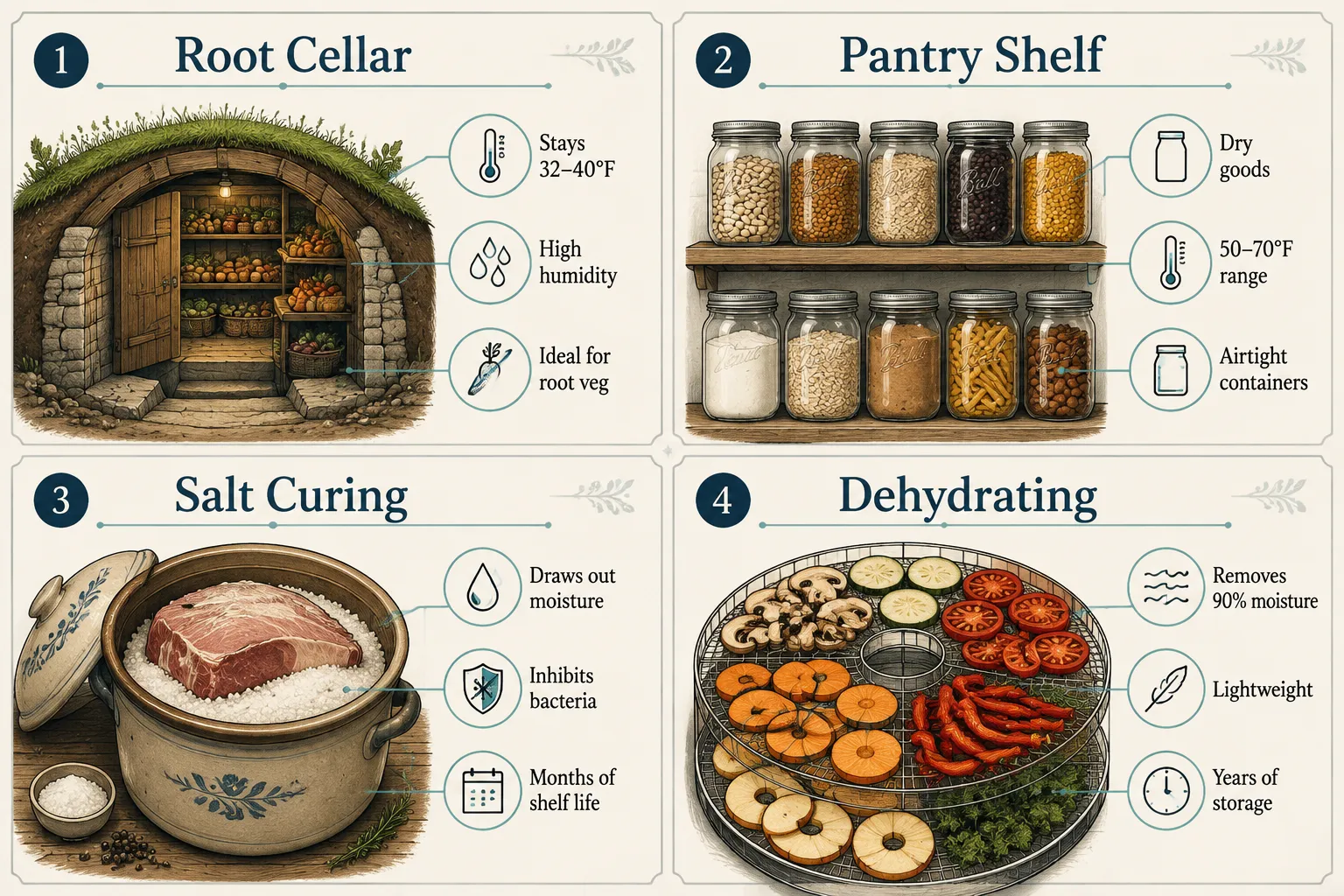
Knowing how to store food without freezer or refrigeration starts with understanding that cold is not the only way to stop food from spoiling, it’s just the most convenient modern shortcut. The real goal is controlling moisture, oxygen, temperature, and microbial activity. Every traditional preservation method targets at least one of these four factors.
The most reliable methods for refrigeration-free food storage are:
- Canning (pressure or water bath): Seals food in airtight jars and destroys pathogens through heat.
- Dehydrating/drying: Removes moisture that bacteria and mold need to survive.
- Salt curing: Draws moisture out of food and creates an inhospitable environment for bacteria.
- Fermentation: Uses beneficial bacteria to acidify food and outcompete harmful organisms.
- Root cellaring: Uses naturally cool, humid underground conditions to slow spoilage of fresh produce.
- Smoking: Combines heat, drying, and antimicrobial compounds from wood smoke.
- Dry pantry storage: Stores shelf-stable items like grains, legumes, and honey in airtight containers at room temperature.
For preppers building a long-term food supply, layering multiple methods is far more resilient than depending on any single approach. See the long-term food storage beginner’s guide for a full breakdown of how to build that system.
How Long Can Food Last Without Refrigeration
Food shelf life without refrigeration varies dramatically depending on the preservation method used, the storage temperature, and whether the food has been processed or is still raw.
Here’s a practical reference:
| Food / Method | Estimated Shelf Life | Key Condition |
|---|---|---|
| White rice (sealed, oxygen-free) | 25-30 years | Cool, dry, airtight |
| Honey (raw, sealed) | Indefinite | Sealed, no moisture |
| Home-canned vegetables | 1-5 years | Proper seal, cool storage |
| Dried beans / lentils | 8-10 years | Airtight, low humidity |
| Salt-cured meat (dry) | Several months to 1 year | Cool, dry, well-cured |
| Fermented vegetables (crock) | 3-6 months | Below 65°F, submerged |
| Dehydrated vegetables | 1-4 years | Airtight, dark, dry |
| Raw meat (unprocessed, room temp) | 2-4 hours | Danger zone above 40°F |
The USDA defines the bacterial “danger zone” as 40°F to 140°F. At room temperature (roughly 70°F), most perishable foods become unsafe within two hours. That’s the baseline rule for any emergency food planning.
Root Cellar vs. Pantry Storage: Which Is Better for Food
A root cellar outperforms a standard pantry for storing fresh produce because it maintains naturally cool, humid conditions that slow respiration and decay in root vegetables, apples, and cabbages. A dry pantry, however, is better for shelf-stable processed foods, grains, and canned goods that need low humidity and stable temperatures.
Root cellar advantages:
- Maintains 32-40°F year-round without electricity
- High humidity (85-95%) keeps root vegetables from shriveling
- Ideal for potatoes, carrots, turnips, beets, apples, and winter squash
- No ongoing cost once built
Dry pantry advantages:
- Suited to grains, legumes, canned goods, salt, sugar, and honey
- Easier to build and maintain than a root cellar
- Better for long-term shelf-stable items
The practical answer: Use both. A root cellar handles your fresh harvest; a pantry handles your processed and packaged stores. If building a root cellar isn’t possible right now, an insulated basement corner or a buried trash can in shaded ground can approximate the same effect. For a full construction guide, see how to build a root cellar for long-term food storage.
Can You Store Meat Without a Freezer, And How
Yes, meat can be stored without a freezer using four proven methods: salt curing, smoking, dehydrating into jerky, and canning. Each method either removes the moisture bacteria need, creates an acidic or saline environment hostile to pathogens, or uses heat to destroy them and seal the food from recontamination.
Salt Curing and Pickling Food Storage Techniques
Salt curing works by drawing moisture out of meat through osmosis, which prevents bacterial growth. Traditional dry curing uses a ratio of roughly 1 ounce of curing salt per pound of meat, packed thoroughly and left to cure in a cool location for several days to weeks depending on thickness.
Key techniques:
- Dry cure: Rub meat with salt (and optional sugar, spices, and curing salt/Prague Powder #1 for safety). Store in a cool, dark place.
- Brine cure: Submerge meat in a salt-water solution (typically 10-20% salt by weight). Works well for pork, poultry, and fish.
- Smoking: Combine curing with hot or cold smoking to add antimicrobial compounds from wood smoke and further reduce moisture.
- Jerky: Slice meat thin, marinate in salt and acid (vinegar or citrus), then dehydrate at 160°F until completely dry and brittle.
Pickling uses vinegar or fermentation brine to create an acidic environment (pH below 4.6) that inhibits most pathogens. It works well for fish, eggs, and some meats as a short- to medium-term preservation method.
What Foods Spoil Fastest Without Refrigeration
The foods that spoil fastest at room temperature are those with high moisture content, neutral pH, and high protein. Knowing which items to prioritize, or avoid stockpiling fresh, is a core skill in emergency food planning.
Fastest spoilers (avoid or process immediately):
- Raw meat and poultry (unsafe within 2 hours above 40°F)
- Raw fish and seafood
- Cooked rice and pasta (bacterial spores reactivate quickly)
- Cut or bruised fruit
- Leafy greens and fresh herbs
- Soft cheeses and fresh dairy
- Cooked beans and stews
Slower to spoil (buy time with cool, dry storage):
- Hard cheeses (wax-coated varieties last weeks)
- Whole uncut fruits and vegetables
- Eggs (unwashed, room temperature eggs last 2-3 weeks)
- Fermented products like sauerkraut or kimchi
The practical takeaway: in a power outage or off-grid scenario, cook and consume perishables first, then transition to your preserved and shelf-stable stores.
Emergency Food Storage Methods: No Electricity Required
When the grid goes down, knowing how to store food without freezer or refrigeration becomes an immediate practical problem, not a theoretical one. The most reliable no-electricity food storage methods are those that work passively, requiring no power to maintain.
Top emergency food storage methods:
- Sealed dry goods in mylar bags with oxygen absorbers: Rice, oats, wheat, and beans stored this way last decades. This is the single highest-value investment for emergency preparedness.
- Home canning: Pressure-canned meats, vegetables, and soups are shelf-stable for years. No electricity needed after processing.
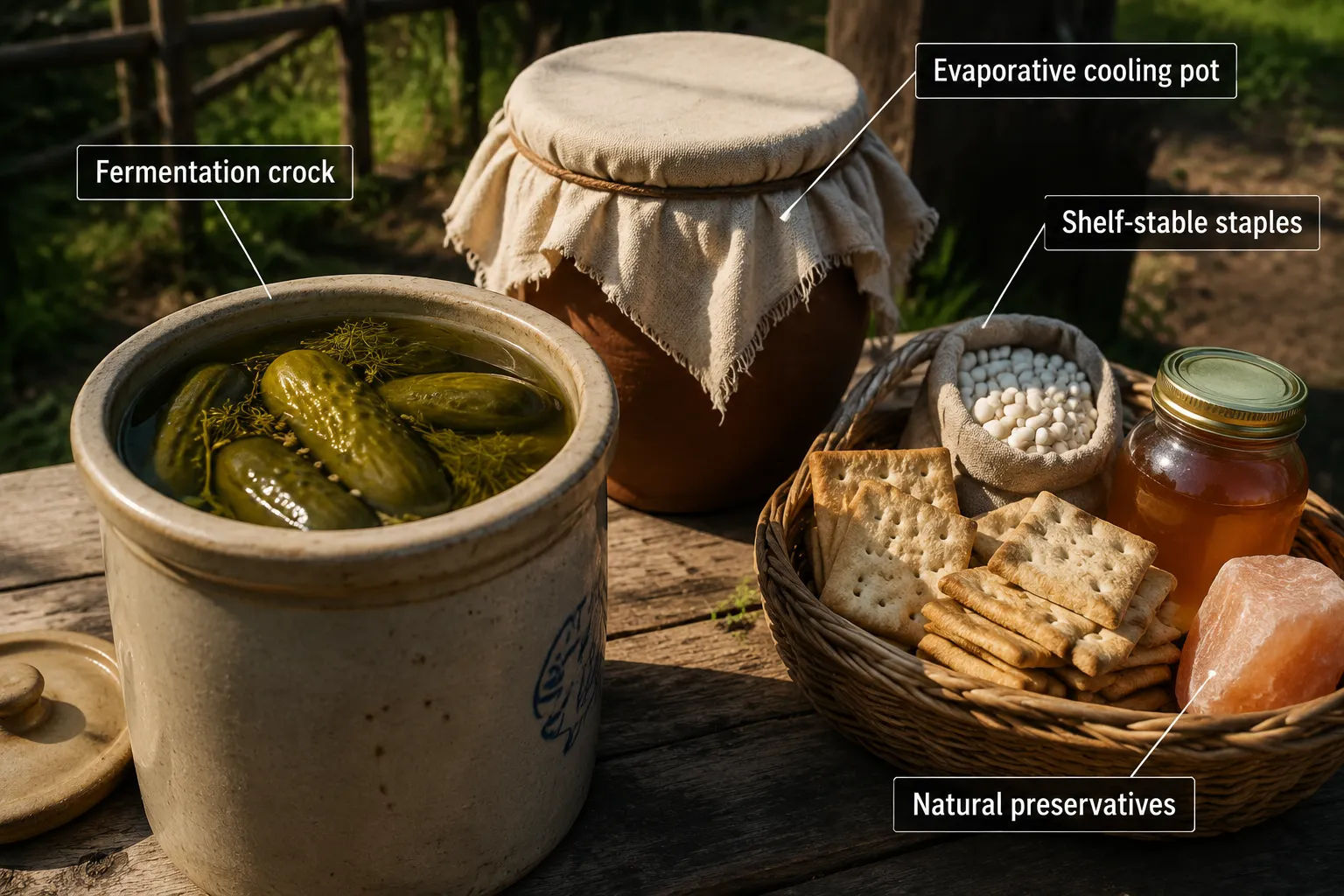
- Fermentation crocks: Vegetables submerged in brine ferment safely at room temperature and keep for months.
- Dehydrated and freeze-dried foods: Require no refrigeration and are among the most space-efficient options. See the ultimate prepper’s guide to freeze-dried food for a deep dive.
- Zeer pot (evaporative cooler): A clay pot inside a larger clay pot with wet sand between them. Evaporation cools the interior by 20-30°F below ambient temperature, useful for extending the life of produce in hot climates.
- Underground storage: Burying food in insulated containers takes advantage of stable ground temperatures (typically 50-55°F at 3-4 feet depth in temperate climates).
For a full no-power cooking and food management plan, the emergency cooking without power guide covers equipment and techniques in detail.
How To Preserve Vegetables Without Freezing
Vegetables can be preserved without freezing through dehydrating, fermenting, canning, pickling, and root cellaring. Each method suits different vegetables and storage timelines.
Best methods by vegetable type:
- Root vegetables (carrots, beets, turnips, parsnips): Root cellar storage in damp sand or sawdust. Lasts 4-6 months.
- Tomatoes: Water-bath canning, dehydrating into sun-dried tomatoes, or fermenting.
- Cucumbers, peppers, green beans: Lacto-fermentation or vinegar pickling.
- Leafy greens and herbs: Dehydrate and crumble for seasoning; ferment into kimchi-style preparations.
- Corn: Blanch and dehydrate, or pressure can.
- Onions and garlic: Cure in a warm, dry place for 2-3 weeks, then braid and hang in a cool, dry location. Lasts 6-12 months.
- Squash and pumpkins: Cure the skin, store in a cool, dry room. Many varieties last 3-6 months.
A survival garden paired with these preservation methods creates a genuinely self-sufficient food system. The survival garden guide for food independence covers what to grow and how to plan harvests around your preservation calendar.
Is Canning Safe for Beginners Storing Food
Yes, canning is safe for beginners when the correct method is matched to the food being preserved. The critical distinction is between water-bath canning (for high-acid foods) and pressure canning (for low-acid foods). Using the wrong method is the primary cause of botulism risk in home canning.
Water-bath canning (safe for beginners, no special equipment beyond a large pot):
- Suitable for: tomatoes with added acid, fruit jams, jellies, pickles, and fruit butters
- Requires pH below 4.6
Pressure canning (requires a pressure canner, but not difficult once learned):
- Required for: meats, poultry, fish, beans, corn, carrots, and all low-acid vegetables
- Destroys Clostridium botulinum spores that water-bath temperatures cannot reach
The beginner’s guide to canning for food preservation walks through both methods with step-by-step safety protocols. Always follow tested recipes from the USDA or the National Center for Home Food Preservation, this is one area where improvising ratios can have serious health consequences.
What Temperature Do You Need To Store Food Safely
The USDA’s food safety guideline establishes that food stored above 40°F and below 140°F is in the bacterial “danger zone.” For non-refrigerated storage, the practical target is keeping food as close to 50-60°F as possible, and never allowing perishables to sit above 70°F for extended periods.
Temperature targets for non-refrigerated storage:
- Root cellar / underground storage: 32-40°F (ideal for fresh produce)
- Cool pantry or basement: 50-65°F (acceptable for canned goods, grains, dried foods)
- Room temperature (65-75°F): Acceptable only for truly shelf-stable items, honey, salt, sugar, white rice in sealed containers
- Above 75°F: Accelerates degradation of canned goods and shortens shelf life of most stored foods
Avoid storing food near heat sources, in direct sunlight, or in spaces that experience large temperature swings. Humidity matters too, aim for below 60% relative humidity for dry goods to prevent mold and clumping.
Foods That Don’t Need Refrigeration: A Practical List
Many foods are naturally shelf-stable at room temperature and form the foundation of any non-refrigerated food supply.
Indefinite or very long shelf life (properly stored):
- Honey (raw, sealed)
- White salt
- White sugar
- Pure vanilla extract and distilled spirits
- White rice, hard wheat berries (in oxygen-free sealed containers)
- Dried pasta
Long shelf life (1-10 years):
- Dried beans, lentils, split peas
- Rolled oats and cornmeal (in sealed containers)
- Commercially canned goods (check “best by” dates, but most are safe well beyond them)
- Powdered milk and powdered eggs
- Freeze-dried foods
- Hard liquor (also useful for barter and antiseptic use)
Moderate shelf life (weeks to months at room temperature):
- Whole uncut onions and garlic
- Winter squash and pumpkins
- Unwashed eggs
- Hard cheeses (wax-coated)
- Apples and citrus (cool, dry conditions)
- Peanut butter (unopened)
- Crackers and hardtack
For a comprehensive list, see the 50 best foods for long-term storage.
How To Keep Food Cool in Summer Without AC, And Camping Food Storage Without a Cooler
Keeping food cool without air conditioning or a cooler is about exploiting natural temperature differentials and evaporative physics. The ground is cooler than the air. Shade is cooler than sun. Moving air over wet surfaces drops temperature significantly.
Practical cooling methods:
- Zeer pot: Two clay pots, wet sand between them, covered with a wet cloth. Can drop interior temperature 20-30°F below ambient. Best in dry climates.
- Stream or spring submersion: Waterproof containers submerged in cold running water stay near water temperature (often 50-60°F in summer).
- Underground caching: A buried container at 3-4 feet depth stays near 50-55°F in temperate climates year-round.
- North-facing shade: The north side of a building or rock formation stays significantly cooler than sun-exposed sides.
- Wet burlap wrapping: Wrapping produce in wet burlap and hanging in a breeze uses evaporative cooling to extend freshness.
For camping specifically: prioritize shelf-stable foods that don’t require cooling. Hard cheeses, cured meats, dried fruit, nuts, crackers, nut butters, and canned fish are all excellent choices that need no refrigeration. The bug-out bag food list covers this in detail for mobile scenarios.
Common Mistakes in Room-Temperature Food Storage
The most common mistake in non-refrigerated food storage is assuming that “shelf-stable” means “store anywhere.” Temperature, humidity, light, and container quality all determine whether stored food actually lasts as long as expected.
Mistakes that shorten shelf life or create safety risks:
- Storing near heat sources: Pantries above stoves, near water heaters, or in garages that heat up in summer dramatically shorten shelf life.
- Using inadequate containers: Cardboard, thin plastic bags, and original grocery packaging allow oxygen and moisture in. Use food-grade mylar bags, glass mason jars, or HDPE buckets with gamma-seal lids.
- Skipping oxygen absorbers: Even sealed containers with residual oxygen will allow fats to go rancid and support some microbial activity. Oxygen absorbers are inexpensive and extend shelf life significantly.
- Ignoring rotation: First-in, first-out (FIFO) rotation is essential. Stored food that never gets used and replaced becomes a liability, not an asset.
- Storing food on concrete floors: Concrete wicks moisture. Use pallets or shelving to keep containers off the floor.
- Canning low-acid foods in a water-bath canner: This is a genuine safety hazard, not just a quality issue.
- Overlooking pests: Rodents and insects can destroy months of stored food. Use airtight containers and inspect storage areas regularly.
Avoiding these errors is covered in depth in the 15 food storage mistakes to avoid guide.
Frequently Asked Questions
Can I store cooked food at room temperature overnight?
No. Cooked food left at room temperature above 40°F for more than two hours enters unsafe bacterial territory. Consume it, reheat it to 165°F, or use a preservation method like canning or fermentation if you need to keep it longer.
How long does canned food actually last?
Commercially canned food is typically safe well beyond its “best by” date if the can is undamaged, not swollen, and stored below 75°F. The USDA notes that high-acid canned goods (tomatoes, fruit) maintain best quality for 1-2 years; low-acid canned goods (meat, beans, vegetables) for 2-5 years or more.
Is fermented food safe to eat without refrigeration?
Yes, when done correctly. Lacto-fermented vegetables kept submerged in brine below 65°F are safe for months. The acid environment produced during fermentation inhibits pathogens. If it smells putrid (not just sour), discard it.
What’s the easiest preservation method for a beginner?
Dehydrating is the most forgiving starting point. A basic food dehydrator costs under $50, the process is straightforward, and dried fruits, vegetables, and jerky are hard to get wrong. Water-bath canning of high-acid foods (jams, pickles) is a close second.
Can eggs be stored without refrigeration?
Unwashed eggs with their natural bloom (cuticle) intact can sit at room temperature for 2-3 weeks. Eggs that have been washed (as most U.S. commercial eggs are) have had the bloom removed and must be refrigerated. If you raise your own chickens or source unwashed eggs, room-temperature storage is viable.
Does salt type matter for curing meat?
Yes. For curing meat that will be stored without refrigeration for more than a few days, use curing salt (Prague Powder #1 for short-cure products, Prague Powder #2 for long-cure/dry-aged products). These contain sodium nitrite, which prevents botulism. Table salt alone is not sufficient for safe meat curing.
How do I know if stored food has gone bad without smelling it?
Look for: swollen or dented cans, broken seals on jars, mold, unusual discoloration, and visible insect activity. For canned goods, a spurting or hissing sound when opened indicates dangerous gas buildup, discard immediately without tasting.
What’s the best container for storing dry goods long-term?
Mylar bags inside food-grade HDPE buckets with oxygen absorbers is the gold standard for bulk dry goods. Glass mason jars with oxygen absorbers work well for smaller quantities and allow visual inspection. Avoid thin plastic bags, cardboard, or containers not rated as food-grade.
Conclusion
Knowing how to store food without freezer or refrigeration is not a niche skill, it’s one of the most practical capabilities any prepper or self-reliant household can develop. Power outages, natural disasters, off-grid living, and economic disruptions all create situations where the ability to feed your family without electricity becomes the difference between stability and crisis.
The core principles are simple: control moisture, oxygen, temperature, and microbial activity. Every method covered here, canning, curing, fermenting, dehydrating, root cellaring, and smart pantry management, is a proven application of those principles. None of them require expensive equipment or specialized expertise to start.
Actionable next steps:
- Audit your current pantry and identify which items are genuinely shelf-stable versus which require refrigeration.
- Start with one method, dehydrating or water-bath canning are the lowest-barrier entry points.
- Build a core dry goods stockpile (rice, beans, oats, salt, honey) in proper sealed containers before moving to more complex preservation methods.
- Learn to recognize spoilage signs for each food type you store.
- Practice using your stored food in regular meals so rotation becomes automatic.
Products, Tools, and Resources
Building a non-refrigerated food storage system doesn’t require a large upfront investment. Start with what’s genuinely useful:
- Food dehydrator: A mid-range unit (Excalibur 9-tray is a long-term community favorite) handles everything from jerky to vegetables to herbs. Worth the investment if you garden or hunt.
- Pressure canner: The All American and Presto brands are the most commonly recommended by experienced canners. A pressure canner doubles as a water-bath canner for high-acid foods.
- Mylar bags and oxygen absorbers: Available in bulk online. Essential for long-term grain and bean storage.
- Food-grade HDPE buckets with gamma-seal lids: Gamma-seal lids allow easy access without compromising the seal, worth the upgrade over standard lids for buckets you open regularly.
- Fermentation crock: A traditional stoneware crock with a water-seal lid makes lacto-fermentation simple and reliable. Half-gallon mason jars with airlock lids are a lower-cost alternative.
- Zeer pot materials: Unglazed terracotta pots in two sizes, coarse sand, and water. Total cost under $30 and genuinely effective in dry climates.
For a structured approach to building your full food storage system on a budget, the 3-month emergency food supply for $100 guide shows exactly how to prioritize spending. And if you’re working with limited space, the apartment food storage guide covers how to build a meaningful supply even without a basement or pantry room.