
Hey there! Some links on this page may be affiliate links which means that, if you choose to make a purchase, I may earn a commission at no extra cost to you. I greatly appreciate your support. Read the full disclosure here.
Most violent crimes in urban areas happen in seconds, and the majority of victims report they never saw it coming. That gap between what happened and what they noticed is exactly what urban survival situational awareness on city streets is designed to close. This guide breaks down the practical skills, mental habits, and decision frameworks that turn an ordinary city walker into someone who is genuinely hard to surprise.
Key Takeaways
- Situational awareness is a trainable skill, not a personality trait. Anyone can develop it with consistent practice.
- The biggest threat to urban awareness in 2026 is smartphone distraction, not crime statistics.
- Recognizing pre-attack indicators, body language signals, and environmental changes gives you time to act before a threat escalates.
- Gut instinct is a real neurological process. Learning to trust and interpret it is a core survival skill.
- Good situational awareness looks calm and unremarkable from the outside. It is not paranoia, and it does not require constant anxiety.
- Women walking alone at night face specific threat patterns that call for specific countermeasures, not just general advice.
- Knowing a neighborhood’s risk profile before you enter it is a proactive skill, not a reactive one.
- Urban survival situational awareness on city streets is the foundation that makes every other prepper skill more effective.
What Is Situational Awareness and Why Does It Matter in Cities
Situational awareness means knowing what is happening around you, understanding what it means, and anticipating what might happen next. In cities, this matters more than almost anywhere else because urban environments compress people, stress, and unpredictability into tight spaces with few escape routes.
The concept was formalized by military aviator John Boyd and later adapted for law enforcement by Lt. Col. Dave Grossman. But the practical framework most preppers use comes from Jeff Cooper’s color code system: White (unaware), Yellow (relaxed alertness), Orange (specific threat identified), Red (ready to act). The goal for anyone on city streets is to stay in Condition Yellow, alert but not anxious, as a default.
Cities are high-stimulus environments. Crowds, noise, and constant visual information make it easy to mentally check out. That cognitive withdrawal is exactly when threats emerge.
Why cities specifically raise the stakes:
- Dense foot traffic makes it easy for someone to move close without appearing unusual
- Multiple entry and exit points at any given location create complex threat geometry
- Urban infrastructure (alleys, parking garages, stairwells) creates natural ambush corridors
- Anonymity in crowds reduces bystander intervention
- Emergency response times in dense urban areas vary widely depending on location and time of day
For preppers who spend time building urban survival skills, situational awareness is the skill that makes all others accessible. You cannot use your gear, your route knowledge, or your physical capabilities if you never see a threat developing.
How to Stay Alert and Aware of Your Surroundings in Urban Areas
Staying alert in an urban environment does not mean staying tense. It means developing a scanning habit that runs in the background while you go about your day.

The most effective method is the “baseline and deviation” approach. Every environment has a normal pattern: typical noise levels, typical pedestrian density, typical behavior. When something deviates from that baseline, your attention should sharpen.
Practical habits that build urban awareness:
- Keep your head up. Your peripheral vision covers roughly 180 degrees. Eyes locked on a phone screen reduce that to near zero.
- Sit with your back to a wall in restaurants, cafes, and waiting areas. This eliminates blind spots behind you and gives you a full view of the space.
- Enter new spaces with a quick scan. Note exits, identify anyone who looks out of place, and locate the nearest cover (solid objects that stop bullets) versus concealment (objects that hide you but don’t stop projectiles).
- Use reflective surfaces. Store windows, car mirrors, and glass doors let you observe what’s behind you without turning around.
- Vary your routes. Predictable patterns make you easier to target. Changing your commute route, timing, and entry points removes that advantage from anyone watching.
- Acknowledge people who make eye contact. A brief nod signals that you noticed them. Many predatory actors prefer targets who appear unaware.
The key constraint: these habits only work if they become automatic. Deliberate practice for two to three weeks is usually enough to make the scanning reflex feel natural rather than effortful.
Signs Someone Is Following You on the Street
Someone following you will usually appear in the same location more than twice within a short period. The “three-location rule” is a reliable test: if you see the same person at three different points along your route, that is not coincidence.
Specific indicators to watch for:
- The person matches your pace changes. You speed up, they speed up. You slow down, they slow down.
- They mirror your turns, especially unusual ones.
- They appear to be on their phone but are not actually looking at the screen.
- They maintain a consistent distance rather than naturally overtaking you or falling further behind.
- You notice them, lose sight of them, and they reappear ahead of you (suggesting they know your destination or route).
What to do if you suspect a tail:
- Do not go home or to any location where you will be isolated.
- Enter a busy, well-lit public space: a pharmacy, a grocery store, a police station.
- Make an obvious course change (cross the street, reverse direction) and observe whether they follow.
- If the concern is serious, call someone and stay on the phone while you move to safety.
- Trust your discomfort. You do not need certainty to take protective action.
How to Know If a Neighborhood Is Safe to Walk Through
A neighborhood’s safety can be assessed before you enter it and while you’re moving through it. Neither method requires special tools.
Before you enter:
- Check local crime mapping tools. Many U.S. cities publish real-time crime data through public portals. Apps like Citizen or SpotCrime aggregate incident reports by area.
- Look at the time of day. Most neighborhoods have different risk profiles at noon versus midnight.
- Ask locals. Residents, delivery drivers, and business owners have ground-level knowledge that no app captures.
While you’re moving through:
- Look at the environment itself. Broken windows, heavy graffiti, abandoned vehicles, and poor lighting are environmental cues that correlate with reduced informal social control, a concept documented in criminology research.
- Watch foot traffic patterns. An unusually empty street in what should be a busy area can indicate that locals know something you don’t.
- Note whether businesses are open and occupied. Active commercial spaces bring natural surveillance.
- Pay attention to how people carry themselves. Relaxed, purposeful movement is a good sign. Groups loitering with active attention on passersby warrants heightened awareness.
Choose a different route if the environmental cues are consistently negative and you have no specific reason to be there. Urban survival situational awareness on city streets includes the judgment to avoid an environment, not just survive inside it.
What Body Language Signals Danger in Urban Environments
Dangerous intent often shows up in the body before it shows up in action. Recognizing pre-attack indicators gives you a critical window to reposition or disengage.
High-priority body language signals:
- Target glancing: Repeatedly looking at your hands, bag, pockets, or waist rather than your face. This indicates someone assessing what you’re carrying.
- Hands hidden: Hands in pockets, behind the back, or under clothing when the temperature doesn’t justify it. Hidden hands mean hidden intentions.
- Bladed stance: Turning the body sideways, which reduces the profile presented and is a common pre-assault position.
- Grooming behavior: Adjusting clothing, touching the face, or fidgeting excessively can indicate elevated adrenaline and nervous preparation.
- Thousand-yard stare: Intense, unfocused eye contact that looks through you rather than at you. This is associated with dissociation under adrenaline.
- Closing distance without social justification: Someone who keeps moving toward you in a context where proximity isn’t normal (an empty sidewalk, a nearly empty parking garage).
These signals do not guarantee hostile intent. But two or more appearing together in a low-stimulus environment should move you from Condition Yellow to Condition Orange immediately.
What’s the Difference Between Paranoia and Good Situational Awareness
Good situational awareness is calm, evidence-based, and proportionate to actual environmental cues. Paranoia is a persistent, irrational fear that does not respond to evidence and exhausts the person experiencing it.
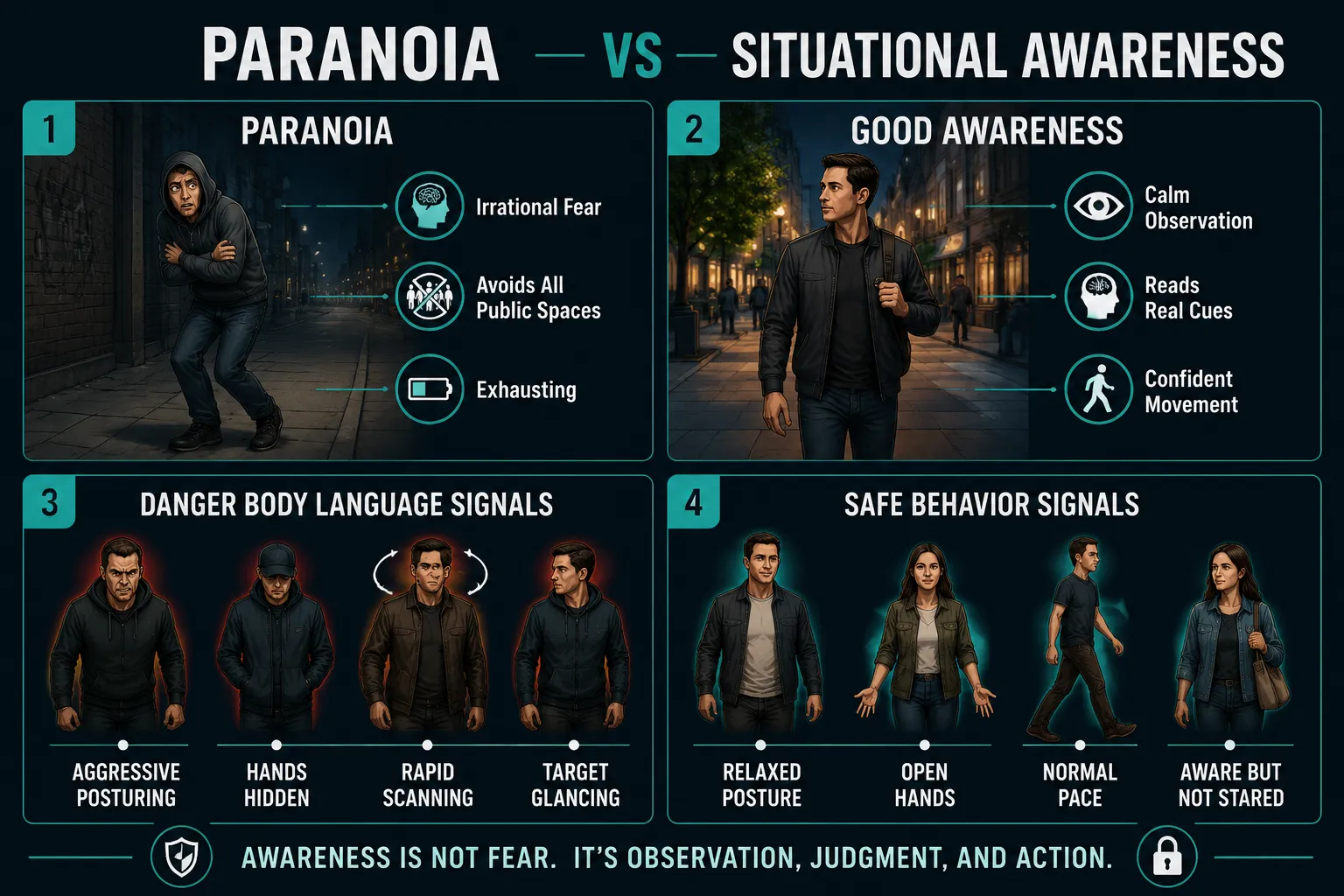
The practical difference is this: a person with good awareness walks into a parking garage, notes the lighting, identifies the exits, observes the two other people present, and continues to their car without distress. A person in a paranoid state may be unable to enter the garage at all, or may be so hypervigilant that they cannot function normally.
How to stay on the right side of that line:
- Base your alertness level on what you actually observe, not on what you fear might be there.
- Practice returning to Condition Yellow after a threat resolves. Staying in Condition Orange or Red for extended periods is exhausting and counterproductive.
- Recognize that most people in any given environment are not threats. The goal is to identify the exceptions, not to treat everyone as a suspect.
- If anxiety about urban environments is persistent and unrelated to specific cues, that is worth addressing separately, as it can impair rather than improve your actual safety.
Preppers who develop genuine situational awareness tend to feel more confident in cities, not more fearful. That confidence is the correct outcome.
What Should I Do If I Feel Threatened on City Streets
If you feel threatened, your first and best option is always to create distance and move toward populated, well-lit spaces. Do not wait for certainty before acting.
Immediate response framework:
- Trust the signal. If your body is telling you something is wrong, act on it. You can apologize for being wrong later. You cannot undo inaction.
- Create distance. Move away from the perceived threat, toward people and light.
- Verbalize clearly if confronted. A loud, clear “Back off” or “Leave me alone” serves two purposes: it communicates your intent and it draws attention from bystanders.
- Use your voice to attract witnesses. Bystander presence dramatically changes the risk calculation for most would-be attackers.
- Know your legal options. Understand the self-defense laws in your jurisdiction before you need them. This is not the moment to figure it out.
- Have an escape route in mind. This is why noting exits when you enter a space matters. You want to move toward a destination, not just away from a threat.
For preppers who carry defensive tools, those tools are a last resort, not a first response. The skills that get you out of a situation before it escalates are always more valuable than the ones that help you survive it after it has.
How to Use Your Phone Safely While Walking in the City
Phone use while walking is the single most common way people drop out of Condition Yellow. It is also one of the most common factors in both opportunistic theft and pedestrian accidents in urban areas.
Practical rules for safer phone use on city streets:
- Stop and step to the side before looking at your phone. Find a wall or a storefront and put your back to it.
- Use headphones only in one ear, or keep the volume low enough to hear your environment.
- Keep your phone at chest height when you must use it while moving, rather than looking down. This keeps your head up and your peripheral vision active.
- Be aware of who is around you before taking out your phone. A visible, expensive device in a low-surveillance area is a straightforward theft opportunity.
- Use voice commands for navigation rather than watching a map screen while walking.
- Never use your phone in a stairwell, elevator, or any other enclosed space where you cannot monitor your surroundings.
This connects directly to the broader principle in the ultimate urban survival guide for preppers: your most important survival tool is your attention, and anything that competes with it is a liability.
Situational Awareness Tips for Women Walking Alone at Night
Women walking alone at night face a specific threat profile that warrants specific countermeasures, not just generic awareness advice. The core issue is that predatory actors who target women often rely on isolation, surprise, and the assumption that their target will not respond assertively.
Targeted strategies:
- Project confidence through posture and pace. Shoulders back, head up, purposeful stride. Research on predatory targeting consistently shows that attackers select victims who appear distracted or uncertain.
- Pre-plan your route. Know where the well-lit streets are, where the 24-hour businesses are, and where you can go if you need to get off the street quickly.
- Tell someone your route and ETA. A simple text before you leave and when you arrive creates accountability and a response trigger if something goes wrong.
- Avoid wearing both earbuds. Music or podcasts are fine. Complete auditory isolation is not.
- Trust social discomfort. If someone makes you uncomfortable and you cannot identify a logical reason, that discomfort is data. Act on it without apology.
- Have your phone ready but not visible. A phone in your hand is a theft target. A phone in your pocket with a trusted contact already dialed is a safety tool.
- Know the difference between a well-lit street and a safe street. Lighting helps, but an empty well-lit street at 2 a.m. carries different risks than a busy one at 10 p.m.
These strategies are part of the broader urban survival skills framework, applied specifically to the threat patterns most relevant to women in urban environments.
How to Trust Your Gut Instinct About People and Places
Gut instinct is not mystical. It is pattern recognition running faster than conscious thought. When your brain detects a mismatch between what it expects and what it observes, it generates a physical signal, often felt as unease, a quickened heartbeat, or the urge to leave.
The problem is that most people have been socially conditioned to dismiss that signal to avoid seeming rude or irrational. In urban survival contexts, that conditioning is a liability.
How to develop and trust your instincts:
- Pay attention to the physical sensation itself. Where do you feel it? What triggered it? Over time, you will learn to distinguish genuine threat signals from general social anxiety.
- After the fact, analyze what you noticed. If you felt uneasy and nothing happened, try to identify what environmental cue generated the feeling. This builds your pattern library.
- Read Gavin de Becker’s “The Gift of Fear” (1997). It remains the most practical and well-researched treatment of this subject available to civilians.
- Practice noticing without acting. You do not have to respond to every gut signal with a dramatic reaction. Sometimes noticing is enough.
The goal is calibration, not suppression. A well-calibrated instinct is one of the most reliable tools in your urban survival kit.
Is Situational Awareness Training Worth It for City Living
Formal situational awareness training is worth it for most city-dwellers, particularly those who travel frequently, work in high-risk environments, or simply want a structured framework rather than building habits through trial and error.
What good training covers:
- Jeff Cooper’s color code system and how to apply it in real environments
- Pre-attack indicator recognition
- Environmental assessment (cover vs. concealment, exit identification, baseline reading)
- Verbal de-escalation fundamentals
- Force continuum awareness for jurisdictions where self-defense is relevant
Where to find it:
- USCCA (United States Concealed Carry Association) offers urban awareness and personal protection courses
- Many local law enforcement agencies offer community safety workshops
- Krav Maga and reality-based self-defense programs typically incorporate awareness training as a foundational module
- Online courses from instructors like Craig Douglas (ShivWorks) address urban threat recognition specifically
For preppers who want to go deeper on the gear side of urban preparedness, the urban survival kit for apartment residents and urban survival gear guides are solid next steps. But no piece of gear compensates for awareness that was never developed.
Common Mistakes People Make With Urban Safety Awareness
Most urban safety failures come from a handful of repeatable errors. Recognizing them is the first step to correcting them.
The most common mistakes:
- Condition White as a default. Walking with headphones in both ears, eyes on a phone, and no mental map of the surrounding environment. This is the most common and most correctable error.
- Assuming familiarity equals safety. People are statistically more likely to be victimized in familiar areas because they relax their awareness there.
- Ignoring environmental cues. A parking garage with broken lights, a stairwell that smells like it hasn’t been maintained, a street where all the businesses are shuttered at an unusual hour. These are signals, not coincidences.
- Freezing instead of acting. The threat response system can produce a freeze reaction. Awareness training specifically addresses this by pre-deciding responses before a threat occurs.
- Over-relying on technology. GPS navigation, crime apps, and safety check-in tools are useful supplements, not replacements for direct observation.
- Failing to pre-plan. Not knowing where you’re going, how you’ll get there, or what you’ll do if something goes wrong before you leave home. This is the urban equivalent of entering the wilderness without a map.
For preppers who want to extend their preparedness beyond personal safety into broader urban scenarios, the urban evacuation route planning guide and city blackout survival checklist are directly relevant. Situational awareness on city streets and emergency preparedness planning are the same skill applied at different scales.
Frequently Asked Questions
What is the best way to practice situational awareness if I’m just starting out?
Start with the “baseline and deviation” exercise. Every time you enter a new space, spend 30 seconds identifying what normal looks like: who is there, what they’re doing, what the noise level is. Then notice anything that doesn’t fit. Do this daily for two weeks and it becomes automatic.
How do I know if I’m being too paranoid or not aware enough?
If your alertness is based on actual observations (a specific person’s behavior, a specific environmental cue), it is awareness. If it is based on a general feeling of dread that is not connected to anything you can point to, that is anxiety. The distinction matters because they require different responses.
Does carrying a weapon replace the need for situational awareness?
No. A weapon is a last-resort tool that only helps if you have time to access and use it. Situational awareness gives you the time. Without awareness, a weapon is often inaccessible before a threat has already made contact.
What should I do if I walk into a situation that already feels dangerous?
Leave immediately if you can. Do not try to assess the situation further. Your instinct to leave is the assessment. Move toward people and light, and do not return to retrieve anything you left behind.
Is it rude to cross the street or change direction to avoid someone?
No. Your safety is more important than the social comfort of a stranger. You owe no one the risk of staying on a path that makes you uncomfortable.
How do I stay aware in a city I’ve never visited before?
Research before you arrive. Look at the neighborhood layout, identify the areas with higher incident rates, and locate the 24-hour businesses and police stations near your accommodation. On the ground, treat every new area as if it were Condition Orange until you’ve established a baseline.
What’s the most dangerous time of day in most urban environments?
Late night hours (roughly 10 p.m. to 2 a.m.) in areas where bars and clubs are concentrated tend to produce the highest rates of opportunistic crime and assault, according to FBI Uniform Crime Report data. However, certain types of crime (pickpocketing, bag theft) peak during busy daytime hours in crowded areas.
Can children be taught situational awareness?
Yes, and they should be. Age-appropriate versions of the color code system, combined with clear rules about what to do if something feels wrong, are effective. The 12 essential survival skills for kids guide covers this in more detail.
What’s the single most important habit for urban awareness?
Keep your head up and your phone down when you’re moving. Everything else builds from there.
Does situational awareness work in a crowd where everyone is moving?
Yes, but the baseline shifts. In a crowd, normal behavior is movement and noise. What stands out is someone moving against the flow, someone stationary in a moving crowd, or someone whose attention is fixed on a specific person rather than moving with the general flow.
Conclusion
Urban survival situational awareness on city streets is not about living in fear. It is about building the mental habits that let you move through cities with confidence, read your environment accurately, and make good decisions before situations escalate. The skills covered in this guide, from baseline reading and body language recognition to gut instinct calibration and phone safety, are all trainable. None of them require special equipment or exceptional physical ability. They require attention and practice.
Start with one habit: head up, phone down. Add the baseline-and-deviation scan. Build from there. Within a few weeks, you will notice things you never noticed before, and you will feel more capable in urban environments, not more anxious.
Actionable next steps:
- Read Jeff Cooper’s color code framework and practice identifying your default condition throughout the day
- Walk your regular urban routes with a deliberate awareness exercise for one week
- Identify the exits and cover positions in the three places you spend the most time
- Pre-plan at least one alternative route for your most common urban commute
- Consider a structured personal safety course through USCCA or a local reality-based defense program
Products, Tools, and Resources
For preppers building out their urban readiness beyond awareness skills, a few resources stand out. A quality urban survival kit gives you the physical tools to back up your awareness. Personal alarms (120dB models from brands like SABRE or Vigilant) are inexpensive, legal everywhere, and effective at drawing attention in a threat situation. A compact flashlight, even a small one carried daily, serves double duty as a navigation tool and a deterrent in low-light environments. For navigation in unfamiliar cities, offline maps downloaded through apps like Maps.me remove the dependency on live data connections. And for preppers who want to extend their urban preparedness into broader emergency scenarios, the urban evacuation route planning guide and safest water sources in urban survival scenarios are worth reading alongside this one.
Awareness is the foundation. Everything else is built on top of it.