
Hey there! Some links on this page may be affiliate links which means that, if you choose to make a purchase, I may earn a commission at no extra cost to you. I greatly appreciate your support. Read the full disclosure here.
14 Essential Survival Skills Every Prepper Must Know
Survival skills are the practical abilities that keep people alive when normal systems — shelter, food supply, medical care, communication — break down. Every prepper and outdoorsman needs a core set of these skills, including fire-making, water purification, shelter building, navigation, and first aid. These aren’t just wilderness tools; they apply equally to natural disasters, grid failures, and extended emergencies. The good news is that all of them can be learned, practiced, and refined before you ever need them.
Key Takeaways
- Mental preparedness is the most underrated survival skill — panic kills faster than most physical threats
- The survival priority order is: mindset, shelter, water, fire, food — in that sequence
- Water purification should use layered methods; no single technique handles every contaminant
- Fire-making requires practice with primitive methods before you need them under pressure
- Edible plant identification demands hands-on field training, not just book knowledge
- Trapping is more calorie-efficient than active hunting in most wilderness scenarios
- Navigation without GPS is a foundational skill that electronics dependency has eroded
- First aid knowledge should include wilderness-specific scenarios: snake bites, hypothermia, fractures
- Signaling for rescue is often overlooked but can cut survival time from weeks to hours
- Consistent practice through scenario drills converts knowledge into instinct
Understanding the Basics of Survival
Survival skills are the practical, learnable abilities that allow a person to meet basic human needs — shelter, water, food, warmth, and safety — when normal infrastructure isn’t available. They apply to hikers, preppers, travelers, and anyone caught in a natural disaster or grid-down scenario.
The foundation isn’t a single skill. It’s a layered system. Each ability reinforces the others. Knowing how to build a fire is useful. Knowing how to build a fire while managing a sprained ankle in a rainstorm is survival.
Most survival frameworks follow a priority order that reflects how quickly different threats become lethal:
- Mindset — panic and poor decisions kill faster than exposure
- Shelter — in extreme cold or heat, you can die within hours without protection
- Water — dehydration becomes critical within 24–72 hours
- Fire — warmth, water purification, signaling, and food preparation
- Food — the human body can survive weeks without food; it’s the lowest immediate priority
Understanding this hierarchy prevents the most common beginner mistake: spending energy on food when shelter or water should come first. For a broader look at how these skills connect to real-world emergency planning, the complete bug-out survival skills guide covers how these priorities shift in evacuation scenarios.
The Importance of Mental Preparedness
Mental preparedness is the single most decisive factor in survival outcomes. Physical skills matter — but the mind controls whether those skills get deployed effectively or collapse under stress.
Survival situations trigger the body’s threat response: elevated cortisol, tunnel vision, impaired decision-making. People freeze, make irrational choices, or exhaust themselves in panic. Training the mind to operate under pressure isn’t optional — it’s the foundation everything else is built on.
What mental preparedness actually looks like in practice:
- Stress inoculation — deliberately exposing yourself to uncomfortable scenarios (cold showers, sleep deprivation drills, timed problem-solving) so that stress feels familiar rather than paralyzing
- Scenario rehearsal — mentally walking through “what would I do if…” situations before they happen
- Controlled breathing — tactical breathing (inhale 4 counts, hold 4, exhale 4) is a documented method used by military and emergency responders to reduce acute stress response
- Decision frameworks — having pre-decided rules (“if I’m lost, I stop moving and signal”) removes the cognitive load of making decisions under duress
The psychological concept of “positive panic management” — acknowledging fear without being controlled by it — is what separates people who survive from those who don’t. A disciplined mindset doesn’t mean fearlessness. It means fear doesn’t get the final vote.
Mastering the Art of Fire Making
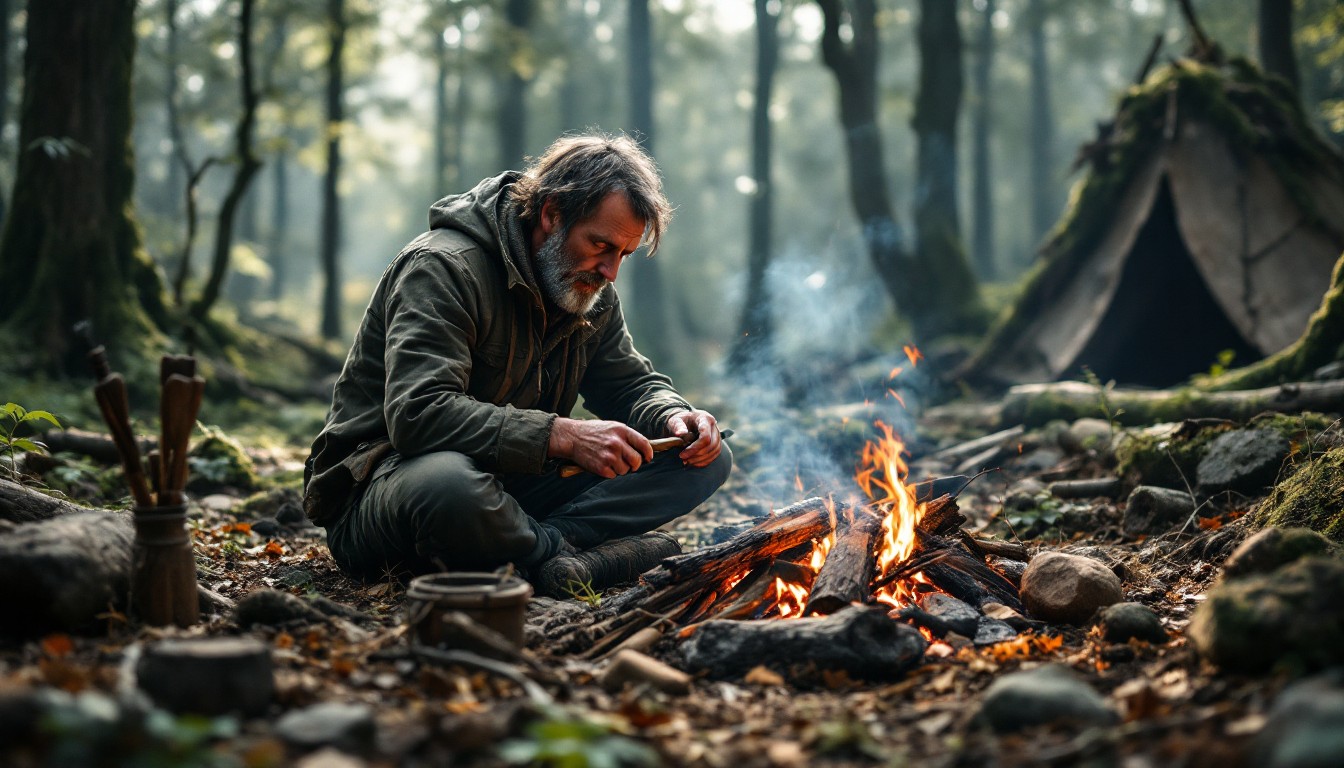
 Fire is one of the most versatile survival tools available. It provides warmth, purifies water, cooks food, deters wildlife, and signals rescuers. In cold environments especially, fire-making can be the difference between surviving a night and not.
The problem is that most people have only ever used a lighter. When that lighter is wet, lost, or empty, the skill gap becomes dangerous.
The fire-making hierarchy every prepper should master:
- Lighter/matches — always carry multiple ignition sources in waterproof containers
- Ferrocerium rod (ferro rod) — works wet, works cold, lasts thousands of strikes
- Flint and steel — primitive but reliable; requires dry char cloth or tinder fungus
- Friction fire (bow drill, hand drill) — the hardest method, but requires zero manufactured tools
Building a fire correctly:
- Start with tinder: dry grass, birch bark, cattail fluff, or fatwood shavings
- Add kindling in a loose structure — oxygen flow is what feeds flame
- Graduate to thumb-sized sticks before adding larger fuel
- Never smother a new fire with large logs too early
Common mistakes:
- Using wet or green wood — it smolders and smokes but rarely sustains flame
- Building fires in enclosed spaces without ventilation (carbon monoxide risk)
- Neglecting fire safety: always clear a perimeter, never leave unattended
Practice fire-making in adverse conditions — rain, wind, cold hands — not just on a dry summer afternoon. The skill you build in comfortable conditions won’t transfer automatically to a stressful situation.
Securing Clean Water for Hydration and Sanitation
Clean water is non-negotiable. The human body begins to deteriorate rapidly without it — cognitive function drops, physical performance declines, and dehydration can become life-threatening within 24–72 hours depending on heat and exertion level.
Finding water in the wilderness is usually possible. Making it safe to drink is the real challenge. Natural water sources — rivers, lakes, springs, even rainwater collected off certain surfaces — can carry bacteria, protozoa, viruses, and chemical contaminants that cause severe illness.
The three primary purification methods and when to use each:
The safest approach in an uncertain environment is to layer methods — filter first to remove particulates, then boil or use chemical treatment to address pathogens the filter may miss.
For a deeper breakdown of water storage and purification strategies for preppers, the emergency water storage and purification guide covers both short-term and long-term solutions.
Identifying and Gathering Edible Plants
Plant foraging is a valuable survival skill — but it carries real risk. Misidentification of toxic plants has caused serious harm and death, even among experienced foragers. This is a skill that demands field training alongside book study, not one or the other.
The good news: in most regions of North America, a relatively small number of edible plants are abundant, easy to identify, and nutritionally useful. Learning 10–15 species well in your specific region is more valuable than having a surface-level knowledge of 100.
High-value edible plants across North American regions:
- Cattail — nearly every part is edible at different seasons; found near water
- Dandelion — leaves, roots, and flowers are all edible; widespread
- Wood sorrel — tart, clover-like plant; easily identified; high in vitamin C
- Pine needles — can be steeped for vitamin C-rich tea; found in most forested regions
- Acorns — calorie-dense but require leaching to remove bitter tannins
Rules for safe foraging:
- Never eat anything you cannot positively identify from multiple characteristics (leaf shape, stem, smell, habitat, season)
- Learn the poisonous look-alikes for any plant you intend to eat
- Apply the “universal edibility test” only as a last resort — it’s time-consuming and not foolproof
- Gather sustainably: take no more than a third of any plant cluster; avoid stripping a single area
Foraging is also a skill that connects directly to long-term self-reliance. For preppers building toward food independence, pairing foraging knowledge with a solid long-term food storage strategy creates a much more resilient food system.
Hunting and Trapping for Food
 When caloric reserves run low and foraging isn’t sufficient, hunting and trapping become necessary survival skills. Between the two, trapping is almost always the better investment of energy in a true survival situation.
Active hunting — stalking, pursuing, and taking game — requires significant caloric expenditure, skill, and often specialized tools. A failed hunt costs you energy you can’t afford to lose. Traps, by contrast, work continuously without your direct involvement, allowing you to gather water, build shelter, or rest while they do the work.
Effective primitive traps for small game:
- Figure-4 deadfall — uses three notched sticks and a weighted rock; effective for squirrels and rabbits
- Snare loops — wire or cordage loops set on game trails; highly effective for rabbits and small rodents
- Spring snare — uses a bent sapling to lift and hold caught animals off the ground, reducing loss to scavengers
Keys to successful trapping:
- Set traps on active game trails, near water sources, or at den entrances — not randomly in open areas
- Use natural materials to mask human scent on traps when possible
- Set multiple traps (10–20 in a real survival scenario) to increase odds
- Check traps every 12–24 hours
For active hunting, understanding animal behavior, movement patterns, and sign-reading (tracks, scat, rubs) matters more than marksmanship alone. A patient hunter who reads the land effectively will outperform an aggressive one who doesn’t.
Note: hunting and trapping regulations vary significantly by location. In a genuine survival emergency, legal considerations shift — but understanding the rules matters for training and practice in normal conditions.
Creating a Safe and Sustainable Shelter
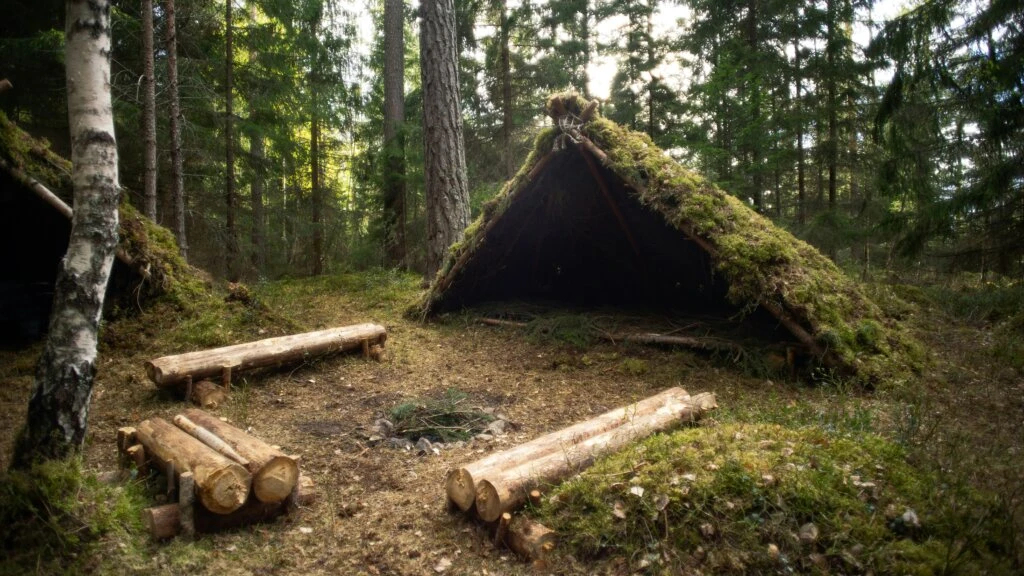 Shelter is the first physical priority in most survival situations, ranking above water and food when exposure is an immediate threat. In cold, wet, or extreme heat conditions, the body loses its ability to regulate temperature faster than most people expect.
A good survival shelter doesn’t need to be elaborate. It needs to be dry, insulated, and positioned safely.
Shelter location criteria:
- Relatively flat and dry ground
- Natural windbreak nearby (rock face, dense trees)
- Away from dead trees (widow-makers), dry riverbeds, and insect nests
- Elevated slightly to avoid cold air pooling and water runoff
Shelter types matched to environment:
- Lean-to — fast to build, good in mild conditions; poor insulation in extreme cold
- Debris hut — excellent insulation; uses leaves, branches, and natural materials; effective in cold weather
- Snow cave or quinzhee — counterintuitive but highly effective in deep snow; interior temperature stays near freezing even when outside temperatures plunge far below
- Tarp shelter — the fastest option if you have gear; multiple configurations possible
Construction priorities:
- Insulation from the ground first — ground conducts heat away from the body faster than cold air
- Overhead protection from rain and wind
- Size matters: smaller is warmer; don’t build larger than necessary
For preppers who may need to build or pre-position shelters as part of a bug-out plan, the bug-out bag guide for beginners includes shelter-relevant gear recommendations.
Getting lost is one of the most common wilderness emergencies. GPS devices and smartphones have made many people navigation-dependent on technology — which fails when batteries die, signals drop, or devices are damaged.
Every prepper and outdoorsman should be able to navigate using map, compass, and natural indicators. These skills don’t require expensive gear and don’t fail.
Core navigation skills to develop:
- Topographic map reading — understanding contour lines, elevation changes, and terrain features
- Compass use — taking and following a bearing, accounting for declination
- Dead reckoning — estimating position based on known starting point, direction, speed, and time
- Natural navigation — using the sun’s arc, star positions (Polaris for north in the Northern Hemisphere), and terrain features
Natural direction indicators:
- The sun rises in the east and sets in the west; at solar noon, it’s due south in the Northern Hemisphere
- Polaris (North Star) sits within 1 degree of true north and doesn’t move
- Moss grows on the north side of trees in the Northern Hemisphere — useful as a general indicator, not a precise one
- Ant mounds in North America are often built on the south side of trees or rocks to maximize sun exposure
Common navigation mistakes:
- Trusting a single indicator rather than cross-referencing multiple sources
- Failing to track distance traveled (pacing or time estimates help)
- Moving when lost rather than stopping, assessing, and signaling
For a thorough breakdown of field navigation techniques, the beginner’s guide to navigation without GPS is an excellent companion resource.
First Aid Knowledge: Preventing and Treating Injuries
Wilderness first aid is not the same as standard first aid. In a survival scenario, professional medical help may be hours or days away. The goal shifts from “stabilize until EMS arrives” to “manage the injury for an extended period with limited supplies.”
Every prepper should have training that goes beyond basic CPR and bandaging. Wilderness First Responder (WFR) or at minimum Wilderness First Aid (WFA) certification provides the practical skills needed for real emergencies.
High-priority wilderness medical scenarios:
- Hypothermia — remove wet clothing, insulate from ground, apply heat to core (armpits, groin, neck), avoid alcohol
- Hyperthermia/heat stroke — move to shade, cool the core aggressively with wet cloths, prioritize hydration
- Snake bites — immobilize the limb below heart level, remove constricting items, evacuate immediately; do not cut, suck, or apply a tourniquet
- Fractures — improvise splints using sticks and cordage; immobilize the joint above and below the break
- Deep lacerations — clean thoroughly with purified water, close with improvised butterfly strips if needed, monitor for infection
- Infection management — clean wounds aggressively; in extended scenarios, honey has documented antimicrobial properties as a wound covering
What every survival first aid kit should contain:
- Tourniquet (CAT or SOFTT-W)
- Israeli bandage or hemostatic gauze
- Nitrile gloves (multiple pairs)
- SAM splint
- Moleskin for blisters
- Oral rehydration salts
- Broad-spectrum antibiotic (requires medical consultation)
- Medical reference card or wilderness first aid guide
Effective Techniques for Signaling Help
Signaling is one of the most overlooked survival skills — and one of the highest-leverage ones. A person who can effectively signal rescuers may be found within hours rather than days or weeks.
The goal of signaling is contrast: making yourself visible or audible against the natural background in a way that’s recognizable as a distress signal.
Proven signaling methods:
- Signal mirror — can be seen from aircraft up to 10 miles away on a clear day; aim reflected sunlight toward the target
- Whistle — three blasts is the universal distress signal; a quality whistle (Fox 40, Storm) carries far further than a human voice
- Fire and smoke — three fires in a triangle is a recognized distress signal; green vegetation creates white smoke visible against dark terrain; rubber or plastic creates black smoke visible against sky or snow
- Ground-to-air signals — stomp or arrange large letters (SOS, X, V) in open clearings using rocks, logs, or trampled vegetation; minimum 10 feet tall to be visible from aircraft
- PLB (Personal Locator Beacon) — the most reliable electronic option; transmits GPS coordinates to search and rescue via satellite; no subscription required in most countries
Signaling priority:
Signal continuously when rescue is likely. Signal intermittently when it isn’t — conserve energy. A signal mirror weighs almost nothing and should be in every pack.
Dealing with Wild Animals: Safety Measures
Most wild animal encounters are not dangerous — the animal wants to leave as much as you do. Problems arise when animals are surprised, cornered, protecting young, or food-conditioned to associate humans with meals.
General principles for wildlife safety:
- Make noise while moving through dense terrain to avoid surprising animals
- Store food in bear canisters or hung at least 10 feet high and 4 feet from the trunk
- Never run from a predator — it triggers chase instinct
- Know the difference between defensive and predatory attacks; response differs significantly
Specific animal responses:
- Black bear — stand tall, make noise, back away slowly; if attacked, fight back aggressively
- Grizzly/brown bear — if a surprise defensive attack, play dead (face down, hands protecting neck); if a predatory night attack, fight back
- Mountain lion — maintain eye contact, appear large, throw objects; do not crouch or turn away
- Venomous snakes — give wide berth, never reach into areas you can’t see; most bites occur when people try to handle or kill snakes
In camp:
- Cook and eat away from your sleeping area
- Never bring food into a tent
- Dispose of food waste properly — bury waste or pack it out
Weather Prediction: Understanding and Adapting to Nature’s Signs
Reading weather without a forecast is a skill that was standard knowledge for most of human history. It’s become rare — but it’s genuinely useful and learnable.
Weather changes don’t happen without warning. The signs are there if you know what to look for.
Reliable natural weather indicators:
- Cloud types — cumulus clouds building vertically (cumulonimbus) indicate incoming thunderstorms; cirrus (high, wispy) clouds moving in indicate weather change within 24–48 hours
- Wind shifts — a sudden wind direction change often precedes a front; wind from the south typically brings warmer, wetter air in North America
- Barometric pressure — a rapidly falling barometer (detectable with an analog altimeter or barometric watch) signals incoming storms
- Animal behavior — birds flying low, insects disappearing, and cattle lying down are traditional indicators of incoming precipitation
- Red sky rule — “Red sky at night, sailor’s delight; red sky in morning, sailor’s warning” has a meteorological basis related to dust particle distribution
Practical application:
Build weather awareness into daily camp routines. Check sky conditions morning and evening. Note wind direction. If conditions suggest incoming severe weather, prioritize shelter reinforcement over other activities.
Clothing and Gear: What to Wear and Carry

Gear doesn’t replace skills — but the right gear makes skills easier to execute and dramatically improves survival odds. The principle is layering: building redundancy so that no single failure leaves you without options.
Clothing system for wilderness survival:
- Base layer — moisture-wicking synthetic or merino wool; never cotton (cotton kills in cold and wet conditions because it loses all insulating value when wet)
- Mid layer — fleece or down for insulation; down is warmer by weight but fails when wet; synthetic insulation performs better in wet conditions
- Outer layer — wind and waterproof shell; Gore-Tex or equivalent
Essential gear every prepper should carry:
- Knife (fixed blade, full tang — the most versatile survival tool)
- Fire-starting kit (lighter, ferro rod, waterproof matches)
- Water filtration (Sawyer Squeeze or equivalent)
- Navigation tools (compass, topo map of the area)
- Signaling devices (mirror, whistle, PLB)
- First aid kit (wilderness-configured)
- Emergency bivy or space blanket
- 550 paracord (50+ feet)
- Headlamp with extra batteries
For a detailed gear checklist organized by scenario, the 72-hour bug-out bag checklist provides a well-organized starting point. And if you’re evaluating blade options, the survival knife training and qualities guide covers what actually matters in a field knife.
Practicing Survival Scenarios: Building Confidence
Knowledge without practice is just trivia. The gap between reading about fire-making and actually producing a flame from a bow drill in cold, damp conditions is enormous. Scenario practice is what closes that gap.
Effective ways to build real survival competency:
- Weekend primitive camping — leave the camp stove and sleeping pad at home; build a fire from scratch, sleep in a debris hut, filter your own water
- Navigation exercises — take a compass bearing to a destination and walk it without trails; practice dead reckoning
- Timed drills — how fast can you build a shelter? Start a fire? Set three snares? Timing creates productive pressure
- Stress inoculation scenarios — practice skills when cold, tired, or hungry; this is when technique breaks down and reveals what needs more work
- Group exercises — practicing with others builds communication skills and reveals how group dynamics affect decision-making under pressure
Formal training programs — wilderness survival courses, SERE training, bushcraft schools — accelerate skill development significantly. Even a single weekend course with hands-on instruction is worth more than months of reading.
For preppers who want to connect scenario practice to real emergency planning, the disaster preparedness strategies guide offers a framework for family-level drills and planning.
Constant Learning and Skills Upgradation: The Key to Survival
Survival skills are perishable. A skill practiced once and then set aside for two years will be unreliable when needed. The preppers who perform best under pressure are those who treat skill maintenance as an ongoing practice rather than a one-time achievement.
Building a sustainable learning habit:
- Rotate through core skills monthly — fire, water, shelter, navigation — rather than focusing on one indefinitely
- Read and apply: books like Tom Brown Jr.’s The Tracker, Mors Kochanski’s Bushcraft, and the U.S. Army Survival Manual (FM 3-05.70) are reference-grade resources
- Follow credible practitioners — people who demonstrate skills in real field conditions, not just controlled studio settings
- Teach others — explaining a skill forces deeper understanding and reveals gaps in your own knowledge
- Stay current on gear and methods — techniques and equipment evolve; what was standard practice five years ago may have better alternatives now
The prepper community is also a valuable resource. Local preparedness groups, online forums, and regional bushcraft clubs provide peer learning, shared scenarios, and accountability. For those newer to the preparedness lifestyle, the getting started with a preparedness lifestyle guide is a practical entry point.
FAQ
What are the basics of survival?
The core survival priorities, in order, are: mental composure, shelter, water, fire, and food. Most survival failures come from addressing these in the wrong order — spending energy on food when exposure or dehydration is the real threat.
How can I master the art of fire-making?
Start with a reliable ignition source (lighter, ferro rod), learn proper tinder and kindling selection, then work backward to primitive methods like flint-and-steel and bow drill. Practice in adverse conditions — wet wood, cold hands, wind — not just ideal ones.
How can I secure clean water for hydration and sanitation?
Layer your methods: filter first to remove particulates, then boil or use chemical treatment to address pathogens the filter may miss. Always carry at minimum a portable filter and chemical backup tablets.
What are the effective techniques for signaling help?
A signal mirror, three-blast whistle, and ground-to-air symbols (SOS in a clearing) are the most reliable low-tech methods. A Personal Locator Beacon (PLB) is the most effective electronic option and should be standard gear for any serious wilderness traveler.
How can I deal with wild animals in a survival situation?
Avoid surprise encounters by making noise while moving. Store food properly. Know the specific response for predators in your region — responses differ significantly between black bears, grizzlies, and mountain lions. Never run.
What kind of clothing and gear should I carry for survival?
Use a three-layer clothing system (moisture-wicking base, insulating mid, waterproof shell) in synthetic or wool — never cotton. Core gear includes a fixed-blade knife, fire kit, water filter, compass, map, signaling devices, and first aid kit.
What is the importance of practicing survival scenarios?
Practice converts knowledge into instinct. Skills that haven’t been rehearsed under pressure will likely fail when pressure arrives. Regular scenario drills — especially in uncomfortable conditions — build the muscle memory and decision-making confidence that matter in real emergencies.
Why is continuous learning and skill maintenance essential for survival?
Survival skills are perishable. Without regular practice, technique degrades. Staying current also means learning improved methods and gear as they become available. Treat skill maintenance as an ongoing practice, not a completed checklist.
Can survival skills be self-taught?
Many can, but hands-on instruction accelerates learning dramatically and corrects technique errors that self-study misses. Wilderness survival courses, bushcraft schools, and local preparedness groups are worth the investment for core skills.
Is foraging safe without formal training?
Plant foraging carries real risk from misidentification. Book study is a starting point, but field training with an experienced forager is strongly recommended before relying on foraged plants as a food source.
What’s the most common survival mistake beginners make?
Addressing survival priorities in the wrong order. Most beginners focus on food immediately, when shelter and water are almost always the more urgent threats.
How long can a person survive without water in the wilderness?
General estimates suggest 24–72 hours without water before cognitive and physical function becomes seriously impaired, with survival unlikely beyond 3–5 days depending on heat, exertion, and individual physiology. This is why water is the second priority after shelter.
Products, Tools, and Resources
These are tools that experienced preppers and wilderness practitioners actually use — not a generic gear list.
Ferrocerium Rod — Light My Fire Swedish FireSteel
One of the most reliable fire-starting tools available. Works when wet, in cold temperatures, and lasts for thousands of strikes. The Army model produces a larger spark and is worth the slight weight increase over the Scout version.
Water Filtration — Sawyer Squeeze
Lightweight, durable, and filters to 0.1 micron — removing bacteria and protozoa effectively. Pair it with Aquatabs (chlorine dioxide tablets) for virus coverage in areas where that’s a concern. The Sawyer Squeeze has become a standard in serious wilderness kits for good reason.
Navigation — Suunto A-10 Compass + National Geographic Topo Maps
A baseplate compass with a rotating bezel is all most people need for reliable land navigation. Pair it with a printed topo map of your region — paper doesn’t need batteries. The Suunto A-10 is accurate, durable, and affordable.
Signaling — ACR ResQLink 400 PLB
If there’s one piece of gear worth the investment for serious wilderness travel, it’s a Personal Locator Beacon. The ACR ResQLink 400 transmits GPS coordinates to COSPAS-SARSAT satellites with no subscription fee. It has a documented track record of successful rescues in remote terrain.
First Aid — Adventure Medical Kits Wilderness Responder Kit
Pre-configured for wilderness scenarios with a solid reference guide included. Supplement with a tourniquet (CAT or SOFTT-W) and hemostatic gauze for trauma coverage.
Reference Books
- Bushcraft 101 by Dave Canterbury — practical, field-tested, and well-organized
- Tom Brown’s Field Guide to Wilderness Survival — deep on primitive skills
- U.S. Army Survival Manual FM 3-05.70 — free online; comprehensive military survival reference
Training
BOSS (Boulder Outdoor Survival School), Tom Brown Jr.’s Tracker School, and Wilderness Medical Associates (for WFR certification) are among the most respected programs in North America. Even a single weekend course with hands-on instruction is worth more than most gear purchases.
For more on building a complete preparedness system, explore the essential bushcraft skills guide and the 25 most critical wilderness survival skills for deeper coverage of field-specific techniques.