
Hey there! Some links on this page may be affiliate links which means that, if you choose to make a purchase, I may earn a commission at no extra cost to you. I greatly appreciate your support. Read the full disclosure here.
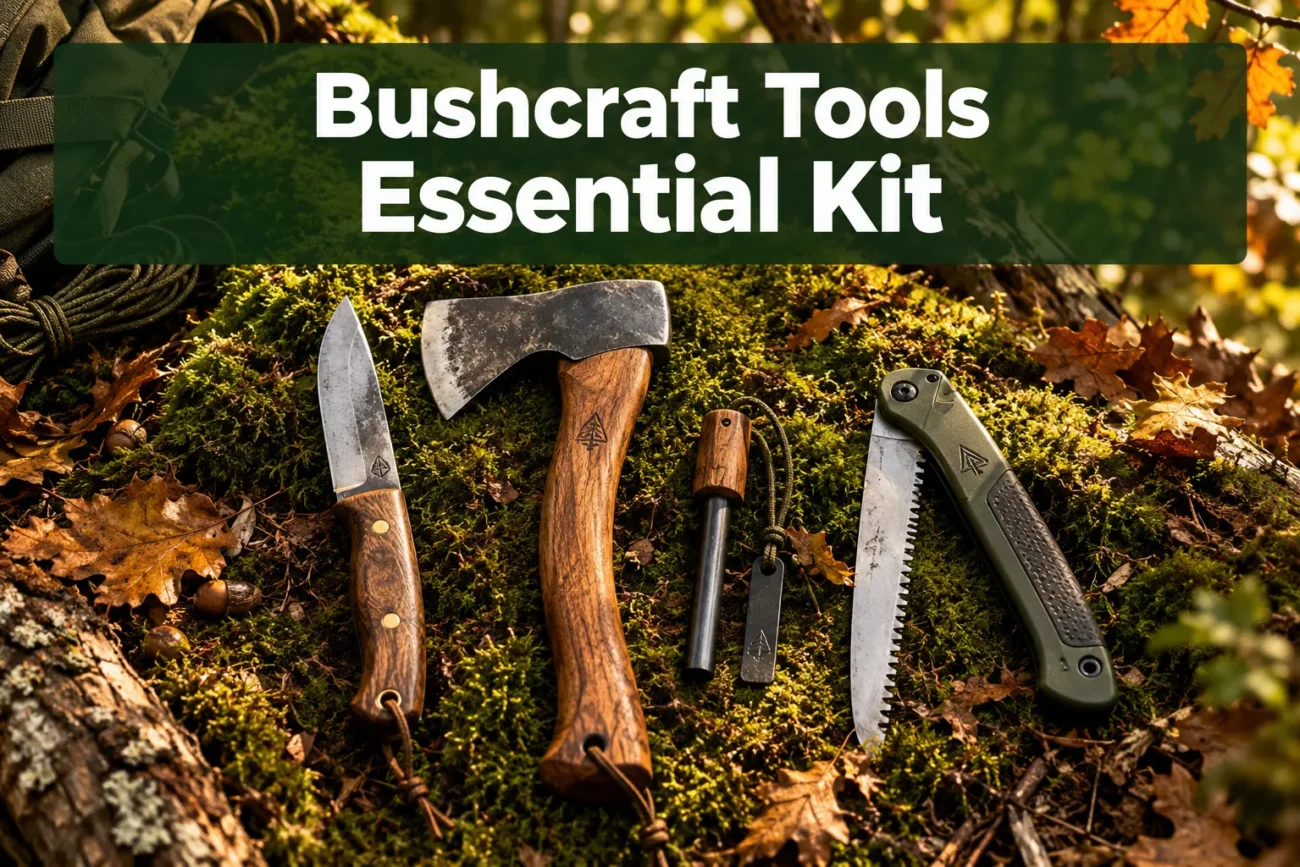
An essential bushcraft tools for woodland survival centers on five core items, a quality fixed-blade knife, a folding saw, a hatchet or forest axe, a ferro rod, and basic cordage. These tools cover shelter building, fire starting, food processing, and camp craft. Everything else is supplemental.
Key Takeaways
- A fixed-blade bushcraft knife is the single most important tool in any woodland survival kit, choose one with a full-tang, 4-5 inch carbon steel blade
- A folding saw processes wood faster and more efficiently than a knife alone, making it a high-value addition for minimal weight
- Ferro rods outlast matches in wet conditions and have a lifespan of thousands of strikes, they are more reliable than matches for long-term survival
- A complete, functional bushcraft kit can be assembled for under $100 if you prioritize proven budget options over premium brands
- Hatchets (under 2 lbs) are better suited for most woodland bushcraft than full-size axes, which are better for base camp firewood production
- Winter survival requires additions to the standard kit: a quality fixed-blade saw, insulated fire-starting tinder, and a heavier-duty shelter tool
- Children can safely participate in bushcraft with age-appropriate tools and direct adult supervision, starting at age 8-10 with a supervised folding knife
- The most common beginner mistake is over-buying gear instead of developing the skills to use what they already have
What Tools Do You Actually Need for Bushcraft Survival
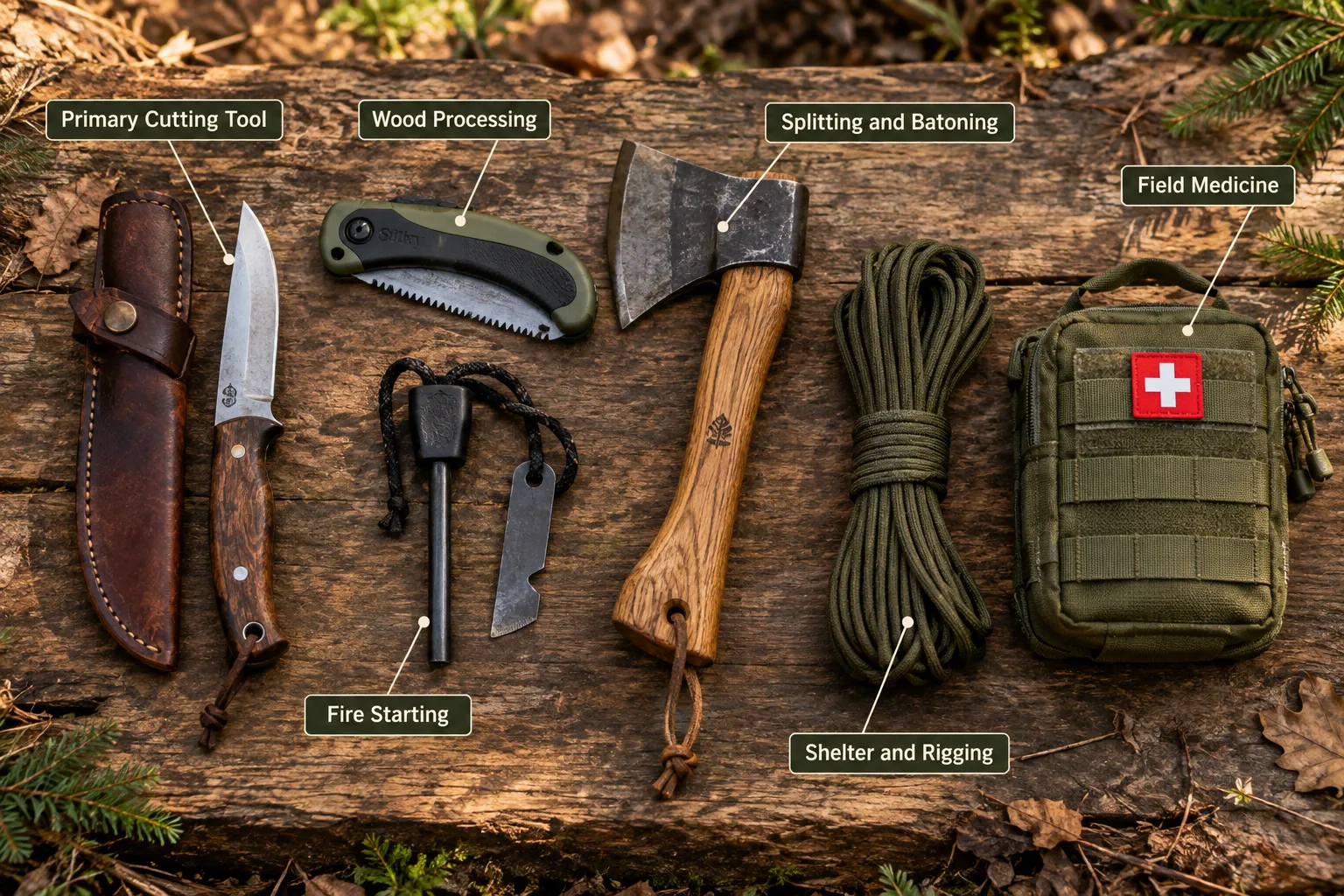
The core bushcraft tools essential kit for woodland survival is smaller than most people expect. Five categories cover nearly every woodland task: cutting, wood processing, fire starting, shelter rigging, and basic first aid.
Here is what belongs in a functional kit:
- Fixed-blade knife (4-5 inch blade, full-tang, carbon steel): primary tool for carving, food prep, fire prep, and batoning
- Folding saw (21-inch blade): efficient wood processing for shelter poles and firewood
- Hatchet or forest axe (1.5-2 lb head): splitting, felling small trees, and heavy camp tasks
- Ferro rod with striker: reliable fire starting in all weather conditions
- Paracord (50-100 feet): shelter construction, lashings, and camp rigging
- Basic first aid kit: wound care, blister treatment, and field medicine essentials
- Tarp or emergency bivy: fast, lightweight shelter in any woodland environment
That’s it for a functional starting point. Navigation tools (map and compass) and a water purification method round out a complete kit. For a deeper look at how these tools fit into broader wilderness readiness, the 7 Essential Wilderness Survival Tools Every Hiker Needs guide covers the full picture.
Best Bushcraft Knife for Beginners
For beginners, the best bushcraft knife is a full-tang, fixed-blade knife with a 4-5 inch carbon steel blade, a comfortable Scandinavian (Scandi) grind, and a secure leather or Kydex sheath. This combination offers the best balance of durability, ease of sharpening, and versatility for woodland tasks.
What to look for:
- Full-tang construction: the blade steel runs the full length of the handle, preventing breakage under hard use like batoning
- Carbon steel (1075, 1095, or similar): easier to sharpen in the field than stainless; throws sparks with a ferro rod as a bonus
- Scandi grind: a flat, single-bevel grind that beginners can maintain with a basic whetstone
- Blade length of 4-5 inches: long enough for most tasks, short enough for fine carving work
- Handle material: stabilized wood, Micarta, or G-10, all hold up to wet conditions
Common beginner mistake: Buying a knife with a serrated spine or excessive features. Serrations are difficult to sharpen and rarely needed in woodland environments. Keep it simple.
For more on what separates a survival knife from a general-purpose blade, see the Survival Knife Training and Qualities resource.
Bushcraft Tools vs Camping Gear: What’s the Difference
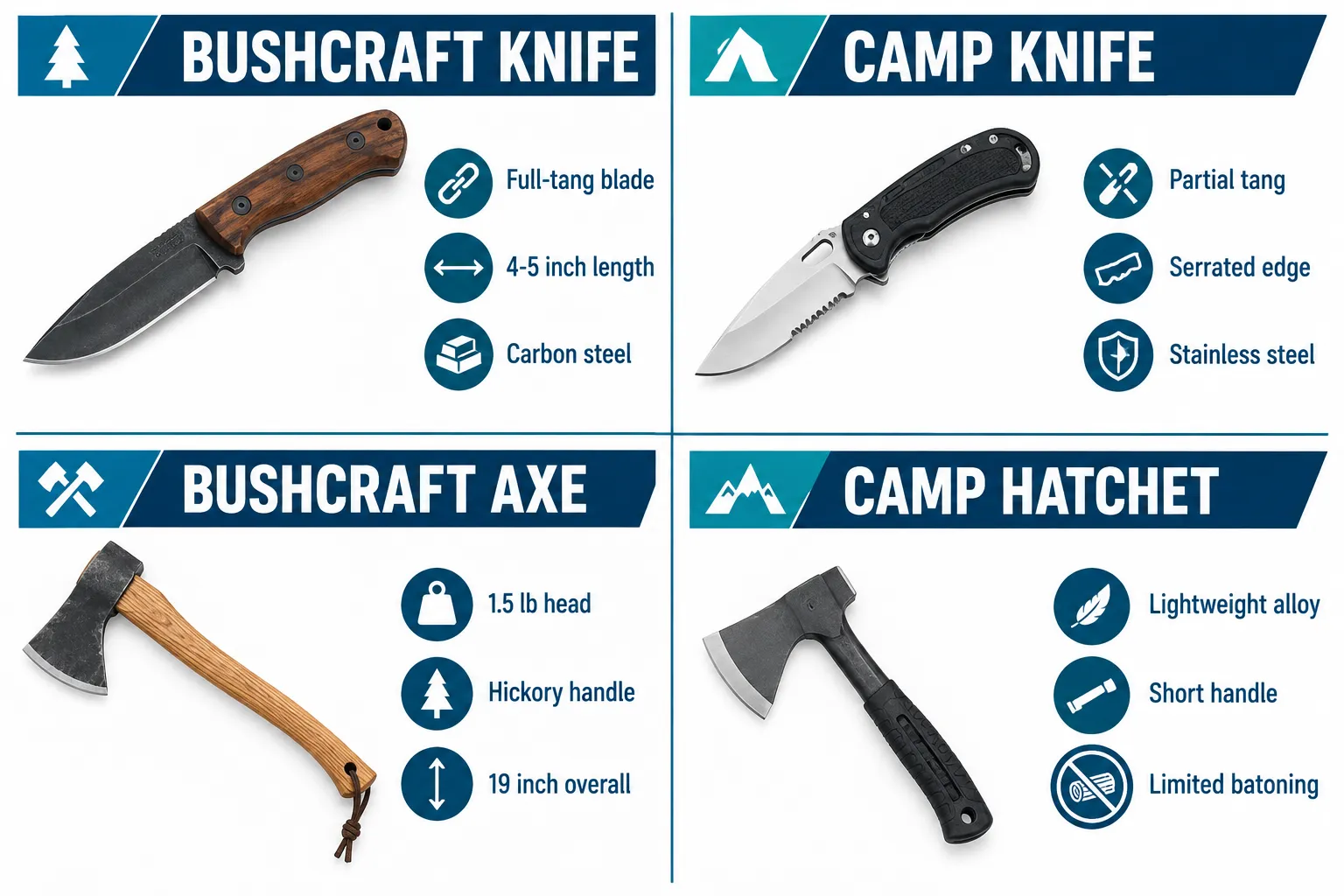
Bushcraft tools and camping gear serve different purposes. Camping gear is designed for comfort and convenience, it assumes you have access to resupply, established campsites, and a vehicle nearby. Bushcraft tools are designed for self-reliance, they’re built to help you extract resources from the environment itself.
| Category | Bushcraft Tool | Camping Gear Equivalent | Key Difference |
|---|---|---|---|
| Cutting | Full-tang carbon steel knife | Multi-tool or folding knife | Durability under hard use |
| Fire | Ferro rod | Lighter or matches | Works wet, lasts years |
| Shelter | Tarp + paracord | Tent with poles | Adaptability to terrain |
| Wood processing | Folding saw + hatchet | Pre-cut firewood | Self-sufficiency from environment |
| Navigation | Map + baseplate compass | GPS device or phone | No battery dependency |
The core principle: bushcraft tools are designed to work with the environment. Camping gear is designed to work despite it.
What Size Axe Is Best for Bushcraft, and How to Choose Between a Hatchet and Full Axe
For most woodland bushcraft, a hatchet or forest axe in the 1.5-2 lb head weight range with a 19-24 inch handle is the right choice. A full-size felling axe (3+ lbs, 28-36 inch handle) is better suited to base camp firewood production, it’s too heavy and unwieldy for the varied tasks bushcraft demands.
Choose a hatchet if:
- You’re moving camp frequently or covering distance on foot
- Your primary tasks are kindling splitting, small log processing, and shelter pole prep
- Weight is a limiting factor in your pack
Choose a full forest axe (not a felling axe) if:
- You’re establishing a semi-permanent camp
- You need to process larger diameter logs for long-burning fires
- You’re in a cold-weather environment where fire output matters more
A 19-inch forest axe like the Gransfors Bruks Small Forest Axe or the Husqvarna 26-inch equivalent hits the sweet spot for most bushcraft practitioners. The handle length provides enough swing power for batoning and splitting without the bulk of a full axe.
Why You Need a Ferro Rod When You Already Have Matches
A ferro rod is more reliable than matches in a genuine woodland survival situation because it works when wet, doesn’t degrade with age, and produces a spark at approximately 5,500°F, hot enough to ignite natural tinder like birch bark, dry grass, and fatwood shavings. A quality ferro rod can produce 12,000 or more strikes before it’s exhausted.
Matches fail when wet. Even waterproof matches have a limited strike count. Lighters run out of fuel and fail in cold temperatures when butane pressure drops.
The ferro rod’s only limitation is that it requires dry, properly prepared tinder. That’s a skill issue, not a tool issue, and it’s exactly why learning how to start a fire without matches is worth your time before you need it.
Carry all three (ferro rod, lighter, waterproof matches) in a real survival kit. The ferro rod is your primary. The lighter is your convenience tool. The matches are your last resort.
Best Bushcraft Tools Under $100: A Complete Budget Kit
A fully functional bushcraft tools essential kit for woodland survival can be assembled for under $100 without sacrificing reliability. The key is prioritizing proven mid-range tools over premium brands while avoiding the cheapest no-name options that fail under real use.
Budget kit breakdown (approximate 2026 pricing):
- Mora Companion HD or Mora Garberg (carbon steel): $15-$80 depending on model, the Companion HD at roughly $20 is the best value knife in bushcraft
- Bahco Laplander folding saw: approximately $30, widely regarded as the best folding saw at any price point
- Husqvarna 13-inch hatchet: approximately $35-$40
- Bayite 4-inch ferro rod with striker: approximately $10-$12
- 100 feet of 550 paracord: approximately $8-$10
Total estimated cost: $75-$130 depending on specific model choices. The Mora knife alone keeps the knife budget under $25, leaving room for quality in the saw and hatchet categories.
What to skip at the budget level: Multi-tools, survival bracelets, and combination tools that try to do everything. They rarely do any single thing well.
Can You Do Bushcraft With Just a Knife
Technically yes, a skilled practitioner can accomplish a remarkable amount with only a good fixed-blade knife. Fire by friction, shelter construction, food processing, and basic tool making are all possible with knife-only technique. But it’s slow, physically demanding, and significantly limits what you can accomplish in a genuine survival situation.
A knife alone cannot efficiently process the volume of wood needed for a debris shelter or a sustained fire. A folding saw reduces that work by 70% or more in practical terms. The knife-only approach is a valuable skill to develop, but it’s not a practical kit strategy.
The honest answer: Build your skills around a knife-first approach so you understand what’s possible. Then add a saw and a hatchet to your kit because efficiency matters when your life depends on it.
For a broader skills foundation, the 20 Essential Bushcraft Skills for Beginners guide covers the techniques that make your tools genuinely effective.
Bushcraft Kit for Winter Survival: What Changes
A standard bushcraft kit needs specific additions for winter woodland survival. Cold weather changes your priorities, fire becomes critical rather than convenient, shelter insulation matters far more, and wet conditions are nearly constant.
Winter-specific additions to your core kit:
- Larger ferro rod (6-inch minimum): cold hands make fine motor tasks harder; a bigger rod is easier to grip and strike
- Fatwood or commercial fire-starting tinder: wet winter conditions make natural tinder collection much harder
- Fixed-blade saw (not folding): folding saws can freeze at the pivot point in sub-zero temperatures
- Wool or synthetic insulation layer: not a tool, but critical to kit function, cold hands can’t use tools effectively
- Metal water bottle or pot: allows you to melt snow for water without plastic degradation from heat
The Winter Blizzard Survival Kit resource covers cold-weather preparedness in more depth, including layering systems and shelter priorities.
Bushcraft Kit for Kids: Is It Safe
Bushcraft with children is safe when tools are age-appropriate and adult supervision is direct and consistent. Children aged 8-10 can begin with a supervised folding knife and progress to a fixed-blade knife with proper instruction. The goal is building competence and respect for tools, not restricting access.
Age-appropriate progression:
- Ages 6-8: Carving with a supervised whittling stick or butter knife equivalent; fire observation only
- Ages 8-10: Folding knife with the “blood bubble” rule (keep the blade inside an imaginary bubble around your body); supervised fire starting with a lighter
- Ages 10-13: Fixed-blade knife with full instruction; ferro rod use with adult present
- Ages 13+: Hatchet use with instruction; independent fire starting; basic shelter construction
The Wilderness Survival for Families with Children guide offers a complete framework for introducing survival skills at every age level.
Bushcraft Tools That Are Overrated and Unnecessary
Several tools appear frequently in bushcraft marketing but add weight and cost without proportional value for most practitioners.
Overrated tools to skip (especially for beginners):
- Survival multi-tools: the knife blade is too short, the saw is too weak, and the whole tool compromises on everything
- Large fixed-blade “survival” knives (7+ inches): too heavy for fine carving, too bulky for everyday use; a 4-5 inch blade handles 95% of tasks better
- Flint and steel traditional fire kits: valuable as a skill exercise, but a ferro rod is faster and more reliable in a real situation
- Machetes in temperate woodland: useful in jungle environments, largely unnecessary in North American or European forests where a hatchet and saw outperform it
- Dedicated wood carving sets: a single good bushcraft knife handles all carving tasks; a full set adds weight with minimal return
The pattern here is consistent: tools marketed for their versatility often underperform compared to single-purpose tools that do one thing exceptionally well.
Common Mistakes Beginners Make With Bushcraft Tools
The most common mistake beginners make is prioritizing gear acquisition over skill development. A $300 knife doesn’t make you a better bushcrafter, 300 hours of practice does.
Other frequent mistakes:
- Neglecting knife maintenance: a dull knife is more dangerous than a sharp one because it requires more force and slips more easily
- Buying a full-size axe as a first chopping tool: too heavy, too fatiguing, and unnecessary for most woodland tasks
- Relying on a single fire-starting method: always carry redundancy, ferro rod, lighter, and matches as a minimum
- Skipping first aid training: tools can cause injuries; knowing how to treat a deep wound in the field is as important as any tool in your kit
- Overloading the pack: a 40-lb bushcraft pack defeats the purpose of mobility; keep your core kit under 20 lbs
Bushcraft Tools for Women: Specific Recommendations
The core bushcraft tools essential kit for woodland survival is the same regardless of gender, but handle ergonomics and tool weight matter more when hand size and grip strength differ from the average male benchmark most tools are designed around.
Practical adjustments for smaller hand sizes or lower grip strength:
- Knife handle: look for handles with a narrower diameter (under 1.1 inches); the Mora Companion and Mora Eldris both work well for smaller hands
- Hatchet: a lighter head weight (1.25-1.5 lbs) reduces fatigue without sacrificing function for most woodland tasks; the Gransfors Bruks Wildlife Hatchet is a strong option
- Folding saw: the Bahco Laplander’s handle is ergonomically neutral and works well across hand sizes
- Ferro rod size: a standard 3-4 inch rod is sufficient; the 6-inch rods marketed as “easier to grip” are often unnecessarily large for practitioners with smaller hands
The principle is fit, not gender. Try tools before buying when possible, and prioritize a comfortable grip over brand reputation.
How Much Does a Complete Bushcraft Kit Cost
A functional bushcraft tools essential kit for woodland survival costs between $75 and $400 depending on whether you choose budget, mid-range, or premium tools. The good news: the budget tier is genuinely capable, the Mora Companion plus Bahco Laplander plus a Husqvarna hatchet outperforms many premium kits in real-world use.
Cost tiers:
- Budget kit ($75-$130): Mora Companion HD, Bahco Laplander, Husqvarna hatchet, Bayite ferro rod, 550 paracord
- Mid-range kit ($200-$350): Mora Garberg or Benchmade Bushcrafter, Silky Pocketboy saw, Gransfors Bruks Wildlife Hatchet, Light My Fire Army ferro rod
- Premium kit ($400+): Custom or semi-custom fixed blade, Silky Gomboy, Gransfors Bruks Small Forest Axe, full kit with quality leather sheaths
The honest recommendation: Start with the budget kit and invest the savings in training and practice time. Upgrade individual tools as you identify specific limitations through actual use.
For a broader look at prioritizing survival gear investment, the Essential Survival Gear Guide: 50 Items Ranked by Priority is a useful reference.
FAQ: Essential Bushcraft Tools Kit for Woodland Survival
What is the single most important tool in a bushcraft kit?
A quality fixed-blade knife is the most important tool. It handles fire prep, food processing, shelter building, carving, and dozens of other tasks. Every other tool in the kit is secondary to a good knife.
Can I use a folding knife instead of a fixed-blade for bushcraft?
A folding knife works for light tasks but is not suitable for hard use like batoning wood or heavy carving. The pivot point is a structural weakness. For genuine woodland survival, a fixed-blade full-tang knife is the correct choice.
How do I sharpen a bushcraft knife in the field without a whetstone?
A smooth flat river stone, a leather strop, or even the unglazed ceramic bottom of a mug can maintain an edge in the field. Carry a small pocket whetstone (around 400/1000 grit) as standard kit, they weigh under 2 ounces.
Is a machete a good bushcraft tool for North American forests?
No. In temperate North American and European woodlands, a hatchet and folding saw outperform a machete for nearly every task. Machetes are optimized for jungle environments with dense low vegetation, not the larger-diameter wood processing that dominates woodland bushcraft.
What’s the best way to carry a bushcraft kit?
A 20-30 liter daypack or a dedicated bushcraft belt kit works well. Keep your knife on your belt for immediate access. The saw, hatchet, and cordage go in the pack. Avoid storing your ferro rod loose, it can accidentally ignite tinder in a packed bag.
How do I start a fire with a ferro rod if everything is wet?
Find dry tinder under bark, inside dead standing wood, or in your pack. Birch bark contains natural oils that ignite even when damp. Fatwood (resin-saturated pine heartwood) is highly flammable even wet. The fire starting in wet conditions guide covers this in detail.
Do I need a dedicated water purification tool in my bushcraft kit?
Yes. A metal water bottle (for boiling) plus water purification tablets covers most situations. A small filter straw adds redundancy. Never assume woodland water sources are safe to drink untreated.
What’s the difference between a bushcraft knife and a survival knife?
A bushcraft knife is optimized for precision craft tasks, carving, food prep, fire starting, with a 4-5 inch blade and a Scandi or flat grind. A “survival knife” is a marketing term that often describes a larger, heavier blade with added features like a hollow handle or serrations. Most survival knives are inferior to purpose-built bushcraft knives for actual woodland use.
How long does a ferro rod last?
A quality ferro rod (magnesium alloy) typically produces between 12,000 and 20,000 strikes depending on diameter and alloy composition. Used daily, a standard ferro rod lasts years. It’s one of the most cost-effective tools in any survival kit.
Should I carry a hatchet and a knife, or just one or the other?
Carry both. A knife and hatchet together cover a far wider range of tasks than either alone. The hatchet handles heavy splitting and log processing; the knife handles precision work. Together, they weigh under 3 lbs and represent the core of any serious woodland survival kit.
Conclusion
Building a bushcraft tools essential kit for woodland survival doesn’t require an expensive gear collection or years of experience to start. It requires five solid tools, a commitment to learning how to use them, and the discipline to practice those skills before you need them.
Start with a Mora Companion, a Bahco Laplander, a mid-weight hatchet, a ferro rod, and 100 feet of paracord. That kit costs under $100 and handles the vast majority of woodland survival tasks. Add a tarp, a first aid kit, and a water purification method, and you have a genuinely capable system.
Then practice. Carve a feather stick. Build a debris shelter. Start a fire with natural tinder and a ferro rod in damp conditions. The tools are only as effective as the hands holding them.
For the skills foundation that makes your kit actually work, the 25 Most Critical Wilderness Survival Skills guide is the logical next step. And if you’re building out a broader preparedness system beyond the woodland, the 14 Essential Survival Skills Every Prepper Must Know covers the full spectrum of readiness.
Being prepared isn’t about having the best gear. It’s about having the right gear and knowing exactly what to do with it.
Products, Tools, and Resources
Recommended tools for a complete bushcraft kit:
- Mora Companion HD (carbon steel): The best entry-level bushcraft knife available. Reliable, easy to sharpen, and priced under $25. A genuine workhorse.
- Mora Garberg: The step-up option with a thicker spine, full-tang construction, and multi-mount sheath. Worth the upgrade if you plan to baton regularly.
- Bahco Laplander Folding Saw: Consistently rated as the best folding saw at any price point. The 7.5-inch blade cuts efficiently through green wood and dry timber alike.
- Husqvarna 13-inch Hatchet: A reliable, affordable hatchet with a hickory handle and a well-tempered head. Handles batoning, kindling splitting, and light felling without complaint.
- Gransfors Bruks Wildlife Hatchet: The premium option for those who want a tool that lasts a lifetime. Forged in Sweden, comes with a leather sheath, and holds an edge exceptionally well.
- Bayite 4-inch Ferro Rod: Solid budget ferro rod with a comfortable handle and a reliable striker. Produces a strong spark even after extended field use.
- Light My Fire Army Ferro Rod: The mid-range upgrade, with a larger rod diameter and a built-in striker integrated into the handle.
- 550 Paracord (100 feet): Choose mil-spec 550 paracord with 7 inner strands, not the cheaper 4-strand imitations. The inner strands are as useful as the outer sheath.
- SOL Emergency Bivy: A lightweight mylar bivy that weighs under 4 ounces and provides genuine thermal protection. Better than a standard emergency blanket for extended use.