
Hey there! Some links on this page may be affiliate links which means that, if you choose to make a purchase, I may earn a commission at no extra cost to you. I greatly appreciate your support. Read the full disclosure here.
Most children can unlock a smartphone before they can find clean water, signal for help, or treat a basic wound. That gap between digital fluency and real-world resilience is exactly what preppers and survivalists are working to close. Teaching survival skills for kids isn’t about scaring them, it’s about giving them the tools to stay calm, make smart decisions, and protect themselves when things go sideways.
This guide covers the 12 most practical, age-appropriate survival skills every child should learn, along with honest advice on how to teach them, when to start, and what mistakes to avoid along the way.
Key Takeaways
- Children as young as 4 can begin learning foundational survival concepts; formal skill-building is most effective starting around age 6-8.
- The 12 core survival skills for kids span both wilderness and urban scenarios, making them relevant regardless of where a family lives.
- Teaching survival skills works best when framed as adventure and competence-building, not fear-based preparation.
- Short, repeated practice sessions (15-30 minutes) are more effective than occasional long training days.
- Anxious or nature-averse children benefit most from starting with indoor, low-stakes versions of each skill before moving outdoors.
- Common parent mistakes include teaching too much at once, skipping practice drills, and underestimating what young children can retain.
- Scouting programs, wilderness camps, and structured family drills are all proven methods for reinforcing these skills.
- A child who knows these 12 skills is a genuine asset during a family emergency, not just a dependent who needs protection.
What Are the Most Important Survival Skills Kids Should Learn
The most important survival skills for kids are the ones that address the highest-probability threats they’ll actually face: getting lost, getting hurt, losing access to clean water, and being separated from adults. Beyond those immediate priorities, kids benefit from learning fire safety, basic navigation, shelter-building, and how to signal for help.
Here are the 12 skills covered in this guide, ordered by life-saving priority:
- Stay calm and think (the survival mindset)
- Know personal information and emergency contacts
- First aid basics
- Finding and purifying water
- Signaling for help
- Fire safety and fire starting
- Building emergency shelter
- Basic navigation without GPS
- Identifying edible plants and avoiding hazards
- Food rationing and foraging awareness
- Urban emergency awareness
- Communication and family emergency plans
For a broader look at how these fit into adult-level preparedness, the 14 essential survival skills every prepper must know provides excellent context for building a family-wide skill set.
What Age Can Kids Start Learning Survival Skills
Children can begin absorbing survival concepts as early as age 4, but structured, hands-on skill training is most effective starting around age 6 to 8. By that age, most children have the attention span, motor skills, and emotional regulation to practice real techniques safely.
Age-by-age breakdown:
- Ages 4-5: Teach name, address, phone number, and what “stranger danger” means in an emergency context. Introduce the concept of a family meeting point.
- Ages 6-8: Introduce basic first aid (cuts, burns), fire safety rules, how to use a whistle to signal for help, and how to stay put if lost.
- Ages 9-11: Add water purification concepts, basic navigation with a compass, shelter-building with simple materials, and how to read a paper map.
- Ages 12+: Introduce fire-starting techniques, foraging basics, urban emergency protocols, and more advanced first aid including wound care.
The key principle: match complexity to developmental stage. A 7-year-old doesn’t need to know how to start a fire with a bow drill, but they absolutely should know how to call 911 and describe their location clearly.
Skill 1-4: Core Survival Skills For Kids That Save Lives First
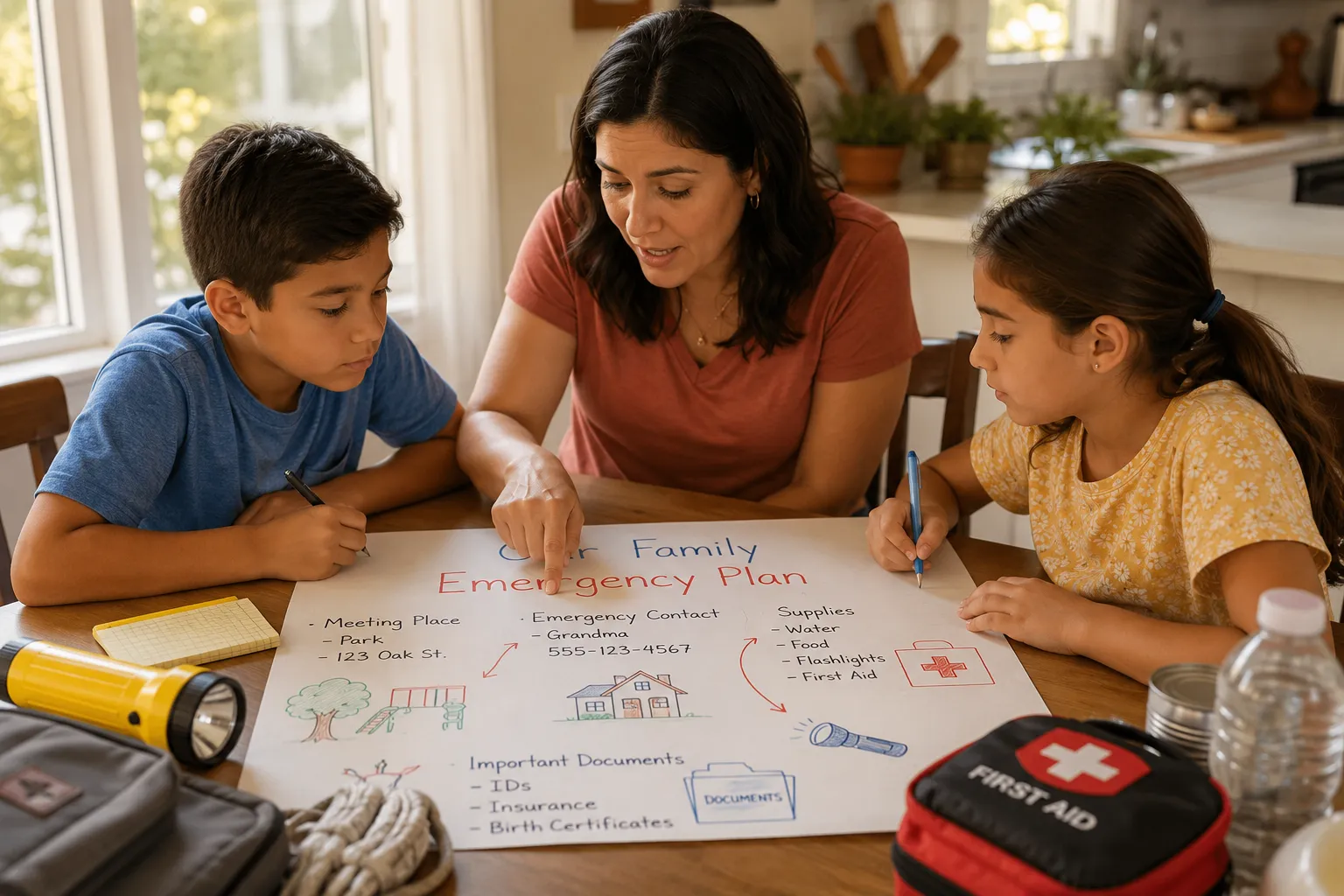
These four skills address the scenarios most likely to turn life-threatening for a child separated from adults.
Skill 1: The Survival Mindset, Stay Calm and Think
Panic kills. The first and most transferable survival skill any child can learn is to stop, breathe, and think before acting. Teach children the “STOP” method: Stop moving, Think about the situation, Observe surroundings, Plan a next step.
Practice this at home by creating low-stakes “what would you do if…” scenarios. The goal is to build the habit of pausing before reacting.
Skill 2: Know Personal Information and Emergency Contacts
Every child should be able to recite their full name, home address, a parent’s phone number, and a backup contact number from memory. This sounds basic, but many children who know how to use a tablet cannot recall a single phone number without looking it up.
Drill this weekly with young children. Make it a game. For older kids, extend it to knowing the family’s out-of-state emergency contact and the address of a designated family meeting location.
Skill 3: First Aid Basics
Children aged 6 and older can learn to clean and cover a wound, recognize signs of a serious injury, and know when and how to call for help. By age 10, most kids can learn the basics of CPR and how to treat a burn or sprain.
For deeper guidance on wound care in emergency situations, the complete guide to treating deep wounds when help can’t reach you is a valuable resource for teaching older children and teens.
Skill 4: Finding and Purifying Water
Dehydration becomes dangerous within hours in extreme conditions. Children should understand that water from streams, ponds, or unknown sources must be purified before drinking. Teach them the basics of boiling water and, for older kids, how to use a portable filter or purification tablets.
The complete guide to purifying water without tools outdoors covers techniques that can be adapted for teaching children in a hands-on setting.
Skill 5-8: Wilderness Survival Skills For Kids
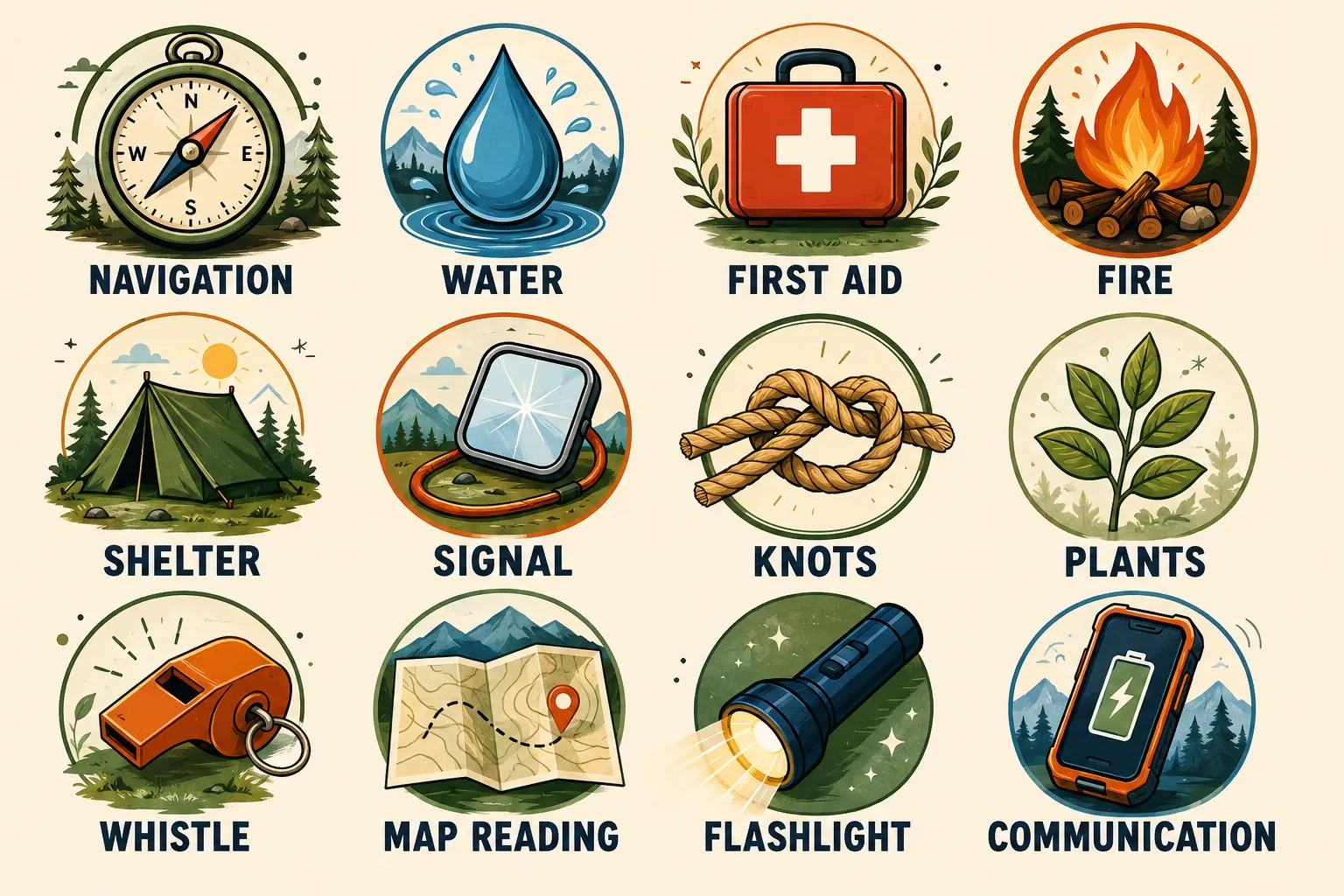
These four skills are especially relevant for families who camp, hike, or live near wilderness areas, but they apply to any child who might become separated from adults outdoors.
Skill 5: Signaling for Help
A whistle carries farther than a voice and requires far less energy. Every child should carry a whistle when outdoors and know the universal distress signal: three short blasts, repeated. Older children can learn to use a signal mirror, create ground-to-air signals visible from aircraft, or build a smoky fire to attract attention.
Simple rule to teach: Three of anything means “I need help”, three whistle blasts, three gunshots, three fires in a triangle.
Skill 6: Fire Safety and Fire Starting
Fire safety comes before fire starting. Children need to understand fire hazards, how to safely extinguish a fire, and the conditions that make fires dangerous before they ever learn to start one. For most children, fire-starting instruction is appropriate around age 10-12, under direct adult supervision.
Start with matches, then lighters, then fire-starting tools like ferro rods. The step-by-step guide to starting a survival fire in rain covers techniques that make for excellent parent-child training exercises.
Common mistake: teaching fire starting before fire safety. A child who can start a fire but doesn’t understand fire behavior is a hazard, not an asset.
Skill 7: Building Emergency Shelter
Exposure is one of the fastest killers in a survival situation. Children should learn how to build a basic debris hut or lean-to using natural materials, branches, leaves, bark. This is one of the most engaging skills to teach because it feels like play.
Practice in the backyard first. Time the build. Challenge kids to improve their design. By the time a child can build a shelter that keeps them dry for 30 minutes in light rain, they have a genuinely useful skill.
Navigation without GPS starts with understanding cardinal directions and how to use a compass. Children aged 9 and older can learn to orient a map, identify landmarks, and follow a bearing. The complete beginner’s guide to navigation without GPS covers these techniques in detail.
Start with a simple treasure hunt using a compass and hand-drawn map. Progress to topographic maps and real terrain as confidence builds.
Survival Skills For Kids in Wilderness vs. Urban Environments
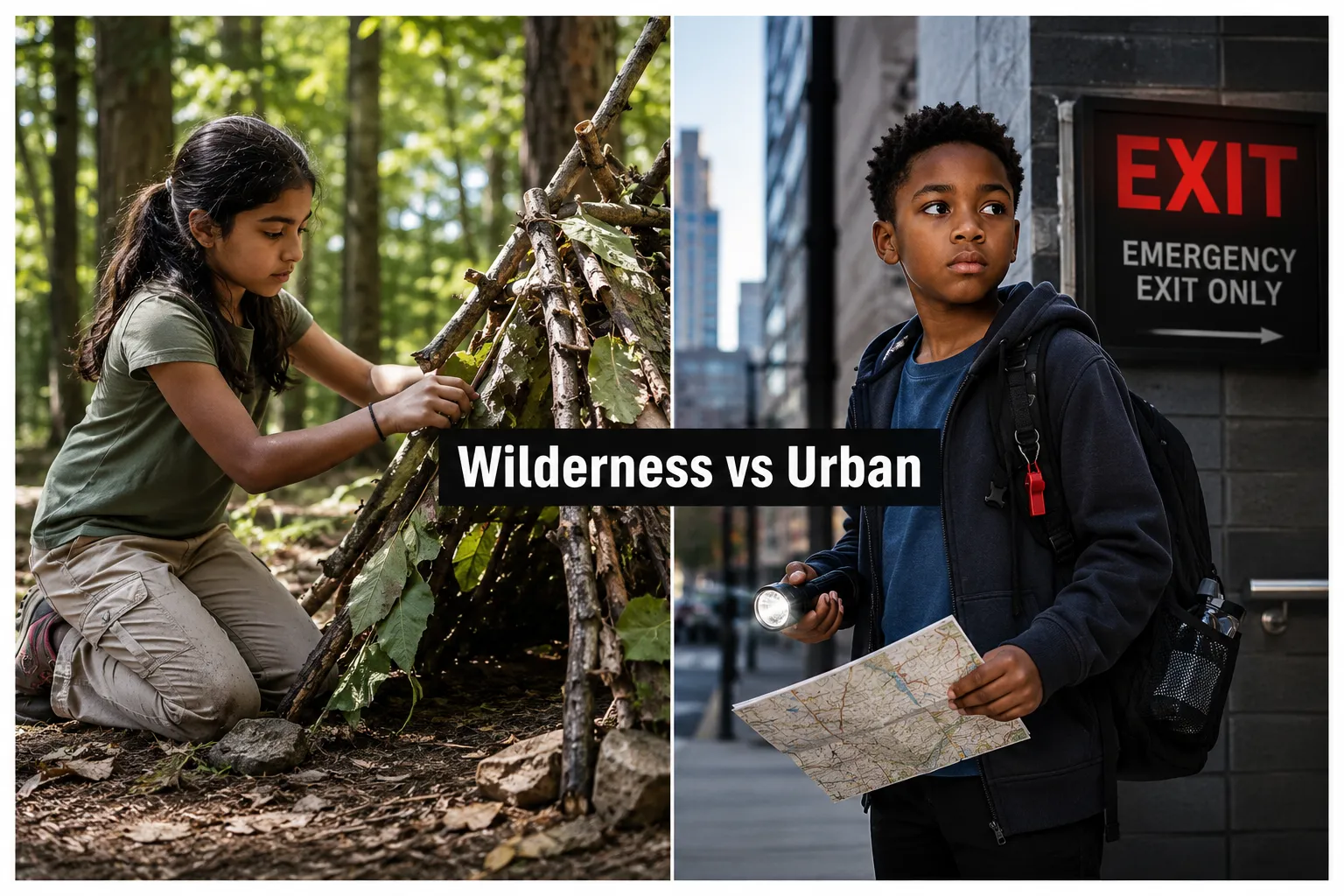
Wilderness and urban survival skills overlap more than most people expect, but the specific threats differ enough to warrant separate attention. In wilderness settings, the primary threats are exposure, dehydration, getting lost, and injury. In urban settings, the threats shift toward power outages, civil unrest, building emergencies, and separation from family in crowds.
Wilderness priorities:
- Shelter, water, fire, navigation, signaling
Urban priorities:
- Emergency contacts, evacuation routes, situational awareness, communication when phones fail, knowing how to shelter in place
For families in cities, the urban survival skills most people ignore for city emergencies is a practical companion resource for teaching the urban side of this equation to older children and teens.
The good news: skills like staying calm, knowing emergency contacts, basic first aid, and water safety apply in both environments. Build the foundation first, then layer in environment-specific training.
Skill 9-12: Advanced Survival Skills For Kids
Skill 9: Identifying Edible Plants and Avoiding Hazards
Plant identification is a nuanced skill that requires patience and repetition. For children, the most important lesson is the negative: learn what NOT to eat before learning what is safe. Teach children to avoid berries they can’t identify, never eat mushrooms without expert guidance, and recognize common toxic plants like poison ivy, poison oak, and nightshade.
For older children (12+), introduce a handful of highly recognizable edible plants common to your region, dandelion, clover, cattail. Keep it simple and regional.
Skill 10: Food Rationing and Foraging Awareness
Children don’t need to become expert foragers, but they should understand that food is less urgent than water and shelter in a survival situation. Teach them that an adult can survive weeks without food but only days without water. For older kids, introduce the concept of calorie conservation, moving less, staying warm, and rationing available food.
Skill 11: Urban Emergency Awareness
Urban emergency awareness means knowing what to do when the environment itself becomes dangerous. Teach children to identify emergency exits in buildings, understand what different alarm sounds mean, know how to shelter in place during a chemical or weather event, and recognize when a situation requires evacuation versus staying put.
The guide to surviving in a city during a natural disaster is an excellent resource for building this awareness in older children and teens.
Skill 12: Communication and Family Emergency Plans
Every prepared family needs a documented emergency plan, and every child in that family should know it. This means knowing the family meeting point, the out-of-state contact, the evacuation route, and what to do if they can’t reach a parent.
Practice the plan at least twice a year with a realistic drill. Children who have rehearsed a plan respond far better in actual emergencies than those who have only heard about it.
The 4-Layer Disaster Plan based on FEMA protocol provides an excellent framework for building a family plan that children can actively participate in.
How to Teach Kids Survival Skills Without Scaring Them
The most effective approach frames survival skills as competence and adventure, not as preparation for catastrophe. Children who learn these skills in a positive, game-like context retain them better and develop genuine confidence rather than anxiety.
Practical teaching principles:
- Keep sessions short: 15-30 minutes of focused practice beats a full-day survival camp that overwhelms a child.
- Use games and challenges: Timed shelter builds, compass treasure hunts, and first aid role-play make learning stick.
- Normalize the skills: Tie survival concepts to everyday activities, purifying water while camping, reading a map on a road trip, practicing fire safety at a backyard bonfire.
- Let children lead: Once a skill is introduced, let the child teach it back to you or to a younger sibling. Teaching reinforces retention.
- Avoid fear-based framing: “If you ever get lost in the woods” lands differently than “when disaster strikes.” Keep the context positive and empowering.
Survival Skills For Kids With Anxiety or Fear of the Outdoors
Children who are anxious or uncomfortable outdoors can still learn every skill on this list. The key is starting indoors with low-stakes versions of each skill, then gradually introducing outdoor contexts as confidence builds.
For example:
- Teach compass use at the kitchen table before going outside.
- Practice building a shelter with couch cushions and blankets before moving to the backyard.
- Role-play emergency phone calls before discussing real scenarios.
Never force a reluctant child into an outdoor survival scenario. Forced exposure creates negative associations that make future learning harder. Progress at the child’s pace, celebrate small wins, and connect each skill to a sense of personal power rather than fear of danger.
Common Mistakes Parents Make Teaching Survival Skills
Even well-intentioned parents make errors that reduce the effectiveness of survival training. The most common ones:
- Teaching too many skills at once. One skill per session, practiced until confident, is far more effective than covering all 12 in a weekend.
- Skipping drills. Knowledge without practice evaporates. If a child has never actually practiced calling 911 or building a fire, they haven’t really learned the skill.
- Underestimating children. Most parents are surprised by how quickly children aged 8-12 absorb technical skills when they’re engaged and motivated.
- Making it all about worst-case scenarios. Survival skills are life skills. Frame them that way.
- Not practicing the family emergency plan. A plan that exists only on paper provides false confidence. Drill it.
Are Survival Skills Courses and Programs Worth It for Kids
Structured programs can accelerate learning significantly, especially for skills that require expert supervision like fire starting, knife handling, and advanced first aid. Scouting programs (Boy Scouts, Girl Scouts, and equivalents) remain the most accessible and well-structured option for most families. Wilderness survival camps, offered by organizations like the National Outdoor Leadership School (NOLS) and various regional providers, offer intensive multi-day training for children aged 10 and older.
Choose a program if:
- The child is motivated and engaged with the topic.
- Parents lack confidence teaching specific technical skills.
- The family wants structured peer learning alongside individual training.
Skip the program if:
- The child is anxious or resistant, start with home-based learning first.
- The program is primarily theoretical rather than hands-on.
For families building a broader preparedness foundation, the complete prepping guide for beginners provides a solid framework that parents can adapt for family-wide training.
How Long Does It Take Kids to Learn Survival Skills
Most children can achieve basic competency in a single survival skill within 3-5 focused practice sessions. Full retention, meaning the child can perform the skill reliably under mild stress, typically requires 4-8 weeks of regular short practice.
A realistic timeline for teaching all 12 skills to a child aged 8-12:
- Month 1-2: Personal information, first aid basics, water safety, emergency contacts
- Month 3-4: Signaling, fire safety, shelter basics, compass use
- Month 5-6: Plant identification, urban emergency awareness, family emergency plan drills, food rationing concepts
That’s roughly one new skill introduced every two weeks, with ongoing reinforcement of previously learned skills. Consistency matters far more than intensity.
Survival Skills For Kids in Different Climates and Regions
The core 12 skills apply universally, but the specific techniques vary by environment. A child in the Pacific Northwest needs to know about hypothermia and rain shelter construction. A child in the desert Southwest needs to prioritize heat management and water conservation. A child in a hurricane-prone coastal region needs to understand storm surge and evacuation routes.
Regional adaptations:
| Climate/Region | Top Additional Priorities |
|---|---|
| Desert | Heat stroke prevention, water caching, shade shelter |
| Cold/Mountain | Hypothermia prevention, snow shelter, layering |
| Coastal/Hurricane | Storm surge awareness, evacuation routes, flotation |
| Urban/Dense City | Building exits, shelter-in-place, crowd navigation |
| Wildfire Region | Evacuation triggers, smoke inhalation, defensible space |
Adapt the core curriculum to the threats most likely in your region. A child prepared for their specific environment is far more resilient than one trained on generic scenarios.
FAQ: Survival Skills For Kids
At what age should I start teaching my child survival skills? Start with foundational concepts like personal information and emergency contacts as early as age 4. Hands-on skill training, compass use, fire safety, basic first aid, is most effective beginning around age 6 to 8, matched to the child’s developmental readiness.
What is the single most important survival skill for a child to know? Staying calm and thinking clearly. A child who panics makes poor decisions regardless of what skills they’ve been taught. The survival mindset, stop, think, observe, plan, is the foundation everything else builds on.
Can children learn to start fires safely? Yes, with proper supervision and age-appropriate progression. Fire safety education should precede fire-starting instruction. Most children are ready for supervised fire-starting practice around age 10-12. Always start with matches under direct adult supervision before introducing other fire-starting tools.
How do I teach survival skills to a child who hates the outdoors? Start indoors. Teach compass use at the kitchen table, practice first aid on stuffed animals, build shelters from household materials. Gradual, positive exposure to outdoor contexts works far better than forced outdoor activities.
Do survival skills courses replace home training? No. Courses supplement home training but don’t replace it. The most important survival lessons, family emergency plans, personal contact information, household-specific protocols, can only be taught at home.
What is the STOP method and should I teach it to my child? STOP stands for Stop, Think, Observe, Plan. It’s a widely taught wilderness survival protocol for managing panic when lost or in danger. It’s appropriate for children aged 6 and older and can be practiced as a simple game at home.
Should every child carry a survival kit? Children aged 8 and older who spend time outdoors should carry a basic personal kit: whistle, small flashlight, emergency contact card, and a mylar emergency blanket. Keep it simple, lightweight, and age-appropriate.
How often should we practice the family emergency plan? At minimum, twice per year as a full drill. Monthly verbal reviews, “where do we meet if we can’t get home?”, reinforce the plan without requiring a full drill each time.
What survival skills are most relevant for urban kids? Urban children should prioritize: knowing emergency contacts by memory, understanding evacuation routes from home and school, recognizing alarm types, knowing how to shelter in place, and basic first aid. The kids emergency preparedness guide covers urban-specific protocols in detail.
Are survival skills just for kids who camp or hike? Absolutely not. Most survival scenarios, power outages, house fires, getting separated in a crowd, a car accident, happen in everyday environments. Every child benefits from these skills regardless of whether they ever set foot in a wilderness area.
Conclusion: Building Resilient Kids, One Skill at a Time
Teaching survival skills for kids is one of the highest-value investments a prepared family can make. A child who knows how to stay calm, find clean water, signal for help, and execute a family emergency plan is not a liability in a crisis, they’re a genuine asset.
The 12 skills covered here don’t require expensive gear or months of wilderness training. They require consistent, short practice sessions, honest conversations, and a parent willing to make preparedness a normal part of family life rather than a fear-driven reaction to headlines.
Actionable next steps:
- Start this week with Skill 2: drill your child on their full name, home address, and one parent’s phone number from memory.
- Schedule one 20-minute survival skill session per week for the next 12 weeks.
- Build or review your family emergency plan and walk every family member through it.
- Add a whistle and emergency contact card to your child’s backpack today.
- Explore the survival skills checklist every prepper needs to ensure your family’s overall preparedness covers all the bases.
Preparedness isn’t about fear. It’s about confidence. And the earlier children develop that confidence, the better equipped they’ll be for whatever life throws at them.
Resources and Tools
- Preppers HQ Survival Skills Hub: Start with the 25 most critical wilderness survival skills for a comprehensive adult-level framework to build family training around.
- Navigation Training: The complete beginner’s guide to navigation without GPS is an excellent parent-child learning resource.
- Fire Skills: Review common fire-starting mistakes in survival situations before teaching this skill to children.
- Family Emergency Planning: The 4-Layer Disaster Plan provides a FEMA-based framework adaptable for families with children of all ages.
- Gear for Kids: A basic whistle, small compass, mylar emergency blanket, and a waterproof emergency contact card are the four items every child aged 8+ should have in their pack.