
Hey there! Some links on this page may be affiliate links which means that, if you choose to make a purchase, I may earn a commission at no extra cost to you. I greatly appreciate your support. Read the full disclosure here.
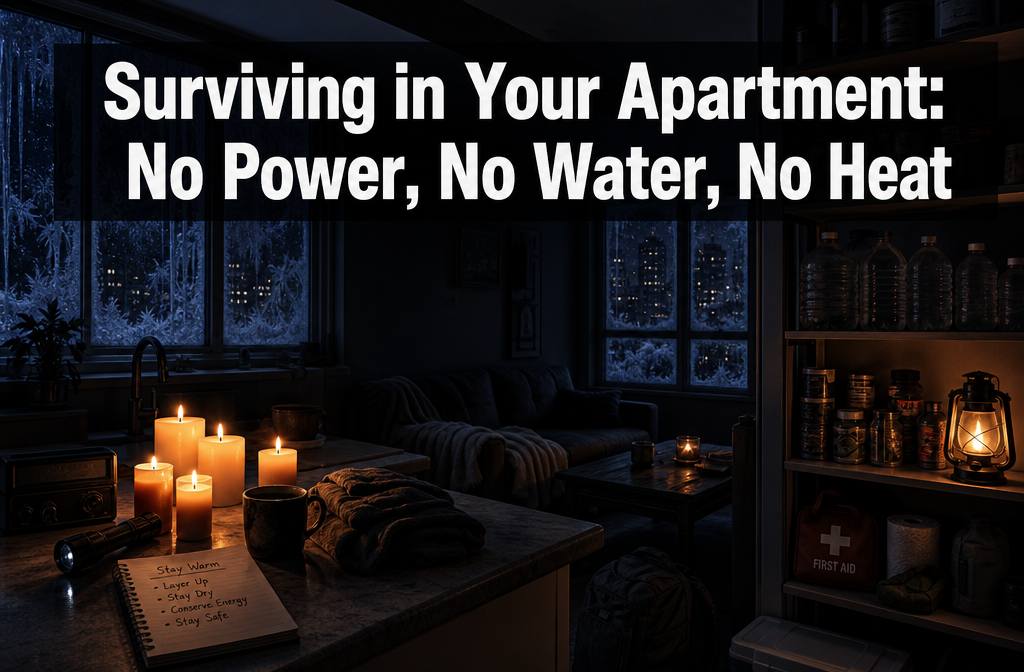
More than 36 million Americans live in apartments, and most of them have zero plan for what happens when the grid goes down, the pipes freeze, or the building’s heating system fails. To survive in an apartment without power, water, or heat isn’t a fringe scenario — it’s a reality that winter storms, infrastructure failures, and natural disasters create every single year. This guide covers exactly what to do before, during, and after a full utility failure in an urban or suburban apartment setting.
Key Takeaways
- A well-prepared apartment dweller can survive 72 hours to two weeks without utilities using pre-stocked supplies and the right techniques.
- Indoor temperatures below 55°F (13°C) become dangerous within hours for elderly residents, infants, and anyone with medical conditions.
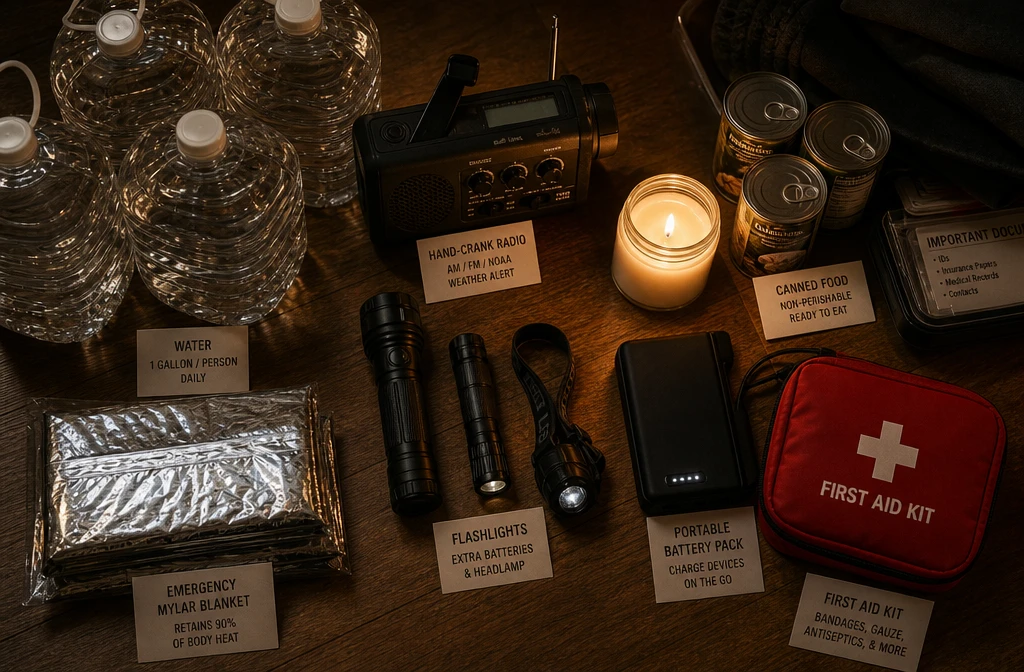
- Store a minimum of one gallon of water per person per day; for a two-person household, that means at least 14 gallons for a one-week supply.
- Never use outdoor combustion appliances (propane grills, generators, charcoal) indoors — carbon monoxide poisoning kills faster than the cold.
- A quality portable power station (500Wh or higher) is the single most versatile piece of emergency equipment for apartment dwellers.
- Layering clothing and creating a “warm room” using thermal blankets can keep body temperature safe even when apartment temperatures drop significantly.
- Know your legal rights: if your landlord fails to restore essential utilities within a legally defined timeframe, you may have grounds for rent withholding or relocation reimbursement.
- Always have a bug-out threshold — a specific temperature or time limit at which you leave the apartment and seek emergency shelter.
How Long Can You Survive in Your Apartment With No Electricity?
Most healthy adults can survive several weeks in an apartment without electricity, provided they have food, water, and a way to stay warm. The real limiting factor isn’t the power itself — it’s what the power was doing for you. Lighting is inconvenient to lose. Heat and refrigeration are potentially life-threatening.
Here’s a practical breakdown of how long key systems last after the grid goes down:
| Resource | Approximate Duration | Key Risk |
|---|---|---|
| Refrigerated food | 4 hours (open fridge) / 48 hours (full, closed freezer) | Food spoilage, illness |
| Tap water pressure | Hours to days (varies by building/municipal system) | Dehydration, sanitation |
| Apartment heat retention | 8–24 hours depending on insulation | Hypothermia |
| Phone battery (no charging) | 1–3 days with minimal use | Loss of communication |
| Pre-stored water supply | 7–30+ days depending on prep | Dehydration |
The honest answer: without any preparation, most people in a poorly insulated apartment hit a critical threshold within 24–48 hours in winter. With proper preparation — stored water, food, thermal gear, and a portable power source — surviving in an apartment without power, water, or heat for 7 to 14 days is entirely achievable.
“Preparedness isn’t about predicting the exact disaster. It’s about building the capacity to handle the unexpected, whatever form it takes.”
For a deeper look at building your apartment-specific supply system, the Ultimate Guide to Prepping in a Small Apartment covers space-efficient strategies that work even in studio apartments.
What Do You Need to Keep Warm Without Heat?
Staying warm without a functioning heating system comes down to one principle: trap body heat, reduce heat loss, and create a small warm zone rather than trying to heat the entire apartment.
The layering system that actually works:
- Base layer — moisture-wicking thermal underwear (wool or synthetic, not cotton)
- Mid layer — fleece or down jacket worn indoors
- Outer layer — a sleeping bag rated to 0°F or lower, used as a blanket or worn as a wrap
- Head and extremities — a wool hat and gloves indoors; up to 40% of body heat escapes through an uncovered head
Creating a “warm room”:
Pick the smallest interior room in your apartment — ideally one with no exterior walls. Hang mylar emergency blankets on the walls and over windows. Seal the door gap with a rolled towel. Multiple people and even pets in one small room generate meaningful radiant heat. Body heat alone can raise a small sealed room by several degrees.
What to avoid:
- Propane heaters indoors without proper ventilation — carbon monoxide risk is serious and fast
- Electric space heaters if power is out (obviously), but also avoid using them on generator power unless the generator is rated for the load
- Alcohol or open-flame heating in enclosed spaces
Choose a sleeping bag rated for 0°F if you live in a region where winter temperatures drop below freezing and your building has poor insulation. For mild climates, a 20°F bag is usually sufficient.
What Temperature Is Dangerous Inside an Apartment?
An indoor apartment temperature below 55°F (13°C) is considered dangerous for vulnerable populations, including infants, elderly residents, and anyone with cardiovascular or respiratory conditions. For healthy adults, sustained temperatures below 50°F (10°C) create real risk of hypothermia over time, especially during sleep.
According to the World Health Organization, indoor temperatures should remain at or above 64°F (18°C) for general health, and at least 68°F (20°C) for households with infants or elderly occupants.
Signs of hypothermia to watch for when your apartment loses heat:
- Uncontrollable shivering (early stage — body is still fighting)
- Slurred speech or confusion (moderate stage — seek warmth immediately)
- Drowsiness and loss of coordination (severe — emergency situation)
- Pale or blue-tinged skin, especially lips and fingertips
The bug-out threshold rule: Set a firm temperature at which you leave. A good benchmark is 45°F (7°C) inside the apartment. Below that, staying becomes more dangerous than going — even if “going” means a warming center, a neighbor’s home, or a hotel.
Emergency Water Sources Inside Your Apartment
When the tap runs dry, most apartments contain more usable water than residents realize. The hot water heater tank alone typically holds 30 to 80 gallons of clean water, accessible via the drain valve at the base of the unit.
Water sources to tap in order:
- Pre-stored water — the gold standard; store at minimum one gallon per person per day (see the Apartment Water Storage Complete Guide for space-efficient options)
- Water heater tank — drain from the bottom valve; water is generally safe but may taste metallic
- Toilet tank (not the bowl) — the tank water is typically clean tap water; do not use if tank cleaning tablets are present
- Ice from the freezer — as it melts, it’s potable water
- Canned goods liquid — the liquid in canned vegetables, beans, and fruit contributes to hydration
What to avoid: Do not collect rainwater from apartment balconies without purification — rooftop runoff contains contaminants. Do not use water from the toilet bowl under any circumstances.
For a comprehensive breakdown of purification methods that work without electricity, the Ultimate Emergency Water Storage and Purification Guide covers every practical option from filtration to chemical treatment.
How to Purify Water Without Electricity
Water purification without electricity relies on four proven methods: boiling (with an alternative heat source), chemical treatment, gravity filtration, and UV pen purification.
Method comparison:
| Method | Kills Bacteria/Viruses | Equipment Needed | Cost |
|---|---|---|---|
| Boiling (camp stove) | Yes (both) | Heat source, pot | Low |
| Bleach treatment | Yes (most) | Unscented bleach, dropper | Very low |
| Gravity filter (Sawyer, Berkey) | Yes (bacteria/protozoa) | Filter unit | $30–$300 |
| UV pen (SteriPen) | Yes (both) | Charged pen | $50–$100 |
| Iodine/chlorine tablets | Yes (most) | Tablets | Very low |
Bleach treatment ratio: Use unscented household bleach (6–8.25% sodium hypochlorite). Add 8 drops per gallon of clear water, 16 drops per gallon of cloudy water. Wait 30 minutes before drinking.
Common mistake: people skip purification when water “looks clean.” Tap water that has been sitting in pipes during a prolonged outage can harbor bacterial growth. Always treat water from secondary sources.
How to Cook Food When There’s No Power
Cooking without electricity in an apartment is straightforward with the right equipment. The key is having at least one alternative heat source that is safe for indoor use and stocked with enough fuel for the duration of the outage.
Best indoor-safe cooking options for apartment dwellers:
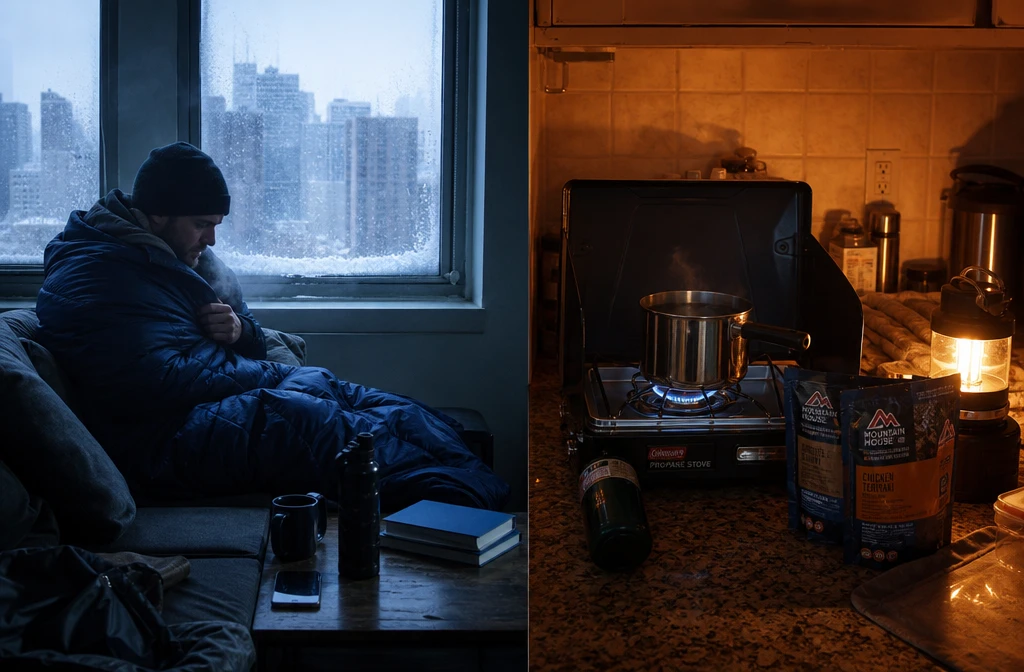
- Butane camp stove — the safest indoor option; butane burns cleaner than propane and produces less carbon monoxide; one canister lasts approximately 1–2 hours of cooking
- Alcohol stove — extremely compact, very low carbon monoxide output, good for boiling water and simple meals
- Induction cooktop on battery power — works with a sufficiently large portable power station (1,000Wh or more); no combustion risk at all
What absolutely cannot be used indoors:
- Propane camp stoves (ventilation required)
- Charcoal grills
- Wood-burning anything
- Gasoline-powered generators inside or in attached garages
For a full breakdown of every viable option, the Emergency Cooking Without Power guide covers fuel types, equipment rankings, and meal planning for extended outages.
Meal strategy during an outage: Eat refrigerated food first (within 4 hours of power loss), then frozen food (within 48 hours if the freezer stays closed), then shelf-stable supplies. This sequencing minimizes waste and keeps your long-term stores intact.
For building a food supply that works in tight apartment spaces, the Ultimate Guide to Apartment Food Storage is worth reading before the next emergency.
Cheap Emergency Supplies for Apartment Dwellers
A functional apartment emergency kit doesn’t require a large budget. The most critical supplies for surviving in an apartment without power, water, or heat can be assembled for under $150 if purchased strategically.
Tier 1 — Under $50 (start here):
- Unscented bleach (water purification) — $4
- Mylar emergency blankets, 4-pack — $10
- Butane camp stove + 8 canisters — $25
- Headlamp with extra batteries — $15
- 7-day water supply (stored in clean 2-liter bottles) — $0 (reuse bottles)
Tier 2 — $50–$150 (add these next):
- Gravity water filter (Sawyer Squeeze or similar) — $30–$45
- Battery-powered or hand-crank NOAA weather radio — $25–$40
- 72-hour emergency food supply (freeze-dried pouches) — $40–$60
- First aid kit — $20–$30
Tier 3 — $150+ (serious preparedness):
- Portable power station (500Wh+) — $200–$500
- 0°F sleeping bag — $60–$150
- Quality water storage containers (5-gallon BPA-free jugs) — $15–$30 each
Common mistake: buying a pre-made “emergency kit” from a big-box store. These kits are often under-supplied for a real multi-day outage and include items that don’t match your specific household needs. Build your own.
Best Portable Battery for an Apartment Emergency Kit
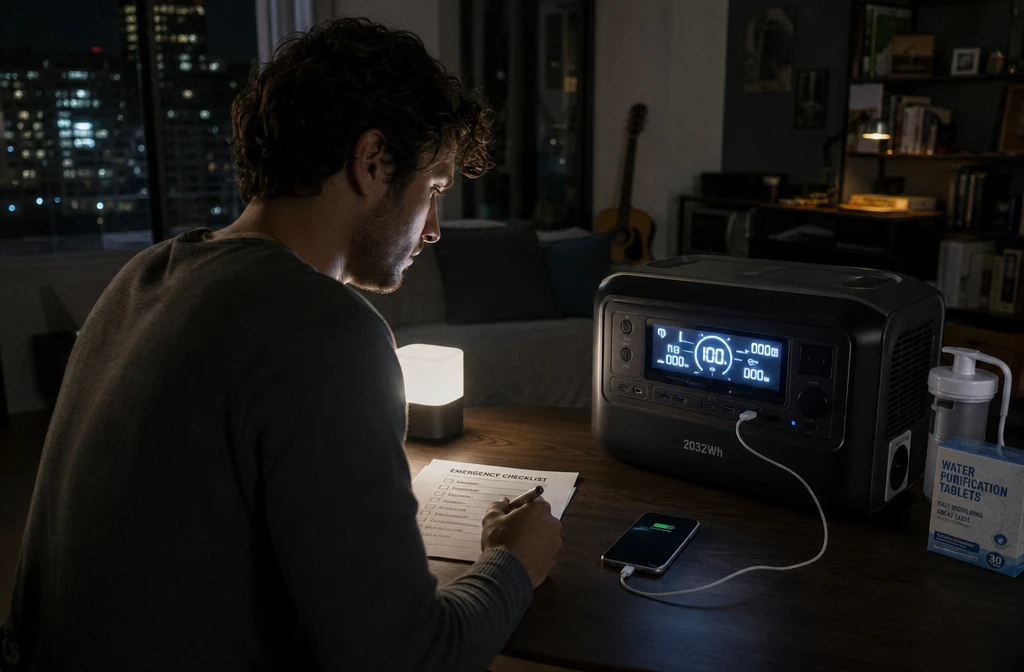
For apartment emergencies, a portable power station in the 500Wh to 1,000Wh range offers the best balance of capacity, portability, and cost. These units can charge phones, power LED lights, run a CPAP machine, and operate a small fan or induction cooktop for limited periods.
What to look for:
- Capacity: 500Wh minimum for a single person; 1,000Wh for two people or anyone with medical equipment needs
- Output ports: Multiple USB-A, USB-C (PD 60W+), and at least one AC outlet
- Recharge options: AC wall charging plus solar input (critical for extended outages)
- Weight: Under 30 lbs for a unit you can carry out if evacuating
Brands with strong track records as of 2026: Jackery, EcoFlow, Bluetti, and Anker SOLIX are the most commonly recommended in the prepper community. EcoFlow’s Delta series and Jackery Explorer models are frequently cited for reliability and recharge speed.
Important note: A portable power station is not a generator replacement. It won’t run an electric stove, a full-size refrigerator, or a central heating unit. Plan accordingly.
For a complete breakdown of backup power options by use case, the Backup Power for Emergencies guide covers everything from power stations to solar setups.
How to Stay Safe Alone During a Power Outage
Staying safe alone in an apartment during a utility failure requires communication planning, situational awareness, and a clear threshold for when to leave. The biggest risk for solo apartment dwellers isn’t the cold or the dark — it’s isolation and delayed decision-making.
Practical steps for solo preparedness:
- Establish a check-in protocol — tell a trusted contact your situation and agree to check in every 12–24 hours. If they don’t hear from you, they call for a welfare check.
- Keep your phone charged — this is where a portable power station earns its keep immediately; a dead phone in an emergency is a serious vulnerability.
- Know your neighbors — during extended outages, community awareness matters. Knowing which neighbors have medical needs or are elderly can save lives.
- Have a printed emergency contact list — phone batteries die; paper doesn’t.
- Set a hard evacuation trigger — don’t wait until you’re too cold to think clearly. Decide in advance: “If the apartment hits 45°F, I leave.”
Carbon monoxide is the silent killer in outages. People bring in propane heaters, grills, or generators and die from CO poisoning before hypothermia becomes an issue. A battery-powered CO detector is a non-negotiable item for any apartment emergency kit.
Apartment Emergency Checklist for Utilities Failure
Surviving in an apartment without power, water, or heat is significantly easier when you’ve worked through a checklist before the emergency happens. Use this as your baseline.
Before the emergency (prep phase):
- Store minimum 14 gallons of water for two people (one week)
- Stock 72-hour minimum food supply (no-cook or minimal-cook options)
- Purchase butane stove and 8+ fuel canisters
- Acquire 0°F sleeping bag and mylar blankets
- Install battery-powered CO and smoke detectors
- Charge portable power station and keep it at 80%+ charge
- Download offline maps and emergency contact list to phone
- Know location of nearest emergency warming center
During the emergency (active phase):
- Assess duration estimate from utility company or local emergency management
- Consolidate to one warm room; seal drafts
- Eat refrigerated food first; document food rotation
- Check in with your designated contact every 12 hours
- Monitor indoor temperature; evacuate if it drops below 45°F
- Conserve phone battery; disable Wi-Fi, Bluetooth, and background apps
The Ultimate Power Outage Preparedness Checklist expands on this with scenario-specific guidance for extended grid failures.
Can You Sue Your Landlord If the Apartment Becomes Uninhabitable?
Yes, in most U.S. states, tenants have legal recourse when a landlord fails to maintain habitable conditions, which explicitly includes functional heat, running water, and electricity in common areas. The specific remedies available — and the timelines that trigger them — vary by state.
Common legal remedies for tenants:
- Rent withholding — many states allow tenants to withhold rent until conditions are restored; specific notice requirements apply
- Repair and deduct — some states allow tenants to hire a repair service and deduct the cost from rent
- Lease termination — a landlord’s failure to provide essential utilities may constitute a material breach of the lease, allowing the tenant to break the lease without penalty
- Relocation reimbursement — in some jurisdictions, landlords must pay for temporary housing if the unit becomes uninhabitable
What counts as uninhabitable: Most state housing codes define uninhabitable conditions to include indoor temperatures below a minimum threshold (commonly 68°F during heating season), loss of running water for more than 24–48 hours, and loss of electricity in essential systems.
What to do: Document everything. Photograph conditions, send written notice to your landlord via email or certified mail, and contact your local housing authority or tenant rights organization. Keep records of every communication.
Important caveat: This is general information, not legal advice. Laws vary significantly by state and municipality. Consult a local tenant rights attorney or legal aid organization for guidance specific to your situation.
Emergency Shelters Near Me for Utility Loss
When your apartment becomes unsafe, local emergency shelters are activated by municipal emergency management agencies, the American Red Cross, and community organizations. Finding them quickly requires knowing where to look before you need them.
How to find emergency warming centers and shelters:
- 211.org — dial 2-1-1 from any phone; this is the national social services hotline and the fastest way to locate local emergency resources
- FEMA’s disaster resources page — fema.gov/disaster; updated in real time during declared emergencies
- Local government website — search “[your city] emergency warming center” or “[your county] emergency shelter”
- NOAA Weather Radio — activated emergency alerts include shelter location announcements
- Red Cross Safe and Well — redcross.org; also lists open shelters during disasters
When to go: Don’t wait for an official “order to evacuate.” If your apartment is below 45°F, you have no water, and no improvement is expected within 24 hours, leaving proactively is the right call. Emergency shelters are designed for exactly this scenario.
For families with pets: Many emergency shelters do not accept animals. Identify pet-friendly shelters or boarding options in advance. The Ultimate Pet Emergency Preparedness Checklist covers this in detail.
FAQ-How to Survive in an Apartment Without Power, Water, or Heat
How much water should I store in my apartment for an emergency?
Store a minimum of one gallon per person per day. For a two-person household planning for one week, that’s 14 gallons. FEMA recommends a 72-hour minimum, but a 7-to-14-day supply is the standard for serious preparedness. Store water in food-grade containers away from direct sunlight and heat sources.
Can I use my gas stove if the power is out?
Most gas stoves can be lit manually with a lighter or match even when the electronic ignition has no power. Turn the burner knob to the lowest gas setting, hold a flame to the burner, then turn up as needed. Do not use the oven for heating — it produces carbon monoxide and is a fire risk.
How do I keep my phone charged during a power outage?
A portable power station is the most reliable solution. Alternatively, a car charger works if you have vehicle access (run the engine in a ventilated area, never in a closed garage). A solar-powered USB charger can work during daylight hours. Conserve battery by enabling airplane mode and reducing screen brightness.
What should I do with medications that require refrigeration?
A well-insulated cooler with ice can maintain safe temperatures (below 46°F / 8°C) for 24–48 hours. Contact your pharmacist during the outage — many medications have longer room-temperature stability windows than labels suggest. For insulin and other critical medications, have a plan before the emergency: know the nearest pharmacy with generator backup.
Is it safe to sleep in a car during an apartment utility failure?
Sleeping in a car with the engine running is extremely dangerous due to carbon monoxide buildup, even with windows cracked. If using a car for warmth, run the engine for short intervals (10–15 minutes) with a window open, then turn it off. Better option: go to a shelter, hotel, or a friend’s home.
How long does food in the freezer stay safe during a power outage?
A full, closed freezer maintains safe temperatures (below 0°F / -18°C) for approximately 48 hours. A half-full freezer lasts about 24 hours. Do not open the freezer door unnecessarily. Once food has thawed and reached above 40°F (4°C) for more than two hours, it should be discarded or cooked immediately.
What’s the minimum I need to spend to be prepared for a week-long apartment outage?
A functional one-week supply kit for one person can be assembled for approximately $75–$100: stored water (free if using clean bottles), a butane stove with fuel ($25), basic food supplies ($30), mylar blankets ($10), and a headlamp ($15). A portable power station adds $200–$500 but is the single most impactful upgrade.
Should I tell my neighbors about my preps?
This is a judgment call. In a short-term emergency (72 hours), coordinating with neighbors — sharing resources, checking on vulnerable residents — is generally positive. For longer-term scenarios, operational security becomes more relevant. Know your neighbors well enough to make that call before an emergency forces the decision.
What if my apartment building has a shared heating system that fails?
Contact your building manager or superintendent immediately and document the contact in writing. In most jurisdictions, landlords are legally required to restore heat within 24 hours during heating season. If they fail to act, contact your local housing authority. Meanwhile, implement your personal warm-room strategy and monitor indoor temperatures.
Can I use hand warmers to stay warm during a cold apartment emergency?
Yes, chemical hand warmers (HeatMax, HotHands) are safe for indoor use and provide useful supplemental warmth. They typically last 8–12 hours. Use them in gloves, pockets, and sleeping bag foot areas. They are not a primary heating solution but are a valuable addition to any apartment emergency kit.
Products, Tools, and Resources Worth Having
These are the items that consistently prove their value in real apartment emergency scenarios — not theoretical ones.
Portable power station: The EcoFlow Delta 2 (1,024Wh) and Jackery Explorer 1000 are the most commonly recommended units in the 2026 prepper community for apartment use. Both recharge via solar and AC, handle CPAP machines, and can run a small induction cooktop for limited cooking. They’re expensive but genuinely versatile.
Butane camp stove: The Iwatani Cassette Feu series is a standout — stable, efficient, and widely available. Butane canisters store longer than propane and burn cleaner indoors (with a window cracked for ventilation). Stock at least 8 canisters per person for a week-long outage.
Water filtration: The Sawyer Squeeze filter is compact, inexpensive (~$35), and removes 99.99999% of bacteria and protozoa. For virus removal (important in urban water emergencies), pair it with chemical treatment. The Berkey countertop filter is a more permanent solution for apartment preppers who want a gravity-fed system.
Sleeping bag: A 0°F mummy bag from brands like TETON Sports or Kelty offers legitimate cold protection at under $100. This is one of the most important investments for anyone in a cold-climate apartment.
Battery-powered CO detector: Kidde and First Alert both make reliable battery-only models for under $25. This is non-negotiable if you’re using any combustion heat source indoors.
NOAA hand-crank weather radio: The Midland ER310 is a consistently recommended unit — it receives NOAA alerts, charges via hand crank or solar, and has a USB output for phone charging. Under $50 and genuinely useful.
For anyone building out a complete preparedness system, the Complete Prepping Guide for Beginners and the Ultimate Emergency Supplies List are the two best starting points on Preppers HQ.
Conclusion: Confidence Comes From Preparation, Not Luck
Surviving in an apartment without power, water, or heat is not about luck or improvisation under pressure. It’s about decisions made before the emergency — the water stored, the gear purchased, the warm room identified, the evacuation threshold set in advance.
The apartment presents real constraints: limited space, building rules, shared infrastructure, and no backyard for outdoor cooking. But none of those constraints make preparation impossible. They just make it different from suburban or rural prepping.
Your next steps:
- Audit your current water supply today. If you don’t have at least 14 gallons stored, that’s your first action.
- Pick up a butane stove and 8 canisters this week — this single purchase solves your cooking and water-boiling problem for under $30.
- Identify your warm room and stock it with mylar blankets and a quality sleeping bag.
- Set your bug-out threshold: write down the indoor temperature at which you will leave, and identify where you’ll go.
- Build toward a portable power station — it’s the most versatile emergency investment an apartment dweller can make.
Preparedness isn’t about fear. It’s about the quiet confidence of knowing you’ve already solved the problem before it arrives.