
Hey there! Some links on this page may be affiliate links which means that, if you choose to make a purchase, I may earn a commission at no extra cost to you. I greatly appreciate your support. Read the full disclosure here.
The Ultimate Home Defense Guide for Preppers (2026)
Effective home defense for preppers means building multiple overlapping layers of security — physical barriers, surveillance, deterrents, and response plans — so that your home remains a viable shelter during natural disasters, civil unrest, or prolonged grid failures. No single measure is enough. The goal is to slow, detect, deter, and respond to threats in sequence, buying time and options for your household.
Key Takeaways
- Start with a vulnerability assessment before spending money on gear or upgrades
- Reinforce doors and windows first — they are the most common points of forced entry
- Layered defense (perimeter → exterior → interior → safe room) is more effective than any single measure
- Surveillance and lighting deter most opportunistic threats before they escalate
- Defensive landscaping is low-cost and highly effective when done correctly
- A safe room with supplies, communication tools, and a secondary exit is a non-negotiable prep
- Non-lethal options and firearms both have a role — training determines which is effective
- Long-term home defense includes water, power, and waste management, not just locks and cameras
- Mental preparedness and household drills matter as much as physical fortifications
- Regular reassessment keeps your defenses current as threats and circumstances evolve
Why Home Defense Is the Foundation of Survival Preparedness
Home defense is the backbone of any serious preparedness plan. Everything else — food storage, medical supplies, communications gear — depends on your ability to secure the space where those resources live.
When a crisis hits, your home becomes your operational base. Whether you’re sheltering through a natural disaster, a prolonged power outage, or a period of civil unrest, the assumption that emergency services will arrive quickly is one you cannot afford to make. Response times stretch. Priorities shift. And unprepared households become targets.
This guide is built for survivalists and preppers who want a practical, layered approach to home defense — not a list of expensive gadgets, but a real system that works across different threat scenarios.
How Do You Assess Your Home’s Vulnerabilities?
Before reinforcing anything, you need to know where your home is weak. Most people skip this step and spend money in the wrong places.
Walk your property like a stranger would. Look for what’s easy, what’s hidden, and what’s unmonitored. Then look again at night.
Exterior Vulnerability Assessment
The exterior assessment is about identifying every possible point of unauthorized entry and every condition that makes your home an easy target.
What to examine:
- Entry doors: Are they solid core or hollow? Do they have deadbolts? Are the strike plates secured with 3-inch screws into the stud, or just the door frame?
- Windows: Do they lock securely? Can they be lifted out of the frame? Are ground-floor windows visible from the street or hidden by shrubs?
- Garage doors: Most standard garage doors can be bypassed in under 10 seconds using a wire coat hanger through the top panel. This is a well-documented vulnerability.
- Side gates and fences: Are they lockable? Do they provide concealment for someone working on a window or door?
- Outbuildings and sheds: These often store tools that become burglary tools — ladders, pry bars, bolt cutters.
- Lighting gaps: Walk the perimeter at night. Dark zones around doors, along fence lines, and near outbuildings are invitation zones.
Common mistake: Focusing only on the front door. Side and rear entries are statistically more likely points of forced entry because they offer concealment.
Interior Vulnerability Assessment
The interior assessment identifies where an intruder could move freely once inside, where your household is most exposed, and where your critical resources are stored.
What to examine:
- Interior door quality and lock strength (especially the master bedroom)
- Staircase visibility and choke points
- Location of firearms, medications, and valuables — are they accessible to you but not obvious to an intruder?
- Fire alarm coverage and fire extinguisher placement
- Basement and attic access points — often overlooked
- Visibility lines: can you see the front door from the main sleeping area?
A good interior assessment also identifies where your household would shelter if someone breached the exterior. That answer should not be “we haven’t thought about it.”
Geographic and Environmental Considerations
Your location shapes your threat profile. A home on a rural road faces different risks than a suburban house on a corner lot.
Factors to consider:
- Visibility: High-visibility homes deter opportunistic crime. Isolated homes may need more layered physical deterrents.
- Terrain: Slopes, dense tree cover, and ravines can provide concealment for threats approaching your perimeter.
- Proximity to high-traffic routes: Homes near highways or major roads see higher transient traffic during crisis events.
- Climate: Heavy snow, flooding, and high winds affect which security measures remain functional. Solar cameras, for example, underperform in extended cloud cover.
- Neighbor density: In suburban areas, community awareness is a legitimate security asset. In rural areas, you’re largely on your own.
How Do You Fortify the Exterior of Your Home?
 Exterior fortification is about making forced entry slow, loud, and difficult enough that most threats give up and move on. Speed and silence are what intruders depend on — deny them both.
Doors
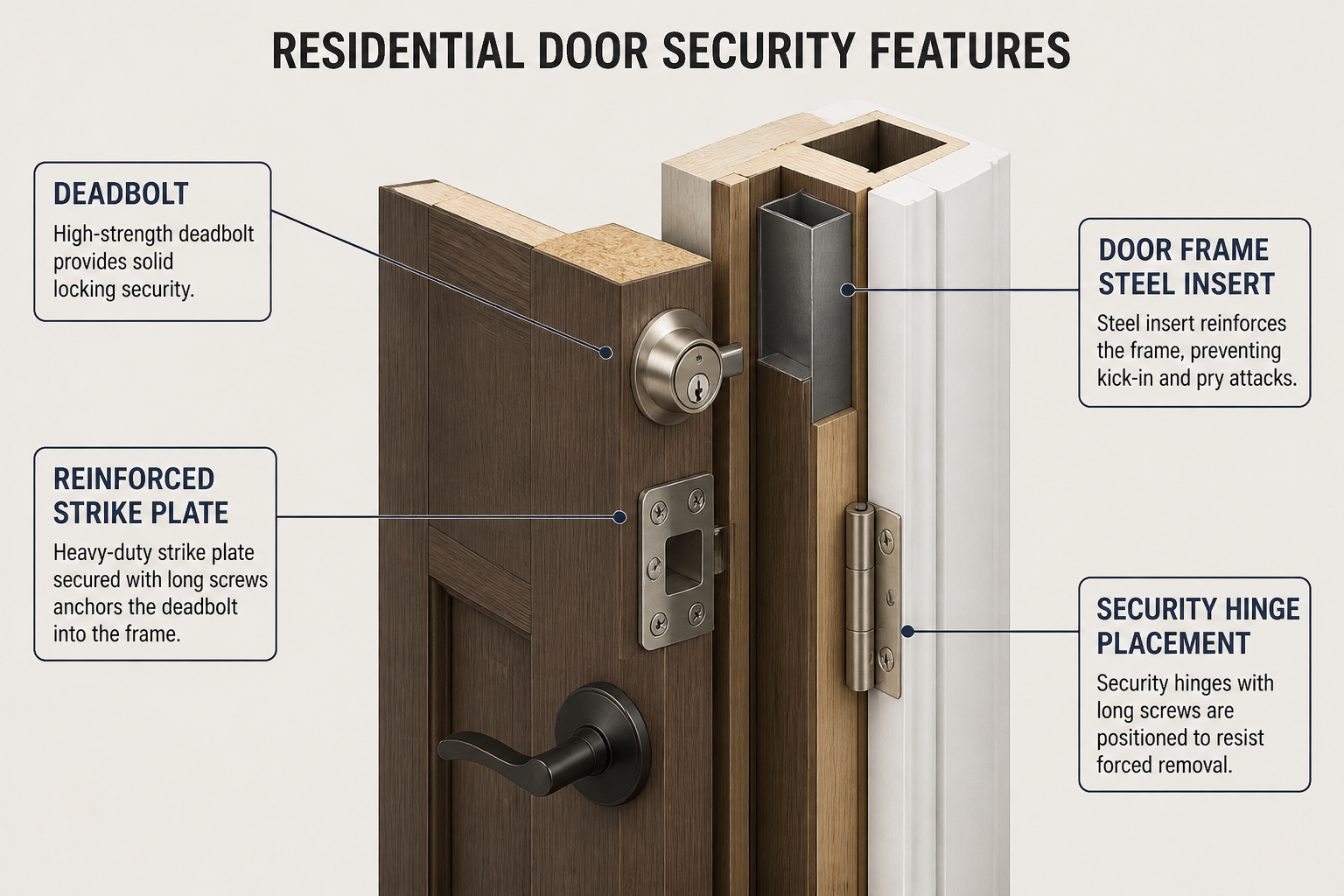
Doors are the most common entry point for forced entry, and most residential doors fail under a single well-placed kick. That’s not a design flaw — it’s a standard that was never built for security.
Upgrades that actually matter:
- Solid core doors on all exterior entries (hollow-core doors offer almost no resistance)
- Grade 1 deadbolts (ANSI Grade 1 is the highest residential rating) with a minimum 1-inch throw
- Reinforced strike plates secured with 3-inch screws that reach the wall stud, not just the door frame
- Door frame reinforcement kits (steel channel inserts that wrap the frame) — these prevent the frame from splitting under impact
- Security hinges with non-removable pins on exterior doors that open outward
- Door barricade bars for nighttime security — these brace against the floor and resist enormous force
For sliding glass doors, a cut-down wooden dowel or metal security bar in the track prevents the door from being forced open or lifted out. A secondary pin lock through the frame adds another layer.
Windows
Windows are the second most common entry point and the most overlooked in home defense planning.
Effective window security measures:
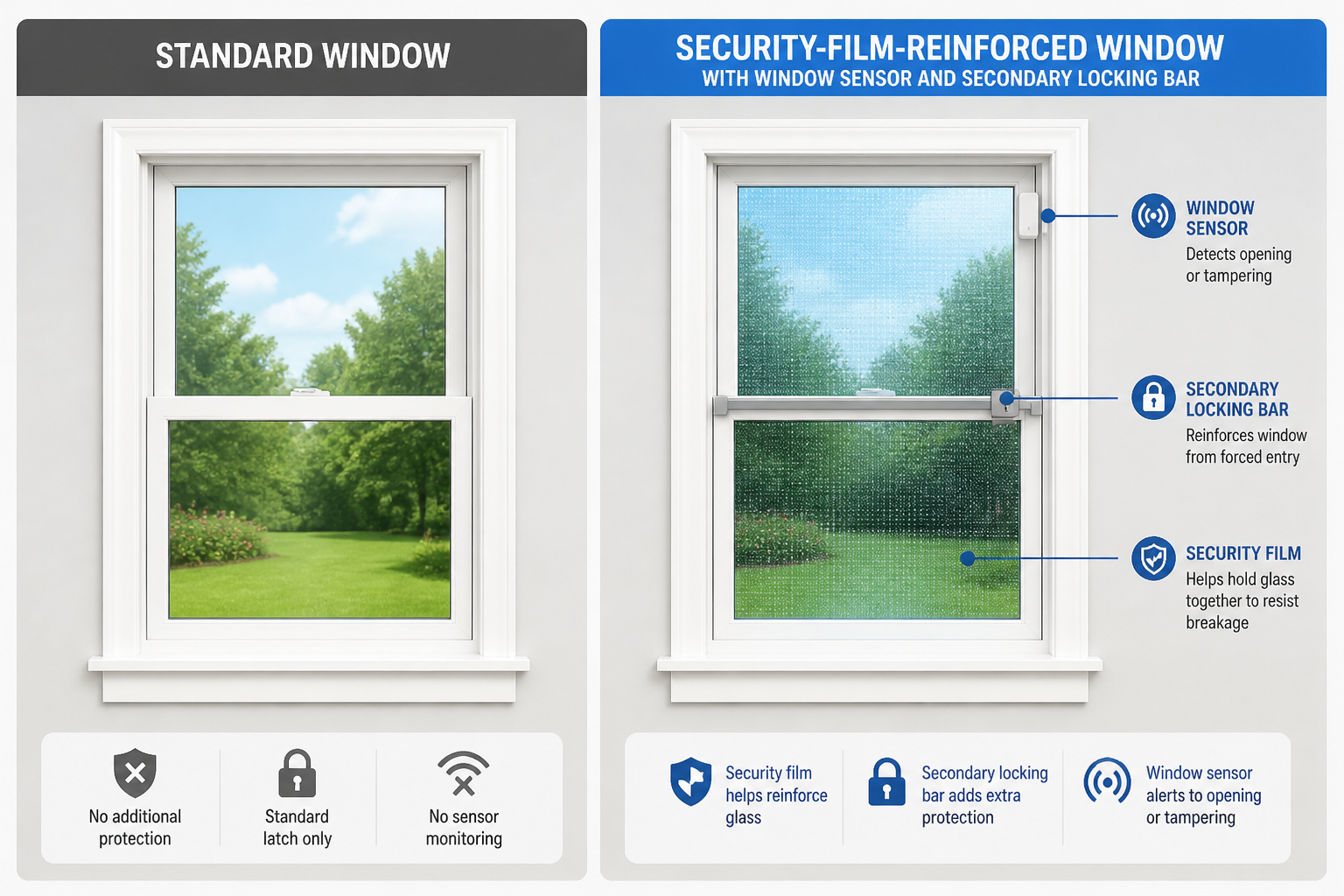
- Window security film (3M Safety Series or equivalent) — doesn’t prevent breaking, but holds glass together and significantly slows entry
- Window locks and secondary pins — most factory latches fail under lateral pressure
- Window sensors tied to an alarm system — the noise alone deters most intruders
- Window bars or grilles on basement and ground-floor windows in high-risk areas — ensure at least one window per room is an emergency egress point
- Frosted or reflective film on windows that reveal interior layout or valuable equipment
Decision rule: If a window is hidden from street view and within 6 feet of the ground, treat it as a primary vulnerability and address it first.
Garage and Outbuildings
The garage is often the weakest link in an otherwise reasonably secured home.
- Disable the emergency release cord or replace it with a zip-tie-style lock that prevents the wire-hanger bypass
- Install a deadbolt on the interior door connecting the garage to the living space — this door is frequently hollow-core and unlocked
- Secure outbuildings with hardened padlocks (shrouded shackle, boron steel) on hasps that are bolted through the door, not just screwed
- Chain or cable-lock ladders, generators, and fuel cans inside outbuildings — these are high-value targets during crises
Fencing and Gates
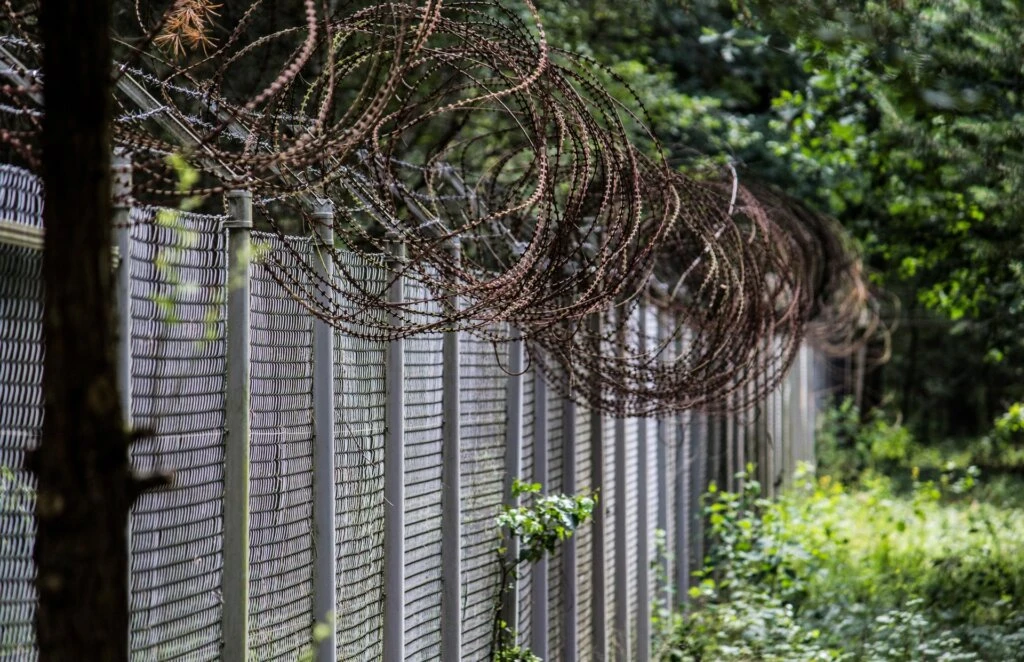
Fencing creates a perimeter boundary and forces any intruder to make a visible, deliberate choice to enter your property. That psychological and physical barrier matters.
- A fence height of 6 feet is the practical minimum for deterrence
- Add trellis toppers, angled extensions, or anti-climb paint on fence tops for higher-risk properties
- Gates should have padlocks with shrouded shackles and be hinged so they cannot be lifted off
- Avoid solid privacy fencing along the front of the property — it conceals intruder activity from neighbors and passersby
How Do You Strengthen Interior Defenses?
 Once an intruder bypasses the exterior, your interior layout determines how much time you have and what options you retain. Good interior defense is about controlling movement and maintaining a defensible position.
Creating a Safe Room
A safe room is a designated space where household members shelter when an exterior breach occurs. It doesn’t need to be a vault — it needs to be defensible, stocked, and connected to the outside world.
Safe room requirements:
- Solid-core door with a deadbolt or barricade bar
- Communication tools: charged cell phone, battery-powered radio, or two-way radio
- Basic supplies: water, flashlight, first aid kit, and any medications
- A secondary exit or window that allows escape if the room itself is threatened
- A means of defense appropriate to the household’s training and legal situation
The master bedroom is the most common safe room choice because it’s where the household is most vulnerable at night and where most people already keep personal defense tools.
Interior Barriers and Choke Points
Interior barriers slow movement through the home and channel threats into predictable paths where they can be more easily managed.
- Reinforce interior bedroom doors with deadbolts or barricade bars
- Identify natural choke points — hallways, stairwells — and understand how to use them defensively
- Remove or secure items that could be used as improvised weapons against you (tools, sporting equipment stored near entry points)
- Consider door alarms on interior doors as an early warning system if the exterior is breached
Securing Storage Areas
 Your food stores, medical supplies, and equipment represent months or years of preparation. Protecting them from theft — by outsiders or, in prolonged crises, by desperate acquaintances — is a real consideration.
- Install a keyed deadbolt on any room used for primary storage
- Use a heavy-duty storage cabinet or gun safe for the most critical supplies
- Avoid advertising your preparedness — discretion is a security measure
- Rotate and audit stored supplies regularly so you know exactly what you have
For more on building a comprehensive food storage system worth protecting, see this guide to long-term food storage.
Escape Routes and Hidden Exits
A home defense plan that has no exit strategy is a trap. Every household member should know at least two ways out of every room.
Escape route planning:
- Map primary and secondary exits for every room, including upper floors
- Keep escape ladder kits (like the Kidde KL-2S) near upper-floor windows
- Establish a family rally point outside the home — a specific location everyone knows
- Practice the routes, especially with children, at least twice a year
- Ensure exits are not blocked by furniture, stored goods, or debris
If bugging out becomes necessary, your escape routes connect directly to your evacuation plan. These two plans should be developed together.
What Perimeter Defense and Deterrence Systems Work Best?
 Deterrence is the most cost-effective form of home defense. If a threat never engages, you’ve won without a confrontation.
Surveillance Systems
Modern home surveillance has become genuinely accessible. A well-placed camera system serves two purposes: it deters threats before they act, and it documents what happens if they do.
What to look for in a home surveillance setup:
- Cameras with 1080p resolution minimum (4K for areas requiring detail at distance)
- Night vision or infrared capability
- Local storage (NVR or SD card) in addition to cloud backup — during grid failures, cloud access disappears
- Wide-angle lenses (110° or wider) for coverage at entry points
- Weatherproofing rated for your climate (IP65 or higher)
- Visible placement at entry points as a deterrent, with additional covert cameras covering the same zones
Recommended coverage zones: Front door, rear door, garage, driveway, and any blind spots along the perimeter fence line.
For grid-down scenarios, battery-powered or solar cameras with local storage are essential. A system that depends entirely on internet connectivity fails exactly when you need it most. The EMP and grid failure survival guide covers how to maintain electronic systems when the grid goes down.
Lighting
Motion-activated lighting is one of the highest-return investments in home security. Intruders depend on darkness. Removing it changes the risk calculation immediately.
Lighting placement priorities:
- All exterior entry doors
- Garage and driveway
- Side passages and fence gates
- Any dark zones identified during your nighttime perimeter walk
Use LED fixtures with 1000+ lumens at entry points. Solar-powered motion lights work well for perimeter zones where running wiring is impractical. Hardwired lights with battery backup maintain function during power outages.
Tip: Combine motion lighting with a visible camera. The light activates the camera’s recording, and both together signal that the property is monitored.
Alarms and Sensors
An alarm system doesn’t stop a threat — it announces one and creates urgency. That urgency is valuable.
Effective alarm components:
- Door and window contact sensors on all ground-floor entry points
- Glass break sensors in rooms with large windows
- Motion sensors covering interior entry paths
- A monitored system with cellular backup (not just landline or Wi-Fi dependent)
- Loud local siren — the noise itself deters many intruders and alerts neighbors
For off-grid or backup scenarios, standalone battery-powered door alarms and portable travel alarms serve as a secondary layer when the primary system is unavailable.
Dogs and Guard Animals
A dog is one of the most effective and most underrated home security tools available. Not because a dog will fight an intruder — though some will — but because a dog detects threats before any electronic system does and announces them loudly.
Medium to large breeds with territorial instincts (German Shepherds, Belgian Malinois, Dobermans, Rottweilers) provide the strongest deterrent. Even smaller, vocal dogs serve as reliable early warning systems.
A dog that barks at an unfamiliar presence at 2 a.m. is worth more than most alarm systems in terms of practical early warning. The combination of a dog, motion lighting, and a camera system covers almost every approach scenario.
What Is Defensive Landscaping and How Does It Work?
 Defensive landscaping uses your property’s natural features and plantings to create barriers, eliminate concealment, and channel movement in ways that favor the defender. It’s low-cost, low-maintenance, and completely invisible as a security measure to casual observers.
Strategic Planting
The goal is to deny concealment near entry points while creating natural barriers at the perimeter.
Plants that work as defensive barriers:
- Hawthorn, Pyracantha (Firethorn), Osage Orange, and Holly — dense, thorny shrubs that form impenetrable hedgerows when mature. These are genuinely painful to push through and leave clothing and skin evidence.
- Berberis (Barberry) — lower-growing thorny shrub, effective under windows to prevent approach
- Climbing roses on fences or trellises — beautiful, functional, and brutal to climb over
What to remove or trim:
- Large shrubs directly against the house that provide concealment at ground level
- Tree branches that overhang the roofline or reach second-floor windows
- Dense plantings that block sightlines from the street or neighboring properties
Paths and Entrances
Gravel paths and driveways serve a dual security function: they’re difficult to walk quietly on, and they channel foot traffic into predictable routes where sensors and cameras can cover them efficiently.
- Use pea gravel or crushed stone on paths leading to secondary entrances
- Avoid soft ground cover (bark mulch, grass) along fence lines — it allows silent approach
- Design your entrance path so that visitors are visible from inside the home before they reach the door
How Should Preppers Store and Access Self-Defense Tools?
 Self-defense tools are only useful if they’re accessible when needed and secure when not. These two requirements create a real tension that every prepper has to resolve deliberately.
Secure Gun Storage
Firearms are the most effective home defense tool for many preppers — and the most dangerous if improperly stored. Both things are true simultaneously.
Storage principles:
- Quick-access biometric or keypad safes (like the Hornady RAPiD Safe or Fort Knox PB1) for bedside firearms — these open in under 3 seconds with a practiced hand
- Full-size gun safes (750+ lbs, bolted to the floor or wall) for the primary collection
- Trigger locks as a secondary measure on stored firearms not in quick-access safes
- Ammunition stored separately from unsecured firearms
Legal note: Storage requirements vary by jurisdiction. Know your local laws regarding safe storage, especially in households with children.
Non-Lethal Options
Non-lethal tools fill important gaps in a home defense plan — particularly for household members who are not trained with firearms, or in situations where lethal force is not legally or ethically appropriate.
Effective non-lethal options:
- Pepper spray (OC spray): Look for formulations with 1–2% Major Capsaicinoids (MC), not just SHU ratings. Sabre Red and POM are well-regarded options.
- Tactical flashlights: A 1000+ lumen flashlight is disorienting at close range and serves as a striking tool. Surefire and Streamlight are the benchmark brands.
- Personal alarms: 120+ dB personal alarms create immediate attention and disorientation
- Stun guns and tasers: Effective at close range; check local legality before purchasing
- Baseball bat or solid walking stick: Simple, legal everywhere, requires no maintenance
Self-Defense Training
Tools without training are liabilities. This is not a philosophical point — it’s a practical one. An untrained person with a firearm in a high-stress situation is a danger to themselves and their household.
Training priorities:
- Firearms: take a basic handgun safety course, then a home defense-specific course (look for NRA Home Defense or similar structured curriculum)
- Situational awareness: understanding how threats develop before they become confrontations
- Basic hand-to-hand: even a single course in Krav Maga or similar reality-based self-defense changes how you process physical threat scenarios
- First aid: knowing how to treat injuries after a defensive encounter is as important as the encounter itself
For a broader look at the skills that support home defense, the 14 essential survival skills every prepper must know is a strong companion resource.
How Do You Plan for Long-Term Home Defense?
 Short-term home defense handles the first 72 hours of a crisis. Long-term home defense handles weeks or months of sustained disruption — grid failure, supply chain collapse, or prolonged civil instability.
Stockpiling Critical Resources
A fortified home with no food or water becomes untenable within days. Long-term defense means sustaining your household inside the perimeter indefinitely.
Minimum stockpile targets:
- Water: 1 gallon per person per day, minimum 30-day supply (more is better)
- Food: 90-day supply of calorie-dense, shelf-stable foods
- Medical supplies: prescription medications (30–90 day buffer where possible), trauma kit, antibiotics if accessible
- Hygiene and sanitation supplies
The ultimate survival pantry list and emergency water storage guide cover the specifics of building these reserves.
Alternative Power Sources
Power outages disable most modern security systems, communications, and medical equipment. Backup power is not optional for serious home defense planning.
Power backup options by scale:
| Option | Best For | Estimated Cost | Runtime |
|---|---|---|---|
| Battery power station (e.g., Jackery 2000) | Small electronics, lighting, communications | $1,500–$2,500 | Hours to days |
| Portable generator (dual-fuel) | Larger loads, refrigeration | $500–$1,500 | Days (with fuel) |
| Solar panel array + battery bank | Long-term off-grid power | $3,000–$10,000+ | Indefinite with sun |
| Whole-home standby generator | Full household loads | $5,000–$15,000 installed | Days to weeks (with fuel) |
For most preppers, a portable battery station combined with a small solar array provides the best balance of cost, capability, and reliability.
Water Collection and Filtration
 Municipal water fails during extended grid outages, infrastructure damage, and contamination events. Your water supply must be independent.
Layered water strategy:
- Stored water (barrels, WaterBOB bathtub bladders, commercial water storage containers)
- Rainwater collection (check local regulations — some jurisdictions restrict this)
- Gravity filtration (Berkey, Sawyer, or similar) for treating collected or sourced water
- Chemical treatment (water purification tablets) as a backup
Waste Management
This is the least discussed and most practically important long-term survival consideration. Without functioning sewage, disease risk escalates rapidly.
- Composting toilet or portable toilet with waste bags for short-term use
- Outdoor latrine construction knowledge for extended scenarios
- Waste disposal well away from water sources and the home perimeter
How Do Mental Preparedness and Household Drills Factor In?
Physical fortifications are only as effective as the people operating within them. Mental preparedness — the ability to think clearly, make decisions, and execute plans under stress — is the variable that determines whether your preparations actually work.
Developing a Household Defense Plan
Every household member who is old enough to understand should know the plan. Vague intentions are not plans.
A complete household defense plan includes:
- Defined roles for each household member during different threat scenarios
- A clear decision tree: shelter in place vs. evacuate, and what triggers each decision
- Communication protocols (what to do if household members are separated)
- A rally point outside the home and a secondary rally point further away
- Practiced escape routes from every room
Run drills. Not elaborate, military-style exercises — just walk-throughs that make the plan muscle memory. Do it at night. Do it when household members are tired. That’s when it matters.
Psychological Resilience Under Stress
Stress degrades decision-making. People freeze, overreact, or default to denial. Preparation reduces this by making responses automatic rather than deliberate.
Practices that build psychological resilience:
- Scenario planning: think through “what if” situations before they happen
- Controlled stress exposure: physical training, cold exposure, sleep deprivation training
- After-action reviews: when something goes wrong in a drill or real event, analyze it without blame and adjust the plan
- Community connection: isolated households are more psychologically vulnerable during prolonged crises
Regular Maintenance and Adaptability
A home defense plan written once and never revisited becomes outdated. Threats evolve. Household composition changes. Equipment degrades.
Quarterly review checklist:
- Test all alarm systems and replace batteries
- Check camera angles and recording function
- Inspect door and window hardware for wear
- Audit food and water stores for expiration and quantity
- Review and update the household defense plan
- Assess any new threats or changed circumstances in your area
Comparison: Layered Home Defense by Threat Scenario
| Threat Type | Primary Defense Layer | Secondary Layer | Critical Prep |
|---|---|---|---|
| Burglary (opportunistic) | Lighting, locks, visible cameras | Alarm system, dog | Reinforced doors/windows |
| Civil unrest / looting | Perimeter fencing, exterior fortification | Interior barriers, safe room | Discretion, community network |
| Natural disaster | Structural reinforcement, safe room | Backup power, water stores | Evacuation plan |
| Prolonged grid failure | Alternative power, water independence | Full supply stockpile | EMP-hardened communications |
| Home invasion | Alarm, dog, interior choke points | Safe room, defense tools | Training, practiced plan |
Conclusion: Home Defense Is a System, Not a Product
Effective home defense isn’t a single purchase or a single upgrade. It’s a system — layered, maintained, and adapted over time. The perimeter slows the threat. The exterior fortifications stop most of what gets through. The interior defenses protect the household if something breaches the exterior. The safe room provides a last line of protection. And the household plan determines whether all of it actually works when it matters.
Start with the assessment. Fix the obvious weaknesses first. Build outward from there. And revisit the plan regularly, because the goal isn’t to build a perfect fortress — it’s to be consistently more prepared than you were last year.
For preppers building a complete preparedness lifestyle, home defense connects directly to bug-out planning, disaster preparedness, and long-term self-reliance. None of these exist in isolation.
Frequently Asked Questions
Where do I start if I’ve never thought about home defense before?
Start with a vulnerability walk-through of your property — exterior first, then interior. Identify the three weakest points. Fix those before buying anything else. Most homes have at least one door with a weak strike plate, at least one unlit entry, and at least one window with a failed latch. Those three fixes cost under $100 and make a measurable difference.
How much does a solid home defense setup cost?
A functional layered system — reinforced doors, window security film, motion lighting, a basic camera system, and a door/window alarm — can be built for $500–$1,500 depending on home size. A comprehensive setup with a monitored alarm, quality surveillance, backup power, and a stocked safe room runs $5,000–$15,000 or more. Most preppers build incrementally over 12–24 months.
Is a safe room really necessary?
Yes, for households with children, elderly members, or anyone who cannot physically confront a threat. A safe room doesn’t need to be purpose-built — a reinforced bedroom with a barricade bar, a phone, and a plan is sufficient for most situations.
What’s the single most effective home defense upgrade?
Reinforcing the door frame and strike plate. Most forced entries exploit the weakness between the deadbolt bolt and the door frame, not the lock itself. A $30 strike plate with 3-inch screws and a $50 door frame reinforcement kit eliminate the most common forced-entry method.
Should every prepper own a firearm for home defense?
Not necessarily. Firearms are highly effective but require consistent training, safe storage, and a clear legal and ethical framework for use. A prepper who is untrained, lives with young children, or is not psychologically prepared to use lethal force may be better served by non-lethal options combined with strong physical barriers and early detection systems.
How do I defend my home during a power outage?
Battery-powered alarms, motion-activated solar lights, a dog, and physical barriers (barricade bars, reinforced doors) all function without grid power. A battery power station keeps communications and a camera system running for 24–72 hours. Longer outages require solar charging capability.
What’s the biggest mistake preppers make with home defense?
Overinvesting in offensive capability (firearms, ammunition) while underinvesting in detection and deterrence. Most threats are deterred before they become confrontations. Lights, cameras, and a barking dog stop more intrusions than any firearm.
How do I secure my home without making it look like a fortress?
Defensive landscaping, standard-looking reinforced doors, and discreetly placed cameras maintain normal curb appeal while providing real security. Avoid visible signs of heavy armament or extreme fortification — these can attract attention rather than deter it.
What should children know about the household defense plan?
Age-appropriate versions of the plan: where to go, how to get out, where to meet outside. Children should know the safe room location, their escape route, and the rally point. Practice it as a calm, matter-of-fact exercise — not a fear-based drill.
How does home defense change in a rural vs. urban setting?
Rural homes rely more on perimeter detection (longer approaches, more concealment) and self-sufficiency (response times are longer). Urban homes benefit from neighbor density and faster emergency response but face higher foot traffic and more concealment options for intruders near the structure. The layering principle applies in both cases — the specific tools and priorities shift.
Can renters implement meaningful home defense measures?
Yes. Portable door barricade bars, window security film, door and window alarms, motion-activated lights (plug-in or battery), and a dog (where allowed) are all renter-friendly. None require permanent modifications. Discuss strike plate reinforcement with your landlord — many will agree when it’s framed as a security improvement.
How often should I update my home defense plan?
Review it quarterly and update it whenever something significant changes: a new household member, a move, a change in local threat environment, or a piece of equipment that fails or is upgraded. An annual full review with a walk-through drill is the minimum standard.
Products, Tools, and Resources
These are tools that experienced preppers actually use — not a curated affiliate list, but a practical reference based on what works in real home defense scenarios.
Door and Window Security
- Armor Concepts Door Armor MAX— a complete door frame reinforcement kit that addresses the most common forced-entry vulnerability. Straightforward installation, significant impact resistance improvement.
- 3M Safety Series Window Film — holds glass together after impact, slowing entry and reducing injury risk from shattered glass. Available in various tint levels.
- Master Lock Door Security Bar — adjustable barricade bar for inward-opening doors. No installation required, works on carpet and hard floors.
Surveillance and Detection
- Reolink RLK8-800B4 — a wired NVR camera system with local storage, 4K resolution, and no subscription fees. Reliable for preppers who want a system that works without internet dependency.
- Ring Alarm Pro (with Eero backup) — a monitored alarm system with cellular backup and local processing. Works during internet outages.
- Blink Outdoor 4 — battery-powered cameras for locations where wiring is impractical. Local USB storage available with the Sync Module 2.
Lighting
- LEONLITE Motion Sensor Flood Light — hardwired, 2500 lumens, adjustable detection range. Reliable in cold climates.
- Aootek Solar Motion Sensor Light — for perimeter zones without wiring access. Adequate for most deterrence applications.
Safe Room and Interior Defense
- Kidde KL-2S Two-Story Escape Ladder — compact, rated for 1,000 lbs, attaches to standard window sills. Keep one per upper-floor bedroom.
- Hornady RAPiD Safe 2700KP — quick-access biometric safe for bedside firearms. RFID, keypad, and biometric access modes.
Non-Lethal Defense
- Sabre Red Crossfire Pepper Gel — gel formula reduces blowback risk indoors, 1.33% MC concentration, 10-foot range.
- Streamlight ProTac HL-X — 1,000-lumen tactical flashlight, runs on CR123 or AA batteries, impact-resistant.
Power and Communications
- Jackery Explorer 2000 Pro — portable power station for running cameras, communications, and lighting during outages. Pairs well with Jackery’s 200W solar panels.
- Baofeng UV-5R — entry-level dual-band radio for local communications when cellular networks are congested or down. Requires a Technician-class ham license for transmission on licensed frequencies.
Training Resources
- NRA Home Defense Fundamentals — structured curriculum covering firearm safety, storage, and defensive use in the home environment
- FEMA IS-907 (Active Threat Training) — free online course covering threat recognition and response decision-making
- Stop the Bleed — free online and in-person training on hemorrhage control, directly applicable to post-incident care
For more on building a complete preparedness system, explore the ultimate emergency preparedness guide and the preparedness lifestyle guide at PrepperHQ.