

Hey there! Some links on this page may be affiliate links which means that, if you choose to make a purchase, I may earn a commission at no extra cost to you. I greatly appreciate your support. Read the full disclosure here.
More than 44 million Americans live in rental apartments, and the vast majority of them have zero emergency supplies on hand. Not because they don’t care about being prepared — but because they assume prepping requires a basement, a garage, and a rural property with room to spare.
Survival prepping in small spaces is entirely doable with smart organization and multi-use gear. This guide shows how to build a practical, compact emergency kit that fits tight urban apartments without sacrificing readiness. With focused storage, budget-friendly choices, and essential skills, even a 400-square-foot studio can be well-prepared for emergencies
.Whether you’re in a 400-square-foot studio, a shared one-bedroom, or a compact urban condo, you can build a serious preparedness system that covers food, water, gear, and evacuation planning. Space is a constraint, not a dealbreaker.
Key Takeaways
- Urban survival prepping means adapting core preparedness principles to limited square footage and city-specific threats
- You can store 30+ days of food and water in under 20 square feet of space using smart storage methods
- Multi-use gear is the cornerstone of small-space prepping — every item should serve at least two purposes
- A well-packed bug-out bag doubles as your emergency kit and requires zero dedicated storage space
- The biggest mistake small-space preppers make is buying bulk supplies without a storage plan first
- Skills matter more than stuff — knowledge, fitness, and planning take up zero square footage
- Prepping for one person in a small apartment costs far less than most people expect, often under $300 to build a solid 30-day foundation
- Concealment and organization are just as important as the supplies themselves
Find this useful? Add us as a preferred source on Google and more of what we publish will show up in your results.
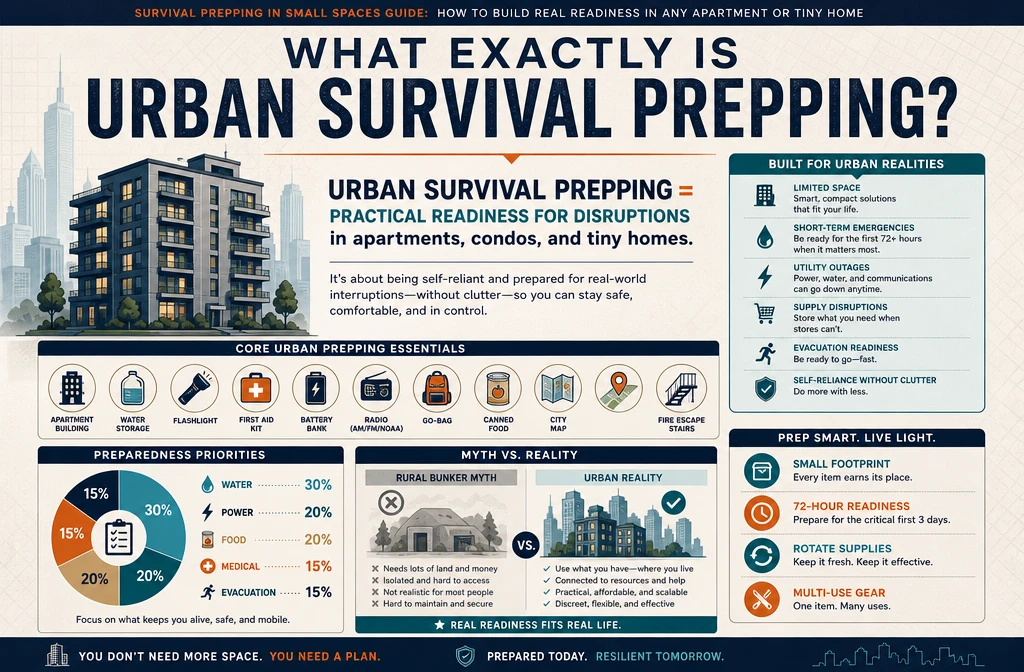
What Exactly Is Urban Survival Prepping?
Urban survival prepping is the practice of building emergency readiness specifically for city and suburban environments, where living spaces are smaller, supply chains are more fragile, and evacuation routes are more congested. It’s the same core mission as traditional prepping — protect yourself and the people you care about when systems fail — but adapted for the realities of apartment living.
Traditional prepping advice often assumes you have land, a vehicle, and a root cellar. Urban prepping flips that script. The threats are different (power grid failures, civil unrest, water main breaks, building lockdowns), the storage is tighter, and the community dynamics are more complex. But the fundamentals — food, water, shelter, security, and a plan — remain identical.
For a deeper foundation on this topic, the Ultimate Urban Survival Guide for Preppers covers city-specific threats and response strategies in detail.
How Much Space Do You Really Need to Start Prepping?
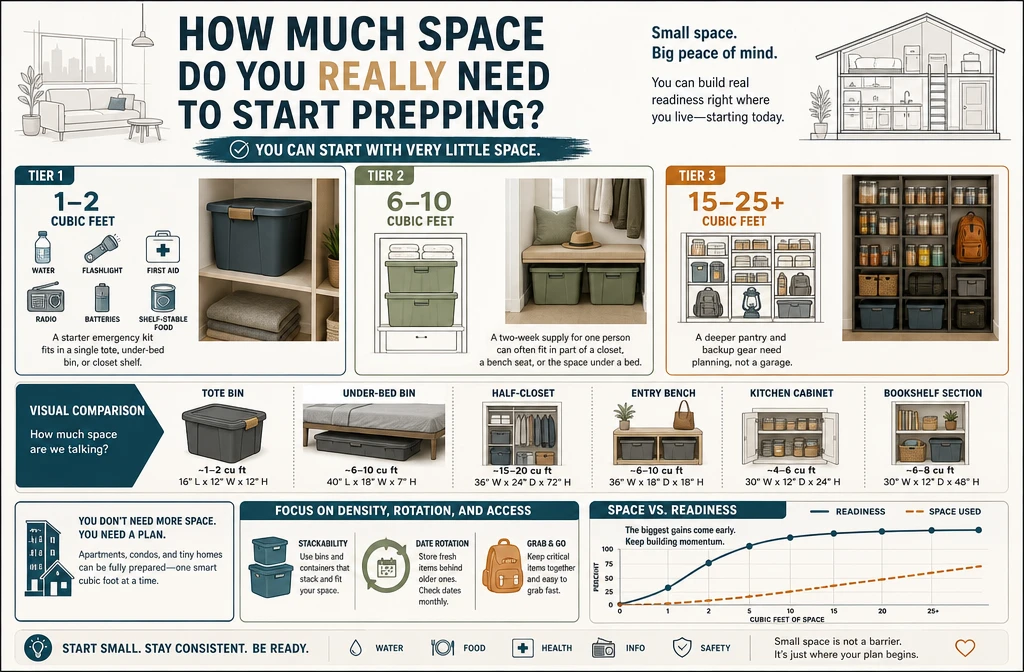
You need less space than you think. A dedicated 15 to 20 square feet — the equivalent of one large closet shelf, the area under a queen bed, and one kitchen cabinet — is enough to store a meaningful 30-day emergency supply for one person.
Here’s a realistic space breakdown:
| Storage Zone | What It Holds | Approx. Space Used |
|---|---|---|
| Under-bed (standard queen) | Water pouches, canned food, clothing | ~20 sq ft |
| One closet shelf | Bug-out bag, first aid, documents | ~6 sq ft |
| Kitchen cabinet (1 shelf) | Dry goods, freeze-dried meals, utensils | ~4 sq ft |
| Nightstand drawer | Flashlight, multi-tool, cash, phone charger | ~1 sq ft |
The key is thinking vertically and using containers that fit the geometry of your space. Flat, stackable bins slide under beds. Vacuum-sealed bags compress clothing and blankets to a fraction of their normal size. Rigid plastic totes stack cleanly in closets.
Choose this approach if: you’re starting from zero and feel overwhelmed. Focus on the under-bed zone first — it’s the highest-yield, lowest-disruption storage location in any small apartment.
Is Prepping Worth It If You Live in a 400 Sq Ft Apartment?
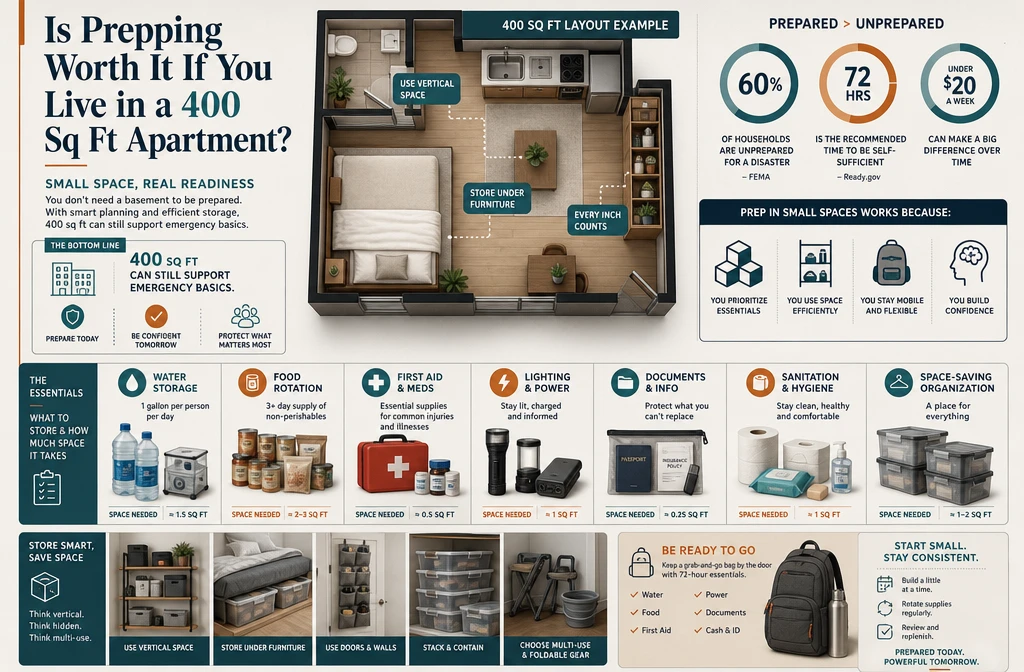
Yes, absolutely — and in many ways, a small apartment forces better prepping habits than a large home does. When space is limited, you can’t afford to stockpile junk. Every item has to earn its place, which means small-space preppers tend to build leaner, more functional kits.
A 400-square-foot apartment can realistically hold:
- 30 days of food for one person (roughly 2 cubic feet of space)
- 14 gallons of water (about 3 gallons per person per week, stored flat under a bed)
- A complete bug-out bag ready to grab in under 60 seconds
- A basic first aid and medical kit
- Emergency lighting, communication, and power backup tools
The Ultimate Guide to Prepping in a Small Apartment goes deeper on layout-specific strategies for studio and one-bedroom setups.
How Do Preppers Store Food in Tiny Homes?
Smart small-space food storage is about density, rotation, and format. The goal is maximum calories per cubic inch, using foods that store long, cook easily, and don’t require refrigeration.
The three best food formats for small spaces:
- Freeze-dried meals — lightweight, 25-year shelf life, compact pouches that stack flat. The Ultimate Prepper’s Guide to Freeze-Dried Food breaks down the best brands and how to build a real rotation system.
- Mylar-sealed dry goods — rice, lentils, oats, and pasta sealed in 1-gallon mylar bags with oxygen absorbers. These store flat, stack easily, and cost very little per calorie.
- Canned goods — heavier but versatile. Store under beds in flat rolling bins or inside ottomans with removable lids.
What to avoid in small spaces: bulk #10 cans (too tall to stack efficiently), large water barrels (impractical in apartments), and anything that requires cooking equipment you don’t own.
For a complete food list with quantities, the Ultimate Survival Pantry List is a practical starting point. Also check the Ultimate Guide to Apartment Food Storage for apartment-specific storage methods that keep supplies hidden and organized.
A useful rule of thumb: One week of food for one person fits in a single large backpack. Scale from there.
Best Survival Gear for Tiny Apartments
The best survival gear for small spaces is multi-use, compact, and immediately accessible. Avoid single-purpose tools that take up real estate without adding proportional value.
Top multi-use picks for compact living:
- Leatherman Wave+ or similar multi-tool — replaces a dozen single-purpose tools in one pocket-sized unit
- LifeStraw or Sawyer Squeeze water filter — eliminates the need to store as much water by enabling purification from any source
- Hand-crank/solar emergency radio (like the Midland ER310) — weather alerts, AM/FM, USB charging, and flashlight in one device
- Portable power bank (20,000+ mAh) — keeps phones, radios, and lights running without grid power
- Compact first aid kit — look for kits that include a tourniquet, Israeli bandage, and QuikClot rather than just bandages
- Mylar emergency blankets — fold to the size of a deck of cards, serve as shelter, signaling, and warmth
- Headlamp with red-light mode — hands-free lighting that fits in a jacket pocket
For a ranked, priority-based gear list, the Essential Survival Gear Guide: 50 Items Ranked by Priority is one of the most practical references available.
Choose multi-use gear if: you have under 10 square feet of dedicated storage. Every item that replaces two or three others is a net gain.
Emergency Kits That Fit in a Closet or Under a Bed
A complete emergency kit for one person can fit in a single 30-liter backpack stored in a closet or under a bed. This is your bug-out bag and your shelter-in-place kit combined — the same pack serves both functions depending on the scenario.
Core contents for a compact emergency kit:
- 3-day food supply (freeze-dried pouches or energy bars)
- Water purification (filter straw + 12 water pouches)
- First aid kit with trauma supplies
- Emergency mylar blanket and poncho
- Multi-tool and fixed-blade knife
- Headlamp with extra batteries
- Portable battery bank and charging cables
- Copies of critical documents in a waterproof bag
- $100–$200 in small bills
- Emergency whistle and signal mirror
- N95 masks (minimum 4)
- Local paper map and compass
The Complete Bug Out Bag Guide: Build a Perfect 72-Hour Kit for Under $200 walks through each category with specific product recommendations and cost breakdowns.
Cheapest Ways to Prep When You Live in a Studio
Building a solid prep foundation in a studio apartment doesn’t require a large budget. The most cost-effective approach is to start with the highest-priority categories and add incrementally.
30-day starter prep budget breakdown (estimated for one person, 2026):
| Category | What to Buy | Estimated Cost |
|---|---|---|
| Water | 14 gallons in 1-gallon jugs or pouches | $15–$25 |
| Food | Rice, oats, canned beans, peanut butter | $40–$60 |
| Light/Power | Headlamp + battery bank | $30–$50 |
| First Aid | Basic trauma kit | $25–$40 |
| Communication | Hand-crank radio | $30–$50 |
| Documents | Waterproof bag + USB drive | $10–$15 |
| Total | ~$150–$240 |
Buy at discount grocery stores, warehouse clubs, or online in small quantities. Don’t buy everything at once — add one category per week and you’ll have a functional kit within a month without financial strain.
Common budget mistake: buying expensive gear before covering basics. A $200 tactical flashlight means nothing if you don’t have two weeks of food.
What Survival Supplies Won’t Work in Small Spaces
Some popular prepping supplies are simply impractical for apartment living. Knowing what to skip saves money and prevents clutter.
Skip these in small spaces:
- 55-gallon water barrels — require floor space you don’t have and are nearly impossible to move
- Propane tanks larger than 1 lb — most apartment leases prohibit them, and they’re a fire hazard indoors
- Bulk #10 cans — too tall to stack under beds, awkward to store in cabinets
- Generator (gas-powered) — cannot be used indoors, requires outdoor access and fuel storage
- Chest freezer — obvious space issue, and useless without power
- Large root vegetable storage — requires cool, dark, dry space that most apartments don’t have
Better alternatives:
- Water barrels → collapsible 5-gallon water containers or WaterBOB bathtub bladder
- Propane → butane canister stove (safer, smaller, apartment-friendly)
- Gas generator → portable power station (Jackery, EcoFlow) — silent, indoor-safe, rechargeable
Survival Skills for City Dwellers With Limited Storage
Skills don’t take up any space at all. For urban preppers with limited storage, developing practical survival skills is the highest-return investment available — and it costs nothing but time.
Priority skills for city-based preppers:
- Water purification — knowing how to use a filter, purification tablets, and boiling correctly
- Basic trauma first aid — tourniquet application, wound packing, CPR
- Navigation without GPS — reading paper maps, using a compass, knowing your neighborhood’s grid
- Emergency cooking — using a butane stove, cooking from shelf-stable ingredients
- Situational awareness — recognizing threats before they escalate, knowing exit routes
- Communication — setting up a family check-in plan, using a hand-crank radio for alerts
The 14 Essential Survival Skills Every Prepper Must Know covers these in depth with actionable training methods.
Skills also make your gear more effective. A $15 water filter is useless if you don’t know how to use it correctly. A first aid kit is just a box of supplies without the training to apply them.
Common Mistakes People Make Prepping in Small Spaces
The most damaging small-space prepping mistakes aren’t about what people buy — they’re about how they plan (or fail to plan).
Mistake 1: Buying supplies before mapping storage
Most people buy gear and then realize they have nowhere to put it. Always audit your storage zones first, then buy to fit them.
Mistake 2: Ignoring water
Food gets all the attention, but water is the real constraint. One gallon per person per day is the minimum. Most small-space preppers are dramatically under-stored on water. The Apartment Water Storage Complete Guide solves this specifically for small living situations.
Mistake 3: No rotation system
Stored food expires. Without a first-in, first-out rotation system, you’ll end up with a cache of expired goods when you need them most.
Mistake 4: No evacuation plan
Sheltering in place isn’t always an option. Every small-space prepper needs a bug-out plan — where to go, how to get there, and what to take. The Bug Out Plan Complete Guide covers this from start to finish.
Mistake 5: Telling too many people
This applies especially in dense urban environments. Neighbors who know about your supplies may become a problem in a real emergency. Discretion is a legitimate security strategy.
How to Hide Emergency Supplies in a Small Space
Concealment in a small apartment is about integration — making your supplies look like normal household items or storing them in places that don’t signal “prepper” to visitors.
Practical concealment strategies:
- Ottoman storage — looks like furniture, holds 20+ cans of food or a full emergency kit
- Bed risers — raise your bed frame 6–8 inches, doubling the under-bed storage capacity
- Bookshelf integration — canned goods behind books, water pouches behind decorative boxes
- Vacuum-sealed clothing bags — compress emergency clothing and blankets into flat, inconspicuous shapes
- False bottom in a drawer — works for documents, cash, and small tools
- Suitcase storage — a rolling suitcase in a closet looks normal but can hold a complete 72-hour kit
The goal isn’t paranoia — it’s smart organization that keeps your home functional while maintaining readiness.
Survival Prepping for Single People in Urban Environments
Single urban preppers have a real advantage: every supply, every decision, and every plan is optimized for one person. There’s no negotiating over priorities, no coordinating schedules, and no scaling up quantities.
What changes when you prep solo:
- Water storage drops to 1 gallon per day (vs. multiplying by household size)
- Food quantities are smaller and easier to rotate
- Bug-out bag weight is manageable for one person to carry
- Decision-making in an emergency is faster — no consensus required
What requires extra attention:
- No backup person — if you’re injured or ill, no one else is managing the situation
- Communication plan — designate an out-of-area contact who knows your check-in schedule
- Community connections — knowing at least two neighbors you trust is a genuine force multiplier
For solo preppers just getting started, the Complete Prepping Guide for Beginners provides a clear 30-day framework that works regardless of household size.
Frequently Asked Questions
How long should my emergency supply last in a small apartment?
Start with 72 hours, build to 2 weeks, then aim for 30 days. Most emergencies resolve within 72 hours, but supply chain disruptions and extended power outages can stretch much longer. Two weeks covers the vast majority of realistic scenarios for urban dwellers.
Can I store water in a studio apartment without it taking over the space?
Yes. Flat, stackable water pouches (like Datrex or SOS brand) slide under beds and behind furniture. A WaterBOB bathtub bladder stores up to 100 gallons using your existing bathtub — filled only when a storm or emergency is imminent.
What’s the single most important prep item for apartment dwellers?
A reliable water purification method. You can forage or buy food in most emergencies, but contaminated water kills fast. A Sawyer Squeeze filter or LifeStraw, combined with purification tablets, covers most scenarios at minimal cost and zero storage footprint.
Is it legal to store emergency supplies in an apartment?
In most cases, yes. Standard food, water, and gear storage is completely legal. Check your lease regarding propane storage (most leases prohibit it indoors). Large fuel canisters and certain chemicals may also be restricted.
How do I prep if I have almost no budget?
Start with what you already have. Fill water jugs from the tap. Buy one extra can of food per grocery trip. A $5 flashlight and a $3 pack of batteries is a real prep. Build slowly — consistency matters more than spending big.
What if my building requires evacuation — do I lose everything?
That’s exactly why a grab-and-go bag is non-negotiable. Your bug-out bag should be packed and accessible at all times. Everything in it comes with you. Shelter-in-place supplies are secondary to your portable kit.
Do I need a gun for apartment prepping?
Not necessarily, and it’s a personal and legal decision that varies by location. Many effective urban preppers prioritize medical training, communication, and evacuation planning well above home defense hardware. Focus on the basics first.
How do I prep without my landlord finding out?
Most landlords have no issue with food and water storage. Use furniture-integrated storage (ottomans, bed risers, bookshelves) so supplies blend into normal household use. Avoid anything that could cause property damage or violates lease terms.
Can freeze-dried food really last 25 years?
Reputable brands like Mountain House and Augason Farms have independently tested shelf lives of 25–30 years when stored properly (cool, dark, dry conditions). In a small apartment, keep them away from heat sources and direct sunlight for maximum longevity.
What’s the best first step for someone completely new to prepping?
Audit your current situation: how many days of food and water do you have right now? Most people have 3–5 days. Your first goal is to extend that to 2 weeks. Start there before buying any specialized gear.
Conclusion: Small Space, Serious Readiness
Living in a small apartment doesn’t make you less prepared — it makes you more intentional. Every square inch has to work harder, every item has to earn its place, and every plan has to be tighter. That’s not a limitation. That’s discipline.
The survival prepping in small spaces guide framework comes down to four priorities: store what you can (water and food first), carry what you must (a packed bug-out bag), learn what money can’t buy (skills and situational awareness), and plan for both staying and leaving.
Your next steps:
- Audit your current storage zones — under-bed, closet, kitchen cabinet
- Calculate your current water supply (1 gallon per person per day)
- Build or review your bug-out bag using the 72-Hour Bug Out Bag Checklist
- Add one week of shelf-stable food to your kitchen this week
- Identify your two most likely local threats and plan specifically for them
Preparedness isn’t about fear. It’s about showing up for yourself and the people who depend on you — no matter what size your apartment is.
Products, Tools, and Resources Worth Knowing
These aren’t sponsorships — they’re tools that consistently come up in small-space prepping discussions because they genuinely solve the space problem:
- Sawyer Squeeze Water Filter — one of the best compact filtration systems available, fits in a jacket pocket, filters up to 100,000 gallons
- Datrex Emergency Water Pouches — flat, stackable, 5-year shelf life, designed for tight storage
- Leatherman Wave+ — the benchmark multi-tool for preppers who want one tool to handle most tasks
- EcoFlow River 2 or Jackery Explorer 240 — compact portable power stations that charge from solar, wall, or car; apartment-safe and quiet
- Mountain House 72-Hour Emergency Food Supply — pre-portioned, compact, and genuinely edible; a solid starting point for freeze-dried food storage
- Midland ER310 Emergency Crank Radio — hand-crank, solar, and battery-powered with NOAA weather alerts and USB charging
- Plano Deep Storage Bins (under-bed style) — flat-profile, rolling bins designed specifically for under-bed storage; ideal for canned goods and water pouches
- WaterBOB Bathtub Emergency Water Storage — 100-gallon capacity using your existing bathtub, fills in 20 minutes, stores clean water for up to 16 weeks
Each of these earns its place in a small-space kit because it does more than one job, stores compactly, and solves a real problem when the grid goes down or the situation demands action.