

Hey there! Some links on this page may be affiliate links which means that, if you choose to make a purchase, I may earn a commission at no extra cost to you. I greatly appreciate your support. Read the full disclosure here.
A single cord of well-seasoned hardwood can produce roughly 15 to 30 million BTUs of usable heat — enough to carry a small, well-insulated home through an entire heating season in a moderate climate. But that number means nothing if you don’t know how to apply it to your specific situation. The how long does firewood last survival calculation isn’t a single formula — it’s a layered system that accounts for wood species, moisture content, your shelter’s heat loss, and how disciplined your rationing strategy is. Get it wrong by even 20%, and you’re splitting logs in January with nothing left in reserve.
Key Takeaways
- One cord of dry hardwood (128 cubic feet) typically provides 15–30 million BTUs, enough to heat a small home for one to three months depending on climate and insulation.
- Hardwoods like oak, hickory, and ash burn significantly longer and hotter than softwoods like pine or cedar — species selection is one of the biggest variables in any survival firewood calculation.
- A typical wood stove in a cold-climate survival scenario burns 3–7 pieces of firewood per hour; daily consumption can range from 30 to 100+ pieces depending on conditions.
- Firewood stored correctly (elevated, covered, with airflow) can last 3–5 years without significant quality loss; improperly stored wood can rot in a single season.
- Wet or green firewood can be used in emergencies, but it produces far less heat, significantly more creosote, and burns inefficiently — always have dry wood as your primary supply.
- For a full winter survival scenario (4–6 months), most preppers in cold climates should plan for 3–5 cords of hardwood per household.
- Firewood doesn’t truly “go bad” if stored properly, but wood older than 5–7 years may begin to lose density and burn quality.
- Rationing strategies — such as using fire only for cooking and critical warmth windows — can extend a firewood supply by 30–50%.
How to Calculate Firewood Consumption Per Day
Daily firewood consumption depends on three factors: the heat output of the wood species, the efficiency of your stove or fireplace, and how cold it is outside. As a working estimate for survival planning, a wood stove in a small shelter (under 1,000 square feet) in freezing temperatures burns roughly 40–60 pieces of split firewood per day.
Here’s a simple daily consumption formula preppers can use:
Daily Firewood Need = (Desired Indoor Temp − Outdoor Temp) × Shelter Heat Loss Factor ÷ Wood BTU Output per Piece
For practical field use, break it down this way:
- Mild cold (30–40°F outside): 20–35 pieces of split hardwood per day
- Moderate cold (10–30°F outside): 40–60 pieces per day
- Severe cold (below 10°F): 70–100+ pieces per day
These estimates assume a mid-efficiency wood stove (65–75% efficiency) and reasonably well-insulated shelter. A drafty cabin or open fireplace can double your consumption. For a deeper look at building a complete survival skill set around fire and shelter, see this guide to 25 most critical wilderness survival skills.
Common mistake: Most people underestimate consumption during the first and last weeks of a cold snap, when they’re also heating a cold shelter mass. Budget 25% more for those transition periods.
How Much Firewood Do I Need to Survive Winter
For a full winter survival scenario, the standard planning target is 3–5 cords of seasoned hardwood per household for a 4–6 month heating season in a cold climate (USDA Hardiness Zones 4–6). Milder climates may get by with 1–2 cords.
Use this framework to build your personal estimate:
- Determine your heating season length — count the months where average lows drop below 35°F.
- Estimate daily consumption using the ranges above.
- Multiply: Daily pieces × Days in heating season = Total pieces needed.
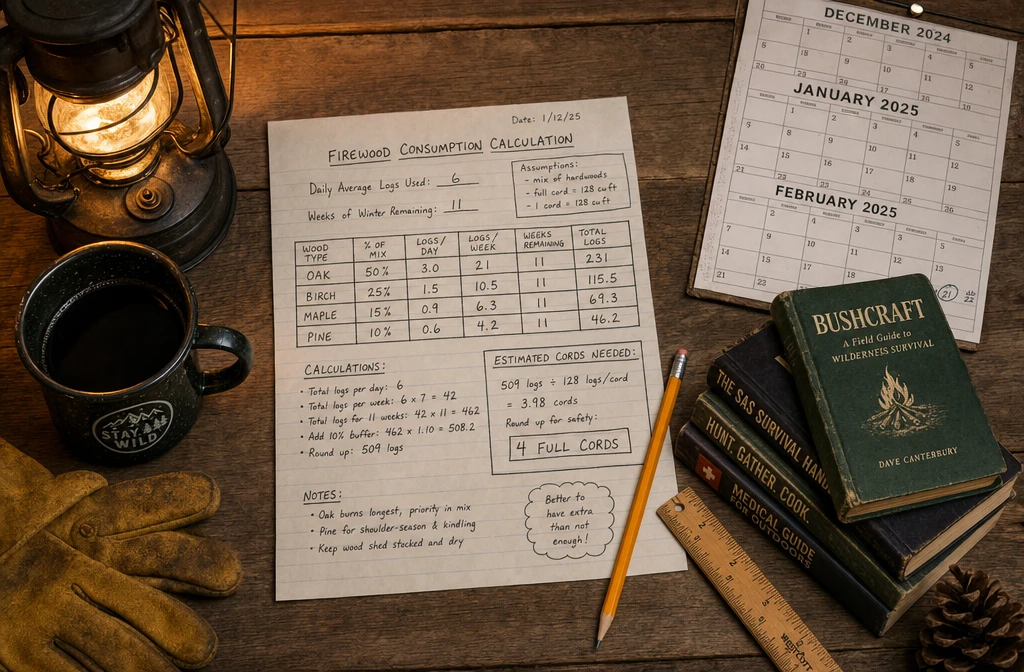
- Convert to cords: A standard cord holds approximately 600–800 pieces of split firewood, depending on split size.
Example calculation:
60 pieces/day × 120 days (4-month winter) = 7,200 pieces ÷ 700 pieces per cord ≈ 10.3 cords
That number might look alarming. But that’s for continuous heating. Survival rationing — using fire strategically for cooking and warmth windows rather than 24/7 — can cut that figure significantly. See the rationing section below for specifics.
Decision rule: If you’re prepping for a grid-down scenario where you can’t resupply, always add a 20–30% buffer to your cord estimate. Running short of firewood in February is not a recoverable situation.
What Burns Longest — Hardwood or Softwood
Hardwood always wins for sustained heat and burn time. Hardwoods are denser than softwoods, which means more combustible material per cubic foot and longer, more consistent burn cycles.
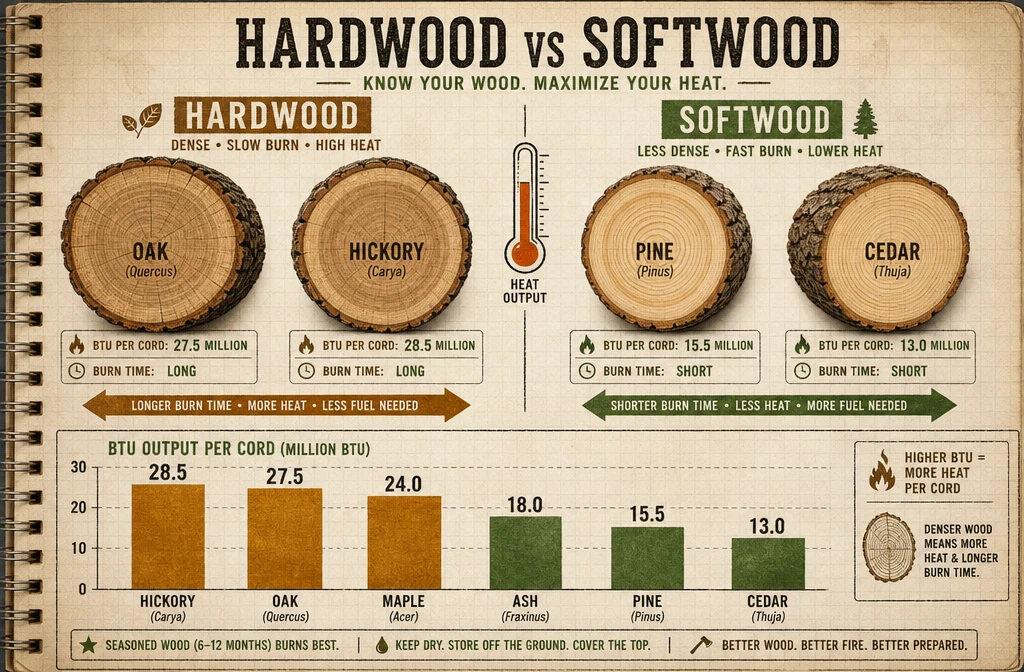
Average Firewood Burn Time and BTU Output by Wood Type
| Wood Species | Type | BTUs per Cord (millions) | Relative Burn Time |
|---|---|---|---|
| Osage Orange | Hardwood | 32.9 | Longest |
| Hickory | Hardwood | 27.7 | Very Long |
| Black Locust | Hardwood | 26.8 | Very Long |
| Oak (White) | Hardwood | 25.7 | Long |
| Ash | Hardwood | 23.6 | Long |
| Birch | Hardwood | 20.3 | Moderate |
| Douglas Fir | Softwood | 20.7 | Moderate |
| Pine (Eastern White) | Softwood | 13.3 | Short |
| Cedar | Softwood | 12.2 | Short |
Source: University of Nebraska-Lincoln Extension, wood fuel BTU data.
Softwoods aren’t useless — they ignite faster and work well for kindling and quick cooking fires. But as a primary survival fuel, they burn through your stockpile at nearly twice the rate of hardwoods. For a 90-day supply, choosing pine over oak could mean running out six weeks early.
What Wood Burns Hottest and Most Efficiently
The hottest-burning, most efficient firewood species are dense hardwoods with low moisture content. Osage orange, hickory, and black locust top the list for raw BTU output. Oak and ash are more widely available and nearly as efficient — making them the practical choice for most preppers.
Efficiency is also about moisture. A piece of wood at 20% moisture content burns at roughly 80–85% efficiency in a modern wood stove. The same piece at 50% moisture (green wood) burns at closer to 50% efficiency, and a significant portion of that energy goes toward evaporating water rather than producing heat.
Key efficiency factors:
- Moisture content below 20% is the target for all survival firewood.
- Split wood dries faster and burns more completely than rounds.
- Stove type matters: An EPA-certified wood stove can achieve 75–85% combustion efficiency; an open fireplace loses up to 90% of heat up the chimney.
If you’re planning an off-grid heating system, this connects directly to the broader infrastructure decisions covered in the ultimate guide to off-grid living.
How Many Hours of Heat Does a Cord of Wood Provide
A cord of seasoned hardwood provides approximately 8,000 to 12,000 hours of burn time in a standard wood stove — but that’s not the same as 8,000 hours of usable heat for your home. The actual heating hours depend on stove efficiency, wood species, and how aggressively you’re burning.
Practical estimate: A cord of white oak in an efficient wood stove (75% efficiency) at moderate burn rate provides roughly:
- 25.7 million BTUs × 75% efficiency = ~19.3 million usable BTUs per cord
- A small survival shelter might need 50,000–80,000 BTUs per day in moderate cold
- At 65,000 BTU/day: 19,300,000 ÷ 65,000 = ~297 days of heat from one cord
That’s under ideal conditions with disciplined fire management. Real-world survival scenarios with imperfect stoves, cold drafts, and less-than-ideal wood might cut that to 90–150 days per cord. This is why the how long does firewood last survival calculation always needs a buffer built in.
Best Ways to Store Firewood to Make It Last Longer
Properly stored firewood retains its burn quality for 3–5 years. The goal is to keep moisture out while allowing airflow to continue the drying process.
The five rules of survival firewood storage:
- Elevate off the ground. Use pallets, concrete blocks, or a dedicated rack. Ground contact invites moisture, insects, and rot.
- Stack in single rows. Single-row stacks allow air to circulate through the pile. Avoid solid block stacks that trap moisture inside.
- Cover only the top. A tarp or metal roof over the top of the pile protects from rain and snow. Covering the sides traps moisture and prevents drying.
- Keep it away from structures. Store at least 20 feet from your home or shelter to reduce pest and fire risk.
- Rotate your stock. Always burn the oldest, driest wood first. Stack new wood at the back or bottom.
How long can firewood sit before it goes bad? Hardwoods stored correctly can last 3–5 years with minimal quality loss. Beyond 5–7 years, wood may become punky (soft and crumbly), which reduces BTU output and makes it harder to ignite. Softwoods degrade faster — expect 2–3 years before noticeable quality loss in outdoor storage.
Can Wet Firewood Still Be Used in an Emergency
Yes, wet or green firewood can be burned in a survival emergency, but it comes with real costs. Green wood (freshly cut) contains 50–100% moisture by weight. Burning it produces significantly less heat, more smoke, and heavy creosote buildup in your flue — which creates a chimney fire risk over time.
If wet wood is your only option:
- Mix it with dry kindling and small dry pieces to sustain combustion.
- Keep fires smaller and more frequent rather than loading a stove with wet wood.
- Inspect and clean your flue more frequently if burning green wood for extended periods.
- Split wet wood as finely as possible — more surface area means faster drying and better combustion.
Emergency drying tip: Bring split pieces inside near your heat source 24–48 hours before burning. Even partial drying improves burn efficiency noticeably.
The bottom line: wet wood is a last resort, not a strategy. Any serious survival firewood plan should include only seasoned wood (dried 6–18 months minimum) as the primary supply.
How to Tell If Firewood Is Too Old to Burn
Firewood that’s too old to burn effectively shows clear physical signs. Check for these before adding old wood to your survival stockpile:
- Punky texture: Wood that crumbles, feels spongy, or breaks apart easily has lost structural integrity and much of its combustible material.
- Heavy fungal growth: Surface mold is normal and burns off. But wood with deep fungal penetration (soft, discolored interior) has significantly degraded BTU value.
- Hollow sound: Tap two pieces together. Good dry wood sounds sharp and dense. Degraded wood sounds dull and hollow.
- Insect galleries: Extensive tunneling from wood-boring beetles means the wood has been compromised from the inside.
- Gray, weathered exterior with soft core: Surface weathering alone is fine. But if the gray extends into the wood and the core feels soft, the piece is past its useful life.
Old but structurally sound wood — dense, dry, and free of deep rot — still burns. Don’t discard wood just because it’s been sitting for four years. Test it physically before writing it off.
Survival Firewood Rationing Tips
Strategic rationing can extend a firewood supply by 30–50% without significantly reducing survival comfort. This is one of the most underrated skills in any long-term grid-down scenario.
Core rationing strategies:
- Consolidate heat zones. Heat one room instead of the whole structure. Close off unused spaces and insulate doorways with blankets.
- Use thermal mass. Heat rocks or bricks in or near the fire, then let them radiate warmth after the fire dies down. This extends each burn cycle’s effective heat output.
- Cook in batches. Every time you light a cooking fire, maximize it. Prepare multiple meals, boil extra water, and dry food or clothing simultaneously.
- Time your burns. In moderate cold, two concentrated burns per day (morning and evening) with good insulation can maintain survivable temperatures without continuous burning.
- Layer up aggressively. Every degree of body insulation from clothing reduces your shelter’s required temperature — and your firewood demand.
- Use a rocket stove or gasifier. These designs extract significantly more heat from the same amount of wood compared to open fires or basic stoves.
For anyone building a broader survival skill foundation, these fire management principles connect directly to the 14 essential survival skills every prepper must know.
The How Long Does Firewood Last Survival Calculation — Putting It All Together
The complete survival firewood calculation combines species selection, daily consumption, storage quality, and rationing strategy into a single actionable number.
Step-by-step survival firewood calculation:
- Identify your heating season (number of days below 35°F average low).
- Estimate daily consumption based on outdoor temperature and shelter size (use the ranges from the daily consumption section above).
- Adjust for wood species — if using softwood, multiply your cord estimate by 1.5 to 2.0.
- Adjust for stove efficiency — open fireplace users should multiply by 2.0 to 3.0.
- Add a 25–30% buffer for cold snaps, unexpected guests, cooking needs, and inefficiencies.
- Factor in rationing — if implementing active rationing strategies, subtract 30–40% from your raw estimate.
Quick reference: How long does one cord of hardwood last by scenario?
| Scenario | Estimated Duration per Cord |
|---|---|
| Mild climate, efficient stove, rationing | 4–6 months |
| Moderate climate, efficient stove, normal use | 2–3 months |
| Cold climate, efficient stove, normal use | 6–10 weeks |
| Cold climate, open fireplace | 3–5 weeks |
| Severe cold, drafty shelter | 2–3 weeks |
This is why experienced preppers and off-grid homesteaders rarely stock less than 3 cords for a single winter — and many keep 5–7 cords as a standard reserve. If you’re building out a full preparedness system, firewood planning belongs alongside your long-term food storage strategy and water reserves as a non-negotiable tier-one resource.
Common Mistakes People Make Storing and Calculating Firewood
Even experienced preppers make errors that leave them short when it matters most.
The most costly firewood mistakes:
- Calculating by volume, not species. A cord of pine and a cord of oak are not equal. Always calculate by BTU output, not just cubic feet.
- Skipping seasoning. Cutting wood in October and expecting to burn it in November is a recipe for a cold, smoky, inefficient winter. Hardwood needs 6–18 months to season properly.
- Storing against the house. Convenient, yes. Smart, no. It attracts termites, carpenter ants, and creates a fire hazard.
- No moisture meter. Guessing at moisture content is unreliable. A basic wood moisture meter (under $20) removes the guesswork and confirms when wood is ready to burn.
- Ignoring creosote buildup. Burning wet or resinous wood without flue maintenance creates dangerous creosote deposits. In a long-term survival scenario without chimney sweep access, this becomes a serious fire risk.
- Underestimating the first and last weeks of winter. Temperature swings during shoulder seasons often require more wood than the coldest mid-winter weeks.
These mistakes compound. A prepper who stores green softwood against their house in a pile, burns it in a drafty fireplace, and never checks moisture content could easily burn through twice the wood they planned for — and still be cold. For a complete look at avoiding similar planning errors across all preparedness categories, the essential survival gear guide covers the broader picture.
Frequently Asked Questions
How long does one cord of firewood last in a survival situation?
One cord of seasoned hardwood lasts approximately 6–10 weeks in a cold-climate survival scenario with an efficient wood stove and normal use. With active rationing and a well-insulated shelter, that can stretch to 3–5 months.
What’s the difference between a cord, a face cord, and a rick?
A full cord is 128 cubic feet of stacked wood (4 feet × 4 feet × 8 feet). A face cord (or rick) is typically one-third of a cord — about 4 feet high × 8 feet long × 16 inches deep. Always confirm dimensions when buying firewood; sellers don’t always use these terms consistently.
How long does firewood need to season before burning?
Hardwoods need 12–18 months of outdoor drying to reach the target moisture content of 20% or below. Softwoods can season in 6–12 months. Freshly split wood dries faster than rounds.
Can I burn firewood that has mold on it?
Surface mold on firewood is common and burns off without significant harm. Wood with deep internal rot or fungal penetration has degraded BTU value and should be used only as a last resort or for kindling.
What’s the best wood to stockpile for long-term survival?
Oak, hickory, and ash are the top three choices for most North American preppers — widely available, high BTU output, and relatively easy to split and store. Black locust is exceptional if available in your region.
How do I know if my firewood is dry enough to burn?
Use a wood moisture meter. Readings below 20% indicate ready-to-burn wood. Without a meter, look for cracks at the ends of the log (checking), a hollow sound when two pieces are knocked together, and a gray/silver color on the end grain.
Does firewood lose BTU value over time?
Yes, but slowly if stored correctly. Well-stored hardwood retains most of its BTU value for 3–5 years. After 5–7 years, density loss from slow decomposition begins to reduce heat output measurably.
How much firewood does a family of four need for winter?
In a cold climate (Zone 4–5), a family of four heating a small to medium shelter should plan for 4–6 cords of hardwood for a full winter survival scenario. This assumes an efficient stove and moderate rationing.
Is it worth buying a moisture meter for firewood?
Absolutely. A basic pin-type moisture meter costs $15–$25 and removes all guesswork from firewood readiness. In a survival context, burning wood that’s too wet wastes fuel and creates creosote — both costly mistakes.
Can softwood be used as a primary survival fuel?
Softwood can work as a primary fuel in mild climates or for short-term emergencies. For cold-climate survival over multiple months, softwood alone is impractical — you’d need nearly twice the volume compared to hardwood to produce the same heat.
What temperature does a wood stove reach with hardwood?
A wood stove burning seasoned hardwood typically reaches 400–700°F at the stove surface, with flue temperatures of 300–500°F. Optimal burning range for efficiency and creosote prevention is 300–400°F in the flue.
How do I extend my firewood supply in an emergency?
Consolidate your living space to one heated room, use thermal mass (heated rocks, bricks) to extend warmth between burns, batch-cook meals, and time your burns to morning and evening windows. These strategies alone can reduce consumption by 30–50%.
Conclusion: Build Your Firewood Plan Before You Need It
The how long does firewood last survival calculation isn’t something to figure out in the middle of a crisis. It’s a pre-season discipline — one that separates preppers who stay warm from those who run out of options in February.
Actionable next steps:
- Calculate your heating season using local historical temperature data.
- Identify the hardwood species available in your region and prioritize those with the highest BTU output.
- Audit your current firewood supply with a moisture meter. If it’s above 20%, split it finer and restack for better airflow.
- Set a cord target using the formulas above, then add 25–30% as a buffer.
- Inspect your storage setup — elevated, covered on top only, away from structures.
- Practice rationing strategies now, not during an emergency. Know how to heat one room efficiently before you have to.
Fire is one of the most fundamental survival resources — and unlike food or water, it’s one you can produce locally if you plan ahead. Stack it deep, store it right, and know your numbers. That’s how confidence gets built before the cold sets in.
For more on building a complete preparedness system, explore the complete prepping guide for beginners and the ultimate home emergency preparedness guide.
Products, Tools, and Resources Worth Knowing
Wood Moisture Meter — A pin-type meter in the $15–$30 range (brands like General Tools or Dr. Meter) is one of the highest-value tools in any prepper’s firewood kit. It tells you exactly when wood is ready to burn and prevents the costly mistake of burning green wood through a cold winter.
Log Moisture Calculator Apps — Several free apps allow you to input wood species and current moisture readings to estimate actual BTU output. Useful for planning when you’re working with mixed species.
Firewood Rack Systems — Steel firewood racks (4-foot or 8-foot models) keep wood elevated, organized, and properly aerated. Look for powder-coated steel with a weight rating above 500 lbs. Avoid plastic or flimsy designs that collapse under a full cord.
EPA-Certified Wood Stoves — If you’re investing in a primary heating system for a survival scenario, an EPA Step 2-certified stove (2020 standards) burns 70–90% more efficiently than older models and produces dramatically less creosote. Brands like Jøtul, Hearthstone, and Lopi have strong reputations among off-grid and preparedness communities.
Splitting Maul and Wedges — For anyone cutting and processing their own firewood, a quality 6–8 lb splitting maul (Fiskars and Estwing are reliable choices) combined with steel splitting wedges makes the work significantly faster. Processing your own wood also lets you control split size for optimal drying.
Firewood BTU Reference Charts— The University of Nebraska-Lincoln Extension and the U.S. Forest Service both publish free, publicly available BTU comparison charts for common firewood species. Print one and keep it with your preparedness binders.
References
- University of Nebraska-Lincoln Extension. (2015). Heating with Wood: Firewood Facts. Retrieved from University of Nebraska-Lincoln Extension publications.
- U.S. Forest Service. (2011). Fuelwood: What Species to Use and Why. USDA Forest Service.
- U.S. Environmental Protection Agency. (2020). Wood Heater Program: Emission Standards and Efficiency. EPA.gov.
- Nix, S. (2019). The Best Firewood: A Comparison of Firewood Types. ThoughtCo / Dotdash Meredith.
- Tharaldson, J. (2018). Firewood Moisture and Combustion Efficiency. University of Minnesota Extension.