
Hey there! Some links on this page may be affiliate links which means that, if you choose to make a purchase, I may earn a commission at no extra cost to you. I greatly appreciate your support. Read the full disclosure here.
Mental toughness is a trainable skill crucial for surviving high-stress scenarios by maintaining focus and making decisions under pressure. Building it involves deliberate practice with techniques like cold exposure, breath control, and scenario rehearsal, starting well before any crisis occurs. Combining mental toughness with resilience ensures both immediate action and long-term recovery when facing survival challenges.
Key Takeaways
- Mental toughness is a trainable skill, not a fixed personality trait, anyone can develop it through deliberate practice.
- The biggest factor separating survivors from non-survivors in crisis situations is often psychological, not physical.
- Navy SEAL training uses stress inoculation, controlled discomfort, and goal-segmentation to build mental toughness systematically.
- Mental toughness and resilience are related but different: toughness drives action under pressure, resilience drives recovery after setbacks.
- Cold exposure, breath control, and scenario rehearsal are three of the most effective and accessible training methods available.
- Beginners should start with low-stakes discomfort (cold showers, timed drills) before advancing to high-stress simulations.
- Common mistakes include skipping recovery, avoiding fear, and training only the body while neglecting the mind.
- Meditation and controlled breathing directly improve stress response regulation, making them core tools for survival psychology.
- Knowing how to build mental toughness for survival situations means practicing before the crisis, not during it.
What Is Mental Toughness and Why Does It Matter in Survival
Mental toughness is the ability to maintain focus, make rational decisions, and keep moving forward when conditions are painful, uncertain, or frightening. In survival situations, it is often the deciding factor between those who act and those who freeze.
Research in military and disaster psychology consistently shows that cognitive and emotional control under stress matters as much as physical capability. The U.S. Army Research Institute has documented that soldiers who demonstrate higher stress tolerance and goal persistence outperform physically stronger counterparts in sustained field operations. When your shelter collapses, your water supply runs out, or you’re lost in the dark, the body can only do what the mind allows it to do.
For preppers and survivalists, understanding how to build mental toughness for survival situations isn’t abstract, it’s as practical as stocking your bug-out bag. Physical gear fails. Skills can be forgotten under pressure. But a trained mind adapts.
What’s the Difference Between Mental Toughness and Resilience
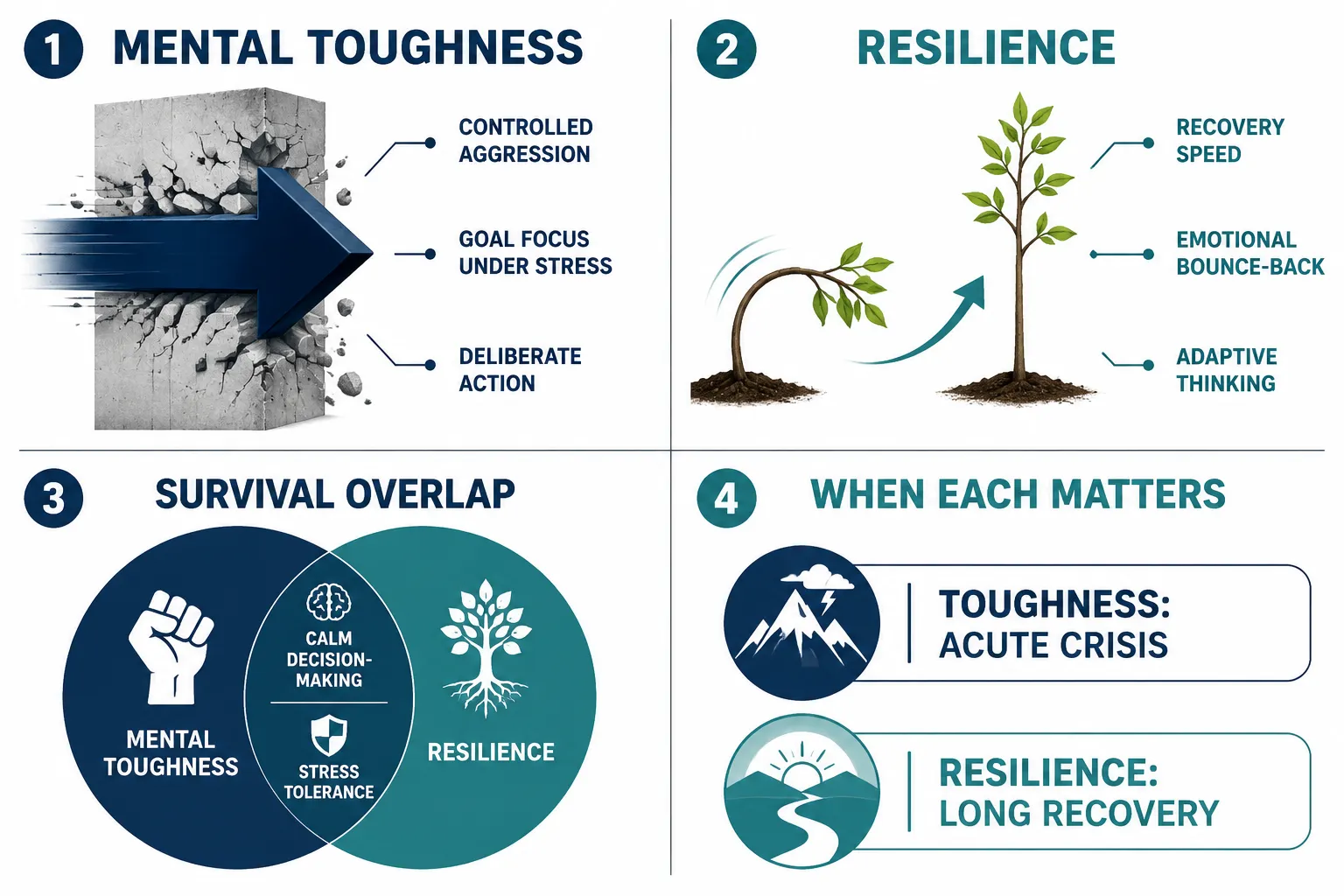
Mental toughness and resilience are not the same thing, though they work together. Mental toughness is the capacity to push through adversity in real time, to keep functioning when everything is going wrong. Resilience is the ability to recover after the crisis has passed.
Think of it this way: mental toughness gets you through the first 72 hours of a grid-down emergency. Resilience is what allows you to rebuild, adapt, and function weeks or months later. Both matter in long-term survival scenarios, but they require different types of training.
- Mental toughness = sustained performance under active stress
- Resilience = recovery speed and emotional bounce-back after trauma
- In survival: you need toughness first, resilience to sustain long-term
A prepper who has only trained resilience may recover well from setbacks but hesitate during the acute moment of crisis. One who has only trained toughness may push hard in the short term but burn out without recovery practices. The goal is developing both.
For a deeper look at the psychological side of crisis response, the guide on psychological preparedness in crisis situations covers how the mind responds to high-threat environments in detail.
Can You Build Mental Toughness or Are You Born With It
Mental toughness is trainable. The science on this is clear. While some people have temperamental advantages, lower baseline anxiety, higher stress tolerance, these traits are not fixed ceilings.
Psychologist Angela Duckworth’s research on grit, published in her 2016 book Grit: The Power of Passion and Perseverance, demonstrated that sustained effort and deliberate practice over time produce mental toughness outcomes regardless of starting point. Military training programs across multiple nations operate on this same premise: take ordinary people, expose them to progressive stress, and produce mentally tough operators.
The mechanism is neurological. Repeated exposure to controlled stress, followed by recovery, strengthens the prefrontal cortex’s ability to regulate the amygdala, the brain’s threat-response center. Over time, the panic response becomes slower and the rational response becomes faster. That’s not motivation. That’s physiology.
The practical implication for preppers: start training now, before you need it.
Navy SEAL training builds mental toughness through three core mechanisms: stress inoculation, goal segmentation, and self-talk discipline. These aren’t secret techniques, they’re documented, teachable, and applicable to civilian survival preparation.
Stress inoculation means deliberately exposing yourself to controlled discomfort so that real-world stress feels more familiar and manageable. SEAL candidates spend weeks in cold water, sleep deprivation, and physical exhaustion, not to destroy them, but to calibrate their stress response.
Goal segmentation is the practice of breaking an overwhelming situation into the smallest possible next action. In Hell Week, candidates don’t think about surviving six days. They think about surviving the next meal, the next evolution, the next hour. This technique directly prevents the psychological shutdown that happens when a crisis feels too large to process.
Self-talk discipline involves replacing catastrophic internal narratives (“I’m going to die out here”) with controlled, factual ones (“I need water, and I know three ways to find it”). SEAL instructors teach candidates to notice their internal voice and redirect it deliberately.
These same techniques apply directly to wilderness emergencies, urban grid failures, or any scenario covered in the 25 most critical wilderness survival skills framework.
What Survival Situations Require the Most Mental Strength
Not all survival scenarios are equally demanding psychologically. The situations that most frequently cause mental collapse are those involving prolonged uncertainty, isolation, or the perceived loss of control.
The highest psychological demand scenarios include:
- Extended wilderness survival (3+ days lost, no rescue confirmation)
- Long-term grid-down emergencies (weeks without power, communications, or supply chains)
- Urban disaster scenarios with social breakdown and threat of violence
- Medical emergencies requiring calm decision-making under extreme emotional pressure
- Bug-out situations involving family members, time pressure, and incomplete information
In each of these, the common thread is ambiguity. The mind struggles most when it cannot predict outcomes. Mental toughness training specifically targets this, building tolerance for uncertainty so that action remains possible even when the outcome is unknown.
Preppers preparing for extended scenarios should also review the 10 critical bug-out survival skills every prepper must master before SHTF to understand how mental readiness integrates with practical skills.
Best Exercises To Practice Mental Toughness at Home
How to build mental toughness for survival situations doesn’t require a military training program. Several effective methods are accessible at home, require no special equipment, and produce measurable results over weeks.
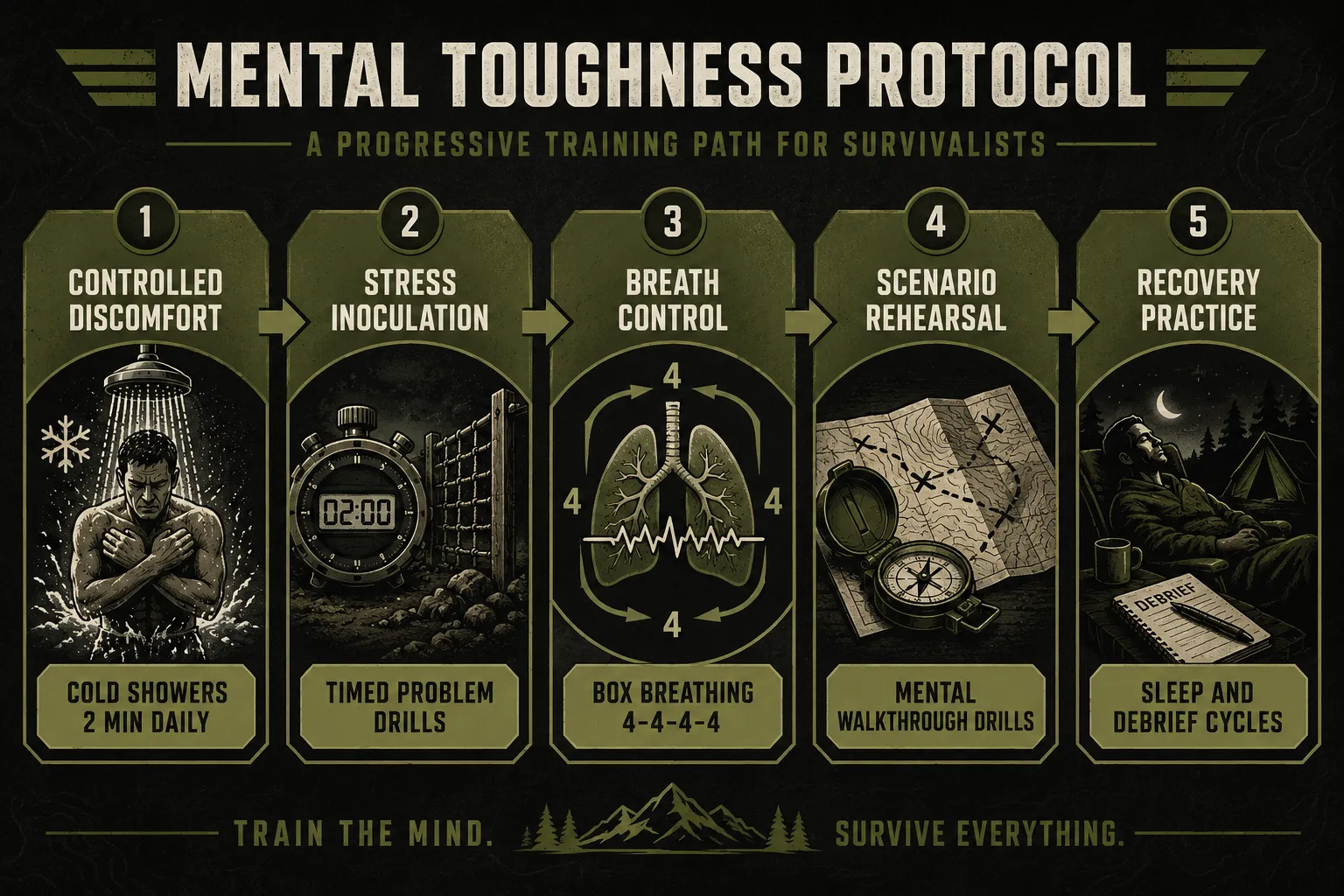
Cold water exposure is one of the most well-documented methods. Starting with 2-minute cold showers and progressively extending duration trains the nervous system to tolerate acute physical discomfort without panic. Research published in Medical Hypotheses (Shevchuk, 2008) suggests cold water immersion activates the sympathetic nervous system in ways that mirror acute survival stress.
Timed problem-solving drills simulate the cognitive pressure of real emergencies. Set a timer for 3 minutes and work through a survival scenario mentally, “I’m lost, it’s getting dark, I have these five items.” The time constraint forces decision-making under pressure, which is exactly the skill that atrophies without practice.
Voluntary discomfort practice means regularly choosing the harder option: skipping the elevator, fasting for 16 hours, sleeping on the floor. These aren’t punishments, they’re calibration exercises that expand your comfort zone and reduce the psychological shock of involuntary hardship.
Scenario rehearsal involves mentally walking through specific crisis events in detail, what you’d do, what you’d feel, how you’d respond. This is not the same as worry. It’s structured, outcome-focused mental preparation, similar to the visualization techniques used by elite athletes.
Journaling under stress, writing briefly during a physically or emotionally challenging moment, builds metacognitive awareness, which is the ability to observe your own mental state without being controlled by it.
How Do Cold Water Exposure and Discomfort Training Build Mental Toughness
Cold exposure and deliberate discomfort training work because they create a controlled, repeatable version of the physiological stress response. When the body enters cold water, cortisol and adrenaline spike, breathing becomes difficult, and the instinct is to escape. Choosing to stay, even for 90 seconds, trains the brain to override the panic impulse.
Over repeated sessions, the stress response becomes less intense and the recovery time shortens. This is called habituation, and it directly transfers to survival situations where the initial shock of a crisis (a house fire, a sudden flood, a medical emergency) would otherwise cause freeze responses.
The key principle: the discomfort must be real but survivable. Mild discomfort builds nothing. Overwhelming trauma is counterproductive. The sweet spot is the edge of your current comfort zone, pushed slightly, consistently, over time.
Can Meditation and Breathing Techniques Improve Mental Toughness for Survival
Yes, and this is one of the most underestimated tools in survival psychology. Controlled breathing directly regulates the autonomic nervous system, slowing the heart rate and reducing the cortisol response during acute stress. This is not a wellness trend. It’s physiology.
Box breathing (inhale 4 counts, hold 4, exhale 4, hold 4) is the technique used by Navy SEALs and taught in tactical medicine programs specifically because it works under extreme conditions. It can be practiced anywhere, requires no equipment, and produces measurable calm within 60 to 90 seconds.
Mindfulness meditation, even 10 minutes daily, has been shown in multiple peer-reviewed studies to increase gray matter density in the prefrontal cortex, the region responsible for rational decision-making under stress (Hölzel et al., Psychiatry Research: Neuroimaging, 2011). For survivalists, this translates directly to better threat assessment, calmer prioritization, and reduced tunnel vision during emergencies.
The practical protocol for beginners:
- Practice box breathing for 5 minutes each morning
- Add a 10-minute body-scan meditation 3 times per week
- Use breathing techniques during any voluntary discomfort training session
- Practice deliberate breath control during physical exertion (hiking, training)
How Do You Stay Mentally Tough When You’re Scared or Exhausted
Fear and exhaustion are not the enemy, unmanaged fear and exhaustion are. Staying mentally tough when you’re scared or depleted requires specific techniques, not willpower alone.
Acknowledge the fear directly. Suppressing fear increases its power. Naming it, “I’m scared because I don’t know where the water source is”, activates the prefrontal cortex and reduces amygdala dominance. This is sometimes called “name it to tame it” in clinical psychology.
Return to the immediate task. When fear spirals into worst-case thinking, the antidote is the smallest possible concrete action. Gather wood. Filter water. Check the perimeter. Action interrupts the anxiety feedback loop.
Manage physical state first. Exhaustion impairs judgment more than almost any other factor. Prioritizing sleep, even in short cycles, is not weakness, it’s tactical. A 20-minute rest in a safe position can restore enough cognitive function to make better decisions than pushing through on fumes.
Use your preparation as an anchor. Knowing that you’ve trained, that you have gear, that you’ve rehearsed this scenario, that knowledge is itself a source of calm. This is one of the strongest arguments for comprehensive preparation. For those building out their physical readiness alongside mental training, the essential survival gear guide provides a ranked framework for what to have on hand.
Mental Toughness Training for Beginners vs. Advanced Preppers
The approach to building mental toughness should scale with experience. Beginners who jump into extreme stress training without a foundation often reinforce anxiety rather than reduce it.
Beginner protocol (weeks 1-8):
- Daily cold showers (start at 30 seconds, build to 3 minutes)
- 10-minute morning meditation or box breathing
- One voluntary discomfort activity per day (skipping a meal, walking in rain)
- Weekly scenario journaling: write through one emergency situation in detail
Intermediate protocol (months 2-6):
- Timed survival problem-solving drills (3-5 minutes, realistic scenarios)
- Physical stress combined with decision-making tasks (navigate while tired)
- Group scenario exercises with other preppers
- Deliberate sleep restriction followed by performance tasks
Advanced protocol (ongoing):
- Full-scale scenario simulations with time pressure and incomplete information
- Extended discomfort events (overnight wilderness stays, 24-hour fasts)
- Teaching others, explaining survival psychology to others deepens your own understanding
- After-action reviews: debrief every drill honestly, including emotional responses
The survival skills checklist covering 7 core skills every prepper needs pairs well with this mental framework, since physical skills and mental readiness reinforce each other.
How Long Does It Take To Develop Mental Toughness
Meaningful improvement in stress tolerance and mental performance under pressure typically begins within 4 to 8 weeks of consistent practice. Significant, durable changes, the kind that hold under genuine high-stakes conditions, generally require 3 to 6 months of deliberate training.
This timeline is not a guarantee. It depends on:
- Consistency of practice (daily beats weekly)
- Quality of the stress stimulus (real discomfort, not simulated comfort)
- Recovery between sessions (mental training requires rest to consolidate)
- Starting baseline (higher anxiety individuals may see faster relative gains)
The important point is that waiting until a crisis to develop mental toughness is not a viable strategy. The brain adapts through repetition before the event, not during it. Every drill, every cold shower, every scenario rehearsal is a deposit into a psychological reserve that pays out when you need it most.
Common Mistakes People Make When Building Mental Resilience
Several patterns consistently undermine mental toughness development, even among motivated preppers.
Avoiding fear entirely. Many people mistake comfort-seeking for preparation. Avoiding anything that causes discomfort prevents the nervous system from ever adapting. Growth requires exposure to manageable stress.
Training only the body. Physical fitness is valuable, but it doesn’t automatically produce mental toughness. A physically strong person with no stress inoculation training can still freeze in a genuine crisis. Both systems need deliberate work.
Skipping recovery. Mental training without adequate rest produces chronic stress, not toughness. Overtraining the mind leads to burnout, increased anxiety, and worse performance under pressure, the opposite of the goal.
Catastrophizing during drills. If scenario rehearsal consistently spirals into worst-case thinking without resolution, it reinforces anxiety rather than building confidence. Every mental rehearsal should end with a successful response, even an imperfect one.
Training alone and never testing with others. Real survival situations almost always involve other people, family members, strangers, group dynamics. Training exclusively in isolation leaves a significant gap in preparedness.
For preppers who want to extend this mental framework to their families, the guide on 12 essential survival skills for kids addresses how to build age-appropriate psychological resilience in children.
Is Mental Toughness the Same as Being Emotionally Tough
No. This is a common and costly misconception. Mental toughness is not the suppression of emotion. It is the ability to experience emotion, fear, grief, anger, exhaustion, without being controlled by it.
People who confuse mental toughness with emotional suppression often perform well in short-term crises but collapse in extended ones. Suppressed fear doesn’t disappear; it resurfaces as panic, poor judgment, or physical symptoms at the worst possible moment.
True mental toughness includes:
- Acknowledging emotional states without amplifying them
- Using emotion as information rather than instruction
- Maintaining decision-making capacity alongside strong emotional experience
- Recovering emotionally after high-stress events rather than numbing out
This distinction matters practically. A prepper who has learned to “never show weakness” may be less prepared than one who has learned to feel fear, name it, and act anyway. The latter is a trained skill. The former is a coping mechanism with a ceiling.
Frequently Asked Questions
Do I need special equipment to train mental toughness for survival?
No. Cold showers, timed drills, breath control practice, and scenario journaling require nothing more than a timer and a notebook. The most effective mental toughness training is low-cost and accessible daily.
Can mental toughness training make me less empathetic or emotionally numb?
Not if done correctly. The goal is regulation, not suppression. Proper training increases emotional awareness and control, it doesn’t eliminate feeling. If training is making you feel disconnected, add recovery practices and reduce intensity.
How is mental toughness for survival different from general stress management?
Survival mental toughness is specifically calibrated for high-stakes, low-resource, time-pressured scenarios. General stress management focuses on reducing stress in everyday life. Survival training deliberately increases stress tolerance so that extreme conditions feel manageable rather than paralyzing.
Should I train mental toughness differently for different types of disasters?
The core skills transfer across scenarios, but scenario-specific rehearsal adds value. A prepper preparing for urban grid failure should mentally rehearse different decision trees than one preparing for wilderness emergencies. Both need the same foundational stress tolerance.
What’s the fastest way to improve mental toughness if I’m starting from zero?
Start with daily cold showers and 10 minutes of box breathing. These two practices alone, done consistently for 30 days, produce measurable improvements in stress response and self-regulation. Add voluntary discomfort activities in week two.
Can children develop mental toughness for survival situations?
Yes, and age-appropriate exposure to manageable challenges is one of the best gifts a prepared parent can give. Age-appropriate problem-solving tasks, outdoor challenges, and honest conversations about emergency preparedness all contribute to resilience in children.
Does physical fitness improve mental toughness automatically?
Physical fitness supports mental toughness but doesn’t replace it. Exercise does reduce baseline anxiety and improve stress recovery, but deliberate psychological training, scenario rehearsal, breath control, stress inoculation, is still required for peak performance under survival pressure.
What’s the biggest psychological threat in a long-term survival scenario?
Hopelessness. The belief that the situation is unwinnable and that effort is pointless. This is why goal segmentation, breaking the challenge into the smallest possible next action, is the single most important mental technique in extended survival situations.
Conclusion
Building mental toughness for survival situations is not about becoming fearless. It’s about becoming functional despite fear, about training the mind the same way serious preppers train their bodies and stock their supplies.
The core message is straightforward: mental toughness is trainable, the training is accessible, and the time to start is before a crisis demands it. Cold exposure, breath control, scenario rehearsal, voluntary discomfort, and deliberate recovery are not complicated. They require consistency, not heroics.
For preppers at any level, the practical next steps are clear. Start with a daily cold shower and 10 minutes of box breathing. Add one scenario rehearsal per week. Build from there. Pair this mental training with the physical and logistical preparation you’re already doing, and the result is a genuinely prepared person, one who can think clearly, act decisively, and protect the people who depend on them when it matters most.
Recommended Resources and Tools:
- “Grit” by Angela Duckworth, the foundational research on perseverance and mental toughness as trainable traits
- “The Obstacle Is the Way” by Ryan Holiday, practical Stoic philosophy applied to adversity and high-pressure decision-making
- Wim Hof Method app, structured cold exposure and breathing protocols with progressive difficulty levels
- Calm or Headspace apps, accessible entry points for daily meditation and breath control practice
- Psychological preparedness in crisis situations, Preppers HQ’s dedicated resource on crisis psychology for survivalists
- 14 essential survival skills every prepper must know, pairs mental readiness with the physical skill set every prepared person needs
Preparation isn’t about fear. It’s about confidence, and the confidence to face the unexpected starts in the mind.