
Hey there! Some links on this page may be affiliate links which means that, if you choose to make a purchase, I may earn a commission at no extra cost to you. I greatly appreciate your support. Read the full disclosure here.
The Ultimate Guide to the Off-Grid Living: Achieving Independent Homestead
There’s a moment — quiet, specific, and increasingly common — when someone looks at their monthly bills, their commute, their inbox, and the relentless hum of a life built entirely on systems they don’t control, and thinks: there has to be another way.
That thought is the beginning of off-grid living.
Not the Instagram version — the curated cabins, the golden-hour gardens, the aesthetic wood stacks. The real version. The one that involves learning how electricity actually works, understanding where water comes from, growing food in soil you’ve amended yourself, and building a financial life that doesn’t depend on a paycheck arriving on schedule.
This guide is for people who are serious about that version.
What Off-Grid Living Actually Means — And Why the Definition Matters More Than You Think
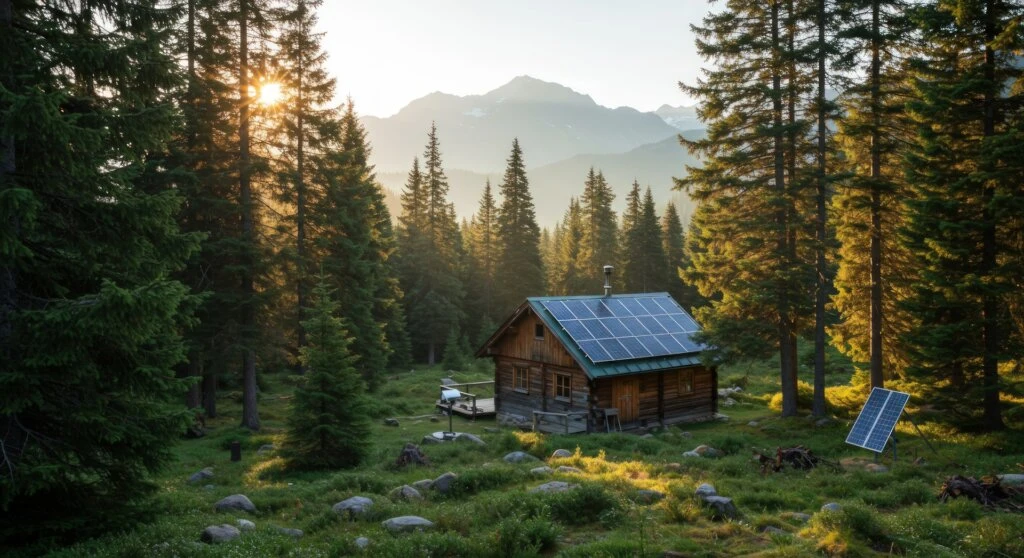 Off-grid living is the practice of operating a household independently of public utility infrastructure — specifically the electrical grid, municipal water supply, and sewage systems. Simple enough as a definition. But the degree of independence varies enormously, and understanding that spectrum is the first step toward making a decision you won’t regret.
The off-grid spectrum:
Partial off-grid: Generating your own electricity while remaining connected to municipal water and sewage. The most common entry point. Many households install solar panels and battery storage while keeping the grid as a backup — a sensible hedge while you learn the system.
Utility-independent: Generating your own electricity, sourcing your own water, and managing your own waste. No utility bills. This is what most people mean when they say “off-grid.”
Self-sufficient: Utility-independent plus producing a significant portion of your own food. The most demanding and most rewarding level.
Fully self-sufficient: Producing virtually all food, medicine, and materials from the land. Practiced by a small minority. Requires significant land, skills, and years of patient development.
Off-Grid vs. Homesteading vs. Tiny House Living — They’re Not the Same Thing
These terms get used interchangeably online, but they describe genuinely distinct approaches — and confusing them leads to misaligned expectations.
Off-grid living focuses primarily on utility independence. It can be practiced on any size property, in any type of structure. You can be off-grid in a converted barn or a custom-built passive solar home.
Homesteading focuses on food self-sufficiency — growing, raising, and preserving your own food. Homesteaders may or may not be off-grid.
Tiny house living focuses on minimizing living space and associated costs. Tiny houses can be on-grid or off-grid, stationary or mobile.
The most complete version of alternative living combines all three: off-grid utility systems, homestead food production, and intentionally sized living spaces. That combination is what this guide is really about.
Why More People Are Choosing Off-Grid Living in 2026
The off-grid movement has accelerated significantly in the past five years. Several forces are converging at once.
Electricity prices have increased substantially across Europe, North America, and Australia. Households that generate their own power are insulated from those increases in a way that feels increasingly significant with every quarterly bill. Solar panels, battery storage systems, and water purification technology have become dramatically more affordable and reliable — a solar system that cost $50,000 in 2010 costs $8,000 to $15,000 in 2026. Remote work has removed the geographic constraint that previously tied most people to urban areas with grid infrastructure. And the supply chain disruptions of the early 2020s created widespread awareness of how fragile centralized systems are — and how vulnerable households that depend entirely on them can be.
The short version: Off-grid living means operating a household independently of public utility infrastructure — electricity grid, municipal water, and sewage systems. The spectrum ranges from partial off-grid (solar power only) to fully self-sufficient (producing all food and materials). The most common form is utility-independent living: generating your own electricity, sourcing your own water, and managing your own waste without monthly utility bills.
How to Start Homesteading From Scratch — The Complete Beginner’s Guide
Off-Grid Power Systems — Building Your Energy Independence From the Ground Up
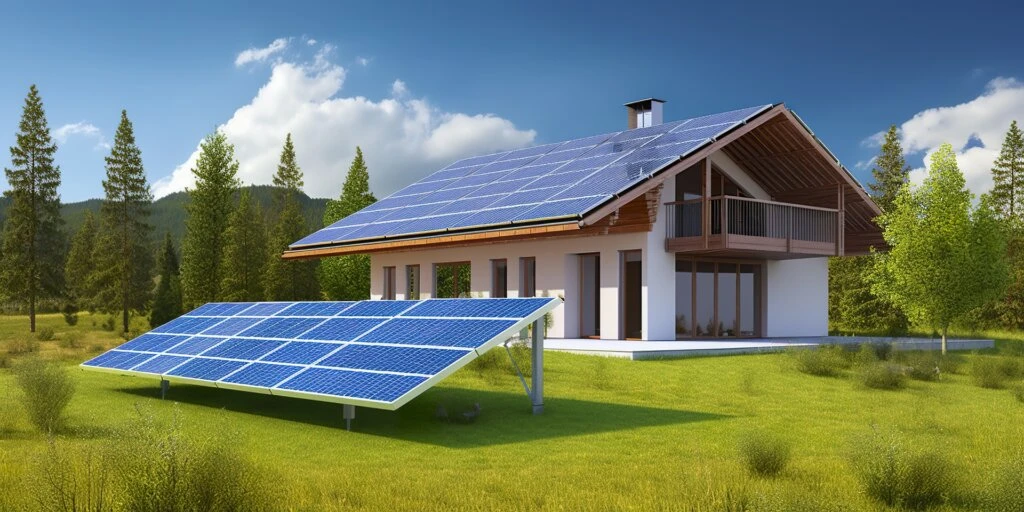 Power is the first system most people think about when considering off-grid living. For good reason. Modern life is deeply dependent on electricity, and designing a reliable off-grid power system requires understanding both your energy needs and the available generation technologies.
Solar Power — The Foundation of Almost Every Off-Grid System
Solar photovoltaic (PV) systems convert sunlight directly into electricity, store it in batteries, and deliver it to your home through an inverter. They are the foundation of most off-grid power setups — and for most locations, the right starting point.
The components of an off-grid solar system:
Solar panels: The generation component. Modern monocrystalline panels convert 20 to 23% of sunlight into electricity. A typical residential panel produces 300 to 450 watts under ideal conditions.
Charge controller: Regulates the flow of electricity from the panels to the batteries, preventing overcharging. MPPT (Maximum Power Point Tracking) charge controllers are significantly more efficient than PWM controllers and are the standard recommendation for off-grid systems.
Battery bank: Stores the electricity generated by the panels for use when the sun isn’t shining. The most critical and most expensive component of an off-grid solar system.
Inverter: Converts the DC electricity stored in batteries to the AC electricity used by most household appliances. For off-grid systems, a pure sine wave inverter is essential — modified sine wave inverters can damage sensitive electronics.
How to calculate your off-grid solar system size:
- Calculate your daily energy consumption: List every electrical device you use, its wattage, and the hours per day you use it. Multiply wattage by hours to get watt-hours. Sum all devices for your daily total.
- Account for system inefficiencies: Multiply your daily consumption by 1.25 to account for inverter losses, battery inefficiency, and wiring losses.
- Determine your peak sun hours: The average number of hours per day that solar irradiance equals 1,000 W/m² at your location. In southern Europe: 4 to 6 hours. In northern Europe: 2 to 4 hours. In the American Southwest: 5 to 7 hours.
- Calculate panel capacity: Divide your adjusted daily consumption by your peak sun hours to determine the kilowatts of panel capacity required.
- Calculate battery capacity: Determine how many days of autonomy you need (typically 2 to 4 days for most off-grid systems) and size your battery bank accordingly.
Example calculation for a modest off-grid home:
Daily consumption: 3,000 watt-hours (3 kWh) Adjusted for inefficiency: 3,750 watt-hours Peak sun hours (moderate climate): 4 hours Panel capacity required: 3,750 ÷ 4 = 937 watts (approximately 1 kW of panels) Battery capacity (3 days autonomy): 3,000 × 3 = 9,000 watt-hours (9 kWh)
Off-grid solar system costs in 2026:
| System Size | Approximate Cost (Installed) | Suitable For |
| 1–2 kW | $5,000–$10,000 | Minimal consumption, cabin |
| 3–5 kW | $12,000–$20,000 | Modest home, 1–2 people |
| 6–10 kW | $20,000–$35,000 | Family home, moderate consumption |
| 10–15 kW | $35,000–$55,000 | Large home, high consumption |
Battery Storage — The Investment That Determines Everything Else
The battery bank is the heart of an off-grid power system. It determines how long you can operate without sun and how reliably your system performs over time. Get this right and everything else works. Get it wrong and you’ll be replacing batteries in three years.
Lithium iron phosphate (LiFePO4) batteries:
The current standard for off-grid battery storage. The advantages over lead-acid are substantial:
- 80 to 100% usable capacity (vs. 50% for lead-acid)
- 3,000 to 6,000 charge cycles (vs. 500 to 1,000 for lead-acid)
- No maintenance required
- Lighter weight
- Better performance in cold temperatures
The disadvantage is upfront cost — approximately 2 to 3 times lead-acid per kWh of capacity. But the lifecycle cost is significantly lower. Over a 10-year period, lithium iron phosphate almost always wins.
Popular lithium battery options for off-grid use:
- Tesla Powerwall 3: 13.5 kWh capacity, integrated inverter, approximately $9,000 to $12,000 installed. Designed for grid-tied systems but usable off-grid.
- Victron Energy batteries: The professional standard for off-grid systems. Excellent reliability and compatibility with Victron’s comprehensive off-grid ecosystem.
- EG4 batteries: A more affordable option gaining popularity in the off-grid community. Good performance at lower price points.
- DIY LiFePO4 battery builds: Experienced builders can assemble battery banks from cells at 40 to 60% of the cost of pre-built systems.
Lead-acid batteries:
Still used in budget off-grid systems. Flooded lead-acid batteries require regular maintenance but are significantly cheaper upfront. AGM (Absorbed Glass Mat) lead-acid batteries are maintenance-free but more expensive than flooded. For a long-term off-grid system, lithium iron phosphate is almost always the better investment despite the higher upfront cost.
Wind Power — The Complement Most People Overlook
Wind power is most valuable as a complement to solar, not a replacement. Wind often blows when the sun doesn’t shine — at night, in winter, during storms — making it an excellent supplement in areas with consistent wind resources.
When wind power makes sense:
- Average wind speeds above 5 m/s (11 mph) at your location
- Significant seasonal variation in solar production (common in northern latitudes)
- Sufficient land for turbine placement (typically 50 to 100 meters from structures)
- Zoning regulations that permit wind turbines
Small wind turbine options for off-grid use:
- 400W to 1kW turbines: Suitable for supplementing a solar system. Cost: $500 to $2,000 plus installation.
- 2kW to 5kW turbines: Significant contribution to off-grid power. Cost: $5,000 to $15,000 plus installation.
- 10kW+ turbines: Can be the primary power source in windy locations. Cost: $20,000 to $50,000 plus installation.
Micro-Hydro Power — The Most Underrated Off-Grid Energy Source
If your property has a stream or river with sufficient flow and head (vertical drop), micro-hydro power is the most reliable and cost-effective off-grid energy source available. Unlike solar and wind, micro-hydro produces power 24 hours a day, 365 days a year. No sun required. No wind required. Just water moving downhill.
Requirements for micro-hydro power:
- A water source with consistent flow (minimum 2 to 5 liters per second for small systems)
- Sufficient head (vertical drop) — even 3 to 5 meters of head can produce meaningful power
- Legal water rights to divert the flow
A small micro-hydro system producing 500W to 2kW continuously can be installed for $3,000 to $15,000 — and will produce more usable energy than a much larger solar system in most climates. If your land has this resource, it changes the entire economics of off-grid living.
Backup Generators — The Insurance Policy You Hope to Never Use
Even the best-designed off-grid solar system will occasionally face extended periods of low production. A backup generator provides the insurance policy that prevents these periods from becoming crises.
Generator fuel options:
Propane: The most common choice for off-grid backup generators. Propane stores indefinitely, burns cleanly, and is widely available. Propane generators can be connected to a large tank (500 to 1,000 gallons) for extended backup capability.
Diesel: More fuel-efficient than gasoline. Diesel stores longer than gasoline (up to 12 months with stabilizer). Diesel generators are typically more durable and longer-lived than gasoline equivalents.
Gasoline: The most accessible fuel but the shortest shelf life (3 to 6 months without stabilizer). Best for occasional emergency use rather than regular backup.
Dual-fuel (propane/gasoline): Provides flexibility. Can run on either fuel, which is valuable when one is unavailable.
Size your generator to handle your essential loads — not your total consumption. A 3,000 to 5,000 watt generator is sufficient for most off-grid homes when used as a backup to charge batteries rather than as a primary power source.
Off-Grid Water Systems — Finding, Storing, and Purifying Your Own Water
Water is the most fundamental requirement for off-grid living — and the system that requires the most careful planning. Unlike power systems, water system failures can create immediate health risks. This is not the place to cut corners.
Well Drilling — The Most Reliable Long-Term Water Source
A drilled well provides access to groundwater that is naturally filtered through rock and soil. It is the most reliable long-term water source for most off-grid properties.
Well drilling costs:
Well drilling costs vary significantly by location, depth, and geology. In the United States, expect to pay $15 to $30 per foot of depth, plus $1,500 to $3,000 for the pump and pressure system. A 200-foot well with pump and pressure tank typically costs $5,000 to $10,000.
Well water quality:
Well water is not automatically safe to drink. It should be tested for bacteria (coliform and E. coli), nitrates and nitrites, pH, hardness, heavy metals (arsenic, lead, iron, manganese), and any contaminants specific to your region. Test your well water before drinking it and annually thereafter.
Powering a well pump off-grid:
Standard submersible well pumps run on 240V AC power and draw significant current during startup. Options for off-grid well pumping:
- DC submersible pumps: Designed specifically for solar-powered systems. Run directly from solar panels or batteries without an inverter. More efficient for off-grid use.
- AC pumps with a large inverter: Standard pumps can be run from an off-grid inverter, but the startup surge requires a sufficiently large inverter.
- Hand pumps: A manual backup for power outages. Bison Pump and Simple Pump are the most recommended brands for deep wells.
Rainwater Harvesting — Collecting What Falls From the Sky
Rainwater harvesting collects precipitation from rooftops and other surfaces, stores it in tanks, and treats it for use. It is the most accessible off-grid water source for properties without wells or springs — and in many climates, it’s surprisingly productive.
Rainwater harvesting system components:
Collection surface: Typically a metal roof (galvanized steel or aluminum). Avoid asphalt shingles, which can leach chemicals into collected water.
Gutters and downspouts: Channel water from the roof to the storage tank. First-flush diverters automatically discard the first portion of rainfall (which carries the most contaminants from the roof surface) before directing water to storage.
Storage tanks: Polyethylene tanks are the most common choice. Sizes range from 500 to 10,000+ gallons. Underground cisterns provide temperature stability and protection from UV degradation.
Filtration and treatment: Rainwater must be treated before drinking. A multi-stage system typically includes:
- Sediment pre-filter (removes particles)
- Activated carbon filter (removes chemicals and improves taste)
- UV sterilization (kills bacteria and viruses)
- Optional: reverse osmosis for the highest purity
Rainwater harvesting legality:
Rainwater harvesting is legal in most jurisdictions but regulated in some. In the United States, most states permit rainwater harvesting. In the UK, rainwater harvesting is legal and encouraged. Always verify local regulations before installing a system.
How much rainwater can you collect?
The formula: Collection area (square feet) × Rainfall (inches) × 0.623 = Gallons collected
Example: A 1,500 square foot roof in an area receiving 30 inches of annual rainfall: 1,500 × 30 × 0.623 = 28,035 gallons per year — approximately 77 gallons per day. Sufficient for a household of 2 to 3 people at modest consumption levels.
Spring Development — The Hidden Gem of Off-Grid Water
A natural spring on your property is one of the most valuable assets for off-grid living. Springs provide gravity-fed water that requires no pumping, no electricity, and minimal treatment. If your land has one, it changes everything.
Developing a spring:
- Locate the spring’s emergence point
- Excavate around the emergence to expose the water-bearing layer
- Install a spring box — a concrete or polyethylene collection chamber that captures the water as it emerges
- Install an overflow pipe to prevent the spring box from flooding
- Cover the spring box to prevent contamination
- Run a gravity-fed pipe from the spring box to your storage tank or home
Spring water should be tested before drinking. While springs are generally cleaner than surface water, they can be contaminated by agricultural runoff, septic systems, or naturally occurring minerals.
Water Storage — Sizing Your System for Real Reliability
Water storage provides the buffer between your water source and your consumption. The size of your storage system determines how long you can operate during periods when your water source is unavailable.
Recommended water storage:
- Minimum: 30-day supply for your household
- Recommended: 60 to 90-day supply
- Ideal: 6-month supply (particularly important in areas with seasonal drought)
Water consumption estimates:
- Drinking and cooking: 1 to 2 gallons per person per day
- Basic hygiene: 2 to 5 gallons per person per day
- Toilet flushing: 5 to 10 gallons per person per day (composting toilets eliminate this entirely)
- Laundry: 15 to 40 gallons per load
- Garden irrigation: 1 to 5 gallons per square foot per week in summer
Off-grid households typically consume 20 to 40 gallons per person per day — significantly less than the average grid-connected household.
Water Purification — Making Any Source Safe to Drink
Regardless of your water source, a multi-stage purification system is essential for off-grid living.
The recommended off-grid water purification stack:
Stage 1 — Sediment filtration: A 5-micron sediment filter removes particles, sand, and debris. Replace every 3 to 6 months.
Stage 2 — Activated carbon filtration: Removes chlorine, chemicals, pesticides, and improves taste and odor. Replace every 6 to 12 months.
Stage 3 — UV sterilization: Destroys bacteria, viruses, and protozoa without chemicals. Requires electricity (typically 10 to 25 watts). Replace UV lamp annually.
Stage 4 (optional) — Reverse osmosis: Removes dissolved solids, heavy metals, and virtually all contaminants. Produces the highest quality drinking water. Requires water pressure and produces wastewater (3 to 4 gallons of wastewater per gallon of purified water).
Gravity-fed filtration systems:
For off-grid properties without reliable electricity, gravity-fed filtration systems (Berkey, Doulton) provide excellent water quality without power. These systems use ceramic and activated carbon filters to remove bacteria, protozoa, and chemical contaminants.
Off-Grid Food Production — Growing and Raising Your Own Food
 Food production is the most complex and most rewarding dimension of off-grid living. It is also the dimension that takes the longest to develop. A productive food system typically requires 3 to 5 years before it provides a significant portion of household food needs. Start earlier than you think you need to.
Planning Your Off-Grid Food System — Before You Plant Anything
Before planting a single seed or acquiring a single animal, plan your food system comprehensively.
Key planning questions:
- How many people are you feeding?
- What is your climate and growing season?
- What is your soil quality?
- How much land do you have available for food production?
- What are your dietary preferences and nutritional requirements?
- What food preservation methods will you use?
Caloric requirements:
The average adult requires approximately 2,000 to 2,500 calories per day. A family of four requires approximately 3,000,000 calories per year. Producing this entirely from a garden and livestock requires approximately 1 to 2 acres of productive land, depending on climate and farming methods.
High-Calorie Crops — The Foundation of Off-Grid Food Security
A well-planned vegetable garden is the most calorie-efficient use of land for food production.
| Crop | Calories per 100g | Yield per 100 sq ft | Storage |
| Potatoes | 77 | 50–100 lbs | 6–12 months |
| Sweet potatoes | 86 | 40–80 lbs | 6–12 months |
| Winter squash | 40 | 30–60 lbs | 3–6 months |
| Dried beans | 337 | 5–15 lbs | 1–5 years |
| Corn (dried) | 365 | 10–20 lbs | 1–5 years |
| Wheat | 340 | 5–10 lbs | 5–25 years |
High-nutrition crops for dietary completeness:
- Leafy greens (kale, chard, spinach): Vitamins A, C, K, iron, calcium
- Tomatoes: Vitamins C and K, lycopene
- Brassicas (broccoli, cabbage, Brussels sprouts): Vitamins C and K, fiber
- Alliums (onions, garlic, leeks): Flavor, antimicrobial properties
- Herbs: Flavor and medicinal properties
Soil development:
Most off-grid properties do not start with ideal soil. Building productive soil takes time and inputs:
- Composting: Convert kitchen scraps, garden waste, and animal manure into rich compost. A well-managed compost system produces 1 to 2 cubic yards of finished compost per year from a household’s organic waste.
- Cover cropping: Plant nitrogen-fixing cover crops (clover, vetch, peas) in the off-season to build soil fertility.
- Mulching: Apply thick layers of organic mulch (wood chips, straw, leaves) to suppress weeds, retain moisture, and build soil organic matter.
- Raised beds: In areas with poor soil, raised beds filled with imported or composted soil allow immediate productive gardening while the native soil is being improved.
Livestock — Protein, Fat, and Fertility for Your Off-Grid Property
Livestock provide protein, fat, dairy, eggs, and fertility (manure for composting) that are difficult to obtain from a garden alone.
Chickens — the essential off-grid livestock:
Chickens are the most practical livestock for most off-grid properties. They require minimal space, produce eggs daily, provide meat, and convert kitchen scraps and garden waste into eggs and manure.
- Space requirement: 4 square feet per bird in the coop, 10 square feet per bird in the run
- Egg production: 250 to 300 eggs per year per hen (for productive breeds)
- Feed requirement: 0.25 pounds of feed per bird per day (supplemented by foraging)
- Breeds for off-grid: Rhode Island Red, Plymouth Rock, Australorp (dual-purpose breeds that produce both eggs and meat)
Goats — dairy and meat for smaller properties:
Goats are the most practical dairy animal for off-grid properties without sufficient land for cattle.
- Space requirement: 200 square feet per goat in the pen, plus grazing area
- Milk production: 1 to 3 quarts per day per doe (breed-dependent)
- Feed requirement: 2 to 4 pounds of hay per day plus browse
- Breeds for off-grid: Nigerian Dwarf (small, high butterfat milk), Nubian (larger, good milk production), Boer (meat breed)
Pigs — efficient meat production:
Pigs convert kitchen scraps, garden waste, and surplus produce into high-quality meat with remarkable efficiency.
- Space requirement: 50 to 100 square feet per pig in a pen
- Feed requirement: 6 to 8 pounds of feed per day (significantly reduced with kitchen scraps and garden surplus)
- Time to market weight: 5 to 6 months from weaning to 250 pounds
Cattle — for larger properties:
Cattle require significant land (1 to 2 acres per animal for grazing) and are most practical for properties of 5 acres or more.
Food Preservation Without Electricity — Making the Harvest Last All Year
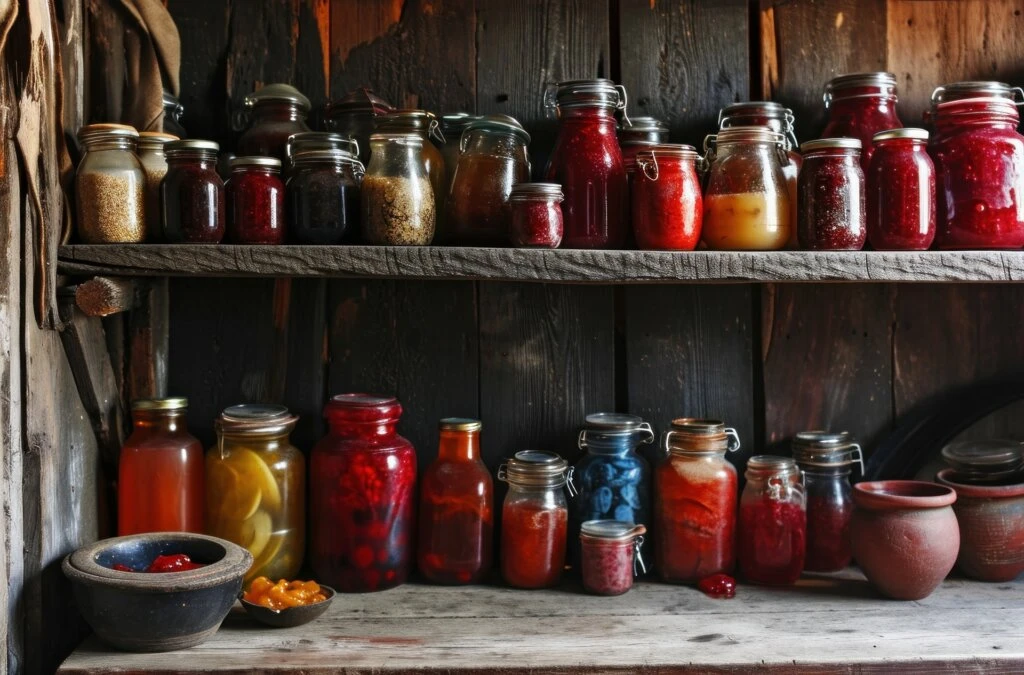 Food preservation is the skill that transforms seasonal abundance into year-round food security. Without reliable refrigeration, off-grid households must master multiple preservation methods. This is not optional — it is the skill that makes everything else sustainable.
Water bath canning:
Suitable for high-acid foods (fruits, tomatoes, pickles, jams). Uses boiling water to create a vacuum seal in glass jars. Properly canned foods last 1 to 5 years.
Pressure canning:
Required for low-acid foods (vegetables, meat, beans, soups). Uses steam pressure to reach temperatures that kill botulism spores. Properly pressure-canned foods last 1 to 5 years.
Fermentation:
One of the oldest and most nutritious preservation methods. Lacto-fermentation (sauerkraut, kimchi, pickles, kefir) uses beneficial bacteria to preserve food and enhance nutritional value. No special equipment required.
Dehydration:
Removes moisture that bacteria and mold require to grow. Solar dehydrators (no electricity required) can dry fruits, vegetables, herbs, and meat effectively in sunny climates. Electric dehydrators are more reliable in cloudy climates.
Root cellaring:
A cool, dark, humid space (typically underground) that maintains temperatures of 32 to 40°F (0 to 4°C) and humidity of 85 to 95%. Ideal for storing root vegetables, apples, cabbages, and other produce that doesn’t require freezing.
Smoking:
Combines heat, dehydration, and antimicrobial compounds from wood smoke to preserve meat and fish. A cold smoker (below 90°F) preserves without cooking; a hot smoker (above 165°F) cooks and preserves simultaneously.
Off-Grid Shelter — Building and Heating Without the Grid
Shelter is the most capital-intensive component of off-grid living. The choices you make about your structure — its design, materials, and heating system — will affect your comfort, energy consumption, and maintenance requirements for decades. Choose carefully.
Off-Grid Building Options — Finding the Right Structure for Your Situation
Log cabin:
The traditional off-grid shelter. Advantages: excellent thermal mass, natural materials, long lifespan, can be built from timber harvested on-site. Disadvantages: requires significant skill or professional help, settling and shrinkage require careful design.
Timber frame:
A structural framework of heavy timbers joined with traditional joinery. Advantages: beautiful, durable, can be infilled with various materials (straw bale, SIPs panels, conventional insulation). Disadvantages: requires skilled craftspeople or significant learning.
Earthship:
A passive solar building constructed primarily from recycled materials (tires, bottles, cans) and earth. Advantages: extremely low material cost, excellent thermal mass, passive solar heating and cooling, integrated water and food systems. Disadvantages: labor-intensive construction, may face building code challenges.
Cob:
A mixture of clay, sand, and straw formed into walls. Advantages: low material cost, excellent thermal mass, can be built by unskilled labor, beautiful aesthetic. Disadvantages: requires dry climate (cob is vulnerable to water damage), labor-intensive.
Straw bale:
Walls constructed from straw bales, typically plastered with clay or lime. Advantages: excellent insulation (R-30 to R-50), low material cost, good thermal mass. Disadvantages: requires careful moisture management, may face building code challenges.
Shipping container:
Repurposed steel shipping containers used as structural elements. Advantages: low cost, durable, readily available, can be stacked and combined. Disadvantages: poor insulation (requires significant added insulation), condensation management challenges.
Prefabricated cabin kits:
Pre-cut timber or log cabin kits that can be assembled by owner-builders. Advantages: faster construction, predictable costs, building code compliance. Disadvantages: higher material cost than site-built alternatives.
Passive Solar Design — The Principle That Changes Everything
Passive solar design uses the building’s orientation, window placement, and thermal mass to capture solar heat in winter and reject it in summer — reducing or eliminating the need for mechanical heating and cooling. It costs nothing extra to design a building this way. It saves enormously over the life of the structure.
The five elements of passive solar design:
- South-facing orientation (Northern Hemisphere):The primary glazing (windows) faces south to capture winter sun. In the Southern Hemisphere, north-facing orientation is correct.
- Thermal mass:Dense materials (concrete, stone, brick, water) absorb solar heat during the day and release it slowly at night. Thermal mass should be located where it receives direct sunlight.
- Insulation:High levels of insulation in walls, roof, and floor minimize heat loss. In cold climates, aim for R-40 to R-60 in the roof and R-20 to R-30 in walls.
- Glazing:South-facing windows should be sized to capture sufficient winter sun without overheating in summer. A general rule: south-facing glazing area should be 7 to 12% of the floor area.
- Shading:Roof overhangs or external shading devices block high summer sun while allowing low winter sun to enter. The correct overhang depth depends on your latitude.
A well-designed passive solar home in a temperate climate can reduce heating energy requirements by 50 to 80% compared to a conventional building.
Wood Heating — The Most Common Off-Grid Heating System
Wood heating is the most common primary heating system for off-grid homes. It uses a renewable fuel source that can often be harvested from the property itself.
Wood stove:
The simplest and most common wood heating option. A quality wood stove (Jøtul, Morso, Vermont Castings, Hearthstone) can heat a well-insulated home of 1,000 to 2,000 square feet.
Wood stove selection criteria:
- Heating capacity (BTU output) matched to your home’s heat loss
- EPA certification (cleaner burning, more efficient)
- Catalytic vs. non-catalytic combustion (catalytic stoves are more efficient but require more maintenance)
- Cast iron vs. steel construction (cast iron retains heat longer)
Masonry heater (rocket mass heater):
A highly efficient wood heating system that burns wood at very high temperatures (achieving near-complete combustion) and stores the heat in a large thermal mass. A masonry heater can heat a home for 24 hours from a single 2-hour burn. Fuel consumption is 75 to 90% less than a conventional wood stove.
Wood boiler (hydronic heating):
A wood-fired boiler that heats water for distribution through radiators or radiant floor heating. Provides even, comfortable heat throughout the home. Can also heat domestic hot water.
Firewood requirements:
A well-insulated home in a cold climate typically requires 3 to 6 cords of firewood per year. One cord = 128 cubic feet of stacked wood.
Off-Grid Waste Management — The Part Nobody Talks About (But Everyone Needs to Plan)
 Waste management is the least glamorous but most legally regulated aspect of off-grid living. Getting it wrong creates health risks and legal problems. Plan this before you buy land.
Composting Toilets — The Most Practical Off-Grid Sanitation Solution
Composting toilets process human waste aerobically, converting it to a stable, pathogen-free compost that can be used as a soil amendment. They require no water for flushing and no connection to a septic system.
Types of composting toilets:
Self-contained composting toilets: The composting chamber is integrated into the toilet unit. Suitable for low-use applications (cabins, vacation homes). Brands: Nature’s Head, Sun-Mar, Separett.
Central composting systems: The toilet is a simple seat with a chute that leads to a separate composting chamber (typically in a basement or crawl space). Suitable for full-time residential use. Brands: Clivus Multrum, BioLet.
Urine-diverting toilets: Separate urine from feces. Urine is collected separately (it’s sterile and can be diluted and used as fertilizer). Feces are composted with much less liquid, making the composting process faster and more effective.
Composting toilets are legal in most jurisdictions but may require permits. Some areas require a conventional septic system as a backup even if a composting toilet is installed. Always verify local regulations.
Septic Systems — The Conventional Off-Grid Sanitation Solution
A conventional septic system consists of a septic tank (where solids settle and anaerobic digestion occurs) and a drain field (where liquid effluent is distributed through perforated pipes and filtered through soil).
Septic system costs:
A conventional septic system costs $5,000 to $20,000 depending on soil conditions, system size, and local regulations. Properties with poor soil drainage may require more expensive alternative systems (mound systems, aerobic treatment units).
Septic system maintenance:
- Pump the septic tank every 3 to 5 years
- Avoid flushing non-biodegradable materials
- Protect the drain field from vehicle traffic and deep-rooted plants
- Use septic-safe cleaning products
Greywater Systems — Recycling the Water You’ve Already Used
Greywater is wastewater from sinks, showers, and laundry (not toilet waste). It can be recycled for irrigation, significantly reducing water consumption.
The simplest greywater system diverts laundry water directly to mulched garden beds. This requires no treatment and is legal in many jurisdictions. A constructed wetland system provides higher treatment quality and can handle larger volumes.
Greywater regulations vary significantly by jurisdiction. Research your local regulations before installing any greywater system.
Off-Grid Internet and Communication — Staying Connected Without Infrastructure
The ability to work remotely has made off-grid living financially viable for many more people. But it requires reliable internet connectivity that traditional infrastructure doesn’t provide in remote locations.
Starlink — The Technology That Changed Off-Grid Living
SpaceX’s Starlink satellite internet service has transformed off-grid connectivity. It provides download speeds of 50 to 200 Mbps and latency of 20 to 40 milliseconds — sufficient for video calls, remote work, and streaming — virtually anywhere on Earth.
Starlink for off-grid living:
- Hardware cost: Approximately $350 to $600 for the dish and router
- Monthly cost: $120 to $250 depending on plan and location
- Power consumption: 50 to 100 watts (manageable for most off-grid solar systems)
- Installation: Self-installation, requires clear view of the sky
Starlink has become the standard internet solution for off-grid properties in areas without cable or fiber infrastructure. If you’re planning off-grid living and need to work remotely, this is the first communication system to budget for.
Cellular Internet — The Backup Option
In areas with cellular coverage, a cellular router with a high-gain antenna can provide reliable internet connectivity. Speeds vary significantly by location and carrier. A cellular booster (weBoost Drive Reach is widely recommended) can significantly improve signal in marginal coverage areas.
Ham Radio — When Everything Else Fails
Amateur (ham) radio provides communication capability that doesn’t depend on any infrastructure. In a genuine emergency — when cellular networks are down and internet is unavailable — ham radio can be the only communication option. A Technician class ham radio license (the entry-level license in the United States) can be obtained by passing a 35-question multiple-choice exam.
Off-Grid Financial Planning — The Real Numbers Behind the Dream
Off-grid living is often presented as a path to financial freedom — and it can be. But the path requires significant upfront investment and careful financial planning. Here are the actual numbers.
How Much Does It Cost to Go Off-Grid — The Complete Breakdown
Land:
Off-grid land prices vary enormously by location. In the United States, rural land suitable for off-grid living ranges from $500 per acre (remote areas of the American West) to $10,000+ per acre (desirable areas with good water and access). A 5 to 20-acre property in a moderate location typically costs $50,000 to $200,000.
Power system: $15,000 to $30,000 installed for a complete off-grid solar system for a modest home.
Water system:
- Well drilling and pump: $5,000 to $15,000
- Rainwater harvesting system: $2,000 to $10,000
- Water storage tanks: $1,000 to $5,000
- Water purification: $500 to $3,000
Shelter:
- Used mobile home or RV: $5,000 to $30,000
- Cabin kit (owner-built): $20,000 to $60,000
- Professionally built conventional home: $100,000 to $300,000+
- Earthship or cob (owner-built): $10,000 to $50,000 in materials
Sanitation:
- Composting toilet: $1,000 to $3,000
- Septic system: $5,000 to $20,000
Total startup cost range:
| Scenario | Estimated Cost |
| Minimal (used RV, basic systems) | $30,000–$60,000 |
| Modest (small cabin, complete systems) | $80,000–$150,000 |
| Comfortable (well-built home, complete systems) | $150,000–$300,000 |
| Premium (custom home, comprehensive systems) | $300,000–$600,000+ |
The Monthly Savings That Make It Worth It
The financial case for off-grid living is strongest when viewed over a 10 to 20-year horizon.
Monthly expenses eliminated or reduced:
- Electricity: $100 to $300 per month eliminated
- Water and sewage: $50 to $150 per month eliminated
- Grocery bills: $200 to $600 per month reduced (depending on food production)
- Mortgage/rent: Potentially eliminated if property is owned outright
Monthly expenses that remain or increase:
- Internet: $120 to $250 per month (Starlink)
- Propane/fuel: $50 to $200 per month
- Equipment maintenance: $100 to $300 per month (amortized)
- Health insurance: Unchanged or increased (no employer coverage)
Net monthly savings: $300 to $1,000+ per month for a household that has paid off its off-grid infrastructure.
Off-Grid Income Strategies — Making Money While Living Off the Grid
Remote work: The most straightforward approach. Any job that can be done from a computer can be done from an off-grid property with Starlink. Software development, writing, design, consulting, customer service, and hundreds of other professions are compatible with off-grid living.
Selling surplus food and products: A productive off-grid property often generates surplus food, eggs, dairy, meat, honey, herbs, and other products that can be sold at farmers markets, through CSA subscriptions, or directly to neighbors.
Off-grid tourism and education: Hosting visitors for workshops, farm stays, or educational experiences. The growing interest in off-grid living creates a genuine market for people who want to learn from those already doing it.
Content creation: Documenting the off-grid journey through YouTube, Instagram, a blog, or a podcast. A long-term strategy that requires consistent effort but can generate significant income for those who build an audience.
Off-Grid Living Laws and Regulations — What You Need to Know Before You Buy
Legal considerations are among the most important and most overlooked aspects of off-grid living planning. Buying land without understanding the legal framework can result in expensive surprises that derail the entire project.
Zoning Laws That Affect Off-Grid Living
Zoning laws determine what you can do with a piece of land. Key zoning considerations:
Agricultural zoning: Generally the most permissive for off-grid living. Typically allows residential structures, livestock, and agricultural activities.
Rural residential zoning: Allows residential use but may restrict livestock, commercial activities, and certain structures.
Conservation zoning: May severely restrict development and land use. Verify carefully before purchasing.
Minimum lot size requirements: Some jurisdictions require minimum lot sizes for residential development. Verify that your intended property meets these requirements.
Building Codes for Off-Grid Structures
Building codes regulate the construction of structures to ensure safety. Most jurisdictions require building permits for permanent structures. Some rural areas have minimal or no building code enforcement. Alternative building methods — earthships, cob, straw bale — may face challenges with conventional building codes. Some jurisdictions have adopted alternative building codes (such as the International Residential Code’s appendix for alternative construction methods).
Water Rights — The Legal Landscape
Water rights are among the most complex legal issues in off-grid living, particularly in the western United States.
Riparian rights (eastern US, UK, most of Europe): Property owners have the right to use water from streams and rivers that border or cross their property, provided they don’t unreasonably interfere with other users’ rights.
Prior appropriation (western US): Water rights are allocated based on historical use (“first in time, first in right”). You may not have the right to use water from a stream on your property if that water has already been allocated to other users.
Groundwater rights: Vary significantly by jurisdiction. In some areas, landowners have the right to pump groundwater from beneath their property without restriction. In others, groundwater is regulated and permits are required.
Always research water rights before purchasing land for off-grid living. This is not a detail to discover after closing.
The Questions People Actually Ask About Off-Grid Living
Is off-grid living legal everywhere?
Off-grid living is legal in most jurisdictions, but the specific systems you can use are regulated. Composting toilets, rainwater harvesting, and alternative building methods may require permits or face restrictions. Some jurisdictions require connection to municipal water or sewer systems even if you prefer off-grid alternatives. Always research local zoning, building codes, and utility regulations before purchasing land.
How much land do you actually need?
For utility independence (power, water, waste) without food production, even a small lot (1 to 2 acres) can work if it has good solar exposure and a reliable water source. For significant food self-sufficiency, 1 to 5 acres is typically recommended for a family of four, depending on climate and farming methods. For complete food self-sufficiency, 5 to 20 acres provides more comfortable margins.
Can you live off-grid with a family?
Yes — and many families do. Off-grid living with children requires additional planning for education (homeschooling or distance learning), healthcare access, and social connection. The physical demands of off-grid living can be distributed across family members, making it more manageable than solo off-grid living. Many families report that off-grid living strengthens family bonds and provides children with practical skills and a deep connection to the natural world.
What’s the hardest part — honestly?
Experienced off-gridders consistently identify three challenges as the most difficult. The learning curve: off-grid living requires competence in electrical systems, plumbing, construction, agriculture, animal husbandry, and food preservation. Developing these skills takes years. The physical demands: off-grid living is physically demanding — chopping wood, hauling water, tending animals, and maintaining systems requires consistent physical effort. And the isolation: remote off-grid properties can be socially isolating. Building and maintaining community connections requires deliberate effort.
How long does it take to set up an off-grid property?
A basic off-grid setup (power, water, shelter, sanitation) can be operational in 6 to 18 months with focused effort and adequate resources. A fully developed off-grid property with productive food systems, established infrastructure, and refined systems typically takes 3 to 7 years to reach its full potential. Most experienced off-gridders describe the first 2 to 3 years as the most challenging and the most educational.
What’s the most important skill to develop before going off-grid?
Electrical systems knowledge is the most immediately practical skill — understanding how to design, install, and troubleshoot a solar power system will save you thousands of dollars and prevent dangerous mistakes. Beyond electrical knowledge, the most valuable skills are: basic plumbing, construction fundamentals, food preservation, and mechanical aptitude — the ability to diagnose and repair equipment when it fails, because it will fail.
Products / Tools / Resources
These are the specific items, systems, and resources that form the foundation of a serious off-grid living setup — selected for reliability, value, and genuine usefulness for beginners.
Power Systems
Victron Energy MultiPlus-II Inverter/Charger — The professional standard for off-grid power systems. Reliable, feature-rich, and compatible with Victron’s comprehensive monitoring and management ecosystem. The inverter that serious off-gridders consistently recommend, and for good reason.
EG4 LiFePO4 Battery Banks — A more affordable entry point into lithium iron phosphate battery storage. Good performance at lower price points than premium brands. Popular in the off-grid community for budget-conscious builds that don’t want to compromise on battery chemistry.
Renogy Solar Panels — Reliable, affordable monocrystalline panels widely used in off-grid systems. Good value for the price, with a solid warranty and widely available replacement parts.
Victron SmartSolar MPPT Charge Controller — The most recommended MPPT charge controller for off-grid solar systems. Bluetooth monitoring, excellent efficiency, and seamless compatibility with the Victron ecosystem.
Water Systems
Sawyer Squeeze Water Filter — The most versatile portable water filter available. Rated for 100,000 gallons. Essential for any off-grid property during the setup phase, and a reliable backup for established systems.
Berkey Water Filtration System— The gold standard for gravity-fed off-grid water purification. Removes bacteria, viruses, protozoa, heavy metals, and chemical contaminants without electricity. The countertop system that off-gridders recommend most consistently.
Simple Pump — The most recommended hand pump for deep wells. Can be installed alongside an electric pump to provide water access during power outages. Built to last decades.
Sanitation
Nature’s Head Composting Toilet — The most popular self-contained composting toilet for off-grid use. Compact, odor-free, and suitable for full-time residential use with regular maintenance. The standard recommendation for off-grid beginners.
Separett Villa 9215 — A urine-diverting composting toilet that separates liquid and solid waste for more efficient composting. Popular in Scandinavia and increasingly available internationally.
Communication
Starlink Standard Kit — The standard recommendation for off-grid internet. Provides reliable broadband connectivity virtually anywhere. The single most impactful technology for making off-grid living financially viable through remote work. Budget for this before anything else if you need to work remotely.
weBoost Home Studio — A cellular signal booster for areas with marginal cellular coverage. Significantly improves cellular data speeds and reliability. A worthwhile investment before committing to Starlink.
Books and Educational Resources
The Renewable Energy Handbook by William Kemp — The most comprehensive guide to off-grid power systems for residential use. Covers solar, wind, micro-hydro, and battery storage in practical detail. Dense with real information.
The Market Gardener by Jean-Martin Fortier — The definitive guide to small-scale intensive vegetable production. Applicable to off-grid food production at any scale. Fortier’s methods are proven and practical.
Preserving Food Without Freezing or Canning by The Gardeners and Farmers of Terre Vivante — A comprehensive guide to traditional food preservation methods that don’t require electricity. Exactly what it sounds like, and exactly what you need.
The Hand-Sculpted House by Ianto Evans, Michael Smith, and Linda Smiley — The definitive guide to cob construction. Practical, detailed, and genuinely inspiring. If you’re considering natural building, start here.
Gaia’s Garden by Toby Hemenway — The most accessible introduction to permaculture design for home-scale food production. Essential reading for anyone planning an off-grid food system.
Online Communities
r/OffGrid (Reddit) — The largest online community for off-grid living discussion. Excellent for specific questions, equipment recommendations, and connecting with experienced off-gridders who have already made the mistakes you’re trying to avoid.
Homesteading Today Forum — A long-established forum community covering all aspects of homesteading and off-grid living. Particularly strong on livestock, food production, and traditional skills.
DIY Solar Forum — The most technically detailed online resource for off-grid solar system design and troubleshooting. Essential for anyone designing their own power system. The community is knowledgeable and genuinely helpful.