

Hey there! Some links on this page may be affiliate links which means that, if you choose to make a purchase, I may earn a commission at no extra cost to you. I greatly appreciate your support. Read the full disclosure here.
Faraday Bag or Faraday Cage Which Is Better for Preppers? A Faraday bag is better for everyday portability and protecting individual devices like phones and key fobs, while a Faraday cage is better for long-term, stationary protection of larger electronics and critical gear. Neither is universally superior, the right choice depends on what you’re protecting, where you are, and what threat you’re preparing for.
Key Takeaways
- Faraday bags are portable, affordable, and ideal for on-the-go EMP and signal protection of small devices.
- Faraday cages offer stronger, more consistent shielding for larger equipment stored at a fixed location.
- A quality Faraday bag costs between $15 and $80; a purpose-built Faraday cage ranges from $50 DIY to $500 or more for commercial units.
- Neither solution is foolproof, both require proper sealing and construction to work effectively.
- For most preppers, the practical answer is both: a bag for everyday carry and a cage for base storage.
- Signal blocking effectiveness depends on material quality, layer count, and how well the enclosure is sealed.
- Faraday bags are prone to failure from punctures, improper sealing, and low-grade materials.
- A DIY Faraday cage built from a metal trash can or ammo box can perform comparably to commercial options when built correctly.
What Is the Difference Between a Faraday Bag and a Faraday Cage
A Faraday bag is a portable, flexible pouch made from conductive fabric or metallic film layers that blocks electromagnetic signals from reaching devices stored inside. A Faraday cage is a rigid or semi-rigid enclosure made from conductive metal mesh or solid metal that serves the same purpose but at a larger scale and with greater structural consistency.
Both work on the same principle, first described by physicist Michael Faraday in 1836: a conductive enclosure redistributes electromagnetic charges around its exterior, preventing the fields from penetrating the interior. The difference is form factor, scale, and reliability.
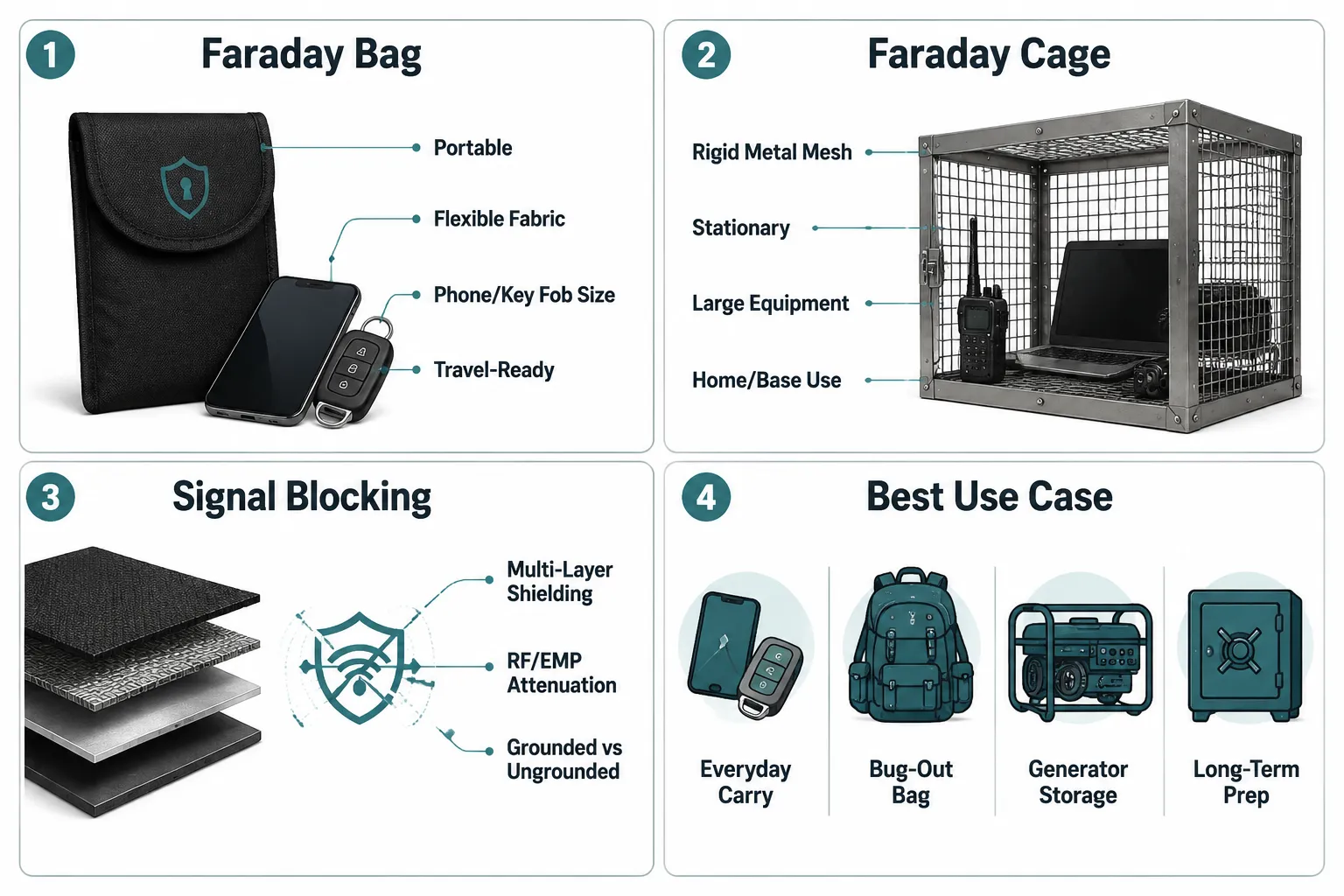
Key structural differences:
- Material: Bags use flexible multi-layer metallic fabric; cages use rigid metal mesh, sheet metal, or galvanized steel.
- Size: Bags fit phones, key fobs, passports, and small radios; cages can hold generators, laptops, two-way radios, and solar charge controllers.
- Portability: Bags go in a pocket or bug-out bag; cages stay at home or a fixed base location.
- Seal integrity: Bags rely on roll-top or velcro closures that can degrade; cages rely on tight-fitting lids and continuous metal contact.
The question of Faraday bag vs Faraday cage which is better really comes down to your scenario, not a blanket ranking.
When Should You Use a Faraday Bag vs a Faraday Cage
Use a Faraday bag when you need to protect a device while moving, during a bug-out, daily carry, or travel. Use a Faraday cage when you need to protect multiple or larger electronics stored at a home base, retreat, or off-grid location.
Choose a Faraday bag if:
- You’re protecting a single phone, key fob, or small radio
- You’re building a car emergency kit and need compact EMP protection
- You want to block GPS tracking or RFID skimming while traveling
- Budget is tight and you need immediate protection
Choose a Faraday cage if:
- You’re storing backup communication gear, solar charge controllers, or spare electronics at home
- You’re preparing for a large-scale EMP or geomagnetic storm event
- You want protection for items too large or rigid to fit in a bag
- You’re building a long-term preparedness setup and want a permanent solution
For preppers building a serious power outage preparedness plan, a cage at the base location combined with a bag for mobile gear is the most complete approach.
Do Faraday Bags Actually Work as Well as Cages
Faraday bags can work as well as cages for small devices, but only when they’re made from high-quality multi-layer materials and properly sealed. In practice, many consumer-grade bags underperform because of thin shielding layers, weak closures, or physical damage to the fabric.
A properly constructed Faraday cage, by contrast, provides more consistent and verifiable shielding because its rigid structure maintains continuous metal-to-metal contact around the entire enclosure. There’s no zipper to fail, no fabric to puncture.
What affects Faraday bag performance:
- Number of metallic shielding layers (two or more is better)
- Quality of the closure seal, roll-top closures outperform simple velcro
- Absence of tears, pinholes, or worn spots in the fabric
- Whether the device inside is powered off or in airplane mode before insertion
Testing your bag: Place your phone inside, seal it, and call the number from another phone. If it rings, the bag is failing. This simple test costs nothing and should be done on any new bag before you rely on it.

How Much Does a Faraday Bag Cost Compared to a Cage
Faraday bags range from about $15 for basic single-layer pouches to $80 or more for multi-layer, military-grade options. Faraday cages range from under $50 for a DIY galvanized steel trash can build to $300-$500 or more for commercial EMP-rated enclosures.
Rough cost comparison:
| Option | Cost Range | Best For |
|---|---|---|
| Basic Faraday bag | $15 – $30 | Phone, key fob, RFID cards |
| Premium Faraday bag | $40 – $80 | Tablet, small radio, passport |
| DIY Faraday cage | $30 – $80 | Home base electronics storage |
| Commercial Faraday cage | $150 – $500+ | Large gear, professional use |
For most preppers, a $40-$60 multi-layer bag for everyday carry plus a DIY cage for home storage covers both scenarios without breaking the budget. See the full Faraday Cage DIY step-by-step guide for a complete walkthrough on building your own.
Can a Faraday Bag Block All Signals Like a Cage Does
A high-quality Faraday bag can block most common signals, cellular, GPS, Wi-Fi, Bluetooth, and RFID, but it may not match the attenuation depth of a well-built rigid cage, particularly against the intense electromagnetic pulse from a nuclear detonation or direct lightning strike.
For everyday signal blocking (RFID skimming, GPS tracking, cellular interception), a good bag is more than sufficient. For EMP protection from a high-altitude nuclear detonation (HEMP), the physics favor a grounded, continuous metal enclosure over flexible fabric.
Signal types and typical bag performance:
- RFID/NFC: Blocked effectively by most quality bags
- Cellular/LTE: Blocked by multi-layer bags with proper sealing
- GPS: Blocked by quality bags when fully sealed
- Wi-Fi/Bluetooth: Blocked by most bags rated for RF shielding
- HEMP/EMP pulse: Partially attenuated, a cage with grounding provides stronger protection
Faraday Bag for Phone vs Full Cage, Which Is Better for Your Specific Gear
For a phone alone, a Faraday bag is the better choice, it’s practical, portable, and purpose-sized. For a collection of electronics including radios, spare batteries, solar controllers, and backup drives, a full cage is the better solution.
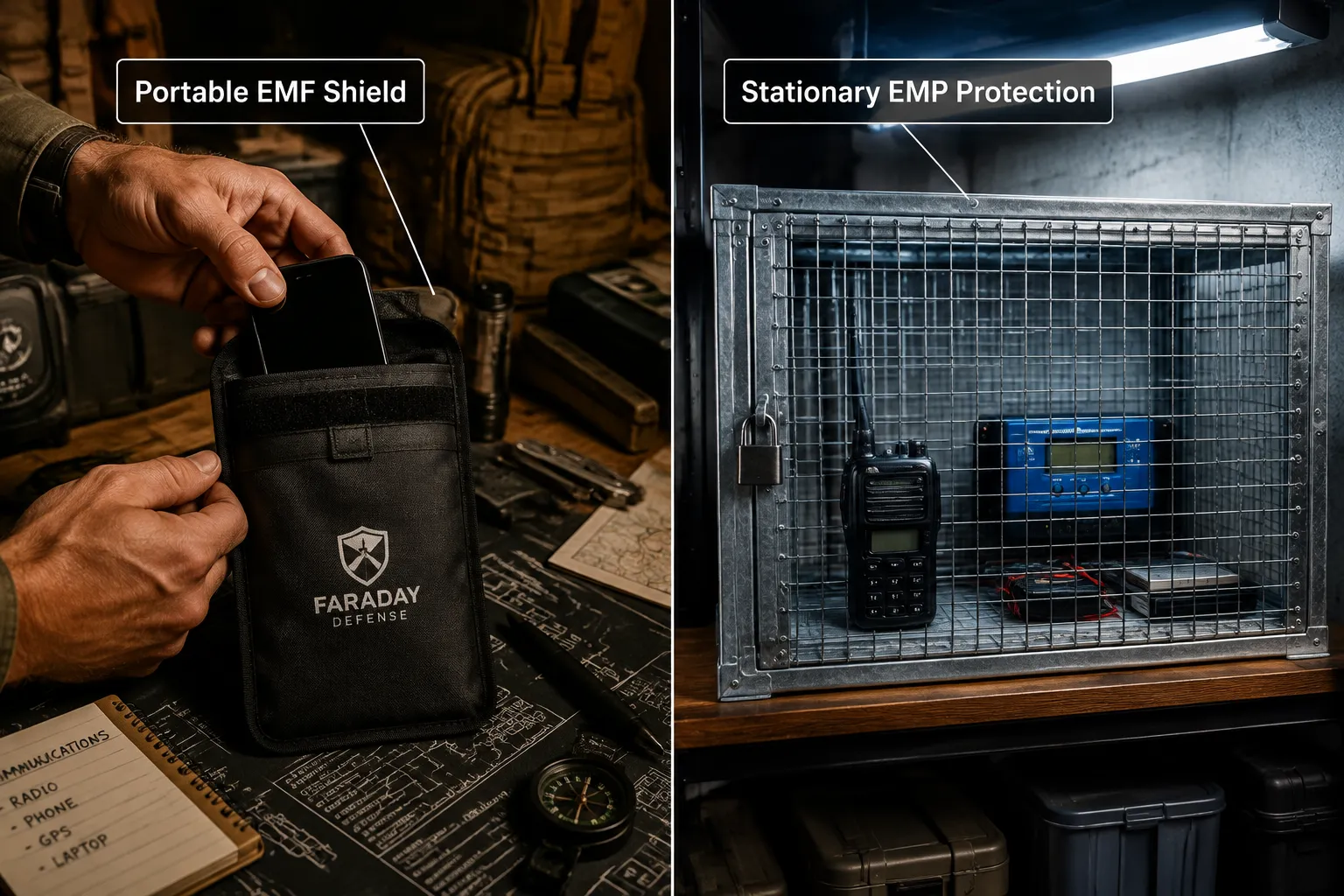
This is one of the most common points of confusion in the Faraday bag vs Faraday cage which is better debate. People assume it’s an either/or decision. It isn’t. Think of them as complementary tools, not competing ones.
Match the tool to the gear:
- Phone, key fob, passport: Faraday bag
- Two-way radios, walkie-talkies: Bag (small) or cage (multiple units)
- Laptop, tablet: Large Faraday bag or small cage
- Generator inverter, solar charge controller: Cage only
- Backup hard drives, USB drives: Bag or small cage
If you’re assembling a full emergency supplies list, plan to protect both your mobile devices and your stationary backup electronics.
What Size Faraday Cage Do You Need for Your Equipment
The cage needs to be large enough that no item inside touches the walls, with at least 1-2 inches of clearance on all sides. Contact between a device and the cage wall can create a conductive path that compromises shielding.
Common cage sizes and what fits:
- Small ammo can (30 cal): USB drives, small radios, batteries
- Large ammo can (50 cal): Handheld radio, small solar controller, spare phone
- 20-gallon galvanized trash can: Laptop, multiple radios, cables, backup drives
- 32-gallon trash can: Full communications kit, inverter, larger electronics
Always line the interior with cardboard, foam, or rubber to prevent devices from touching the metal walls. This is the single most common DIY mistake that causes shielding failure.
Who Actually Needs a Faraday Cage vs Just a Bag
Most everyday preppers can start with a quality Faraday bag and add a cage later. Someone building a serious off-grid communications setup, protecting a ham radio station, or preparing specifically for an EMP or geomagnetic storm scenario needs a cage.
You probably need a cage if:
- You have a ham radio, CB radio, or GMRS setup at home
- You’re storing backup electronics for a long-term grid-down scenario
- You’re building a backup power system with solar and inverters
- You’re preparing for a HEMP or Carrington-level geomagnetic event
A bag is probably enough if:
- You want to protect your phone and key fob from everyday RF threats
- You’re building a go-bag or evacuation plan and need compact protection
- You’re new to prepping and want an affordable starting point
Faraday Bag Not Blocking Signals, Troubleshooting
If your Faraday bag fails the phone-call test, the most common causes are an improper seal, physical damage to the fabric, or a single-layer bag that lacks sufficient shielding depth.
Troubleshooting checklist:
- Re-seal the bag completely, roll-top closures need at least 3 full rolls
- Inspect the fabric for pinholes, tears, or worn areas near seams
- Check whether the bag is single-layer (likely insufficient for cellular blocking)
- Make sure the phone is in airplane mode before testing, some signals can still leak through with the radio active
- Test in a different location, proximity to a strong cell tower can overwhelm a marginal bag
- Replace with a multi-layer bag if the single-layer version keeps failing
A bag that fails the call test should not be trusted for EMP protection either. Replace it before you need it.
Can You Make a Faraday Bag at Home Instead of Buying One
A DIY Faraday bag can work, but it requires multiple layers of heavy-duty aluminum foil with no gaps, wrapped tightly around the device. It’s a short-term solution, not a reliable long-term one.
DIY Faraday bag method:
- Wrap the device in a layer of plastic wrap or place it in a plastic bag (prevents grounding contact)
- Wrap tightly in 3-4 layers of heavy-duty aluminum foil, overlapping all seams
- Seal all edges, no gaps, no tears
- Test with the phone-call method before trusting it
This works in a pinch. But foil wrapping is fragile, difficult to reseal, and not practical for daily use. For a permanent solution, a purpose-built bag or a DIY cage built from a metal ammo can is more reliable. The full Faraday Cage DIY guide covers both approaches in detail.
Faraday Cage Alternatives for Home Use
If a full cage isn’t practical, a metal ammo can, a galvanized steel trash can with a tight-fitting lid, or even a microwave oven (unplugged) can provide partial Faraday shielding. These aren’t perfect, but they’re better than no protection.
Practical alternatives ranked by effectiveness:
- Galvanized steel trash can with gasket-sealed lid: Best DIY option
- Military surplus ammo cans (30 or 50 cal): Excellent for small electronics
- Metal filing cabinet with continuous metal contact on the drawer: Moderate protection
- Unplugged microwave oven: Partial protection, not rated for EMP
- Aluminum foil-lined cardboard box: Minimal protection, last resort only
For preppers living in small spaces, a 30-cal ammo can on a shelf takes up almost no room and protects a meaningful amount of backup gear. See survival prepping in small spaces for more compact storage ideas.
FAQ: Faraday Bag or Faraday Cage Which Is Better for Preppers
Does a Faraday bag need to be grounded to work? No. Faraday bags do not need to be grounded to block everyday signals like cellular, GPS, and RFID. Grounding becomes more relevant for large rigid cages designed to handle the surge from a direct EMP event, but for portable bags, the multi-layer shielding alone provides the protection.
Can I use a Faraday bag to stop my car from being stolen? Yes. Placing your key fob in a Faraday bag blocks the relay signals that thieves use to amplify and clone the fob’s signal to unlock and start modern keyless-entry vehicles. This is one of the most practical everyday uses of a Faraday bag.
Will a Faraday cage protect electronics from a nuclear EMP? A well-built, properly sealed Faraday cage provides meaningful protection against EMP, but no cage guarantees 100% protection from a high-altitude nuclear EMP. The intensity, distance, and orientation all affect outcomes. A grounded cage with no gaps offers the best available protection short of military-hardened equipment.
Do I need to turn my phone off before putting it in a Faraday bag? Turning the phone off or switching it to airplane mode before bagging it is best practice. An active phone continues trying to connect to networks, which can slightly degrade the bag’s effective shielding and also drains the battery.
Can a Faraday bag protect a laptop? Yes, but you need a bag specifically sized for laptops. Standard phone-sized bags won’t work. Large Faraday bags designed for laptops and tablets are available and provide the same multi-layer shielding in a larger format.
Is a metal garbage can a good Faraday cage? A galvanized steel trash can with a tight-fitting metal lid is one of the most recommended DIY Faraday cage options. The key is ensuring continuous metal contact between the lid and the can body. Adding a rubber gasket or copper tape around the rim improves the seal significantly.
How do I know if my Faraday cage is working? Place a phone inside, close the lid completely, and call it from another phone. No ring means the cage is blocking cellular signals. You can also check for Wi-Fi or Bluetooth signals from a device inside, if they disappear from your network scan, the cage is working.
Can a Faraday bag block 5G signals? Quality multi-layer Faraday bags rated for high-frequency RF shielding can block 5G signals, but not all bags are built for the higher frequency ranges 5G uses. Look for bags that specify shielding effectiveness across a broad frequency range including above 3 GHz.
Should I store my Faraday bag inside a Faraday cage? For maximum protection of critical devices, yes. Nesting a bagged device inside a cage provides two layers of shielding, a practical approach for irreplaceable backup electronics or communication gear.
What’s the biggest mistake people make with Faraday protection? Buying a cheap single-layer bag, never testing it, and assuming it works. The bag-in-a-drawer that has never been tested is not a preparedness asset. Test every bag when you buy it and retest periodically, especially if it’s been handled frequently.
Conclusion
The Faraday bag vs Faraday cage which is better question has a practical answer: use both, matched to your actual gear and scenarios. A quality multi-layer Faraday bag handles everyday carry, travel, and mobile protection. A properly built Faraday cage, whether DIY or commercial, handles your stationary backup electronics, communications gear, and anything too large for a bag.
Start with a bag. Test it the day it arrives. Then build or buy a cage for your base location, sized to fit the electronics you’d actually need after a grid-down event. Neither solution requires a large investment, and both provide meaningful protection against threats ranging from RFID skimming to EMP events.
Actionable next steps:
- Buy a multi-layer Faraday bag rated for cellular and GPS blocking, and test it immediately with the phone-call method.
- Inventory the electronics at your home base that would be critical in a grid-down scenario (radios, solar controllers, backup drives).
- Build or purchase a Faraday cage sized for that gear, a galvanized trash can or ammo can works for most preppers.
- Review the Faraday Cage DIY guide to build your own for under $50.
- Integrate EMP protection into your broader emergency communication plan so your gear is still usable when it matters most.
Products, Tools, and Resources
Faraday bags worth considering:
- Faraday Bag by Grid Doctor (110 Liter), One of the most tested multi-layer bags on the market, with documented attenuation specs. Available in phone, tablet, and laptop sizes. Preferred by security professionals and preppers who want verified performance.
- SLNT Faraday Sleeve, A slim, durable option for phones and key fobs. Good everyday carry choice with a low profile.
- Faraday Defense NEST-Z, A larger bag designed for tablets and small electronics kits. Useful for protecting a backup communications pouch.
For Faraday cages:
- Behrens galvanized steel trash cans, The go-to for DIY cage builds. Widely available at hardware stores, affordable, and easy to line with cardboard for interior insulation.
- Military surplus 50-cal ammo cans, Compact, airtight, and naturally conductive. Ideal for protecting a small radio kit or USB backup drives.
- Copper tape with conductive adhesive, Used to seal the lid-to-body gap on DIY cages. A small roll dramatically improves shielding integrity.
For a complete build walkthrough, the Faraday Cage DIY guide at Preppers HQ covers materials, construction steps, and testing methods in full detail.