

Hey there! Some links on this page may be affiliate links which means that, if you choose to make a purchase, I may earn a commission at no extra cost to you. I greatly appreciate your support. Read the full disclosure here.
An electromagnetic pulse event does not announce itself. One second your electronics work. The next, every unprotected device in your home is a paperweight. The U.S. EMP Commission has warned Congress multiple times that a single high-altitude nuclear detonation could disable unshielded electronics across a continent-sized area. Whether the threat is a nuclear EMP, a Coronal Mass Ejection (CME), or targeted electronic warfare, the solution is the same: a properly built Faraday cage.
This guide covers everything you need to know about Faraday cage DIY how to build, from the physics behind the protection to step-by-step construction methods, common mistakes, and how to verify your cage actually works. No fluff. No fear-mongering. Just practical, actionable information for preppers who want real protection.
For a broader view of grid-down scenarios and what they mean for your preparedness plan, see our EMP attack and grid failure survival guide.

Key Takeaways
- A Faraday cage works by distributing electromagnetic energy around its conductive shell, preventing it from reaching the interior.
- You do not need expensive materials, a galvanized steel trash can, metal ammo can, or even aluminum foil over a cardboard box can provide meaningful protection.
- Continuous conductive coverage with no gaps is more important than the specific material you use.
- Always insulate your electronics from the cage walls, direct contact can actually transfer charge to your devices.
- Testing your cage with a cell phone or AM radio is the fastest way to confirm it works before trusting it with critical gear.
- A DIY Faraday cage built correctly costs between $10 and $80 depending on size and materials.
- Building one yourself is almost always better value than buying a pre-made unit for basic protection needs.
- Grounding a Faraday cage is debated among experts, for EMP protection specifically, an ungrounded cage can still be highly effective.
What Is a Faraday Cage and How Does It Work
A Faraday cage is any enclosure made of conductive material that blocks electromagnetic fields from penetrating its interior. When an electromagnetic wave hits the conductive shell, the free electrons in the metal redistribute themselves to cancel out the incoming field, effectively shielding whatever is inside.
Named after scientist Michael Faraday, who demonstrated the principle in 1836, the concept is straightforward: surround your electronics with a continuous conductive barrier, and electromagnetic energy cannot reach them. The cage does not absorb the energy, it redirects it around the outside of the enclosure.
For preppers, the practical implication is this: any device stored inside a properly built Faraday cage during an EMP or severe CME event should survive intact and be operational afterward. That means your backup radio, spare GPS, medical devices, and communication equipment could be the difference between recovery and helplessness in a grid-down scenario.
How the physics actually plays out:
- High-frequency signals (like radio waves) require denser mesh or thicker metal to block effectively.
- Low-frequency fields are easier to block and require less material.
- EMP from a nuclear detonation produces a very fast, high-frequency pulse (the E1 component) that is the hardest to block, this is why gaps and seams matter so much.
- Solar CME events produce slower, lower-frequency surges that are somewhat easier to shield against.
Do I Really Need a Faraday Cage at Home
For most preppers, yes, especially if your preparedness plan includes grid-down scenarios lasting more than a few days. A Faraday cage is one of the few preparations that protects gear you have already invested in rather than adding new supplies.
Consider what you would lose without one: backup communication radios, spare solar charge controllers, medical devices, GPS units, and any electronics you plan to rely on post-event. Replacing these after an EMP is not possible if the grid is down and supply chains are disrupted.
You especially need one if:
- You own a backup ham radio or shortwave receiver for post-disaster communication.
- You have a spare solar charge controller or inverter stored for off-grid power.
- You rely on electronic medical devices (insulin pumps, pacemaker accessories, CPAP machines).
- You store a secondary phone, laptop, or tablet for emergency use.
You can probably skip it if:
- Your preparedness plan is entirely analog, no electronics beyond a hand-crank radio.
- You live off-grid with no electronic infrastructure to protect.
Building even one small Faraday cage for your most critical gear is a low-cost, high-value step. It fits naturally into a broader home emergency preparedness plan.
Cheapest Materials to Build a Faraday Cage
The most affordable Faraday cage materials are galvanized steel trash cans, metal ammo cans, and aluminum foil, all of which cost between $10 and $40 at hardware or sporting goods stores.
You do not need exotic materials. The key property is electrical conductivity and continuous coverage. Here is a breakdown of the most practical options by cost:
| Material | Approx. Cost | Best For | Limitation |
|---|---|---|---|
| Galvanized steel trash can (with lid) | $20,$40 | Medium to large gear storage | Lid seal must be tight |
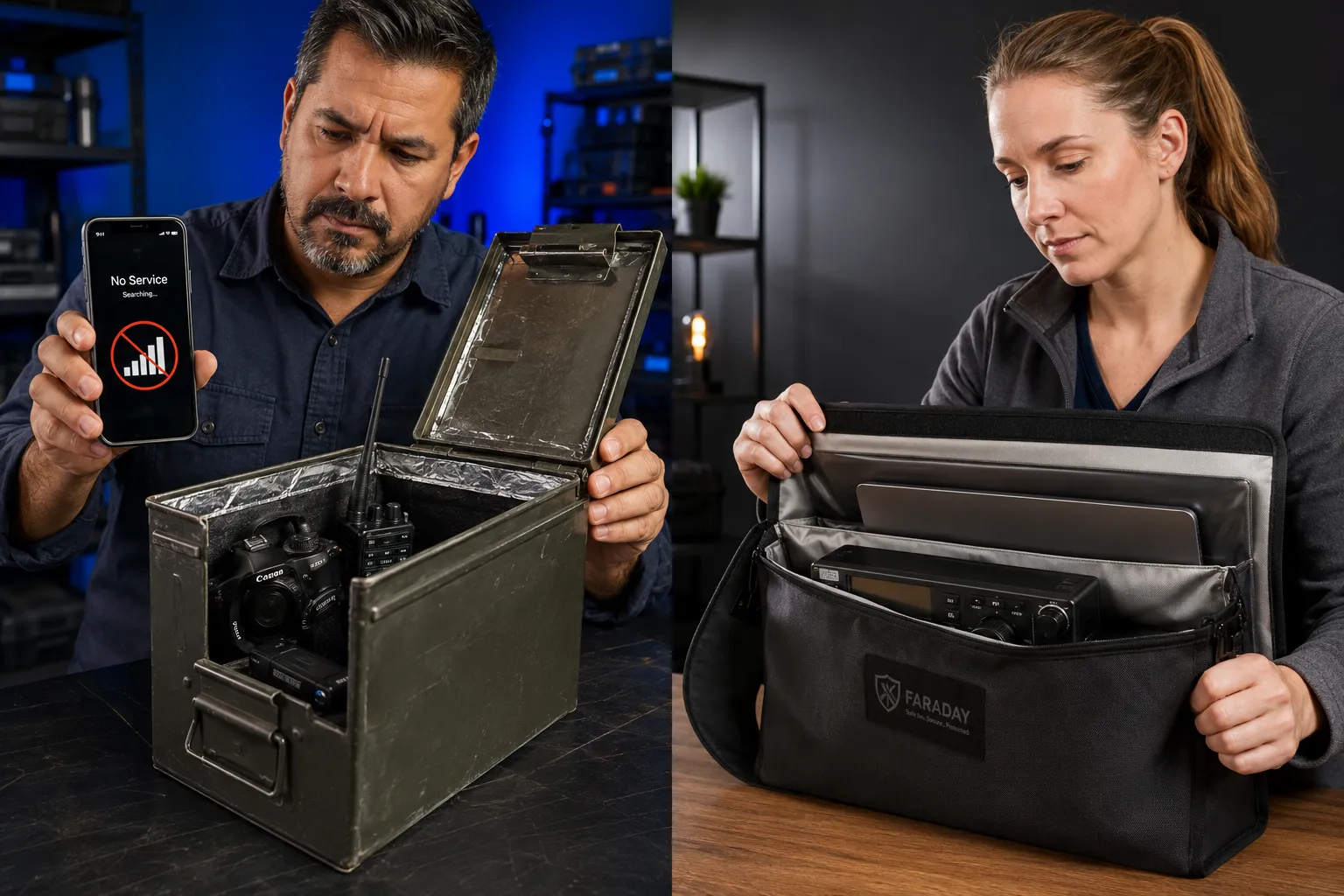
| Metal ammo can (military surplus) | $15,$30 | Small electronics, phones, radios | Limited interior space |
| Aluminum foil + cardboard box | $5,$10 | Quick, temporary protection | Tears easily; gaps likely |
| Copper mesh fabric | $25,$60/yard | Custom-shaped enclosures | Seams require conductive tape |
| Steel filing cabinet | $0 (repurposed) | Large gear, documents, hard drives | Drawer gaps need sealing |
Pro tip: The galvanized steel trash can is the go-to recommendation for most preppers. It is widely available, inexpensive, holds a significant amount of gear, and the lid creates a reasonably tight conductive seal when properly maintained.

Faraday Cage DIY How To Build: Step-by-Step Methods
Building a DIY Faraday cage is a straightforward process that takes 30 minutes to a few hours depending on the method. The core principle is always the same: create a complete conductive enclosure with no gaps, and insulate your electronics from the walls.

Method 1: Galvanized Steel Trash Can (Recommended for Most Preppers)
This is the most practical Faraday cage DIY how to build method for protecting multiple devices at once.
What you need:
- Galvanized steel trash can with a tight-fitting metal lid
- Foam padding, cardboard, or rubber mat (for insulation)
- Conductive aluminum tape (optional, for sealing the lid seam)
- A multimeter (for testing)
Steps:
- Purchase a galvanized steel trash can, not plastic, not powder-coated. The metal must be exposed and conductive.
- Line the interior with non-conductive material: foam, cardboard, or a rubber mat. This prevents your devices from touching the metal walls directly.
- Wrap each device in a layer of plastic bags or bubble wrap for an additional insulation barrier.
- Place your electronics inside. Do not let any device touch the metal walls or floor.
- Seal the lid. If the lid fits loosely, run a strip of conductive aluminum tape around the seam where the lid meets the can body. This closes any electromagnetic gap.
- Test before trusting (see the testing section below).
Method 2: Metal Ammo Can
Military surplus ammo cans have a rubber gasket that seals the lid, but that gasket is non-conductive. For EMP protection, you need to bridge the lid-to-body gap with conductive tape.
Steps:
- Remove the rubber gasket or bridge it with conductive tape around the entire lid perimeter.
- Line the interior with foam or cardboard.
- Place wrapped electronics inside.
- Close and latch the lid.
- Test with a cell phone (see testing section).
Method 3: Aluminum Foil Wrap (Budget Option)
This method works for temporary or emergency protection but is less reliable than a rigid metal container.
- Wrap the device in a layer of plastic (a zip-lock bag works well).
- Wrap that in at least three complete layers of heavy-duty aluminum foil, overlapping edges by at least 2 inches.
- Wrap again in another layer of plastic.
- Add a final layer of foil.
The double-layer approach compensates for pinholes and thin spots. This is not a long-term solution, but it beats nothing if you are caught without a metal container.
Faraday Cage DIY vs Buying One: Which Is Better
For most preppers, building a DIY Faraday cage is the better choice. A galvanized trash can or ammo can costs $15,$40 and provides comparable or superior protection to commercial Faraday bags priced at $30,$150.
Commercial Faraday bags and pouches have their place, they are portable, lightweight, and convenient for everyday carry items like phones and key fobs. But for storing critical backup gear at home, a rigid metal container beats a flexible bag every time. Bags can develop micro-tears, their seams are a weak point, and they cannot protect larger items like solar charge controllers or backup laptops.
Choose DIY if:
- You need to protect multiple or larger devices.
- You want a permanent, reliable home storage solution.
- Budget is a priority.
Choose commercial if:
- You need portable protection for a phone or key fob.
- You want a tested, certified product with known attenuation ratings.
- You are protecting against RFID skimming or everyday signal interception rather than full EMP events.
For preppers building out their complete bug out bag, a small commercial Faraday pouch for a backup phone makes sense alongside a larger DIY cage at home.
Can a Faraday Cage Block All Signals or Just Some
A Faraday cage blocks most electromagnetic signals, but not all, and the effectiveness depends heavily on the frequency of the signal, the material used, and the quality of construction.
Here is what a well-built Faraday cage will and will not block:
Typically blocked:
- Cell phone signals (700 MHz, 2.7 GHz range)
- Wi-Fi (2.4 GHz and 5 GHz)
- Bluetooth
- EMP E1 pulse (if construction is tight)
- Radio frequency identification (RFID)
Harder to block or partially blocked:
- Very low frequency (VLF) signals used by submarines
- DC magnetic fields (a Faraday cage does not block static magnetic fields)
- EMP E3 component (a slow magnetic pulse similar to a CME, requires additional protection)
Practical implication: A steel trash can with a properly sealed lid will block cell signals, Wi-Fi, and most EMP components. It will not block a DC magnetic field from a strong magnet placed against the outside. For the threats preppers face, EMP, CME, and signal interception, a well-built DIY cage is adequate.
Common Mistakes People Make Building Faraday Cages
The most common mistake is leaving gaps in the conductive enclosure, particularly at the lid or door seam. A gap as small as a few millimeters can allow high-frequency EMP components to penetrate.
Other frequent errors that undermine protection:
- Letting electronics touch the cage walls. If a device contacts the conductive shell, charge can transfer to the device’s external casing and potentially damage internal components. Always insulate.
- Using a painted or powder-coated metal container. Paint is non-conductive. A painted trash can is not a Faraday cage. The metal surface must be bare and exposed.
- Assuming one layer of foil is enough. Single-layer aluminum foil has pinholes and thin spots. Use multiple overlapping layers.
- Not sealing the lid. The lid-to-body junction is the most common failure point on trash can builds. Conductive tape solves this.
- Grounding incorrectly. Grounding a Faraday cage can actually make it more vulnerable to certain EMP components if the ground wire acts as an antenna. For home EMP protection, an ungrounded cage is often safer.
- Storing devices with batteries connected to external antennas. Antennas are designed to collect electromagnetic energy. If a device inside the cage has an external antenna running through the cage wall, you have created a direct path for the EMP to follow.
How to Test If Your DIY Faraday Cage Actually Works
The fastest test is placing a cell phone inside the sealed cage and calling it from another phone. If the call goes through, the cage is not blocking signals adequately. If it goes straight to voicemail or shows no service, you have a working enclosure.
Step-by-step testing process:
- Place a cell phone inside the cage with the lid or seal fully closed.
- Call the phone from another device.
- If it rings, find and seal the gap, common locations are the lid seam, any handle holes, or thin spots in the metal.
- Repeat until the phone shows no signal.
- For more rigorous testing, place an AM/FM radio inside tuned to a strong local station. A working cage will silence the broadcast.
- For the most thorough test, use a multimeter to verify electrical continuity across the entire outer surface, confirming there are no breaks in the conductive path.
Edge case: Cell phone frequencies (700 MHz, 2.7 GHz) are higher frequency than the EMP E3 component. A cage that blocks cell signals may not fully block slower, lower-frequency magnetic surges from a CME. However, if it blocks cell signals, it will almost certainly handle the fast E1 EMP component, which is the most immediately damaging to solid-state electronics.
Faraday Cage Alternatives That Work Just as Well
For small electronics and everyday carry items, several alternatives to a full Faraday cage provide meaningful protection. For large-scale EMP protection, nothing replaces a properly built metal enclosure.
Practical alternatives:
- Commercial Faraday bags and pouches: Rated alternatives for phones, key fobs, and credit cards. Look for products with verified attenuation ratings (typically 40-60 dB for quality bags).
- Microwave ovens (unplugged): A microwave’s metal shell and door mesh are designed to contain microwave-frequency radiation. An unplugged microwave can block many signals, though it is not rated for EMP protection and should not be relied upon for that purpose.
- Steel filing cabinets: A repurposed metal filing cabinet with gaps sealed using conductive tape can protect a significant amount of gear. The drawer seams need attention.
- Metal cookie tins: For small items like USB drives, spare SD cards, or backup hearing aids, a metal tin with a tight-fitting lid provides basic protection.
None of these alternatives match a purpose-built, tested Faraday cage for critical gear. But they are better than nothing, and layering multiple levels of protection is always smart prepper strategy.
How Big Should My Faraday Cage Be
Your Faraday cage should be large enough to hold your most critical backup electronics without them touching the walls. For most preppers, that means at least one medium-sized container (a 20-gallon trash can) and one small container (an ammo can) for different gear categories.
Planning your size by what you are protecting:
- Phones, radios, and small devices: A 30-caliber or 50-caliber ammo can is sufficient.
- Laptops, tablets, and backup solar equipment: A 20-32 gallon galvanized trash can.
- Large backup power equipment (charge controllers, inverters): A 55-gallon drum or a sealed metal cabinet.
A common mistake is building one cage and trying to cram everything in. Separate your gear into tiers: the items you absolutely cannot replace go in the most secure, best-sealed container. Secondary gear can go in a secondary container.
Faraday Cage for Phone vs Faraday Cage for Room: Key Differences
A phone-sized Faraday cage and a room-sized Faraday cage serve fundamentally different purposes and are built to entirely different standards. A phone cage blocks signals to a single device. A Faraday room (also called a shielded room or RF-shielded enclosure) blocks all electromagnetic energy from entering an entire space.
Phone/device cage:
- Built from a metal container, foil, or commercial pouch.
- Costs $10,$80 DIY.
- Protects specific stored devices.
- Practical for preppers at any budget level.
Room-sized Faraday cage:
- Requires copper or steel mesh embedded in walls, floors, and ceiling.
- All electrical penetrations (outlets, pipes, HVAC) require special RF filters.
- Costs tens of thousands of dollars for professional installation.
- Used by military facilities, government secure rooms, and high-security data centers.
- Not practical for most residential preppers.
For the vast majority of preppers, a device-level Faraday cage is the right answer. A Faraday room is a specialized infrastructure project, not a weekend DIY build.
Faraday Cage Legal Issues: Are You Allowed to Build One
Building and owning a Faraday cage for personal use and storage is legal in the United States and most countries. There are no federal laws prohibiting the construction or possession of Faraday cages for personal protection of electronics.
However, there is one important legal boundary: using a Faraday cage to block signals from a device you are legally required to make available, such as an ankle monitor or court-ordered GPS tracker, is illegal. Similarly, using a Faraday pouch to block a cell phone signal in a context where that constitutes obstruction of justice is a legal problem.
What is legal:
- Building a Faraday cage to protect your personal electronics from EMP or CME events.
- Storing devices inside a Faraday cage.
- Using a Faraday pouch to protect your own phone from RFID skimming.
What is not legal:
- Blocking signals from a court-ordered monitoring device.
- Using a Faraday enclosure to prevent lawful interception in contexts where that is required by law.
For the vast majority of preppers building home protection against EMP and CME threats, there are no legal concerns whatsoever.
Faraday Cage for Car: How It Is Different from a Regular One
A Faraday cage for a car is a fundamentally different challenge from a home storage cage. Modern vehicles are not Faraday cages, they have extensive electronic systems, antennas, and sensors that are exposed to electromagnetic events.
Some preppers ask whether parking a car in a metal garage provides protection. The answer is: marginally, but not reliably. A typical metal garage has large gaps (doors, windows, vents) that allow EMP penetration. A true automotive Faraday cage would require a fully sealed metal enclosure with no gaps, essentially a specialized shielded garage that is impractical for most people.
Practical approaches for vehicle EMP protection:
- Store spare electronic vehicle components (ignition modules, ECUs for older vehicles, backup radios) in a Faraday cage inside your home.
- Consider keeping an older, pre-electronic-ignition vehicle (pre-1980s) as a backup, these have minimal solid-state electronics to damage.
- For your everyday vehicle, focus on having non-electronic transportation alternatives (bicycles, horses, or feet) as part of your bug out planning.
The car itself is difficult to protect. The smarter approach is protecting the spare parts and backup communication gear you would need after an event.
Frequently Asked Questions
Does a Faraday cage need to be grounded to work? No. For EMP protection specifically, grounding is not required and can sometimes be counterproductive if the ground wire acts as an antenna. An ungrounded, sealed metal enclosure is effective for blocking electromagnetic pulses.
Will a Faraday cage protect against a nuclear EMP? A well-built cage with no gaps and proper internal insulation will protect against the E1 component of a nuclear EMP, which is the fastest and most damaging to solid-state electronics. The E3 component (a slower magnetic surge) is harder to block but less immediately damaging to small electronics.
Can I use a regular cardboard box covered in foil? Yes, with caveats. Multiple overlapping layers of heavy-duty aluminum foil over a cardboard box provide basic protection. It is less reliable than a rigid metal container because foil tears and gaps form easily. Use it as a temporary measure, not a permanent solution.
Does the size of the mesh matter for a Faraday cage? Yes. Mesh openings should be smaller than the wavelength of the signals you are blocking. For EMP E1 protection, openings smaller than 1mm are recommended. For blocking cell phone signals, openings under 5cm are generally sufficient.
Should I keep my devices turned on or off inside a Faraday cage? Off is safer. A powered device with active antennas or wireless radios may be more susceptible to damage if the cage is imperfect. Powered-off devices have no active antenna elements drawing in electromagnetic energy.
Can a Faraday cage block a CME from the sun? A Faraday cage protects against the fast electromagnetic pulse components of a CME. The geomagnetically induced currents (GIC) from a severe CME affect the power grid infrastructure rather than individual electronics directly. Your cage protects your devices; it cannot protect the grid.
How long will a DIY Faraday cage last? A galvanized steel trash can or ammo can built correctly will last decades with minimal maintenance. Check the lid seal annually and replace conductive tape if it loses adhesion. Avoid storing in humid environments that accelerate corrosion.
Is a microwave oven a Faraday cage? An unplugged microwave oven blocks many radio frequencies due to its metal shell and door mesh. However, it is not designed or tested for EMP protection, and the power cord and door gaps make it unreliable for that purpose. Use it only as a last resort.
What electronics should I prioritize protecting? In order of priority: backup communication radio (ham or shortwave), spare solar charge controller, backup GPS, secondary phone loaded with offline maps and documents, medical device backups, and spare hard drives with critical data.
Can I build a Faraday cage for my whole house? Technically yes, but it requires embedding copper or steel mesh into every wall, floor, and ceiling surface, filtering every electrical and plumbing penetration, and installing RF-filtered doors and windows. The cost runs into tens of thousands of dollars. It is not practical for residential preppers.
Conclusion
A Faraday cage is one of the most cost-effective, practical preparations a serious prepper can make. For $20,$40 and an hour of work, a galvanized steel trash can becomes a reliable shield for your most critical electronics against EMP and CME events. The physics are well-established, the materials are widely available, and the construction process is straightforward enough for anyone to complete.
The key principles to carry forward: use bare metal, seal every gap, insulate your devices from the walls, and test before you trust. Build one cage for your most critical gear today, and expand from there as your preparedness plan develops.
Actionable next steps:
- Identify the three to five electronic devices most critical to your post-disaster plan.
- Purchase a galvanized steel trash can and foam padding this week.
- Build and test your first Faraday cage using the cell phone test.
- Store your backup radio, spare solar components, and secondary phone inside.
- Review your broader grid-down preparedness plan, including cooking without power and communication alternatives.
For preppers building out a complete emergency system, a Faraday cage pairs naturally with a 72-hour emergency kit and a solid urban survival skill set.
Products, Tools, and Resources
Galvanized steel trash cans (20-32 gallon): Available at hardware stores like Home Depot or Lowe’s. Look for cans with bare metal lids, avoid plastic lids or powder-coated finishes. Brands like Behrens are widely trusted in the prepper community.
Military surplus ammo cans: Available at surplus stores, gun shows, and online retailers. The 50-caliber size is the most versatile for small electronics. Inspect the lid gasket and replace with conductive tape before use.
Conductive aluminum tape: 3M and Nashua both make reliable conductive foil tape. Avoid standard HVAC tape, it must be conductive, not just metallic-looking.
Commercial Faraday bags: Mission Darkness and SLNT make well-regarded bags for portable protection of phones and small devices. Look for products that publish verified attenuation ratings.
Multimeter: Any basic digital multimeter (Fluke, Klein Tools, or budget options from Harbor Freight) works for continuity testing. This is a worthwhile tool for any prepper’s kit.
Copper mesh fabric: Available from specialty electronics suppliers and online marketplaces. Useful for custom-shaped enclosures or lining wooden boxes. Ensure seams are joined with conductive tape, not standard adhesive.
For a complete look at what electronics and gear deserve protection, the essential survival gear guide is a strong starting point for prioritizing your investment.