
Hey there! Some links on this page may be affiliate links which means that, if you choose to make a purchase, I may earn a commission at no extra cost to you. I greatly appreciate your support. Read the full disclosure here.
Our guide “How to stay mentally calm in survival situations” is about maintaining clear thinking and controlled action despite fear, not the absence of it. Techniques like controlled breathing, mental rehearsal, and focused problem-solving disrupt panic and improve decision-making. Preparing your mind ahead of time is as crucial as having the right skills and gear.
Key Takeaways
- Panic is a physiological response, not a character flaw, but it can be interrupted and controlled with the right techniques.
- Controlled breathing is the single fastest tool for restoring mental clarity in a crisis, and it works within 60 to 90 seconds.
- The difference between survival and tragedy often comes down to mental state, not gear or physical ability.
- Special forces personnel use deliberate pre-training, rehearsal, and breathing protocols, not willpower, to stay calm under fire.
- Denial is not the same as calmness. Genuine calm includes clear-eyed acknowledgment of the threat.
- Common mental mistakes, freezing, catastrophizing, and rushing decisions, are predictable and avoidable.
- You can train your nervous system to respond better before an emergency ever happens.
- Focusing on the next small, actionable step is more effective than trying to solve the entire situation at once.
Find this useful? Add us as a preferred source on Google and more of what we publish will show up in your results.
What Mental Calmness Actually Means in a Survival Situation
Mental calmness in a survival context does not mean feeling no fear. It means maintaining enough cognitive control to assess, decide, and act despite fear. A calm survivor acknowledges danger clearly, regulates their emotional response, and channels adrenaline into useful action rather than paralysis or reckless movement.
This distinction matters because many people confuse calmness with the absence of stress. In reality, a calm survivor’s heart rate may still be elevated. Their hands may still shake. What separates them from someone in full panic is that their prefrontal cortex, the decision-making center of the brain, remains online. That’s the goal.
For preppers and survivalists, understanding this definition reframes the entire challenge. The task isn’t to stop feeling afraid. It’s to keep thinking clearly while afraid.
Why Panic Makes Survival Situations Worse
Panic actively degrades every skill you need to survive. When the brain perceives extreme threat, the amygdala triggers a stress response that floods the body with cortisol and adrenaline. This is useful for short bursts of physical action, but it also narrows attention, impairs memory recall, and reduces the ability to think through multi-step problems.
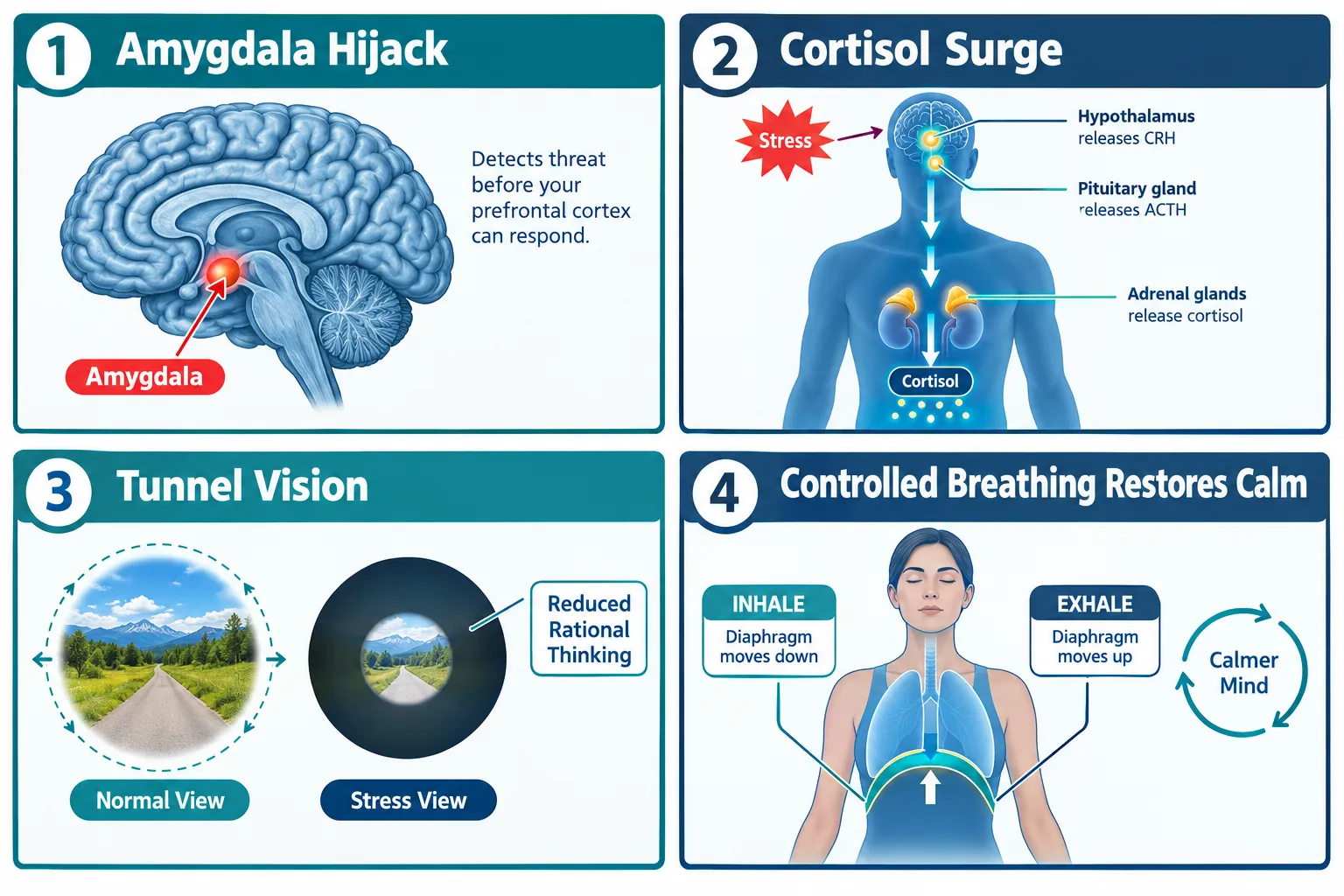
In practical terms, panic causes:
- Tunnel vision, you stop scanning your environment for resources or threats
- Decision paralysis, the brain cycles through options without committing
- Impulsive action, moving fast in the wrong direction, burning energy and worsening the situation
- Hyperventilation, which reduces oxygen to the brain and amplifies anxiety in a feedback loop
- Memory failure, trained skills become harder to access under extreme stress
Research in disaster psychology consistently shows that untrained individuals often freeze or flee in the first minutes of a crisis, while those with prior mental preparation move into problem-solving mode faster. Understanding this cycle is the first step toward breaking it.
For a deeper look at the psychological side of preparedness, the Psychological Preparedness In Crisis Situations guide covers the full spectrum of crisis psychology relevant to preppers.
How To Control Your Breathing When You’re Scared and In Danger
Controlled breathing is the fastest, most accessible tool for interrupting panic, and it works because breathing is the one part of the autonomic nervous system you can consciously override. Slowing and deepening your breath directly activates the parasympathetic nervous system, which counteracts the stress response.
The most field-tested method is tactical breathing, also called box breathing:
- Inhale slowly through the nose for 4 counts
- Hold for 4 counts
- Exhale slowly through the mouth for 4 counts
- Hold for 4 counts
- Repeat 4 to 6 cycles
This technique is used by military personnel, emergency responders, and competitive athletes. It doesn’t require equipment, silence, or a calm environment. It works in the middle of chaos.
Common mistake: Many people try to breathe deeply but rush through it. The key is the slow, deliberate pace, not the depth alone. Even two or three slow exhales can begin to reduce cortisol levels and restore clearer thinking.
If you’re with children in a survival scenario, teaching them this same technique in advance is one of the most valuable things you can do. The 12 Essential Survival Skills For Kids resource covers age-appropriate mental and physical preparedness for younger family members.
What’s the Difference Between Staying Calm and Being in Denial During Emergencies
Staying calm means accurately perceiving a threat and choosing a measured response. Denial means minimizing or ignoring the threat to avoid the discomfort of confronting it. These two states feel similar from the inside but produce opposite outcomes.
A person in denial might say, “This isn’t that serious, it’ll pass,” and delay taking shelter, signaling for help, or rationing water. A genuinely calm person says, “This is serious. Here’s what I know, here’s what I don’t know, and here’s my next step.”
The practical test: Ask yourself whether your current behavior is based on the situation as it actually is, or the situation as you wish it were. Denial protects feelings. Calm protects lives.
Survivalists who have read about the Survival Mindset Mental Preparation For Disaster Guide will recognize this as the core of the “STOP” protocol, Stop, Think, Observe, Plan, which forces reality-based assessment before action.
Techniques To Calm Your Mind When Lost or Stranded
When lost or stranded, the mind tends to catastrophize, jumping immediately to worst-case outcomes. This is a survival instinct, but it consumes cognitive resources you need for problem-solving. Several techniques help interrupt this pattern.
The STOP Protocol
- Stop, Physically halt movement. Sit down if possible.
- Think, Acknowledge your situation without judgment. What do you know for certain?
- Observe, Look at your environment. What resources are available? What are the immediate threats?
- Plan, Choose one small, achievable action and do it.
Additional grounding techniques:
- 5-4-3-2-1 sensory grounding: Name 5 things you can see, 4 you can hear, 3 you can touch, 2 you can smell, 1 you can taste. This interrupts rumination and anchors attention to the present.
- Task anchoring: Give yourself a small, concrete job, gathering tinder, finding water, building a signal marker. Purposeful action reduces helplessness.
- Positive self-talk: Replace “I’m going to die out here” with “I’ve prepared for this. What’s my next step?” The brain responds to language.
For wilderness-specific scenarios, pairing these mental techniques with solid physical skills is essential. The 25 Most Critical Wilderness Survival Skills guide covers the practical side of what to do once your mind is clear enough to act.
Does Meditation or Mindfulness Help in Real Survival Scenarios?
Yes, but not in the way most people think. Meditation doesn’t help because it makes you serene. It helps because it trains the brain to notice when it’s being hijacked by fear and return attention to the present moment. That skill, practiced regularly, transfers directly to high-stress situations.
Studies in neuroscience (including work from Harvard Medical School published in 2011 by Sara Lazar and colleagues) have shown that consistent mindfulness practice measurably changes the structure of the prefrontal cortex and amygdala, the exact brain regions involved in stress regulation. Preppers who practice even 10 minutes of daily breath-focused meditation are building a neurological buffer against panic.
What works in the field:
- Brief breath-focus (2 to 3 minutes of tactical breathing)
- Single-point attention, focusing entirely on one physical task
- Body scan, quickly checking in with physical sensations to identify where tension is held and consciously releasing it
Meditation doesn’t need to look like sitting cross-legged in silence. In a survival context, it looks like pausing, breathing, and choosing where to direct attention.
How To Manage Fear and Anxiety When Your Life Is at Risk
Fear in a genuine life-threatening situation is appropriate and useful, it signals danger and prepares the body for action. The goal is not to eliminate fear but to prevent it from escalating into anxiety spirals that consume decision-making capacity.
Practical fear management strategies:
- Name it: Saying (even silently) “I am afraid right now” activates the prefrontal cortex and reduces amygdala activity. This is called affect labeling, documented in research by Matthew Lieberman at UCLA.
- Accept it: Resisting fear amplifies it. Acknowledging it as a normal physiological response reduces its grip.
- Redirect it: Use the physical energy of adrenaline for a productive task, moving to shelter, gathering materials, signaling.
- Avoid rumination: Don’t replay what went wrong. Focus only on what can be done now.
For preppers dealing with the longer psychological arc of extended emergencies, the Psychological Effects Of Long Term Disaster Survival article addresses how fear and anxiety evolve over days and weeks of sustained crisis.
How To Think Clearly Under Extreme Stress
Clear thinking under extreme stress requires reducing cognitive load, the number of decisions the brain has to make at once. The more you’ve prepared and rehearsed in advance, the fewer novel decisions you face in the moment.
Strategies for maintaining clear thinking:
- Chunk the problem: Break the situation into one immediate priority. Not “how do I survive the next three days” but “what do I need in the next 30 minutes.”
- Use checklists (mental or physical): Pre-learned protocols bypass the need for creative problem-solving when the brain is under load.
- Slow down to speed up: Counterintuitively, taking 60 seconds to breathe and assess before acting almost always produces faster, better outcomes than immediate reactive movement.
- Avoid decision fatigue: Make the most critical decision first, while cognitive resources are highest.
Building mental toughness for survival situations before a crisis is the most reliable way to ensure these strategies are available when you need them.
Can You Train Yourself To Stay Calm Before an Emergency Happens?
Absolutely, and this is one of the most important things a prepper can do. The nervous system responds to training just like muscles do. Repeated exposure to controlled stress, combined with deliberate recovery, builds what researchers call stress inoculation.
Practical pre-emergency mental training:
- Scenario rehearsal: Walk through emergency scenarios mentally or physically. The more familiar a situation feels, the less novel threat it registers.
- Cold exposure and physical discomfort training: Voluntarily experiencing controlled discomfort (cold showers, difficult hikes, hunger) teaches the nervous system that discomfort is survivable.
- Tactical breathing practice: Drill box breathing daily so it becomes automatic under stress.
- First aid and skills training: Competence is one of the most powerful antidotes to panic. Knowing what to do reduces fear of the unknown.
- Tabletop exercises: Run through disaster scenarios with your household or group, making decisions out loud.
The Situational Awareness Training For Preppers guide offers a structured approach to building the observational habits that feed directly into crisis calmness.
How Special Forces and Military Personnel Stay Mentally Calm in Crisis
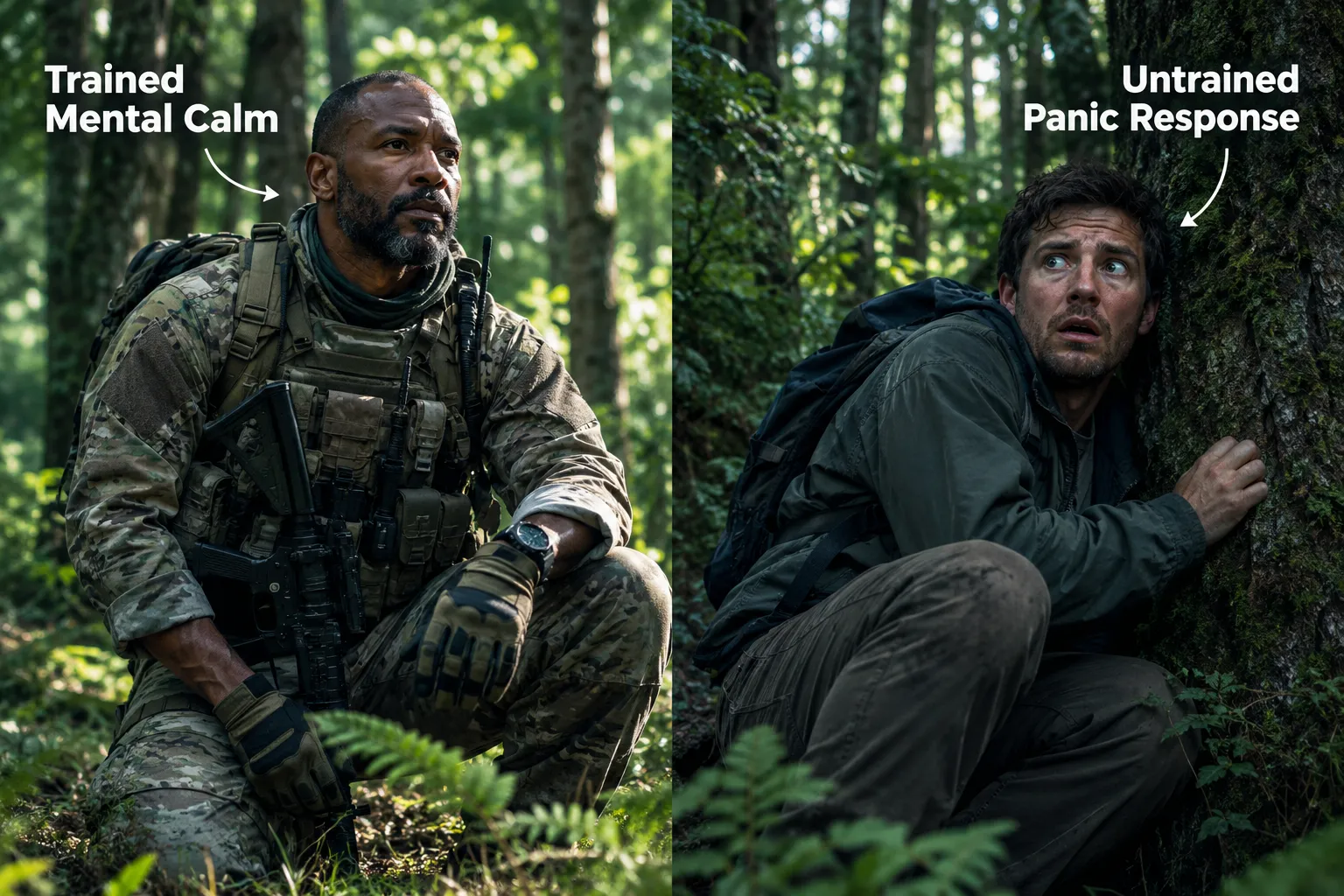
Special forces operators don’t stay calm because they’re fearless. They stay calm because they’ve been trained to perform under stress until that performance becomes habitual. The key mechanisms are stress inoculation, pre-commitment, and protocol reliance.
What military training teaches about mental calmness:
- Pre-commitment: Decisions are made before the crisis. When X happens, I do Y. This eliminates the cognitive cost of deciding under fire.
- Stress inoculation training: Operators are deliberately exposed to escalating stress in controlled environments until their performance under stress approaches their performance in calm conditions.
- Team accountability: Having a role and a team reduces individual cognitive load and provides social anchoring during chaos.
- After-action review: Systematic debriefing after stressful events builds accurate self-knowledge and reduces fear of future events.
The lesson for civilian preppers is direct: preparation, rehearsal, and protocol-building before an emergency are what create calm during one. Willpower alone is not a reliable strategy.
Common Mental Mistakes That Make Survival Harder
Several predictable cognitive errors consistently worsen survival outcomes. Recognizing them in advance is the first line of defense.
| Mental Mistake | What It Looks Like | The Fix |
|---|---|---|
| Normalcy bias | Assuming the situation isn’t as bad as it is | Use the STOP protocol; assess facts, not feelings |
| Catastrophizing | Jumping to worst-case scenarios immediately | Focus only on the next 30 minutes |
| Rushing | Moving fast without a plan, burning energy | Pause, breathe, assess before moving |
| Fixation | Locking onto one solution and ignoring alternatives | Force yourself to generate two options before acting |
| Isolation mindset | Refusing to signal for help or accept assistance | Recognize that cooperation increases survival odds |
| Rumination | Replaying what went wrong instead of acting | Assign yourself a task; action interrupts rumination |
Is Staying Calm More Important Than Having Survival Skills?
Both matter, but mental calmness is the prerequisite that makes survival skills accessible. A person with excellent skills who panics may fail to use them. A calm person with moderate skills will apply what they know effectively and improvise what they don’t.
Survival instructors consistently report that the most common failure in real emergencies isn’t lack of knowledge, it’s inability to access knowledge under stress. The skills are there. The mental state to use them is not.
The practical answer: build both. Skills without mental preparation are unreliable under pressure. Mental preparation without skills leaves you calm but underequipped. The Survival Skills Checklist: 7 Core Skills Every Prepper Needs is a good benchmark for where your physical skill set currently stands.
How Long Does Panic Usually Last and What Happens After
Acute panic typically peaks within 5 to 10 minutes and begins to subside as the body’s adrenaline response naturally diminishes. This is important to know because many people in the grip of panic believe the feeling will last indefinitely, which itself amplifies the panic.
After the initial surge, most people enter a more manageable state of heightened arousal. This is the window where trained responses kick in. If you’ve practiced breathing techniques and scenario protocols, this is when they become available.
What to expect in the timeline:
- 0 to 2 minutes: Acute panic peak, breathing exercises are critical here
- 2 to 10 minutes: Adrenaline begins to metabolize, breathing normalizes if you’re working with it
- 10 to 30 minutes: Cortisol remains elevated but decision-making begins to return
- 30 minutes onward: Rational assessment becomes increasingly possible
Knowing this timeline helps. When you’re in the worst of it, the knowledge that it will pass in minutes, not hours, is itself calming.
What To Focus Your Mind on When You’re in Survival Mode
In survival mode, the most effective mental focus is the immediate, actionable, and concrete. Broad thinking about the full scope of the situation overwhelms the brain. Narrow, task-specific focus preserves cognitive resources and creates forward momentum.
The hierarchy of focus in survival:
- Immediate physical safety, Are you in immediate danger right now? If yes, move. If no, stay put and assess.
- Breathing and physiological regulation, Get your nervous system under control before making decisions.
- The rule of threes, 3 minutes without air, 3 hours without shelter in harsh conditions, 3 days without water, 3 weeks without food. This framework tells you what to prioritize.
- One next step, Not the plan for tomorrow. The one thing to do in the next 15 minutes.
- What you know, not what you fear, Inventory your actual resources, skills, and options. Fear is about the unknown. Knowledge is about the known.
FAQ: How To Stay Mentally Calm In Survival Situations
Can anyone learn how to stay calm in survival situations mentally, or is it a natural trait?
Anyone can develop this skill. Mental calmness under stress is trainable, not innate. Consistent practice with breathing techniques, scenario rehearsal, and stress exposure builds genuine resilience over time.
What’s the first thing I should do when I feel panic starting in an emergency?
Stop moving, sit or crouch if possible, and begin box breathing immediately. Four counts in, hold four, four counts out, hold four. Do this for at least four cycles before making any decision.
Does having more survival gear make you calmer in a crisis?
Gear helps, but competence and preparation matter more. Knowing how to use your gear, and having rehearsed using it, produces more calm than simply owning it.
Is it normal to freeze completely when something dangerous happens?
Yes. Freezing is a documented stress response, not a personal failure. The key is having pre-rehearsed protocols that give the brain a default action to fall back on when it freezes.
How do I stay calm when others around me are panicking?
Focus on your own breathing first. Calm is genuinely contagious, a composed person in a group tends to stabilize others. Assign specific tasks to panicking individuals; purposeful action reduces panic.
Can children learn to stay calm in survival situations?
Yes, and teaching them early is highly effective. Age-appropriate breathing exercises, simple decision frameworks, and regular family emergency drills build real resilience in children.
What’s the biggest mental mistake people make in the first few minutes of a survival situation?
Moving immediately without assessing. The instinct to “do something” often leads to wasted energy, poor decisions, and worsened conditions. Pausing for even 60 seconds to breathe and observe produces dramatically better outcomes.
Does physical fitness affect how calm you stay mentally?
Yes, significantly. Physically fit individuals have lower resting cortisol levels and recover from adrenaline surges faster. Regular exercise is one of the most underrated mental preparedness tools.
How is staying calm in a survival situation different from everyday stress management?
The stakes and the time pressure are higher, but the underlying biology is the same. Techniques that work for everyday stress, breathing, grounding, task focus, work in survival scenarios. The difference is that in survival, there’s no option to disengage.
Should I tell others in my group that I’m scared?
In most cases, yes, with a caveat. Naming fear out loud can reduce it for you and normalize it for others. What to avoid is catastrophizing aloud, which amplifies group panic. “I’m scared, and here’s what we’re going to do” is far more useful than “I’m scared, we’re all going to die.”
Conclusion
Knowing how to stay calm in survival situations mentally may be the most decisive factor in whether skills, gear, and preparation actually get used when it counts. Panic is not a character flaw, it’s a physiological response. But it can be interrupted, shortened, and trained against with the right tools.
The core framework is straightforward: breathe deliberately, stop before you move, focus on the immediate and concrete, and use pre-rehearsed protocols to bypass the decision fatigue that crisis creates. None of this requires extraordinary willpower. It requires preparation done now, before the emergency.
Actionable next steps for 2026:
- Start a daily 5-minute box breathing practice, consistency matters more than duration
- Run one tabletop emergency scenario per month with your household
- Review and internalize the STOP protocol until it’s automatic
- Build competence in core survival skills so knowledge is accessible under stress
- Read through the Survival Mindset Mental Preparation For Disaster Guide for a structured framework
- Consider the How To Build Mental Toughness For Survival Situations resource for a progressive training approach
Recommended Tools and Resources
For preppers building out their mental and physical preparedness system, a few resources stand out. A quality journal for scenario planning and after-action review costs almost nothing and builds the reflective habit that accelerates mental readiness. First aid certification courses (offered through the Red Cross and similar organizations) build competence-based confidence directly. Apps like Wim Hof Method or Breathwrk provide structured breathing training that translates directly to field use.
On the physical preparedness side, having a well-organized kit reduces cognitive load in a crisis, fewer decisions to make means more mental bandwidth for staying calm. The Essential Survival Gear Guide: 50 Items Ranked By Priority is a practical starting point for ensuring your physical resources match your mental preparation.
Preparedness isn’t about fear. It’s about confidence, and confidence, in a survival situation, begins in the mind.
References
- Lazar, S. W., et al. (2005). “Meditation experience is associated with increased cortical thickness.” NeuroReport, 16(17), 1893-1897.
- Lieberman, M. D., et al. (2007). “Putting feelings into words: Affect labeling disrupts amygdala activity in response to affective stimuli.” Psychological Science, 18(5), 421-428.
- Grossman, D., & Christensen, L. W. (2008). On Combat: The Psychology and Physiology of Deadly Conflict in War and in Peace. Warrior Science Publications.
- Leach, J. (2004). “Why people ‘freeze’ in an emergency: Temporal and cognitive constraints on survival responses.” Aviation, Space, and Environmental Medicine, 75(6), 539-542.
- American Psychological Association. (2024). “Stress effects on the body.” APA Help Center.