
Hey there! Some links on this page may be affiliate links which means that, if you choose to make a purchase, I may earn a commission at no extra cost to you. I greatly appreciate your support. Read the full disclosure here.
Situational awareness is the ability to perceive, understand, and anticipate what is happening around you in real time. For preppers, it is one of the most critical non-physical survival skills because it allows you to detect threats before they escalate, make faster decisions under pressure, and protect the people around you. Situational awareness training for preppers can be self-taught through structured daily practice, and it can also be deepened through formal courses.
Key Takeaways
- Situational awareness is a trainable skill, not an innate talent, anyone can develop it with consistent practice.
- The most widely used framework is Jeff Cooper’s Color Code System, which defines four mental states from unaware to action-ready.
- Urban and rural environments require different awareness strategies, but the core principles are the same.
- Common mistakes include fixating on a single threat, over-relying on technology, and failing to establish a baseline for “normal.”
- Formal training courses range from free online resources to multi-day tactical programs costing $200 to $800 or more.
- Families and children can be taught basic awareness skills through age-appropriate games and routines.
- People with anxiety can practice situational awareness safely by starting with low-stakes, controlled environments.
- Apps and tools can support awareness training, but they should supplement, never replace, direct observation skills.
What Is Situational Awareness and Why Do Preppers Need It
Situational awareness is the continuous process of gathering information from your environment, understanding what that information means, and anticipating how conditions might change. For preppers, it is the mental foundation that makes every other preparedness skill more effective.
You can stockpile supplies, build a bug-out bag, and master first aid, but if you don’t notice a threat developing until it’s on top of you, none of that preparation matters. Situational awareness gives you time, and time is the most valuable resource in any emergency.
The concept was formalized in aviation and military contexts, most notably by researcher Mica Endsley, who defined it in 1988 as having three levels: perception of environmental elements, comprehension of their meaning, and projection of their future status. Applied to prepping, this translates directly: notice what’s happening, understand why it matters, and anticipate what comes next.
For preppers specifically, situational awareness matters across a wide range of scenarios, from recognizing the early signs of civil unrest in a crowd, to detecting when someone is following you, to reading weather patterns before a storm closes in. It pairs naturally with skills like urban survival situational awareness on city streets and broader urban survival strategy.
How to Improve Your Situational Awareness Skills
Improving situational awareness is a matter of deliberate, repeated practice. The goal is to make environmental scanning a habit rather than a conscious effort.
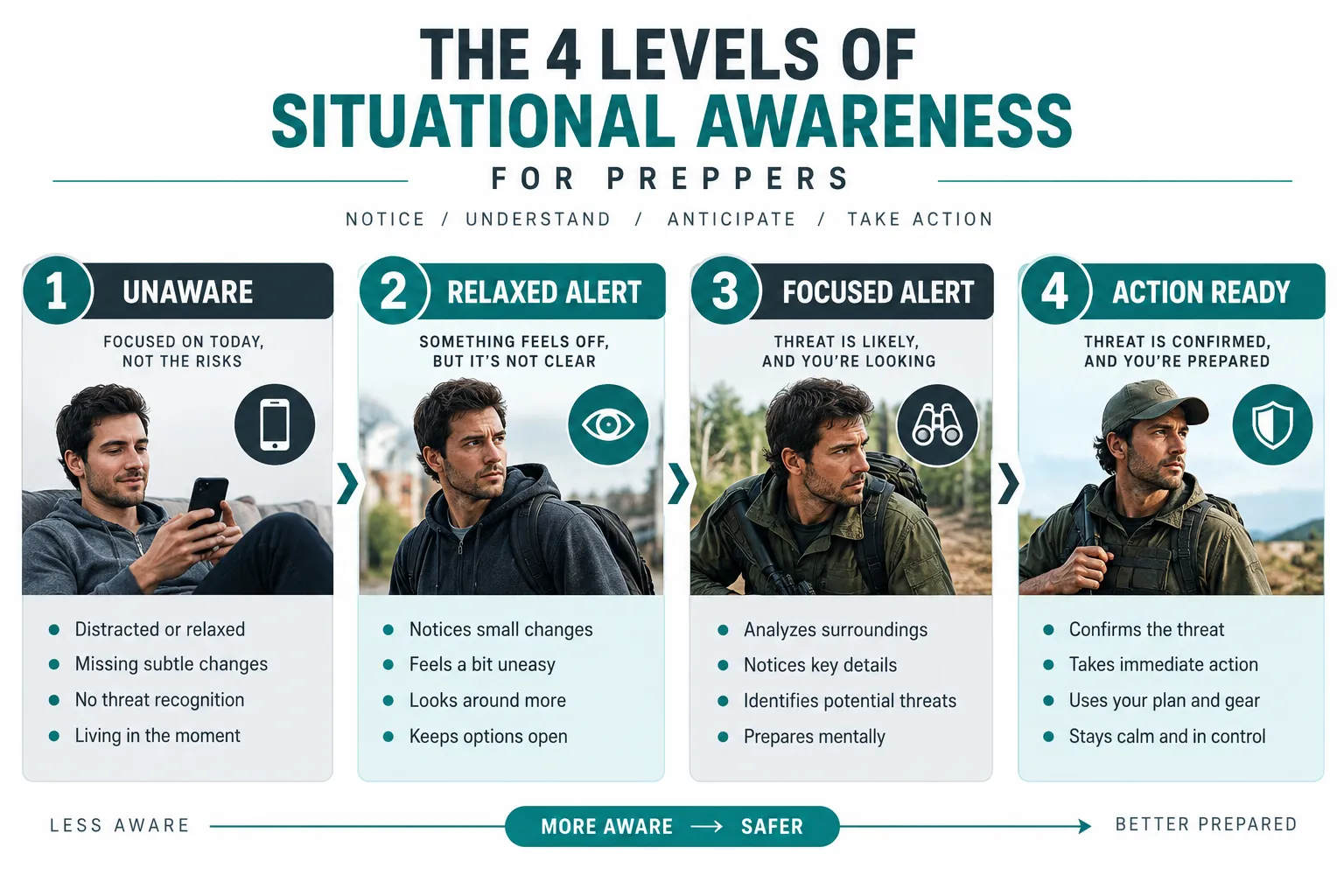
Start with the Cooper Color Code. Developed by Lt. Col. Jeff Cooper, this framework defines four mental states:
- White: Unaware and unprepared. This is dangerous in public.
- Yellow: Relaxed alertness. Aware of surroundings without fixating on any single thing. This is the target state for daily life.
- Orange: Focused alert. Something specific has triggered concern and you are evaluating it.
- Red: Action required. A threat is confirmed and you are responding.
The goal of situational awareness training for preppers is to live comfortably in Yellow and shift smoothly into Orange when warranted, without jumping straight to panic.
Practical drills to build the habit:
- Baseline assessment: Every time you enter a new space, take 10 seconds to identify exits, note who is present, and establish what “normal” looks like for that environment.
- Kim’s Game: A classic military observation exercise. Study a tray of objects for 60 seconds, cover it, then write down everything you remember. This sharpens perceptual memory.
- People-watching analysis: Sit in a public space and practice reading body language, clusters of tension, avoidance behavior, unusual clothing for the season.
- Route variation: Deliberately change your daily routes and note what you observe that you would have missed on autopilot.
Common mistake: Fixating on one potential threat while ignoring the broader environment. This is called “tunnel vision” and it’s one of the most dangerous awareness failures a prepper can make.
Situational Awareness vs Tactical Awareness: What’s the Difference
Situational awareness and tactical awareness are related but not the same thing. Situational awareness is broad, it covers everything happening in your environment. Tactical awareness is a narrower application focused specifically on threat response and defensive positioning.
Think of it this way: situational awareness tells you that a confrontation may be developing. Tactical awareness tells you where to stand, which exit to use, and how to position yourself relative to a threat. Both skills are essential for preppers, and tactical awareness builds on a foundation of strong situational awareness.
Situational awareness is always active. Tactical awareness activates when a situation moves from Yellow to Orange or Red on the Cooper scale.
Situational Awareness Training For Preppers: Courses and Costs
Formal situational awareness training ranges from free online content to multi-day in-person programs. The right choice depends on your budget, experience level, and specific goals.
Free and low-cost options:
- Online video courses on platforms like YouTube, covering Cooper’s Color Code and basic observation drills
- Military and law enforcement training manuals available through public domain sources
- Community emergency response team (CERT) training, often offered free through local fire departments
Mid-range options ($50,$200):
- Online tactical awareness courses from providers like USCCA or similar organizations
- Self-defense schools that incorporate environmental awareness into their curriculum
Advanced programs ($200,$800+):
- Multi-day personal protection and threat assessment courses
- Force-on-force scenario training, which places participants in simulated real-world situations
- Executive protection training programs that include advanced surveillance detection
For most preppers, a combination of free self-study, a quality mid-range course, and consistent daily practice delivers strong results. Formal training accelerates the process, but it is not a requirement to develop solid awareness skills.
Situational Awareness Training For Beginners: Where to Start
Beginners should start with the fundamentals before moving to advanced techniques. Trying to learn surveillance detection before you’ve mastered basic environmental scanning is like trying to run before you can walk.
A beginner’s starting sequence:
- Learn the Cooper Color Code and commit to staying in Yellow during all public activity.
- Practice the baseline assessment drill every time you enter a new location.
- Begin Kim’s Game exercises at home, start with 10 objects, then increase.
- Read “Left of Bang” by Patrick Van Horne and Jason Riley, which translates Marine Corps combat hunter training into civilian situational awareness.
- Practice one new observation drill per week for 30 days before adding complexity.
This pairs well with the broader prepper checklist for beginners 30-day system, situational awareness can be built in parallel with your physical preparedness steps.
Can You Teach Yourself Situational Awareness, or Do You Need a Class
You can absolutely teach yourself situational awareness through structured self-study and daily practice. A formal class accelerates learning and adds scenario-based experience, but it is not required for competence.
The most important factor is consistency. Thirty days of deliberate daily practice will produce more measurable improvement than a single weekend course with no follow-through. That said, formal training provides feedback, correction, and realistic pressure that self-study cannot fully replicate. If budget allows, combining both approaches is the most effective path.
Situational Awareness in Urban vs Rural Environments
Urban and rural environments demand different awareness strategies, though the underlying principles are identical.
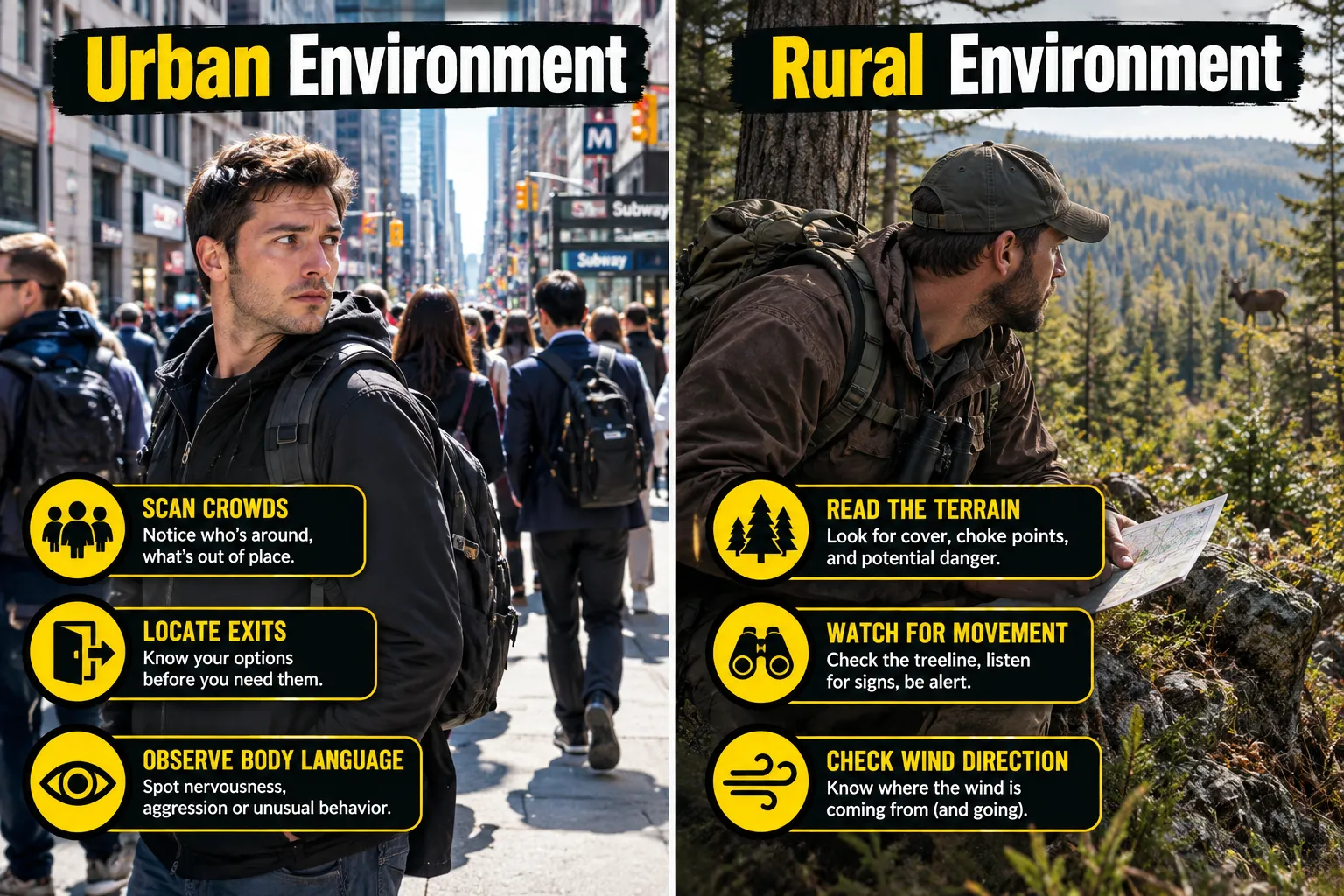
Urban awareness focuses on crowd dynamics, choke points, surveillance cameras, vehicle threats, and the behavioral baseline of dense public spaces. The volume of stimuli is higher, which makes filtering relevant signals from background noise a critical skill. For a deeper look at this, the ultimate urban survival guide for preppers covers the broader skill set that situational awareness supports in city environments.
Rural awareness shifts toward terrain reading, tracking, weather pattern recognition, and identifying signs of human activity in low-population areas. Baselines are quieter, which means anomalies stand out more clearly, but the distances involved mean threats can develop from farther away and approach faster than expected.
Choose X if: You spend most of your time in cities, prioritize crowd behavior reading and urban threat indicators. If you’re primarily rural or preparing for a bug-out scenario, invest more time in terrain and tracking awareness.
Situational Awareness for Families and Kids
Families can and should incorporate situational awareness training into everyday routines. Children as young as 5 can learn basic versions of these skills through age-appropriate games.
For young children:
- “What’s different?” games that train observation and memory
- Teaching them to identify two exits in any building they enter
- Simple “find the adult in charge” drills for public spaces
For older children and teens:
- Introduce the concept of baseline behavior and anomalies
- Practice the Kim’s Game exercise together as a family activity
- Discuss real-world scenarios in age-appropriate terms, not to create fear, but to build confidence
For families with specific needs, the 12 essential disaster preparedness strategies for families provides a broader framework that situational awareness training fits directly into.
Situational Awareness Training For Preppers With Anxiety
Anxiety and situational awareness training can conflict if the training is approached incorrectly. Hypervigilance, being in a constant state of high alert, is not the goal. It is exhausting, counterproductive, and can worsen anxiety over time.
The correct approach for people with anxiety is to start in controlled, low-stakes environments and build tolerance gradually. Practicing baseline assessments in a familiar coffee shop is very different from trying to scan a crowded stadium. Progress from familiar to unfamiliar spaces as comfort increases.
The key distinction: situational awareness in Yellow is calm and relaxed, not tense. The goal is confident awareness, not fearful scanning. Framing training around confidence and competence rather than threat detection tends to work better for anxiety-prone individuals.
What to Do If You Notice a Threat
When your awareness moves from Yellow to Orange, something specific has triggered concern, follow a deliberate sequence rather than reacting impulsively.
- Confirm the signal. One anomaly is a data point. Two or more converging signals are a pattern worth acting on.
- Create distance and options. Move toward exits, open space, or cover without drawing attention.
- Communicate. Alert your family or group using a pre-established signal or code word.
- Decide: avoid, de-escalate, or respond. Most situations resolve at the avoidance stage if you act early enough.
Having a pre-planned emergency communication plan is essential here, your family needs to know what to do when you signal a threat, not figure it out in the moment.
Common Mistakes People Make With Situational Awareness
Even experienced preppers make these errors. Knowing them in advance prevents costly habits from forming.
- Normalcy bias: Assuming that because nothing bad has happened before, nothing bad will happen now. This is the single most dangerous cognitive trap in awareness training.
- Tunnel vision: Locking onto one potential threat and losing awareness of everything else.
- Over-reliance on technology: GPS, security cameras, and alert apps are tools, not substitutes for direct observation.
- Inconsistent practice: Situational awareness degrades without regular use. Treating it as a skill you “learned once” rather than a habit you maintain is a common failure point.
- Ignoring gut instinct: Research by Gavin de Becker (author of “The Gift of Fear,” 1997) suggests that the subconscious processes environmental data faster than conscious thought. Dismissing that instinctive unease is a mistake.
How Often Should You Practice Situational Awareness Drills
Situational awareness should be practiced daily, even if only in small ways. Unlike physical fitness, awareness training doesn’t require dedicated workout sessions, it can be woven into ordinary life.
Minimum effective practice:
- Daily baseline assessments in every new location you enter
- One dedicated observation drill per week (Kim’s Game, people-watching analysis, route variation)
- Monthly scenario review with family members
More intensive drills, like force-on-force scenarios or structured surveillance detection exercises, can be done quarterly or whenever a formal training opportunity arises. The daily habit is what builds the neural pathways that make awareness automatic under stress.
Situational Awareness Apps and Tools for Preppers
Apps and tools can supplement awareness training but should never become a crutch. The core skill must live in your head, not your phone.
Useful tools:
- Citizen and Nextdoor: Real-time local incident alerts that help establish community threat baselines
- Weather apps with severe alert functions: Part of environmental awareness is knowing what conditions are developing
- FEMA’s emergency alert system: For large-scale threat notification
- Analog tools: A small notebook for recording observations during training exercises is more effective than most apps for building the habit
The complete beginner’s guide to navigation without GPS reinforces an important point: technology-dependent awareness fails when technology fails. Build the analog skill first, then layer tools on top.
Frequently Asked Questions
Is situational awareness the same as paranoia?
No. Paranoia is unfounded fear of threats that don’t exist. Situational awareness is calm, evidence-based observation. The goal is relaxed alertness, not constant anxiety.
How long does it take to develop solid situational awareness?
Most people notice meaningful improvement within 30 days of consistent daily practice. Developing reliable instincts under pressure takes longer, typically several months of regular training.
Do I need military or law enforcement experience to learn this?
No. Situational awareness is a civilian skill as much as a tactical one. Most of the core techniques are accessible to anyone willing to practice consistently.
What’s the best book for learning situational awareness?
“Left of Bang” by Patrick Van Horne and Jason Riley is widely recommended for civilians and preppers. Gavin de Becker’s “The Gift of Fear” (1997) is also essential reading for understanding threat intuition.
Can situational awareness help during natural disasters?
Yes. Reading environmental cues, unusual animal behavior, pressure changes, crowd movement, can provide early warning before official alerts. It also helps you navigate evacuation routes and assess crowd safety in real time.
Is situational awareness useful at home, or just in public?
Both. Home awareness includes knowing your property’s normal sounds and patterns, recognizing when something is off, and maintaining perimeter awareness. The ultimate home defense guide for preppers covers how awareness integrates with home security.
What’s the difference between a baseline and a threat indicator?
A baseline is the normal pattern of behavior for a given environment. A threat indicator is any deviation from that baseline that suggests something unusual is happening.
Can children really learn situational awareness?
Yes. Age-appropriate observation games, exit identification drills, and simple “what changed?” exercises are effective for children as young as 5. The key is framing it as a game, not a fear response.
Should I tell people I’m practicing situational awareness?
In most contexts, no. Part of the skill is observing without being observed. Announcing your awareness training changes the dynamic and reduces the realism of practice scenarios.
What if I freeze when I actually notice a threat?
Freezing is a normal stress response. The solution is scenario-based practice that simulates pressure, the more often you rehearse responses mentally and physically, the less likely you are to freeze when it counts.
Conclusion
Situational awareness training for preppers is not about living in fear, it’s about building the kind of calm, practiced attention that lets you act decisively when it matters. Every skill in your preparedness toolkit becomes more effective when you can see threats developing early, communicate clearly with your family, and make decisions from a position of information rather than surprise.
Start with the Cooper Color Code. Practice baseline assessments daily. Add structured drills weekly. Build the habit before you need it.
The good news is that this is one of the most accessible preparedness skills available, it costs nothing to start, it improves every day you practice it, and it works in every environment you’ll ever find yourself in.
For a broader foundation, the 14 essential survival skills every prepper must know and the survival skills checklist: 7 core skills every prepper needs provide excellent context for where situational awareness fits within a complete preparedness skill set.
Products, Tools, and Resources
Books:
- “Left of Bang” by Patrick Van Horne and Jason Riley, the most practical civilian application of combat hunter awareness training available
- “The Gift of Fear” by Gavin de Becker (1997), essential reading on threat intuition and subconscious threat processing
Training:
- USCCA (United States Concealed Carry Association), offers online and in-person courses that incorporate situational awareness into personal protection training
- CERT (Community Emergency Response Team) training, free through many local fire departments, covers emergency awareness and response
- Local self-defense schools that incorporate scenario-based training
Practice tools:
- A small pocket notebook for daily observation logging
- Kim’s Game object sets (available as dedicated training kits or assembled at home)
- Citizen app for real-time local incident awareness
Related reading on Preppers HQ:
- Urban survival situational awareness on city streets
- The ultimate emergency preparedness guide for preppers
- Emergency communication plan: the complete preppers guide