
Hey there! Some links on this page may be affiliate links which means that, if you choose to make a purchase, I may earn a commission at no extra cost to you. I greatly appreciate your support. Read the full disclosure here.
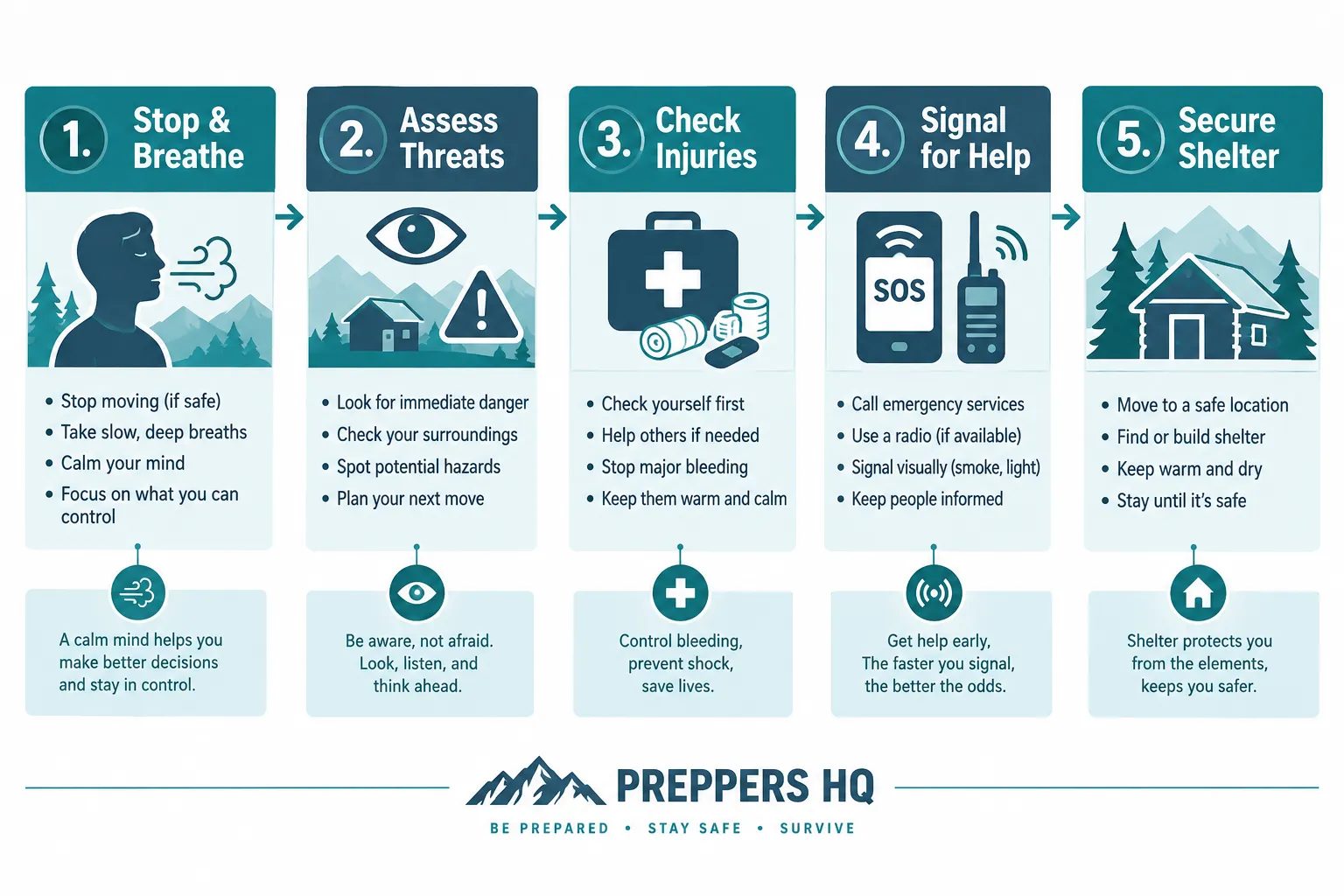
The first hour of an emergency survival situation is the most critical window you have. Stop moving, control your breathing, assess immediate threats and injuries, signal for help if possible, and secure basic shelter. These five actions, done in order, dramatically improve your odds of survival and rescue.
Key Takeaways
- The first 60 minutes of any survival emergency set the trajectory for everything that follows, panic is the primary killer in this window
- Stop and assess before acting; uncontrolled movement wastes energy and can worsen your situation
- Follow the survival priority order: protection from immediate threats, injury assessment, signaling, shelter, and then water
- Staying put is almost always the better choice in the first hour unless your current location is actively dangerous
- Water is not an emergency in the first hour, the human body can survive days without it; shelter and signaling come first
- A whistle, signal mirror, and brightly colored material are the most effective signaling tools in the first hour
- Knowing what to do in the first hour of emergency survival before a crisis happens is the single biggest advantage a prepared person has
What Are the First Steps To Take in an Emergency Survival Situation
The first steps in any emergency survival situation are to stop moving, control your breathing, and take a full situational assessment before doing anything else. Unplanned action in the first minutes burns energy, creates confusion, and can take you further from help.
Survival instructors and search-and-rescue professionals consistently point to one framework: S.T.O.P., Stop, Think, Observe, Plan. It sounds simple, but most people skip it entirely.
Here is how to execute it:
- Stop, Physically sit or crouch down. Resist every instinct to run or react immediately.
- Think, Ask yourself: What just happened? Am I injured? Is anyone with me? What do I have on me?
- Observe, Scan your surroundings. Note terrain, weather, visible hazards, and any signs of people or shelter.
- Plan, Make one decision at a time. Don’t try to solve everything at once.
This framework applies whether you’re lost in the wilderness, stranded after a vehicle accident, or caught in a sudden natural disaster. The specifics change; the discipline of stopping first does not.
How To Stay Calm During the First Hour of a Survival Emergency
Staying calm in the first hour of a survival emergency is not about suppressing fear, it’s about redirecting your body’s stress response into controlled action. Panic causes tunnel vision, poor decision-making, and rapid energy depletion.
Two techniques work reliably under real pressure:
- Tactical breathing (box breathing): Inhale for 4 counts, hold for 4, exhale for 4, hold for 4. Repeat three times. This activates the parasympathetic nervous system and reduces cortisol spikes.
- Verbal self-talk: Say out loud, “I have time. I can figure this out.” Spoken words interrupt the panic loop more effectively than internal thoughts alone.
Mental toughness is a trainable skill, and the time to build it is before a crisis, not during one. For a deeper look at building that foundation, see how to build mental toughness for survival situations.
What Should You Prioritize First in a Survival Emergency
The correct priority order in the first hour of emergency survival is: immediate threat removal, injury assessment, signaling for help, shelter, and then water. Food is irrelevant in the first hour entirely.
Most people instinctively prioritize water or fire first. That’s backwards. Here’s why the order matters:
| Priority | Action | Why It Comes First |
|---|---|---|
| 1 | Remove immediate threats | Fire, flood, unstable terrain, or traffic kill in minutes |
| 2 | Assess and treat injuries | Uncontrolled bleeding is fatal within minutes |
| 3 | Signal for help | The sooner rescuers know your location, the sooner you’re found |
| 4 | Shelter | Exposure kills in hours in cold or wet conditions |
| 5 | Water | The body survives 3 days without water, not a first-hour crisis |
This priority order holds across most emergency types. The one exception: if you’re in extreme heat with no shade, shelter moves to the top immediately.
How To Assess Injuries in an Emergency Survival Situation
Injury assessment in the first hour follows the same logic used in emergency medicine: address life threats first, then everything else. The primary survey covers airway, breathing, circulation, and major bleeding.
Rapid self-assessment checklist:
- Is your airway clear? Can you breathe without obstruction?
- Are you bleeding? Check your head, neck, torso, and limbs systematically.
- Can you bear weight on both legs?
- Do you feel any sharp pain in your spine or neck after a fall or impact?
- Is anyone else with you who needs immediate attention?
Uncontrolled bleeding is the number one preventable cause of death in trauma situations. If you or someone with you is bleeding heavily, apply direct pressure immediately and do not release it. A tourniquet should be applied to a limb if direct pressure fails to control arterial bleeding.
Every prepared person should carry a well-stocked first aid kit. The 47 things every prepper first aid kit needs covers exactly what belongs in yours.
How To Signal for Help in the First Hour
Signaling for help in the first hour of a survival emergency should begin as soon as you’ve addressed immediate threats and injuries. The earlier rescuers receive a signal, the smaller the search area, and the faster the rescue.
Most effective signaling methods, ranked by reliability:
- Personal locator beacon (PLB) or satellite communicator, Activates a GPS-linked distress signal to emergency services. No other method comes close in effectiveness.
- Signal mirror, Visible up to 10 miles on a clear day. Aim reflected sunlight at any aircraft or distant observer.
- Whistle (three blasts), The universal distress signal. Carries further than a voice and requires less energy.
- Signal fire with smoke, Build a fire and add green leaves or wet material to create white smoke visible from aircraft. Three fires in a triangle is the universal distress pattern.
- Brightly colored material, Lay a tarp, jacket, or any high-visibility item in an open area where it can be seen from above.
If you’re in an area with cell service, call 911 first. If service is intermittent, send a text, texts often go through when voice calls won’t.
For a complete communication strategy before emergencies happen, review the emergency communication plan guide for preppers.
What Basic Shelter Can You Make in the First Hour of Survival
In the first hour, shelter doesn’t need to be elaborate, it needs to block wind, retain body heat, and keep you dry. A simple debris hut, lean-to, or even a space blanket draped over a natural windbreak can be built in under 20 minutes and will protect you from hypothermia.
Quick-build shelter options by environment:
- Forest: Lean branches against a fallen log or low fork, layer with debris (leaves, bark, pine needles) at least 12 inches thick on the sides and top. This insulates through dead air space.
- Open terrain: Use a tarp, emergency blanket, or poncho staked at an angle to deflect wind and rain.
- Urban/suburban disaster: Shelter in place inside a structurally sound building. Move to an interior room away from windows.
- Vehicle breakdown: Stay in the vehicle. It’s your best shelter and the most visible object for rescuers.
The rule of thumb: if the temperature is below 50°F, wet, or windy, shelter is a genuine first-hour priority. In mild, dry conditions, it can wait while you focus on signaling.
For more advanced techniques, the bushcraft shelter building guide covers construction methods for every terrain type.
Is It Better To Stay Put or Move in the First Hour of an Emergency
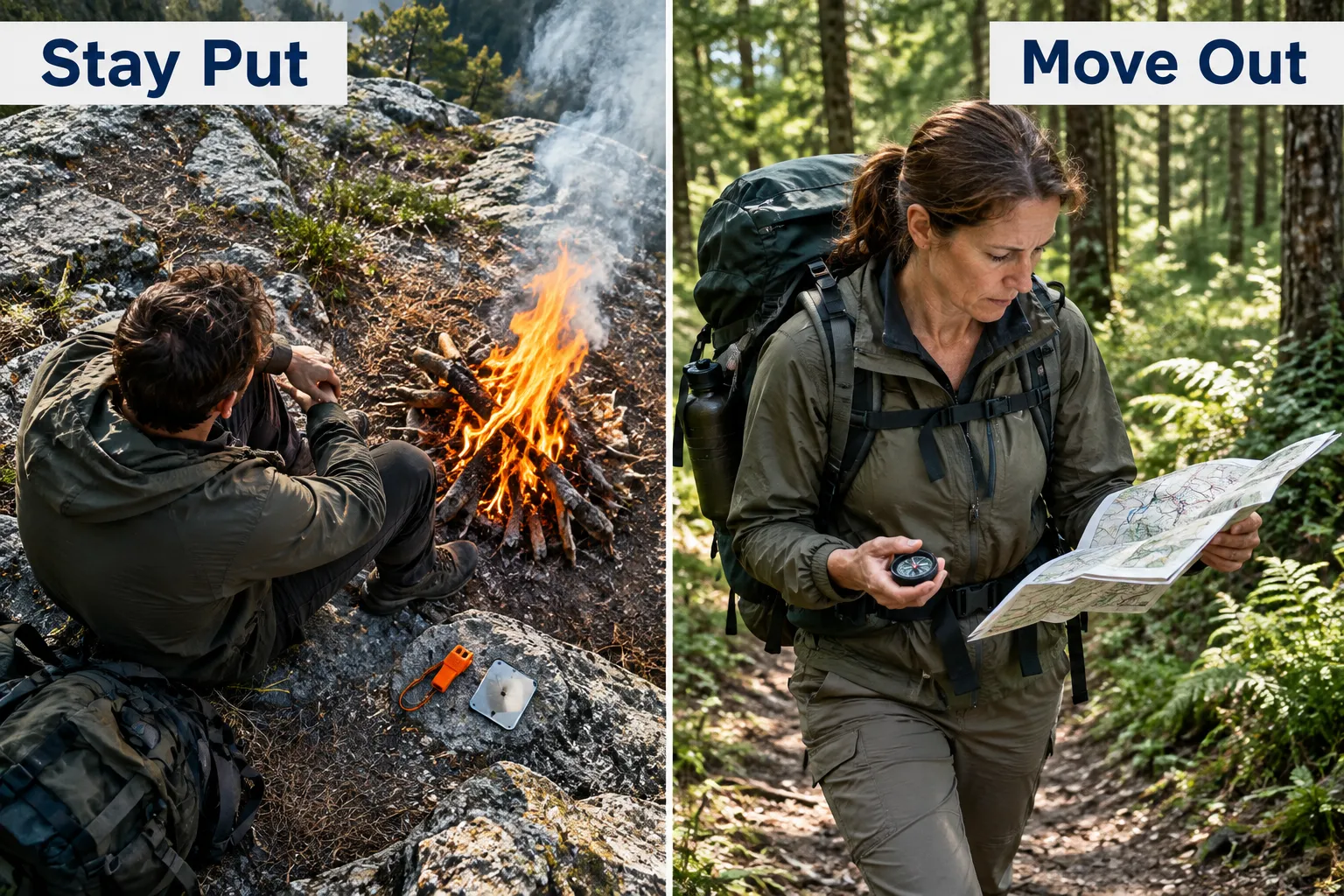
Stay put in the first hour unless your current location is actively dangerous. This is the guidance given by search-and-rescue teams worldwide, and it applies to the vast majority of survival emergencies.
Here’s the logic: when someone is reported missing or overdue, rescuers start searching from the last known point. Every mile you travel away from that point expands the search area exponentially. Staying put keeps you in the most likely search zone.
When staying put is correct:
- You are lost in the wilderness and people know your general route
- You are injured and movement would worsen the injury
- Weather conditions are deteriorating
- You have adequate shelter at your current location
When moving is the right call:
- Your current location is directly threatened (rising flood water, active fire, unstable structure)
- You can clearly see safety or help within a short, manageable distance
- You have no means of signaling and know exactly where help is located
If you must move, mark your starting point visibly, travel in a straight line, and leave directional markers for rescuers.
What’s the Difference Between Survival Priorities for Different Emergencies
The core survival priorities remain consistent, but the sequence and emphasis shift depending on whether you’re lost, injured, stranded, or facing a large-scale disaster. Understanding this distinction is part of what to do in the first hour of emergency survival.
Lost in the wilderness: Signaling and staying put dominate. Shelter and water follow. The primary threat is exposure and panic-driven movement.
Injured after an accident: Injury assessment and bleeding control come before everything else. Then signal, then shelter.
Natural disaster (tornado, earthquake, flood): Immediate threat removal is first, get away from structural collapse, rising water, or fire. Then assess injuries, then shelter in place or evacuate per your pre-made plan. For tornado-specific guidance, see what to do in the first 24 hours after a tornado.
Grid-down or power outage: The timeline is slower, but the priority order still applies. Assess your situation, secure your home, and establish communication. See the grid-down scenario: what to expect in the first 72 hours of a power outage for a full breakdown.
Do You Need Water in the First Hour of Survival, or Can It Wait
Water can wait in the first hour of survival. The human body can survive approximately three days without water under normal conditions, and longer in cool temperatures. Dehydration does not become a functional threat within 60 minutes.
That said, if you have clean water on you, drink it. There’s no reason to ration water you’re already carrying. The mistake to avoid is spending the first hour searching for water instead of addressing shelter, signaling, and injury assessment.
When water becomes a priority:
- You are in extreme heat (above 90°F) with direct sun exposure and no shade
- You are already dehydrated before the emergency began (common in desert or high-altitude environments)
- You have injuries that cause significant fluid loss
If you do need to find water, moving water sources (streams, rivers) are safer than stagnant pools. Never drink untreated water if you have any means to purify it. For a full breakdown of safe water sourcing and purification, the ultimate emergency water storage and purification guide is the definitive resource.
Can You Start a Fire in the First Hour of Survival, or Is It Too Early
Fire is worth attempting in the first hour if you’re in cold or wet conditions and shelter alone won’t keep you warm enough. Otherwise, fire is a second-hour priority, signaling and shelter come first.
Fire serves three functions in a survival emergency: warmth, water purification, and signaling. In the first hour, only warmth is urgent enough to justify the time and energy investment.
When to prioritize fire in the first hour:
- Temperature is below 50°F and you’re wet or wind-exposed
- You have no shelter material and fire is your only insulation option
- You have a lighter or waterproof matches and fire can be started quickly
When to delay fire:
- Conditions are mild and shelter is secured
- You don’t have reliable ignition tools and friction fire will take 30+ minutes
- Your energy is better spent signaling or building shelter
Always carry a reliable fire-starting kit in your emergency bag. If you’re dealing with wet conditions specifically, the guide on how to start a fire in wet conditions covers the techniques that actually work.
What Survival Mistakes Do People Make in the First Hour
The most common and dangerous mistake in the first hour of emergency survival is immediate, unplanned movement. The second is underestimating how quickly panic degrades decision-making.
The most critical first-hour mistakes:
- Panic-running: Moving without a plan burns calories, creates distance from rescuers, and often leads to injury
- Ignoring minor injuries: A small cut that goes untreated can become infected and debilitating within 24 hours
- Drinking untreated water immediately: Waterborne illness compounds your problems; purify first unless it’s a true immediate emergency
- Failing to signal early: Every hour without a signal narrows your rescue window
- Over-relying on electronics: Phone batteries die. GPS devices fail. Always have analog backups, a whistle, map, and compass
- Not conserving energy: The first hour feels urgent, but exhausting yourself early is a serious strategic error
- Assuming rescue is coming: Act as if you are responsible for your own survival. If rescue comes sooner, great. If it doesn’t, you’re prepared.
The difference between a person who survives and one who doesn’t often comes down to preparation done weeks or months before the emergency. A solid 72-hour bug-out bag checklist and a practiced plan change everything.
What Survival Gear Should You Have Ready for the First Hour
The gear that matters most in the first hour of emergency survival is lightweight, multi-purpose, and immediately accessible. It doesn’t help if it’s buried at the bottom of a bag you can’t reach.
First-hour survival gear essentials:
- Signaling: Whistle, signal mirror, personal locator beacon (PLB)
- Shelter: Emergency space blanket or bivy, lightweight tarp
- First aid: Tourniquet, pressure bandage, nitrile gloves, basic wound care
- Fire: Waterproof matches, BIC lighter, ferrocerium rod
- Navigation: Compass, physical map of the area
- Cutting tool: Fixed-blade knife or multi-tool
- Water: 1-liter water bottle, purification tablets or filter straw
- Light: Headlamp with fresh batteries
The key principle: this gear should be on your person or in a bag you carry at all times in a survival context, not left in the car or at camp. For a comprehensive gear list built around the first 72 hours, the complete bug-out bag guide is worth reading in full. And if you’re building a kit on a tight budget, a 72-hour emergency kit for under $50 proves it doesn’t have to be expensive to be effective.
Frequently Asked Questions
What is the single most important thing to do in the first five minutes of a survival emergency?
Stop moving and assess. Uncontrolled movement is the leading cause of worsened outcomes in survival emergencies. Sit down, breathe, and run through S.T.O.P., Stop, Think, Observe, Plan, before taking any action.
How long does it take for hypothermia to become dangerous?
In cold, wet, and windy conditions, mild hypothermia can set in within 30 minutes. In extreme cold (below 32°F) with wet clothing, it can become life-threatening in under an hour. Shelter and dry insulation are genuine first-hour priorities in these conditions.
Should I use my phone to call for help before doing anything else?
Yes, if you have signal. Call 911 immediately, give your location as specifically as possible, and describe your situation. If the call drops, send a text, texts transmit more reliably on weak signals. After the call, proceed with your survival priorities.
Is it safe to drink from a stream in the first hour if I’m very thirsty?
Only as a last resort. Waterborne pathogens like Giardia and Cryptosporidium cause severe illness that will compound your survival challenge. If you have any purification method available, tablets, a filter straw, or the ability to boil water, use it. Thirst alone is not a medical emergency in the first hour.
What if I’m with children or elderly family members during a survival emergency?
Assign them a specific, simple task immediately, holding a whistle, keeping the emergency blanket ready, staying in one spot. Giving people a job reduces panic. Children especially respond well to clear, calm instructions. For family-specific guidance, see the wilderness survival guide for families with children.
Do I need to find food in the first hour?
No. The human body can survive weeks without food. Food is not a first-hour concern under any normal survival scenario. Spending energy searching for food in the first hour is a misallocation of your most valuable resource.
What if I don’t know where I am?
Stay where you are. Retrace your steps mentally to identify your last known location. Look for landmarks, water flow direction, sun position, and any man-made structures. If you have a map, orient it using the sun or a compass. Signal from your current position.
How do three signal fires in a triangle help?
Three fires in a triangular pattern is the internationally recognized distress signal. Pilots and rescuers are trained to recognize it as a call for help rather than a casual campfire. Space the fires at least 50 feet apart and keep them burning.
What’s the biggest difference between urban and wilderness first-hour survival?
In urban emergencies, shelter is usually already available and the primary concerns are safety from structural damage, fire, or civil unrest. In wilderness survival, shelter and signaling take center stage. The mental framework, stop, assess, prioritize, applies to both.
Conclusion
Knowing what to do in the first hour of emergency survival is not about memorizing a checklist under pressure. It’s about building the right habits and carrying the right gear long before a crisis occurs, so that when adrenaline spikes and clarity narrows, your body already knows what to do.
The sequence is straightforward: stop and assess, control your breathing, address immediate threats and injuries, signal for help, build or find shelter, and conserve your energy. Water, food, and fire follow after these fundamentals are handled.
Preparedness is confidence. Every piece of gear you carry, every skill you practice, and every plan you make in advance shortens the gap between crisis and control.
Actionable next steps for 2026:
- Build or audit your emergency kit using the ultimate emergency supplies list
- Practice the S.T.O.P. framework on your next hike or camping trip until it’s automatic
- Review the 14 essential survival skills every prepper must know and identify any gaps in your current skill set
- Create and practice a family emergency plan so every household member knows their role
The first hour is yours to control. Use it.
Products, Tools, and Resources
Personal Locator Beacon (PLB): A registered PLB like the ACR ResQLink or Garmin inReach Mini is the single most effective signaling tool available. It requires no cell service and sends a GPS-linked distress signal directly to emergency services. For anyone who spends time in remote areas, this is non-negotiable.
Emergency Space Blanket or Bivvy: Lightweight, compact, and capable of retaining up to 90% of body heat, a quality emergency bivy (SOL Escape Bivvy or similar) belongs in every pack. It doubles as a signaling tool due to its reflective surface.
Survival Whistle: The Fox 40 Classic or similar pealess whistle produces 115+ decibels and works when wet. Attach it to your pack strap or zipper where it’s accessible in seconds.
Ferrocerium Fire Starter: A quality ferro rod (Light My Fire Swedish FireSteel or similar) works in wet conditions and lasts for thousands of strikes. Pair it with a BIC lighter as a primary ignition source.
Compact First Aid Kit: Pre-built kits from Survive X provide a solid foundation. Supplement with a CAT tourniquet and Israeli pressure bandage for trauma readiness.
Signal Mirror: A glass-based signal mirror (Coghlan’s or Ultimate Survival Technologies) is inexpensive, weighs almost nothing, and is visible from miles away on a clear day.
These tools don’t replace skills, but they dramatically increase your options in the first critical hour.