
Hey there! Some links on this page may be affiliate links which means that, if you choose to make a purchase, I may earn a commission at no extra cost to you. I greatly appreciate your support. Read the full disclosure here.
The U.S. Department of Energy has documented over 180 significant grid disturbances annually in recent years, and grid operators openly acknowledge that a major, prolonged outage affecting millions of people is not a question of if, but when. For anyone serious about preparedness, understanding the grid-down scenario, what to expect in the first 72 hours, is the difference between controlled confidence and dangerous confusion.
This guide walks through exactly what happens when the grid fails, how fast conditions deteriorate, and what actions give you the highest survival advantage during that critical opening window.
Key Takeaways
- A true grid-down event is fundamentally different from a standard blackout; recovery timelines can stretch from days to months depending on the cause.
- The first 24 hours are deceptively calm. Most people underestimate how quickly essential systems degrade after that.
- Water access becomes the most urgent problem within 48 to 72 hours for most households.
- Refrigerated food begins spoiling within 4 hours of a power loss if the door stays closed; frozen food lasts up to 48 hours.
- Cell networks typically remain operational for 4 to 8 hours on backup battery power before failing.
- Hospitals and emergency services operate on generator backup, but fuel supplies are finite and prioritized.
- A generator alone is not a complete preparedness strategy; fuel storage, water reserves, and communication plans matter equally.
- The most dangerous mistakes happen in hours 12 to 48, when people exhaust initial supplies and begin making reactive decisions.
What Is the Difference Between a Blackout and a Grid-Down Event
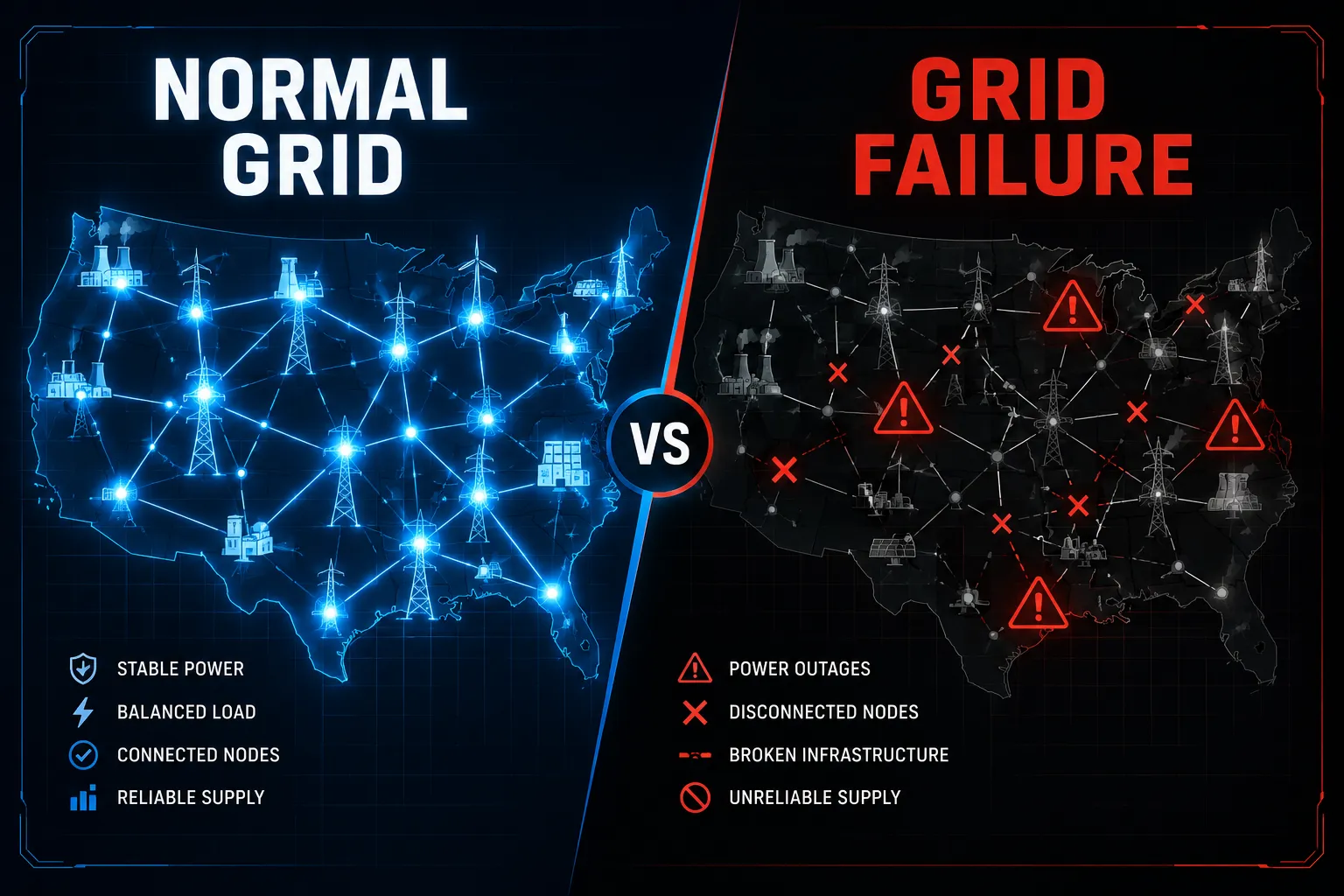
A standard blackout is a localized, temporary power interruption: a transformer blows, a storm knocks out a substation, and crews restore power within hours. A grid-down event is categorically different. It refers to a large-scale, sustained failure of the electrical grid affecting entire regions or the national infrastructure, with restoration timelines measured in days, weeks, or longer.
The causes matter because they determine recovery speed:
- Weather events (ice storms, hurricanes): Regional outages, typically restored in 3 to 14 days.
- Cyberattacks on grid infrastructure: Unpredictable recovery could affect multiple regions simultaneously.
- Physical attacks on substations: Targeted damage to high-voltage transformers, which have lead times of 12 to 18 months to replace.
- EMP or geomagnetic storm: Potentially the most severe scenario, widespread electronic damage with no quick fix. For a deeper breakdown of this threat, the EMP attack and grid failure survival guide covers the full scope.
Decision rule: If your local utility cannot give a restoration estimate within the first 6 hours, treat the situation as a potential long-term grid-down event and act accordingly.
What Happens to Electricity When the Power Grid Goes Down
When the grid fails, the loss of power is immediate and total for affected areas. There is no gradual fade; lights go out, HVAC systems stop, refrigerators stop cooling, and any device without a battery backup goes dark instantly.
What most people don’t realize is what happens beyond their home:
- Traffic signals go dark, creating dangerous intersections within minutes.
- Gas station pumps require electricity to operate; most stations cannot dispense fuel during an outage.
- Water treatment and pumping stations lose power, meaning municipal water pressure can drop or fail within 24 to 72 hours depending on the facility’s backup capacity.
- ATMs and point-of-sale systems go offline, making cash the only viable currency.
- Internet routers and modems lose power, taking home internet access with them.
The cascade happens faster than most people expect. Within the first two hours, the visible infrastructure of daily life begins to unravel.
How Long Does It Take to Restore Power After a Grid Failure
Restoration time depends entirely on the cause and scale of the failure. A localized outage from storm damage might be resolved in 12 to 72 hours. A coordinated attack on multiple high-voltage substations could take weeks to months, because the specialized equipment required is not stockpiled domestically and must often be manufactured or imported.
FEMA’s preparedness guidance recommends that households be self-sufficient for a minimum of 72 hours, but many emergency management professionals now advocate for two-week readiness as a more realistic baseline for serious grid events.
Common restoration timelines by cause:
| Cause | Typical Restoration Time |
|---|---|
| Local storm / equipment failure | 4 to 72 hours |
| Regional severe weather event | 3 to 14 days |
| Widespread cyberattack | 1 to 4+ weeks |
| Physical substation attack | Weeks to months |
| EMP / geomagnetic storm | Months to years (worst case) |
For a comprehensive look at building your backup power capacity, the complete prepper’s guide to backup power for emergencies is an essential companion read.
What Should You Do in the First 24 Hours of a Grid-Down Scenario
The first 24 hours of a grid-down scenario are your most valuable window. Conditions are still relatively stable, stores may still have inventory, and most people haven’t yet recognized the severity of the situation.
Hours 0 to 4: Assess and secure
- Confirm the outage is widespread, not just your home or block. Check your battery-powered or hand-crank radio for emergency broadcasts.
- Do not open the refrigerator or freezer unnecessarily. A closed refrigerator maintains safe temperatures for approximately 4 hours; a full freezer holds for up to 48 hours.
- Fill bathtubs and any available containers with tap water immediately; municipal pressure may drop within 24 to 72 hours.
- Locate your flashlights, candles, and battery lanterns before dark.
- Withdraw cash if ATMs are still operational.
Hours 4 to 12: Stabilize
- Inventory your food and water supplies honestly.
- Charge all devices using your car’s USB ports or a power bank while charge remains.
- Establish a communication plan with family members who may be at different locations. Having a pre-set emergency communication plan in place before an event is far more effective than improvising during one.
- Identify your nearest neighbors and assess whether vulnerable people nearby need assistance.
Hours 12 to 24: Conserve and monitor
- Begin rationing water to 1 gallon per person per day for drinking and sanitation.
- Avoid unnecessary travel; roads may be congested or dangerous without traffic signals.
- Monitor your battery-powered radio for official updates on restoration timelines.
- Decide whether to shelter in place or consider relocating based on available information.
Will My Phone Work During a Power Grid Outage
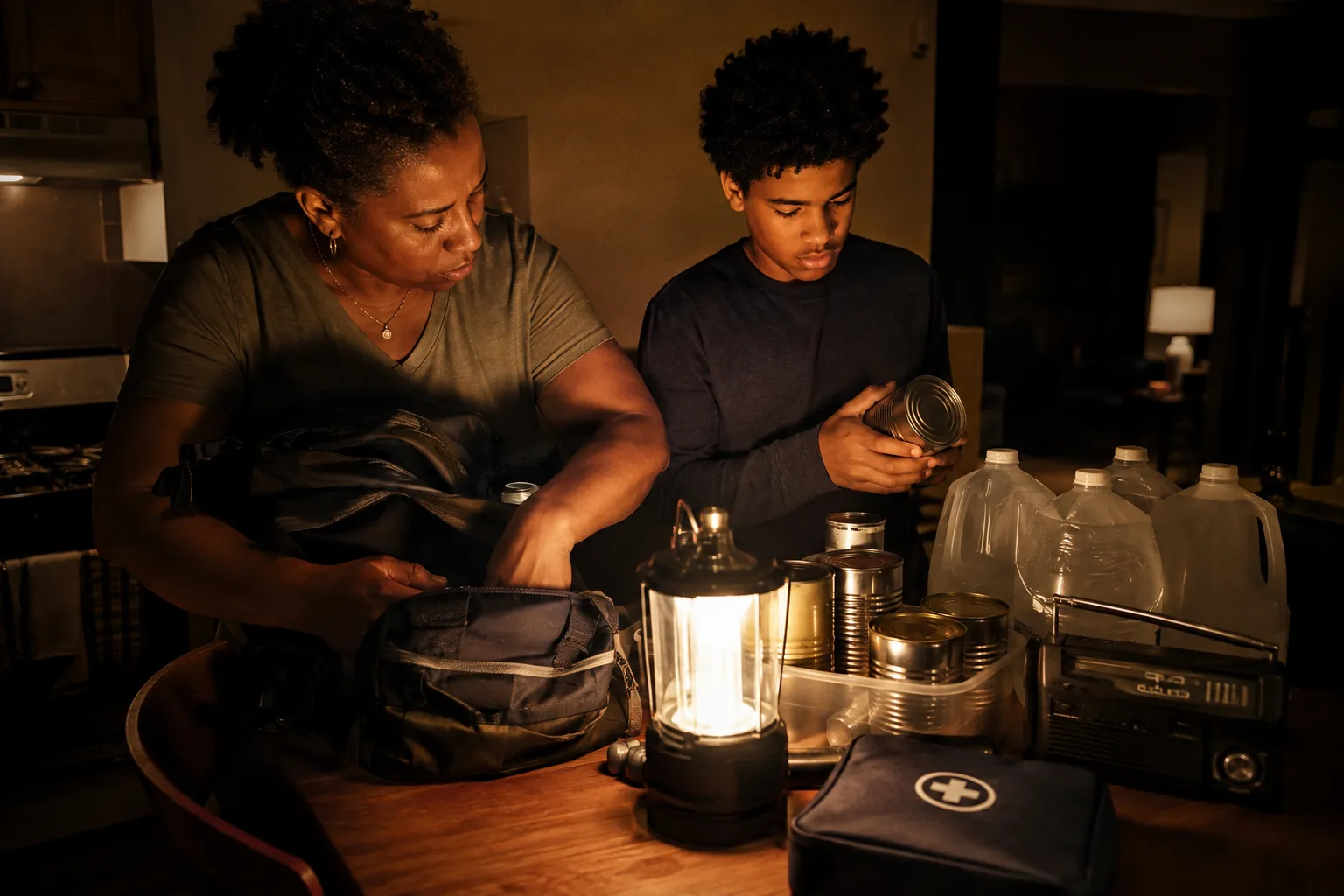
Cell phones themselves will continue to work as long as the battery holds charge. The real question is whether cell towers remain operational. Most cellular towers have battery backup systems that last 4 to 8 hours, and some have generator backup that can extend service for 24 to 72 hours if fuel is available.
After that window, cell service becomes unreliable or fails entirely in a widespread grid-down event.
What still works when cell towers go down:
- Battery-powered AM/FM radios: The most reliable information source in any grid failure.
- NOAA weather radios: Broadcast emergency alerts on dedicated frequencies.
- Satellite communicators (Garmin inReach, SPOT): Operate independently of the cellular grid.
- Ham radio requires a license but functions completely off-grid.
- SMS text messages often get through when voice calls cannot, because they require less bandwidth.
Common mistake: Burning through your phone battery in the first 6 hours by refreshing news apps. Conserve battery for essential communication and use a dedicated radio for information gathering.
What Food Will Spoil First When the Fridge Stops Working
Refrigerated food begins entering the danger zone (above 40°F / 4°C) within 4 hours of power loss if the door remains closed. The USDA’s food safety guidelines are clear: when in doubt, throw it out.
Spoilage order to expect:
- First to go (within 4 hours): Milk, soft cheeses, yogurt, opened mayonnaise, cooked leftovers, raw meat and seafood.
- Next (4 to 8 hours): Eggs, hard cheeses, butter, opened juice.
- Longer-lasting (if the freezer stays closed): Frozen meats and vegetables can remain safe for 24 to 48 hours in a full freezer, 12 to 24 hours in a half-full freezer.
Practical priority: Eat refrigerated perishables first in the initial hours. Move to canned goods, dried foods, and freeze-dried reserves as the outage extends. For building a food reserve that outlasts any grid failure, the ultimate survival pantry list provides a complete framework.
Edge case: Never rely on smell alone to judge meat safety. Dangerous bacteria multiply without producing noticeable odors.
How Do You Get Water If the Grid Is Down
Municipal water systems rely on electrically powered pumps to maintain pressure. In most cities, water pressure will drop significantly within 24 to 72 hours of a grid failure as backup generators at pumping stations exhaust their fuel. In some areas, gravity-fed reservoir systems provide additional time, but this varies widely by location.
Immediate actions:
- Fill bathtubs, pots, and any clean containers as soon as the outage is confirmed.
- A standard bathtub holds 80 to 100 gallons, enough for one person for roughly 80 to 100 days at drinking-only rationing, or 10 to 12 days at full household use.
- Water heaters contain 40 to 80 gallons of usable water accessible via the drain valve at the base.
Alternative water sources during extended outages:
- Rainwater collection (filter and purify before drinking)
- Natural water sources (streams, ponds), always be treated before consumption
- Neighbors with wells (hand-pump wells are especially valuable)
For urban dwellers, the guide on safest water sources in urban survival scenarios covers practical options most people overlook.
How to Stay Warm Without Electricity During a Grid Down Event
Staying warm without electricity depends on your climate, your home’s insulation, and your fuel reserves. The core principle is heat conservation before heat generation; a well-insulated space retains warmth far longer than a drafty one.
Passive heat retention:
- Close off unused rooms and concentrate people in one smaller space.
- Hang heavy blankets over windows and exterior doors to reduce drafts.
- Use sleeping bags rated for temperatures below what you expect to encounter.
- Layered clothing, wool, and synthetic insulation retain warmth even when damp.
Active heating options without grid power:
- Wood-burning fireplace or stove: The most reliable long-term option if you have fuel.
- Propane or kerosene heaters: Effective but require ventilation to prevent carbon monoxide buildup. Never use indoors without proper airflow.
- Catalytic propane heaters (Mr. Heater Buddy-style): Designed for indoor use with oxygen depletion sensors, a solid short-term option.
- Body heat: In extreme cold, multiple people sharing a sleeping space with good insulation can maintain survivable temperatures.
Critical mistake: Using a gas oven or charcoal grill indoors for heat. Carbon monoxide poisoning kills quickly and silently.
Can I Use My Car for Power During a Grid Down Scenario
Yes, with important limitations. A running car engine can charge devices via USB ports, power a 12V inverter, or run a dedicated car-to-AC power inverter to operate small appliances. This is a legitimate short-term strategy for maintaining phone charge, running a CPAP machine, or powering a small fan or lamp.
Practical guidelines:
- Run the engine for 30-minute intervals to charge devices rather than idling continuously; this conserves fuel.
- A standard car inverter (150W to 400W) can power laptops, phone chargers, and small fans.
- Never run a vehicle in an enclosed garage; carbon monoxide accumulates fatally within minutes.
- Gasoline degrades over time; fuel stored for emergencies should be treated with a fuel stabilizer.
Important limitation: A car is not a substitute for a generator for high-draw appliances. It cannot run a refrigerator, electric heater, or well pump effectively.
What Medications Need Refrigeration During a Power Outage
Insulin is the most critical medication affected by power loss. Unopened insulin can typically be stored at room temperature (below 77°F / 25°C) for 28 days. Once opened, most insulin formulations remain viable for 28 days at room temperature. However, heat accelerates degradation significantly; temperatures above 86°F / 30°C can render insulin ineffective within hours.
Other commonly refrigerated medications at risk:
- Certain biologics and injectable medications
- Some liquid antibiotics
- Eye drops containing specific preservatives
- Certain vaccines (if stored at home)
Preparation steps for medication-dependent individuals:
- Consult your pharmacist before any anticipated event about room-temperature stability windows.
- Invest in a medical-grade insulated case with ice packs for short-term storage.
- Maintain a 30-day supply minimum of any critical medication.
- Know the nearest hospital or pharmacy with generator backup in your area.
For a broader look at medical preparedness, the 47 things every prepper first aid kit needs covers the full spectrum of medical supply planning.
How Do Hospitals and Emergency Services Operate Without Power
Hospitals are required by law to maintain backup generator systems capable of powering critical systems, operating rooms, ICUs, ventilators, and lighting, for a minimum of 96 hours. In practice, most large hospitals have fuel contracts that extend this window, but fuel delivery depends on functioning supply chains.
What emergency services can and cannot do:
- Police, fire, and EMS typically have generator-backed dispatch centers and fuel reserves for vehicles.
- 911 call centers have backup power but may be overwhelmed with call volume.
- Hospitals will triage aggressively; non-emergency cases will be turned away.
- Pharmacies without generator power cannot access prescription databases or dispense controlled medications.
What this means for preppers: Do not count on emergency services being available on their normal timelines during a major grid-down event. Self-sufficiency in medical care, security, and basic needs is not paranoia; it’s an accurate assessment of system capacity under stress.
Is a Generator Enough to Prepare for a Grid Down Scenario
A generator is a valuable tool, but it is not a complete preparedness strategy. Generators require fuel, produce carbon monoxide, create noise that signals your location, and have limited run time. Depending on a single device for all power needs creates a single point of failure.
What a generator does well:
- Powers refrigerators and freezers to preserve food and medications.
- Runs a sump pump to prevent basement flooding.
- Provides lighting and device charging.
- Operates medical equipment like CPAP machines.
What a generator cannot replace:
- A water storage plan
- A food reserve independent of refrigeration
- A communication strategy
- Heat in a cold climate if fuel runs out
A layered approach, generator plus stored water, shelf-stable food, battery banks, hand-crank radio, and a documented family plan, is far more resilient than any single piece of equipment. The ultimate power outage preparedness checklist provides a structured framework for building that layered system.
How to Know If the Grid Down Event Is Temporary or Long-Term
In the first hours, distinguishing a short outage from a long-term grid-down scenario is genuinely difficult. The signals that suggest a serious, extended event include:
- No utility restoration estimate provided within 6 to 12 hours
- Multiple regions affected simultaneously (confirmed via battery radio)
- Emergency broadcasts mentioning infrastructure attacks or major natural disasters
- Cell service degrading or failing within the first 8 hours
- Visible damage to major transmission infrastructure in your area
What to monitor:
- NOAA weather radio and AM emergency broadcasts
- Battery-powered shortwave radio for national and international news
- Neighbors and community networks for local intelligence
Decision rule: If you cannot get a credible restoration estimate within 12 hours and multiple systems (cell, internet, water pressure) are degrading simultaneously, activate your full preparedness plan rather than waiting for confirmation. Acting early costs little. Acting late costs everything.
Most Common Mistakes People Make During Extended Grid Outages
The grid-down scenario, what to expect in the first 72 hours, is often shaped more by what people do wrong than by the event itself. These are the errors that consistently turn manageable situations into dangerous ones.
- Waiting too long to fill water containers. Municipal pressure can drop before most people realize the outage is serious.
- Opening the refrigerator repeatedly. Every opening costs 30 to 60 minutes of safe temperature retention.
- Burning through phone battery on social media. Information discipline matters; conserve battery for essential communication.
- Assuming the outage will be short. Optimism bias leads to delayed action on water, food, and heat.
- Using generators, grills, or stoves indoors. Carbon monoxide is the leading cause of non-storm deaths during power outages.
- Failing to secure the home. Extended outages increase opportunistic crime as desperation grows. The ultimate home defense guide for preppers addresses this directly.
- Not having a family communication plan. People separated during an outage with no pre-arranged meeting point or contact protocol face unnecessary risk.
- Neglecting psychological readiness. Stress, sleep deprivation, and fear impair decision-making. Mental preparedness is as important as physical supplies.
Frequently Asked Questions
How long can I survive without running water during a grid-down event? The human body requires a minimum of half a liter of water per day to survive, though 2 liters is the functional minimum for basic activity. Without stored water or an alternative source, serious dehydration begins within 24 to 48 hours in warm conditions. Most households with no preparation exhaust safe water access within 48 to 72 hours of municipal pressure loss.
Should I bug out or shelter in place during a grid-down event? Shelter in place unless your location becomes unsafe. Bugging out during a widespread grid failure means competing for resources on roads filled with other displaced people, often with limited fuel. Your home, with stored supplies, is almost always the superior option for the first 72 hours. If evacuation becomes necessary, a well-stocked 72-hour bug-out bag makes the transition far more controlled.
Will natural gas still work if the electrical grid goes down? In most cases, yes, for a limited time. Natural gas distribution relies on electrically powered compressor stations. Most of these have backup power, but a prolonged grid failure will eventually affect gas pressure. Gas appliances with electronic ignition won’t light without power; a manual lighter or match solves this for most stoves.
Can I flush my toilet during a grid-down event? Yes, as long as municipal water pressure holds. Once pressure drops, toilets can still be flushed manually by pouring a bucket of water directly into the bowl. Plan for approximately 1.5 gallons per flush for sanitation purposes.
How do I cook food without electricity or gas? Propane camp stoves, wood fires, charcoal grills (outdoors only), and solar cookers are all viable options. The emergency cooking without power guide covers each method with practical meal planning.
What is the single most important thing to do in the first hour of a grid-down event? Fill every available container with tap water. Water access degrades faster than any other resource, and the cost of filling containers when you don’t need them is zero. The cost of not filling them when you do need them is severe.
How do I keep infants and elderly family members safe during a grid-down event? Infants are highly vulnerable to temperature extremes and require consistent feeding schedules. Elderly individuals may depend on refrigerated medications or powered medical equipment. Both groups require priority planning, dedicated water reserves, temperature management, and medication continuity plans established well before any event occurs.
Is a hand-crank radio really necessary? Absolutely. When cell towers fail and the internet goes down, a battery-powered or hand-crank AM/FM/NOAA radio becomes your only reliable connection to emergency broadcasts and official guidance. It costs under $40 and should be in every preparedness kit without exception.
What should I do if my neighbors are unprepared and asking for help? This is one of the most psychologically difficult aspects of a grid-down event. Sharing resources is a personal decision, but establishing boundaries early prevents your own supplies from being depleted to the point of endangering your household. Community cooperation is genuinely valuable; coordinating skills, labor, and resources among several prepared households is more effective than any single household acting alone.
How much water should I store before a potential grid-down event? FEMA recommends 1 gallon per person per day as a minimum. For a household of four over 72 hours, that’s 12 gallons at minimum. A two-week supply, 56 gallons for four people, is a far more realistic target for serious grid-down preparedness.
Conclusion
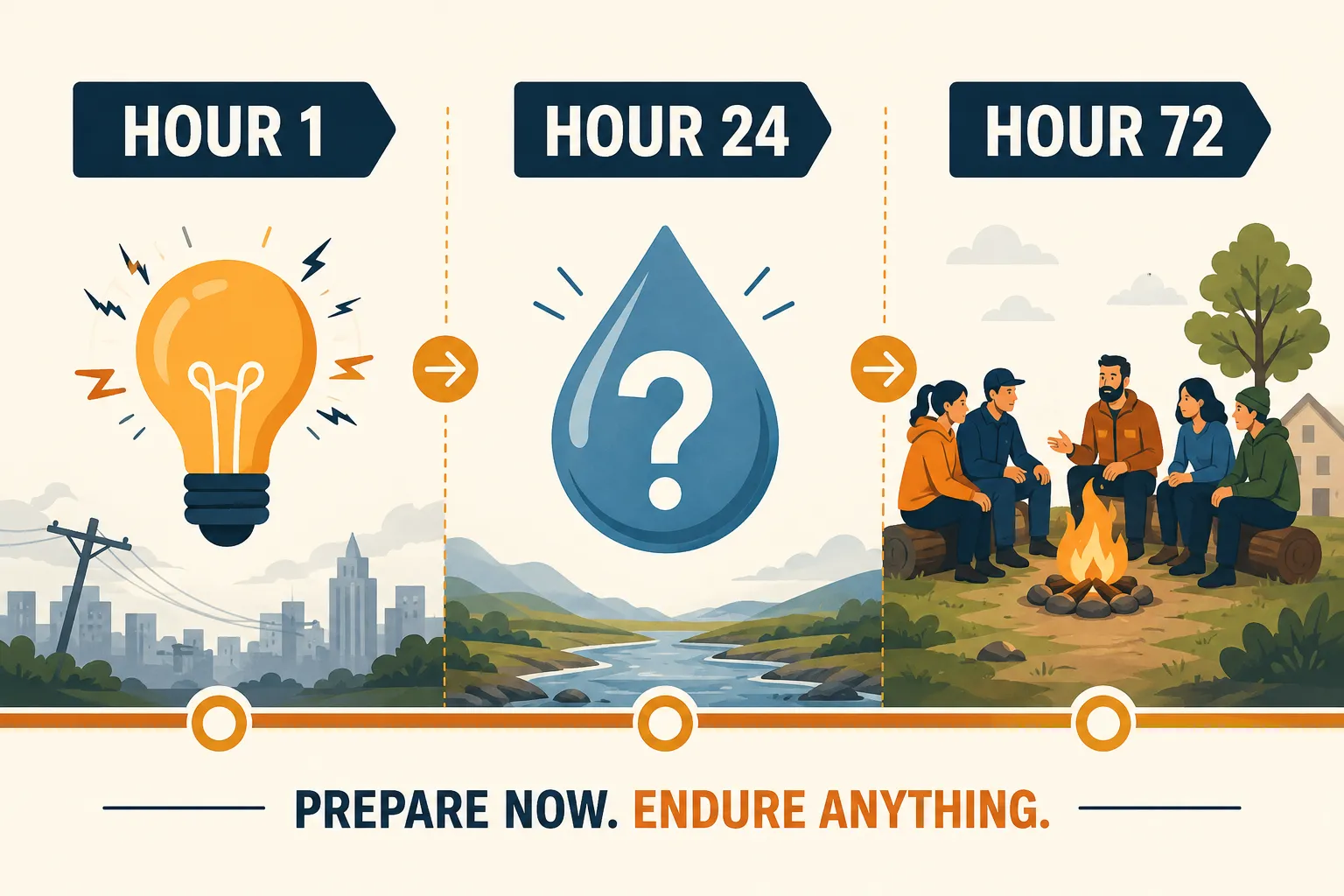
The grid-down scenario, what to expect in the first 72 hours, follows a predictable pattern that rewards preparation and punishes delay. The first hours are deceptively normal. By hour 24, water, food, and communication systems are under stress. By hour 72, unprepared households are in genuine crisis while prepared ones are managing with confidence.
The gap between those two outcomes is not luck. It’s the result of decisions made weeks or months before the event.
Actionable next steps:
- Store a minimum of 1 gallon of water per person per day for at least two weeks.
- Build a food reserve of shelf-stable items that require no refrigeration or minimal cooking.
- Acquire a battery-powered or hand-crank NOAA weather radio.
- Establish a written family communication and meeting plan.
- Review your medication needs and consult a pharmacist about room-temperature storage windows.
- Conduct a home audit using the city blackout survival checklist as a baseline.
- Build a layered backup power strategy, not just a generator, but also battery banks and solar charging options.
Preparedness is not about predicting the worst. It’s about ensuring that whatever happens, your household has the tools, knowledge, and supplies to stay calm, stay safe, and stay ahead of the crisis.
Products, Tools, and Resources
Hand-crank emergency radio: A Midland ER310 or Kaito KA500 covers AM/FM/NOAA and includes a USB charging port. These are non-negotiable items for any preparedness kit.
Water storage containers: WaterBOB bathtub bladders (100-gallon capacity) and 5-gallon BPA-free water jugs from Reliance or Scepter are reliable, purpose-built options for rapid water storage.
Portable power stations: Jackery Explorer 500 or Goal Zero Yeti 500X provide enough capacity to charge phones, run a CPAP, and power LED lighting for multiple days when paired with a compatible solar panel.
Propane camp stove: A Camp Chef Explorer or Coleman Classic propane stove with a 20-lb propane tank gives you 30 to 50 hours of cooking capacity, more than enough for a 72-hour event and well into an extended outage.
Medical-grade cooler for medications: Frio insulin cooling cases use water-activated evaporative cooling to keep insulin within safe temperature ranges for 45+ hours without electricity, essential for insulin-dependent individuals.
Freeze-dried food reserves: Mountain House and Wise Company offer 72-hour emergency kits and longer-term buckets with 25-year shelf lives. These eliminate the food spoilage problem entirely.
For a complete system approach to readiness, the ultimate emergency preparedness guide for preppers ties every element together into a coherent, actionable framework.