
Hey there! Some links on this page may be affiliate links which means that, if you choose to make a purchase, I may earn a commission at no extra cost to you. I greatly appreciate your support. Read the full disclosure here.
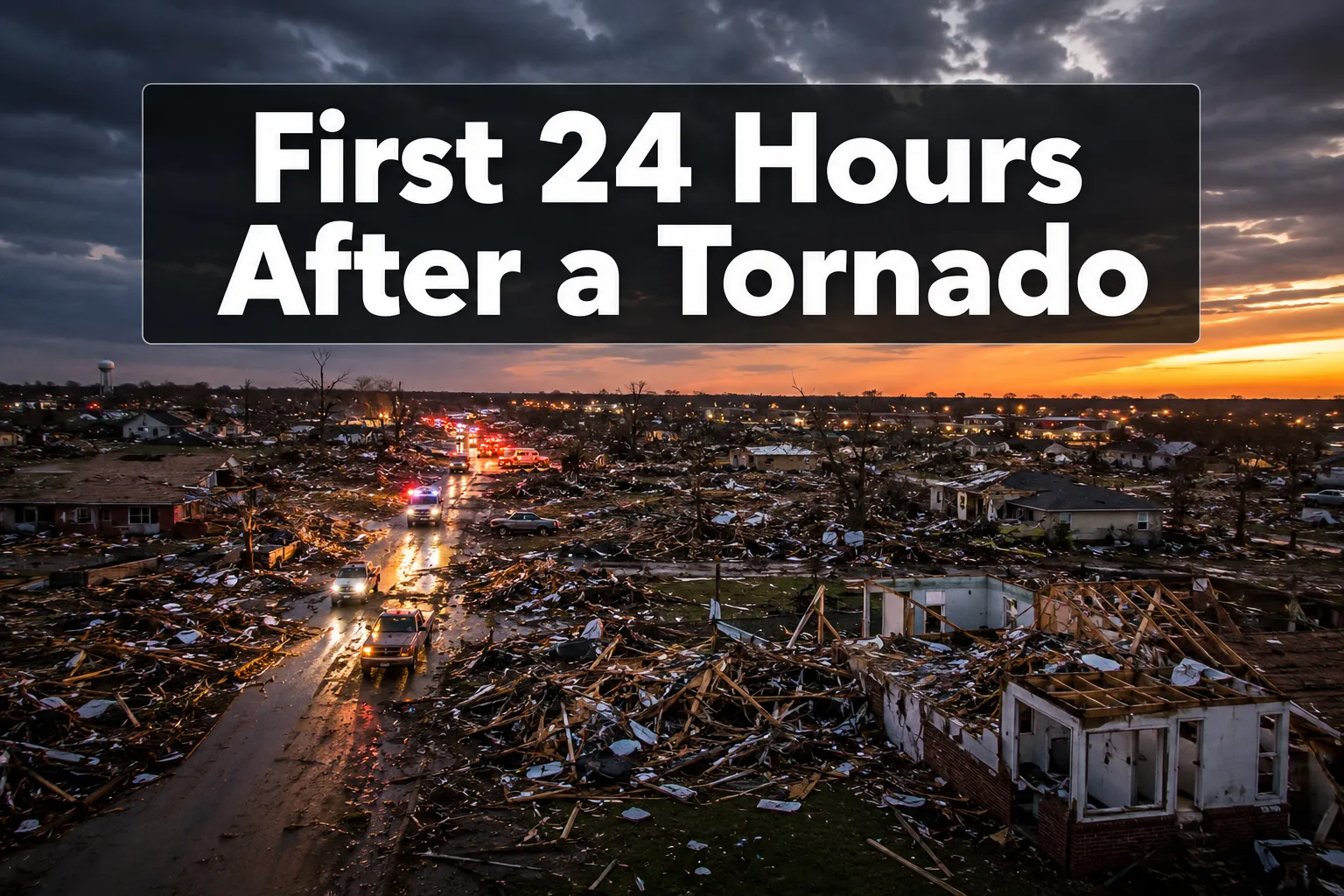
Tornadoes kill an average of 70 people per year in the United States, according to NOAA, but a significant portion of tornado-related deaths and injuries happen after the storm passes, not during it. Carbon monoxide poisoning, structural collapses, downed power lines, and contaminated water claim lives in the hours that follow. Knowing what to do in the first 24 hours after a tornado is just as critical as having a shelter plan before one hits.
This guide breaks down every phase of that critical window, from the moment the wind stops to the end of the first day, so you can protect yourself, account for your family, and begin recovery with confidence.
Find this useful? Add us as a preferred source on Google and more of what we publish will show up in your results.
Key Takeaways
- Do not leave your shelter until official all-clear is given, secondary tornadoes and debris hazards are real threats.
- Treat all downed power lines as live and lethal; maintain at least 30 feet of clearance.
- Check for gas leaks before re-entering any structure; if you smell gas, leave immediately and call your utility provider.
- Account for all household members before anything else, then check on neighbors.
- Avoid tap water until local authorities confirm it is safe, tornado damage frequently compromises municipal water systems.
- Document all property damage with photos and video before moving or discarding anything, for insurance purposes.
- Call 911 only for life-threatening emergencies; use 311 or local non-emergency lines for property and utility issues.
- A pre-built emergency kit with 72 hours of supplies is your most valuable asset in the immediate aftermath.
What to Do Immediately After a Tornado Hits
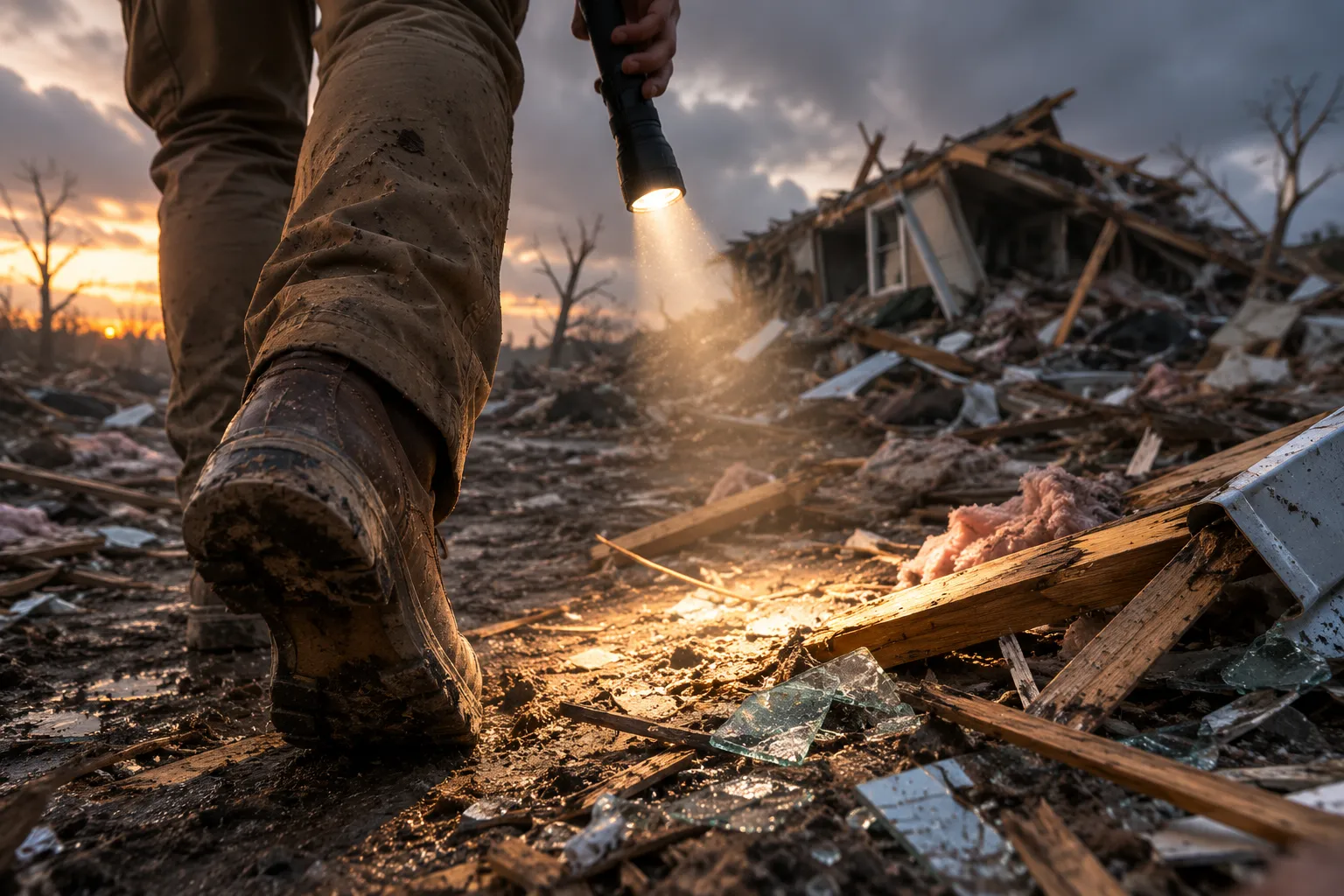
The moment the tornado passes, your first move is to stay put and assess before acting. Wait for official confirmation that the storm has cleared your area, either through a battery-powered weather radio, a NOAA alert, or emergency broadcast. Secondary tornadoes can and do follow the first.
Once you have confirmation:
- Check yourself and others for injuries before moving. Adrenaline masks pain; a person may not realize they are seriously hurt.
- Do not light candles or matches until you have confirmed there are no gas leaks. Natural gas and propane lines are frequently ruptured by tornado damage.
- Put on sturdy footwear, closed-toe boots if possible. Broken glass, exposed nails, and sharp metal debris are everywhere.
- Listen to your battery-powered or hand-crank weather radio for updates from the National Weather Service and local emergency management.
If you are in a damaged building, move toward an exit carefully. Watch the ceiling. If the structure is visibly compromised, cracks running through load-bearing walls, roof partially collapsed, floors buckling, get out and do not go back in until a structural inspector clears it.
How to Stay Safe in the First Hours After a Tornado
Safety in the immediate post-tornado period comes down to one principle: treat every hazard as active until proven otherwise. Gas leaks, structural instability, and electrical hazards do not announce themselves.
Gas leaks: If you smell sulfur or rotten eggs, leave the building immediately, leave the door open, and do not use any electrical switches or your phone until you are well clear. Call your gas utility from outside.
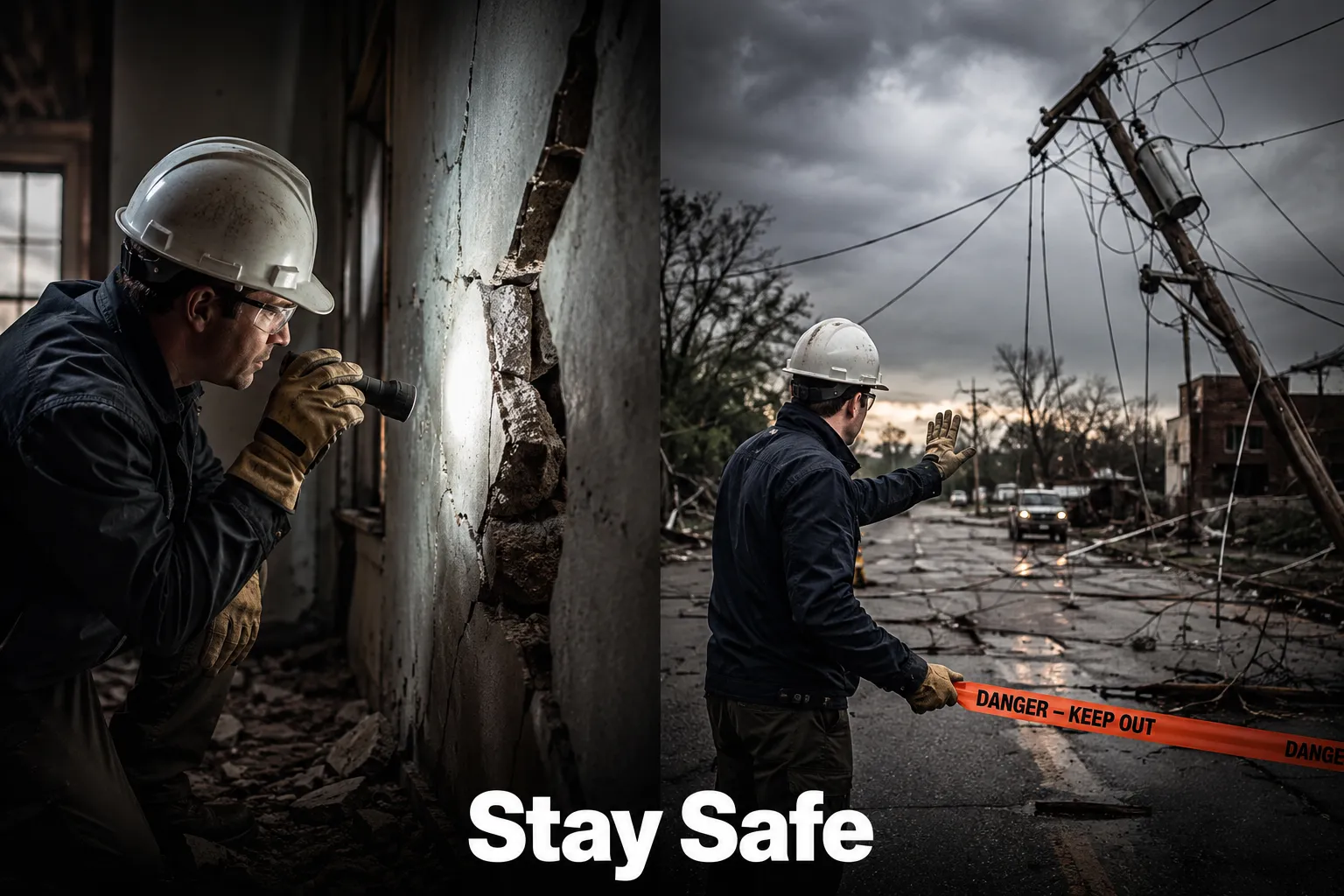
Electrical hazards: Assume every downed wire is live. Water conducts electricity, so standing water near downed lines is especially dangerous. Keep at least 30 feet away from any downed power line and report it immediately.
Structural hazards: Walls can appear intact but have lost their structural integrity. Avoid leaning on walls, entering rooms with sagging ceilings, or walking across floors that feel soft or springy.
Air quality: Tornadoes stir up asbestos, mold, fiberglass insulation, and chemical dust from damaged buildings. If you have an N95 respirator in your emergency kit, now is the time to use it. If not, a damp cloth over your nose and mouth provides minimal but better-than-nothing filtration.
For a deeper look at building a kit that covers these scenarios, the ultimate emergency supplies list at Preppers HQ covers gear that FEMA guidance often omits.
How to Avoid Hazards Like Downed Power Lines After a Tornado
Downed power lines are responsible for a disproportionate share of post-tornado fatalities. The rule is simple: never assume a line is de-energized.
- Do not touch any downed line, and do not touch anything the line is touching, fences, vehicles, puddles, or debris.
- If you are in a vehicle that has come into contact with a downed line, stay inside. Call 911. If you must exit due to fire, jump clear of the vehicle with both feet together and shuffle away, do not walk normally, as ground current can travel through the earth.
- Mark the hazard with whatever you have, a cone, a piece of bright fabric, a flagged stick, to warn others approaching on foot.
- Report every downed line to your utility company and local emergency services. Do not assume someone else has already called it in.
Where Should You Go After a Tornado?
Stay close to your location unless the structure is unsafe or authorities order evacuation. Moving through debris fields on foot or by vehicle creates new risks, damaged roads, unstable overpasses, and hidden hazards.
If your home is structurally sound: Shelter in place. This keeps you accessible to emergency services and prevents you from becoming a casualty on compromised roads.
If your home is unsafe: Go to the nearest designated shelter. FEMA and local emergency management agencies activate community shelters, typically schools, community centers, or churches, within hours of a major tornado. Tune into local emergency broadcasts for shelter locations.
If you need to drive: Avoid roads with visible damage. Bridges and overpasses may look intact but have compromised structural integrity. Take the longest safe route, not the shortest damaged one.
For those with a pre-planned evacuation route, your bug out route planning guide is worth revisiting before tornado season, not after.
How to Find Family Members After a Tornado
Reuniting with separated family members is often the most emotionally urgent task in the first 24 hours. Start with your pre-established family communication plan.
- Designated out-of-area contact: If local phone lines are jammed, text messages often get through when voice calls do not. An out-of-state contact person can serve as a relay point for family members checking in from different locations.
- Text, don’t call: SMS uses less bandwidth than voice calls and is more likely to go through during network congestion.
- Check local shelter registries: Red Cross Safe and Well (safeandwell.communityos.org) allows survivors to register and search for loved ones. Local emergency management agencies often maintain their own lists.
- Physical meeting points: If you established a neighborhood or community meeting point in your family emergency plan, go there. This is why pre-disaster planning matters so much.
If a family member is unaccounted for and you have reason to believe they may be trapped, contact local search and rescue through 911 immediately. Do not attempt to excavate debris yourself unless you have confirmed training, untrained rescue attempts frequently cause secondary collapses.
For families with children or elderly members, the disaster preparedness for families guide covers communication planning in detail.
What Injuries Are Common After Tornadoes and What to Do
The most common tornado-related injuries are lacerations from flying debris, blunt force trauma, puncture wounds, and crush injuries. In the immediate aftermath, expect to encounter people with:
- Deep lacerations: Apply direct pressure with the cleanest material available. Do not remove embedded objects, stabilize them in place.
- Suspected fractures: Immobilize the limb with whatever is available, boards, rolled clothing, or rigid debris, before moving the person.
- Head injuries: Any loss of consciousness, confusion, or unequal pupils is a medical emergency. Keep the person still and call 911.
- Crush injuries: If someone has been trapped under debris for more than 15 minutes, do not move them without medical guidance. Crush syndrome can cause fatal cardiac events when pressure is suddenly released.
Carbon monoxide poisoning from generators running indoors is a major post-tornado killer. Symptoms include headache, nausea, dizziness, and confusion. If multiple people in a structure are experiencing these symptoms simultaneously, get everyone out immediately and call 911.
Every prepper should have a well-stocked first aid kit that goes beyond basic bandages. The 47 things every prepper first aid kit needs covers the supplies that actually matter in trauma situations like these.
How to Check If Your House Is Safe After a Tornado
Do not re-enter a damaged structure until you have done a basic exterior assessment. A house that looks intact from the street can have catastrophic internal damage.
Exterior check before entering:
- Look for visible foundation cracks or shifting
- Check for sagging or collapsed roof sections
- Look for leaning walls or walls that have separated from the roofline
- Smell for gas before opening any door
Interior check (only if exterior appears sound):
- Open windows and doors immediately to ventilate any gas buildup
- Do not use light switches, use a battery-powered flashlight only
- Check the basement and crawl space for water intrusion or foundation damage
- Look up: ceiling cracks, sagging drywall, or water stains indicate roof damage above
- Check the electrical panel for signs of water damage before restoring power
When to call a professional: If you have any doubt about structural integrity, do not guess. Contact a licensed structural engineer or your local building department. Many municipalities deploy rapid damage assessment teams after major tornadoes, they can tag a structure as safe, limited entry, or unsafe within hours.
Do You Need to Call 911 After a Tornado?
Call 911 for life-threatening emergencies: trapped persons, serious injuries, fires, or gas leaks with immediate danger. For non-emergency issues, downed lines with no immediate threat, property damage, utility outages, use your local 311 line or utility provider’s emergency number to keep 911 lines clear for true emergencies.
After a major tornado, 911 centers are overwhelmed. Prioritize your call appropriately:
| Situation | Who to Call |
|---|---|
| Person trapped or seriously injured | 911 immediately |
| Active gas leak or fire | 911 immediately |
| Downed power line (no immediate threat) | Utility company emergency line |
| Property damage, no injuries | Local non-emergency line or 311 |
| Missing family member | Red Cross Safe and Well + local emergency mgmt |
What Supplies Do You Need in the First 24 Hours After a Tornado?
The supplies that matter most in the first 24 hours are those that keep you safe, hydrated, and able to communicate, not comfort items.
Critical supplies for the first 24 hours:
- Water: One gallon per person per day minimum. Municipal water systems are frequently compromised after tornadoes. Do not drink tap water until authorities confirm it is safe.
- Food: Ready-to-eat items that require no cooking or refrigeration. Granola bars, canned goods with a pull-top, peanut butter.
- Flashlights and batteries: Multiple sources of battery-powered light. Candles create fire risk in damaged structures.
- Battery-powered or hand-crank weather radio: Your primary information source when cell networks are down.
- First aid kit: Trauma-capable, not just bandages.
- N95 respirators: For dust, asbestos, and chemical particulates in debris.
- Work gloves and boots: Hand and foot protection during debris navigation.
- Phone battery bank: A fully charged power bank extends your communication window significantly.
- Cash: ATMs and card readers go offline when power is out.
- Important documents: Insurance policies, IDs, medical records, ideally in a waterproof bag.
A properly built 72-hour bug out bag covers most of these items and should be accessible within seconds of needing it.
Should You Leave Your Area After a Tornado or Stay Put?
Stay unless you are ordered to evacuate or your structure is unsafe. Spontaneous self-evacuation after a tornado creates traffic gridlock that blocks emergency vehicles and puts you at risk on damaged roads.
Stay if:
- Your home is structurally sound
- You have adequate water and food for 72 hours
- No evacuation order has been issued
Leave if:
- Local authorities have issued an evacuation order
- Your home is structurally compromised
- You have a medical emergency that requires hospital access
- Utility hazards (gas, flooding) make staying dangerous
If you do leave, tell someone where you are going, take your emergency kit, and follow designated evacuation routes only.
How Long Does It Take for Emergency Services to Arrive After a Tornado?
Response times vary widely based on the scale of the tornado, the number of affected areas, and available resources. After a significant tornado outbreak, emergency services may be stretched across dozens of simultaneous incidents. Realistic expectations:
- Search and rescue teams may take 2-6 hours to reach your area in a widespread event
- Utility crews for power restoration may take 24-72 hours or longer
- FEMA individual assistance registration typically opens within 24-72 hours of a disaster declaration
This is why self-sufficiency for the first 72 hours is not optional, it is the baseline. Do not plan around emergency services arriving quickly. Plan around them arriving when they can.
What If You’re Trapped or Injured After a Tornado?
If you are trapped in debris, conserve energy and signal for help. Do not exhaust yourself trying to move heavy debris alone.
- Signal rescuers: Tap on pipes or walls in a rhythmic pattern, three taps is a universal distress signal. Shout only when you hear rescuers nearby to conserve energy.
- Protect your airway: Cover your mouth and nose with clothing to reduce dust inhalation.
- Do not light a flame: Gas leaks in debris fields are common. A spark can be fatal.
- Stay calm: Panic increases oxygen consumption and impairs decision-making.
If you are injured but not trapped, apply self-aid using whatever is available, then move toward open ground where rescuers can see you. A brightly colored piece of clothing or material placed in a visible location can help aerial search teams locate you.
How to Document Damage for Insurance After a Tornado
Document everything before you touch anything. Insurance adjusters work from evidence, and the more thorough your documentation, the stronger your claim.
Documentation checklist:
- Photograph and video every room, every exterior wall, and the roof from safe vantage points
- Capture close-ups of specific damage: cracked foundations, broken windows, damaged appliances
- Do not throw away damaged items until your adjuster has seen them
- Write down the date and time of the tornado and when you first observed each type of damage
- Keep receipts for any emergency repairs or hotel stays, these are often reimbursable
Contact your insurance company as soon as possible to open a claim. Most insurers have 24-hour disaster hotlines. Having your policy number and agent contact in your emergency documents bag makes this faster. The ultimate financial survival checklist covers which documents to protect before disaster strikes.
Where to Get Help and Shelter After a Tornado
Multiple organizations activate within hours of a major tornado to provide food, shelter, and basic supplies.
- American Red Cross: Opens emergency shelters and provides food, water, and basic medical support. Find shelter locations at redcross.org or by calling 1-800-RED-CROSS.
- FEMA: Registers survivors for individual assistance after a federal disaster declaration. Apply at disasterassistance.gov or call 1-800-621-3362.
- Salvation Army: Provides mobile feeding units, cleaning supplies, and emotional support at disaster sites.
- Local emergency management: Your county or city emergency management office coordinates local resources and shelter locations. Follow them on social media before tornado season.
- 211: Dial 211 in most US areas to connect with local social services, including emergency shelter and food assistance.

First 24-Hour Post-Tornado Action Checklist
Frequently Asked Questions
Is it safe to use tap water after a tornado? Not until local authorities confirm it is safe. Tornado damage frequently breaks water mains, allows ground contamination into the supply, or disrupts treatment systems. Use bottled water or treat water from alternative sources until an official all-clear is issued by your water utility or local health department.
Can I run my generator inside the garage after a tornado? No. Running a generator indoors or in an attached garage, even with the door open, produces carbon monoxide at levels that can be lethal within minutes. Generators must be placed at least 20 feet from any door, window, or vent, with the exhaust directed away from the structure.
Should I try to rescue someone trapped in debris myself? Only if you have confirmed training in debris rescue. Untrained rescuers frequently cause secondary collapses that injure both the victim and themselves. Call 911, mark the location clearly, and guide professional rescuers to the site.
What if my car is damaged and I can’t evacuate? Shelter in place in the most structurally sound part of your home or a neighbor’s home. Contact local emergency management via 911 or 311 to report your situation and location. Emergency services prioritize stranded and injured residents.
How do I know if my home is condemned after a tornado? Local building inspectors or rapid damage assessment teams tag structures after major tornadoes. A red tag means the structure is unsafe for any entry. A yellow tag means limited entry only. A green tag means the structure is considered safe. If no inspector has assessed your home, treat significant visible structural damage as a red-tag situation until confirmed otherwise.
Can I eat food from my refrigerator after a tornado? If power has been out for more than 4 hours, perishables in the refrigerator should be discarded. A full freezer stays safe for approximately 48 hours if kept closed. When in doubt, throw it out. Foodborne illness during a disaster compounds an already difficult situation.
What if I smell gas but can’t find the source? Leave the structure immediately, leave the door open, do not use any electrical devices or your phone until you are outside and well clear of the building. Call your gas utility’s emergency line from a safe distance. Do not re-enter until the utility company confirms the leak has been addressed.
How do I register for FEMA assistance after a tornado? You can register at disasterassistance.gov, through the FEMA app, or by calling 1-800-621-3362. Registration is only available after the President has issued a federal disaster declaration for your county. Keep your address, insurance information, and Social Security number available when registering.
What should I do if my neighborhood has no cell service? Use a battery-powered or hand-crank weather radio for information. Send a family member on foot to the nearest emergency shelter or fire station to report your situation and get updates. Pre-arranged neighborhood communication plans, where neighbors check on each other in person, are invaluable when technology fails.
Is it safe to drive through flooded roads after a tornado? No. Tornado damage frequently causes road washouts, bridge damage, and debris-covered flooding. Six inches of moving water can knock a person down; two feet can carry away most vehicles. Turn around, don’t drown, it applies after tornadoes just as much as after hurricanes.
Conclusion
Knowing what to do in the first 24 hours after a tornado is the difference between a difficult recovery and a preventable tragedy. The storm itself may last minutes, but the decisions you make in the hours that follow determine whether you and your family come through safely.
The framework is straightforward: prioritize life safety over property, treat every hazard as active until proven otherwise, account for your people before anything else, and document everything for the recovery process that follows. Preparedness built before the tornado, a stocked emergency kit, a family communication plan, and a clear understanding of local shelter resources, makes every one of these steps faster and more effective.
The prepper mindset is not about fear. It is about having thought through these scenarios before the adrenaline hits, so your actions in a crisis are deliberate rather than reactive.
Products, Tools, and Resources
Weather radio: A battery-powered or hand-crank NOAA weather radio (Midland and Kaito are well-regarded brands) is the single most important communication tool when cell networks fail after a tornado. Keep one in your shelter area and one in your emergency kit.
N95 respirators: Standard construction-grade N95s provide meaningful protection against the dust, fiberglass, and chemical particulates common in tornado debris fields. Keep a small supply in your emergency kit.
Emergency kit foundation: If you don’t yet have a fully built emergency kit, the 47 things every prepper’s first aid kit needs and the 72-hour bug out bag checklist are the two best starting points on this site.
Water purification: If tap water is compromised, a portable water filter (Sawyer Squeeze or LifeStraw Mission) combined with water purification tablets covers most scenarios. For a deeper look at water safety after disasters, the guide on survival water filtering mistakes covers the errors that compromise otherwise good setups.
Documentation tools: A waterproof document bag for insurance policies, IDs, and medical records is a low-cost, high-value prep. Pair it with a fully charged power bank so your phone camera is available for damage documentation when you need it most.
Pre-disaster planning: The natural disaster preparedness step-by-step guide and the ultimate family emergency plan template are the two resources that will make the first 24 hours after any tornado significantly more manageable, because the best time to build your plan is before you need it.