
Hey there! Some links on this page may be affiliate links which means that, if you choose to make a purchase, I may earn a commission at no extra cost to you. I greatly appreciate your support. Read the full disclosure here.
Only 53% of American households keep enough food on hand to last more than three days, according to FEMA preparedness surveys. For a family of four, that gap between comfort and crisis can close faster than most people expect, a single severe storm, job disruption, or supply chain breakdown is all it takes. A solid food storage checklist for family of four is not a luxury for extreme survivalists. It’s a practical system that every household should have in place before they need it.
Key Takeaways
- A family of four needs roughly 2,000 calories per person per day, which means planning for approximately 8,000 calories daily across the household.
- FEMA recommends a minimum 72-hour supply, but most experienced preppers build toward a 3-month reserve as a realistic baseline.
- Short-term storage focuses on familiar, ready-to-eat foods; long-term storage prioritizes shelf-stable staples like grains, legumes, and freeze-dried proteins.
- Airtight containers, cool temperatures (ideally 50-70°F), and darkness are the three non-negotiable conditions for maximizing shelf life.
- Rotating stock using the FIFO (first in, first out) method prevents waste and keeps your supply fresh.
- A separate chest freezer significantly expands storage capacity and is worth the investment for most families.
- Budget-conscious families can build a meaningful 3-month supply for under $200 by prioritizing bulk staples first.
- Water storage is inseparable from food storage; plan for at least one gallon per person per day.
Find this useful? Add us as a preferred source on Google and more of what we publish will show up in your results.
How Much Food Should a Family of 4 Store for Emergencies
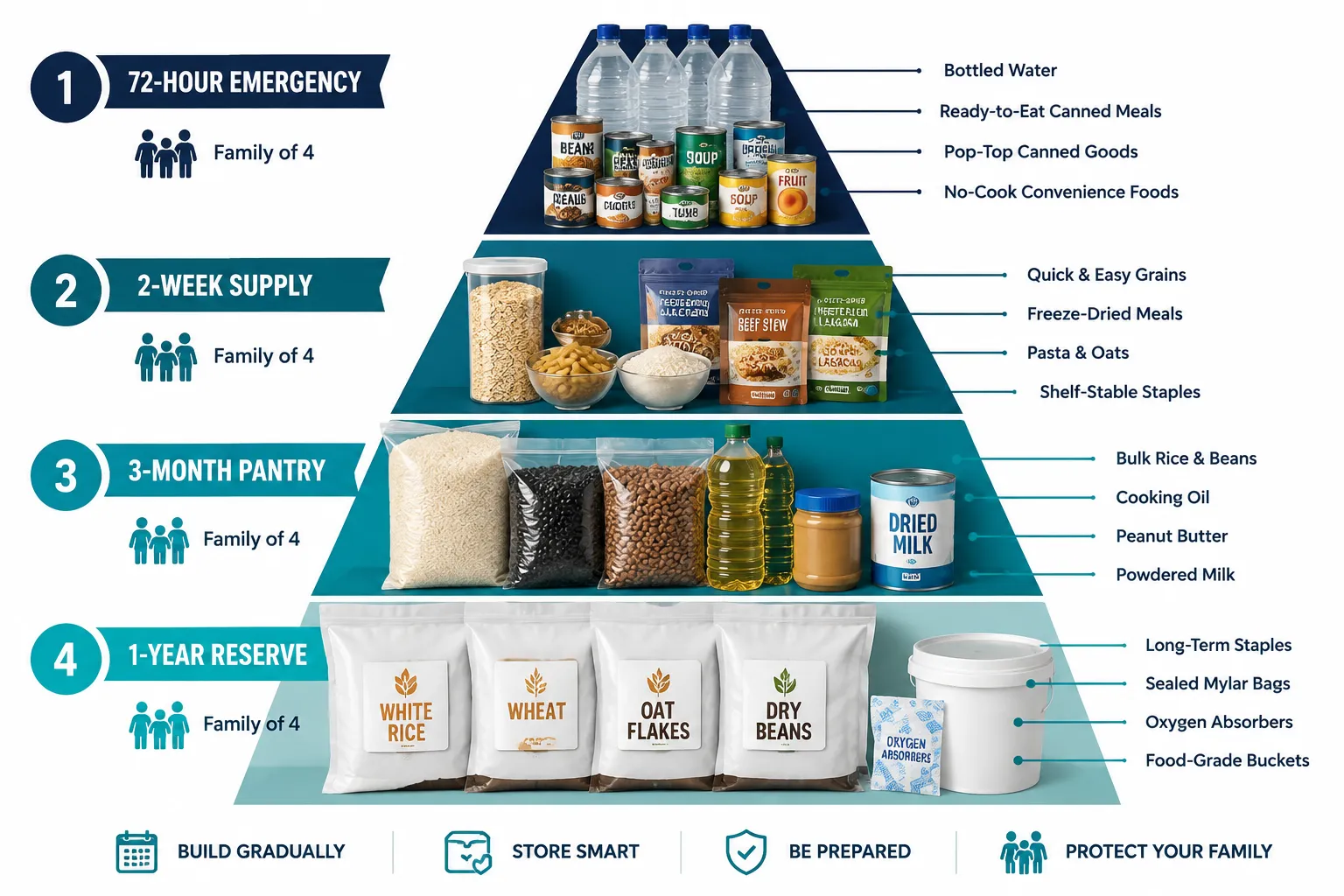
A family of four needs a minimum of 72 hours of food and water as an absolute floor, but a 3-month supply is the practical target that most preparedness experts recommend. At 2,000 calories per person per day, that’s roughly 720,000 calories total for a 90-day supply for four people.
Here’s a practical breakdown by time horizon:
| Storage Goal | Total Calories Needed | Approximate Weight |
|---|---|---|
| 72-Hour Emergency | ~24,000 calories | 15-20 lbs |
| 2-Week Supply | ~112,000 calories | 60-80 lbs |
| 3-Month Supply | ~720,000 calories | 350-500 lbs |
| 1-Year Supply | ~2.9 million calories | 1,200-1,800 lbs |
These numbers account for average adult activity levels. Adjust upward if your household includes teenagers, physically active adults, or anyone doing manual labor during an emergency. Children under 10 typically need 1,200-1,600 calories per day, which can reduce your total slightly.
For a deeper breakdown of exactly what to stock, the ultimate survival pantry list covers quantities and categories in detail.
Food Storage Checklist For Family Of Four: Short-Term vs. Long-Term Storage
Short-term and long-term food storage serve different purposes and require different approaches. Short-term storage (72 hours to 2 weeks) focuses on familiar, minimally processed foods your family already eats. Long-term storage (3 months to 1 year or more) relies on shelf-stable staples with multi-year shelf lives.
Short-Term Storage Priorities (72 hours to 2 weeks)
- Canned vegetables, beans, and soups (no-cook or low-prep)
- Peanut butter and nut butters
- Crackers, granola bars, and trail mix
- Shelf-stable milk and juice boxes
- Ready-to-eat meals and protein bars
- Manual can opener (non-negotiable)
Long-Term Storage Priorities (3 months to 1 year+)
- White rice (25-30 year shelf life in sealed mylar bags)
- Dried beans and lentils (up to 30 years sealed)
- Rolled oats and wheat berries
- Freeze-dried proteins (chicken, beef, eggs)
- Honey (indefinite shelf life when sealed)
- Salt, sugar, baking soda, and baking powder
- Cooking oils (coconut oil and ghee last longest)
- Freeze-dried fruits and vegetables
For a thorough look at the long-term side of this equation, the complete beginner’s guide to long-term food storage is worth reading alongside this checklist.
Common mistake: Many families stock only short-term comfort foods and neglect calorie-dense staples. A pantry full of canned soup is reassuring, but it won’t sustain four people for 90 days without grains and fats.
How Long Does Canned Food Last in Storage
Most commercially canned foods remain safe and nutritious for 2 to 5 years past their printed “best by” date when stored properly. The USDA notes that canned goods stored in cool, dry conditions can remain safe indefinitely, though quality and nutritional value decline over time.
Practical shelf life guidelines by category:
- High-acid canned foods (tomatoes, citrus, pickles): 12-18 months best quality, safe 2-3 years beyond
- Low-acid canned foods (beans, corn, meat, vegetables): 2-5 years best quality, often safe much longer
- Home-canned goods: 1 year for best quality; always inspect before eating
- Freeze-dried pouches: 25-30 years sealed, 1-2 years after opening
Inspect cans before use. Discard any that are bulging, deeply dented along seams, rusted through, or producing an off smell when opened. These are signs of potential contamination, not just age.
Best Containers for Storing Food at Home
The best containers for home food storage are food-grade airtight options that block moisture, oxygen, and pests. The right choice depends on the food type and storage duration.
Container options by use case:
- Mylar bags with oxygen absorbers: Best for long-term dry goods (rice, beans, grains). Use 5-mil or thicker bags with 300-2,000cc oxygen absorbers depending on bag size.
- Food-grade 5-gallon buckets with gamma-seal lids: Excellent for bulk staples; stack well and are rodent-resistant.
- Glass mason jars: Ideal for herbs, spices, dehydrated foods, and short-to-medium term storage. Not rodent-proof on their own.
- BPA-free PETE plastic bottles: Good for sugar, salt, and small grain quantities.
- Commercial #10 cans: The gold standard for freeze-dried foods; most come pre-sealed from manufacturers.
Avoid cardboard boxes, paper bags, and original retail packaging for anything stored longer than a few weeks. Pests can breach these easily, and moisture penetration is a serious risk.
Foods That Don’t Need Refrigeration for Storage
Shelf-stable foods that require no refrigeration form the backbone of any emergency food supply. These items should make up the majority of a family’s food storage checklist.
Top shelf-stable foods to prioritize:
- White rice, pasta, and dried noodles
- Dried beans, lentils, split peas, and chickpeas
- Rolled oats and cornmeal
- Canned meats (tuna, salmon, chicken, sardines)
- Canned vegetables and fruits
- Peanut butter, almond butter, and tahini
- Honey, maple syrup, and white sugar
- Salt, vinegar, and soy sauce
- Hardtack, crackers, and dry biscuits
- Instant coffee, tea, and powdered drink mixes
- Coconut oil, olive oil (shorter shelf life), and ghee
- Dried herbs and spices
For ready-to-use meal ideas built around these items, the collection of 30 easy prepper pantry recipes shows exactly how to turn shelf-stable staples into real meals.
What Foods Shouldn’t Be Stored Together
Certain foods degrade faster or create contamination risks when stored in close proximity. This is one of the most overlooked aspects of a food storage checklist for a family of four.
Keep these separated:
- Strong-smelling foods away from neutral ones: Coffee, onions, and garlic can transfer odors to rice, flour, and sugar stored nearby in permeable packaging.
- Raw and ready-to-eat items: In any active pantry or short-term cache, keep raw grains and beans away from ready-to-eat crackers or dried fruit to prevent cross-contamination.
- Chemicals and cleaning supplies away from food: Never store bleach, detergents, or pesticides in the same space as food, even in sealed containers. Fumes can penetrate.
- Moisture-producing items away from dry goods: Fresh produce, even root vegetables, release moisture that can accelerate mold in nearby dry goods.
- Pet food separate from human food: Pet food attracts different pests and can introduce contamination.
How to Store Food to Prevent Spoilage and Pests
Preventing spoilage and pest infiltration requires controlling four variables: oxygen, moisture, light, and temperature. Address all four and your food storage system becomes dramatically more reliable.
Pest prevention checklist:
- Seal all dry goods in hard-sided containers or thick mylar bags, cardboard and thin plastic are not barriers
- Inspect incoming food before adding it to storage (some pests arrive in store-bought packaging)
- Place bay leaves inside grain containers, they deter weevils naturally
- Use food-grade diatomaceous earth along storage room perimeters
- Check storage areas monthly for signs of rodent activity (droppings, gnaw marks)
Spoilage prevention checklist:
- Use oxygen absorbers in sealed mylar bags for anything stored longer than 6 months
- Keep moisture absorbers (silica gel packets) in containers holding dried herbs, spices, and powders
- Store all oils in dark, cool locations and rotate them every 1-2 years
- Never return partially used food to a long-term sealed container without resealing properly
For a detailed breakdown of what goes wrong in most storage setups, the guide on 15 food storage mistakes to avoid covers the most costly errors preppers make.
What Temperature Should Food Storage Areas Be
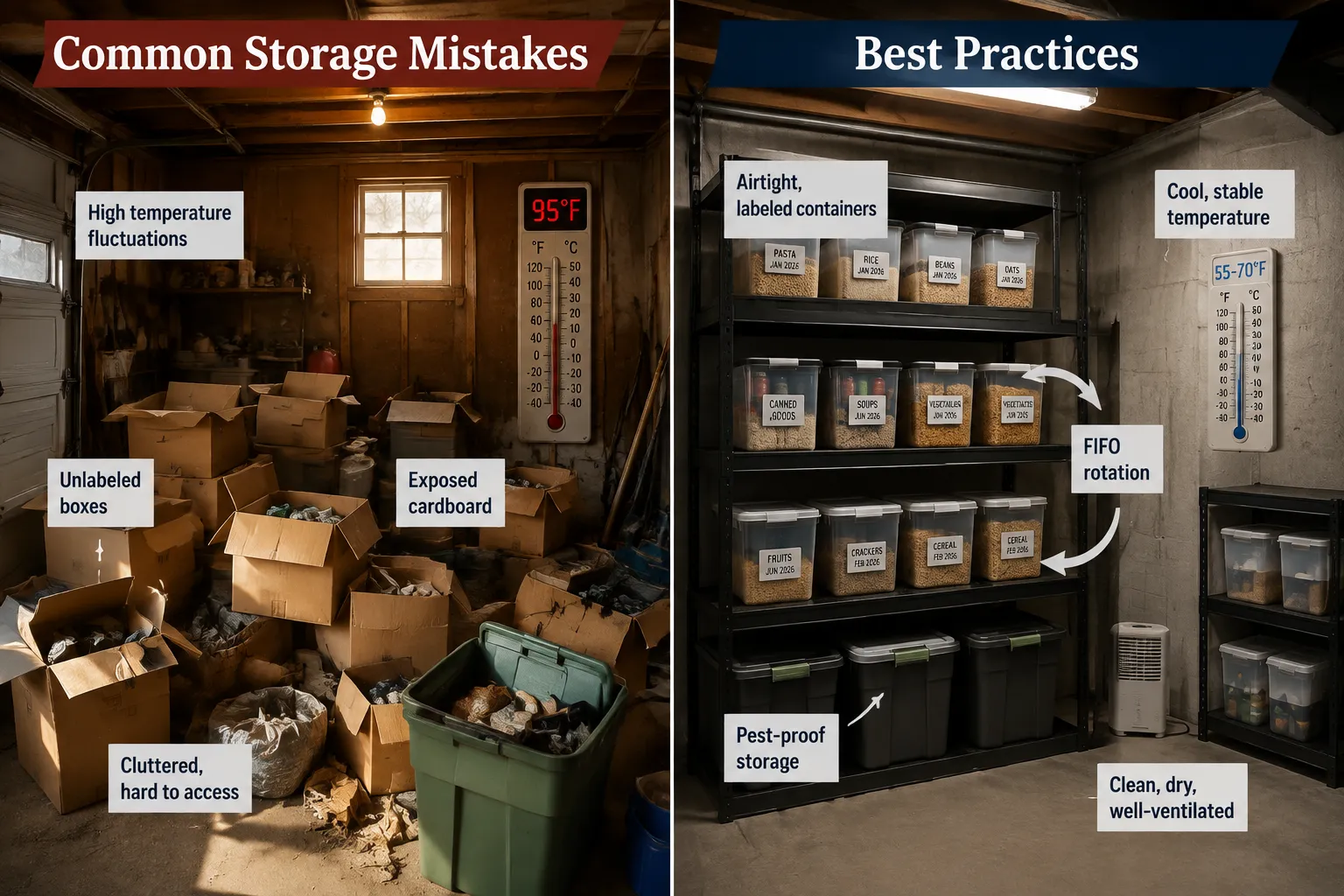
The ideal temperature for food storage is between 50°F and 70°F (10°C to 21°C). Every 10-degree increase above 70°F roughly halves the shelf life of most stored foods, according to food science research from Utah State University Extension.
Temperature guidelines by location:
- Basement: Often ideal, naturally cool, stable temperatures year-round in most climates
- Interior closets: Good if away from exterior walls and heat sources
- Garage: Problematic in most climates due to extreme temperature swings; acceptable only in mild, stable climates with insulation
- Attic: Almost always unsuitable, temperatures can exceed 120°F in summer, which destroys nutritional value and accelerates spoilage rapidly
If a basement isn’t available, an interior room on the lowest floor of the home is the next best option. A root cellar is the most temperature-stable solution for long-term storage, the guide to building a root cellar for long-term food storage walks through construction and setup.
Can You Store Food in the Garage or Basement
A basement is one of the best locations for food storage; a garage is generally one of the worst. The distinction matters because temperature stability is the single biggest factor in shelf life.
Basement storage: Suitable for most long-term food storage. Naturally cool and dark. Watch for moisture, use a dehumidifier if humidity exceeds 60% and store items on shelving units off the floor to allow air circulation.
Garage storage: Acceptable only if the garage is climate-controlled or located in a consistently mild climate. Uninsulated garages in hot climates can reach temperatures that destroy freeze-dried food quality within months. If garage storage is unavoidable, use it only for short-term rotation stock and keep it away from vehicle exhaust fumes.
How to Organize a Pantry for a Family of 4
An organized pantry for a family of four uses the FIFO (first in, first out) system, clear labeling, and category grouping to make rotation automatic and inventory visible at a glance.
Step-by-step pantry organization system:
- Group by category: Grains together, canned proteins together, canned vegetables together, fats and oils together, comfort/snack items together.
- Label everything with purchase date and expiration: Use a permanent marker or label maker directly on the container.
- Oldest in front, newest in back: When restocking, push existing items forward and place new items behind them.
- Create an inventory sheet: A simple spreadsheet or notebook listing item, quantity, and expiration date saves significant time and prevents over-buying.
- Designate a “use soon” zone: A small section of the pantry for items expiring within 60 days ensures nothing gets wasted.
- Store water separately but nearby: Water storage belongs in the same general area as food for emergency access. Review the emergency water storage and purification guide for sizing your water supply alongside your food supply.
How Often Should You Rotate Stored Food
Stored food should be rotated on a schedule tied to each item’s shelf life, not on a single annual sweep. A practical rotation schedule prevents waste and ensures your supply is always at peak quality.
Rotation schedule by category:
- Oils and fats: Every 12-18 months
- Canned goods: Every 2-3 years (consume oldest first continuously)
- Dried pasta and crackers: Every 1-2 years
- Bulk grains and beans in mylar: Every 5-10 years (inspect seals annually)
- Freeze-dried pouches: Every 10-25 years depending on product
- Spices and seasonings: Every 1-2 years for potency
The most effective rotation system is simply cooking from your storage regularly. Families who treat their food storage as a working pantry, not a sealed vault, naturally rotate stock without a formal schedule.
Cheapest Way to Build a Food Storage Supply
The most cost-effective approach to building a food storage supply is buying bulk staples first, then adding variety. Grains, legumes, salt, sugar, and cooking oil provide the highest calorie density per dollar of any food category.
Budget-first priority order:
- 50 lbs white rice (~$25-35)
- 25 lbs dried beans and lentils (~$20-30)
- 20 lbs rolled oats (~$15-20)
- Cooking oil, salt, sugar, and honey (~$30-40)
- Canned vegetables and proteins (add gradually)
- Freeze-dried items (add as budget allows)
For families working with a tight budget, the 3-month emergency food supply for $100 guide provides a specific shopping framework. It’s achievable, and it proves that meaningful preparedness doesn’t require a large upfront investment.
Do Families of 4 Need a Separate Freezer for Storage
A dedicated chest freezer is a worthwhile investment for most families of four building a serious food storage system. It significantly expands capacity for proteins, garden harvests, and bulk-cooked meals that would otherwise be impossible to store.
A 7-cubic-foot chest freezer holds roughly 245 lbs of food and costs $150-$300 new. Running costs are typically $30-50 per year in electricity. For a family storing meat, poultry, and garden produce, the freezer pays for itself in reduced food waste within the first year.
Important caveat: A freezer is not a substitute for shelf-stable storage. Power outages, exactly the scenario many preppers prepare for, render a freezer useless within 24-48 hours without a generator. Build your shelf-stable foundation first, then add freezer capacity as a supplement.
Food Storage Checklist For Family Of Four: Complete Quick-Reference
Use this master checklist as a starting point. Quantities are approximate for a 3-month supply for four adults.
Grains and Starches
- White rice: 100 lbs
- Dried pasta: 30 lbs
- Rolled oats: 30 lbs
- Cornmeal or flour: 25 lbs
- Crackers and hardtack: 10 lbs
Proteins
- Dried beans and lentils: 60 lbs
- Canned tuna/salmon/chicken: 60+ cans
- Peanut butter: 15 lbs
- Freeze-dried meat: 10-15 lbs
- Canned sardines/mackerel: 24 cans
Fats and Oils
- Coconut oil: 6 lbs
- Olive or vegetable oil: 2 gallons
- Ghee: 4 lbs
Fruits and Vegetables
- Canned vegetables (corn, green beans, peas): 90+ cans
- Canned tomatoes and tomato sauce: 36+ cans
- Canned fruit: 36+ cans
- Freeze-dried vegetables: 10 lbs
Baking and Seasoning
- Salt: 10 lbs
- White sugar: 20 lbs
- Honey: 10 lbs
- Baking soda and powder: 5 lbs each
- Vinegar: 2 gallons
- Spices and seasonings: assorted
Beverages and Comfort
- Instant coffee or tea: 3-month personal supply
- Powdered drink mixes
- Instant cocoa
Water
- Minimum 1 gallon per person per day = 360 gallons for 90 days for four people
- Store what space allows; prioritize filtration and purification as backup
FAQ
How long should a family of four’s food storage last?
Most preparedness experts recommend a minimum of 3 months. FEMA’s official guidance starts at 72 hours, but a 3-month supply covers most realistic emergency scenarios including job loss, supply chain disruptions, and regional disasters.
What’s the single most important item in a food storage checklist for a family of four?
Water. Without adequate water, food storage is irrelevant. Plan for at least one gallon per person per day for drinking and basic sanitation.
Can I store food in my garage?
Only if your garage is climate-controlled or located in a mild climate. Uninsulated garages in hot or cold climates experience temperature extremes that dramatically reduce shelf life. A basement or interior closet is strongly preferred.
How do I keep pests out of my food storage?
Use hard-sided airtight containers or thick mylar bags. Inspect food before storing it. Place bay leaves in grain containers. Check storage areas monthly for signs of rodent or insect activity.
Is freeze-dried food worth the cost?
For protein and vegetables with 25-year shelf lives, yes. Freeze-dried food is expensive upfront but eliminates rotation concerns for long-term storage. Start with bulk staples for budget efficiency, then add freeze-dried items as your budget allows. The ultimate prepper’s guide to freeze-dried food covers this in depth.
What’s the best way to store rice long-term?
Seal white rice in 5-mil mylar bags with 2,000cc oxygen absorbers, then place the sealed bags inside food-grade 5-gallon buckets. Stored at 70°F or below, white rice can last 25-30 years this way.
How do I know if my canned food has gone bad?
Discard any can that is bulging, leaking, has deep dents along the seam, or produces an off odor when opened. A slight loss of color or texture in older cans is normal and doesn’t indicate spoilage.
Do I need special equipment to start food storage?
Not for the basics. A manual can opener, some food-grade buckets, and a cool dry space are enough to get started. Mylar bags and oxygen absorbers become important once you move into long-term storage of bulk grains.
How do I rotate my food storage without wasting anything?
Cook from your storage regularly. Treat your stored food as your primary pantry, not a separate emergency vault. This naturally keeps stock fresh and eliminates the need for formal rotation schedules.
What if I live in a small apartment with no basement?
Apartment food storage is absolutely achievable. Under-bed storage containers, closet shelving, and furniture with built-in storage can hold a meaningful supply. The emergency food storage for small apartment guide covers space-efficient strategies specifically for this situation.
Conclusion
Building a food storage checklist for a family of four doesn’t require a bunker, a massive budget, or years of experience. It requires a clear starting point, a realistic goal, and consistent action over time. Start with water and bulk staples. Add variety as your budget allows. Organize for rotation from day one. Store in the coolest, darkest space available.
The families who navigate emergencies with the least disruption aren’t the ones who panicked and bought everything at once, they’re the ones who built their supply methodically, stored it correctly, and knew exactly what they had when they needed it.
If this is your first step into food preparedness, the prepper checklist for beginners 30-day system provides a structured month-by-month framework that pairs well with this food storage guide. And if you want to go deeper on the 50 best individual foods for long-term storage, that resource is worth bookmarking as a companion reference.
Preparedness is confidence. Start building yours today.
Products, Tools, and Resources
Mylar bags and oxygen absorbers: Look for 5-mil, food-grade mylar bags in 1-gallon and 5-gallon sizes. Brands like Wallaby and PackFreshUSA offer reliable options. Pair with 300cc (small bags) or 2,000cc (5-gallon bags) oxygen absorbers.
Food-grade 5-gallon buckets with gamma-seal lids: Available at most hardware stores and restaurant supply outlets. Gamma-seal lids allow easy access without breaking the seal entirely, worth the small premium over standard lids.
Chest freezer: A 7-cubic-foot chest freezer from brands like Frigidaire or Midea provides excellent capacity at a reasonable price point. Look for Energy Star ratings to minimize operating costs.
Dehumidifier: For basement storage areas with humidity above 60%, a small dehumidifier protects your entire supply. Eva-Dry and Frigidaire make reliable compact units.
Manual can opener: Keep at least two quality manual openers in your supply. The Kuhn Rikon and OXO Good Grips models are consistently rated for durability.
Inventory spreadsheet: A simple Google Sheet or printed binder tracking item name, quantity, purchase date, and expiration date is the most underrated tool in any food storage system. Free, effective, and immediately useful.
Food-grade diatomaceous earth: Useful for pest deterrence along storage room perimeters. Harris is a widely available brand with food-safe certification.