

Hey there! Some links on this page may be affiliate links which means that, if you choose to make a purchase, I may earn a commission at no extra cost to you. I greatly appreciate your support. Read the full disclosure here.
A single nuclear warhead detonated 250 miles above the continental United States could, according to the U.S. EMP Commission’s 2008 report to Congress, disable electronics across the entire country within milliseconds. No warning. No gradual failure. Just silence where machines used to hum. Understanding EMP proof devices, what still works after an attack, is not a fringe concern. It is one of the most practical, actionable areas of preparedness any serious prepper can invest time in.
This guide covers every angle: what survives, what doesn’t, how shielding works, what to buy, and how to test whether your protection is actually doing its job.
Key Takeaways
- Most modern consumer electronics, smartphones, computers, vehicles with electronic ignition systems, are highly vulnerable to a strong EMP event.
- Devices with no microelectronics, such as analog radios, mechanical watches, and hand-crank tools, are naturally resistant to EMP damage.
- A Faraday cage is the most reliable and cost-effective method of protecting electronics before an attack occurs.
- “EMP hardened” and “EMP proof” are not the same thing, hardened devices tolerate reduced field strength, while truly proof devices require continuous shielding or complete isolation.
- Commercial EMP protection products vary widely in quality; third-party tested products with known attenuation ratings are worth the premium.
- Protecting a vehicle from EMP is possible but complex and expensive; most preppers are better served by keeping a pre-1980 mechanical backup vehicle.
- Testing your Faraday cage with a cell phone signal check is a simple, free first step, but it only confirms radio frequency shielding, not full EMP protection.
- A layered approach, naturally resistant devices plus shielded backups plus non-electric alternatives, gives the most resilient outcome.

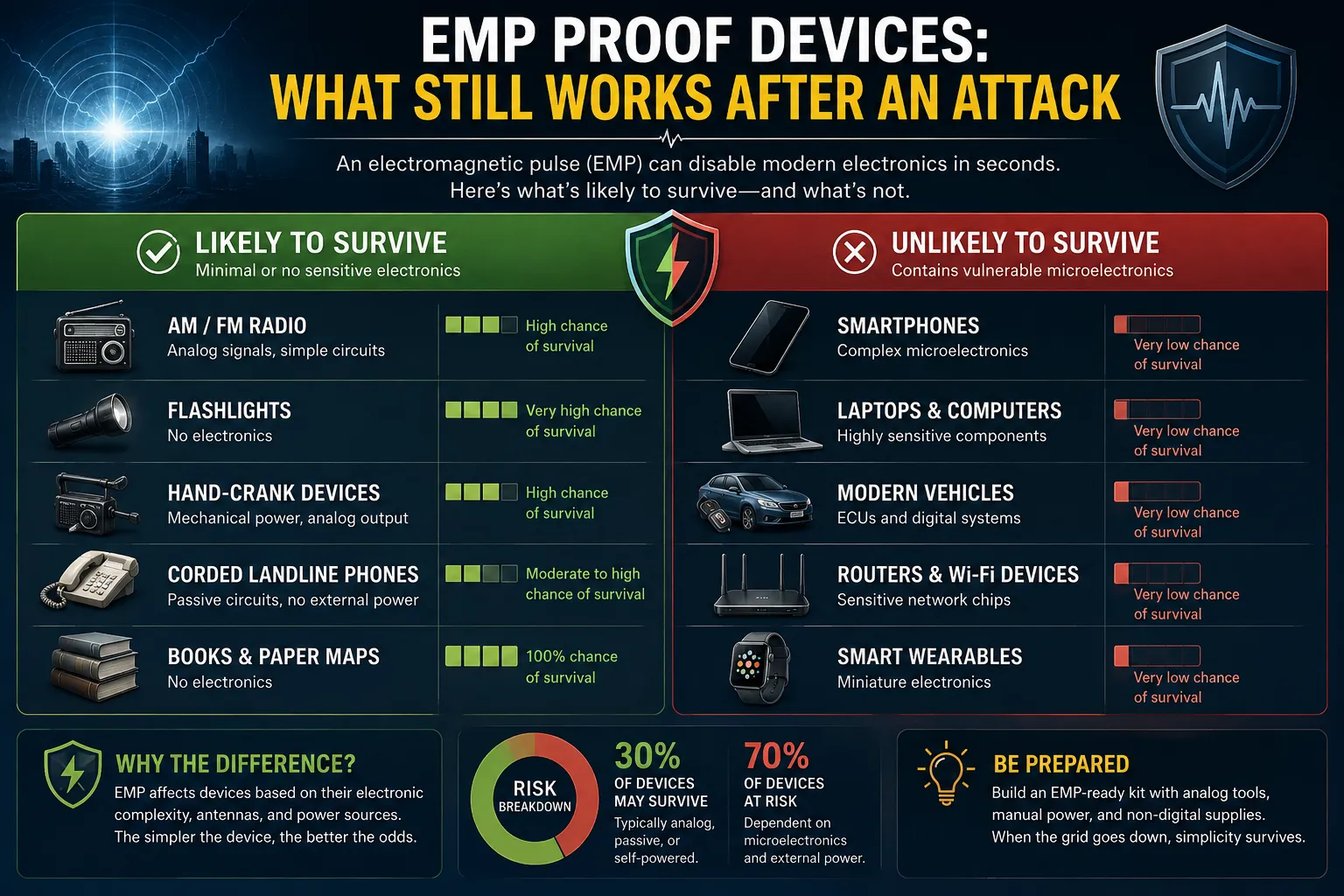
What Devices Actually Work After an EMP Attack
The devices most likely to survive an EMP attack are those with no solid-state electronics: analog instruments, mechanical tools, and non-electric equipment. Devices that contain no transistors, microprocessors, or semiconductor components have nothing for an EMP pulse to damage.
Here is a practical breakdown of what survives and what doesn’t:
Naturally Surviving (No Protection Needed)
- Hand-crank or wind-up mechanical clocks and watches
- Non-electric hand tools (axes, saws, manual drills)
- Analog AM/FM radios with vacuum tubes (pre-1960s era)
- Mechanical firearms
- Cast iron cookware and wood-burning stoves
- Bicycles and non-motorized vehicles
- Paper maps, printed books, and written records
- Oil lamps and candles
Likely Surviving (With Proper Shielding)
- Handheld ham radios stored in a Faraday cage
- Backup solar charge controllers (if disconnected and stored)
- LED flashlights with simple circuits (stored, not connected)
- Older laptops or tablets stored in metal enclosures
- Spare vehicle ignition modules for older vehicles
Almost Certainly Destroyed
- Smartphones and modern tablets
- Vehicles manufactured after approximately 1980 with electronic ignition and engine control units
- Grid-tied solar inverters and charge controllers
- Modern medical devices (pacemakers, insulin pumps, though this is debated and depends on pulse strength)
- Smart home devices, routers, and modems
The core rule: the more complex and miniaturized the electronics, the more vulnerable the device. Smaller transistors are more susceptible because they operate at lower voltages and have less tolerance for induced current spikes.
For a broader look at how a grid failure scenario unfolds after an EMP event, the EMP attack and grid failure survival guide covers the full survival timeline.

How Do EMP Proof Devices Work
EMP proof devices work by either containing no electronic components that can be damaged, or by using shielding that prevents the electromagnetic pulse from reaching sensitive components. There are two mechanisms at play: the device itself is inherently immune, or a conductive enclosure blocks the pulse entirely.
An EMP generates three distinct components, E1, E2, and E3, each with different characteristics:
- E1 is the fastest and most destructive. It induces voltage spikes in electronic components within microseconds and is what destroys semiconductors.
- E2 resembles a lightning strike in its timing and is easier to manage with standard surge protection.
- E3 is a slow pulse similar to a geomagnetic storm that damages long conductors like power lines and transformers.
Most consumer surge protectors only address E2-type events. True EMP protection requires shielding that addresses the E1 component, which is where Faraday cages and purpose-built EMP bags become essential.
A device is “EMP proof” in practical terms when it either has no vulnerable components or is stored inside a properly constructed conductive enclosure that absorbs and redirects the pulse energy away from the electronics inside.
Which Electronics Survive EMP and Which Ones Don’t
Electronics with simple, low-density circuits and no microprocessors have the best survival odds. The more a device relies on integrated circuits, the more vulnerable it is.
Higher Survival Probability (unshielded)
- Older tube-based radios (pre-transistor era)
- Simple battery-powered LED lights with minimal circuitry
- Basic analog meters and gauges
- Older gasoline engines without electronic controls (pre-1975 vehicles, approximately)
Lower Survival Probability (unshielded)
- Any device with a microcontroller or CPU
- Devices connected to external power lines or antennas (antennas act as receivers for the pulse)
- Networked devices (the network itself amplifies the induced current)
A critical point that many preppers overlook: a device that is powered off but still connected to a power outlet or antenna is almost as vulnerable as one that is running. The connection is what matters, not the power state.
Can Phones Be EMP Proof
A standard smartphone cannot be made inherently EMP proof, but it can be protected from an EMP event by storing it in a properly shielded enclosure before the attack occurs. Once the pulse has passed, a phone that was stored in a Faraday cage and removed afterward will function normally, assuming cell towers and network infrastructure still exist.
The honest reality for preppers: even a perfectly protected smartphone becomes a limited tool after a major EMP event because the communications infrastructure it depends on will likely be destroyed. A protected smartphone is still worth saving for offline functions, downloaded maps, medical reference apps, stored documents, but it should not be the centerpiece of a post-EMP communications plan.
Better alternatives for post-EMP communication:
- Handheld ham radios (stored in Faraday protection)
- CB radios
- Shortwave receivers
- Walkie-talkies with simple circuitry
For a complete look at backup power and communications equipment worth protecting, see the complete prepper’s guide to backup power for emergencies.
EMP Shielding: Faraday Cage vs. Commercial EMP Proof Devices
A DIY Faraday cage and a commercial EMP protection bag both work on the same principle, a conductive enclosure that blocks electromagnetic fields, but they differ significantly in attenuation rating, convenience, and cost.

Faraday Cage (DIY or Purpose-Built)
A Faraday cage is a conductive enclosure, metal mesh, solid metal, or layered foil, that surrounds a device completely. When built correctly, it can achieve attenuation levels of 40-80 dB or more, which is sufficient for most EMP scenarios.
DIY options include:
- Galvanized steel trash cans with tight-fitting lids (lined with non-conductive material inside)
- Ammo cans with conductive gaskets
- Nested layers of aluminum foil with cardboard insulation between layers
The key requirement: the conductive layer must be continuous with no gaps larger than the wavelength of the pulse. The interior must not directly contact the conductive walls (use foam, cardboard, or cloth as a buffer).
Commercial EMP Protection Bags and Devices
Commercial options like Mission Darkness, Faraday Defense, and similar brands offer tested, rated protection in portable form. Quality products will list their attenuation rating in decibels across a frequency range.
Choose a commercial product if:
- Portability matters (go-bag, vehicle storage)
- You need to protect items regularly accessed and re-stored
- You want a tested, rated solution without DIY uncertainty
Choose a DIY Faraday cage if:
- You need to protect large items (generators, spare vehicle parts)
- Budget is a primary concern
- You’re protecting items that stay in a fixed location
A common mistake: storing a Faraday cage near large metal structures or power lines without proper grounding consideration. The cage itself does not need to be grounded for EMP protection, this is a widely repeated misconception. Grounding can actually introduce a path for induced current in some configurations.

What’s the Difference Between EMP Hardened and EMP Proof
“EMP hardened” means a device has been engineered to withstand a specified level of EMP exposure without failing, it can tolerate the pulse up to a defined threshold. “EMP proof” implies complete immunity, which is essentially impossible for any device that needs to operate in the open.
The U.S. military uses the term “hardened” for equipment designed to MIL-STD-461 and related standards. These devices use shielded cables, filtered connectors, transient voltage suppressors, and other engineering techniques to reduce vulnerability. They are not indestructible, they are rated to survive a specific pulse strength.
For preppers, this distinction matters practically:
- A “hardened” device might survive a distant or moderate EMP but fail in a close, high-altitude nuclear burst scenario.
- A device stored in a proper Faraday enclosure achieves better protection than most “hardened” commercial electronics because the enclosure prevents the pulse from reaching the device at all.
- Marketing language like “EMP resistant” or “EMP safe” without a specific attenuation rating or test standard is largely meaningless.
Do EMP Proof Devices Really Work, or Is It a Scam
Legitimate EMP protection products do work, but the market also contains products that offer minimal real-world protection. The difference comes down to whether the product has been independently tested and rated.
Verified, credible protection products:
- Have published attenuation ratings (measured in dB across a frequency range)
- Reference testing standards such as MIL-STD-461, IEEE 299, or similar
- Are made from continuous conductive material with proper sealing
Red flags for ineffective products:
- No attenuation rating listed
- Vague claims like “blocks all EMPs” without test data
- Single-layer thin foil pouches marketed as full EMP protection
- Products priced under $5 claiming military-grade protection
The physics are real and well-established. A properly constructed Faraday enclosure does block electromagnetic fields. The question is always whether a specific product achieves sufficient attenuation across the relevant frequency range for an E1 pulse event.
Which Devices Are Naturally EMP Resistant
Devices are naturally EMP resistant when they contain no semiconductor components that can be damaged by induced voltage. This is the most reliable form of protection because it requires no advance preparation.
The most practically useful naturally resistant devices for preppers:
| Device Type | Why It Survives | Prepper Value |
|---|---|---|
| Hand-crank emergency radio | Simple or no semiconductor circuit | Communications |
| Mechanical watch | No electronics at all | Timekeeping |
| Analog compass | No electronics | Navigation |
| Manual water pump | No electronics | Water access |
| Wood-burning stove | No electronics | Cooking, heat |
| Bicycle | No electronics | Transportation |
| Vacuum tube radio (pre-1960) | Tubes more tolerant than transistors | Long-range comms |
| Battery-powered LED lantern (simple circuit) | Minimal circuitry | Lighting |
The practical takeaway: building a preparedness kit around non-electric and mechanically simple tools is the most EMP-resilient strategy possible. Electronics stored in Faraday protection are a valuable supplement, not the foundation.
For a comprehensive look at what to include in a resilient emergency kit, the ultimate emergency supplies list covers the full spectrum of non-electric essentials.
Can You EMP Proof a Car
Most modern vehicles can be partially protected, but true EMP proofing of a vehicle in regular use is not practically achievable. Vehicles manufactured after approximately 1980 contain engine control units, fuel injection systems, and ignition electronics that are vulnerable to an E1 pulse.
Options for vehicle EMP protection:
Pre-1980 Vehicles (Best Option) Vehicles with carbureted engines and mechanical ignition systems have minimal or no electronic components to damage. Keeping a pre-1980 backup vehicle, even a simple truck, is the most reliable vehicle EMP strategy.
Spare Parts Storage For a modern daily driver, storing spare electronic components (ignition module, ECU, fuel pump relay) in a Faraday enclosure means the vehicle can potentially be repaired after an event. This is a practical middle-ground approach.
Full Vehicle Faraday Shielding Technically possible through complete metal enclosure (a steel garage with bonded metal doors and no gaps), but impractical for most preppers. The vehicle must be completely enclosed, not just parked near metal.
The honest assessment: for most preppers, the vehicle EMP strategy should be a pre-1980 backup vehicle plus stored spare parts for the modern vehicle, not an attempt to fully harden a current-model car.
How to Test If Something Is Actually EMP Proof
The simplest field test is the cell phone signal test: place a phone inside the enclosure, close it completely, and call the phone from another device. If the call goes through, the enclosure has gaps and is not providing adequate shielding. If the call fails and the phone shows no signal, the enclosure is blocking radio frequencies, a good indicator of basic shielding integrity.
This test has limits. Cell phone frequencies (roughly 700 MHz to 2.6 GHz) are not identical to the frequency range of an E1 EMP pulse, which spans from DC to approximately 1 GHz with peak energy around 200 MHz. Passing the phone test means the cage blocks RF energy in the cellular range, which is a reasonable proxy but not a guarantee of full EMP protection.
For more rigorous testing:
- Use a known RF signal source at 200-500 MHz and measure attenuation with a spectrum analyzer (requires equipment)
- Submit a sample to a testing laboratory that measures to IEEE 299 standard
- Purchase products that already carry independent test certification
For most preppers, the phone test plus a quality commercial product with published ratings provides a reasonable confidence level without laboratory equipment.
Military-Grade EMP Protection for Home Use
Military-grade EMP protection standards (primarily MIL-STD-461) are achievable at home through purpose-built Faraday rooms or high-quality commercial enclosures, but they require more investment than basic DIY solutions.
Practical military-grade options for home preppers:
- Steel ammo cans with copper tape sealing the lid gasket area: inexpensive, effective for small items
- Purpose-built Faraday rooms: essentially a room lined with copper mesh or aluminum sheeting with bonded seams, a significant construction project but achievable for a dedicated prepper
- Commercial Faraday cabinets: products like those from Faraday Defense or similar manufacturers offer tested enclosures sized for larger equipment
- EMP cloth/fabric: conductive fabric that can be used to wrap equipment or line storage containers
The realistic home standard for most preppers is 40-60 dB of attenuation, which handles most EMP scenarios short of a direct overhead high-altitude nuclear burst. Achieving 80+ dB requires more sophisticated construction and sealing.
For preppers building out a comprehensive home preparedness system, pairing EMP protection with a power outage preparedness checklist ensures the non-EMP scenarios are covered as well.
EMP Proof Devices for Preppers vs. Everyday Use
The EMP proof devices that make sense for preppers differ significantly from what an everyday consumer might consider. Preppers prioritize post-event utility, devices that serve a function in a grid-down world. Everyday users prioritize convenience and connectivity.
For Preppers, Highest Priority Devices to Protect
- Handheld ham radio (Baofeng UV-5R or similar): communications in a grid-down scenario
- Solar charge controller (small, portable): power generation capability
- LED headlamps and flashlights: lighting without grid power
- Shortwave receiver: monitoring broadcasts from outside the affected area
- Backup ignition module for primary vehicle: mobility restoration
- Medical devices if applicable: insulin pumps, CPAP machines
For Everyday Use, Lower Priority but Still Worth Protecting
- Laptop with downloaded offline resources
- External hard drive with important documents, maps, and reference material
- Backup smartphone with offline apps loaded
The prepper’s priority list is shaped by one question: what do you actually need to function in a world without grid power for weeks or months? That filter eliminates most consumer electronics and focuses protection efforts on communications, power generation, and navigation tools.
Pairing EMP-protected communications gear with a solid emergency communication plan ensures the equipment has a purpose when it matters.
How Much Does EMP Protection Cost
EMP protection ranges from essentially free (using existing metal containers and aluminum foil) to several thousand dollars for purpose-built Faraday rooms. The cost scales with the size of what you’re protecting and the level of attenuation required.
Approximate Cost Ranges (2026 estimates)
- Aluminum foil + cardboard DIY wrap for small devices: under $5
- Galvanized steel trash can with lid (DIY Faraday): $30,$60
- Military surplus ammo can: $20,$50
- Commercial EMP protection bag (phone/radio size): $30,$80
- Commercial EMP protection bag (laptop size): $60,$150
- Purpose-built Faraday cabinet (tested, rated): $300,$1,500
- Full Faraday room construction: $2,000,$10,000+
The best value for most preppers is a combination: a $40 galvanized trash can for larger items, two or three quality commercial bags for everyday-carry electronics, and a $30 ammo can for critical spare parts. Total investment under $200 covers the most important scenarios.
A critical mistake to avoid: spending heavily on protection for devices that have no post-EMP utility. Protecting a smart TV or gaming console is a waste of resources. Protect what you’ll actually use.
Frequently Asked Questions
Will my car work after an EMP attack? Vehicles made before approximately 1980 with carbureted engines and mechanical ignition have a high chance of surviving. Modern vehicles with electronic fuel injection and engine control units will likely be disabled. Storing spare electronic components in a Faraday enclosure gives you a repair option.
Does aluminum foil actually work as EMP protection? Multiple layers of aluminum foil with non-conductive insulation between layers do provide measurable RF attenuation. It is not as reliable as a solid metal enclosure, but it is better than nothing for small items. The key is ensuring complete coverage with no gaps and an insulating layer between the foil and the device.
Can a EMP destroy a device that is turned off? Yes. A powered-off device that is connected to a power line, antenna, or network cable is still vulnerable because those connections act as antennas that collect and conduct the pulse into the device. Disconnected and stored devices are far safer.
Are older tube-based radios really EMP resistant? Vacuum tubes are significantly more tolerant of EMP than transistors and integrated circuits, but they are not completely immune. Very strong pulses can still damage tube equipment. Pre-transistor radios are a valuable backup, but storing them in Faraday protection is still the right approach.
What is the most important single device to protect in a Faraday cage? A handheld ham radio is the most commonly cited priority among serious preppers. It provides two-way communication capability in a grid-down scenario, which is critical for coordinating with family, monitoring emergency broadcasts, and accessing information about what is happening.
Does a Faraday cage need to be grounded? No. For EMP protection purposes, a Faraday cage does not need to be grounded. The shielding works by distributing the induced charge across the outer surface of the enclosure. Grounding is relevant for lightning protection but is not required, and in some configurations can be counterproductive, for EMP shielding.
Can I build an EMP proof room in my house? Yes, with significant effort and cost. A room lined with copper mesh or aluminum sheeting, with all seams bonded and all penetrations (doors, windows, electrical) properly filtered, can achieve high levels of attenuation. It is a serious construction project but within reach for a dedicated prepper with a budget of $3,000,$10,000.
What about EMP protection for solar panels? The panels themselves (photovoltaic cells) are relatively simple and may survive. The vulnerable components are the charge controller and inverter. Storing backup charge controllers and inverters in Faraday protection, and having a manual disconnect system, is the practical approach. The panels can be re-wired to protected equipment after the event.
Is there any warning before an EMP attack? A natural EMP from a geomagnetic storm (like a Carrington-level event) may have hours to days of warning from space weather monitoring agencies like NOAA’s Space Weather Prediction Center. A nuclear EMP attack would have no meaningful warning for civilians. This is why protection must be in place before any event occurs.
Do EMP protection bags lose effectiveness over time? Quality conductive bags do not degrade significantly under normal storage conditions. However, physical damage, tears, worn seams, compromised closures, reduces effectiveness. Inspect bags annually and replace any that show wear. The conductive fabric itself has a long service life when stored properly.
Conclusion
The core truth about EMP proof devices and what still works after an attack is this: preparation before the event is everything. There is no post-event fix for unprotected electronics. The pulse is instantaneous, and by the time the lights go out, the window for protecting your gear has already closed.
The most resilient preppers build in layers. First, they rely on non-electric tools and analog equipment that require no protection at all. Second, they store critical electronics, radios, charge controllers, spare vehicle parts, in properly constructed Faraday enclosures. Third, they have a communications plan that doesn’t depend on infrastructure that may no longer exist.
Actionable next steps:
- Audit your current gear and identify which items have genuine post-EMP utility.
- Build or purchase a Faraday enclosure for your most critical electronics this month.
- Test it with the cell phone signal method.
- Source a pre-1980 backup vehicle or store spare electronic components for your current vehicle.
- Stock non-electric alternatives for every critical function: lighting, navigation, communication, water, and cooking.
For preppers who want to extend their resilience beyond EMP preparedness, building out a complete 72-hour bug out bag checklist ensures mobility options are covered regardless of what scenario unfolds. And for the longer-term picture, the city blackout survival checklist addresses the extended grid-down scenario that follows any major EMP event.
Confidence in a crisis comes from preparation that happened long before the crisis arrived. Start now.
Products, Tools, and Resources
Faraday Protection
- Mission Darkness TitanRF Faraday Fabric, A tested, rated conductive fabric useful for wrapping large items or lining custom enclosures. Published attenuation data is available from the manufacturer.
- Faraday Bag by Grid Doctor, A well-reviewed commercial bag for phones, radios, and small electronics with waterproofing and RF shielding combined.
- Galvanized Steel Trash Can (30-gallon), The most cost-effective DIY Faraday solution for larger items. Pair with foam or cardboard lining and copper tape on the lid seam.
- Military Surplus Ammo Cans (50-caliber), Solid metal construction, tight-fitting lids, and widely available. Excellent for storing spare electronic components.
Communications Devices Worth Protecting
- Baofeng UV-5R Handheld Ham Radio, Inexpensive, widely used, and capable of both transmit and receive on amateur frequencies. Store in Faraday protection; have a spare.
- Kaito KA500 Emergency Radio, Hand-crank, solar, and battery-powered AM/FM/NOAA/shortwave receiver with simple circuitry. A strong candidate for naturally resistant operation.
Reference Material
- EMP Protection and Restoration Guidelines, Published by the EMP Task Force on National and Homeland Security; freely available and worth downloading to offline storage.
- The EMP attack and grid failure survival guide at Preppers HQ covers the full scenario from initial event through long-term recovery.
References
- U.S. EMP Commission. (2008). Report of the Commission to Assess the Threat to the United States from Electromagnetic Pulse (EMP) Attack: Critical National Infrastructures. United States Congress. https://www.empcommission.org
- Glasstone, S., & Dolan, P. J. (1977). The Effects of Nuclear Weapons (3rd ed.). U.S. Department of Defense and U.S. Department of Energy.
- NOAA Space Weather Prediction Center. (2024). Geomagnetic Storm Scales and Solar Event Monitoring. https://www.swpc.noaa.gov
- Radasky, W. A., Baum, C. E., & Wik, M. W. (2010). Introduction to the special issue on high-power electromagnetics (HPEM) and intentional electromagnetic interference (IEMI). IEEE Transactions on Electromagnetic Compatibility, 46(3), 314-321.
- EMP Task Force on National and Homeland Security. (2020). EMP Protection and Restoration Guidelines for Equipment and Facilities. https://www.emptaskforce.us