
Hey there! Some links on this page may be affiliate links which means that, if you choose to make a purchase, I may earn a commission at no extra cost to you. I greatly appreciate your support. Read the full disclosure here.
Wildfires can travel faster than a person can run, up to 14 miles per hour in open terrain, according to the U.S. Forest Service. That’s not a statistic to file away. That’s a hard deadline. When an evacuation order hits your phone, the difference between a calm, confident exit and a panicked scramble comes down to one thing: whether you built your Wildfire Evacuation Checklist: 30 Minutes or Less to Out the Door before the smoke appeared on the horizon.
This guide covers everything, what to pack, how to move with pets and elderly family members, which direction to drive, and the critical mistakes that cost people their lives. Read it now, build your system today, and you won’t need to think under pressure.
Key Takeaways
- A pre-packed go-bag eliminates most of the 30-minute window pressure; build it now, not during the event.
- An “Evacuation Warning” means get ready; an “Evacuation Order” means leave immediately, no exceptions.
- Always drive perpendicular to the fire’s path, not directly away from it.
- Pets need their own pre-packed kit; shelters and hotels have limited pet capacity, so plan ahead.
- Never re-enter an evacuation zone without official clearance, even briefly.
- Turn off the gas at the meter before leaving if you have time; leave the electricity on for emergency responders.
- Download at least two wildfire tracking apps and pre-save your local emergency alert system.
- Documents, medications, and irreplaceable items are the hardest to replace; prioritize them first.
Find this useful? Add us as a preferred source on Google and more of what we publish will show up in your results.
What Should You Pack in a Wildfire Evacuation Kit
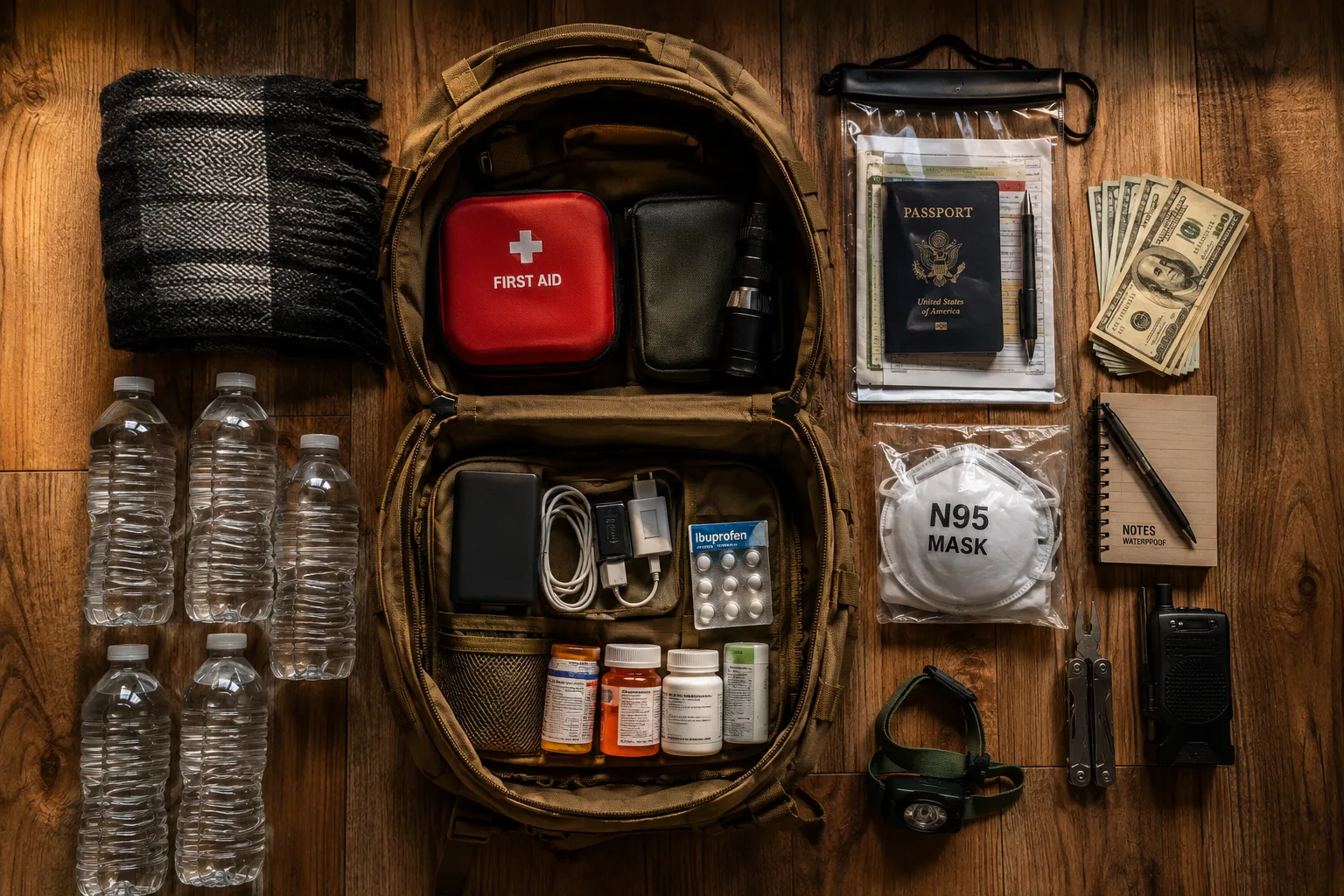 A solid wildfire evacuation kit covers survival basics for 72 hours minimum, plus the personal items that cannot be replaced. Pre-packing a dedicated bag is the single most effective way to execute a Wildfire Evacuation Checklist: 30 Minutes or Less to Out the Door without freezing up when the alert sounds.
Tier 1, Grab first (under 5 minutes):
- Government-issued IDs, passports, and Social Security cards (store in a waterproof pouch)
- Insurance policies and property documents (physical copies or a USB drive)
- Prescription medications, a minimum 7-day supply
- Cash in small bills ($200,$500 minimum)
- Phone chargers and a portable power bank
- Car keys and a second set if available
Tier 2, Pre-packed go-bag (already staged):
- Water: 1 gallon per person per day for 3 days; include a water filter as backup
- Food: 3-day supply of calorie-dense, non-perishable items, see the ultimate bug out bag food list for specific options
- First aid kit with burn treatment supplies specifically
- N95 or P100 respirator masks, wildfire smoke is a serious respiratory hazard
- Flashlight and extra batteries
- Change of clothes and sturdy closed-toe shoes
- Blankets or emergency mylar blankets
- Basic tools: multi-tool, duct tape, work gloves
Tier 3, If time allows (10-20 minutes):
- Laptop or hard drives with irreplaceable files
- Sentimental items: photos, heirlooms (pre-box these in advance)
- Extra food from the refrigerator
- Additional clothing layers
For a more detailed breakdown of go-bag construction, the 72-hour bug out bag checklist covers gear selection and weight management in depth.
What Documents Do You Need to Grab Before Evacuating
Grab identity documents, financial records, and insurance paperwork first. These are the hardest to replace after a disaster and the most critical for accessing aid, housing, and financial recovery.
Priority document list:
- Passports and birth certificates
- Driver’s licenses and state IDs
- Social Security cards
- Property deeds or rental agreements
- Homeowner’s or renter’s insurance policy (with your agent’s contact number)
- Vehicle titles
- Medical records and vaccination history
- Bank account numbers and credit card information (written down, not just digital)
- Recent tax returns (for FEMA assistance claims)
Store all of these in a single waterproof document pouch that lives inside your go-bag permanently. A fireproof document bag adds another layer of protection if you store originals at home. Alternatively, scan everything and store encrypted digital copies in cloud storage, accessible from any device, anywhere.
For a complete financial document protection framework, the financial survival checklist covers 40 critical items most people overlook until it’s too late.
What Is the Difference Between an Evacuation Warning and an Evacuation Order
An Evacuation Warning means a threat is possible, and you should prepare to leave immediately. An Evacuation Order means the threat is imminent or already occurring; leave now, without delay, and do not wait to see the fire.
Many people lose their window because they treat a Warning like a suggestion. It isn’t. The moment a Warning is issued for your zone:
- Load your pre-packed bags into the vehicle
- Gather pets and their supplies
- Fill the car’s gas tank if it’s below half full
- Notify your out-of-area contact person
- Identify your primary and alternate evacuation routes
When the Warning upgrades to an Order, you should already be in the car. The order means conditions have deteriorated faster than expected. Staying behind during an Evacuation Order is not a defensible risk; it puts your life and the first responders’ lives at risk.
What Are the Best Apps to Check Wildfire Evacuation Zones and Routes
Download at least two apps before fire season: one for real-time fire mapping and one for official emergency alerts. Relying on a single source during an active evacuation is a single point of failure.
Recommended tools:
- Watch Duty, real-time wildfire tracking with evacuation zone overlays, widely used in Western U.S. states
- PulsePoint and Zonehaven, zone-based evacuation status tools used by many county emergency services
- FEMA App, official emergency alerts with shelter locations and disaster resources
- Wireless Emergency Alerts (WEA), built into every modern smartphone; ensure it’s enabled in your phone’s notification settings
- Google Maps / Waze, real-time traffic routing that can identify road closures during evacuations
Also bookmark your county’s Office of Emergency Services website and sign up for their direct text alert system. Many counties have a separate opt-in system that provides more granular zone-specific information than national apps.
How Do You Know Which Direction to Evacuate From a Wildfire
Drive perpendicular to the fire’s direction of travel, not directly away from it. Wildfires move with the wind, so driving downwind means the fire is chasing you. Moving across the fire’s path gets you out of its corridor faster.
Before leaving:
- Check your Watch Duty app or local emergency broadcast for fire location and wind direction.
- Identify your primary evacuation route and one alternate, roads close fast.
- Avoid roads that run parallel to ridgelines or through dense brush corridors.
- Drive toward population centers, not into open wildland.
If you’re caught on a road with fire on both sides, do not abandon your vehicle. Pull off the road, turn off the engine, turn on hazard lights, get down below window level, and cover yourself with a wool blanket or coat. The vehicle provides significant protection from radiant heat.
For urban-specific route planning, the urban evacuation route planning guide covers traffic bottlenecks and alternate corridor strategies in detail.
Can You Take Your Car or Should You Walk During Wildfire Evacuation
Always take your car if the roads are open. Walking during a wildfire evacuation is only appropriate if roads are completely blocked and fire is not yet between you and safety. Wildfires move faster than any person can walk or run, especially uphill.
If your car is unavailable:
- Contact neighbors immediately, carpool coordination saves lives in wildfire evacuations
- Call 211 (the community services hotline in most U.S. states) for evacuation transportation assistance
- Move to a pre-identified defensible space: a large parking lot, a lake or river bank, or a building with a concrete or metal roof, never a wooden structure
Keep your car’s gas tank above half during fire season. Many people run out of fuel in evacuation traffic. Also, ensure your car emergency kit is stocked; a breakdown during evacuation is a life-threatening scenario.
How Do You Evacuate Safely With Pets During a Wildfire
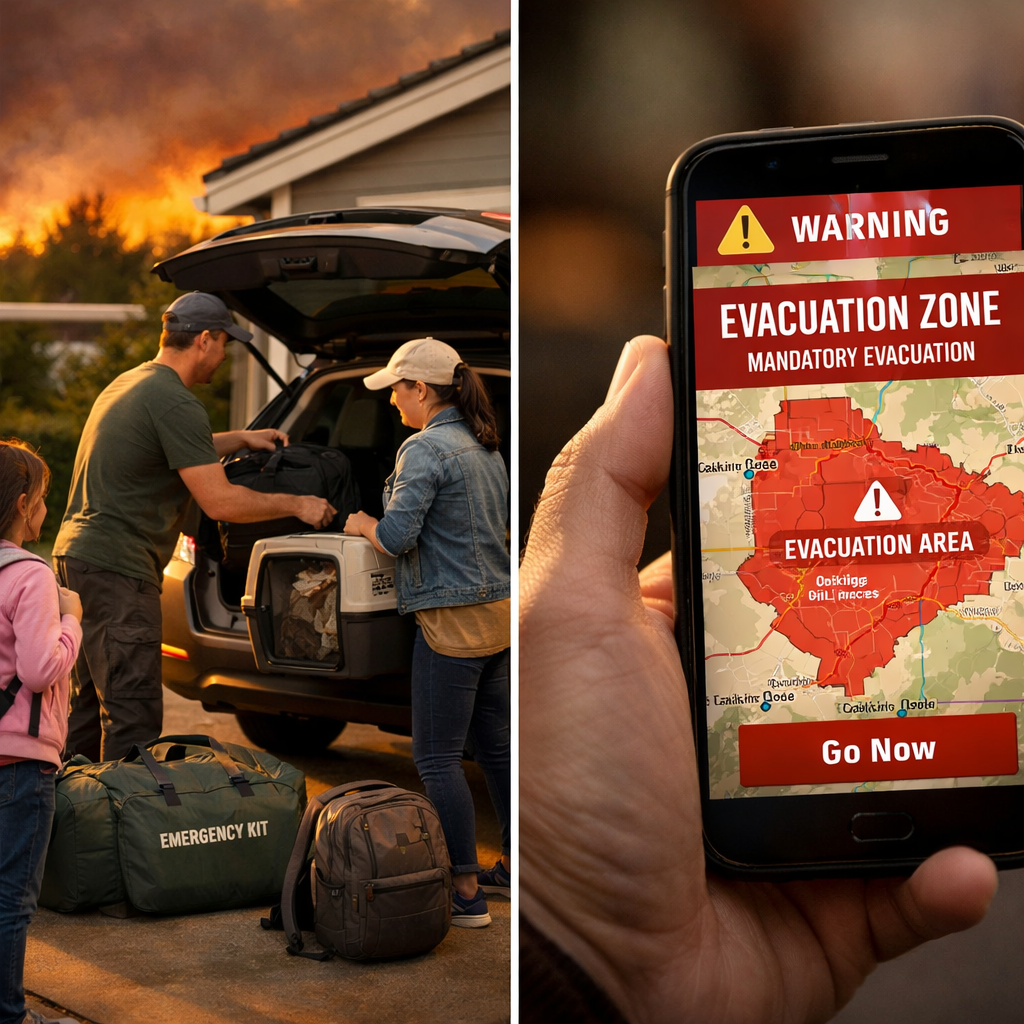
Pets must have their own pre-packed kit, and their evacuation plan must be decided in advance, not improvised at departure time. Shelters and hotels fill quickly, and many don’t accept animals, so knowing your pet-friendly options before an event is essential.
Pet evacuation essentials:
- Carrier or crate (practice loading your pet into it regularly so it’s not a struggle under stress)
- 3-day supply of food and water
- Medications and vaccination records
- Collar with ID tag and a recent photo of you with your pet (for reunification)
- Leash, waste bags, and a familiar blanket or toy to reduce anxiety
Pre-plan these now:
- Identify pet-friendly hotels along your evacuation routes (call ahead during fire season, not during the event)
- Locate your county’s animal evacuation shelter. Many counties have separate facilities for large animals and livestock
- Register large animals with your local sheriff’s office or agricultural extension so they can be prioritized in evacuation assistance
For a comprehensive pet preparedness system, the ultimate pet emergency preparedness checklist covers 45 specific items for dogs, cats, and larger animals.
How Do You Help Elderly Family Members Evacuate Quickly
Elderly family members need a dedicated evacuation plan that accounts for mobility limitations, medical equipment, and medication management. The plan must be built and rehearsed before an event, not assembled during one.
Action steps to take now:
- Pre-pack a dedicated bag for each elderly family member, including a 7-day medication supply, medical device chargers, and a written list of conditions and prescriptions
- Register with your county’s Access and Functional Needs (AFN) program, many counties maintain evacuation assistance lists for residents who cannot self-evacuate
- Assign a specific family member or neighbor as their evacuation contact who can reach them within 10 minutes
- Confirm that their vehicle can accommodate any mobility aids (wheelchairs, walkers)
- Pre-identify accessible shelters along the evacuation route
For broader strategies on preparing older family members, the 9 essential disaster prep strategies for seniors provides a structured framework worth reviewing with elderly relatives directly.
What If You Don’t Have 30 Minutes to Evacuate
If you have less than 30 minutes, or no warning at all, grab only Tier 1 items (IDs, medications, phone, keys) and leave immediately. Your life is worth more than anything else in the building.
The Wildfire Evacuation Checklist: 30 Minutes or Less to Out the Door is designed to be compressed under pressure. If you’ve pre-packed your go-bag, a 5-minute evacuation is entirely achievable. If you haven’t, this is the scenario that ends badly.
The 5-minute protocol (no bag pre-packed):
- Grab wallet, phone, and keys, these three items cover most immediate needs.
- Grab any prescription medications from the medicine cabinet.
- Load pets into the car.
- Drive.
Everything else is replaceable. For a deeper look at ultra-fast evacuation protocols, the 5-minute evacuation packing guide is worth bookmarking and sharing with every member of your household.
Should You Turn Off Gas and Electricity Before Leaving for a Wildfire
Turn off the gas at the main meter shutoff before leaving if you have time and know how to do it safely. Leave electricity on unless instructed otherwise, emergency responders and utility crews need it active to assess the situation.
Gas shutoff procedure:
- Locate the gas meter (usually on the exterior of the home near the foundation)
- Use a crescent wrench or gas shutoff tool to turn the valve a quarter turn so it’s perpendicular to the pipe
- Do not turn the gas back on yourself after a wildfire; this requires a licensed technician
Additional home preparation steps (if time allows):
- Close all windows and doors to slow smoke infiltration
- Remove flammable patio furniture and doormats from around the structure
- Leave exterior lights on so the home is visible in the smoke
- Leave a note on the front door indicating when you left and where you’re going
What Not to Do When Evacuating From a Wildfire
The most dangerous mistakes during wildfire evacuation are waiting too long to leave, taking unnecessary routes through fire corridors, and returning home before official clearance.
Critical mistakes to avoid:
- Waiting for visual confirmation of fire, by the time you can see flames clearly, your window may already be closing
- Overloading the vehicle, packing non-essentials, slows you down and adds weight; prioritize people and Tier 1 items
- Using unfamiliar back roads, these often dead-end in wildland terrain with no turnaround
- Stopping to take photos or video, this has contributed to deaths in documented wildfire events
- Returning home to “grab one more thing”, this is addressed directly below
Can You Go Back Home After Evacuating to Grab More Stuff
No. Do not re-enter an evacuation zone for any reason until the official all-clear is issued by local authorities. Fire behavior is unpredictable, and conditions can change within minutes. Roads that were passable an hour ago may be blocked by fire, downed power lines, or emergency vehicles.
People who re-enter active evacuation zones face:
- Criminal charges in many jurisdictions (re-entry during an active order is illegal in most U.S. states)
- Extreme personal risk from spot fires, toxic smoke, and structural collapses
- Diversion of emergency resources for rescue operations
The only exception is if a law enforcement officer explicitly authorizes a supervised re-entry. Wait for that clearance. The items inside the home are not worth the risk.
What Is the Fastest Way to Pack Irreplaceable Items During Evacuation
Pre-boxing irreplaceable items is the only reliable strategy. During an active evacuation, cognitive function degrades under stress, you will forget things you’d normally remember without any pressure.
The pre-boxing method:
- Identify your top 10 irreplaceable items (photos, heirlooms, specific documents) right now
- Place them in a single labeled box or bag stored near your go-bag
- Update this box seasonally, add new photos, and remove items that have been digitized
For items that can’t be pre-boxed:
- Digitize photos and store them in cloud backup (Google Photos, iCloud, or an encrypted external drive stored off-site)
- Store original documents in a fireproof safe, some models are rated to withstand temperatures above 1,700°F
- Keep a printed “irreplaceable items” checklist on the refrigerator so any family member can execute the plan, not just you
The goal is to decide the emergency, not during it. Every item on that list should have a designated location so retrieval takes seconds, not minutes.
30-Minute Wildfire Evacuation Checklist
Check off items as you pack. Tap each tier to expand.
Frequently Asked Questions
How early should I start preparing my wildfire evacuation kit? Start today, regardless of fire season. Wildfires in 2026 are occurring outside traditional seasonal windows in many U.S. regions. A go-bag that takes a weekend to build can serve you for years.
What if my go-bag is too heavy to carry? Prioritize Tier 1 items in a lightweight daypack. A full 72-hour bag isn’t always practical for everyone. The goal is to have the critical items accessible, not to carry a perfect kit at the expense of mobility.
Should I shelter in place if I can’t evacuate? Only as an absolute last resort. If fire is actively surrounding your location and roads are impassable, move to the most fire-resistant room (interior, no windows), seal door gaps with wet towels, and call 911 to report your location. This is a survival scenario, not a strategy.
Do I need a separate bag for each family member? Yes, for adults and older children. Each person should be able to carry their own essentials independently. This also prevents a single bag from becoming a bottleneck.
What’s the best way to store my go-bag so it’s always ready? Keep it near the exit you’d use during an emergency, typically a garage or mudroom. Check and rotate perishable contents (food, water, medications) every six months. Set a calendar reminder.
How do I know if my neighborhood is in an evacuation zone? Check your county’s official emergency management website. Most counties in fire-prone states have interactive zone maps. Register for direct alerts specific to your zone; don’t rely solely on news broadcasts.
What should I do if I get separated from my family during evacuation? Designate an out-of-area contact person before fire season. Everyone in the household should have that person’s phone number memorized. Establish a meeting point outside your immediate neighborhood as a secondary option.
Can I use a regular backpack as a go-bag? Yes. A sturdy 30-40 liter backpack works well. Purpose-built tactical bags offer better organization and durability, but the contents matter far more than the container.
What about medications that require refrigeration? Pack a small insulated bag with a reusable ice pack for insulin or other temperature-sensitive medications. Note that many medications tolerate short-term temperature excursions, check with your pharmacist in advance and document the safe temperature range.
Is wildfire smoke dangerous even if I’m far from the fire? Yes. Wildfire smoke contains fine particulate matter (PM2.5) that penetrates deep into the lungs. N95 masks filter these particles effectively. Surgical masks and cloth masks do not provide adequate protection from wildfire smoke.
Conclusion
The Wildfire Evacuation Checklist: 30 Minutes or Less to Out the Door isn’t a document you read once and forget. It’s a system you build, rehearse, and update. The families who evacuate safely aren’t the ones who react fastest in the moment; they’re the ones who made their decisions weeks or months before the smoke appeared.
Your action steps, starting today:
- Build or audit your go-bag this weekend. Use the Tier 1, 2, and 3 framework above.
- Create a waterproof document pouch with all critical IDs and insurance papers.
- Download Watch Duty and your county’s emergency alert app. Enable all notifications.
- Identify your primary and alternate evacuation routes. Drive them once.
- Build a pet evacuation kit and identify pet-friendly lodging along your routes.
- Have the conversation with elderly family members and assign a specific evacuation contact.
- Pre-box irreplaceable items and digitize everything you can’t physically store.
Preparedness isn’t about fear. It’s about building the confidence to act decisively when the stakes are highest. The 30-minute window is real. Build your system before you need it.
Products, Tools, and Resources
Go-bag and evacuation gear worth considering:
- A quality 30-40L backpack with hip belt support (brands like 5.11 Tactical, Mystery Ranch, or Osprey are commonly used in the prepper community for their durability)
- A waterproof document organizer or fireproof document bag, look for models rated to at least 1,200°F
- N95 or P100 half-face respirator masks, 3M and Moldex make reliable options; keep at least two per household member
- A gas shutoff wrench stored near the meter, a dedicated tool that costs under $15 and, could prevent a post-fire gas leak
- A portable water filter (Sawyer Squeeze or LifeStraw) as a backup to stored water
- A hand-crank or battery-powered NOAA weather radio for alerts when cell networks are overloaded
For broader emergency kit building, the ultimate emergency supplies list covers items that FEMA’s standard guidance consistently underemphasizes. And if you’re building your overall preparedness foundation from scratch, the complete prepping guide for beginners is the logical next step.