
Hey there! Some links on this page may be affiliate links which means that, if you choose to make a purchase, I may earn a commission at no extra cost to you. I greatly appreciate your support. Read the full disclosure here.
A woman living alone is statistically more likely to be targeted by a home intruder than a household with multiple occupants — and yet most home security advice is written as if a six-foot partner is always nearby. This Solo Women’s Home Defense Guide: What Actually Works cuts through that assumption and gives you a practical, layered system built specifically for solo living. Whether you’re in an apartment, a rural homestead, or a suburban house, the strategies here are tested, realistic, and scalable to your budget.
Key Takeaways
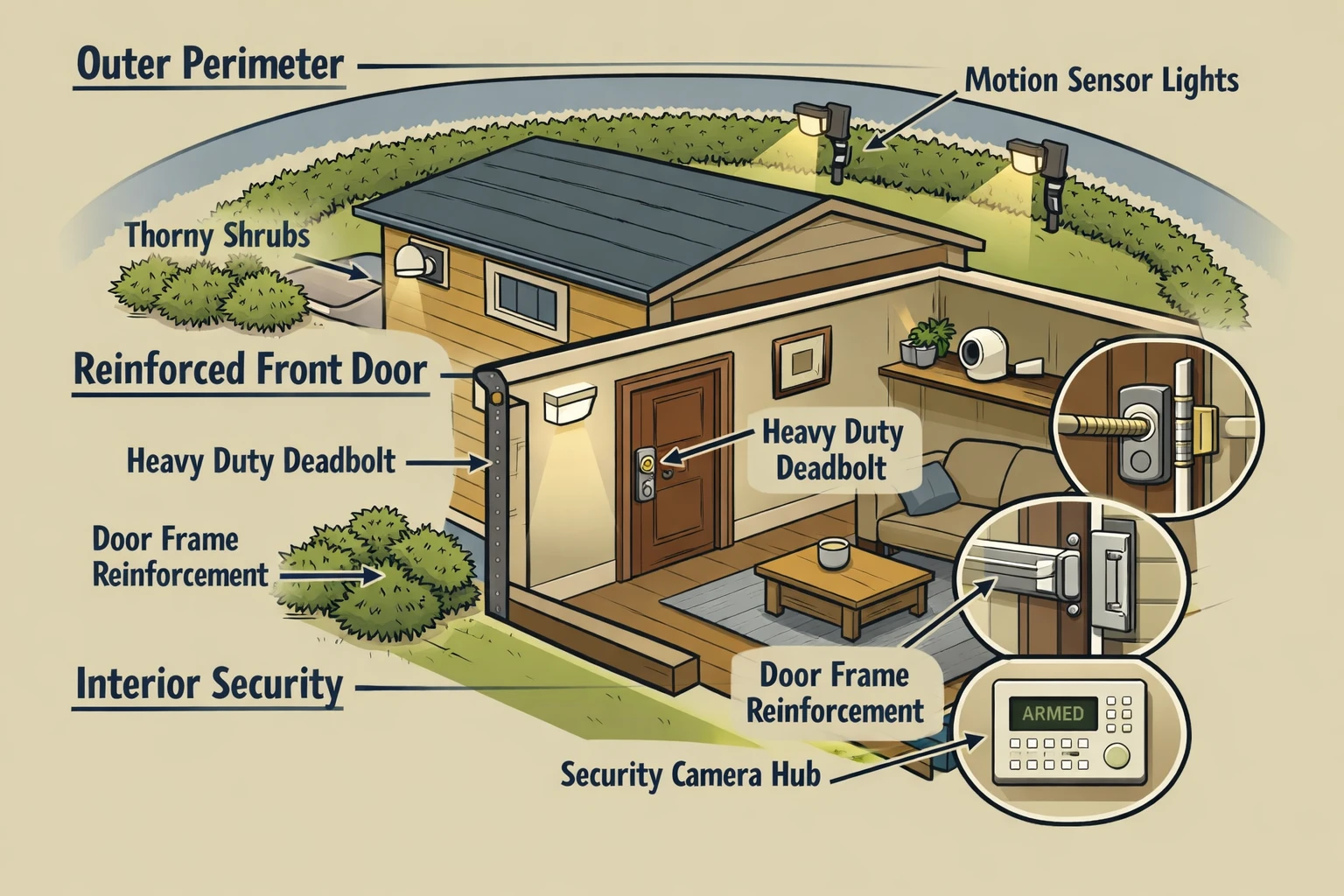
- Effective home defense is built in layers: perimeter deterrence, entry hardening, interior alerts, and a personal response plan.
- Smart security cameras and alarm systems with professional monitoring are worth the investment for solo occupants.
- Non-lethal tools like pepper spray, personal alarms, and door barricade bars offer strong protection without requiring a firearm.
- Most home invasions are deterred before they start — visible security measures and good lighting do more work than most people realize.
- Renters can implement meaningful security upgrades without violating lease agreements.
- Training and mental preparedness matter as much as physical tools. Knowing your plan before an incident is the difference between action and panic.
- A dog, even a medium-sized one, is one of the most effective and underrated deterrents available.
- The biggest mistakes solo women make involve predictable routines, poor lighting, and relying on a single layer of security.
What Are the Most Effective Home Security Systems for Single Women
The most effective home security systems for single women combine professional monitoring with smart sensors, cameras, and loud local alarms. No single device is enough — the goal is a system where each component backs up the others.
The top-performing systems in 2026 for solo occupants include:
- SimpliSafe — No contract required, easy DIY installation, professional monitoring available. Strong choice for renters.
- Ring Alarm Pro — Integrates with existing Ring cameras, built-in router with backup internet, and affordable monthly plans.
- ADT — Professional installation, long track record, and 24/7 monitoring. Higher upfront cost but strong deterrence value.
- Abode — Smart home integration, no mandatory monitoring fee, and flexible for tech-savvy users.
For solo women specifically, prioritize systems that include:
- Door and window sensors on every entry point
- Motion-activated interior cameras with cloud storage
- A loud local siren (95+ decibels) that triggers immediately
- Two-way audio so you can communicate without opening the door
- Mobile app alerts so you’re notified anywhere, instantly
For a deeper breakdown of physical and electronic home security layers, the Ultimate Home Defense Guide for Preppers covers the full system architecture.
How Much Does a Good Home Defense Setup Actually Cost
A functional solo home defense setup costs between $200 and $800 upfront, with ongoing monitoring fees ranging from $0 to $30 per month. You don’t need to spend thousands to be well-protected.
Here’s a realistic cost breakdown:
| Defense Layer | Budget Option | Mid-Range Option |
|---|---|---|
| Door reinforcement kit | $30–$50 | $80–$120 |
| Window/door sensors | $50–$80 | $100–$150 |
| Security camera (1–2 units) | $40–$80 | $150–$250 |
| Personal alarm keychain | $10–$20 | $25–$40 |
| Pepper spray (quality brand) | $15–$25 | $40–$60 |
| Smart doorbell camera | $60–$100 | $150–$200 |
| Monitoring subscription/month | $0–$10 | $20–$30 |
A solid starter setup — door reinforcement, two cameras, window sensors, a personal alarm, and quality pepper spray — runs around $250 to $350. That’s a reasonable one-time investment for meaningful protection.
Avoid the trap of buying one expensive device and calling it done. A $400 camera system with a hollow-core door and no alarm is far less effective than a $300 layered setup with reinforced entry points and a loud siren.
Warning Signs Your Home Might Be Targeted by Potential Intruders
Intruders typically scout before they act. Recognizing the early warning signs gives solo women time to respond before a situation becomes dangerous.
Common pre-targeting behaviors include:
- Unfamiliar vehicles parked on your street for extended periods, especially at different times of day
- Door-to-door solicitors who ask unusual questions about whether you live alone or when you’re home
- Flyers or rubber bands placed on your door — sometimes used to test whether they’re removed (indicating someone is home)
- Tampered locks or gates that show signs of being tested
- Neighbors reporting strangers asking about your property or schedule
Structural vulnerabilities that make a home more attractive to intruders:
- Poor exterior lighting, especially near entry points
- Overgrown shrubs that provide concealment near windows or doors
- Mail or packages left uncollected for multiple days
- Predictable, visible routines (same departure time every morning, lights always off at the same hour)
- Absence of any visible security indicators (no cameras, no alarm company signage)
Changing your visible routine periodically — varying when lights go on, using smart plugs to randomize interior lighting — reduces your predictability without any cost.
Best Self-Defense Techniques for Women Living Alone
The best self-defense approach for women living alone combines situational awareness, physical technique training, and a pre-planned response protocol. Awareness prevents most incidents; technique handles the rest.
Situational awareness basics:
- Always know who is at your door before opening it. Use a peephole, doorbell camera, or ask through the door.
- Trust discomfort. If something feels wrong about a situation or person, act on that feeling immediately.
- Keep your phone accessible at all times inside the home, not just when you leave.
Physical training worth pursuing:
- Krav Maga — Designed for real-world defense, not sport. Focuses on fast, effective responses to common attacks.
- Brazilian Jiu-Jitsu (BJJ) — Especially valuable for smaller individuals. Teaches ground defense and escapes from grabs.
- Basic self-defense courses — Many local police departments and women’s organizations offer free or low-cost workshops.
Even six to eight hours of structured training dramatically improves response capability. The goal isn’t to win a fight — it’s to create enough time and distance to escape and call for help.
Pre-planned response protocol for a break-in:
- Move to your pre-designated safe room (ideally a bedroom with a reinforced door and a lock)
- Call 911 immediately — do not investigate the noise
- Announce loudly that you’ve called police (this alone often ends an intrusion)
- Stay on the line with the dispatcher until officers arrive
The Ultimate Urban Survival Guide for Preppers covers situational awareness and threat assessment in detail for those living in dense residential areas.
Non-Lethal Self-Defense Tools That Really Work for Home Protection
Non-lethal tools are highly effective for home defense, especially for solo women who want reliable protection without the legal, training, and storage responsibilities of a firearm. The key is choosing tools that work under stress, not just in ideal conditions.
Top non-lethal options:
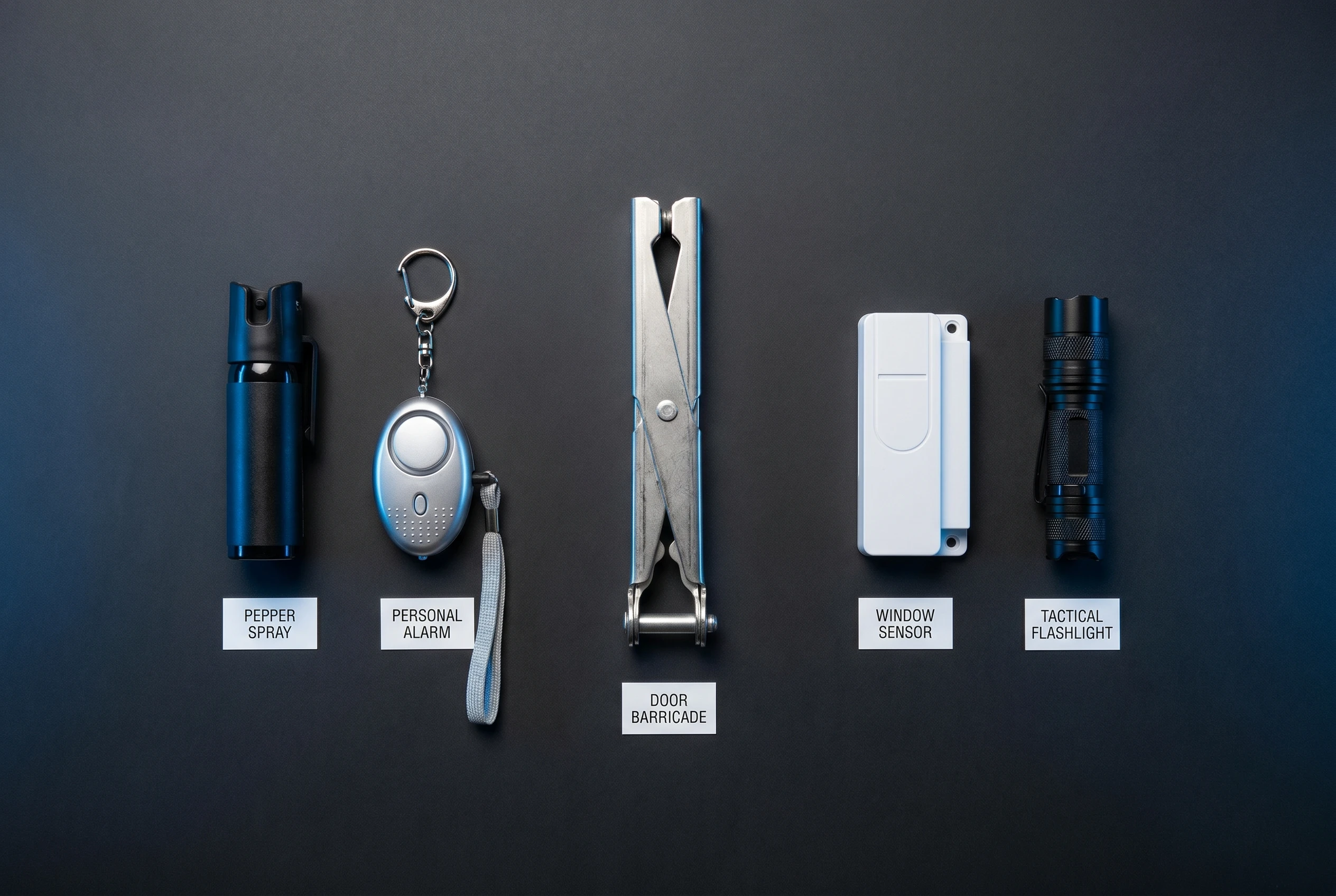
- Pepper spray (OC spray) — Sabre Red and POM are consistently recommended by law enforcement instructors. Choose a gel formula for indoor use to reduce blowback. Effective range of 10–15 feet. Keep one in your bedroom and one near the main entry.
- Personal alarm keychain — 120–130 decibel alarms draw immediate attention and disorient attackers. Inexpensive and require zero training.
- Door barricade bar — Devices like the Master Lock door bar brace prevent doors from being forced open even after a lock is defeated. Costs $30–$50 and requires no installation.
- Tactical flashlight — A 1,000+ lumen flashlight temporarily blinds an intruder and serves as a striking tool. Doubles as a power outage tool.
- Taser or stun gun — Effective at close range. Check your state laws before purchasing, as some states restrict civilian ownership.
- Noise-making door alarms — Wedge alarms placed under doors trigger a loud alarm when the door is pushed. Excellent for apartment renters.
Common mistake: Storing tools in a drawer across the room. Every tool must be within arm’s reach of where you sleep or spend most of your time. A pepper spray canister in the kitchen doesn’t help you in the bedroom at 2 a.m.
Affordable Ways to Make Your Home Safer Without Expensive Gear
Meaningful security improvements don’t require a large budget. Several of the most effective deterrents cost under $50 or nothing at all.
Zero-cost improvements:
- Vary your daily routine so your schedule isn’t predictable to observers
- Keep interior lights on timers to simulate occupancy when you’re away
- Get to know your neighbors — a connected neighborhood is a watched neighborhood
- Never announce on social media that you’re traveling or away from home
Low-cost physical upgrades (under $100):
- Install a door frame reinforcement kit (Strike Master II or Door Armor). Most break-ins use kick-in force, not lock-picking. A reinforced frame stops this.
- Add a secondary lock to sliding glass doors — a cut-down wooden dowel in the track costs nothing.
- Install motion-activated exterior lights on all entry points. Solar-powered models require no wiring.
- Apply window security film to ground-floor windows. It doesn’t prevent breaking, but it holds glass together and significantly slows entry.
- Place gravel or crushed stone under windows. The noise of footsteps on gravel is a simple but effective alert.
For renters specifically, all of these options are non-invasive and won’t violate standard lease agreements.
Home Defense Options for Renters With Limited Modifications Allowed
Renters can build a strong home defense system without drilling, permanent installation, or lease violations. The best renter-friendly options focus on portable, removable, and non-damaging solutions.
Renter-approved security stack:
- Portable door alarms — Wedge under any door. No installation needed.
- Window sensors with adhesive mounts — SimpliSafe and Ring both offer adhesive-mounted sensors that leave no damage.
- Freestanding security cameras — Plug-in or battery-powered cameras sit on shelves or furniture with no wall mounting required.
- Door barricade bars — Brace against the floor, no drilling.
- Smart doorbell cameras with adhesive mounts — Ring and Blink offer adhesive installation kits.
- Portable safe — Secure valuables and important documents without a wall-mounted safe.
If your landlord won’t allow any modifications, focus on the portable layer: door bars, window wedge alarms, personal alarms, and a strong monitoring subscription. That combination costs under $200 and provides real deterrence.
For broader guidance on apartment-specific preparedness, the Ultimate Guide to Prepping in a Small Apartment is a practical resource.
Are Smart Home Security Devices Worth the Money
Smart home security devices are worth the investment for solo occupants, specifically because they provide real-time awareness and remote monitoring that traditional systems can’t match. The ability to see who’s at your door from your phone — whether you’re in the bedroom or across town — is a genuine safety advantage.
Where smart devices deliver real value:
- Smart doorbell cameras allow you to see, hear, and speak to anyone at your door without opening it or even being home
- Smart locks let you grant access remotely and receive alerts when your door is unlocked
- Motion-activated cameras with instant phone alerts give you awareness of perimeter activity in real time
- Smart plugs with light timers simulate occupancy convincingly and cost under $20 each
Where smart devices underperform:
- They depend on Wi-Fi and power. A grid failure or internet outage can disable cloud-connected systems. Always pair smart devices with non-electronic backups (door bars, physical locks, local sirens).
- Cheap smart cameras often have poor night vision, slow alert speeds, and unreliable cloud storage. Invest in a reputable brand.
For context on power resilience and backup systems, the Backup Power for Emergencies guide explains how to keep critical systems running during outages.
Do Dogs Really Help Prevent Home Invasions
Yes — dogs are one of the most effective home intrusion deterrents available, and the research supports it. A study published by the University of North Carolina’s Department of Criminal Justice found that burglars consistently identified dogs as a primary deterrent when choosing targets. Even medium-sized dogs create noise, unpredictability, and visible evidence of occupancy that most intruders want to avoid.
What makes a dog effective as a deterrent:
- Barking alerts you and draws neighbor attention
- Intruders cannot predict or control a dog’s behavior
- The presence of a dog is visible through windows and audible from outside
- Dogs sense approach before humans do, giving you earlier warning
A large, visibly protective breed (German Shepherd, Belgian Malinois, Doberman) provides the strongest deterrent effect. However, even a vocal small dog offers meaningful early warning. The key factor is that the dog barks at strangers — a dog that sleeps through everything provides little security value.
If pet ownership isn’t possible, a “Beware of Dog” sign combined with a dog bowl near the entry door creates a visual suggestion of a dog’s presence. It’s not foolproof, but it costs nothing and may cause a cautious intruder to move on.
What Should Single Women Do If Someone Tries to Break In
If someone attempts to break into your home, the immediate priority is distance, noise, and communication — not confrontation. Here is the step-by-step protocol:
- Get to your safe room — Move immediately to a pre-designated room with a solid door, a lock, and your phone. A bedroom is usually the best choice.
- Call 911 — Do this first, before anything else. Stay on the line. Give your address immediately in case the call drops.
- Make noise — Shout loudly that you’ve called the police. Trigger your alarm if you haven’t already. Most intruders will flee when they know law enforcement has been contacted.
- Barricade the door — Use a door bar or push heavy furniture against the door while waiting for police.
- Prepare your defense tool — Have your pepper spray, personal alarm, or other tool ready but don’t leave the room to confront the intruder.
- Stay on the phone — Keep communicating with the 911 dispatcher. They will guide you and coordinate the police response.
What not to do:
- Do not investigate the noise by moving through the house
- Do not open the door to “check” once you’ve barricaded
- Do not assume it’s just the wind or an animal — treat every ambiguous noise as a real threat until confirmed otherwise
Having an emergency communication plan in place before an incident means you’re not making decisions under maximum stress.
How Different Home Security Systems Compare in Price and Effectiveness
| System | Monthly Cost | Contract | DIY Install | Professional Monitoring | Best For |
|---|---|---|---|---|---|
| SimpliSafe | $0–$30 | No | Yes | Optional | Renters, budget-conscious |
| Ring Alarm Pro | $10–$20 | No | Yes | Optional | Smart home users |
| ADT | $28–$60 | Yes (3 yr) | No | Included | Homeowners wanting full service |
| Abode | $0–$20 | No | Yes | Optional | Tech-savvy users |
| Wyze Home Monitoring | $5–$10 | No | Yes | Optional | Extreme budget |
Decision rule: Choose SimpliSafe if you rent and want flexibility. Choose ADT if you own your home and want professional installation with guaranteed monitoring. Choose Ring if you already use Ring cameras and want seamless integration.
What Home Security Mistakes Do Women Living Solo Often Make
The most common home security mistakes among solo women are predictability, single-layer reliance, and underestimating entry point vulnerabilities. Each of these is fixable without significant expense.
Top mistakes and how to correct them:
- Predictable routines — Varying your schedule and light patterns makes your home a harder target. Use smart plugs to randomize interior lighting.
- Relying on one security layer — A camera without an alarm, or an alarm without a reinforced door, leaves obvious gaps. Build in redundancy.
- Hollow-core interior doors — Many interior doors, including bedroom doors, are hollow and kick through in seconds. Upgrade the door to your safe room to a solid-core model.
- Posting travel plans on social media — Announcing you’re away for a week is an open invitation. Adjust privacy settings and post trip photos after you return.
- Ignoring the garage — Garage doors and the door connecting the garage to the home are frequently overlooked entry points. Both need the same attention as front doors.
- No exterior lighting — Motion-activated lights are cheap and highly effective. Dark entry points are an intruder’s best friend.
- Trusting door chains — Door chains are not security devices. They break with minimal force. A reinforced deadbolt and door frame are the actual barrier.
The Ultimate Guide to Home Emergency Preparedness covers household vulnerability assessment in detail.
Training and Mindset Tips for Feeling More Confident About Home Safety
Confidence in home defense comes from preparation, not from having the most gear. The mental component of this Solo Women’s Home Defense Guide: What Actually Works is just as important as the physical tools.
Practical steps to build genuine confidence:
- Walk your home as an intruder would. Go outside and look at your property from the street. Identify every dark area, every concealed entry point, every window without a sensor. Fix what you see.
- Practice your response plan. Time yourself getting from your living room to your safe room. Know exactly where your phone and defense tools are at all times.
- Take a self-defense class. Even one weekend course changes how you carry yourself and how you respond under stress. Look for courses taught by law enforcement or certified Krav Maga instructors.
- Run “what if” scenarios. Ask yourself: what would I do if I heard glass breaking at 3 a.m.? Having a rehearsed answer means you act instead of freeze.
- Build a support network. Tell a trusted neighbor or friend your schedule. Have a check-in system so someone notices if you go dark unexpectedly.
Preparedness is not about living in fear. It’s about building the kind of confidence that comes from knowing you’ve thought it through and you have a plan. That mindset shift — from reactive to proactive — is the foundation of everything in this guide.
For broader preparedness planning, the Complete Prepping Guide for Beginners is a strong starting point for building a full preparedness lifestyle.
Frequently Asked Questions
Do I need a gun for effective home defense as a solo woman? No. A firearm is one option, not a requirement. Non-lethal tools, reinforced entry points, a reliable alarm system, and a practiced response plan provide strong protection without the training burden, legal complexity, and storage requirements of a firearm. Choose the tools you’ll actually train with and use confidently.
What’s the single most important home security upgrade I can make today? Reinforce your door frame. The majority of home break-ins use kick-in force against the door frame, not the lock. A door frame reinforcement kit costs $30–$80 and installs in under an hour. It stops the most common attack method immediately.
Is professional monitoring worth the monthly fee? For solo occupants, yes. Professional monitoring means someone contacts emergency services even if you can’t — if you’re incapacitated, asleep, or your phone is out of reach. The $10–$30 monthly cost is reasonable for that backup layer.
Can I build a secure home on a tight budget? Absolutely. Door reinforcement, window dowels, motion-activated lights, a personal alarm, and a noise-making door wedge cost under $150 combined and address the most common vulnerabilities. Start with entry points and build from there.
How do I make my apartment safer without my landlord finding out about modifications? Focus on non-invasive tools: adhesive-mounted sensors, portable door alarms, door barricade bars, and freestanding cameras. None of these require drilling or permanent changes, and all can be removed when you move out.
What’s the best way to handle a situation where I think someone is watching my home? Document it: write down dates, times, vehicle descriptions, and physical descriptions. Report it to local police as a non-emergency concern. Tell a trusted neighbor. Increase your visible security indicators (add a camera, put up alarm company signage) and vary your routine immediately.
Are neighborhood watch programs actually effective? Yes, consistently. Research from the National Crime Prevention Council indicates that active neighborhood watch programs reduce residential burglary rates in participating areas. Joining or starting one costs nothing and creates a network of eyes on your street.
Should I tell people I live alone? No, as a general rule. Avoid confirming to strangers — including service workers, delivery drivers, and casual acquaintances — that you live alone. A simple “my roommate is home” or “I’ll check with my partner” creates ambiguity that works in your favor.
What room should I designate as my safe room? Your primary bedroom is usually the best choice. It’s where you’re most vulnerable (sleeping) and typically has a lockable door. Upgrade that door to solid-core if possible, keep your phone charging within arm’s reach, and store your defense tools there.
How often should I test my security system? Test door and window sensors monthly. Test your alarm siren quarterly. Check camera footage quality and storage every two weeks. Replace smoke and CO detector batteries annually. A system you never test is a system you can’t trust.
Conclusion
Building a secure home as a solo woman isn’t about fear — it’s about making deliberate, informed choices that put you in control. The Solo Women’s Home Defense Guide: What Actually Works isn’t a single product or a single tactic. It’s a layered system: harden your entry points, add reliable detection, keep response tools within reach, and train your mind to act before panic sets in.
Start with the fundamentals this week: reinforce your door frame, add motion-activated lights to your exterior, and place a personal alarm within reach of your bed. From there, build outward — sensors, cameras, a monitoring subscription, and eventually a practiced response plan.
The women who feel most confident about their safety aren’t the ones with the most gear. They’re the ones who’ve thought it through, tested their setup, and know exactly what they’ll do when something goes wrong.
Recommended tools and resources to take action now:
- The Ultimate Home Defense Guide for Preppers — comprehensive physical and electronic security planning
- Ultimate Guide to Home Emergency Preparedness — household-level emergency systems and protocols
- Emergency Communication Plan guide — build a communication system before you need it
- The 4-Layer Disaster Plan — a structured preparedness framework applicable to home security
- Sabre Red Pepper Gel — consistently rated by self-defense instructors for indoor use
- SimpliSafe Home Security System — best overall for renters and solo occupants
- Master Lock Door Bar — affordable, effective, no installation required
- Strike Master II Door Frame Reinforcement Kit — addresses the most common break-in method
Preparedness is a practice, not a purchase. Build your system one layer at a time, and you’ll have something that actually works when it matters most.