
Hey there! Some links on this page may be affiliate links which means that, if you choose to make a purchase, I may earn a commission at no extra cost to you. I greatly appreciate your support. Read the full disclosure here.
Emergency Cooking Without Power: The Complete Survival Guide
Cooking without power means relying on alternative heat sources — butane burners, propane camp stoves, rocket stoves, solar cookers, and thermal retention methods — combined with a smart inventory of shelf-stable food. The safest approach depends on your location (indoors vs. outdoors), available fuel, and how long the outage lasts. With the right gear and a basic plan in place, a household can eat warm, nutritious meals for weeks without touching the electrical grid.
Find this useful? Add us as a preferred source on Google and more of what we publish will show up in your results.
Key Takeaways
- Butane stoves are the best indoor option for apartments; propane stoves work better for families with outdoor access
- Never use charcoal grills, wood fires, or propane indoors — carbon monoxide builds fast even with windows cracked
- Thermal cookers and insulated bags let food finish cooking without any active flame, saving significant fuel
- A 72-hour emergency food supply built around non-perishables eliminates most cooking complexity during short outages
- Solar cookers are the only truly fuel-free cooking method, but require direct sunlight and more cooking time
- Frozen food stays safe for roughly 24–36 hours in an unopened freezer — eat perishables first, then shift to shelf-stable stores
- Flavor variety (hot sauce, bouillon, spice packets) matters more than people expect; food fatigue undermines discipline faster than hunger
- Practice your off-grid cooking setup before an emergency — the first time you light a rocket stove should not be during a blackout
- Fuel efficiency tactics (lids, reflectors, batch cooking) can meaningfully extend a limited fuel supply
- A basic beginner setup — butane stove, three canisters, thermal bag, and a metal pot — costs under $60
Why Cooking Without Power Deserves Serious Preparation
 Most households are one grid failure away from a genuine food crisis. Not because food disappears, but because nearly every cooking method in a modern home depends on electricity or gas lines that can be disrupted simultaneously during major outages, natural disasters, or EMP and grid failure events.
Hunger doesn’t pause for infrastructure repairs. And in extended outages — the kind that follow hurricanes, ice storms, or regional grid failures — the ability to cook safely and efficiently becomes one of the most practical survival skills a household can have. It’s also one of the most overlooked.
This guide covers everything from immediate solutions you can use tonight to long-term off-grid cooking systems worth building toward. Whether you’re new to preparedness or refining an existing setup, the goal is the same: warm food, safe conditions, and enough calm to think clearly when the lights go out.
What Are the Safest Indoor Cooking Methods During a Power Outage?
Cooking indoors without power is possible, but it requires the right equipment and strict ventilation habits. The three most practical options for indoor use are butane stoves, gel fuel burners, and thermal cookers.
Butane stoves are the most versatile indoor option. They burn cleanly, produce minimal soot, and are compact enough for apartments. A single butane canister typically provides about 1.5 to 2 hours of burn time at medium heat. Keep at least six canisters stored per person for a 72-hour outage. Butane performs well at room temperature but loses pressure in cold environments below roughly 40°F (4°C), which matters if your home loses heat alongside power.
Gel fuel chafing dishes produce lower heat output but are useful for reheating soups, sauces, or pre-cooked food. They’re inexpensive, widely available, and produce no significant fumes when used in a well-ventilated room.
Thermal cookers (also called retained-heat cookers) are underrated. The method is simple: bring food to a full boil on any heat source for 10–15 minutes, then transfer the covered pot into an insulated bag or box. The retained heat continues cooking the food for 2–4 hours without any additional fuel. This works well for rice, beans, stews, and soups — exactly the foods that form the backbone of most emergency meal plans.
Critical safety rule: Any combustion indoors — even a small butane burner — produces carbon monoxide. Always crack at least one window, keep a battery-operated CO detector within six feet of your cooking area, and never cook in a sealed room. This is non-negotiable.
Which Outdoor Cooking Methods Work Best in an Emergency?
 Outdoors, the options expand considerably. The best choice depends on available fuel, cooking volume, and how long the outage is expected to last.
Propane camp stoves are the most reliable all-around option for families. They light easily, maintain consistent heat, and handle wind better than butane. A standard 1-pound propane canister lasts roughly 1–2 hours at medium heat; larger 20-pound tanks (used with an adapter hose) extend that dramatically. Propane also performs well in cold weather, unlike butane.
Rocket stoves are worth learning. They burn small-diameter wood — twigs, scrap lumber, broken branches — with surprising efficiency. The design channels airflow to concentrate heat directly under the cooking vessel, which means less fuel and less smoke than an open fire. The learning curve is real, but once mastered, a rocket stove turns a backyard into a functional kitchen with essentially unlimited fuel.
Charcoal grills and fire pits work, but they consume fuel quickly and require more management. They’re better suited to longer cooking sessions (smoking meat, boiling large volumes of water) than quick daily meals.
Practical tip for windy conditions: Surround your cook station with a loose ring of stones or use a metal windscreen. This concentrates heat and can reduce fuel consumption by 30–40% — a meaningful difference during a prolonged outage.
For those building a broader emergency plan, pairing outdoor cooking capability with a solid bug-out bag food list ensures you’re covered whether you shelter in place or need to move.
What No-Fuel Cooking Options Actually Work?
Three methods can produce warm food with no stored fuel at all — solar cookers, MRE heaters, and thermal retention. Each has specific conditions where it performs well.
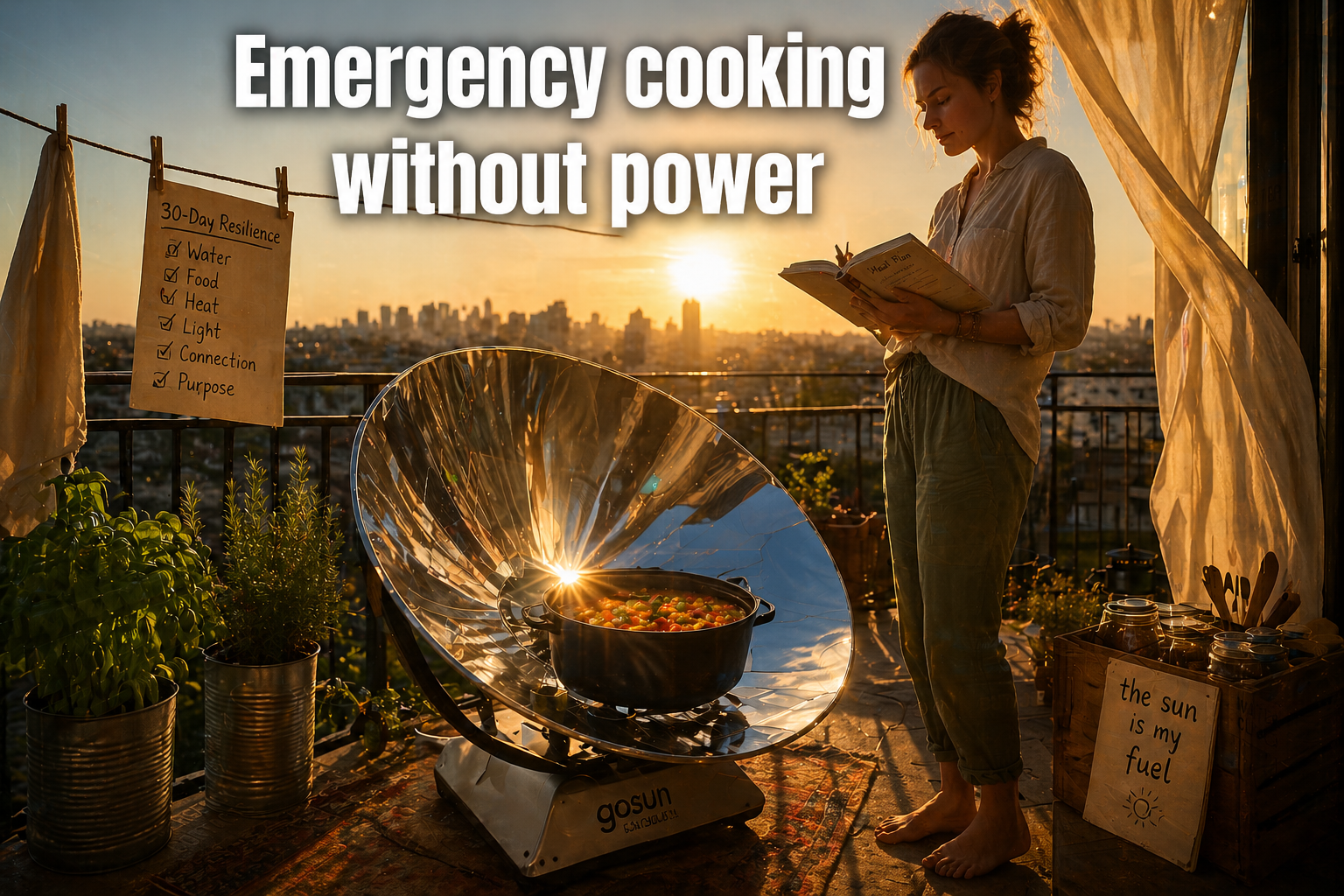
Solar cookers are the only genuinely renewable option. A basic parabolic or box-style solar cooker can reach 120–200°C (roughly 250–390°F) in direct sunlight, enough to cook rice, bake bread, or pasteurize water. They take longer than conventional cooking — a pot of rice might take 45–90 minutes depending on sun angle and cloud cover — but they require no fuel purchases, no storage concerns, and no combustion risk. The limitation is obvious: they need direct sunlight, which makes them unreliable in winter, overcast climates, or during the early days of a crisis when conditions may be unpredictable.
MRE heaters (flameless ration heaters, originally designed for military use) use a chemical reaction between magnesium iron alloy and salt water to generate heat. They can raise food temperature by 100°F in about 10–12 minutes. They’re single-use, but compact and reliable — useful for situations where open flame isn’t possible, such as in a vehicle or a small enclosed space.
Thermal bags and insulated cookers extend the thermal method described above. Pre-heat food on any source, seal it tightly, and place it in an insulated container. A good thermal bag can maintain cooking temperatures for 4–8 hours. This is particularly useful for overnight cooking: start a pot of beans before bed, and they’re ready by morning.
DIY alternatives when commercial gear isn’t available:
- A tin can stove made from two nested cans with airflow holes punched near the base burns alcohol gel or small twigs effectively
- A brick rocket stove — four bricks arranged in a U-shape with a metal grate — costs nothing if bricks are available and works immediately
- A pizza box solar oven lined with aluminum foil and covered with clear plastic wrap can reach temperatures sufficient to warm food or dehydrate fruit on a sunny day
What Off-Grid Cooking Gear Is Worth Buying?
 The right gear depends on your living situation, budget, and how long you’re preparing for. Here’s a direct comparison of the most common options:
Choose a propane camp stove if you have a family, outdoor space, and want the most reliable all-weather performance. Choose a butane stove if you’re in an apartment and need something clean and compact. Add a thermal cooker to either setup — it’s the most cost-effective way to stretch fuel and simplify cooking.
If budget is tight, a dual-fuel stove that accepts both butane and propane canisters offers the most flexibility for under $80.
How Should You Plan Meals During a Power Outage?
Smart meal planning during an outage reduces cooking complexity, conserves fuel, and — more than most people expect — maintains morale. Structure matters when everything else feels unpredictable.
The core principle: eat perishables first (within the first 24 hours), then transition to shelf-stable foods. This minimizes waste and keeps the most calorie-dense, long-lasting supplies intact for later.
A practical 3-day emergency meal framework:
Day 1 — Use what’s already open
- Breakfast: Oats with shelf-stable milk and honey (no cooking needed if soaked overnight)
- Lunch: Canned tuna with crackers, hot sauce
- Dinner: Canned beans and pre-cooked rice heated on butane; canned vegetables on the side
Day 2 — Transition to shelf-stable staples
- Breakfast: Peanut butter on flatbread or crackers
- Lunch: Lentil soup simmered briefly, finished in a thermal bag
- Dinner: Canned chili over instant rice with a bouillon-based broth
Day 3 — Maintain routine and energy
- Breakfast: Instant coffee or tea, protein bar or granola
- Lunch: Pasta with canned tomatoes and sardines
- Dinner: Couscous (cooks in 5 minutes with boiling water) with canned chicken and dried spices
This framework uses minimal fuel, requires no refrigeration, and provides reasonable nutritional variety. For a more comprehensive approach to stocking these supplies, the ultimate survival pantry list is a strong starting point.
Which Foods Require No Cooking or Water During an Emergency?
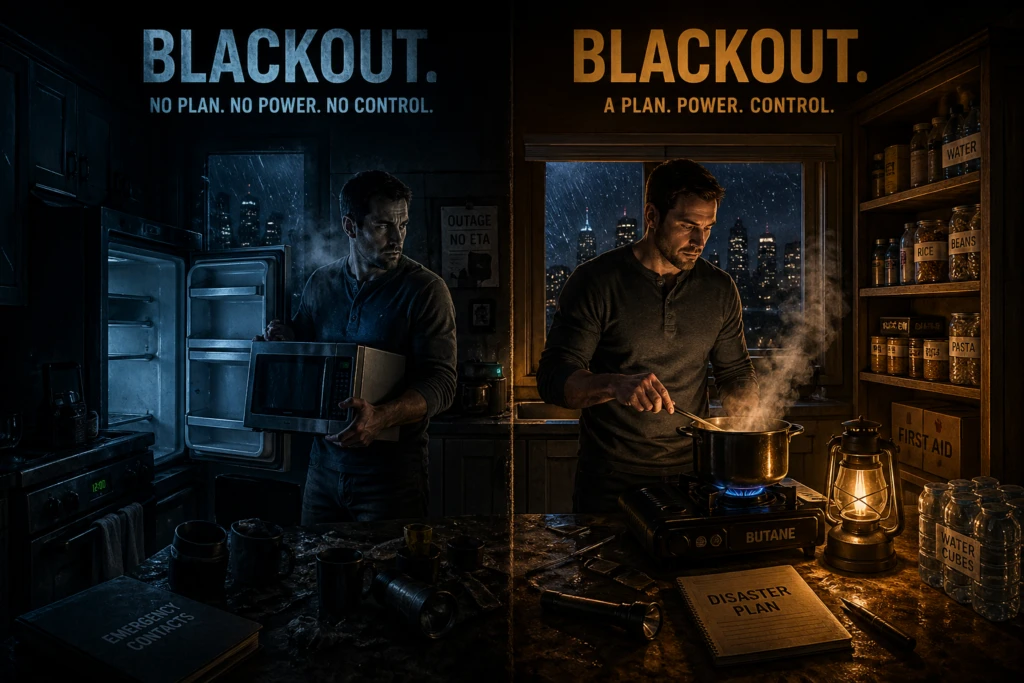 Some foods require zero preparation and should form the first layer of any emergency food supply. These are the items to reach for immediately — no stove, no water, no waiting.
Ready-to-eat options that need nothing:
- Peanut butter (calorie-dense, stable for 1–2 years)
- Canned fruit (provides hydration and a morale boost)
- Nuts and seeds
- Beef jerky and meat sticks
- Granola bars and protein bars
- Vacuum-sealed crackers
- Pouched tuna, salmon, or chicken
- Dried fruit (raisins, apricots, mango)
- Nut butters in single-serve packets
Electrolyte powders deserve a specific mention. During power outages, especially in summer heat or following physical exertion, dehydration is a real risk. Electrolyte mixes require no cooking, extend the usefulness of plain water, and help maintain energy and cognitive function.
One practical habit: rotate these items monthly by consuming one or two items from your emergency stock and replacing them. This keeps everything fresh and keeps the inventory familiar — so there are no surprises about what’s actually on the shelf when it matters.
How Do You Store Emergency Food for Long-Term Blackout Readiness?
Effective long-term food storage for power outages comes down to four factors: temperature stability, oxygen control, rotation discipline, and flavor variety.
Temperature: Store food in the coolest, darkest space available — a basement, interior closet, or pantry away from exterior walls. Heat accelerates spoilage and degrades nutritional content over time. Avoid garages or sheds where temperatures fluctuate widely.
Oxygen control: For bulk staples like white rice, dried beans, oats, and pasta, use food-grade buckets with gamma-seal lids and oxygen absorbers. This can extend shelf life from 1–2 years to 20–30 years for some grains. Mylar bags inside buckets add another layer of protection.
Rotation: Label every container with a “packed on” date and a “use by” date. Follow a first-in, first-out system. The goal is a living pantry — one that’s always stocked with items you actually eat, not a static collection of things you’ll never touch.
Flavor variety: This is consistently underestimated. Salt, sugar, vinegar, garlic powder, hot sauce, bouillon cubes, and dried herbs take up almost no space but transform the eating experience during extended outages. Food fatigue — the psychological exhaustion of eating the same bland meals repeatedly — erodes morale and discipline faster than caloric shortfall.
For a deeper dive into avoiding common mistakes, the guide on food storage mistakes to avoid covers the most costly errors preppers make when building long-term supplies.
What Safety Rules Apply to Emergency Cooking?
Emergency cooking introduces real hazards that don’t exist in a normal kitchen: open flames in unfamiliar configurations, limited ventilation, and the cognitive fog that comes with stress. A few non-negotiable rules prevent the most serious outcomes.
Fire and carbon monoxide safety:
- Keep all cook stations at least three feet from curtains, paper, fabric, or other combustibles
- Use an ABC-rated fire extinguisher — keep it within arm’s reach, not stored in a cabinet
- Never use charcoal, wood fires, propane, or any combustion source indoors without significant ventilation
- Install a battery-operated CO detector near any indoor cooking area; carbon monoxide is odorless and kills without warning
- Practice your setup before an emergency — the first time you use a rocket stove or butane burner should not be during a crisis
Fuel efficiency — making limited resources last:
- Prep all ingredients before lighting the stove; every minute of open flame without active cooking is wasted fuel
- Use lids on every pot — this alone reduces heat loss by roughly 25–30%
- Batch cook when possible; one large pot of stew reheated over two days uses far less fuel than cooking three separate meals
- Use stone or metal windscreens to concentrate heat
- After cooking, pour remaining boiling water into a sealed thermos for tea, rehydrating food, or basic sanitation
Post-crisis sanitation:
When running water is unavailable, hygiene becomes a slow-burn threat. Keep baby wipes and a vinegar-water spray for surface cleaning. Use a two-basin system for dishes: one with soapy water, one with a diluted bleach rinse. Utensils left in direct sunlight for several hours benefit from UV exposure, which reduces bacterial load on surfaces. This isn’t a replacement for proper sanitation, but it’s a practical interim measure.
How Do You Build a Sustainable Off-Grid Kitchen Beyond the Emergency?
 The difference between short-term survival and long-term resilience is whether cooking without power becomes a practiced skill or remains a panicked improvisation. Building toward sustainability means treating off-grid cooking as a system, not a backup plan.
Transition to renewable fuel sources as soon as the immediate crisis stabilizes. Solar cookers, biomass pellet stoves, and ethanol gel burners reduce dependence on stored canisters that eventually run out. Pairing a solar cooker with a propane backup gives both reliability and sustainability.
Run quarterly blackout drills. Cook one full meal per quarter using only your emergency setup. This keeps skills sharp, reveals gaps in your supply (you’ll discover you’re out of butane canisters before a crisis does), and normalizes the experience so it doesn’t feel alien under pressure.
Build a rotation system — not a static stockpile. Restock what you use before it’s gone. This applies to fuel canisters as much as food. A propane tank that’s been sitting in the garage for three years may be fine, or it may have a slow leak. Regular use and replacement eliminates that uncertainty.
Core off-grid kitchen tools worth having:
- Dual-fuel camp stove (butane/propane compatible)
- Thermal cooker or large insulated bag
- Collapsible cookware with silicone lids
- Cast iron skillet (works on any heat source, nearly indestructible)
- Manual can opener (obvious, but frequently forgotten)
- Water filtration system or purification tablets
- 20-liter water storage container with a spigot
For those interested in going further, the complete guide to off-grid living covers how to build permanent cooking and energy systems that don’t depend on the grid at all.
The psychological dimension matters too. Cooking reconnects people to a sense of control during chaos. The act of preparing food — the smells, the deliberate steps, the shared meal — re-anchors the brain’s sense of safety in a way that few other activities can. Serve others before yourself. Celebrate the first warm meal off-grid. These aren’t soft suggestions; they’re practical tools for maintaining the mental clarity that good decision-making requires under stress. Families who treat preparedness as a lifestyle rather than a one-time purchase consistently recover faster from disruptions — not because they have more gear, but because they’ve practiced.
FAQ
What can be cooked with absolutely no fuel or electricity?
Plenty. Canned goods, peanut butter, crackers, pouched tuna, nuts, dried fruit, and granola bars require nothing. For warm food with no fuel, a solar cooker works in direct sunlight, and MRE heaters (flameless ration heaters) use a chemical reaction to heat food without any flame.
How long does frozen food stay safe when the power goes out?
A full, unopened freezer maintains safe temperatures for roughly 24–48 hours. A half-full freezer drops to unsafe temperatures faster — closer to 24 hours. Eat perishables first and transition to shelf-stable food before anything thaws completely.
Can a charcoal grill be used indoors if windows are open?
No. Charcoal produces carbon monoxide in concentrations that are dangerous even with open windows. This applies to wood fires and propane as well. Outdoor-only combustion sources must stay outdoors, full stop.
What’s the cheapest functional emergency cooking setup?
A single-burner butane stove (around $20–30), four butane canisters (roughly $12–15), a basic thermal bag or insulated tote ($15–20), and a stainless steel pot covers most short-term cooking needs for under $70 total.
How do you prevent food boredom during a long outage?
Condiment rotation. Small packets of hot sauce, bouillon cubes, soy sauce, lemon powder, and dried spices take up almost no space but make the same base ingredients taste meaningfully different day to day. This is one of the most overlooked aspects of emergency food planning.
Is a rocket stove worth learning to build?
Yes, especially for anyone outside an urban apartment. A rocket stove burns small wood efficiently, produces less smoke than an open fire, and can be built from bricks or cinder blocks at zero cost. The skill takes one or two practice sessions to develop and pays off significantly in a prolonged outage.
How much fuel should be stored for a two-week outage?
For a family of four using a propane camp stove for three meals daily, estimate roughly two to three 1-pound canisters per day at medium use — or one 20-pound tank for the full two weeks, supplemented with a thermal cooker to reduce active burn time. Actual consumption varies significantly based on cooking habits.
Can solar cookers work in winter?
Yes, but with limitations. Solar cookers require direct sunlight, not warmth. On a clear winter day with good sun angle, a parabolic solar cooker can still reach cooking temperatures. Cloud cover, short daylight hours, and low sun angles in northern latitudes reduce effectiveness considerably. Use solar as a supplement, not a sole winter cooking method.
What’s the biggest mistake people make when cooking without power?
Using combustion heat sources indoors without adequate ventilation. Carbon monoxide poisoning is a documented cause of emergency-related deaths during power outages. The second most common mistake is having gear but never practicing with it — so the first real use happens under stress, with unfamiliar equipment.
Does cooking without power require special cookware?
Not necessarily. Cast iron and stainless steel work on any heat source. Avoid non-stick pans on open flames — the coating degrades at high temperatures. Collapsible silicone cookware is useful for space efficiency but should be rated for direct flame use before relying on it.
Products, Tools, and Resources
These are the tools that consistently come up in serious preparedness communities — not because they’re the most expensive, but because they work reliably under pressure.
Camp Chef Everest 2-Burner Propane Stove — One of the most trusted camp stoves in the preparedness community. Two burners, a wind-resistant design, and compatible with standard propane tanks. The kind of stove that gets pulled out for camping, tailgating, and power outages alike — meaning it actually gets used and tested before it’s needed.
Iwatani Butane Stove (ZA-3HP) — The go-to for apartment preppers. Compact, clean-burning, and widely available. Butane canisters are sold at most Asian grocery stores and outdoor retailers, making resupply straightforward. Pairs well with a thermal bag for fuel-efficient indoor cooking.
Saratoga Jacks Thermal Cooker — A retained-heat cooker that works with any heat source. Bring food to a boil, transfer to the insulated container, and walk away. Genuinely useful for overnight bean cooking or slow-simmering stews without burning fuel.
UCO Flatpack Portable Grill and Rocket Stove — A collapsible stainless steel rocket stove that folds flat for storage. Burns wood, twigs, or biomass fuel tablets. Useful for both camping and emergency use, and durable enough to last years with basic care.
Goal Zero Nomad 100 Solar Panel — Not a cooking device, but worth including here. Paired with a small power bank, it keeps a CO detector, phone, and hand-crank radio charged during extended outages. Power and cooking capability together form a more complete emergency system.
Mylar Bags and Oxygen Absorbers (1-gallon, pack of 50) — The most cost-effective way to extend the shelf life of bulk grains, rice, and dried beans. Available from multiple suppliers online. Follow established guidelines for oxygen absorber quantity per bag volume.
For building out the rest of your emergency system, the ultimate emergency supplies list and the power outage preparedness guide cover the broader picture beyond cooking alone.