
Hey there! Some links on this page may be affiliate links which means that, if you choose to make a purchase, I may earn a commission at no extra cost to you. I greatly appreciate your support. Read the full disclosure here.
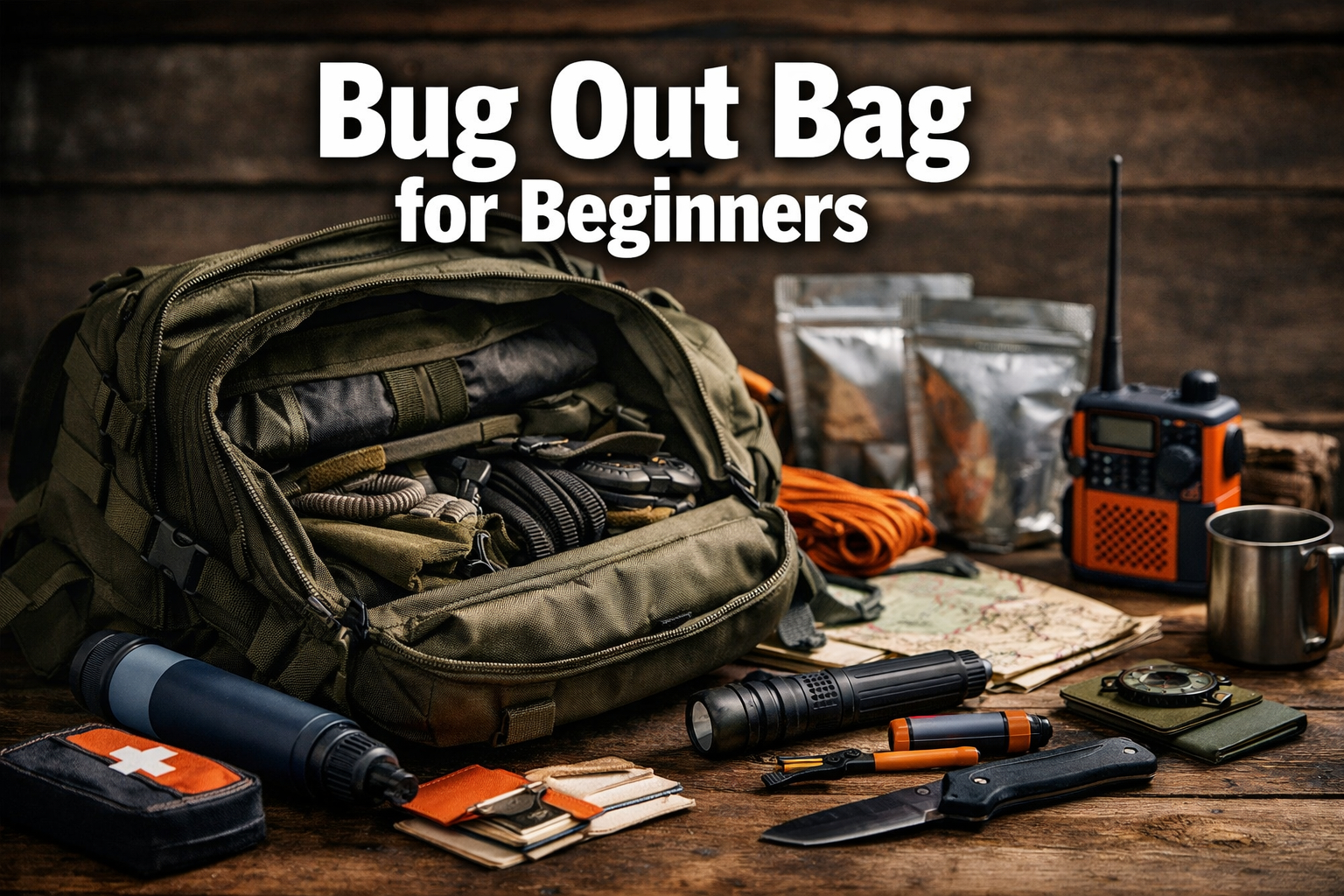
Bug Out Bag for Beginners: The Complete 2026 Guide to Building Your First 72-Hour Emergency Kit
A bug-out bag (BOB) is a pre-packed portable kit containing everything needed to survive independently for 72 hours during an emergency evacuation. For beginners, the core categories are water, food, shelter, first aid, navigation, communication, and documentation. Start with a 25–35 liter pack, keep total weight under 25% of your body weight, and build incrementally rather than buying everything at once.
Key Takeaways
- A bug-out bag for beginners should cover 72 hours of self-sufficiency across five core survival categories: water, food, shelter/warmth, first aid, and communication.
- Keep pack weight under 20–25% of your body weight to maintain mobility during an actual evacuation.
- Choose a bag between 25–45 liters; larger is not always better, especially for new preppers still learning load management.
- Water is the highest-priority item — plan for a minimum of one liter per person per day, plus purification capability.
- Documentation (copies of IDs, insurance, and emergency contacts) is one of the most overlooked yet critical components.
- Avoid the common beginner mistake of buying a pre-made “survival kit” without auditing its contents for quality and relevance.
- Rotate perishable items (food, medications, batteries) every 6–12 months to maintain readiness.
- Tailor your bag to your specific geography, climate, and household composition — a generic list is a starting point, not a final answer.
- Practice carrying your loaded bag on a 2–3 mile walk before an emergency occurs; many beginners discover weight or fit issues only under real conditions.
- A bug-out bag is not a substitute for a broader emergency preparedness plan, including a designated rally point and communication protocol with family members.
What Is a Bug-Out Bag and Why Does Every Prepper Need One?
 A bug-out bag is a portable emergency kit designed to sustain one person for approximately 72 hours when forced to evacuate quickly. The 72-hour benchmark reflects guidance from emergency management agencies like FEMA, which recommends households maintain at least three days of supplies independent of public infrastructure.
The term originates from military slang — “bugging out” means withdrawing rapidly from a compromised position. In the preparedness community, it describes any scenario requiring immediate departure from home: wildfires, flooding, chemical spills, civil unrest, or infrastructure failure.
Why 72 hours specifically? Emergency management research consistently shows that most localized disasters resolve or stabilize within three days, and that 72 hours is the realistic window before organized relief efforts reach affected populations. It’s a practical, not arbitrary, standard.
For anyone new to emergency preparedness, the bug out bag for beginners concept is the ideal entry point because it’s concrete, achievable, and immediately useful. Unlike long-term food storage or off-grid homesteading, assembling a functional BOB requires modest investment and can be completed in stages over weeks or months.
Who this guide is for:
- First-time preppers with no prior gear experience
- Households in disaster-prone regions (coastal, wildfire zones, flood plains)
- Urban and suburban residents who may need to evacuate on foot or by vehicle
- Experienced preppers looking to help a partner or family member build their first kit
How to Choose the Right Bag: Size, Weight, and Fit
The bag itself is the foundation — a poor choice here undermines everything packed inside. For a bug-out bag for beginners, prioritize fit and carry comfort over brand prestige or tactical aesthetics.
Recommended capacity: 25–45 liters for most adults. A 72-hour kit for one person typically fills 30–35 liters when packed efficiently.
Weight rule: Loaded pack weight should not exceed 20–25% of the carrier’s body weight. For a 160-pound adult, that means a maximum of 32–40 pounds. Most well-built beginner BOBs land between 20 and 30 pounds.
Key features to look for in a BOB pack:
- MOLLE webbing for attaching additional pouches without internal space sacrifice
- Hip belt with padding — critical for loads over 20 pounds; transfers weight from shoulders to hips
- Multiple compartments for organized access under stress
- Water-resistant material or included rain cover (not fully waterproof, but weather-resistant)
- Sternum strap for stability during movement over uneven terrain
- Neutral or subdued colors (coyote tan, olive drab, gray, black) — avoid bright colors that draw attention during civil unrest scenarios
Choose a larger pack (40–45L) if: you live in a cold climate requiring bulky insulation layers, have young children whose gear you’ll carry, or have medical equipment needs.
Choose a smaller pack (25–30L) if: you’re building a vehicle-based BOB, you’re physically smaller, or you prioritize speed and mobility over extended comfort.
Common beginner mistake: Buying the largest bag available “just in case.” Oversized packs encourage overpacking, which leads to carrying weight that slows evacuation and causes injury.
What Goes in a Bug-Out Bag for Beginners: The Core Categories
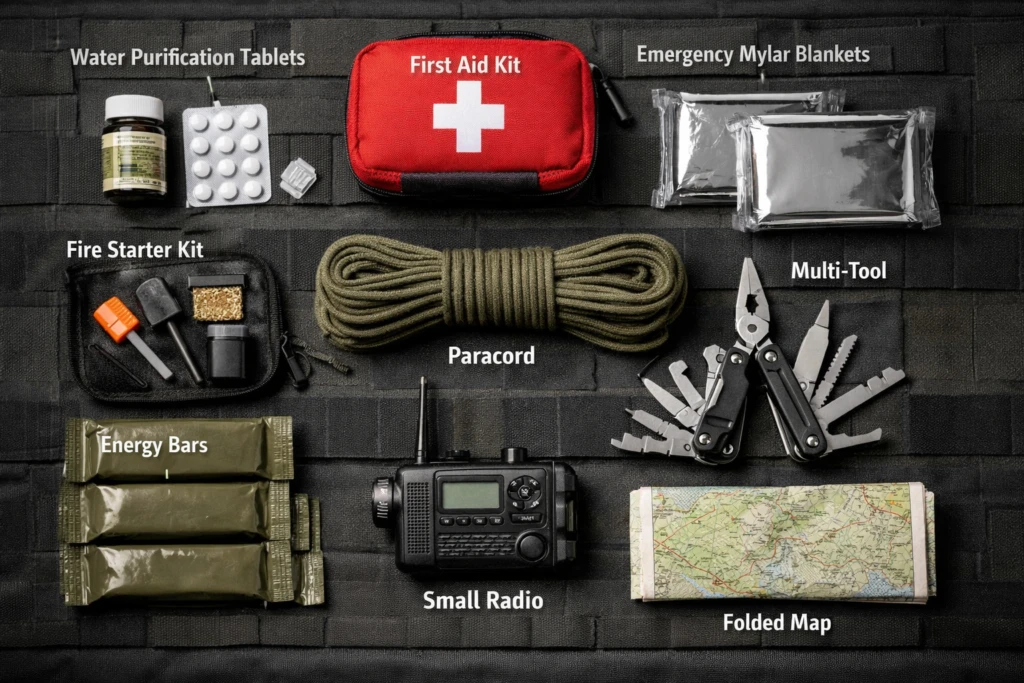 Every functional bug-out bag for beginners is organized around the same survival priorities, regardless of geography or threat type. The categories below follow the logic of survival triage — address the most immediately life-threatening needs first.
1. 💧 Water and Hydration
Water is the non-negotiable priority. Dehydration impairs judgment within hours and becomes life-threatening within days.
Minimum standard:
- 1 liter of stored water per person (as a starting reserve)
- Water filtration capability (Sawyer Squeeze, LifeStraw, or similar)
- Water purification tablets (iodine or chlorine dioxide) as backup
- Collapsible water container (1–2 liter capacity) for field collection
Do not rely solely on stored water. Carrying three full days of water (3+ liters) adds over 6 pounds to your pack. The smarter approach is carrying 1–2 liters plus robust purification capability.
2. 🍫 Food and Nutrition
The goal is calorie density, not culinary satisfaction. Aim for 1,500–2,000 calories per day from foods that require no cooking or minimal preparation.
| Food Type | Calories/oz | Weight | Prep Required |
|---|---|---|---|
| Freeze-dried meals | ~100–120 | Light | Hot water |
| Energy/protein bars | ~120–140 | Very light | None |
| Peanut butter packets | ~160–180 | Light | None |
| Jerky/dried meat | ~80–100 | Light | None |
| Hard candies/glucose | ~110 | Very light | None |
Practical tip: Pack foods you’d actually eat under stress. Unfamiliar textures and flavors become significant morale issues during real emergencies.
3. 🏕️ Shelter and Warmth
Exposure kills faster than hunger. Even in temperate climates, nighttime temperatures and wet conditions create hypothermia risk.
Minimum shelter kit:
- Emergency mylar space blankets (2 minimum; they tear easily)
- Lightweight tarp or bivy sack (a tarp is more versatile)
- 50 feet of paracord (550-lb test)
- Fire-starting kit: waterproof matches, BIC lighter, ferrocerium rod, tinder
4. 🩺 First Aid
A trauma-capable first aid kit goes beyond the standard bandage-and-aspirin kit found at drugstores. For a bug-out bag, prioritize:
- Israeli bandage or similar pressure dressing for wound control
- Tourniquet (CAT or SOFTT-W; learn to use it before you need it)
- Nitrile gloves (multiple pairs)
- Antiseptic wipes and antibiotic ointment
- Blister treatment (moleskin)
- Any personal prescription medications (30-day supply if possible)
- OTC medications: ibuprofen, antihistamine, anti-diarrheal, antacid
- Multi-tool (Leatherman Wave or similar)
- Fixed-blade knife (3–4 inch blade)
- Headlamp with extra batteries (or rechargeable with hand-crank backup)
- Compass and physical map of your region (do not rely on phone GPS)
- Duct tape (small flat roll)
- Zip ties (assorted sizes)
6. 📡 Communication and Information
- Battery-powered or hand-crank NOAA weather radio
- Whistle (Fox 40 or similar; audible at 100+ meters)
- Fully charged portable battery bank for phone
- Written list of emergency contacts (phones die; memory fails under stress)
7. 📄 Documentation
This category is consistently underweighted by beginners and consistently critical in real evacuations.
- Copies of ID, passport, and insurance cards
- Copies of property documents, prescriptions
- Small amount of cash in small bills (ATMs fail during power outages)
- USB drive with digital copies of key documents (encrypted)
How Much Does a Bug Out Bag Cost to Build?
Building a functional bug-out bag for beginners does not require a large upfront investment, but budget expectations matter. A realistic breakdown follows.
Budget tier ($150–$250): Covers functional versions of every core category using mid-range gear. Suitable for most beginners. Expect to compromise on pack quality and some tool durability.
Mid-range tier ($300–$500): Allows for a quality 30–40L pack, a reliable water filter, a proper trauma kit, and durable tools. This is the recommended target for most preppers.
Premium tier ($600+): Includes purpose-built tactical packs, advanced medical gear, satellite communicators (like a Garmin inReach), and a high-calorie freeze-dried food supply. Appropriate for those in high-risk environments or with advanced preparedness goals.
Build incrementally. Most preppers start with the bag and water/food basics, then add tools and medical gear over 2–3 months. This approach also allows time to research and test individual items before committing.
Bug-Out Bag for Beginners: Common Mistakes That Undermine Readiness
Even well-intentioned preppers make avoidable errors when building their first kit. Recognizing these patterns early saves money and, potentially, lives.
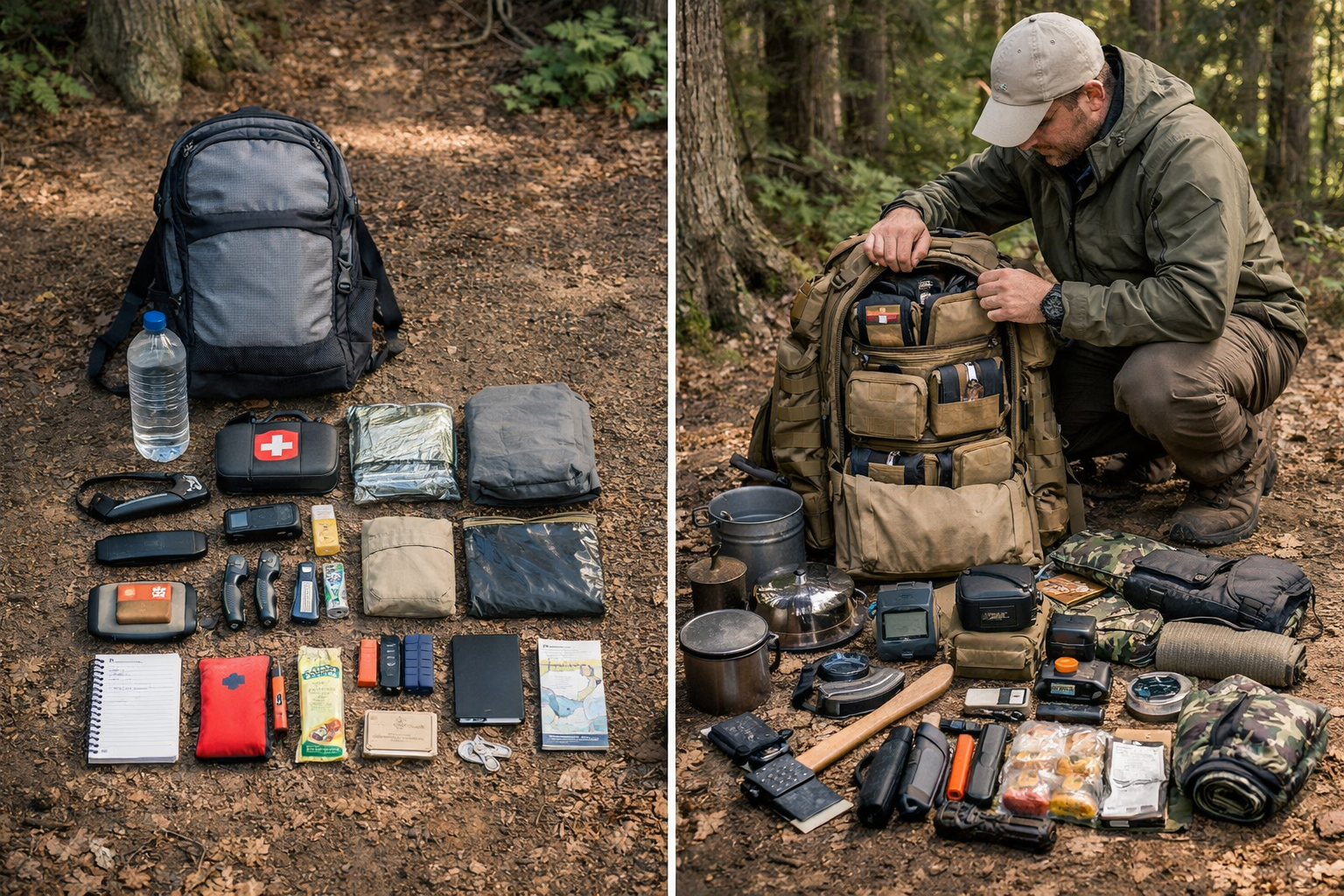
Mistake 1: Buying a pre-made “survival kit” without auditing it.
Many commercially sold “72-hour kits” contain low-quality items that fail under real conditions — cheap compasses that don’t hold bearing, thin mylar blankets that tear on first use, and calorie counts that fall far short of actual needs. Always audit contents against your personal needs.
Mistake 2: Ignoring climate and geography.
A bug-out bag built for a Florida hurricane evacuation looks very different from one built for a Pacific Northwest winter scenario. Factor in your specific environment: temperature ranges, terrain, distance to shelter, and likely threat types.
Mistake 3: Never testing the loaded pack.
A bag that feels manageable in a living room may become debilitating after two miles on uneven terrain. Test your loaded pack on a real walk before an emergency demands it.
Mistake 4: Forgetting medications and medical needs.
Prescription medications are among the hardest items to replace during a disaster. A 30-day emergency supply, maintained and rotated, is a critical component for anyone with chronic health conditions.
Mistake 5: No plan to go with the bag.
A bug-out bag without a bug-out plan is just a heavy backpack. Know your evacuation routes (primary and secondary), your destination (family, shelter, campsite), and your communication protocol with household members.
How to Maintain and Update Your Bug-Out Bag
A bug-out bag is not a one-time project. It requires scheduled maintenance to remain functional.
Recommended maintenance schedule:
- Every 6 months: Rotate food and water, check battery charge levels, and inspect medications for expiration
- Annually: Full gear audit — test all tools, replace worn items, update documentation copies, reassess pack weight and fit
- After any use or partial use: Restock immediately; don’t leave gaps
Seasonal adjustments: Swap clothing layers seasonally. A summer BOB in Minnesota needs a cold-weather clothing upgrade before October.
Trigger-based updates: After a major life change (new household member, relocation, new medical needs), conduct a full audit regardless of schedule.
FAQ: Bug Out Bag for Beginners
Q: How heavy should a bug-out bag be for a beginner?
A: Keep total loaded weight at or below 20–25% of the carrier’s body weight. For most adults, this means 20–30 pounds. Beginners often overpack; err toward lighter and more mobile.
Q: Can I use any backpack, or does it need to be tactical?
A: Any well-fitting, durable backpack with a hip belt can work. Tactical packs offer MOLLE attachment points and often more rugged construction, but a quality hiking pack from a brand like Osprey or Gregory is equally functional.
Q: Should each family member have their own bag?
A: Yes, whenever physically possible. Children over age 8–10 can carry a smaller pack with their own snacks, water, and comfort items. Adults should not carry the full household load in a single pack.
Q: How long does food in a bug-out bag stay good?
A: Commercial energy bars typically last 1–5 years, depending on brand. Freeze-dried meals can last 25+ years sealed. Check expiration dates and rotate every 6–12 months regardless.
Q: Is a bug-out bag the same as a get-home bag?
A: No. A get-home bag (GHB) is a lighter kit kept in a vehicle or office to help you reach home during an emergency. A bug-out bag is designed for leaving home and sustaining yourself for 72+ hours away from it.
Q: Do I need a weapon in my bug-out bag?
A: This is a personal and legal decision. Many experienced preppers include a firearm or defensive tool, but it’s not a prerequisite for a functional beginner kit. Prioritize survival fundamentals first.
Q: What’s the single most important item in a bug-out bag?
A: Water purification capability. Stored water is heavy and finite; a quality filter (like the Sawyer Squeeze) weighs 3 ounces and can process hundreds of gallons from natural sources.
Q: Should I tell people I have a bug-out bag?
A: Operational security (OPSEC) is a legitimate concern in the preparedness community. Discretion about your supplies and plans is generally advisable, particularly in high-density urban environments.
Q: Can I build a bug-out bag on a tight budget?
A: Yes. Prioritize water filtration, a reliable fire starter, a basic first aid kit, and calorie-dense food first. Many items (paracord, duct tape, mylar blankets) are inexpensive. Build incrementally rather than waiting until you can afford everything at once.
Q: What’s the difference between a bug-out bag and a 72-hour kit?
A: Functionally, they’re the same concept. “72-hour kit” is the term more commonly used by emergency management agencies and tends to imply a home-based or vehicle-based kit, while “bug out bag” implies a wearable, portable kit designed for foot evacuation.
Products, Tools, and Resources
These recommendations reflect practical, field-tested options commonly used in the preparedness community. No single product is universally “best” — context matters.
Packs:
- Condor 3-Day Assault Pack (50L) — A reliable budget-friendly option with MOLLE webbing, frequently recommended for beginners building their first kit.
- 5.11 Tactical Rush 24 (37L) — A mid-range pack with excellent organization and durability; widely used by both beginners and experienced preppers.
- Osprey Atmos AG 50 — For preppers who prioritize ergonomic fit and long-distance carry comfort over tactical aesthetics.
Water filtration:
- Sawyer Squeeze Filter — Lightweight, highly effective, and affordable. The go-to recommendation for most beginner kits.
- Katadyn BeFree — Slightly faster flow rate; good for group use or higher-volume needs.
- Aquatabs (chlorine dioxide tablets) — Essential backup; weigh almost nothing and add critical redundancy.
First aid:
- North American Rescue Individual First Aid Kit (IFAK) — A trauma-capable kit used by military and emergency responders; includes a tourniquet and pressure dressing.
- CAT Tourniquet (Combat Application Tourniquet) — The standard for extremity hemorrhage control; worth learning to use properly before you need it.
Communication:
- Midland ER310 Emergency Crank Radio — Hand-crank and solar-powered NOAA weather radio with USB charging port; excellent value for emergency communication.
- Garmin inReach Mini 2 — Satellite communicator for two-way messaging outside cell coverage; relevant for preppers in remote or rural areas.
Food:
- Mountain House freeze-dried meals — Widely available, calorie-dense, 30-year shelf life. Good for the food component of a long-term BOB.
- Clif Bars, RX Bars, or RXBAR Protein Bars — Practical, widely available, and palatable under stress. Rotate every 12 months.
Learning resources:
- The Survival Medicine Handbook by Joseph and Amy Alton — Highly regarded reference for medical preparedness beyond basic first aid.
- FEMA’s Ready.gov — Free, practical emergency planning guides including evacuation checklists and family communication plan templates.
- American Red Cross First Aid/CPR certification — Before relying on any trauma kit, formal training dramatically improves outcomes.
Conclusion
Building a bug-out bag for beginners is one of the most practical, immediately actionable steps any prepper can take. The process doesn’t require specialized expertise, military experience, or a large budget — it requires systematic thinking, honest assessment of personal needs, and the discipline to maintain what you build.
Actionable next steps:
- This week: Choose a bag in the 30–40L range that fits your torso correctly. Try it on before buying if possible.
- Week two: Acquire water filtration (Sawyer Squeeze) and a 72-hour food supply. These are your highest-priority items.
- Week three: Build or purchase a trauma-capable first aid kit. Take a basic first aid course if you haven’t already.
- Week four: Add shelter, fire-starting, navigation, and communication components.
- Month two: Compile documentation, add tools, and conduct your first full pack test on a real walk.
- Ongoing: Schedule biannual maintenance checks and reassess your plan annually.
A well-built, well-maintained bug out bag represents genuine preparedness — not anxiety, not paranoia, but the practical confidence that comes from knowing you can sustain yourself and your household through the first critical 72 hours of any emergency. Start simple, build deliberately, and test everything before you need it.
References
- FEMA. (2022). Build a Kit. Ready.gov. https://www.ready.gov/kit
- American Red Cross. (2023). Emergency Preparedness and Response. https://www.redcross.org/get-help/how-to-prepare-for-emergencies.html
- Alton, J., & Alton, A. (2021). The Survival Medicine Handbook: The Essential Guide for When Medical Help is Not on the Way (4th ed.). Doom and Bloom LLC.
- Centers for Disease Control and Prevention. (2022). Emergency Preparedness and You. https://www.cdc.gov/niosh/topics/emres/default.html