
Hey there! Some links on this page may be affiliate links which means that, if you choose to make a purchase, I may earn a commission at no extra cost to you. I greatly appreciate your support. Read the full disclosure here.
More than 40% of Americans now live in multi-unit buildings, and a significant portion of those are families in high-rise apartments above the 10th floor, a demographic that most mainstream prepping content almost entirely ignores. Urban survival for families in high rise buildings is a distinct discipline, not a variation of suburban preparedness. The rules change when your exit is a stairwell, your water depends on electric pumps, and your nearest exit is 20 floors up.
This guide covers every critical layer of urban survival for families in high-rise buildings, from building-specific evacuation planning to water storage in tight spaces, communication when cell towers fail, and the gear that actually makes sense when you’re living vertically.
Key Takeaways
- High-rise emergencies require stairwell-based evacuation plans, not standard ground-level exit strategies
- Water access in tall buildings depends on electric pumps, making stored water non-negotiable for any serious prep
- A minimum 72-hour supply is the baseline; 14 days is the realistic target for urban apartment families
- Families with children, elderly members, or disabled individuals need dedicated evacuation protocols, not afterthoughts
- A battery-powered or hand-crank radio is the single most important communication tool when cell networks fail
- Urban survival gear for high-rise families must prioritize portability, compact storage, and multi-use functionality
- Practicing evacuation drills twice per year is the difference between a plan and a practiced response
- Renters face different constraints than homeowners but have more flexibility than most people assume
What Is Urban Survival and Why Does It Matter for High Rise Families
Urban survival is the practice of maintaining safety, health, and basic function during emergencies within a densely populated city environment. For families in high-rise buildings, it matters because the building itself becomes both a resource and a liability the moment something goes wrong.
Ground-level homeowners can walk out a back door. They can access a yard, a garage, or a vehicle within seconds. High-rise families face a fundamentally different set of constraints: vertical evacuation, shared infrastructure, elevator dependency, and limited storage space. These aren’t minor inconveniences, they’re life-safety variables that require specific planning.
The good news is that urban survival for families in high rise buildings is entirely achievable with the right knowledge and modest investment. The families who struggle in emergencies are almost always the ones who assumed their building management had a plan that covered everything.
How High Rise Buildings Differ From Ground-Level Homes in Emergencies
High-rise buildings differ from ground-level homes in three critical ways during emergencies: evacuation complexity, infrastructure dependency, and supply access limitations.
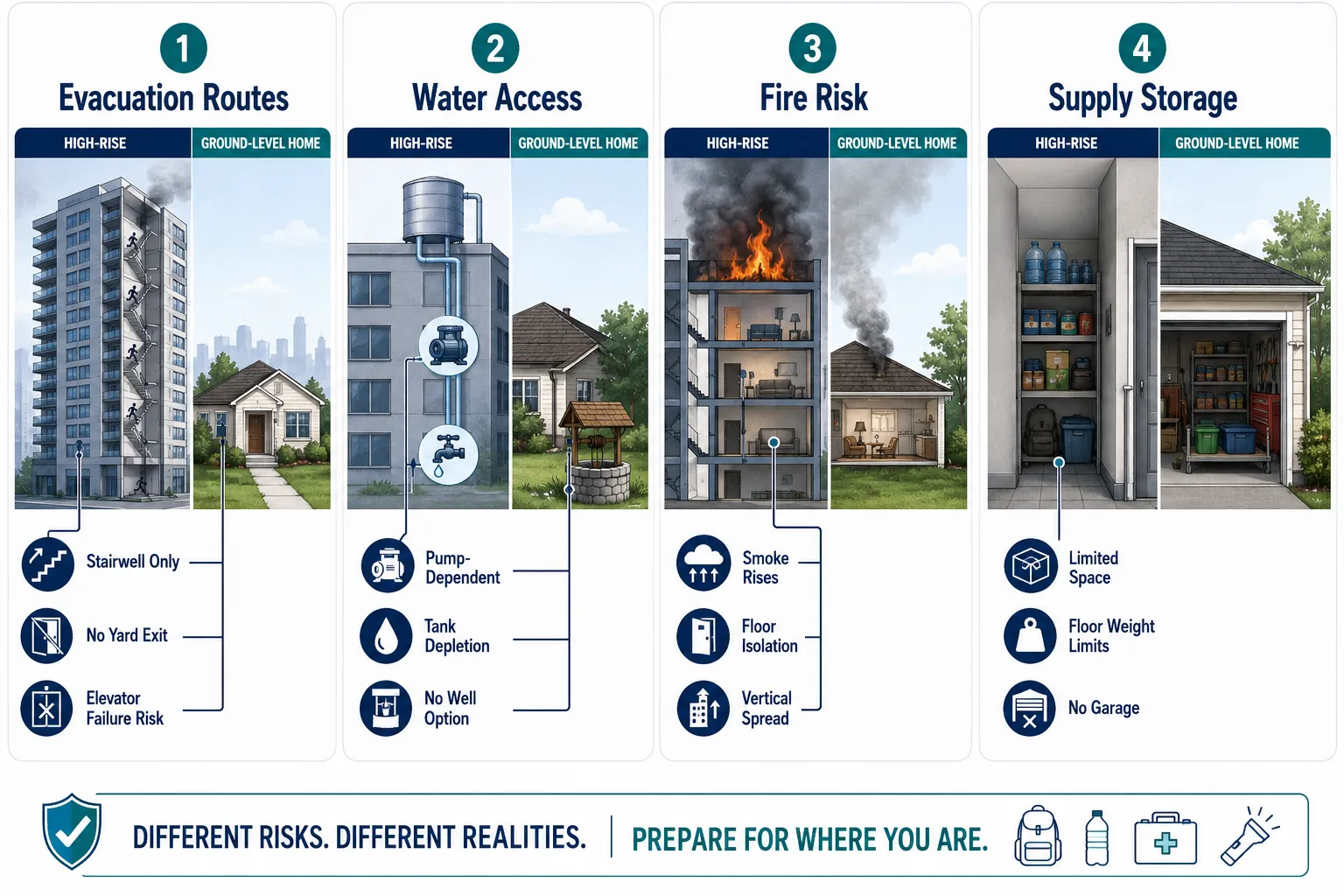
Evacuation complexity is the most obvious difference. A family on the 22nd floor cannot use a window exit. They cannot jump to a fire escape. Every evacuation route runs through interior stairwells, which can fill with smoke, become congested with panicking residents, or be physically impassable for people with mobility limitations.
Infrastructure dependency is the less-discussed problem. Most high-rise buildings use electric pumps to push water to upper floors. When the power goes out, water pressure drops within hours. Elevators stop. HVAC systems fail. The building that felt like a fortress becomes a very tall box.
Supply access limitations compound both of the above. You can’t easily carry 50-gallon water barrels up 18 flights of stairs. You can’t store a generator on a balcony. Every supply decision has to account for weight limits, building rules, and the physical reality of moving things vertically.
For a deeper look at how urban emergencies differ from rural scenarios, the Ultimate Urban Survival Guide For Preppers covers the full spectrum of city-specific threats and responses.
Best Emergency Supplies To Keep in a High Rise Apartment
The best emergency supplies for a high-rise apartment are those that are compact, lightweight, multi-use, and accessible without power. Prioritize water, food, light, communication, and first aid above everything else.
Here’s a practical breakdown by category:
Water (highest priority)
- Store a minimum of 1 gallon per person per day; 14 gallons per person for a two-week supply
- Use stackable 5-gallon BPA-free containers or WaterBOB bathtub bladders for surge storage
- Include a quality water filter (Sawyer Squeeze or LifeStraw) as a backup purification option
Food
- Focus on no-cook or minimal-prep options: freeze-dried meals, canned goods, nut butters, energy bars
- Aim for caloric density, you need volume of calories, not volume of packaging
- Rotate stock every 6-12 months to maintain freshness
Light and power
- Headlamps with extra batteries for hands-free use in dark stairwells
- A hand-crank or solar-powered lantern for sustained ambient light
- A portable power bank (20,000+ mAh) for phone charging
Communication
- Battery-powered or hand-crank NOAA weather radio
- A pair of FRS/GMRS walkie-talkies for in-building communication
First aid
- A comprehensive kit that includes tourniquets, Israeli bandages, and a CPR mask
- Any prescription medications in a 30-day supply if possible
For a fully built-out supply list tailored to apartment living, the Urban Survival Kit For Apartment Residents guide is an excellent starting point.
How To Evacuate a High Rise Building With Kids During a Crisis
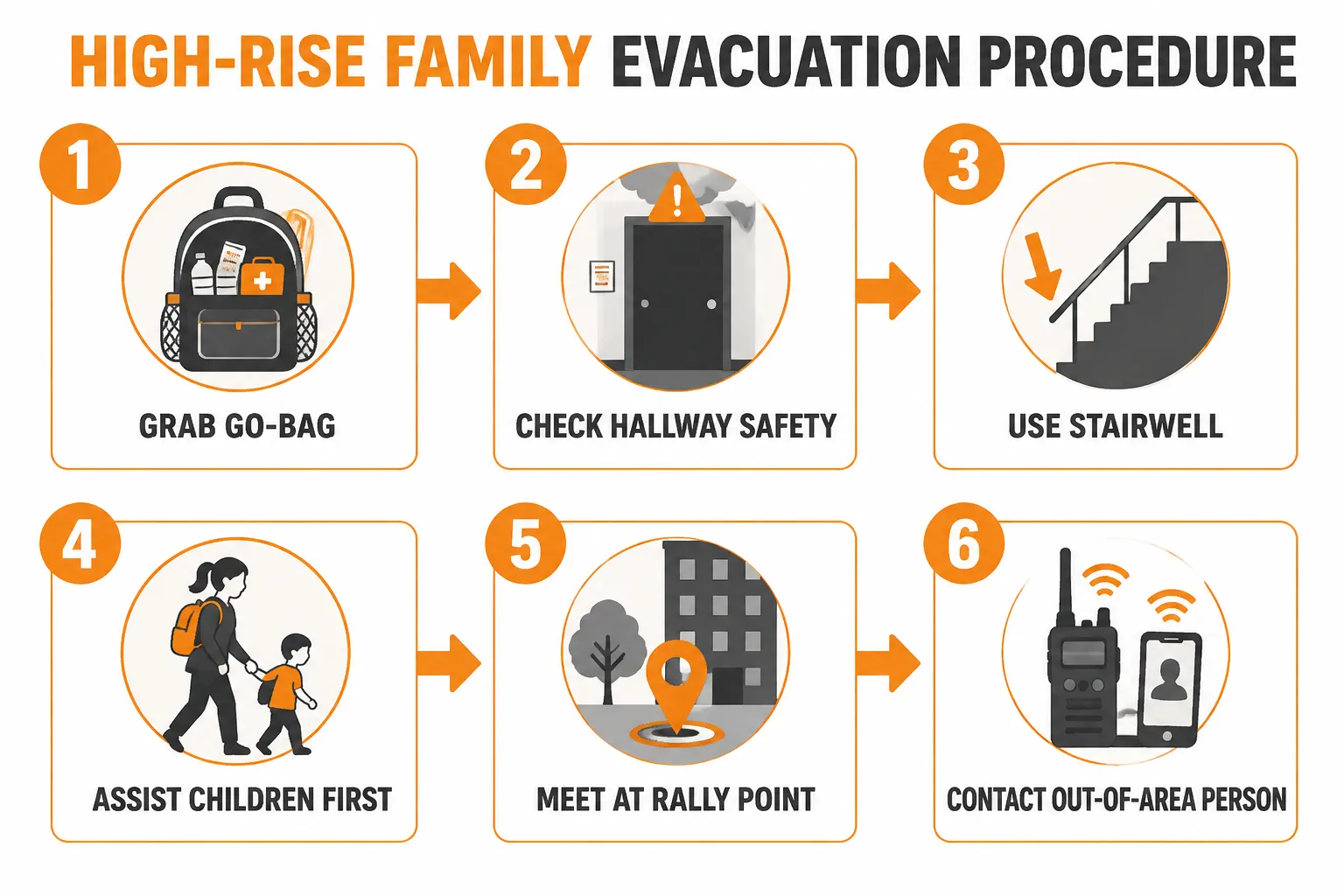
Evacuating a high-rise with children requires a pre-assigned role for every family member, a designated rally point outside the building, and a practiced stairwell route, not a plan made up on the spot.
Follow this sequence:
- Grab the go-bag first. Keep it by the door, not in a closet. Seconds matter.
- Touch the door before opening it. If it’s hot, do not open. Use an alternate route or shelter in place.
- Take the stairwell, never the elevator. Elevators can trap occupants or open on a fire floor.
- Assign a child to each adult. If you have more children than adults, pair older children with younger ones and assign them a specific adult to stay behind.
- Count floors as you descend. Smoke reduces visibility; knowing you’re on floor 12 vs. floor 8 matters.
- Meet at a pre-agreed rally point at least one block from the building entrance.
- Do not re-enter for any reason until emergency services clear the building.
Children as young as 6 can be taught to count floors, stay low in smoke, and identify the rally point. Teaching these skills early, and practicing them, removes panic from the equation. The 12 Essential Survival Skills for Kids guide covers age-appropriate training in detail.
Can You Survive in a High Rise Without Power or Water
Yes, a family can survive in a high-rise without power or water for an extended period, but only if supplies were stored before the outage and the building remains structurally safe. Improvising after the fact is extremely difficult in a vertical urban environment.
Without power, the primary challenges are:
- No elevator access (stair mobility becomes critical)
- No water pressure above approximately the 7th floor in most buildings
- No HVAC (temperature regulation becomes a serious concern in extreme weather)
- No refrigeration for food or medication
Without running water, stored water becomes the only option. A family of four needs a minimum of 4 gallons per day for drinking and basic sanitation. A 14-day supply means 56 gallons, achievable in apartment storage with planning, but impossible to source after the fact.
For heating alternatives that work safely indoors, the Apartment Emergency Heating Without Electricity guide covers safe, building-compliant options. For water specifically, Survive in an Apartment Without Power, Water or Heat walks through the full scenario.
Urban Survival Gear for Families on a Budget
Effective urban survival gear for high-rise families does not require a large budget. The most important items are also among the most affordable, and a family can build a solid foundation for under $150.
Budget-first priorities (under $150 total):
| Item | Approximate Cost | Why It Matters |
|---|---|---|
| 5-gallon water containers (x4) | $20-30 | Water storage without bulk |
| Headlamps (x2) | $20-30 | Hands-free light in stairwells |
| Hand-crank NOAA radio | $25-40 | Communication when cell fails |
| Basic first aid kit | $20-30 | Injury management during chaos |
| FRS walkie-talkies | $25-35 | In-building family communication |
| 72-hour food supply | $30-50 | Calorie-dense, no-cook options |
For a structured approach to building this kit without overspending, How To Build a 72-Hour Emergency Kit For Under $50 is a practical starting point. For a more comprehensive gear overview, the Urban Survival Gear guide covers everything from entry-level to advanced setups.
How Long Should Emergency Supplies Last for a Family in an Apartment
The minimum standard is 72 hours, but for urban high-rise families, 14 days is the realistic and recommended target. FEMA’s 72-hour guideline was designed for scenarios where external help arrives quickly, a reasonable assumption in many suburban emergencies, but not always valid in dense urban environments where infrastructure failures can cascade.
A 14-day supply accounts for:
- Extended power outages affecting water pumps and supply chains
- Civil disruption that delays emergency response
- Illness within the household that reduces mobility
- Scenarios where evacuation is not immediately possible
Building to 14 days doesn’t happen overnight. Start with 72 hours, then extend to 7 days, then 14. Each step is manageable in a small apartment with smart storage. The Survival Prepping in Small Spaces guide covers exactly how to do this without taking over your living room.
What Mistakes Do High Rise Families Make When Prepping for Emergencies
The most common mistake high-rise families make is treating their apartment like a suburban home and applying the same preparedness logic. The second most common mistake is assuming the building has a plan that covers them.
Specific mistakes to avoid:
- Storing water in impractical containers. Large barrels are unmanageable in elevators and stairwells. Use stackable 5-gallon containers or collapsible options.
- Not knowing the building’s stairwell layout. Many residents have never walked their building’s stairs. They discover locked doors, dead ends, or roof-only access during an actual emergency.
- Relying on cell phones as the primary communication tool. Cell towers in dense urban areas become overloaded within minutes of a major emergency.
- Ignoring building-specific rules. Many high-rises prohibit propane, open flames, or certain storage configurations. Violating these rules can result in eviction or create new hazards.
- No plan for pets. Evacuating with a dog or cat adds time and complexity that must be accounted for in advance.
- Skipping medication prep. A 30-day supply of critical prescriptions is one of the most overlooked elements of family preparedness.
Is Urban Survival Training Worth It for City Dwellers
Urban survival training is worth it for city dwellers, particularly for high-rise families. The skills most relevant to apartment emergencies, first aid, fire response, stairwell evacuation, and communication protocols, are not intuitive and degrade quickly without practice.
The most valuable training categories for high-rise families:
- Basic first aid and CPR (Red Cross or equivalent certification)
- Fire safety and smoke navigation (many local fire departments offer free community training)
- Communication protocols (how to establish a family communication plan and use backup devices)
- Physical fitness for stair evacuation (descending 20+ floors with a loaded pack and a child is physically demanding)
Training doesn’t need to be expensive or time-consuming. A single weekend course in first aid combined with a practiced home evacuation drill covers most of the critical gaps. For a broader skill foundation, the Urban Survival Skills guide covers the competencies most relevant to city-based emergencies.
How To Practice Evacuation Drills in a High Rise Safely
Practice evacuation drills in a high-rise by walking the stairwell route during a calm, non-emergency period, timing the descent, and identifying any obstacles or access issues before they become critical.
Drill protocol for families:
- Walk every stairwell in the building at least once. Note which ones are locked from certain floors.
- Time a full descent from your floor to street level with your go-bag.
- Practice with children present, including at night if possible, since low-light conditions change everything.
- Identify the rally point and confirm every family member knows it without being told.
- Run the drill twice per year minimum, and after any change in family composition (new baby, elderly parent moving in).
Coordinate with building management where possible. Some buildings conduct annual fire drills, these are valuable, but they rarely simulate realistic conditions. Your family drill should go further.
What About Families With Elderly Parents or Disabled Members in Tall Buildings
Families with elderly parents or disabled members face the most serious evacuation challenges in high-rise emergencies, and they require a dedicated plan, not a modified version of the standard one.
Key considerations:
- Identify the building’s Area of Rescue Assistance (ARA). Most modern high-rises have designated refuge areas on each floor where mobility-impaired individuals can wait for fire department assistance. Know where yours is.
- Pre-register with building management. Many buildings maintain lists of residents with mobility limitations so emergency responders can prioritize those floors.
- Invest in an evacuation chair. These devices allow one person to safely carry a seated individual down stairs. They’re compact, relatively affordable, and can be stored in a closet.
- Assign a dedicated evacuation partner. One adult should be responsible for one mobility-limited person, with no other assignment during an evacuation.
For a comprehensive framework covering this population, Emergency Preparedness for Disabled Individuals is an essential resource.
Urban Survival for Renters vs. Homeowners in Cities
Renters and homeowners in urban high-rises face different constraints, but renters often have more flexibility than they assume. The key difference is structural modification, renters cannot install backup power systems, reinforce doors, or make permanent storage changes. Everything else is largely available to both groups.
What renters can do:
- Store water, food, and gear within their unit without restriction (check lease for weight limits on balconies)
- Use portable, non-permanent solutions for power (battery banks, solar chargers)
- Build the same communication and evacuation plans as any homeowner
- Advocate for building-level preparedness improvements through tenant associations
What homeowners (condo owners) can do additionally:
- Participate in HOA decisions about building emergency infrastructure
- Install hardwired smoke and CO detectors beyond building minimums
- Potentially negotiate dedicated storage space in building facilities
The practical gap between renters and owners in a high-rise emergency is smaller than most people think. Preparedness is primarily about supplies, plans, and skills, not property rights.
Best Communication Plan When Cell Towers Go Down in Your Building
When cell towers fail, which happens within minutes of a major urban emergency due to network overload, the best communication plan relies on pre-arranged protocols, physical meeting points, and radio-based backup devices.
Build a layered communication plan:
- Designate an out-of-area contact. Local lines overload first. A relative in another city can often receive calls when local networks cannot. Every family member memorizes this number.
- Use SMS over voice calls. Text messages require less bandwidth and often get through when voice calls fail.
- Establish in-building walkie-talkie channels. FRS/GMRS radios work independently of cell infrastructure and allow floor-to-floor communication.
- Keep a hand-crank or battery NOAA radio. This is how you receive emergency broadcasts, evacuation orders, and infrastructure status updates when the internet and cell networks are both down.
- Post the rally point and contact number physically. Write it on a card in every family member’s go-bag. Don’t rely on a phone to store this information.
A communication plan that depends entirely on smartphones is not a plan, it’s an assumption. The City Blackout Survival Checklist Essentials covers communication and other critical blackout protocols in detail.
FAQ: Urban Survival For Families In High-Rise Buildings
Do I really need 14 days of supplies in a high-rise apartment, or is 72 hours enough? Seventy-two hours is the minimum baseline, not the target. Urban infrastructure failures, water pump outages, grid failures, supply chain disruptions, can extend well beyond three days. Fourteen days is the realistic standard for families who want genuine security, not just the appearance of preparedness.
Can I use a propane camp stove in my apartment during an emergency? Most high-rise leases and fire codes prohibit open-flame cooking indoors, including propane stoves. Check your lease and local fire code before assuming this is an option. Safer alternatives include electric induction hot plates (which work with a power bank for brief use) or no-cook meal planning.
What floor is safest to live on in a high-rise during a fire? Lower floors are generally safer for evacuation speed, but no floor is inherently “safe” during a fire. Floors 2-7 offer faster stairwell exit times. Above floor 7, water pressure from fire hoses may not reach effectively, which is why fire suppression systems within the building become more critical.
How do I store enough water in a small apartment without taking over the space? Use under-bed storage for flat water pouches, stackable 5-gallon containers in closets, and a WaterBOB bathtub bladder (holds up to 100 gallons) for emergency surge storage. The key is distributed storage across multiple small containers rather than one large tank.
What’s the first thing I should do when a building alarm goes off? Grab your go-bag, touch the door before opening it, and proceed to the stairwell if the hallway is clear. Do not wait for confirmation. Do not use the elevator. Do not assume it’s a false alarm until you’re outside.
How do I keep my kids calm during a high-rise evacuation? Children who have practiced the drill are significantly calmer than those experiencing it for the first time. Assign each child a specific job (carry the small bag, count floors, hold the flashlight), purposeful tasks reduce panic. Calm, directive communication from adults sets the tone.
Should I shelter in place or evacuate during a high-rise emergency? It depends on the threat. Fire: evacuate immediately unless your floor is directly affected and the stairwell is impassable, in which case shelter in place and signal from a window. Civil unrest or external threat: shelter in place is often safer. Structural failure or gas leak: evacuate immediately.
What’s the best way to find out if my building has an emergency plan? Ask building management directly and request a copy of the emergency response plan. Most buildings are required to have one. If management cannot produce it, that’s critical information, and a reason to build your own family plan with greater urgency.
Are walkie-talkies actually useful in a high-rise, or do floors block the signal? Standard FRS/GMRS walkie-talkies work reasonably well within a building, though concrete floors and walls reduce range. Most quality units rated for 5+ miles outdoors will maintain communication across 10-15 floors indoors. Test yours in your actual building before an emergency.
What if I can’t afford a full emergency kit right now? Start with water and a flashlight. Those two items alone improve your position significantly. Build the kit over 30-60 days by adding one category at a time. A partial kit is always better than no kit.
Conclusion
Urban survival for families in high rise buildings is not a niche concern, it’s a practical necessity for tens of millions of people who live and raise families above the ground floor in cities across North America and beyond. The building you live in is not a passive backdrop; in an emergency, it becomes an active variable with specific failure modes that require specific responses.
The families who come through urban emergencies intact are not the ones who had the most gear. They’re the ones who had a practiced plan, stored water before they needed it, knew their stairwell, and had a communication protocol that didn’t depend on a cell signal.
Start here:
- Walk your building’s stairwells this week. Time the descent. Identify locked doors.
- Store a minimum 72-hour water supply within the next 30 days.
- Build or update your family communication plan with an out-of-area contact and a physical rally point.
- Run one evacuation drill with every family member present.
- Expand your supply target to 14 days over the next 90 days.
Preparedness is built in layers, not all at once. Each step you take now is one fewer variable working against you when the unexpected happens.
Products, Tools, and Resources
For families building their high-rise preparedness system, these resources provide the practical depth to go beyond the basics:
- Urban Survival Kit For Apartment Residents, A complete gear list built specifically for apartment constraints, not suburban assumptions.
- Survival Prepping in Small Spaces, Practical storage solutions for families who don’t have a garage or basement.
- City Blackout Survival Checklist Essentials, Everything you need to function during an extended urban power outage.
- Disaster Preparedness for Families, A family-focused framework covering multiple disaster types, including those most relevant to urban environments.
- Urban Evacuation Route Planning, How to map and practice evacuation routes in a dense city environment.
On the gear side, the items that consistently deliver the most value for high-rise families are: a quality hand-crank NOAA radio (Midland ER310 is a reliable choice), stackable 5-gallon water containers with spigots, headlamps with lithium batteries for cold-weather reliability, and a pair of FRS/GMRS radios tested specifically in your building. None of these are expensive. All of them are the kind of thing you’ll be grateful you bought before you needed them.