
Hey there! Some links on this page may be affiliate links which means that, if you choose to make a purchase, I may earn a commission at no extra cost to you. I greatly appreciate your support. Read the full disclosure here.
A single high-altitude nuclear detonation could generate an electromagnetic pulse powerful enough to disable unprotected electronics across an entire continent. That’s not speculation, it’s the conclusion of the 2004 and 2008 reports from the U.S. Congressional EMP Commission, which warned that modern infrastructure has virtually no hardening against such an event. For preppers and survivalists who depend on radios, medical devices, backup power systems, and communication tools, knowing how to protect electronics from EMP blast isn’t optional, it’s a core survival skill.
Key Takeaways
- A Faraday cage is the most reliable and affordable way to protect electronics from EMP damage.
- Surge protectors offer zero protection against a true EMP event, they are designed for different threats.
- Aluminum foil can provide limited EMP shielding when used correctly, but metal ammo cans and galvanized steel trash cans are far more effective.
- The most vulnerable electronics are those with long conductive wires, microprocessors, and solid-state components.
- Whole-house EMP protection is possible but expensive, typically ranging from several hundred to several thousand dollars.
- Older, simpler electronics with fewer semiconductors are naturally more EMP-resistant.
- Testing your Faraday cage with a cell phone or FM radio is a practical, low-cost verification method.
- Layering protection, Faraday cage plus whole-house shielding plus analog backups, gives the best odds of survival.

What Is an EMP Blast and How Does It Damage Electronics
An electromagnetic pulse (EMP) is a burst of electromagnetic energy that can overload and permanently destroy electronic circuits. It damages electronics by inducing sudden, massive voltage surges in conductive materials, wires, circuit boards, and antennas, that far exceed what any component was designed to handle.
There are three main types of EMP threats preppers need to understand:
- Nuclear EMP (HEMP): A high-altitude nuclear detonation (above 30 km) produces three distinct pulse components, E1, E2, and E3. The E1 pulse is the most destructive, striking in nanoseconds and frying semiconductors before any protection can respond. The E3 pulse is slower and can damage power grid transformers.
- Non-nuclear EMP (NNEMP): Devices like EMP bombs or directed-energy weapons can produce localized pulses. These are a military and terrorism concern.
- Solar EMP (Geomagnetic Storm): A powerful coronal mass ejection (CME) from the sun generates a geomagnetic disturbance similar to the E3 component. The 1989 Quebec blackout and the 1859 Carrington Event are real-world examples of solar EMP damage.
The key mechanism of damage is simple: electronics are built to handle specific voltage ranges. An EMP induces voltages that can be thousands of times higher than normal operating levels. Semiconductors, the transistors and microchips inside every modern device, are especially fragile. Once the junction inside a transistor burns out, the device is dead.
How Far Does an EMP Blast Reach
The reach of an EMP depends entirely on the source. A nuclear EMP detonated at 400 km altitude could theoretically affect the entire continental United States. A ground-level EMP device might only affect a radius of a few hundred meters.
Here’s a practical breakdown:
| EMP Source | Approximate Affected Radius |
|---|---|
| High-altitude nuclear (400 km) | 2,200+ km radius (continental scale) |
| High-altitude nuclear (30 km) | ~600 km radius |
| Solar CME (Carrington-class) | Global power grid, long-line infrastructure |
| Ground-level EMP device | 100 m to 1 km (estimated) |
| Lightning-induced EMP | Localized, within a structure |
For preppers, the practical takeaway is this: if a nuclear EMP event occurs, distance from the detonation point offers almost no protection for unshielded electronics. The threat is area-wide. A solar CME primarily threatens long-line infrastructure (power grids, pipelines) rather than small standalone electronics, though the grid damage alone would be catastrophic for modern life.
Which Electronics Are Most Vulnerable to EMP Damage
Modern electronics with microprocessors, long antenna leads, or solid-state components are the most vulnerable. Older analog devices with fewer semiconductors are significantly more resistant.
High vulnerability (protect these first):
- Smartphones and tablets
- Modern vehicles (post-1980s, especially anything with engine control units)
- Computers and laptops
- Two-way radios and ham radio equipment
- Solar charge controllers and inverters
- Medical devices (insulin pumps, pacemakers, CPAP machines)
- LED drivers and modern solar panels with electronics
Lower vulnerability:
- Simple battery-powered AM/FM radios (older models with minimal circuitry)
- Mechanical watches and analog gauges
- Vehicles manufactured before the mid-1970s (minimal electronics)
- Manual tools and non-electronic equipment
The length of connected wires matters significantly. Long antenna wires or power lines act as collectors, picking up more of the pulse energy and channeling it into connected equipment. Disconnecting devices from the grid and from antennas before a known threat reduces exposure.
Can a Faraday Cage Really Protect Electronics From EMP
Yes, a properly constructed Faraday cage is the most proven method to protect electronics from EMP blast damage. It works by surrounding electronics in a conductive shell that absorbs and redirects the electromagnetic energy around the contents rather than through them.
The concept dates to physicist Michael Faraday’s 1836 experiments. The principle is straightforward: electromagnetic fields cannot penetrate a continuous conductive enclosure. When an EMP strikes the cage, the induced currents flow through the outer conductor and dissipate as heat, leaving the interior shielded.
What makes a Faraday cage effective:
- Continuous conductive enclosure with no large gaps
- Insulation between the contents and the cage walls (the electronics must not touch the metal)
- Proper sealing of any openings (lids, doors, seams)
Common Faraday cage containers that work:
- Galvanized steel trash cans with tight-fitting lids
- Metal ammo cans (military surplus)
- Metal filing cabinets with sealed seams
- Commercial EMP bags (metalized Mylar)
- Nested containers (one inside another for layered protection)
A single layer of thin metal provides meaningful protection. Multiple layers provide better attenuation. The key failure point in most DIY cages is gaps, a lid that doesn’t seal tightly, a hinge gap, or a hole for a power cord can dramatically reduce effectiveness.
Best Materials to Block EMP Damage
Steel and copper are the most effective materials for blocking EMP. Aluminum also works well and is widely available. The material’s conductivity and thickness both affect attenuation levels.
Ranked by effectiveness for EMP shielding:
- Copper, Excellent conductivity, used in professional shielding rooms (Faraday rooms). Expensive for DIY use.
- Steel, Strong, widely available, effective. Galvanized steel trash cans are a prepper staple.
- Aluminum, Good conductivity, lightweight, affordable. Used in commercial EMP bags and foil.
- Conductive fabric, Used in commercial EMP pouches. Convenient but less robust than rigid containers.
The thickness of the material matters less than its continuity. A thin but complete aluminum enclosure outperforms a thick steel box with a poorly sealed lid.
Can Aluminum Foil Block EMP
Aluminum foil can provide partial EMP shielding, but it’s not reliable as a standalone solution. Multiple tightly wrapped layers with no gaps or tears can attenuate an EMP signal, but the protection level is inconsistent and difficult to verify.
A better approach: use aluminum foil as a supplemental layer inside a more rigid container. Wrap the device in foil first (with a layer of cardboard or bubble wrap between the foil and the device), then place it inside a metal container. This double-layer approach is more reliable than foil alone.
Do not rely on foil alone for critical devices. The seams and folds in foil wrapping create gaps that reduce shielding effectiveness. For a backup radio, medical device, or critical communication tool, invest in a proper metal container.
How to Make a Faraday Cage at Home for Cheap
A functional DIY Faraday cage can be built for under $30 using materials from any hardware store. The most popular and reliable option for preppers is the galvanized steel trash can method.
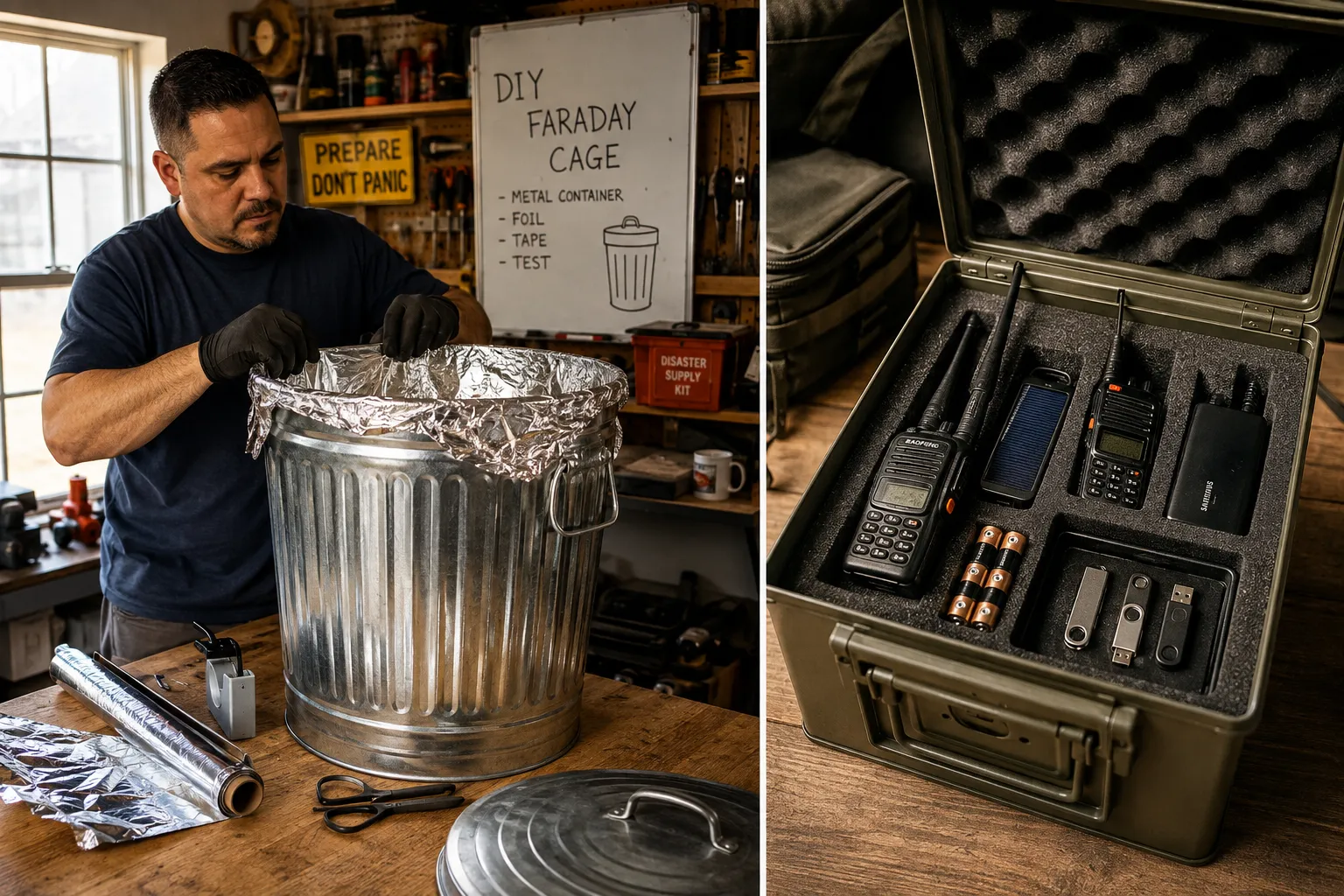
Step-by-step: Galvanized steel trash can Faraday cage
- Buy a galvanized steel trash can with a tight-fitting lid (20-32 gallon sizes work well). Cost: $20,$40.
- Inspect the lid seal. The lid must sit flush against the can body with no large gaps. If the fit is loose, add copper tape or aluminum tape around the rim to improve the seal.
- Line the inside with insulating material. Cardboard, foam, or rubber matting works. The electronics must not touch the metal walls. This is a critical step many people skip.
- Wrap individual devices in additional foil (optional but recommended for layered protection). Place a layer of cardboard between the foil and the device.
- Place devices inside and seal the lid. For storage, keep the can in a dry location away from moisture.
- Test the cage (see the testing section below).
Alternative low-cost options:
- Military surplus ammo cans: $15,$30, already well-sealed, excellent for smaller devices
- Metal cookie tins: Effective for phones, USB drives, and small electronics
- Nested containers: Place a smaller metal box inside a larger one for better attenuation
The total cost for a basic but functional setup protecting a backup radio, spare phone, and USB drives is typically under $60.
Do Surge Protectors Protect Against EMP
No. Standard surge protectors offer no meaningful protection against a true EMP event. This is one of the most dangerous misconceptions in prepper circles.
Surge protectors are designed to handle slow-moving voltage spikes from lightning strikes or grid fluctuations. They work by diverting excess voltage through a metal oxide varistor (MOV). An EMP’s E1 pulse, however, rises in nanoseconds, far faster than any MOV can respond. The surge protector itself may be destroyed before it can act, and the connected devices will be damaged regardless.
What surge protectors cannot stop:
- Nuclear EMP E1 pulse (nanosecond rise time)
- Directed EMP weapons
- The initial spike from a solar CME hitting connected grid infrastructure
What surge protectors can help with:
- Normal power surges and brownouts
- Some protection against the slower E3 component if the device survives the E1
For EMP protection, the only reliable solution is physical shielding, a Faraday cage, combined with disconnecting devices from grid power and antenna lines before a known threat.
What’s the Difference Between EMP Shielding and Regular Surge Protection
EMP shielding and surge protection address fundamentally different threats. Surge protection manages voltage spikes traveling through power lines. EMP shielding blocks electromagnetic radiation from penetrating the device itself.
Think of it this way: a surge protector is a filter on a pipe. An EMP is a flood that bypasses the pipe entirely and soaks through the walls. No pipe filter stops a flood.
EMP shielding must enclose the device on all sides. It must block the electromagnetic field before it reaches the circuitry. Surge protection only addresses the conductive path through the power cord.
For preppers building a comprehensive power resilience plan, this distinction matters. A backup power system for emergencies needs both surge protection for normal use and Faraday shielding for EMP scenarios, and those are separate preparations.
How to Test If Your Faraday Cage Actually Works
Testing a Faraday cage is straightforward and costs nothing. The most reliable low-tech test uses a cell phone.
Cell phone test (most common):
- Place a fully charged cell phone inside the sealed cage.
- Call the phone from another device.
- If the phone rings, the cage is not providing adequate shielding. If the call goes directly to voicemail and the phone shows no signal when removed, the cage is working.
FM radio test:
- Place a battery-powered AM/FM radio tuned to a strong local station inside the sealed cage.
- If you can still hear the broadcast through the cage walls, shielding is inadequate.
- Complete silence indicates effective shielding.
Important caveat: Cell phone frequencies (700 MHz to 2.1 GHz) are much higher than the primary frequencies of concern in a nuclear EMP E1 pulse. A cage that blocks cell signals may not fully block lower-frequency EMP components. However, for most preppers, the cell phone test is a practical baseline. If a cage can’t even block a cell signal, it will certainly fail against an EMP.
For more rigorous testing, professional RF shielding effectiveness measurements require specialized equipment. For the average prepper, the cell phone test combined with quality construction (tight seals, proper insulation) is a reasonable standard.
Can You Protect a Whole House From EMP
Whole-house EMP protection is possible but significantly more complex and expensive than protecting individual devices. It requires shielding the entire building envelope, walls, roof, windows, and all entry points for electrical and communication lines.
Practical options for whole-house protection:
- EMP hardened electrical panels: Specialized surge arrestors rated for EMP (not standard surge protectors) installed at the main panel. These address the E2 and E3 components but not E1 directly.
- Whole-house Faraday shielding: Installing conductive mesh or foil behind drywall, covering windows with conductive film, and sealing all penetrations. This is a major construction project.
- Critical circuit protection: Rather than shielding the whole house, many preppers focus on protecting a single “safe room” or storage area where backup electronics are kept in Faraday containers.
Estimated costs for professional whole-house EMP hardening: Several thousand to tens of thousands of dollars, depending on house size and protection level. This is beyond most preppers’ budgets.
The practical middle ground: protect your most critical devices in Faraday cages, keep backup electronics stored and unplugged, and invest in a power outage preparedness plan that doesn’t depend on grid power at all.
How Much Does Professional EMP Shielding Cost
Professional EMP shielding costs range from about $20 for a single EMP bag to $50,000 or more for a full Faraday room. Most preppers can achieve meaningful protection at the $50,$300 range.
Cost breakdown by protection level:
- EMP bags (metalized Mylar pouches): $10,$40 per bag. Good for phones, radios, small electronics.
- Metal ammo cans: $15,$50. Excellent for medium-sized devices.
- Galvanized steel trash cans (DIY cage): $25,$60. Protects multiple devices.
- Commercial EMP-rated enclosures: $100,$500. Pre-tested, more reliable than DIY.
- Whole-house EMP panel protection: $500,$3,000 for professional installation of EMP-rated surge arrestors.
- Full Faraday room (professional): $10,000,$50,000+.
For most preppers, the sweet spot is $100,$300 covering a layered approach: one or two metal ammo cans for the most critical devices, a galvanized trash can for larger backup electronics, and EMP bags for portable items in a bug-out kit. This is money well spent compared to the cost of replacing every electronic device after an event.
Do Phone Cases Protect Against EMP
No. Standard phone cases, including metal-edged cases, carbon fiber cases, and military-grade drop-protection cases, provide no meaningful EMP protection. They are not designed to be conductive enclosures, and they don’t seal around the phone.
The only phone cases that offer any EMP protection are dedicated Faraday pouches, which are essentially small EMP bags designed to fit a phone. These use metalized fabric to create a conductive enclosure around the device. They typically cost $20,$50 and are a practical addition to any bug-out bag.
Important note: A phone in a Faraday pouch cannot send or receive calls or data. The pouch must be opened to use the phone. This means you need a plan: keep the phone shielded during a known threat, remove it when you need to communicate, and re-shield it when not in use.
Is EMP Protection Worth It for Preppers
For serious preppers, EMP protection is absolutely worth the investment, especially given the low cost of basic Faraday cage solutions relative to the value of the electronics being protected. The question isn’t whether an EMP event will happen; it’s whether you’ll be prepared if it does.

Consider what’s at stake. A backup communication radio, a solar charge controller, a spare medical device, and a loaded USB drive with critical documents and maps could be the difference between managing a crisis and being completely blind. Replacing these items after an EMP event, when supply chains are disrupted and electronics stores are empty, may be impossible.
The cost-benefit is straightforward:
- A galvanized trash can Faraday cage costs $30,$60 and protects hundreds or thousands of dollars in electronics.
- A set of EMP bags costs $30,$80 and protects portable devices.
- The time investment is a few hours for a complete DIY setup.
EMP protection also integrates naturally with other prepper priorities. Devices stored in Faraday cages are also protected from moisture, dust, and physical damage. The discipline of keeping backup electronics sealed and stored reinforces broader preparedness habits.
For preppers already building out their emergency preparedness systems, EMP protection is a logical and affordable layer. It fits alongside power outage planning, natural disaster preparedness, and communication planning as a core resilience measure.
Frequently Asked Questions
Will my car survive an EMP? Modern vehicles manufactured after the mid-1980s contain engine control units and other electronics that are vulnerable to EMP. Older vehicles with carbureted engines and minimal electronics are far more resistant. There’s no guarantee any modern car will survive a strong E1 pulse, even if parked in a garage.
Should I keep my electronics unplugged as everyday EMP protection? Unplugging devices removes the power line as a collection antenna, which reduces one pathway for EMP damage. It’s a free and easy step, but it doesn’t protect against the radiated E1 component that can damage electronics directly without any wire connection.
Can I store a generator in a Faraday cage? A generator is too large for a standard Faraday cage. The practical approach is to store a spare voltage regulator and ignition module (the vulnerable electronic components) in a Faraday cage, and replace them after an EMP event if the generator fails.
Does a microwave oven work as a Faraday cage? A microwave oven’s metal enclosure does block some electromagnetic frequencies, it’s designed to keep microwave radiation in, not out. It provides some shielding, but it’s not designed or tested for EMP protection. It’s a reasonable improvised option in an emergency but not a reliable long-term solution.
How long can I store electronics in a Faraday cage? Indefinitely, as long as the storage environment is dry and the batteries are managed properly. Remove or periodically charge lithium batteries to prevent degradation. Check stored devices every 6-12 months.
Does EMP protection also protect against solar CME? Partially. A solar CME primarily damages long-line infrastructure (power grids) through the E3-like geomagnetic disturbance. Small standalone electronics in a Faraday cage are largely protected from direct CME effects. The bigger threat from a CME is grid failure, which is addressed through backup power planning rather than shielding.
What’s the most important single item to protect in a Faraday cage? A battery-powered shortwave or ham radio receiver. In any grid-down scenario, the ability to receive information, emergency broadcasts, weather updates, situational awareness, is critical. Protect communication first.
Can I use a Faraday cage while the device is plugged in or in use? No. A Faraday cage only works when the device is completely enclosed with no conductive connections to the outside. Any wire passing through the cage wall creates a pathway for EMP energy to enter.
Are EMP threats from foreign adversaries a realistic concern in 2026? Multiple nations have acknowledged EMP as a strategic capability. The U.S. Department of Homeland Security and the EMP Commission have both treated it as a credible threat. Whether the probability is high or low, the cost of basic protection is low enough that it’s a rational precaution.
Do I need to protect every device I own? No. Focus on devices that would be critical after a grid-down event: backup radios, medical devices, solar charge controllers, spare ignition components, and communication tools. Consumer electronics you use daily can be replaced if the economy recovers. Irreplaceable backup tools cannot.
Conclusion
Learning how to protect electronics from EMP blast is one of the highest-leverage, lowest-cost preparations a serious prepper can make. The threat is real, the physics are well understood, and the solutions are affordable and practical.
Actionable next steps to take this week:
- Buy a galvanized steel trash can and line it with cardboard. Place your most critical backup electronics inside. That’s a functional Faraday cage for under $40.
- Order a set of EMP bags for portable devices, phones, USB drives, backup radios, that belong in a bug-out kit.
- Identify which electronics in your home are truly critical for post-disaster survival and prioritize protecting those first.
- Test your cage with the cell phone method before trusting it with valuable equipment.
- Unplug non-essential electronics when not in use as a free, immediate step.
EMP protection doesn’t require a large budget or advanced technical knowledge. It requires understanding the threat, choosing the right materials, and building the habit of keeping critical electronics shielded and ready. That’s what preparedness looks like, not fear, but confident, practical action.
For preppers building out a complete resilience system, EMP protection pairs naturally with power outage preparedness, emergency communication planning, and a broader home emergency preparedness strategy. Build each layer deliberately, and you’ll be ready for whatever comes.
Products, Tools, and Resources
Galvanized steel trash cans (20-32 gallon): Available at most hardware stores (Home Depot, Lowes, Tractor Supply). Look for cans with tight-fitting lids and no plastic components on the body. Behrens brand is a popular prepper choice.
Military surplus ammo cans: Available at Army surplus stores, gun shows, and online. The 50-caliber size is ideal for radios and medium electronics. The 30-caliber size works for phones and small devices.
EMP/Faraday bags: Mission Darkness, Faraday Defense, and Silent Pocket are well-regarded brands. Look for bags rated to MIL-STD-461 or similar standards.
Copper tape: Used to seal lid seams on DIY cages. Available at hardware stores and electronics suppliers. A roll costs $5,$15 and significantly improves seal quality.
Backup shortwave/ham radio: The Kaito KA500, Tecsun PL-880, and Baofeng UV-5R (with amateur radio license) are popular prepper choices. Keep a spare sealed in a Faraday cage at all times.
Foam insulation sheets: Closed-cell foam from hardware stores works perfectly for lining Faraday cages and keeping electronics from touching metal walls. Cost: $5,$15 per sheet.
For a complete emergency electronics and communication setup, review the ultimate power outage preparedness checklist and ensure your backup power sources are as protected as the devices they’ll run.