
Hey there! Some links on this page may be affiliate links which means that, if you choose to make a purchase, I may earn a commission at no extra cost to you. I greatly appreciate your support. Read the full disclosure here.
Most children who grow up in prepared households don’t remember being frightened by emergency drills. They remember feeling capable. That single distinction is the foundation of every strategy in this guide, and it’s the difference between raising a child who freezes under pressure and one who acts with purpose.
This mom’s guide to kids emergency preparedness: teaching kids without scaring them covers everything from the right age to start, how to explain natural disasters in plain language, what goes in a kid-friendly go-bag, and how to recognize when your child is carrying anxiety you didn’t intend to give them. Whether you’re a seasoned prepper or just building your family’s first emergency plan, the principles here are practical, tested, and grounded in how children actually learn.
Key Takeaways
- Children as young as 3 can begin learning basic emergency skills through play and routine, not lectures.
- The goal is confidence, not fear. Framing emergencies as problems the family solves together is the most effective approach.
- Toddlers need simple, repeated actions. Teenagers need real responsibility and context.
- A kid-friendly go-bag should include comfort items alongside survival basics to reduce panic during actual emergencies.
- Signs of emergency-related anxiety in children are specific and easy to miss. Know what to look for.
- Free, high-quality resources from FEMA, the American Red Cross, and Ready.gov make teaching emergency skills accessible at no cost.
- Children with special needs require individualized emergency plans, not modified versions of standard family plans.
- Drills done well build confidence. Drills done poorly cause lasting anxiety. The difference is in how you frame them.
What Age Can Kids Start Learning Emergency Skills
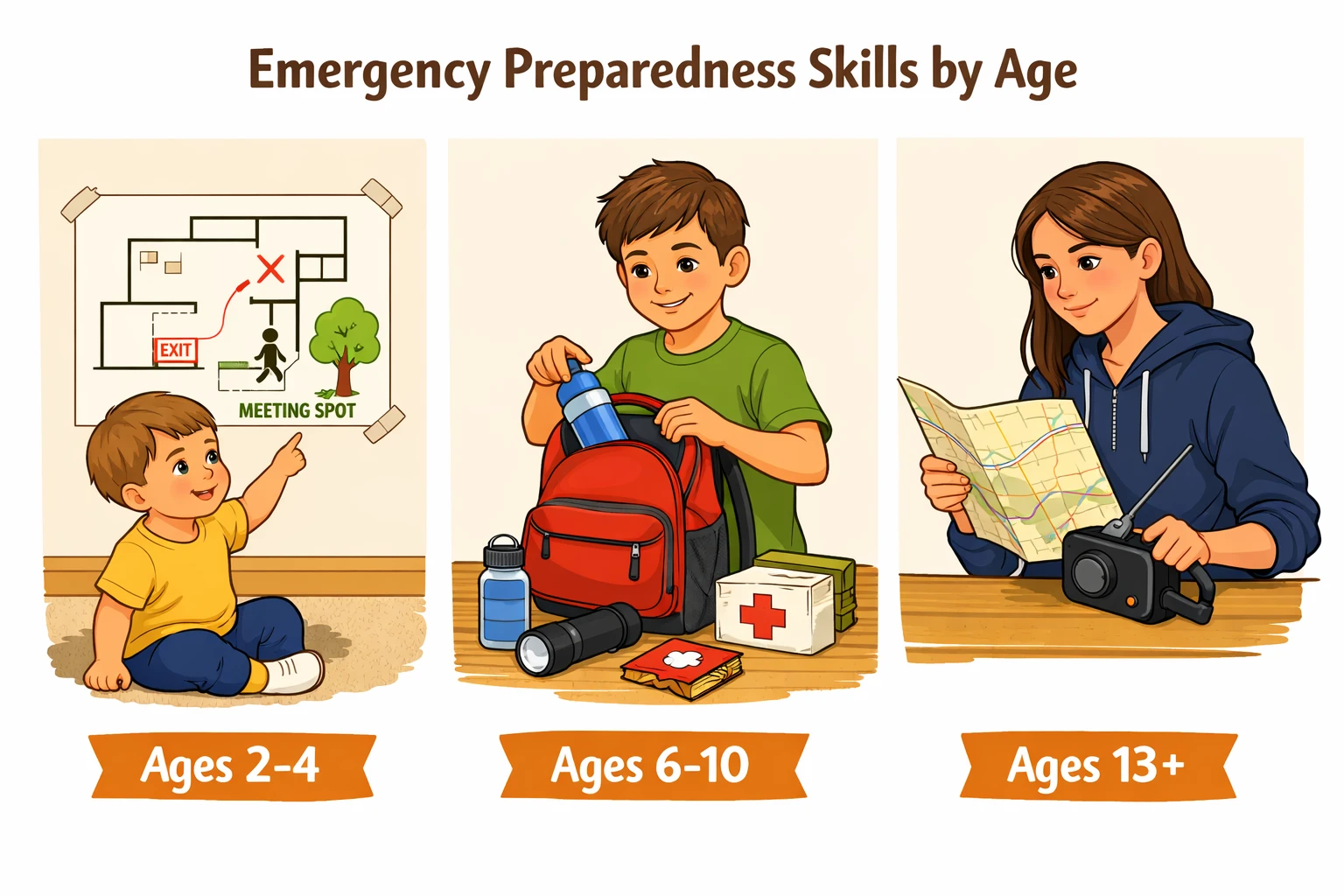
Children can begin learning basic emergency skills as early as age 3. At that age, the “skill” is a single repeated action: know where the family meeting spot is, know to stop and drop if there’s smoke, know to find a trusted adult. Complexity builds with age, but the foundation starts early.
Here’s a practical breakdown by developmental stage:
Ages 2 to 4 (Toddlers)
- Teach one concept at a time through repetition and play.
- Practice “stop, drop, and roll” as a game.
- Identify the family meeting spot using a landmark they already know (“the big tree in front”).
- Teach them their first name and a parent’s first name.
Ages 5 to 7 (Early Elementary)
- Introduce the concept of a “safe person” at school and in the neighborhood.
- Teach them to dial 911 and what to say. Practice it out loud.
- Begin simple home fire escape routes using a hand-drawn map they help create.
- Introduce the idea that emergencies are problems families prepare for, not things to fear.
Ages 8 to 12 (Middle Childhood)
- Assign real roles in the family emergency plan (grab the go-bag, check on a younger sibling, meet at the corner).
- Teach basic first aid: how to apply pressure to a wound, how to recognize when someone needs help.
- Practice reading a paper map of your neighborhood.
- Let them help build and maintain the family emergency kit.
Ages 13 and up (Teenagers)
- Treat them as junior partners in preparedness, not students.
- Teach them to use a hand-crank radio, read weather alerts, and understand evacuation routes.
- Assign genuine responsibility: they should be capable of leading younger siblings through a basic emergency response.
- Discuss realistic scenarios appropriate to your region (earthquakes, tornadoes, power outages) with honest, calm context.
The common mistake parents make is waiting until children are “old enough to understand.” By then, the window for building confident, automatic responses has partially closed.
How to Explain Natural Disasters to Young Children
Young children can understand natural disasters when explanations focus on what happens, what the family will do, and that the adults are prepared. Avoid graphic descriptions of destruction. Lead with action and safety.
A reliable framework: name the event, explain the cause simply, describe what it feels like, then immediately pivot to the family’s response.
For example: “A tornado is a spinning wind that can be very strong. It makes a loud sound. If we ever hear the warning siren, our job is to go to the basement together and wait until it’s safe. We’ve already practiced that, remember?”
What works for young children:
- Simple cause-and-effect language (“the ground shakes because the earth is moving underneath”)
- Immediate reassurance paired with action (“that’s why we have our go-bags ready”)
- Books and age-appropriate media that normalize emergency preparedness without dramatizing it
- Letting them ask questions without cutting the conversation short
What backfires:
- Showing news footage of disasters to “teach” them what could happen
- Using worst-case framing to motivate compliance (“if we don’t practice, something bad will happen to us”)
- Avoiding the topic entirely, which leaves children to fill the gap with imagination
The Step-by-Step Guide to Natural Disaster Preparedness is a strong companion resource for parents building out their household disaster plan alongside these conversations.
Difference Between Emergency Prep for Toddlers vs Teenagers
The core difference is this: toddlers need repetition and simplicity, while teenagers need ownership and real information. Applying the same approach to both ages is one of the most common mistakes in family preparedness.
Toddlers (ages 2 to 5):
- Learn through physical practice, not verbal instruction
- Respond to calm, consistent repetition of a single action
- Cannot retain complex sequences; one step at a time
- Need comfort objects included in any emergency bag
- Should never be left to interpret an emergency situation independently
Teenagers (ages 13 to 18):
- Disengage quickly from anything that feels condescending
- Respond well to being given genuine responsibility
- Can handle honest, age-appropriate discussions about risk
- Should understand the “why” behind every preparedness decision
- Are capable of executing a full evacuation plan independently if trained
A teenager who helped build the family bug-out bag will use it correctly under pressure. One who was simply told it exists probably won’t.
The middle years (ages 8 to 12) are where the transition happens. Children in this range can absorb responsibility in stages. Give them one real job in the family plan and let them own it completely.
Are Emergency Drills Too Scary for Preschoolers
Done correctly, emergency drills are not too scary for preschoolers. Done poorly, they can cause lasting anxiety. The difference is almost entirely in framing and tone.
Preschoolers take their emotional cues from the adults around them. If a parent presents a fire drill as a calm, practiced routine, most children will experience it that way. If the parent is visibly anxious, or if the drill involves unexpected loud noises and urgent commands, the child will register it as a threat.
Rules for preschool-safe drills:
- Always announce the drill in advance. “We’re going to practice our fire drill today. It’s a game where we walk fast to the front yard.”
- Use a calm, matter-of-fact voice throughout.
- Avoid simulating alarms or sirens without warning for children under 6.
- Keep the drill short (under 3 minutes) and end with positive reinforcement.
- Never use a drill as a consequence or a test the child can “fail.”
If a child becomes upset during a drill, stop, comfort them, and revisit the concept through play or books before trying again. Forcing a frightened child through a drill does not build resilience. It builds avoidance.
Signs My Child Is Anxious About Emergency Scenarios
Children who are anxious about emergencies rarely say “I’m worried about disasters.” The anxiety shows up indirectly, and parents who know what to look for can address it before it becomes a persistent fear.
Common signs to watch for:
- Asking repetitive “what if” questions about disasters, fires, or family separation
- Refusing to participate in drills or becoming unusually upset during them
- Difficulty sleeping after emergency-related conversations or school drills
- Excessive checking behavior (repeatedly confirming that doors are locked, that parents are home)
- Avoidance of weather-related news or visible distress during storms
- Expressing worry about family members dying or being separated
What to do:
- Acknowledge the feeling directly. “It sounds like you’re worried about that. That makes sense. Let’s talk about what we’d do.”
- Redirect from the threat to the response. The family plan is the antidote to anxiety.
- Reduce exposure to disaster news coverage. Children do not need to watch emergency events unfold on television.
- If anxiety is persistent or interfering with daily life, consult a pediatric mental health professional.
The goal of a mom’s guide to emergency preparedness: teaching kids without scaring them is not to eliminate all discomfort. Some healthy caution is appropriate. The goal is to ensure that awareness doesn’t tip into chronic fear.
Best Emergency Preparedness Games for Kids and Free Online Resources
Games are one of the most effective tools for teaching emergency skills to children under 12. They lower anxiety, increase retention, and make repetition feel natural rather than forced. Several free, high-quality resources exist specifically for this purpose.
Games and activities that work:
- Fire escape map drawing: Give children graph paper and ask them to draw the floor plan of your home, marking all exits and the meeting spot. Make it a competition to see who can find the most routes out.
- Go-bag scavenger hunt: List items that belong in an emergency kit and let children find them around the house. Discuss why each item matters.
- Emergency role-play: Assign roles (who calls 911, who grabs the bag, who checks on the dog) and walk through scenarios at a slow, calm pace.
- First aid practice: Use a doll or stuffed animal to practice bandaging, checking for breathing, and the recovery position.
Free online resources:
- Ready.gov/kids (FEMA): Age-graded activities, downloadable family emergency plan templates, and an interactive section designed specifically for children.
- American Red Cross Preparedness Resources: Includes family communication plan templates and age-appropriate guides.
- FEMA’s “Prepare with Pedro” series: Designed for early elementary children, available as free downloads.
These resources align directly with the Ultimate Guide to Home Emergency Preparedness and can be used to supplement a household preparedness system that’s already in place.
What Should Be in a Kid-Friendly Emergency Go-Bag
A kid-friendly emergency go-bag should contain survival basics scaled to the child’s age and size, plus at least one comfort item. The comfort item is not optional. Under real stress, a familiar object reduces panic and helps children remain calm and compliant.
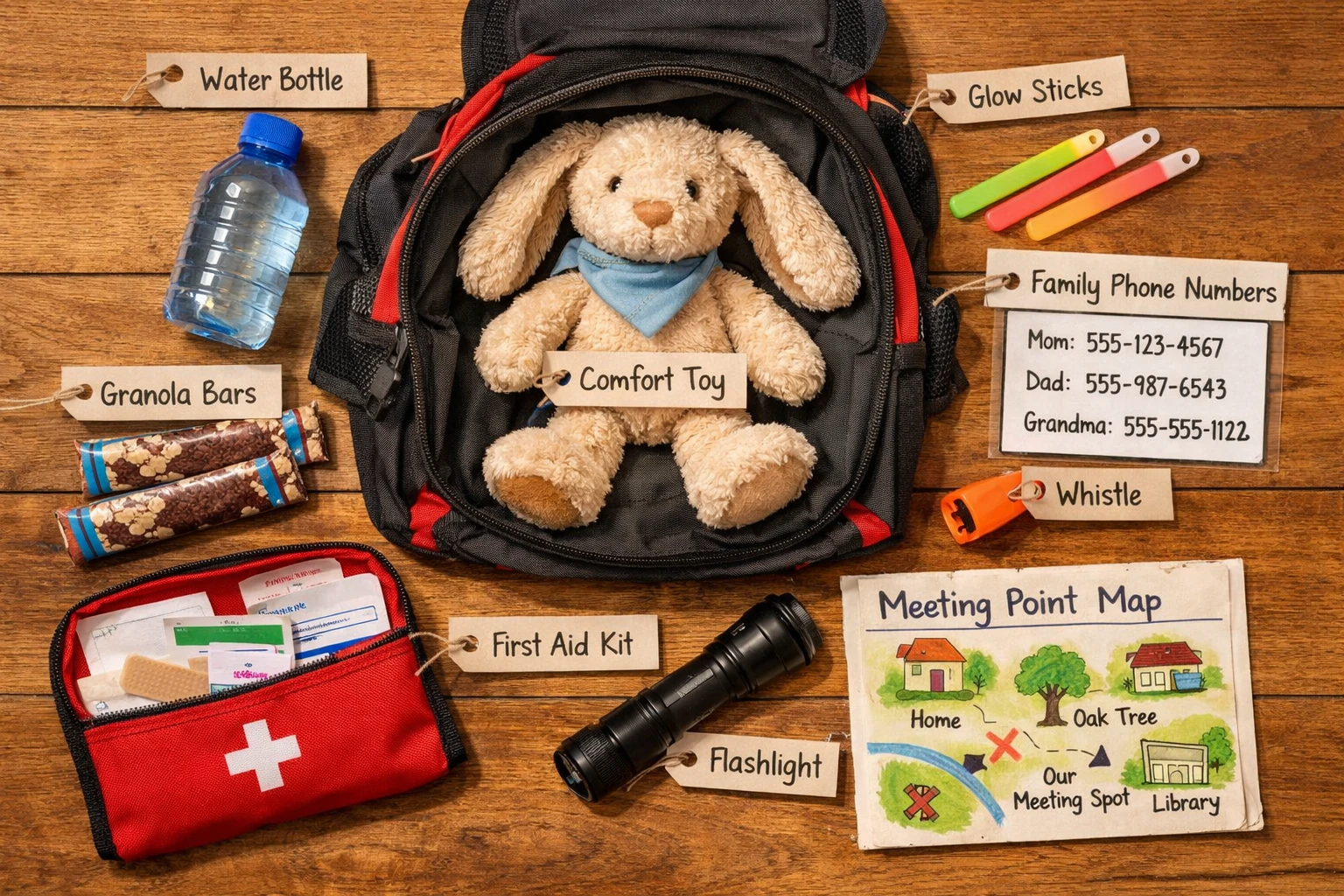
Core contents for a child’s go-bag:
| Item | Notes |
|---|---|
| Water (small bottle) | 16 oz minimum; child-sized for carrying ease |
| High-calorie snacks | Granola bars, dried fruit, peanut butter packets |
| Glow stick or small flashlight | Glow sticks are safer for young children |
| Whistle | Teach them to blow three times if separated |
| Laminated emergency contact card | Full name, parents’ names, phone numbers, address |
| First aid basics | Band-aids, antiseptic wipe, small gauze pad |
| Comfort item | Small stuffed animal, photo, or familiar object |
| Change of clothes | Rolled tight, appropriate for season |
| Medications | If applicable; clearly labeled |
| Hand-drawn meeting point map | Created together so the child recognizes landmarks |
Children ages 8 and up can carry their own bag. Keep it under 15% of their body weight. For younger children, a parent carries the bag but the child knows what’s in it and why.
For a more comprehensive family-level approach, the Complete Bug Out Bag Guide covers adult and family configurations in detail.
Cheap Emergency Kit Supplies for Families
A functional family emergency kit does not require a large budget. The most critical supplies are inexpensive, and many items may already be in the home.
Budget-friendly essentials (under $100 total for a family of four):
- Water storage: Fill clean 2-liter bottles from the tap. A family of four needs roughly 1 gallon per person per day for 3 days minimum. Cost: near zero.
- Food: Canned goods, peanut butter, crackers, and oatmeal from the grocery store. Rotate stock regularly.
- Flashlights: Basic LED flashlights are available for under $5 each. Buy extras and store batteries separately.
- First aid kit: A basic kit runs $15 to $25 at most pharmacies.
- Emergency radio: A hand-crank or battery-powered NOAA weather radio costs $20 to $40.
- Whistle: Under $2 per unit. Every family member should have one.
- Copies of important documents: Print and laminate; store in a waterproof bag.
The Ultimate Emergency Supplies List breaks down every category in detail, including what FEMA recommends versus what experienced preppers actually prioritize.
Water is the single most important and most underestimated supply. The Ultimate Emergency Water Storage and Purification Guide covers storage methods that work for any budget and any home size.
Common Mistakes Parents Make When Teaching Emergency Safety
The most damaging mistake is using fear as a motivator. It works short-term and creates anxiety long-term. Children who are frightened into compliance don’t build genuine preparedness skills. They build avoidance.
Other frequent mistakes:
- Overloading with information in one session. Emergency preparedness is a lifestyle, not a lecture. Spread learning across weeks and months.
- Not practicing. A plan that exists only on paper is not a plan. Children need to physically walk through responses.
- Excluding children from the planning process. Kids who help build the plan are invested in it. Kids who are handed a plan are indifferent to it.
- Treating the subject as adult-only. Children overhear adult conversations. If they hear concern without context, anxiety fills the gap.
- Forgetting to update the plan. A plan built when children were 5 may be inadequate when they’re 10. Review annually.
- Neglecting the emotional component. Preparedness without emotional support is incomplete. Children need to know that adults are capable and calm, not just stocked with supplies.
This is the heart of a mom’s guide to emergency preparedness: teaching kids without scaring them. The logistics matter, but the emotional framing matters more.
Emergency Preparedness Tips for Kids With Special Needs
Children with special needs require individualized emergency plans, not standard plans with minor adjustments. The differences in communication, mobility, sensory processing, and medical requirements are significant enough to warrant a separate planning process.
Key considerations:
- Communication: If a child uses AAC (augmentative and alternative communication) devices, ensure backup communication tools are in the go-bag. Laminated picture boards are a low-tech, reliable option.
- Mobility: Evacuation routes must account for wheelchairs, walkers, or limited mobility. Practice the actual physical route, not just the concept.
- Sensory sensitivities: Loud alarms, flashing lights, and chaotic environments can trigger severe distress. Work with occupational therapists to develop desensitization strategies and identify calming tools to include in the emergency bag.
- Medical needs: Medications, medical equipment, and care instructions should be documented and stored in a waterproof container. Include a brief medical summary card that emergency responders can read quickly.
- Routine dependence: Many children with autism spectrum disorder or similar conditions are highly routine-dependent. Practice emergency responses as a consistent routine so they become familiar rather than disruptive.
- Notify local emergency services: Many municipalities allow families to register special needs household members so first responders are aware during a disaster.
The Disaster Preparedness for Families guide includes additional strategies for households with complex needs.
How Much Emergency Information Is Too Much for Kids
The threshold is different by age, but the rule is consistent: stop before the child becomes visibly distressed, and never introduce new emergency information during an already stressful period (after a news event, during a storm, after a school drill that upset them).
Practical guidelines:
- Ages 3 to 6: One concept per session, no more than 5 to 10 minutes. Focus on actions, not threats.
- Ages 7 to 12: Broader conversations are appropriate, but keep them solution-focused. Introduce one new scenario per month at most.
- Ages 13 and up: Teenagers can handle realistic, honest discussions. The limit here is less about information volume and more about avoiding catastrophizing.
The test is simple: after the conversation, does your child seem more confident or more anxious? If the answer is more anxious, you’ve gone too far for that session. Pull back, redirect to the family plan, and try again later.
Information that empowers is preparedness. Information that overwhelms is counterproductive.
How to Make Emergency Learning Feel Like a Fun Family Activity
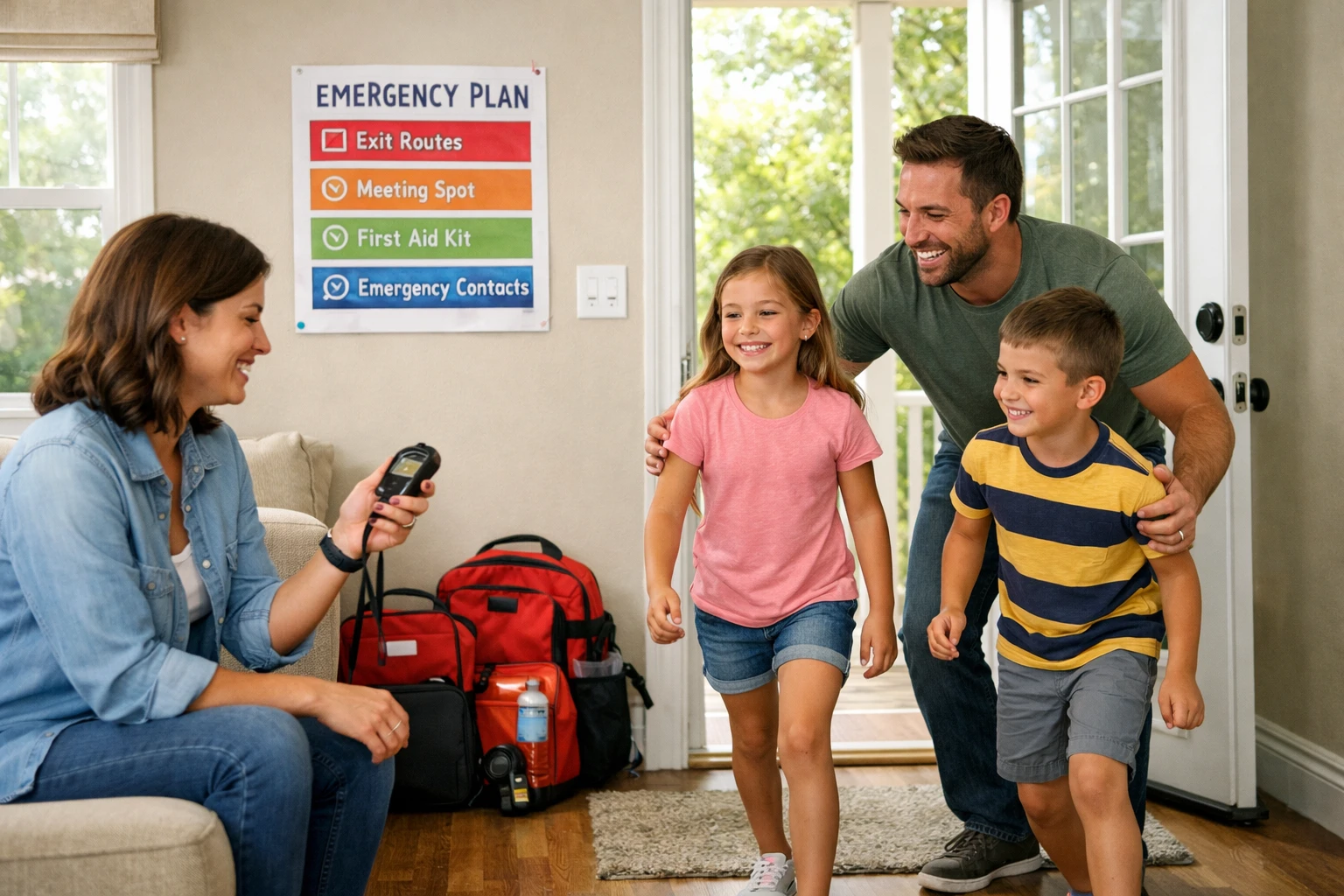
Emergency preparedness becomes a natural part of family culture when it’s treated as a shared skill-building activity rather than a safety lecture. Families that approach it this way report that children ask to practice, rather than resist it.
Strategies that work:
- Make it a family project. Build the emergency kit together over several weekends. Let each child choose one item to contribute.
- Use challenge-based learning. “Can you find three ways out of your bedroom?” is more engaging than “memorize the escape route.”
- Celebrate milestones. When a child masters a new skill (dialing 911 correctly, packing their go-bag independently), acknowledge it specifically.
- Connect it to identity. Families that identify as self-reliant and capable pass that identity to their children. Preparedness becomes part of who they are, not a chore they’re assigned.
- Tie it to things they already enjoy. Camping trips are natural opportunities to practice fire safety, navigation, and water purification in a low-stakes, enjoyable context.
- Keep drills short and positive. A 5-minute drill that ends with hot chocolate is remembered fondly. A 30-minute drill that ends with criticism is remembered with dread.
The family emergency plan template at Preppers HQ is a solid starting point for building a documented plan that the whole family, including children, can contribute to and understand.
FAQ-Mom’s Guide to Emergency Preparedness
At what age should I start teaching my kids about emergencies? Age 3 is a reasonable starting point for the simplest concepts: a meeting spot, a trusted adult, and one physical response like stop-drop-and-roll. Complexity scales with age, but early exposure builds the most automatic responses.
How do I explain a house fire to a 4-year-old without terrifying them? Focus on the action, not the threat. “If we ever smell smoke, we crawl low and go to the front yard to find each other. We’ve practiced that together.” The family plan is the reassurance.
Should I show my kids news coverage of natural disasters? No, not for children under 12. News coverage is designed to hold adult attention through dramatic imagery and repetition. For children, it creates anxiety without providing useful preparedness information.
What if my child refuses to participate in drills? Don’t force it. Find out what specifically feels scary or uncomfortable and address that first. Reintroduce drills through play or books. A child who is coerced through drills learns to associate preparedness with distress.
How often should we practice our family emergency plan? Twice a year is the standard recommendation. Once in the spring before severe weather season, and once in the fall. Review the written plan annually and update it as children age and family circumstances change.
Can a 10-year-old really be responsible for part of the emergency plan? Yes, and they should be. A 10-year-old who has practiced grabbing the go-bag and meeting at the corner will do exactly that under pressure. One who has only been told about it probably won’t.
What’s the single most important thing to include in a child’s go-bag? The laminated emergency contact card with the child’s full name, parents’ names, phone numbers, and home address. If a child is separated from their family, this card is what reunites them.
How do I handle a child with autism who is resistant to changes in routine during drills? Work with their therapist to introduce the drill as a new routine, practiced consistently at the same time and in the same sequence. Predictability is the key. Once the drill is a known routine, it becomes far less disruptive.
Are there free resources to teach kids emergency skills? Yes. Ready.gov/kids (FEMA), the American Red Cross preparedness portal, and FEMA’s “Prepare with Pedro” series are all free, age-graded, and professionally developed.
What’s the biggest mistake parents make in this area? Using fear as a motivator. Children who are frightened into preparedness don’t build confidence. They build avoidance. The goal is capability, not compliance through anxiety.
Conclusion
A mom’s guide to emergency preparedness: teaching kids without scaring them comes down to one core principle: confidence is built through practice, not through warnings. Children who grow up in households where preparedness is a calm, practiced, family-wide activity become adults who respond well under pressure. That’s not an accident. It’s the direct result of intentional, age-appropriate, emotionally intelligent preparation.
Start where you are. If your children are young, begin with a single concept this week: the family meeting spot. If they’re older, sit down together and build the emergency contact card. If you have teenagers, hand them a real responsibility in the family plan and let them own it.
The preparedness lifestyle isn’t about stockpiling fear. At Preppers HQ, the mission has always been confidence, independence, and protecting the people you love. That starts with your kids, and it starts with how you talk to them today.
Actionable next steps:
- Identify your family meeting spot and practice walking to it with every child in the household this week.
- Build or update your family emergency contact cards and laminate one for each child’s go-bag.
- Review the Ultimate Family Emergency Plan Template and assign each family member a specific role.
- Visit Ready.gov/kids and download one age-appropriate activity for each child.
- Schedule your first family drill for this month, announce it in advance, and keep it under 10 minutes.
Products, Tools, and Resources
Ready.gov/kids (FEMA): Free downloadable family emergency plan templates, age-graded activity sheets, and the “Prepare with Pedro” series for early elementary children. No cost, no registration required.
American Red Cross First Aid App: Free mobile app with step-by-step first aid guidance. Useful for older children learning basic first aid skills.
Basic LED Flashlights (multi-pack): Available at most hardware stores for under $20 for a pack of four. Assign one to each child’s go-bag and store spare batteries separately.
Laminating pouches and a home laminator: A $25 investment that protects emergency contact cards, maps, and medical information sheets from water damage. Worth every dollar.
NOAA hand-crank weather radio: Models from Midland and Eton are reliable, run on $20 to $40, and require no batteries for basic operation. Teenagers can be trained to monitor weather alerts independently.
Preppers HQ Emergency Communication Plan guide: Covers how to build a communication system that works when cell networks are down, including protocols that older children can follow independently.
The Complete Prepping Guide for Beginners: If this is your household’s first serious step into preparedness, this guide provides the 30-day framework to build a complete system without overwhelm.