
Hey there! Some links on this page may be affiliate links which means that, if you choose to make a purchase, I may earn a commission at no extra cost to you. I greatly appreciate your support. Read the full disclosure here.
Family homesteading made easy with no experience is entirely possible starting small—whether from a backyard garden, patio containers, or a few backyard chickens. Focus on one or two simple projects first, build skills season by season, and expect modest initial investments that pay off in reduced grocery bills and greater food security. This lifestyle fosters self-reliance, resilience, and practical survival skills without requiring large land or farming expertise.
Key Takeaways
- Homesteading for families with no experience is entirely achievable, most successful homesteaders started with zero farming background.
- You don’t need acreage to begin. A backyard, a patio, or even a sunny windowsill is enough to start building real self-reliance skills.
- Start with one or two projects, a raised garden bed and a small flock of backyard chickens, before scaling up.
- The average family can expect to invest $500,$2,000 in their first year of beginner homesteading, with costs dropping significantly in year two.
- Food preservation is one of the highest-return skills a new homesteader can learn, and it requires almost no upfront equipment.
- Common beginner mistakes include trying to do everything at once, underestimating time commitments, and skipping soil preparation.
- Homesteading is not the same as farming. It’s a lifestyle of intentional self-sufficiency, not a commercial food operation.
- Families who homestead report stronger household resilience, reduced grocery bills over time, and practical survival skills that directly support a preparedness mindset.
What Is Homesteading and How Do Families Get Started
Homesteading is the practice of living with greater self-sufficiency by producing your own food, preserving resources, and reducing dependence on commercial supply chains. For families with no experience, it starts not with a dramatic move to rural land, but with one deliberate skill practiced consistently.
The modern homesteading movement has roots in the back-to-land era of the 1970s, but its appeal today is driven by something more practical: supply chain disruptions, food price inflation, and a growing awareness that the systems most families depend on are more fragile than they appear. For preppers and survivalists, homesteading isn’t a hobby, it’s a long-term resilience strategy.
How families typically get started:
- Identify one skill to learn first (gardening, food preservation, or raising chickens)
- Assess available space, backyard, raised beds, balcony containers
- Set a modest first-year goal, such as growing 20% of your family’s vegetables
- Connect with a local homesteading group, extension office, or online community for mentorship
- Build skills progressively, adding one new project per season
The key distinction for beginners: homesteading is a direction, not a destination. You don’t graduate into it, you grow into it one season at a time.
How Much Land Do You Need to Start Homesteading
Most families can begin meaningful homesteading on as little as 1,000 square feet of growing space. A full acre allows for significant food production, but it is not a prerequisite for starting.
According to the USDA National Agricultural Library, a well-managed 100-square-foot garden bed can produce 50 pounds or more of vegetables per growing season, depending on crop selection and soil quality. For a family of four, even a modest backyard plot can meaningfully offset grocery costs.
Land requirements by homesteading goal:
- Container gardening or raised beds: Any outdoor space, including patios and balconies
- Backyard vegetable garden: 400-1,000 square feet
- Small flock of chickens (4-6 hens): Typically requires a minimum 10 square feet per bird in the coop, plus outdoor run space
- Fruit trees and perennial food plants: 1,500-3,000 square feet
- Goats, rabbits, or larger livestock: One acre minimum, with zoning approval
Start with what you have. Waiting for the “right” property is the most common reason families never begin.
Can You Homestead on a Small Property or in the Suburbs
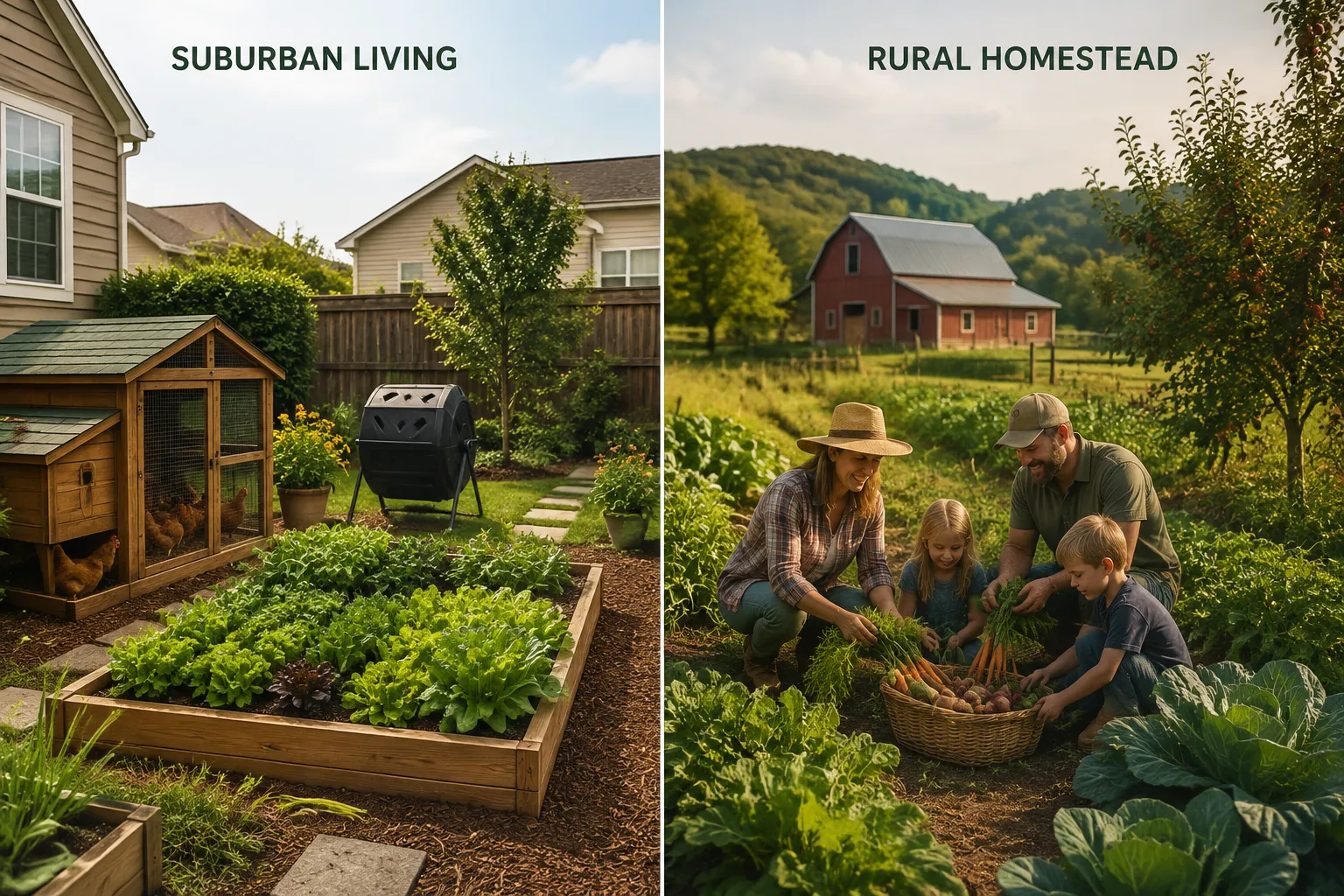
Yes, suburban homesteading is one of the fastest-growing segments of the self-reliance movement, and it’s well-suited to families with no experience because the scale stays manageable. Many families in standard suburban lots successfully grow vegetables, keep backyard chickens, maintain compost systems, and preserve food without owning rural land.
The main constraints in suburban homesteading are local zoning ordinances, HOA rules, and neighbor relations, not the land itself. Before investing in infrastructure, check your municipality’s codes on:
- Backyard poultry (hen limits, rooster bans, coop setback distances)
- Beekeeping regulations
- Rainwater collection legality (varies significantly by state)
- Front-yard food gardens (some municipalities restrict these)
Suburban homesteaders who focus on high-yield, low-space crops, tomatoes, leafy greens, herbs, beans, and peppers, can produce a surprising volume of food on a standard residential lot. Vertical growing structures, intensive planting methods, and container gardening multiply productive space considerably.
Homesteading for Beginners: What Should Your Family Grow First
For families with no experience, the best first crops are those that are forgiving, fast-producing, and high-value. Start with crops that give you visible results quickly, this builds confidence and keeps the whole family engaged.
Best beginner crops by category:
- Leafy greens: Lettuce, spinach, kale, harvest in 30-45 days, grow in containers
- Herbs: Basil, chives, parsley, low maintenance, high culinary value
- Tomatoes: High yield per plant, versatile for preservation
- Zucchini and summer squash: Almost impossible to kill, extremely productive
- Green beans: Easy to grow, easy to preserve by canning or freezing
- Radishes: Ready in 25 days, great for teaching kids the full grow cycle
Avoid starting with crops that require significant skill or infrastructure, corn, melons, and root vegetables like carrots can frustrate beginners with poor germination or pest problems. Master the easy wins first.
One practical rule: grow what your family actually eats. A garden full of crops nobody wants to eat is a garden that gets abandoned by July.
How Much Does It Cost to Start Homesteading
Starting homesteading for families with no experience typically costs between $300 and $2,000 in the first year, depending on the projects chosen and whether infrastructure like raised beds or coops is built from scratch or sourced secondhand.
Estimated first-year costs by project:
- Raised garden bed (4×8 ft, built from lumber): $80,$150
- Soil and amendments for one bed: $50,$100
- Seed packets for a full season: $30,$60
- Basic hand tools (trowel, hoe, watering can): $50,$100
- Backyard chicken starter kit (4 hens, basic coop): $300,$700
- Canning supplies (water bath canner, jars, lids): $80,$150
Year two costs drop sharply. Seeds can be saved, soil improves with compost, and equipment is already in place. Many families find their homesteading investments pay back in reduced grocery bills within 18-24 months, particularly on high-cost items like eggs, fresh herbs, and tomatoes.
Best Homesteading Projects for Families With Kids
Homesteading with children is one of its most underrated benefits. Kids who participate in growing, raising, and preserving food develop practical skills, patience, and a relationship with food that no classroom can replicate.
High-engagement projects for families with children:
- Raising backyard chickens: Daily feeding and egg collection gives kids real responsibility
- Planting a “pizza garden”: Tomatoes, basil, peppers, and garlic in one raised bed
- Composting: Simple, low-mess, and teaches the nutrient cycle
- Seed saving: Collecting seeds from mature vegetables at season’s end
- Making jam or pickles: A tangible, delicious result that kids are proud of
Assign age-appropriate tasks. A five-year-old can water plants and collect eggs. A ten-year-old can help build a raised bed or learn to use a canning funnel safely. Teenagers can take ownership of an entire garden bed or manage the flock independently.
How Do You Raise Chickens for Beginners
Backyard chickens are the most common first livestock project for beginner homesteaders, and for good reason: they’re relatively low-maintenance, produce food daily, and provide a manageable introduction to animal husbandry.
Getting started with backyard chickens:
- Check local ordinances for hen limits and coop setback requirements
- Choose a beginner-friendly breed: Rhode Island Reds, Plymouth Rocks, and Australorps are hardy and productive
- Build or purchase a secure coop, predator protection is the most critical factor
- Start with 3-6 hens for a family of four; expect 4-6 eggs per hen per week during peak laying
- Provide a balanced layer feed, fresh water daily, and grit for digestion
- Plan for reduced production in winter when daylight hours drop
A healthy flock of four hens can produce enough eggs to supply a family and reduce or eliminate the need to purchase eggs. The annual cost of feed for four hens runs approximately $150,$250, depending on your region and whether you supplement with kitchen scraps and garden waste.
What’s the Difference Between Homesteading and Farming
Homesteading and farming are related but fundamentally different in purpose. Farming is a commercial enterprise focused on producing food for sale. Homesteading is a self-sufficiency practice focused on producing food for personal and family consumption.
A homesteader growing tomatoes is trying to feed their family and reduce grocery bills. A farmer growing tomatoes is optimizing yield, managing labor costs, and selling to market. The mindset, scale, and financial structure are entirely different.
For preppers and survivalists, homesteading is the more relevant model. It builds household resilience without requiring the capital, land, or operational complexity of a working farm. It’s also more forgiving of mistakes, a bad tomato crop affects your pantry, not your income.
Common Mistakes New Homesteaders Make
The most common mistake in homesteading for families with no experience is scaling too fast. Enthusiasm in spring leads to overplanted beds, too many chickens, and a workload that collapses by August.
Other frequent beginner mistakes:
- Skipping soil preparation: Poor soil is the leading cause of garden failure. Invest in a soil test before planting.
- Ignoring pest and disease management: Learn to identify common problems early, late-stage infestations are far harder to address.
- Not preserving the harvest: Growing food and then watching it rot because you didn’t have a preservation plan is a painful and avoidable loss.
- Underestimating water needs: Gardens require consistent moisture. Install drip irrigation or a watering schedule before planting.
- Treating it as all-or-nothing: Missing a week of garden maintenance doesn’t mean the season is ruined. Homesteading rewards consistency, not perfection.
How Much Time Does Homesteading Actually Take
A beginner homestead, one raised bed and a small flock of chickens, requires approximately 30-60 minutes per day during the growing season and 15-20 minutes per day in the off-season. This is manageable for most working families when tasks are distributed and routinized.
Time requirements scale with project size. Adding fruit trees, a larger garden, or additional livestock increases the daily commitment proportionally. Most experienced homesteaders recommend adding no more than one new major project per year until the time demands are fully understood.
The honest answer: homesteading takes more time than most beginners expect in year one, and less time than they fear by year three. Skills become faster with practice, systems become efficient, and the work becomes routine.
Is Homesteading Worth It Financially for Families
For most families, homesteading becomes financially worthwhile by the second or third year, once infrastructure costs are recovered. The financial case is strongest for high-value food items: eggs, fresh herbs, tomatoes, berries, and leafy greens consistently show strong returns relative to their cost to grow.
A family of four spending $150 per month on produce can realistically offset $50,$80 of that through a well-managed backyard garden by year two. Backyard egg production typically costs $0.10,$0.25 per egg once the flock is established, compared to $0.30,$0.60 per egg at retail (depending on region and egg type).
The non-financial returns are equally significant for a preparedness-minded family: food security, practical skills, reduced supply chain dependence, and the confidence that comes from knowing you can feed your family from your own land.
What If You Have No Gardening Experience, Can You Still Homestead
Absolutely. The majority of people who successfully homestead today started with no gardening experience whatsoever. Homesteading for families with no experience is the normal starting point, not an exception.
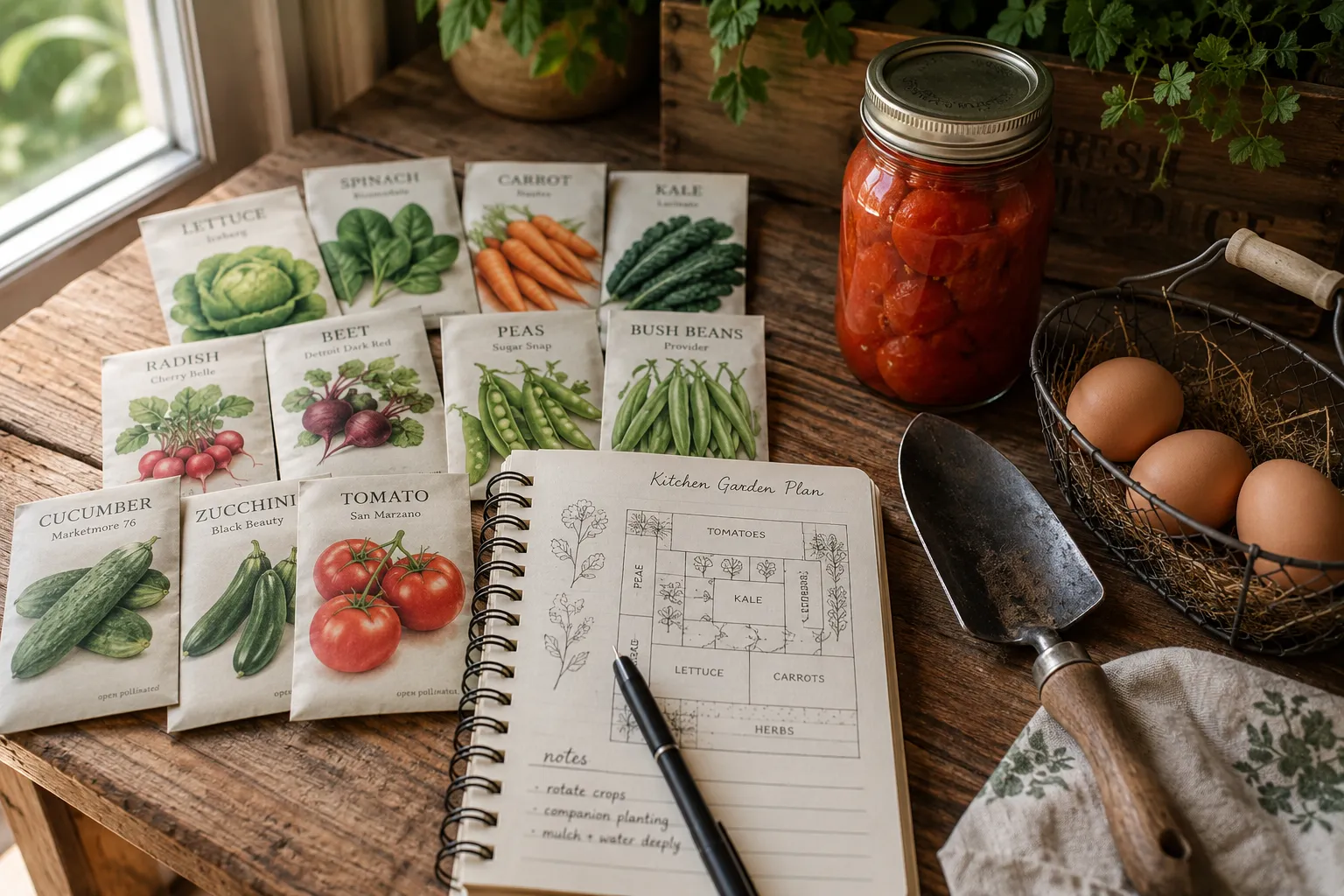
The learning curve is real but not steep. Vegetables want to grow. Your job as a beginner is mostly to give them the right conditions, good soil, adequate water, and sufficient sunlight, and then stay out of the way. The most important thing a first-year gardener can do is keep notes: what you planted, when, how it performed, and what you’d do differently.
Free resources that accelerate the learning curve:
- Your county’s Cooperative Extension Service (land-grant university programs with local gardening guidance)
- The National Gardening Association’s online planting guides
- Seed company planting calendars (Johnny’s Selected Seeds, Baker Creek Heirloom Seeds)
- Local homesteading Facebook groups and community gardens
Homesteading vs. Buying Organic: Which Saves More Money
In the short term, buying organic food is cheaper than homesteading. In the medium to long term, homesteading produces food at a fraction of organic retail prices, but only after the initial infrastructure investment is recovered.
The real comparison isn’t purely financial. Homesteading produces food you know exactly how it was grown, harvested, and handled. It builds skills that have value beyond any single season. And for preppers, it creates a food production capability that no grocery store, organic or otherwise, can replicate when supply chains are disrupted.
For families who want the best of both, a hybrid approach works well: homestead the crops you use most and that are most expensive to buy (tomatoes, herbs, eggs, leafy greens), and purchase the rest.
How Do You Preserve Food When You’re Just Starting Out
Food preservation is one of the highest-impact skills a beginner homesteader can learn, and the entry point is simpler than most people expect. Start with methods that require minimal equipment and carry low risk of failure.
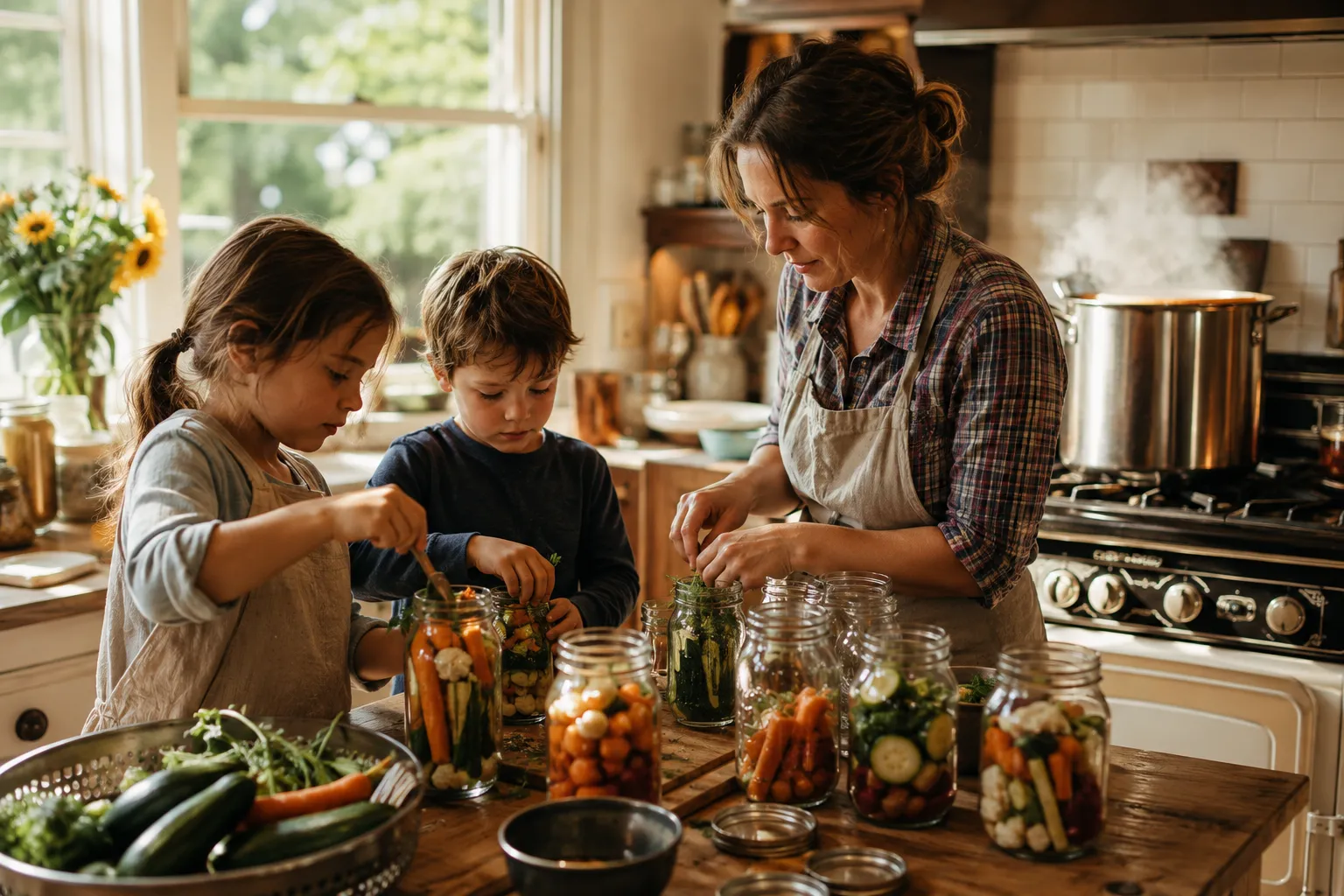
Beginner-friendly preservation methods, ranked by ease:
- Freezing: No special equipment beyond freezer bags. Works for most vegetables after blanching.
- Refrigerator pickling: No canning required. Cucumbers, carrots, and peppers last 2-4 weeks in a vinegar brine.
- Dehydrating: A basic food dehydrator costs $40,$80 and preserves herbs, fruits, and vegetables for 6-12 months.
- Water bath canning: Requires a large pot, mason jars, and a rack. Safe for high-acid foods like tomatoes, pickles, and jams.
- Pressure canning: Required for low-acid foods (green beans, meats, soups). Steeper learning curve but essential for a full preservation system.
The National Center for Home Food Preservation (NCHFP) provides tested, science-based recipes and processing times for all canning methods. Always use tested recipes for canning, improvised recipes can result in unsafe pH levels.
FAQ: Family Homesteading Made Easy
Do I need to own land to start homesteading?
No. Renters can homestead using container gardens, indoor herb systems, and community garden plots. Homesteading is a set of practices, not a property type.
How do I get my kids interested in homesteading?
Give them ownership of a specific task, their own plant, their own chickens to name, their own row in the garden. Children engage when they have real responsibility and can see tangible results.
Is homesteading legal in suburban areas?
Most suburban homesteading activities are legal, but local ordinances vary on backyard chickens, rainwater collection, and front-yard gardens. Check with your municipality before investing in infrastructure.
What’s the single best first project for a beginner homesteading family?
A raised garden bed with tomatoes, herbs, and leafy greens. It’s low-cost, fast-producing, and teaches soil management, watering, pest identification, and harvest timing, the core skills everything else builds on.
Can I homestead if I work full-time?
Yes. A well-designed beginner homestead requires 30-45 minutes per day. Many full-time working families homestead successfully by distributing tasks among family members and automating irrigation.
How do I know if my soil is good enough to garden?
Get a basic soil test through your county extension office, they typically cost $10,$20 and tell you pH, nutrient levels, and organic matter content. Most suburban soils need amendment before productive gardening.
When should I add chickens to my homestead?
After you’ve successfully maintained a garden for at least one season. Chickens add daily responsibility and a new set of skills. Establishing one system at a time prevents overwhelm.
What’s the fastest way to build homesteading skills with no experience?
Find a local mentor. A single afternoon with an experienced homesteader is worth weeks of reading. Local homesteading groups, county fairs, and cooperative extension workshops are the best places to find them.
Is homesteading the same as being off-grid?
No. Off-grid living refers specifically to energy and utility independence. Homesteading is about food self-sufficiency and can be practiced while fully connected to the grid.
How do I preserve food safely without taking a course?
Use only tested recipes from the USDA Complete Guide to Home Canning or the National Center for Home Food Preservation. These are free, science-based, and updated regularly.
Conclusion
Homesteading for families with no experience isn’t about having the right land, the right background, or the right amount of time. It’s about making a decision to become more self-reliant and then taking the first practical step, one raised bed, one flock of chickens, one jar of preserved tomatoes at a time.
For preppers and survivalists, homesteading is one of the most durable long-term investments a family can make. The skills don’t expire. The food doesn’t depend on a supply chain. And the confidence that comes from knowing you can feed your family from your own hands is something no amount of stored supplies can fully replace.
Actionable next steps for 2026:
- Assess your available outdoor space and check local ordinances this week
- Order a soil test from your county extension office
- Choose one beginner project, a raised bed or a small flock of chickens, and commit to it this season
- Connect with a local homesteading group or cooperative extension program for hands-on guidance
- Build a basic food preservation kit: mason jars, a water bath canner, and a copy of the USDA canning guide
The preparedness community at Preppers HQ covers the full spectrum of self-reliance skills, from off-grid living fundamentals to emergency water storage and how to start homesteading from scratch. Every skill you build compounds the next one. Start now, start small, and stay consistent.
Products, Tools, and Resources
For the garden:
- Raised bed kits (Cedar or composite lumber beds from brands like Vego Garden or Birdies are durable, non-toxic options)
- A quality soil test kit or county extension test service
- My Pateriot Supply Seeds or Baker Creek Heirloom Seeds for open-pollinated, seed-saving-friendly varieties
For chickens:
- A predator-proof coop with hardware cloth (not chicken wire), brands like Omlet’s Eglu Cube are popular for small urban flocks
- Layer feed from a local feed store (buying local reduces shipping costs significantly)
- A basic chicken care reference: “Storey’s Guide to Raising Chickens” by Gail Damerow remains the standard beginner resource
For food preservation:
- All American or Presto pressure canners for low-acid foods
- Ball or Mason jars (wide-mouth pints and quarts cover most recipes)
- The Ball Complete Book of Home Preserving, a reliable, tested-recipe reference
- A mid-range food dehydrator (Excalibur 9-tray models are the homesteading standard for serious beginners)
For learning:
- Your county’s Cooperative Extension Service, free, local, and underused
- The National Center for Home Food Preservation (nchfp.uga.edu), free tested canning recipes
- The Preppers HQ resource library for integrating homesteading into a broader preparedness strategy