
Hey there! Some links on this page may be affiliate links which means that, if you choose to make a purchase, I may earn a commission at no extra cost to you. I greatly appreciate your support. Read the full disclosure here.
A 3-day power outage triggers a cascade of problems most households are completely unprepared for, spoiled food, unsafe temperatures, failed medications, and no running water (in many cases). Understanding what happens if the power goes out for 3 days, and preparing for it in advance, is the difference between a manageable inconvenience and a genuine household emergency.
Find this useful? Add us as a preferred source on Google and more of what we publish will show up in your results.
Key Takeaways
- Refrigerators lose safe temperature (above 40°F) within 4 hours of power loss; most food becomes unsafe after that window without intervention
- A full freezer stays frozen for approximately 48 hours; a half-full freezer lasts only about 24 hours
- The USDA’s rule is clear: when in doubt, throw it out, eating spoiled food from a powerless fridge can cause serious foodborne illness
- Insulin and many other refrigerated medications lose effectiveness within 24-48 hours at room temperature, making medication planning critical
- Indoor temperatures can drop to dangerous levels within 24 hours in winter, or climb to heat-stroke territory in summer
- A full fridge stays cold significantly longer than an empty one, keep it stocked and keep the door closed
- Preparation before an outage (stored water, backup power, shelf-stable food, insulated coolers) dramatically reduces the risk of every hazard listed above
- Most people underestimate how dependent their home is on electricity, sump pumps, well pumps, garage doors, and medical devices all stop working
What Happens to Food in the Fridge If Power Goes Out for 3 Days
The short answer: most refrigerated food becomes unsafe to eat well before the 72-hour mark. A refrigerator without power begins warming immediately, and once the internal temperature climbs above 40°F, bacteria like Salmonella and E. coli start multiplying at dangerous rates.
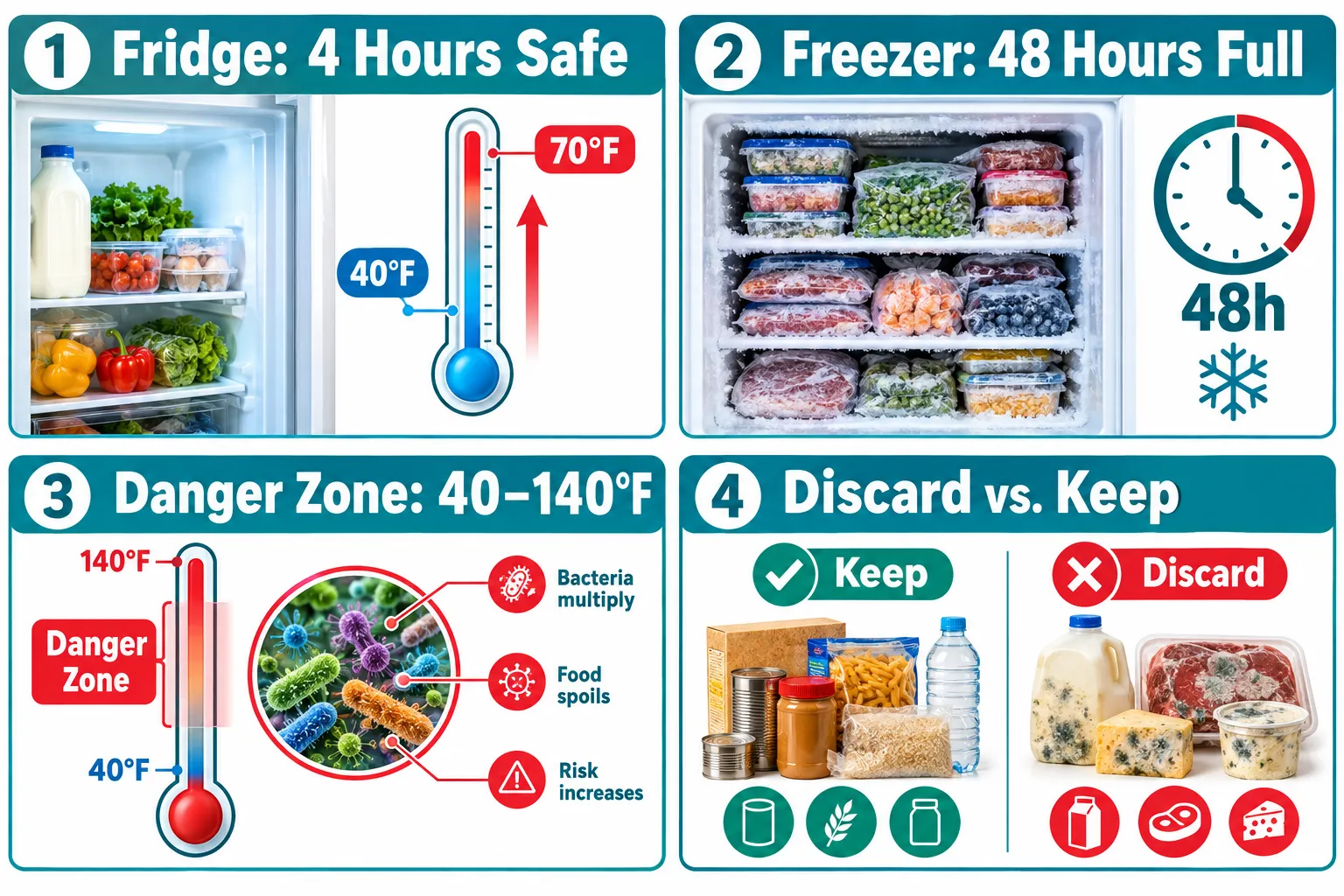
According to the USDA, a refrigerator will only keep food safely cold for about 4 hours after power loss, provided the door stays closed. After that, the temperature climbs steadily toward room temperature. By hour 6 to 8, perishables like meat, dairy, eggs, and cooked leftovers are already in the danger zone. By day 3, virtually everything in the fridge that requires refrigeration is unsafe.
What to discard after a 3-day outage:
- Raw or cooked meat, poultry, and seafood
- Milk, soft cheeses, yogurt, and sour cream
- Eggs and egg-based dishes
- Cooked pasta, rice, and casseroles
- Opened mayonnaise, tartar sauce, and creamy dressings
- Cut fruits and vegetables
What is generally safe to keep:
- Hard cheeses (uncut)
- Butter and margarine
- Fruit juices and opened fruit drinks
- Vinegar-based salad dressings
- Peanut butter, jelly, and jam
- Bread, rolls, cakes, and muffins
The takeaway: do not rely on smell or appearance to judge safety. Many dangerous bacteria produce no visible or olfactory signs. The USDA’s guidance is unambiguous, if perishable food has been above 40°F for more than 2 hours, discard it.
How Long Can Frozen Food Stay Frozen Without Power
A full freezer holds safe temperatures for approximately 48 hours after power loss. A freezer that is only half full holds for roughly 24 hours. These estimates assume the door remains closed and the ambient room temperature is not extreme.
The physics are straightforward: a densely packed freezer has more thermal mass, meaning it takes longer for the collective temperature to rise. Frozen items also act as ice blocks for each other.
Factors that affect how long your freezer stays cold:
- Fill level: Full freezers last twice as long as half-empty ones
- Freezer type: Chest freezers retain cold better than upright models because cold air doesn’t spill out when opened
- Ambient temperature: A freezer in a cool garage holds longer than one in a hot kitchen
- Insulation quality: Older or lower-quality freezers lose temperature faster
If the outage extends beyond 48 hours and you have no dry ice or block ice available, inspect each item carefully. Foods that still contain ice crystals or are at 40°F or below are safe to refreeze. Any item that has fully thawed and reached above 40°F should be cooked immediately or discarded.
Can You Get Food Poisoning from Food Left in the Fridge for 3 Days Without Power
Yes, absolutely. This is one of the most serious health risks during a 3-day power outage. Foodborne illness from improperly stored food can cause severe vomiting, diarrhea, dehydration, and in vulnerable populations (elderly, young children, immunocompromised individuals), it can be life-threatening.
The bacteria most commonly responsible, Salmonella, Listeria, Staphylococcus aureus, and E. coli, thrive between 40°F and 140°F. After 72 hours without power, a standard fridge will have been in that danger zone for most of that time.
Common mistake: People assume that if food “smells fine,” it’s safe. That is not accurate. Staphylococcal toxins, for example, are odorless and tasteless, and they are not destroyed by reheating. The only reliable protection is time-and-temperature management.
What Temperature Does a Fridge Reach Without Power
Without power, a refrigerator typically reaches room temperature within 8 to 12 hours, depending on how full it is and what the ambient temperature of the home is. A fridge that starts at 37°F will pass through the 40°F danger threshold within 4 hours of power loss under normal conditions.
In a hot house (above 80°F in summer), the process accelerates significantly. In a cool basement, it slows. This is why keeping the door closed is the single most effective action you can take immediately after an outage begins.
Does a full fridge stay cold longer than an empty one? Yes, significantly. A fridge packed with food and beverages retains cold much longer than a sparse one. If you know an outage is coming, fill empty spaces with water bottles or bags of ice. Each item acts as a thermal buffer.
What Happens to Medications That Need Refrigeration During a Power Outage
Medications that require refrigeration, insulin, certain biologics, some liquid antibiotics, and eye drops, are at serious risk during a 3-day outage. Most insulin, for example, loses potency when stored above 77°F for extended periods, and some formulations degrade significantly within 24 hours at room temperature.
This is a life-safety issue for diabetics, people on immunosuppressants, and others dependent on refrigerated medications.
Immediate steps when power goes out and you have refrigerated medications:
- Transfer medications to an insulated cooler with ice packs immediately, do not wait
- Keep the cooler closed as much as possible
- Contact your pharmacist or prescribing physician if you’re unsure whether your medication has been compromised
- Check the manufacturer’s guidance for your specific medication, storage requirements vary
Some medications can tolerate brief temperature excursions; others cannot. Never assume. When in doubt, contact a pharmacist before using a medication that may have been compromised.
How to Keep Food Safe During an Extended Power Outage
The best strategy combines preparation before the outage with active management during it. For a full breakdown of supplies and systems, the Ultimate Power Outage Preparedness Checklist is an excellent starting point.
Before an outage (preparation):
- Keep a well-stocked freezer, a full freezer is your best insurance
- Store block ice or dry ice in advance when a storm is forecast
- Keep a quality insulated cooler on hand (a good cooler can hold temperature for 5+ days with proper ice management)
- Maintain a supply of shelf-stable foods so you’re not dependent on the fridge at all
During an outage:
- Keep the refrigerator door closed; every opening costs roughly 20-30 minutes of safe temperature
- Move the most critical perishables (insulin, infant formula, raw meat) to a cooler with ice immediately
- Use a refrigerator thermometer to monitor internal temperature
- Cook and eat refrigerated perishables first, before they spoil
For cooking options when the stove is out, the Emergency Cooking Without Power guide covers camp stoves, propane burners, and other reliable alternatives.
How to Prepare for a 3-Day Power Outage Before It Happens
Preparation is what separates a stressful emergency from a manageable situation. A 3-day outage is one of the most common and realistic scenarios preppers plan for, and one of the most overlooked by the general public.
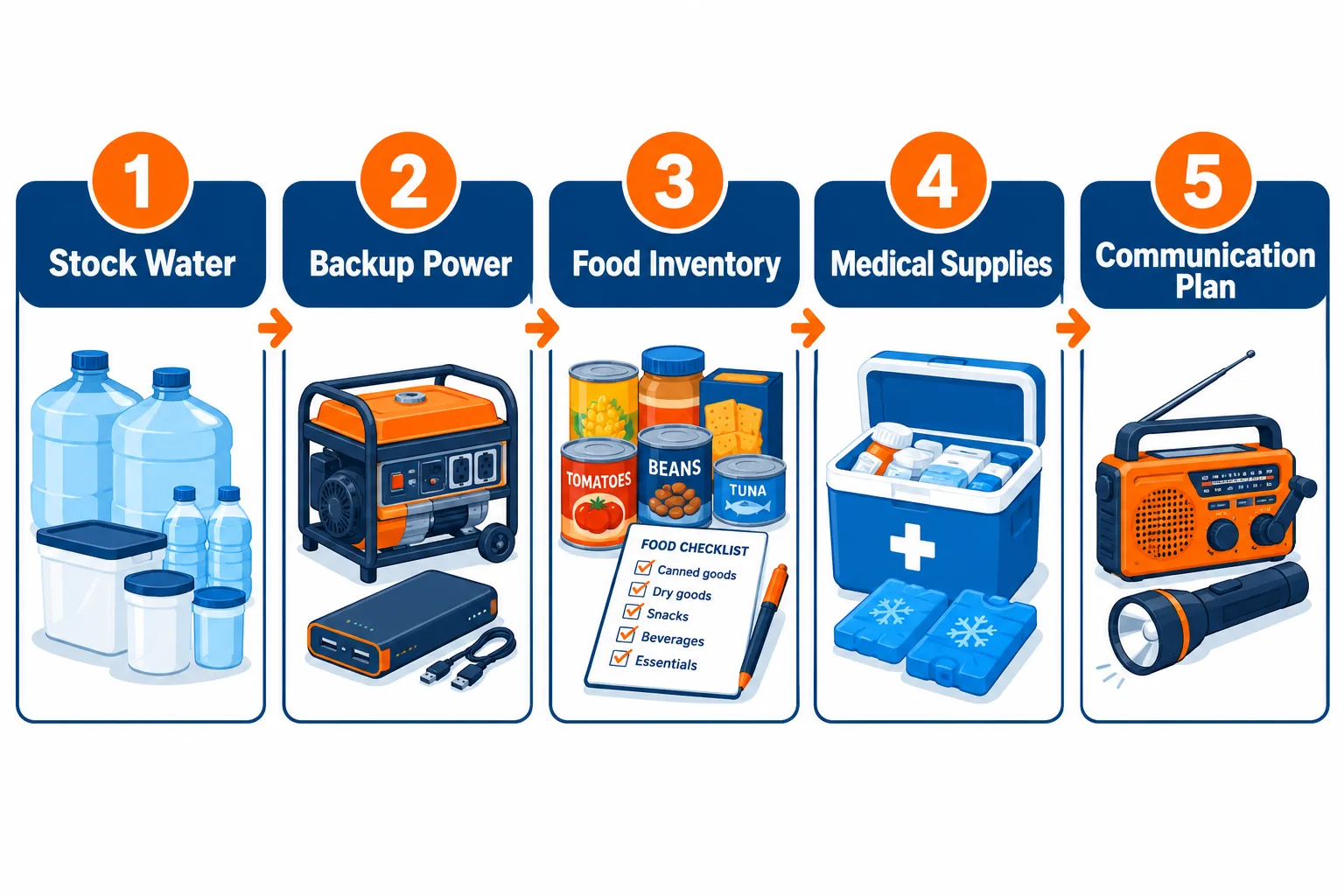
Core preparation checklist:
- Water: Store at least 1 gallon per person per day (3 gallons minimum per person for a 72-hour outage). Municipal water systems often rely on electric pumps, so tap water may not be available.
- Food: Stock at least 72 hours of shelf-stable food per household member. Canned goods, freeze-dried meals, and dry staples require no refrigeration.
- Backup power: A portable power station or generator keeps critical devices running. See the Complete Preppers Guide to Backup Power for Emergencies for a full breakdown.
- Lighting: Battery-powered lanterns, headlamps, and candles (used safely)
- Communication: A hand-crank or battery-powered emergency weather radio
- Heat and cooling: Sleeping bags rated for cold temperatures, battery-powered fans, or a wood stove for winter outages
For a broader look at what the first 72 hours of a grid-down event actually looks like, the Grid-Down Scenario: What To Expect In The First 72 Hours article walks through the timeline in detail.
What Happens to Your Home Temperature After 3 Days Without Power
Home temperature during a 3-day outage depends heavily on the season, climate, and how well-insulated the home is. The risks run in both directions.
In winter: A well-insulated home loses roughly 1°F per hour when outdoor temperatures are near freezing. Within 24 hours, indoor temperatures can drop below 50°F. By day 3, a home in a cold climate can reach dangerously cold temperatures, especially for infants, elderly residents, and anyone with circulatory issues. Hypothermia risk becomes real.
In summer: Without air conditioning, a home in a hot climate can reach 90°F or higher within 24 hours during a heatwave. Heat exhaustion and heat stroke become serious risks, particularly for elderly residents and young children. The CDC considers indoor temperatures above 90°F dangerous for vulnerable populations.
Practical responses:
- In winter: gather the household into one room, use sleeping bags and layered clothing, and consider a propane or wood-burning heat source rated for indoor use
- In summer: keep blinds closed during daylight, move to the lowest level of the home (cooler air sinks), use battery-powered fans, and stay hydrated
- In either season: know your evacuation threshold, if conditions become dangerous, leaving to a shelter or family member’s home is the right call
For those in apartments without backup heating options, the guide on how to Survive in an Apartment Without Power, Water, or Heat covers specific urban strategies.
What Should You Do First When Power Comes Back On After 3 Days
When power is restored after a 3-day outage, the instinct is to relax, but there are several critical steps to take before returning to normal.
Immediate priorities:
- Check the freezer: Any item still containing ice crystals or at 40°F or below is safe. Items that have fully thawed and been above 40°F should be discarded or cooked immediately.
- Discard refrigerator perishables: Unless you actively managed fridge temperature with ice during the outage, assume all perishables are unsafe.
- Check medications: Assess whether refrigerated medications were properly maintained. Contact a pharmacist if there’s any doubt.
- Run water before drinking: If the outage affected municipal water pressure, flush the taps for a minute before consuming tap water.
- Inspect appliances: Power surges when electricity is restored can damage electronics. Use surge protectors and consider unplugging sensitive devices until the grid stabilizes.
- Restock immediately: A 3-day outage is a reminder that your prep supplies need replenishing. Rebuild your emergency food and water supply before the next event.
How to Tell If Food Is Still Safe to Eat After a Power Outage
The safest approach is to apply the 4-hour rule: if refrigerated food has been above 40°F for more than 2 hours (cumulative), discard it. For a 3-day outage without active cooling, virtually all standard refrigerator perishables should be discarded.
The only reliable indicators of safety:
- Internal temperature at or below 40°F (use a food thermometer, not touch)
- Frozen items still containing ice crystals throughout
- Shelf-stable items that were never opened and stored at room temperature
Do not rely on color, smell, or texture. These are unreliable indicators for most dangerous bacteria. The cost of discarding food is far lower than the cost of treating foodborne illness, especially during a broader emergency when medical services may be strained.
For long-term food storage that eliminates this problem entirely, the Food Storage for 30 Days Emergency Supply guide provides a complete system for building a shelf-stable pantry.
FAQ: What Happens If The Power Goes Out For 3 Days
How long does a fridge stay cold without power?
A refrigerator stays at a safe temperature (below 40°F) for approximately 4 hours after power loss, provided the door stays closed. After that, it begins warming toward room temperature.
Is it safe to eat meat from a fridge that lost power for 3 days?
No. Raw and cooked meat that has been above 40°F for more than 2 hours is unsafe to eat. After 3 days without power and no active cooling, all meat in the fridge should be discarded.
How long does a full freezer stay frozen without power?
A fully packed freezer maintains safe temperatures for about 48 hours. A half-full freezer lasts approximately 24 hours. Keep the door closed to maximize this window.
What should I do with my insulin during a power outage?
Transfer insulin to an insulated cooler with ice packs immediately when power goes out. Most insulin can tolerate room temperature for up to 28 days (unopened) per manufacturer guidance, but this varies by formulation, always verify with your pharmacist.
Can I use a generator indoors during a power outage?
Never run a gasoline-powered generator indoors or in an attached garage. Carbon monoxide poisoning is a leading cause of death during power outages. Generators must be used outside, at least 20 feet from windows and doors.
Will my sump pump work during a 3-day power outage?
A standard sump pump will not work without power. If your home is at risk of flooding, a battery backup sump pump or a water-powered backup system is essential preparation.
How do I keep my home warm for 3 days without power in winter?
Consolidate the household into one room, use sleeping bags and layered clothing, hang blankets over doorways to trap heat, and use a properly ventilated propane heater or wood stove if available. Avoid burning anything indoors that produces carbon monoxide.
Does opening the fridge during an outage make things worse?
Yes. Every time the door opens, cold air escapes and warm air enters. Keep the fridge closed as much as possible to extend the safe window.
What foods don’t need refrigeration and are good for a 3-day outage?
Canned goods, peanut butter, crackers, dried fruit, nuts, granola bars, shelf-stable milk, instant oatmeal, and freeze-dried meals are all reliable options that require no refrigeration.
How much water do I need for a 3-day power outage?
FEMA recommends a minimum of 1 gallon per person per day for drinking and sanitation. For a 3-day outage, that’s at least 3 gallons per person, more if you have pets or live in a hot climate.
What if I live in an apartment and can’t use a generator?
Portable battery-powered stations (like a Jackery or EcoFlow unit) can power small devices, fans, and phone chargers without combustion. These are safe for indoor use and are a practical alternative for apartment dwellers.
How do I know if my area is prone to extended outages?
Check your utility company’s outage history and review local hazard maps. Areas prone to hurricanes, ice storms, wildfires, and severe thunderstorms have higher outage risk. The Power Grid Failure: How Long Could It Last? guide covers grid vulnerability in detail.
Conclusion
A 3-day power outage is not a theoretical scenario, it happens to millions of households every year. What separates a dangerous situation from a manageable one is almost entirely preparation made before the lights go out.
The core lessons are straightforward: refrigerated food becomes unsafe within hours, not days; frozen food has a 24-48 hour window depending on fill level; medications need immediate active management; and home temperatures can become dangerous in both summer and winter within 24 hours.
Actionable next steps to take today:
- Build a 72-hour supply of shelf-stable food and water (minimum 3 gallons per person)
- Purchase a quality insulated cooler and keep ice packs in the freezer
- Invest in a portable power station or generator for critical devices
- Create a medication plan with your pharmacist for any refrigerated prescriptions
- Download or print the Ultimate Power Outage Preparedness Checklist and work through it systematically
Being prepared isn’t about expecting the worst. It’s about knowing that when the power goes out, and eventually, it will, your household is equipped to handle it with confidence.
Products, Tools, and Resources
Insulated coolers: A quality rotomolded cooler (brands like YETI, RTIC, or Pelican) can hold temperature for 5-7 days with proper ice management, far longer than a standard cooler. This is one of the highest-value purchases for food safety during outages.
Portable power station: A unit from Grid Doctor can power a CPAP machine, phone chargers, a small fan, and LED lighting for 24-72 hours on a single charge. They’re silent, safe indoors, and recharge from solar panels.
Refrigerator thermometers: A simple appliance thermometer (under $15) lets you monitor fridge and freezer temperatures without opening the door. It’s one of the cheapest and most useful tools in any prep kit.
Freeze-dried food supply: A 72-hour or 30-day freeze-dried food supply eliminates refrigeration dependency entirely. These meals store for 25 years and require only water to prepare.
Hand-crank emergency radio: A weather alert radio keeps you informed about outage duration and emergency instructions when cell service is unreliable.
Water storage containers: BPA-free 5-gallon water containers or a WaterBOB bathtub bladder (holds up to 100 gallons) provide reliable emergency water storage before and during an outage.
For a complete list of recommended gear and supplies, the Ultimate Emergency Supplies List covers everything a prepared household needs, organized by priority and scenario.