
Hey there! Some links on this page may be affiliate links which means that, if you choose to make a purchase, I may earn a commission at no extra cost to you. I greatly appreciate your support. Read the full disclosure here.
Tornadoes kill an average of 70 people in the United States every year, according to NOAA, and the majority of those deaths are preventable with a practiced plan. Not a plan you read once and forgot, but one your family has rehearsed until the steps are automatic. That’s what a real tornado safety plan for families looks like. This guide covers everything: where to shelter, what to pack, how to run drills with kids, and what most families get dangerously wrong.
Key Takeaways
- The safest shelter during a tornado is a basement or an interior room on the lowest floor, away from all windows.
- A tornado warning means a tornado has been spotted or confirmed, get to shelter immediately, not after you finish what you’re doing.
- Families should run tornado drills at least twice a year, ideally once in spring and once in fall.
- Children need age-appropriate tornado safety education, not just instructions shouted at them during an actual event.
- Mobile home residents must have a pre-identified off-site shelter location, mobile homes offer no meaningful protection from tornadoes.
- A tornado emergency kit should be staged in or near your shelter location, not in a garage or car.
- Post-tornado communication plans are just as critical as pre-tornado shelter plans.
- Even families in low-risk areas need a basic tornado plan, tornadoes have been recorded in all 50 U.S. states.
Find this useful? Add us as a preferred source on Google and more of what we publish will show up in your results.
What Should Be in a Family Tornado Safety Plan
A complete tornado safety plan for families covers four core areas: shelter identification, alert systems, communication protocols, and supply staging. Without all four, the plan has gaps that can cost lives.
Start by walking through your home and identifying your primary and backup shelter locations. Write them down. Then layer in the following:
Shelter locations (primary and backup)
- Primary: basement or storm cellar
- Backup: interior bathroom, closet, or hallway on the lowest floor
- Away from windows and exterior walls in all cases
Alert systems
- NOAA Weather Radio (battery-powered or hand-crank)
- Wireless Emergency Alerts enabled on all family smartphones
- Local siren awareness, know what your county’s warning sirens sound like
Communication plan
- Designate an out-of-state contact that all family members call or text after a tornado
- Establish a meeting point if family members are separated
- Keep a written contact list in your kit, phones die
Drill schedule
- Twice yearly minimum, more if you live in Tornado Alley
- Practice at different times of day, including nighttime scenarios
For a broader framework that integrates tornado planning into your overall household strategy, the 4-Layer Disaster Plan: FEMA-Based Protocol for Total Family Safety is worth reviewing in full.
What’s the Difference Between a Tornado Watch and a Tornado Warning
A tornado watch means conditions are favorable for tornado development, stay alert and be ready to move. A tornado warning means a tornado has been confirmed by radar or a trained spotter and is an immediate threat to life. These two terms are not interchangeable, and confusing them costs precious minutes.
| Alert Level | What It Means | Your Action |
|---|---|---|
| Tornado Watch | Conditions favor tornado formation | Monitor alerts, review your plan |
| Tornado Warning | Tornado confirmed or radar-indicated | Go to shelter NOW |
| Tornado Emergency | Catastrophic, confirmed large tornado | Extreme immediate action required |
The National Weather Service issues tornado warnings with an average lead time of about 13 minutes, according to NOAA data. That sounds like enough time. But if your family hasn’t practiced, 13 minutes disappears fast, especially at 2 a.m. when everyone is asleep.
Where Is the Safest Place to Shelter During a Tornado
The safest place to shelter during a tornado is a basement or underground storm shelter. If neither is available, an interior room on the lowest floor of a sturdy building, a bathroom, closet, or hallway away from windows, is the next best option.
The physics are straightforward: below-ground shelters are protected from direct wind impact and flying debris, which causes the majority of tornado fatalities and injuries. Interior rooms on lower floors put as many walls as possible between you and the storm.
Ranked shelter locations (best to worst):
- Underground storm cellar or purpose-built safe room
- Basement interior room, away from windows
- Interior bathroom on lowest floor (bathtubs offer some protection)
- Interior closet or hallway on lowest floor
- Under a staircase on the lowest floor
What to do once you’re in shelter:
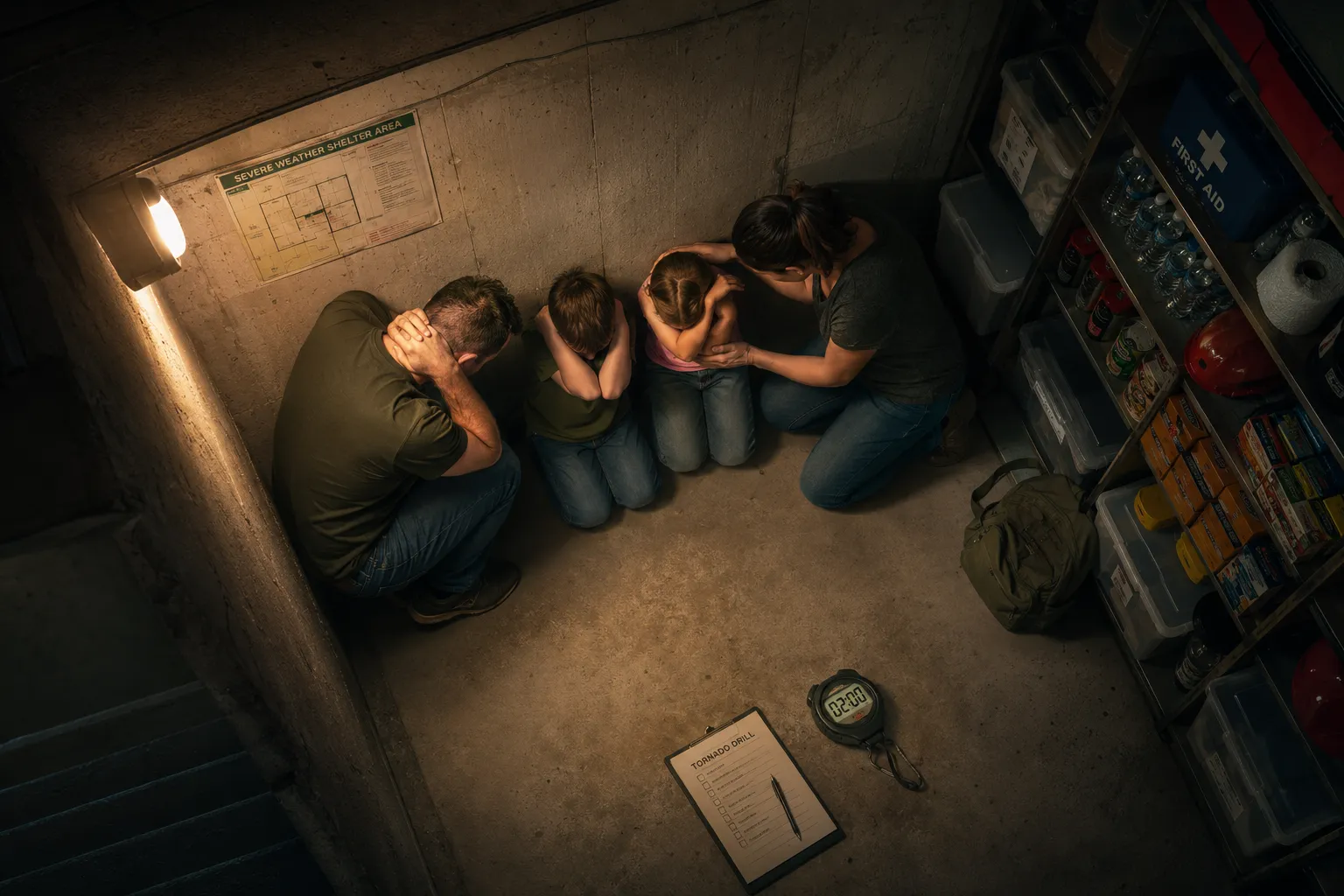
- Cover your head and neck with your arms or a helmet
- Use a mattress, sleeping bag, or thick blankets if available
- Stay away from exterior walls
- Do not open windows, this is a myth and wastes time
What Should Be in a Tornado Safe Room or Emergency Kit
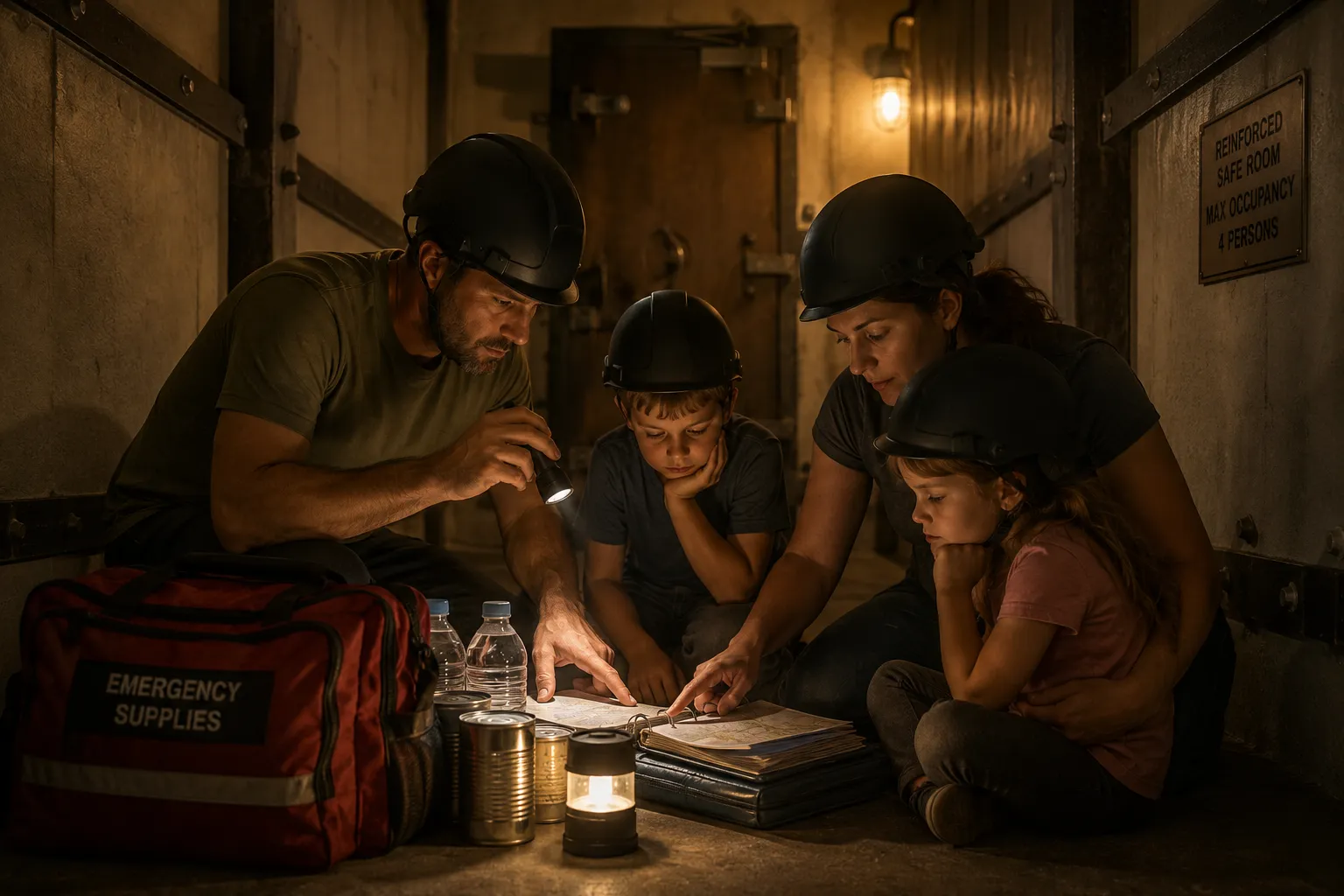
A tornado safe room should contain a pre-staged emergency kit that your family can access without leaving the shelter area. The kit is separate from your main bug-out bag, it’s designed for sheltering in place, not evacuation.
Core tornado emergency kit contents:
- NOAA weather radio (battery or hand-crank)
- Flashlights with extra batteries
- Bicycle or construction helmets for each family member
- First aid kit
- Water: minimum 1 gallon per person per day for 3 days
- Non-perishable food (3-day supply)
- Copies of important documents in a waterproof bag
- Whistle (to signal for help if trapped under debris)
- Work gloves and sturdy shoes
- Medications (7-day supply minimum)
- Phone charger and backup battery pack
- Cash in small bills
- Written emergency contact list
Stage this kit in a waterproof bin kept inside or immediately adjacent to your shelter room. Don’t store it in the garage, you may not be able to reach it.
For guidance on building out your broader emergency supply system, the Ultimate Emergency Supplies List covers the full spectrum of what preppers should have on hand.

How Much Time Do You Have to Get to Shelter When a Tornado Hits
On average, a tornado warning gives families roughly 8 to 13 minutes of lead time, based on NOAA historical data. But that figure assumes the warning is issued before the tornado reaches your location, which isn’t always the case. Some tornadoes form and touch down faster than detection systems can respond.
The practical answer: assume you have less time than you think.
A family that has never practiced getting to shelter will spend 2 to 4 minutes just orienting, waking people up, finding shoes, figuring out where to go. A family that drills regularly can be sheltered in under 90 seconds. That gap is the entire reason tornado drills exist.
Time-wasters that kill people during tornadoes:
- Stopping to watch the storm from a window
- Trying to drive away from a visible tornado
- Going outside to look for the tornado before acting
- Waiting for a second confirmation before moving
- Grabbing valuables instead of going directly to shelter
How to Create a Tornado Safety Plan for Families: Step-by-Step Drill Guide
A tornado drill isn’t just yelling “drill time” and walking to the basement. A well-run drill tests every part of your plan and reveals the gaps before a real tornado does.
Step 1: Map your shelter locations Walk every room in your home and identify the fastest route to your primary shelter. Time it. Do the same for your backup location.
Step 2: Assign roles Who grabs the emergency kit? Who accounts for pets? Who checks on elderly or mobility-limited family members? Write it down.
Step 3: Set up your alert system Test your NOAA radio. Confirm that Wireless Emergency Alerts are enabled on every phone. Know what your local sirens sound like.
Step 4: Run the drill unannounced At least one drill per year should be unannounced, ideally at night. This tests real-world response, not a rehearsed performance.
Step 5: Time the drill Use a stopwatch. Your goal is to have everyone in shelter within 90 seconds of the alert. If it takes longer, identify why and fix it.
Step 6: Debrief After every drill, ask: What slowed us down? Did everyone know where to go? Were the supplies accessible? Update your plan based on what you find.
Drill frequency recommendations:
- Minimum: twice per year (spring and fall)
- Ideal: quarterly if you live in a high-risk region
- After any household change: new baby, new pet, new family member, home renovation
How to Practice Tornado Drills With Young Children
Children need tornado drills explained at their level, not just ordered into a room. Kids who understand why they’re practicing respond faster and with less panic during real events.
For children under 6, frame the drill as a “storm safety game.” Use simple language: “We go to our safe room when we hear the weather alarm.” Practice the physical movements, crouching, covering their neck, as a game, not a fear exercise. The Kids Emergency Preparedness guide has detailed strategies for teaching preparedness to children at different developmental stages.
Age-specific approaches:
- Ages 3 to 5: Focus on recognition (what the alarm sounds like) and one action (go to the safe room with a parent).
- Ages 6 to 10: Teach the difference between a watch and a warning. Let them help pack the kit. Give them a role.
- Ages 11 and up: Teach them to run a drill themselves. Explain what tornadoes are and how warnings work. Practice what to do if they’re home alone.
Keep a stuffed animal or comfort item in the shelter kit for younger children. Reducing fear during drills means less panic during real events.
Can You Do Tornado Drills in an Apartment or Mobile Home
Yes, and if you live in either, tornado drills are arguably more critical, not less. Apartments and mobile homes present unique shelter challenges that require specific planning.
Apartments: Interior hallways on the lowest floor are your best option. Avoid elevators. If your building has a basement or parking structure below grade, confirm whether residents are permitted to shelter there during emergencies. Know your building’s emergency plan and whether it includes tornado protocols.
Mobile homes: A mobile home offers no meaningful protection from a tornado, regardless of whether it’s tied down. Every mobile home resident needs a pre-identified off-site shelter: a nearby community shelter, a neighbor’s basement, or a public building. This location should be within walking distance and you should have practiced getting there. If you can’t reach shelter in time, a low-lying ditch away from trees and vehicles is safer than staying in the mobile home.
For apartment-specific preparedness strategies, the Ultimate Guide to Prepping in a Small Apartment covers shelter planning alongside storage and supply considerations.
What Kids Should Know About Tornado Safety
Children should know four core things: what a tornado warning sounds like, where the family shelter location is, what to do if they’re at school or away from home, and how to protect their head and neck if caught without shelter.
Schools run tornado drills regularly, but home drills are different. Kids need to know the home-specific plan, not just the school version. Walk them through it. Show them the emergency kit. Let them ask questions.
What every school-age child should be able to answer:
- “What do we do when we hear the weather alarm?”
- “Where is our safe room?”
- “What number do we call if we can’t reach Mom or Dad?”
- “What do we do if a tornado comes while I’m at a friend’s house?”
Post a laminated one-page family tornado plan on the inside of a cabinet door in your shelter room. Include shelter location, emergency contacts, and the out-of-state contact number.
What Communication Plan Should Families Have After a Tornado
Post-tornado communication is one of the most overlooked parts of family tornado preparedness. Local cell networks frequently overload or fail after a major tornado, voice calls drop, but texts often go through on a delay.
The standard post-disaster communication framework:
- Designate one out-of-state contact as the family “hub.” Everyone checks in with that person, who relays status to other family members. Local calls may fail while long-distance connections stay open.
- Establish a physical meeting point near your home and a secondary one farther away in case the immediate area is inaccessible.
- Use SMS texts before voice calls, they require less bandwidth.
- If you have children in school, know the school’s reunification protocol before a disaster, not during one.
The Emergency Communication Plan: The Complete Prepper’s Guide goes deep on building a communication system that works when infrastructure fails.
What Are Common Mistakes People Make During Tornadoes
The most dangerous tornado mistakes are behavioral, not logistical. People who have supplies but no practiced plan still make fatal decisions under pressure.
The most common, and deadly, mistakes:
- Sheltering in a vehicle: Cars are not safe during tornadoes. If you can’t reach a building, abandon the car and lie flat in a low ditch.
- Waiting to confirm the tornado visually: By the time you see it, you may have seconds, not minutes.
- Sheltering under a highway overpass: This is a widely believed myth. Overpasses create wind tunnels and offer no protection.
- Ignoring nighttime warnings: Most tornado fatalities occur from storms at night when people are asleep and miss alerts.
- Not accounting for pets: Pets slow evacuation to shelter. Train them as part of your drill.
- Keeping the kit in the wrong place: A tornado kit in the garage or car is useless if the tornado hits before you can retrieve it.
Should Families Have a Tornado Plan Even in Low-Risk Areas
Yes. Tornadoes have been recorded in all 50 U.S. states, including states most people don’t associate with tornado risk, Massachusetts, California, and even Alaska. The risk is lower outside of Tornado Alley and Dixie Alley, but it is never zero.
Beyond tornadoes specifically, the shelter, communication, and supply elements of a tornado safety plan for families transfer directly to other emergencies: severe thunderstorms, straight-line wind events, and structural emergencies all benefit from the same preparation. A family that has practiced sheltering and communication is better prepared across the board.
For families in lower-risk regions, a basic plan, identified shelter location, a NOAA radio, a staged kit, and one annual drill, is a reasonable minimum. The Disaster Preparedness for Families guide provides a broader framework for multi-hazard household planning.
Tornado Safety Plan FAQ
Do I need a basement to be safe from a tornado? No. A basement is ideal, but an interior room on the lowest floor, a bathroom, closet, or hallway away from windows and exterior walls, provides meaningful protection. The goal is maximum walls between you and the storm.
How long does a tornado warning typically last? NOAA tornado warnings are typically issued for 30 to 60 minutes. Stay sheltered until the warning expires or local authorities confirm the threat has passed, not just until the wind dies down.
What if a tornado hits while I’m driving? If you can safely drive at a right angle away from the tornado’s path, do so. If you cannot escape, abandon the vehicle and take shelter in a sturdy building. If no building is available, lie flat in a low ditch with your hands covering your head. Never shelter under an overpass.
Can I use a bathtub for tornado protection? A bathtub in an interior bathroom on the lowest floor provides some protection, primarily because the plumbing adds structural stability to the room. Cover yourself with a mattress or heavy blankets if possible. It’s not ideal, but it’s better than an exterior room.
Should I open windows before a tornado to equalize pressure? No. This is a persistent myth. Opening windows wastes critical time and does not protect your home. Go directly to shelter.
How do I prepare for a tornado at night? Keep a battery-powered NOAA weather radio with the alarm function enabled in your bedroom. Keep shoes and a flashlight next to your bed. Practice a nighttime drill so every family member knows the route to shelter in the dark.
What’s the best helmet for tornado protection? A bicycle helmet is the most practical option for most families, they’re affordable, already owned by many households with children, and provide meaningful head protection from debris. Construction hard hats also work. Football or hockey helmets are effective but less likely to be on hand.
How do I find local tornado shelters near me? Contact your county emergency management office or check your local government’s website. Many counties maintain a list of public shelters, and some areas have community storm shelters in parks or public buildings. Identify these before tornado season.
What should I do with my pets during a tornado? Include pets in your drill. Practice moving them to the shelter location. Keep a leash and carrier in or near the shelter kit. Small pets can be placed in a carrier inside the shelter room. Large dogs should be trained to go to the shelter location on command.
Is a safe room worth the investment? If you live in a high-risk tornado region and your home lacks a basement, a FEMA-compliant safe room is one of the highest-value preparedness investments you can make. FEMA provides design guidelines and some states offer grant programs to offset costs. For families in Tornado Alley or Dixie Alley, it’s a serious consideration.
How do I know if my area is high-risk for tornadoes? NOAA’s Storm Prediction Center publishes historical tornado data by county. The highest-risk regions in the U.S. are Tornado Alley (Texas, Oklahoma, Kansas, Nebraska) and Dixie Alley (Mississippi, Alabama, Tennessee, Arkansas). However, significant tornado events occur regularly outside these zones. The Ultimate Geographic Threat Prep Guide breaks down regional risk profiles across the U.S.
What’s the single most important thing a family can do to improve tornado safety? Run a drill. Having supplies and a written plan matters, but the research on disaster response consistently shows that practiced behavior under stress outperforms knowledge alone. A family that has physically rehearsed the plan will respond faster and more calmly than one that has only read about it.
Conclusion
A tornado safety plan for families is not a document you file away and forget. It’s a living system, one that gets tested, updated, and practiced until every family member can execute it without thinking. The planning itself takes a few hours. The drills take less than 10 minutes twice a year. The payoff is the ability to protect your family in the 13 minutes (or less) that a tornado warning gives you.
Start this week. Identify your shelter location. Stage a basic kit. Set a date for your first drill. Then do it again in six months.
Actionable next steps:
- Walk your home today and identify your primary and backup shelter locations.
- Test your NOAA weather radio and confirm Wireless Emergency Alerts are enabled on all phones.
- Assemble or audit your tornado emergency kit and stage it in or near your shelter room.
- Schedule your first tornado drill, announce it to the family, run it, and time it.
- Schedule a second drill for six months out, unannounced.
- Review and update your family emergency plan to incorporate your tornado-specific protocols.
Products, Tools, and Resources
NOAA Weather Radio: The Midland – WR400 Weather Radio Deluxe – NOAA
is a widely recommended entry-level unit with alarm functionality and battery backup. Keep one in the bedroom and one near your shelter location.
Bicycle helmets: Any CPSC-certified helmet works. The goal is head protection from debris, prioritize fit and coverage over style.
Waterproof emergency document bag: Look for a roll-top dry bag rated at least IPX6. Keep copies of IDs, insurance cards, and emergency contacts inside.
FEMA Safe Room resources: FEMA Publication P-320 (“Taking Shelter from the Storm”) provides free design guidance for above-ground and below-ground safe rooms. Available at fema.gov.
Emergency kit bin: A 27-gallon Rubbermaid ActionPacker or similar latching bin keeps your kit organized, stackable, and accessible. Label it clearly.
Family emergency plan template: The Ultimate Family Emergency Plan Template at Preppers HQ provides a printable, fillable framework that covers tornadoes alongside other household emergencies.