

Hey there! Some links on this page may be affiliate links which means that, if you choose to make a purchase, I may earn a commission at no extra cost to you. I greatly appreciate your support. Read the full disclosure here.
When temperatures drop below freezing and the power grid fails, the average unheated apartment loses roughly 1°F per hour — meaning a 68°F living space can hit dangerous levels within a single overnight outage. Apartment emergency heating without electricity isn’t a fringe concern anymore. Winter storms, ice events, and grid failures have knocked out power to millions of urban residents in recent years, and renters face a unique challenge: limited space, building restrictions, and no control over the central heating system.
This guide gives you the full picture — what works, what kills, and exactly how to prepare before the cold hits.
Find this useful? Add us as a preferred source on Google and more of what we publish will show up in your results.
Key Takeaways
- Indoor-safe propane heaters (like the Mr. Heater Buddy series) are the most practical emergency heat source for apartments, but require ventilation and a working CO detector.
- Candles and oil lamps provide minimal warmth but meaningful psychological comfort — they are not primary heat sources.
- Battery-powered space heaters exist but are largely impractical for sustained heating due to battery limitations.
- Pipes can freeze when sustained indoor temperatures drop below 32°F (0°C), but risk increases significantly below 20°F (-6.7°C) outdoor temps.
- Carbon monoxide poisoning is the #1 danger with any combustion-based indoor heating — never skip the detector.
- Thermal layering, room consolidation, and insulation are free and should be your first line of defense.
- Renters must check lease agreements and local fire codes before using any open-flame or combustion device indoors.
- A pre-staged winter emergency kit costs under $150 and can keep a small apartment survivable for 72+ hours.
What Are the Safest Ways to Heat My Apartment During a Power Outage?
The safest approaches to apartment emergency heating without electricity combine passive heat retention with low-risk supplemental heat sources. No single method is perfect — the goal is layering strategies so no one failure point leaves you exposed.
Start with passive methods first:
- Consolidate into one room. Body heat is real. Two adults in a sealed bedroom generate meaningful warmth. Close every door to unused rooms and stuff towels under gaps.
- Thermal layering. Wool blankets, sleeping bags rated to 0°F, and thermal underlayers retain body heat far more efficiently than trying to heat an entire apartment.
- Window insulation. Hang heavy curtains or tape plastic sheeting over windows. Single-pane windows are massive heat sinks in winter.
- Draft blocking. Door draft stoppers, rolled towels, and foam tape on window frames make a measurable difference in heat retention.
Supplemental heat sources ranked by safety for apartments:
| Method | Safety Level | Heat Output | Apartment-Friendly? |
|---|---|---|---|
| Indoor-safe propane heater | Moderate (needs CO detector) | High | Yes, with ventilation |
| Kerosene heater (low-odor) | Moderate | High | Check local codes |
| Alcohol/gel fuel heater | Moderate | Low-Medium | Generally yes |
| Oil lamp / candles | Low risk (fire) | Very low | Supplemental only |
| Battery-powered heater | Low risk | Very low | Yes, limited runtime |
| Wood stove / fireplace | N/A for most apartments | High | Rarely available |
For most apartment dwellers, an indoor-safe propane heater paired with a carbon monoxide detector is the most practical combination. More on that below.
How Do Portable Gas Heaters Work for Emergency Heating?
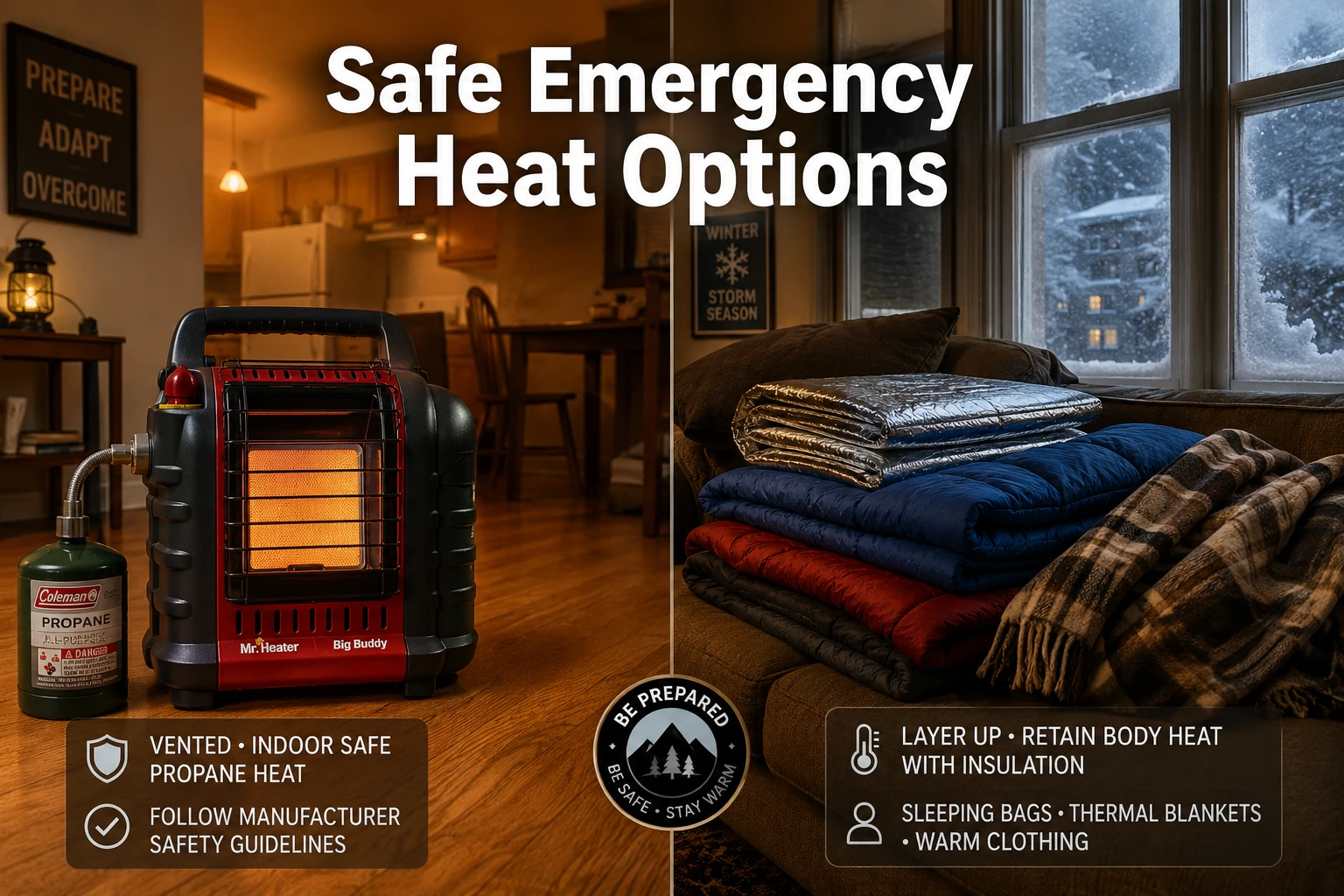
Portable propane heaters designed for indoor use — the most widely known being the Mr. Heater Buddy and Big Buddy series — use catalytic combustion to generate heat from small 1-lb propane canisters or larger 20-lb tanks. They’re specifically engineered with an Oxygen Depletion Sensor (ODS) that automatically shuts the unit off if oxygen levels in the room drop too low.
How they work in practice:
- Propane feeds into a catalytic burner element.
- The element heats to a glowing temperature without an open flame (catalytic, not direct combustion).
- Heat radiates outward, warming the immediate space.
- The ODS monitors ambient oxygen and cuts fuel if levels fall below a safe threshold.
Runtime estimates for propane heaters:
- A 1-lb canister on low setting: approximately 5–6 hours
- A 1-lb canister on high setting: approximately 2–3 hours
- A 20-lb tank on low setting: approximately 100+ hours
Choose this if: You have a small-to-medium apartment (under 800 sq ft), you can crack a window slightly for ventilation, and you have a functioning CO detector installed.
Common mistake: Running the heater in a completely sealed room overnight while sleeping. Even ODS-equipped heaters should not run unattended in a sleeping space without ventilation.
How Long Can a Small Propane Heater Run During an Emergency?
A small indoor propane heater running on a standard 1-lb canister will last roughly 3–6 hours depending on the heat setting. On the low setting (around 4,000 BTU), expect closer to 5–6 hours. On high (9,000 BTU), closer to 2–3 hours.
Practical planning for a 72-hour outage:
- Running 6 hours per day on low: you need approximately 3–4 canisters for 72 hours.
- Running 8 hours per day on medium: stock 6–8 canisters minimum.
- Connecting to a 20-lb tank via adapter hose dramatically extends runtime and reduces cost per BTU.
Store propane canisters in a cool, dry location — not inside the apartment in warm weather, and never near heat sources. Propane has an indefinite shelf life when stored properly, making it an excellent prep supply.
For a broader look at managing energy needs during extended outages, the Ultimate Power Outage Preparedness Checklist covers fuel storage, backup power options, and grid-failure planning in detail.
Can I Use Candles or Oil Lamps to Warm Up My Apartment Safely?
Candles and oil lamps will not meaningfully heat an apartment — but they’re not useless. A single candle produces roughly 80 BTU/hour, compared to a small space heater’s 5,000–9,000 BTU/hour. You’d need dozens of candles burning simultaneously to raise room temperature even a few degrees.
Where they actually help:
- Psychological warmth and morale — genuinely underrated in a survival situation.
- Supplemental light source, reducing the need to open doors and lose heat.
- Clustered in a small enclosed space (like a bathroom), multiple candles can provide minor warmth in a pinch.
Safe candle use in apartments:
- Never leave burning candles unattended.
- Keep away from curtains, bedding, and paper.
- Use wide-base holders on stable, non-flammable surfaces.
- Extinguish before sleeping.
Oil lamps burning lamp oil (not kerosene) produce slightly more heat and a steadier flame, but the same fire safety rules apply. Neither is a substitute for a real emergency heat source.
What Should I Avoid Doing When Trying to Heat My Apartment Without Electricity?
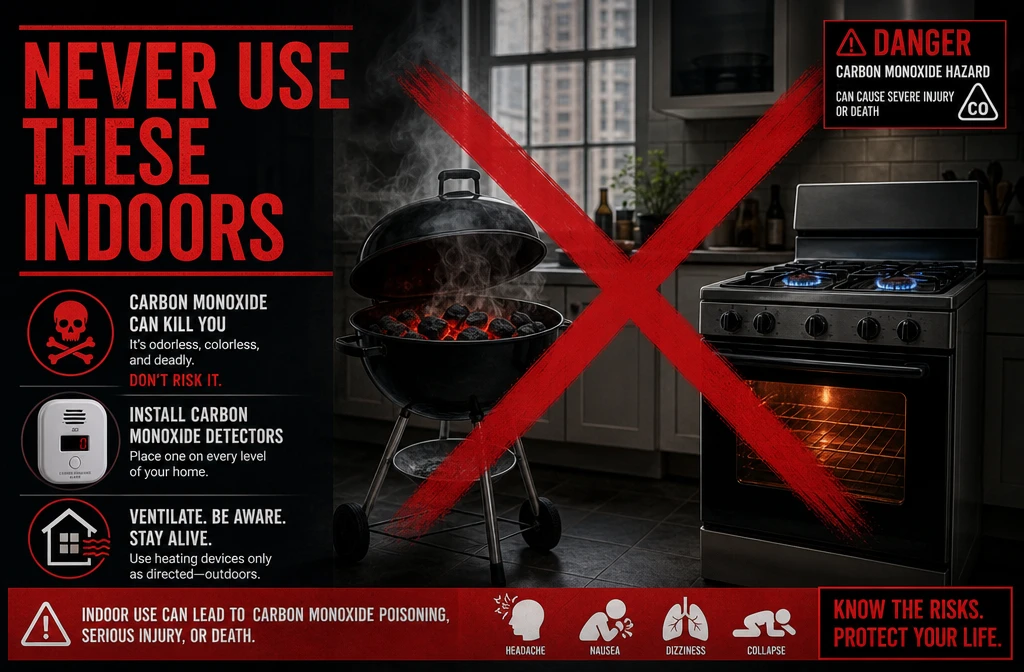
This is the section that saves lives. The most dangerous mistakes in apartment emergency heating without electricity all share one trait: they introduce carbon monoxide (CO) into an enclosed space.
Never do these things:
- Use a gas oven or stovetop burners for heat. Gas ovens are not designed for sustained heat output and produce CO in a sealed space. This kills people every winter.
- Burn charcoal indoors. Charcoal grills, hibachis, and similar devices produce lethal CO concentrations within minutes in an enclosed space.
- Run a generator indoors or in an attached garage. CO from generators travels through walls and floors.
- Use a camp stove (propane or butane) as a primary heat source. Camp stoves are designed for cooking, not sustained heating, and are not equipped with ODS sensors.
- Block all ventilation while running any combustion device. Even indoor-rated heaters need a small air exchange.
- Use a propane heater in a bathroom or very small sealed room. The confined space depletes oxygen faster than the ODS can respond.
⚠️ Carbon monoxide is odorless, colorless, and fast-acting. Symptoms of CO poisoning include headache, dizziness, nausea, and confusion — all of which can be mistaken for flu symptoms. A battery-powered CO detector is non-negotiable.
For a complete breakdown of what’s missing from most people’s emergency setups, see 15 Things Missing From Your Emergency Kit That Could Cost You Everything.
Are There Battery-Powered Space Heaters That Actually Work?
Battery-powered space heaters exist, but they come with serious limitations that make them impractical as a primary heat source for apartment emergency heating without electricity.
The math problem: A typical small space heater draws 1,500 watts. A large lithium power station (like a Jackery 2000 or EcoFlow Delta Pro) holds roughly 2,000 watt-hours of capacity. That means even a large, expensive power station runs a standard space heater for just over one hour.
What actually works:
- Low-wattage heated blankets (45–60 watts) can run 30+ hours on a 2,000Wh power station. These are the most practical battery-powered warming solution.
- USB-powered hand warmers — useful for extremities, not room heating.
- 12V heated seat cushions — can be powered by a car battery or portable power station.
Choose battery-powered options if: You need supplemental warmth for sleeping, you have a large-capacity power station already, or you’re dealing with a short-duration outage (under 12 hours).
For longer outages, propane is more energy-dense and cost-effective than battery storage for heating purposes. Check out the Complete Prepper’s Guide to Backup Power for Emergencies for a full comparison of backup energy systems.
How Cold Can My Apartment Get Before Pipes Might Freeze?
Pipes freeze when the water inside them reaches 32°F (0°C), but the real risk threshold is when outdoor temperatures drop below 20°F (-6.7°C) and stay there for an extended period. At that point, pipes in exterior walls, crawl spaces, or poorly insulated areas can freeze within hours.
Warning signs your pipes are at risk:
- Outdoor temps below 20°F for more than 6 hours
- No heat in the apartment for 12+ hours
- Pipes located on exterior walls or near uninsulated windows
What you can do:
- Keep cabinet doors under sinks open to allow ambient air to reach pipes.
- Let faucets drip slightly — moving water resists freezing.
- Wrap exposed pipes with foam insulation sleeves (a $5–10 prep item worth having).
- Know where your building’s main water shutoff is located.
What temperature is dangerous if your apartment loses heat?
For human health, the CDC and emergency management agencies generally consider indoor temperatures below 55°F (13°C) to be a health risk for vulnerable individuals (elderly, infants, those with chronic illness). Below 40°F (4.4°C), hypothermia risk increases significantly for anyone. Healthy adults in proper cold-weather clothing and sleeping bags can tolerate lower temperatures, but pipes and vulnerable household members are the more immediate concern.
Emergency Heating Options for Renters in Apartments
Renters face specific constraints that homeowners don’t: lease agreements, building fire codes, and no ability to install permanent heating systems. Here’s how to work within those limits.
Renter-friendly options:
- Indoor-safe propane heaters — most leases don’t explicitly prohibit these, but check yours. The key is the “indoor-safe” designation and CO detector requirement.
- Electric space heaters (when power is available) — almost universally allowed.
- Heated blankets and thermal sleeping systems — no restrictions, highly effective.
- Passive insulation upgrades — window film, draft stoppers, and thermal curtains are removable and renter-safe.
Before an emergency, do this:
- Read your lease for language about open flames, combustion devices, or space heaters.
- Check your city or county fire code for apartment-specific restrictions.
- Talk to your building manager about the heating system’s backup plan.
- Identify a warming center, friend’s home, or hotel as a fallback if the apartment becomes uninhabitable.
If you’re building a full apartment preparedness system, the Ultimate Guide to Prepping in a Small Apartment covers storage, supplies, and space-constrained strategies in depth.
Which Emergency Heating Methods Are Cheapest?
For budget-conscious preppers, the most cost-effective approach to apartment emergency heating without electricity combines free passive methods with a modest one-time investment in a propane heater.
Cost comparison (approximate 2026 prices):
| Solution | Upfront Cost | Per-Hour Cost | Notes |
|---|---|---|---|
| Thermal blankets + layering | $20–50 | $0 | Most cost-effective overall |
| Indoor propane heater + canisters | $80–120 + $5–8/canister | ~$1–2/hr | Best heat-per-dollar |
| Kerosene heater + fuel | $100–200 + $4–6/gallon | ~$0.50–1/hr | Cheapest to run, more odor |
| Battery-powered heated blanket + power station | $500–2,000 | Low per-use | High upfront, versatile |
| Candles (bulk) | $10–20 | Minimal | Supplemental only |
Bottom line: A $90 indoor propane heater, a $20 CO detector, and a $30 supply of 1-lb canisters gives you a functional emergency heating system for under $150. That’s the minimum viable prep for most apartment dwellers.
What Supplies Do I Need to Prepare for Winter Power Outages?
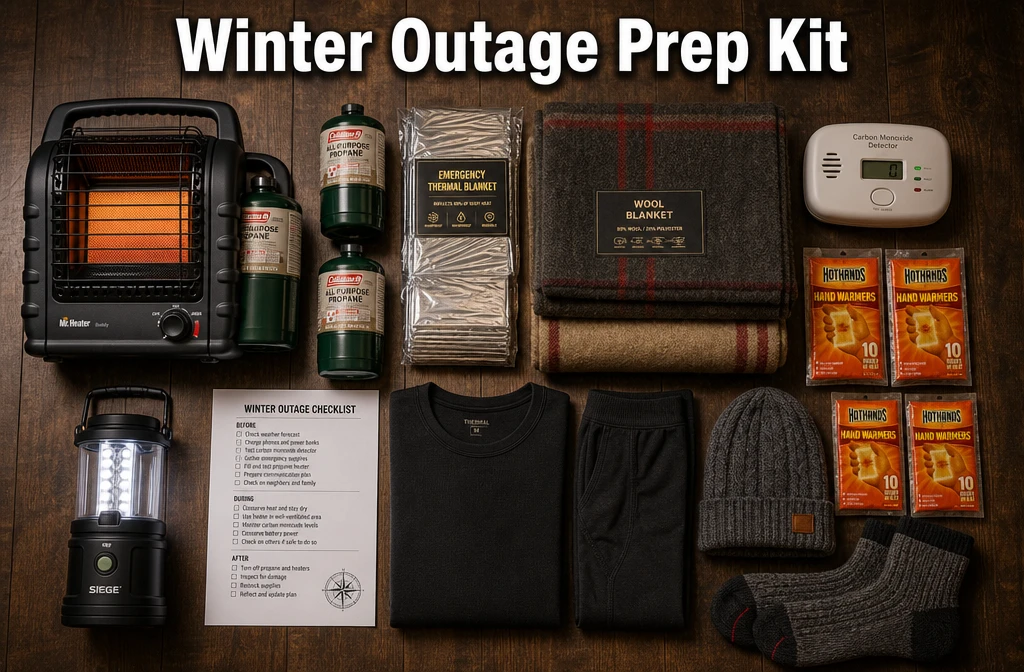
A well-staged winter emergency kit for apartment emergency heating without electricity doesn’t require a lot of space or money. The goal is 72-hour self-sufficiency minimum, with a stretch goal of 7 days.
Winter power outage supply checklist:
Heating:
- ☐ Indoor-safe propane heater (Mr. Heater Buddy or equivalent)
- ☐ 6–10 x 1-lb propane canisters (or 20-lb tank + adapter hose)
- ☐ Battery-powered CO detector (with fresh batteries)
- ☐ Smoke detector (verify it’s functional)
Warmth:
- ☐ 0°F-rated sleeping bag per person
- ☐ Wool or fleece blankets (minimum 2 per person)
- ☐ Thermal base layers (top and bottom) per person
- ☐ Emergency Mylar blankets (pack of 4–10, under $10)
- ☐ Hand warmers (air-activated, 10+ pairs)
Insulation:
- ☐ Draft stoppers for doors
- ☐ Heavy curtains or thermal window film
- ☐ Foam pipe insulation sleeves for exposed pipes
Other essentials:
- ☐ LED lanterns and headlamps with spare batteries
- ☐ 3-day water supply (1 gallon per person per day)
- ☐ Non-perishable food that requires no cooking or minimal prep
For food planning during extended outages, the Emergency Food Rationing and Cooking guide covers caloric needs, no-cook options, and rationing strategies.
Also review the Ultimate Emergency Supplies List to make sure your broader emergency kit covers gaps beyond heating.
Risks of Using Indoor Heating Methods Not Designed for Indoor Use
The risks are severe and fast-moving. Devices not rated for indoor use — charcoal grills, camp stoves, outdoor propane heaters, generators — can produce lethal CO concentrations in under 30 minutes in a sealed apartment.
Carbon monoxide by the numbers:
- CO concentration of 70 ppm causes headache and fatigue within hours.
- 150–200 ppm causes headache, dizziness, and disorientation within 2–3 hours.
- 400 ppm is life-threatening within 3 hours.
- 1,600+ ppm causes death within 1 hour.
A running charcoal grill indoors can exceed 400 ppm within minutes.
Fire risk is the second major concern. Improvised heating setups — candles too close to bedding, kerosene heaters near curtains, overloaded extension cords — cause a significant portion of residential fire deaths during winter emergencies.
The rule is simple: If the device doesn’t say “indoor safe” on the label and isn’t equipped with an ODS or equivalent safety system, it does not belong inside an apartment.
Best Emergency Heating Solutions for Small Apartments (Summary)
For apartments under 600 square feet, the best approach combines room consolidation with a targeted heat source.
Top 3 solutions for small apartments:
- Mr. Heater Buddy (4,000–9,000 BTU) — sized appropriately for small spaces, ODS-equipped, widely available, runs on standard 1-lb canisters.
- Thermal sleeping system — a quality 0°F sleeping bag eliminates the need to heat the room at all for sleeping hours.
- Insulation layering — window film, door draft stoppers, and a single consolidated room can reduce heat loss by 30–50% in older apartment buildings.
For small apartments specifically, the goal isn’t to heat the whole unit. It’s to make one room survivable and keep your body warm within that room.
Conclusion: Heat Is a Survival Priority — Prepare Before You Need It
Cold kills quietly. Unlike food shortages or water contamination, hypothermia and CO poisoning can incapacitate a person before they realize the danger is serious. Apartment emergency heating without electricity is a solvable problem — but only if the supplies and knowledge are in place before the outage happens.
Your actionable next steps:
- Buy a battery-powered CO detector today if you don’t already have one. This is the single most important safety item for any combustion-based heating plan.
- Pick up an indoor-safe propane heater and 6–8 canisters. Store them in a cool, dry location.
- Audit your insulation. Draft stoppers and thermal curtains cost under $30 total and meaningfully extend how long your apartment stays warm.
- Stage a 72-hour winter kit using the checklist above. Keep it in one accessible location.
- Know your building’s emergency plan and identify a backup warming location before you need it.
Preparedness isn’t about fear. It’s about making sure a winter storm is an inconvenience, not a crisis. For a broader foundation, the Ultimate Guide to Home Emergency Preparedness and the Step-by-Step Guide to Natural Disaster Preparedness are worth building into your planning system.
FAQ-Apartment Emergency Heating Without Electricity
Can I use a propane heater in my apartment?
Yes, if it’s specifically rated for indoor use and equipped with an Oxygen Depletion Sensor. The Mr. Heater Buddy series is the most common choice. Always run a battery-powered CO detector simultaneously and crack a window slightly for air exchange.
How long will my apartment stay warm after the heat goes out?
A well-insulated modern apartment loses roughly 1°F per hour in moderate cold. An older, poorly insulated unit can lose 2–3°F per hour. In extreme cold (below 10°F outside), even well-insulated apartments can drop to dangerous temperatures within 12–24 hours without supplemental heat.
What temperature is too cold for a baby or elderly person in an apartment?
Temperatures below 65°F (18°C) are considered unsafe for infants, and below 55°F (13°C) pose serious health risks for elderly individuals. Prioritize evacuating vulnerable household members to a warming center if indoor temps drop below these thresholds.
Is it safe to sleep with a propane heater on?
No. Even indoor-safe propane heaters should not run unattended while occupants are sleeping. Heat the space before bed, then turn the heater off and rely on insulated sleeping bags and blankets through the night.
How do I know if my pipes are about to freeze?
Watch for outdoor temperatures sustained below 20°F (-6.7°C) for more than 6 hours, especially if your apartment has been without heat. Open cabinet doors under sinks, let faucets drip slowly, and wrap exposed pipes in foam insulation sleeves.
What’s the cheapest way to stay warm in an apartment without power?
Consolidate into one room, seal all drafts, layer thermal clothing and blankets, and use a 0°F sleeping bag. This costs nothing if you already own the gear and can keep a healthy adult comfortable down to very low indoor temperatures.
Can candles actually heat a room?
Not meaningfully. A single candle produces about 80 BTU/hour. A small room requires thousands of BTU to raise temperature even a few degrees. Candles are useful for light and morale, not primary heating.
Do I need to tell my landlord I’m using a propane heater?
Check your lease first. Some leases prohibit open flames or combustion devices. If yours does, contact your landlord to clarify. In a declared emergency, most landlords and local authorities are more flexible, but knowing your lease terms before the emergency is always better.
What’s the difference between indoor and outdoor propane heaters?
Indoor-rated heaters have an Oxygen Depletion Sensor that shuts the unit off if oxygen drops too low. Outdoor heaters lack this safety feature and can produce dangerous CO concentrations in enclosed spaces. Never use an outdoor-rated heater indoors.
How much propane should I stockpile for winter emergencies?
A reasonable minimum for a 72-hour emergency is 6–8 standard 1-lb canisters. For a 7-day supply running 6–8 hours per day, stock 15–20 canisters or invest in a 20-lb tank with an adapter hose.
Products, Tools, and Resources Worth Having
These are practical items that align with the strategies covered in this guide — not a shopping list, but a starting point for anyone building a real winter emergency kit.
Mr. Heater Buddy (MH9BX) or Big Buddy (MH18B): The most widely used indoor-safe propane heater among preppers. The Buddy handles spaces up to 225 sq ft; the Big Buddy covers up to 450 sq ft. Both use standard 1-lb canisters and include ODS safety shutoff. Available at most hardware stores and online retailers.
Kidde or First Alert Battery-Powered CO Detector: Non-negotiable if you’re using any combustion heat source. Battery-powered models work during power outages; plug-in models with battery backup are also solid. Replace batteries annually.
Sleeping bag rated to 0°F: Brands like TETON Sports, Coleman, and Kelty offer quality 0°F bags in the $60–120 range. This is arguably the most important single piece of cold-weather survival gear for apartment dwellers.
Emergency Mylar blankets (bulk pack): A 10-pack costs under $10 and reflects up to 90% of body heat. Use them as window insulation, sleeping bag liners, or emergency wraps.
Frost King door draft stoppers and window insulation kits: Inexpensive, removable, and renter-safe. A window insulation kit with shrink film can reduce heat loss through single-pane windows by a meaningful margin.
Jackery Explorer 1000 or EcoFlow Delta (power station): If budget allows, a mid-range power station powers heated blankets, LED lights, phone charging, and small appliances for 24–48 hours. Not a heating solution on its own, but a valuable multi-purpose prep tool.
For more on building a complete apartment-specific preparedness system, the Ultimate Guide to Prepping in a Small Apartment is the logical next read.